

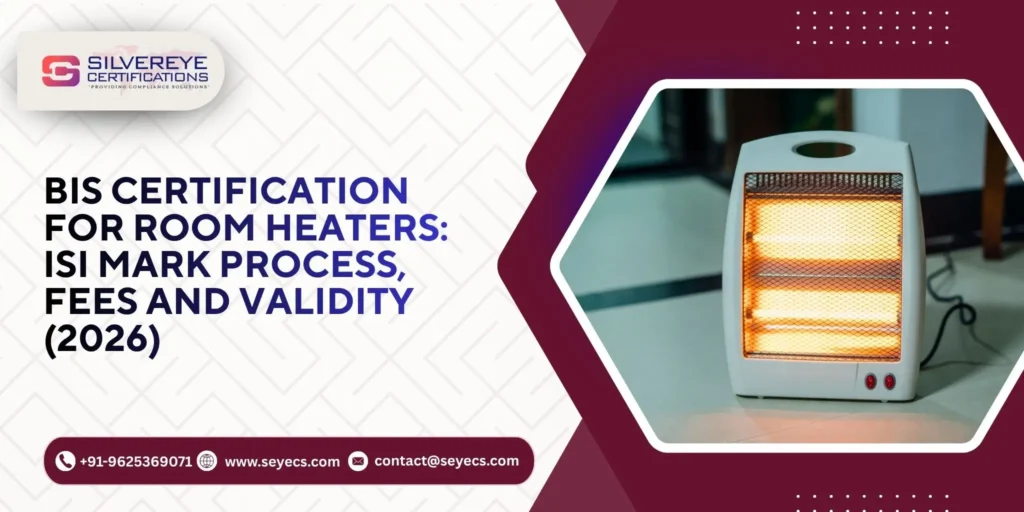
- Listed in the 2026 QCO: Thermal Storage Room Heaters are covered under Serial No. 61, while other heating appliances may fall under separate entries.
- Implementation deadlines: 1 October 2026 for general manufacturers, 1 January 2027 for small enterprises and 1 April 2027 for micro enterprises, subject to the applicable provisions.
- Applicable standards: IS 302 (Part 1):2024 is referenced under the order. Room heater testing may also involve the particular requirements of IS 302 (Part 2/Sec 30):2007, as applicable to the product.
- Confirm the applicable QCO: Appliances covered by another Quality Control Order may be excluded from this order. Verify the product classification and applicable requirements before beginning certification.
Introduction
BIS Certification for Room Heaters is the authorization to use the ISI Mark under Scheme-I of the BIS (Conformity Assessment) Regulations, 2018. The Safety of Household, Commercial and Similar Electrical Appliances (Quality Control) Order, 2026 (S.O. 1739(E)) lists Thermal Storage Room Heaters under Serial No. 61.

The implementation dates are 1 October 2026 for general manufacturers, 1 January 2027 for small enterprises and 1 April 2027 for micro enterprises, subject to the applicable provisions. Testing may also involve the room-heater-specific requirements of IS 302 (Part 2/Sec 30):2007, alongside IS 302 (Part 1):2024, as applicable. Other heater types should be assessed separately to identify the correct product classification, applicable standard and mandatory certification route.
What Is BIS Certification for Room Heaters?
The Bureau of Indian Standards (BIS) is India's national standards body. BIS Certification for Room Heaters authorizes a manufacturer to use the ISI Standard Mark after the product meets the applicable Indian Standard and the manufacturing facility satisfies the relevant conformity assessment requirements.

Under the Safety of Household, Commercial and Similar Electrical Appliances (Quality Control) Order, 2026, the applicable certification route is Scheme-I under Schedule II of the BIS (Conformity Assessment) Regulations, 2018. This is a factory-based certification route and differs from the Compulsory Registration Scheme (CRS) used for certain electronic products.
Three key elements determine compliance:
- General safety standard: IS 302 (Part 1):2024, aligned with IEC 60335-1:2020, specifies general safety requirements for household and similar electrical appliances.
- Room heater-specific standard: IS 302 (Part 2/Sec 30):2007 addresses particular safety requirements for room heaters, where applicable to the product.
- BIS license and ISI Mark: The manufacturer must obtain the applicable license after completing the required testing and factory assessment. The ISI Mark must be used in accordance with the license conditions.
Why Room Heater Brands Need to Plan Early for Winter
Room heater sales are highly seasonal, with demand typically increasing during the colder months. Manufacturers and importers therefore need to ensure their products are tested, certified where required and ready for sale before the winter season begins. A delay in certification can affect product launches, inventory planning and seasonal revenue.
The Safety of Household, Commercial and Similar Electrical Appliances (Quality Control) Order, 2026, notified through S.O. 1739(E) on 6 April 2026, introduces requirements for specified electrical appliances, including certain heating products. The applicable implementation dates depend on the manufacturer's enterprise classification and the product entry covered by the order.
This guide explains the 2026 regulatory framework for room heater manufacturers, importers and brand owners in India. It covers product classification, applicable standards, testing requirements, documentation, certification costs and licence validity. For a broader overview of the order, refer to our guide to BIS Certification for Electrical Appliances.
2026 Regulatory Update: Safety of Household, Commercial and Similar Electrical Appliances (QCO), 2026
The following summary outlines the provisions described in the 2026 order. Before making compliance decisions, verify the exact wording of the official Gazette notification and confirm which entry applies to your product.
Order details
| Item | Details |
|---|---|
| Order name | Safety of Household, Commercial and Similar Electrical Appliances (Quality Control) Order, 2026 |
| Notification number | S.O. 1739(E), dated 6 April 2026 |
| Issuing authority | Ministry of Commerce and Industry, Department for Promotion of Industry and Internal Trade (DPIIT) |
| Legal basis | Section 16 of the Bureau of Indian Standards Act, 2016 |
| Earlier order | Supersedes the earlier order of the same name, subject to the savings provisions |
| General implementation date | 1 October 2026, subject to the applicable product entry and enterprise category |
Clause 1: Application
The order's application provisions establish the following scope:
- Product coverage: Electrical appliances intended for household, commercial or similar applications, subject to the conditions specified in the order.
- Voltage limits: Up to 250 V for single-phase appliances and 480 V for other appliances, including covered direct-current and battery-operated appliances.
- Exclusions: Appliances covered by another Quality Control Order under the BIS Act, or notified for mandatory BIS certification under another Act, may fall outside this order's scope.
Clause 2: Compulsory use of the Standard Mark
Products listed in Column (2) of the order's Table must conform to the corresponding Indian Standard in Column (3) and bear the Standard Mark under a BIS license issued through Scheme-I of Schedule II of the BIS (Conformity Assessment) Regulations, 2018, where applicable.
The general safety standard specified in the order is IS 302 (Part 1):2024, covering general safety requirements for household and similar electrical appliances. The applicable edition and any additional product-specific standard must be confirmed for the particular heater model.
The order also provides that the latest version of the relevant Indian Standard applies for its purposes, as specified in the notification.
Implementation dates
| Manufacturer category | Implementation date |
|---|---|
| General manufacturers, excluding micro and small enterprises | 1 October 2026 |
| Small enterprises | 1 January 2027 |
| Micro enterprises | 1 April 2027 |
These dates should be applied only after confirming the relevant product entry and the manufacturer's classification under the applicable MSME provisions.
Exemptions and provisos under Clause 2
- Goods manufactured for export: The order provides an exemption for goods manufactured domestically for export, subject to the notification's terms.
- Micro and small enterprises: Eligible enterprises must comply from the implementation dates specified for their respective categories.
- Research and development imports: The order provides for the import of up to 200 units per year for research and development, subject to its conditions. Such units cannot be sold commercially, and the required annual records must be maintained.
- Existing stock: Certain goods manufactured domestically or imported before the applicable implementation date may qualify for a limited sell-off period of up to six months, subject to the specified certification or application conditions and the required declaration to BIS.
Do not assume that every existing shipment or inventory item qualifies for transitional relief. Confirm the exact conditions and relevant implementation date before selling, displaying or offering stock for sale.
Clause 3: Certification and enforcement authority
The Bureau of Indian Standards (BIS) is the certifying and enforcing authority for products covered by the order.
Clause 4: Penalty
Contraventions of the order may attract penalties under the applicable provisions of the BIS Act, 2016.
Heating appliances listed in the Table
The following entries are relevant when assessing heating-related products. Confirm the serial numbers and descriptions against the current Gazette before publication or making a compliance decision.
| Serial number* | Product entry |
|---|---|
| 61 | Thermal Storage Room Heaters |
| 50 | Clothes Dryers and Towel Rails |
| 56 | Sauna Heating Appliances and Infrared Cabins |
| 65 | Water-Bed Heaters |
| 66 | Fixed Immersion Heaters |
| 68 | Foot Warmers and Heating Mats |
| 76 | Gas, Oil and Solid-Fuel Burning Appliances Having Electrical Connections |
| 89 | DC-Supplied or Battery-Operated Foot Warmers and Heating Mats |
Is Your Room Heater Covered by the 2026 Order? Check Before Applying
Correct product classification is an essential first step in the BIS certification process. The order specifically identifies Thermal Storage Room Heaters, but other products that consumers commonly call room heaters may not appear under that exact description.
For example, fan heaters, oil-filled radiators, radiant heaters, halogen heaters and convection heaters should not automatically be treated as either covered or exempt merely because their names do not appear in the Table. Their regulatory status must be assessed against the applicable QCOs, product definitions and relevant standards.
| Heater type | Initial scope assessment | Recommended action |
|---|---|---|
| Thermal storage room heater | Specifically identified in the order, subject to confirmation of the entry | Confirm the applicable standard, implementation date and certification route |
| Heated towel rail | Listed with clothes dryers and towel rails, subject to the exact entry | Check the applicable QCO requirements |
| Sauna heater or infrared cabin | Identified under the relevant heating-appliance entry | Verify product classification and applicable standards |
| Heating mat or foot warmer | Mains-powered and battery-operated variants may fall under different entries | Confirm the relevant entry and any additional requirements |
| Gas, oil or solid-fuel appliance with electrical connections | Identified as a separate product category | Verify the applicable product scope and exclusions |
| Fan heater, oil-filled radiator, radiant heater or convection heater | Coverage cannot be determined by name alone | Obtain confirmation of the governing QCO and standard before arranging testing |
Water heaters and geysers are a separate product category and may be governed by their own applicable regulatory requirements. They should not be automatically included in a room heater certification assessment.
Before ordering samples or beginning laboratory testing, prepare a model list containing each heater's product type, heating technology, rated voltage, power rating and key electrical components. Share it with your laboratory or compliance consultant to establish the appropriate certification route.
What Do Laboratories Check on a Room Heater?
Room heater testing may involve IS 302 (Part 1):2024 and the applicable particular requirements of IS 302 (Part 2/Sec 30):2007, which addresses the safety of room heaters. The precise standards, editions and tests depend on the product classification and applicable certification requirements.
In general, laboratory evaluation may cover the following areas:
- Protection against electric shock: Protection against access to live parts.
- Power input and current: Verification of electrical operating parameters.
- Leakage current and electric strength: Assessment of electrical insulation and safety under applicable test conditions.
- Heating and temperature rise: Evaluation of internal temperatures and accessible surfaces.
- Moisture resistance: Assessment of safety under relevant moisture-related test conditions.
- Abnormal operation: Examination of safety under specified fault conditions, such as restricted airflow or control failures, where applicable.
- Stability and mechanical hazards: Assessment of stability, construction and relevant mechanical risks.
- Construction and internal wiring: Review of wiring arrangements, electrical connections and critical components.
- Supply connections and flexible cords: Verification of applicable connection and cord requirements.
- Earthing: Assessment of protective earthing provisions for applicable models.
- Clearances and insulation: Evaluation of clearances, creepage distances and solid insulation.
- Resistance to heat, fire and corrosion: Assessment of materials and construction against the applicable requirements.
Routine production checks
A manufacturer operating under a BIS license must also maintain appropriate production controls and quality records. Depending on the applicable requirements and the factory's quality plan, routine checks may include earth continuity, electric strength and functional testing.
The list above is a general overview, not an exhaustive test plan. The laboratory's applicable test requirements and report should be used to establish the precise testing scope for each room heater model.
Benefits of BIS Certification for Room Heaters
Obtaining BIS Certification for Room Heaters helps manufacturers and importers meet applicable regulatory requirements and demonstrate product safety. Key benefits include:
- Legal Compliance: Selling a heater covered by a mandatory Quality Control Order without the required certification can result in enforcement action under the BIS Act, 2016.
- Import Compliance: Ensuring the required BIS licence and marking are in place helps reduce compliance-related delays when importing covered products.
- Improved Product Safety: Room heaters operate at high temperatures and may run for extended periods. Relevant safety testing helps assess risks involving overheating, electric shock, insulation failure and stability.
- Greater Retailer Confidence: Retailers and distributors may prefer appropriately certified products when sourcing heaters for the winter season.
- Reduced Product Failures: Identifying safety or performance issues during testing can help manufacturers address problems before products reach customers.
- Stronger Brand Credibility: Proper certification and authorised use of the ISI Mark can help distinguish compliant products in a competitive market.
Who Can Apply for BIS Certification for Room Heaters?
Eligibility and the application route depend on the product, manufacturing arrangement and applicable BIS certification requirements.
| Applicant | Applicable Route or Arrangement | Key Requirement |
|---|---|---|
| Indian manufacturer | Scheme-I certification | The manufacturing facility must meet the applicable production, quality-control and testing requirements. |
| Foreign manufacturer | Foreign Manufacturers Certification Scheme (FMCS), where applicable | The overseas manufacturer must follow BIS requirements, including appointing an authorised Indian representative where required. Factory inspection may be conducted overseas. |
| Importer or trader | Sources products from a BIS-licensed manufacturer | Must ensure the covered product is manufactured under the appropriate licence and bears the authorised Standard Mark before sale. |
| Brand owner using contract manufacturing | Certification arrangement linked to the manufacturing facility | Confirm the licence scope, brand details and manufacturing arrangement with BIS before placing production orders. |
| Micro or small enterprise | Applicable Scheme-I route | Confirm enterprise classification and the relevant implementation date under the QCO. |
For products covered by the 2026 order, the specified implementation dates are 1 January 2027 for small enterprises and 1 April 2027 for micro enterprises. Keep your Udyam registration and supporting enterprise documents ready where needed to establish eligibility.
Requirements for BIS Certification
Before applying for BIS Certification for Room Heaters, manufacturers should review the following requirements:
- Product conformity: The heater must meet the applicable Indian Standard and any relevant particular requirements identified for its product category.
- Laboratory testing: Testing must follow the applicable BIS certification procedure and use an authorised laboratory or another permitted testing arrangement, where available.
- Factory readiness: Maintain suitable quality-control procedures, calibrated test equipment, incoming component inspections and required routine production tests.
- Critical component records: Maintain details of heating elements, thermostats, thermal cut-outs, switches, fans, internal wiring, supply cords and plugs, including their ratings and manufacturers.
- Marking and labelling: Ensure the ISI Mark, licence details and required product-rating information comply with the applicable standard and licence conditions.
- Production records: Maintain accurate production and marking records to support compliance, surveillance and applicable marking-fee calculations.
The exact requirements should be confirmed for the heater type and the certification route applicable to the product.
Documents Required for BIS Certification
BIS may request additional documents depending on the product category, factory arrangement and application. The following checklist covers commonly required information.
| Category | Documents and Information |
|---|---|
| Applicant identity | Incorporation or partnership documents, GST registration where applicable, and authorized signatory details |
| Factory details | Manufacturing address proof, factory layout and machinery list |
| Enterprise classification | Udyam registration and supporting documents, where relevant to the applicable MSME provisions |
| Product information | Model list, rating-label artwork, circuit diagrams, critical component list, user manual and safety instructions |
| Quality system | Process flow chart, quality-control plan, inspection and test procedures, test-equipment list and calibration records |
| Testing | Applicable test reports from an authorised laboratory or other permitted testing arrangement |
| Foreign manufacturers | Indian representative appointment documents, manufacturing-facility details and applicable FMCS documentation |
| Existing stock | Declaration and supporting records required under the applicable transitional provisions, if eligible |
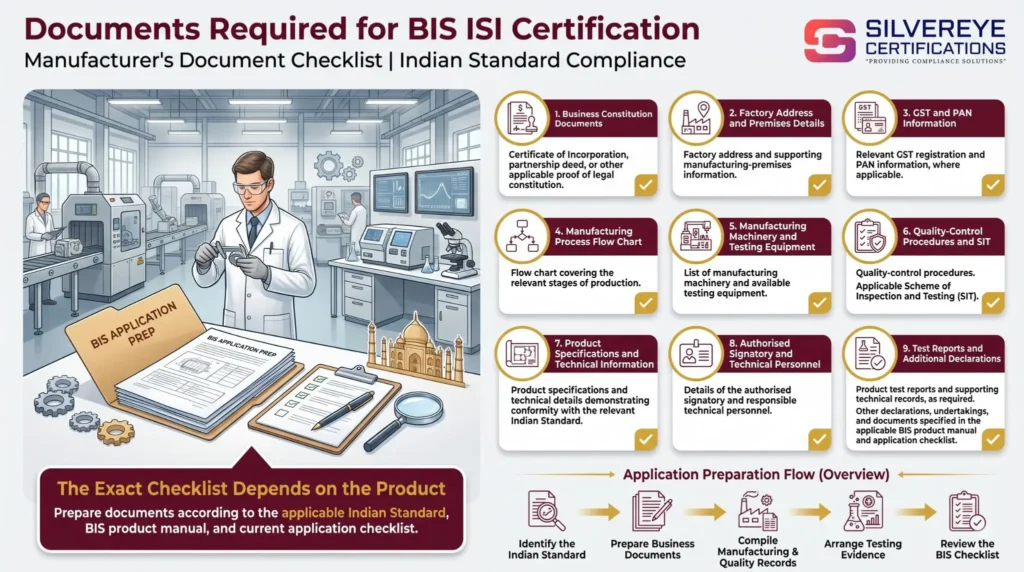
Preparing these documents before submitting the application can help reduce clarification requests and avoidable delays.
BIS Certification Process for Room Heaters: Step by Step
The certification process generally involves the following stages, subject to the applicable Scheme-I requirements.
- Confirm the applicable QCO and standard. Map each heater model to the relevant product entry and establish which order and Indian Standards apply.
- Finalise the models and critical components. Prepare the model list and bill of critical components before testing. Changes to safety-related components may require further evaluation or testing.
- Arrange product testing. Submit representative samples for testing against the applicable Indian Standards through the permitted testing process.
- Submit the online application. Complete the applicable BIS application, provide the required documents and pay the prescribed fees through the designated process.
- Prepare for factory assessment. BIS assesses relevant manufacturing facilities, quality-control systems and testing arrangements. Overseas factories may be inspected under the applicable foreign-manufacturer procedure.
- Complete any required sample verification. Where required, samples may be drawn or verified to establish that production models conform to the assessed product.
- Obtain the licence. The application must satisfy the applicable requirements before BIS grants the licence. Pay the prescribed licence and marking fees according to the applicable payment instructions.
- Apply the ISI Mark and maintain compliance. Mark products only as authorised by the licence. Maintain required records, meet fee obligations and comply with applicable surveillance and renewal requirements.
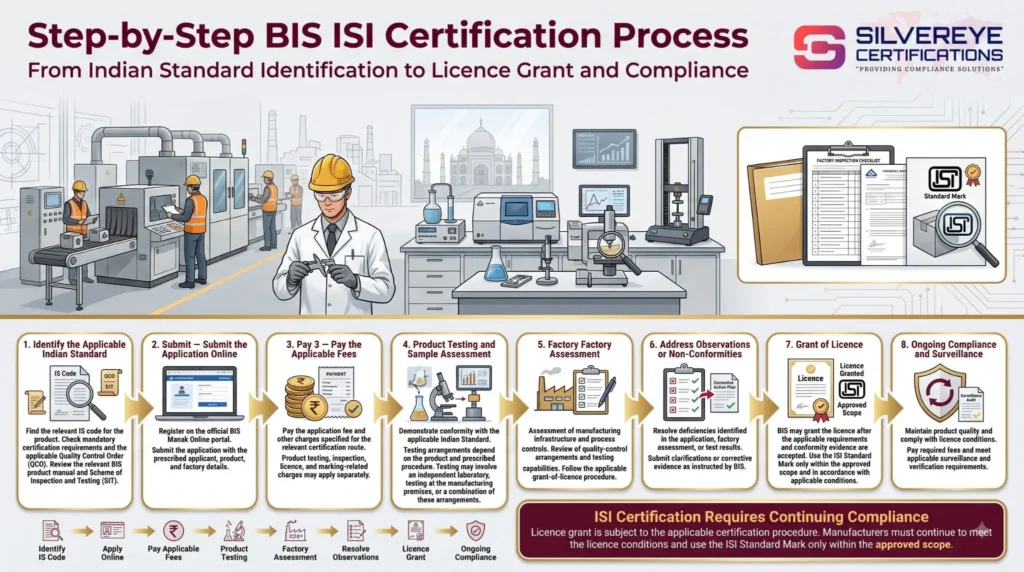
Following a structured process helps manufacturers prepare for certification, identify potential issues early and plan production around the applicable regulatory deadlines.
How Long Does BIS Certification for Room Heaters Take?
The timeline for BIS Certification for Room Heaters depends on laboratory availability, document readiness, sample testing and factory inspection scheduling. The following estimates are indicative and are not guaranteed timelines from BIS.
| Stage | Indicative Time |
|---|---|
| Product scoping and document preparation | 1–2 weeks |
| Testing at a recognised laboratory | 2–4 weeks, depending on model count and laboratory queue |
| Application submission and scrutiny | 1–2 weeks |
| Factory inspection scheduling and visit | 2–4 weeks |
| Licence grant after compliance | 1–2 weeks |
| Overall estimated timeline | Approximately 2–3 months, provided documents and samples are ready |
Room heater sales are seasonal, so manufacturers should plan certification well ahead of winter. Laboratory queues and inspection scheduling may take longer during peak periods. Arranging testing early can help reduce the risk of missing the intended launch date.
BIS Certification Fees for Room Heaters
The cost of BIS certification depends on the applicable fee schedule, testing requirements, number of models, factory location and marking fees. The amounts below are indicative and should be verified against the latest BIS requirements before budgeting.
| Fee Component | Indicative Amount or Basis | Notes |
|---|---|---|
| Application fee | ₹1,000, as reported in the referenced fee information | Confirm the current amount on the BIS portal |
| Annual licence fee | ₹1,000 per year, as reported in the referenced fee information | Verify the applicable payment requirements |
| Minimum marking fee | Product-specific, as per the BIS marking-fee schedule | Check the applicable standard and production category |
| Marking-fee payment | Subject to the applicable BIS guidelines | Confirm the current payment schedule |
| MSME concessions | Subject to eligibility and applicable provisions | Verify the current concession rates and validity |
| Laboratory testing | Charged by the laboratory | Depends on the number of models, tests and sample requirements |
| Factory inspection | Depends on inspection arrangements | Overseas inspections may involve additional travel costs |
| Consultant fee | Quoted according to the project scope | Depends on model count, factory location and support required |
Important: BIS fees, concessions and payment procedures may change. Confirm the latest applicable fee schedule and regulations before relying on specific amounts. Laboratory testing and consultancy charges are separate from statutory BIS fees.
Where permitted under BIS model-grouping guidelines, similar room heater models may be considered together. Models that differ only in colour or cosmetic housing details may be suitable candidates, while differences in heating elements, thermostats, thermal cut-outs or other safety-related components may require additional evaluation.
BIS License Validity and Renewal
The validity and renewal requirements for a room heater BIS license depend on the applicable conformity assessment regulations and the conditions specified in the license.
| Aspect | Details |
|---|---|
| Initial validity | Confirm the validity period under the applicable BIS regulations and the licence issued |
| Renewal | Apply according to the applicable BIS renewal requirements |
| Annual payments | Verify the licence and marking-fee payment obligations applicable to the licence |
| When to apply for renewal | Start the process well before expiry to allow time for documentation and scrutiny |
| Typical renewal documents | Production and marking records, compliance details, applicable fees and clearance of outstanding dues, as required |
| What happens if a licence lapses | An expired, suspended or cancelled licence can affect the manufacturer's authority to mark and sell covered products |
| New models and variants | Obtain the required approval to include additional models in the licence scope before marking and selling them |
A longer license validity period does not remove ongoing compliance obligations. Manufacturers must maintain accurate production records, meet applicable fee requirements, comply with surveillance provisions and use the ISI Mark only as authorized.
Importing Room Heaters: What Changes?
Importers and overseas manufacturers should consider the following points when planning BIS compliance for room heaters.
- Foreign manufacturer route: Overseas manufacturers must follow the applicable BIS certification procedure, including the Foreign Manufacturers Certification Scheme (FMCS), where applicable. An authorized Indian representative is required under the relevant procedure. Covered products must meet the applicable licensing and marking requirements before commercial sale.
- Existing stock manufactured or imported before implementation: Certain products may qualify for a transitional sell-off period of up to six months, subject to the exact conditions in the 2026 order. Eligibility depends on factors such as the applicable implementation date, the manufacturer's certification or application status and the required declaration to BIS. For products subject to the general implementation date of 1 October 2026, the six-month period would extend to 1 April 2027, if the provision applies. Small and micro enterprises should verify the calculation against their respective implementation dates.
- Research and development samples: The order provides a conditional exemption for importing up to 200 units per year for research and development. These units cannot be sold commercially, and the required year-wise records must be maintained.
- Plan supplier agreements early: Include applicable BIS certification requirements in purchase orders and supplier agreements. Confirm certification status, marking arrangements and shipment timelines before dispatch to reduce the risk of delays during the winter sales season.
Common Mistakes to Avoid
Manufacturers and importers should avoid these common mistakes when seeking BIS Certification for Room Heaters:
- Assuming the 2026 Table covers every room heater type. The order names specific products; other heater types must be assessed under the applicable regulatory framework.
- Choosing the wrong certification route. Confirm whether Scheme-I applies instead of assuming the Compulsory Registration Scheme (CRS) is appropriate.
- Testing one model and selling materially different variants with different heating elements, thermostats, thermal cut-outs or other safety-related components without checking whether additional testing or approval is required.
- Starting certification too late. Delays in laboratory testing or factory inspection can affect seasonal product launches.
- Misusing the transitional stock provision. It applies only where the relevant conditions are met and does not provide blanket permission for new production after the implementation date.
- Budgeting only for the application fee. Account for testing, sample transportation, inspection and applicable marking fees.
- Confusing room heaters with water heaters. These are different product categories and may be governed by separate regulatory requirements.
Early product classification, accurate documentation and timely laboratory coordination can help manufacturers prepare for certification and plan their room heater launches more effectively.
Why Choose Silvereye Certifications?
BIS certification projects can face delays because of incorrect product classification, missing critical component records or inadequate factory preparation before inspection. Silvereye Certifications provides regulatory compliance support for BIS, CDSCO, WPC and related approvals, helping manufacturers and importers navigate the certification process with greater clarity.
Here's how we can support your room heater certification project:
- Accurate Regulatory Scoping: Identify the applicable Quality Control Order and product entry for each heater type before testing begins.
- Laboratory Coordination: Assist with sample submission, testing schedules and eligible model grouping to help manage costs and minimise delays.
- Application and Documentation Support: Help prepare the required documents, submit applications and track progress throughout the process.
- Factory Audit Preparation: Provide a pre-inspection checklist to help your manufacturing facility prepare for the BIS assessment.
- Importer Support: Guide overseas manufacturers and importers on applicable FMCS requirements, Indian representative coordination and eligible transitional stock declarations.
- Post-Certification Assistance: Support renewal planning, marking-fee compliance and the addition of eligible models to the licence scope.
Need to know which of your room heaters require the ISI Mark and what certification may cost? Contact Silvereye Certifications with your product details and model list to discuss the applicable requirements and next steps.
Conclusion
BIS Certification for Room Heaters is an important compliance requirement for businesses manufacturing or importing products covered by mandatory Quality Control Orders. The 2026 order identifies thermal storage room heaters and several other heating appliances, with implementation dates that vary according to the applicable product entry and enterprise category.
To prepare effectively, confirm which order governs each heater type, identify the applicable Indian Standards, finalize critical components, arrange the required testing and submit a complete application. Manufacturers should also plan for factory assessment, applicable marking fees, license maintenance and renewal.
Starting early is particularly important for seasonal products such as room heaters, where certification delays can affect winter sales. With accurate product classification and proper preparation, businesses can reduce avoidable delays and work towards meeting the applicable BIS requirements.
Silvereye Certifications can assist with product scoping, documentation, laboratory coordination and certification support, helping manufacturers and importers approach the process with greater confidence.
Frequently Asked Questions
Is BIS certification mandatory for room heaters in India?
Room heaters have historically been subject to mandatory BIS certification, and the 2026 order names Thermal Storage Room Heaters at serial no. 61. Which order governs your exact heater type should be confirmed before testing.
Which standard applies to room heaters?
The 2026 order specifies IS 302 (Part 1):2024. Room heaters are also tested against IS 302 (Part 2/Sec 30):2007, which is based on IEC 60335-2-30. Your lab confirms the exact parts for your model.
What are the 2026 deadlines For Room Heaters?
1 October 2026 for general manufacturers, 1 January 2027 for small enterprises and 1 April 2027 for micro enterprises, for goods listed in the order's Table.
Are fan heaters and oil-filled radiators named in the 2026 order?
Not by name. Confirm the governing mandatory order for these types with BIS or your lab before you start.
What other heating products does the 2026 order name?
Heated towel rails, sauna heating appliances and infrared cabins, water-bed heaters, fixed immersion heaters, foot warmers and heating mats, and gas, oil and solid-fuel burning appliances with electrical connections.
What is the voltage limit?
Up to 250 V for single-phase appliances and up to 480 V for other appliances, including DC supplied and battery-operated ones.
Can I sell my existing stock after the deadline?
For goods under the 2026 order, stock made or imported before the implementation date by a BIS-certified manufacturer, or one who has applied, can be sold or offered for sale for up to six months from that date. A declaration to BIS is required.
Can I import sample heaters for R&D?
Up to 200 units per year can be imported for R&D by manufacturers of household and similar electrical appliances. They cannot be sold commercially, and records must be kept.
Are export-only heaters exempt?
Goods manufactured domestically for export are outside the 2026 order.
How much does BIS certification for a room heater cost?
Government fees include a Rs 1,000 application fee, a Rs 1,000 annual licence fee and a product-specific minimum marking fee. Testing and inspection are charged at actuals. Verify current figures on the BIS portal.
How long is the license valid?
Under the 2026 amendment, up to 5 years initially and renewable for up to 5 years. Annual fees still apply.
Can a foreign heater manufacturer apply?
Yes, through FMCS with an Indian representative. BIS may inspect the overseas factory.
What is the penalty for non-compliance?
The 2026 order says contravention is punishable under the BIS Act, 2016.