

- Both Product Categories Are Listed: The 2026 Quality Control Order includes Dishwashers at Serial No. 40 and Commercial Electric Dishwashing Machines at Serial No. 59.
- Implementation Deadlines: The specified dates are 1 October 2026 for general manufacturers, 1 January 2027 for small enterprises and 1 April 2027 for micro enterprises, subject to the applicable provisions.
- Certification Requirements: Covered products require the applicable BIS Scheme-I license to use the ISI Mark. Certification involves testing against the relevant Indian Standards, including IS 302 (Part 1):2024, where applicable, and a factory assessment.
- Penalties for Non-Compliance: Contravention of applicable mandatory requirements may result in penalties under the Bureau of Indian Standards Act, 2016.
Introduction
BIS Certification for Dishwashers is the process of obtaining a license to use the ISI Standard Mark under Scheme-I of the BIS (Conformity Assessment) Regulations, 2018. The Safety of Household, Commercial and Similar Electrical Appliances (Quality Control) Order, 2026 (S.O. 1739(E)) lists household dishwashers at Serial No. 40 and commercial electric dishwashing machines at Serial No. 59. Covered products must comply with the applicable Indian Standards, including IS 302 (Part 1):2024, where specified, and meet the relevant BIS certification and marking requirements.

The implementation dates are 1 October 2026 for general manufacturers, 1 January 2027 for small enterprises and 1 April 2027 for micro enterprises, subject to applicable provisions. Goods manufactured domestically for export are exempt, in accordance with the Order's conditions.
What Is BIS Certification for Dishwashers?
The Bureau of Indian Standards (BIS) is India's national standards body. BIS certification for dishwashers is the process through which a manufacturer obtains a license to use the ISI Standard Mark on covered products after satisfying the applicable product testing, factory assessment and certification requirements.

Under the Safety of Household, Commercial and Similar Electrical Appliances (Quality Control) Order, 2026, the applicable certification route is Scheme-I of Schedule II of the BIS (Conformity Assessment) Regulations, 2018. This is the ISI Mark certification route, not the Compulsory Registration Scheme (CRS) used for specified electronic products.
Three elements are central to the process:
- Applicable standard: IS 302 (Part 1):2024, aligned with IEC 60335-1:2020, establishes general electrical safety requirements for household and similar electrical appliances.
- BIS licence: The manufacturer must obtain the applicable licence after completing the required conformity assessment.
- ISI Standard Mark: Covered products must bear the Standard Mark in accordance with the licence and applicable marking requirements.
Why Do Dishwasher Manufacturers Need to Act Now?
Dishwashers combine water, electricity and heat in a single appliance. Meeting the applicable electrical safety requirements is therefore important for manufacturers, importers, brand owners and distributors.
The 2026 Quality Control Order introduces mandatory certification requirements for covered household and commercial electrical appliances, including dishwashers. The Order was issued by the Department for Promotion of Industry and Internal Trade (DPIIT) on 6 April 2026, and its general implementation date was 1 October 2026.
This guide explains the applicable Order, dishwasher categories, certification requirements, documents and compliance considerations for businesses supplying dishwashers in India.
If your business manufactures or imports multiple appliance categories, review the relevant QCO entries separately because each product must be assessed according to its classification and applicable requirements.
2026 Regulatory Update: Safety of Household, Commercial and Similar Electrical Appliances QCO
The following summary is based on the notified Safety of Household, Commercial and Similar Electrical Appliances (Quality Control) Order, 2026, S.O. 1739(E), dated 6 April 2026. Read the Gazette notification and any subsequent amendments before making a compliance decision.
Key details of the Order
| Item | Details |
|---|---|
| Order name | Safety of Household, Commercial and Similar Electrical Appliances (Quality Control) Order, 2026 |
| Notification | S.O. 1739(E), dated 6 April 2026 |
| Issuing department | Department for Promotion of Industry and Internal Trade, Ministry of Commerce and Industry |
| Legal basis | Section 16 of the Bureau of Indian Standards Act, 2016 |
| Previous Order | Supersedes the 2025 Order, subject to the provision concerning things done or omitted before supersession |
| General commencement date | 1 October 2026 |
Scope and applicability
The Order applies to electrical appliances intended for household, commercial or similar applications within the specified voltage limits:
- Single-phase appliances: Rated voltage not exceeding 250 V.
- Other appliances: Rated voltage not exceeding 480 V.
- The scope also includes applicable direct-current-powered and battery-operated appliances.
The Order excludes appliances that fall within the scope of another Quality Control Order issued under the BIS Act or that are notified for mandatory BIS certification under another Act, as provided in the Order.
Compulsory use of the Standard Mark
Covered products must conform to the Indian Standard specified in the Order's table and bear the Standard Mark under a valid BIS license, following Scheme-I of Schedule II of the BIS (Conformity Assessment) Regulations, 2018.
For the listed appliance category, the specified general safety standard is IS 302 (Part 1):2024, aligned with IEC 60335-1:2020. The Order also states that the latest version of the applicable Indian Standards applies. Manufacturers should confirm the current applicable requirements before testing or applying for certification.
Implementation deadlines for dishwasher manufacturers
| Business category | Implementation date |
|---|---|
| General manufacturers, excluding micro and small enterprises | 1 October 2026 |
| Small enterprises | 1 January 2027 |
| Micro enterprises | 1 April 2027 |
As of 26 October 2026, the general implementation date has passed. Small and micro enterprises have later dates under the Order, subject to the applicable enterprise definitions and conditions.
Exemptions and transitional provisions
The Order contains specific provisions that may affect particular goods or businesses. These should not be interpreted as general exemptions from certification.
- Goods manufactured for export: The Order does not apply to goods manufactured domestically for export, subject to its wording.
- Research and development imports: The Order provides for the import of up to 200 units per year for specified R&D purposes, subject to conditions. These units cannot be sold commercially, and the prescribed records must be maintained.
- Certain existing stock: Qualifying goods manufactured domestically or imported before the applicable implementation date may be eligible for a limited sell-through period of up to six months, subject to the Order's conditions, including the required declaration to BIS.
- Small and micro enterprises: The later implementation dates apply according to the relevant legal definitions and conditions.
Before relying on an exemption or transition provision, verify that your product, business and stock meet the specific eligibility criteria.
Certifying and enforcing authority
The Bureau of Indian Standards is the certifying and enforcing authority for the products listed in the Order.
Penalty for non-compliance
Contravention of the Order is punishable under the Bureau of Indian Standards Act, 2016. The applicable consequences depend on the nature of the violation and the relevant statutory provision.
Which Dishwashers Are Covered?
The 2026 Order identifies two dishwasher-related categories in its table:
| Serial number | Product category |
|---|---|
| 40 | Dishwashers |
| 59 | Commercial Electric Dishwashing Machines |
The Order also lists other commercial kitchen appliances separately, including Commercial Electric Rinsing Sinks at Serial No. 62 and Commercial Electric Kitchen Machines at Serial No. 63. These are separate entries and should not automatically be treated as dishwasher products.
The following table provides an illustrative classification guide.
| Type of machine | Potentially relevant entry | What to verify |
|---|---|---|
| Household freestanding dishwasher | Serial No. 40 — Dishwashers | Product description, electrical rating and intended use |
| Built-in household dishwasher | Serial No. 40 — Dishwashers | Whether the product falls within the entry and specified voltage limits |
| Compact or countertop household dishwasher | Serial No. 40 — Dishwashers | Intended use and technical specifications |
| Commercial undercounter dishwasher | Serial No. 59 — Commercial Electric Dishwashing Machines | Commercial application, design and electrical rating |
| Commercial hood-type dishwasher | Serial No. 59 — Commercial Electric Dishwashing Machines | Intended use, operating configuration and electrical rating |
This table is a practical guide, not a substitute for formal product classification. The precise scope depends on the product's design, intended use, rated voltage and applicable provisions of the Order.
Important points to check before applying
- Three-phase commercial dishwashers: The Order specifies a voltage limit of up to 480 V for other appliances. Confirm the product's rating and scope before concluding that it is covered.
- Food waste disposers: These are listed separately from dishwashers. If your business supplies both, assess the applicable requirements for each product category.
- Other mandatory certification schemes: Check whether the appliance falls within another QCO or a separate mandatory certification requirement.
- Wireless connectivity: If a dishwasher includes Wi-Fi or Bluetooth functionality, check whether separate wireless regulatory approvals apply. Such approvals are distinct from BIS certification under the electrical-appliance QCO.
Before arranging testing, confirm the exact product category and applicable standard with BIS or a suitably qualified testing laboratory. This helps ensure that your certification application matches the appliance you intend to manufacture or import.
What Do BIS-Recognized Laboratories Check on a Dishwasher?
IS 302 (Part 1):2024 establishes general safety requirements for household and similar electrical appliances. For dishwasher certification, the applicable testing scope must be confirmed for the specific product category, including whether additional product-specific requirements apply.
For example, IEC 60335-2-5 covers household dishwashers, while IEC 60335-2-58 covers commercial electric dishwashing machines. Ask your laboratory to confirm the corresponding Indian Standards, current editions and applicable test requirements before submitting samples.
During testing, laboratories may assess the following safety aspects, depending on the applicable standard and test scope:
- Protection against electric shock: Safety around live parts, controls, wiring and accessible components.
- Moisture resistance and insulation: Protection against electrical hazards associated with water exposure.
- Leakage current and electric strength: Whether electrical insulation and protective measures meet the prescribed requirements.
- Heating and temperature rise: Temperature limits for heaters, drying systems and other relevant components.
- Abnormal operation: Safety under specified fault conditions, such as control failures or restricted water flow.
- Mechanical safety: Relevant risks involving doors, stability and moving components.
- Construction and wiring: Internal wiring, electrical connections, supply cords and fixed electrical connections.
- Marking and instructions: Required ratings, safety warnings, product markings and user instructions.
This is an overview, not a complete test schedule. The laboratory's test report records the assessments performed against the applicable requirements and forms part of the certification process.
Benefits of BIS Certification for Dishwashers
Obtaining the required BIS license can help manufacturers and importers meet regulatory obligations and demonstrate that covered dishwashers have undergone the prescribed conformity assessment.
- Regulatory compliance: Helps businesses meet mandatory certification requirements once the applicable implementation date takes effect.
- Import compliance: Helps importers establish that covered products meet the applicable certification and marking requirements.
- Retailer and builder confidence: Provides documentation that retailers, kitchen studios and construction businesses may request when sourcing appliances.
- Commercial buyer confidence: Helps hotels, restaurants and catering businesses assess the compliance credentials of commercial dishwashing equipment.
- Product safety assurance: Testing evaluates specified electrical and other safety risks before products enter the market.
- Brand credibility: A valid BIS license and authorized ISI Mark can support confidence in a product's conformity with applicable Indian Standards.
Certification does not guarantee that a product will never fail. Manufacturers must continue to follow the applicable quality-control, marking and license-maintenance requirements.
Who Can Apply for BIS Certification for Dishwashers?
The applicable certification route depends on the manufacturing arrangement and the location of the factory.
| Applicant | Applicable route or arrangement | Important consideration |
|---|---|---|
| Indian manufacturer | Scheme-I certification | The manufacturing facility must meet applicable production, testing and quality-control requirements. |
| Foreign manufacturer | Foreign Manufacturers Certification Scheme (FMCS), where applicable | The overseas manufacturer must meet BIS requirements, including the applicable Indian Representative arrangements. |
| Importer or trader | Source products from an appropriately licensed manufacturer | The product, manufacturing unit, brand and model must be covered as required by the licence. |
| Brand owner using contract manufacturing | Certification arrangements must be established with the actual manufacturer | Confirm how the brand and product models must be declared and covered under the licence before production or import. |
| Small or micro enterprise | Applicable BIS certification route, with the relevant implementation date | Confirm the enterprise classification and any applicable concessions or exemptions. |
Enterprise classification: Keep your Udyam registration and supporting business records ready if you intend to rely on the later implementation date for small or micro enterprises. Verify eligibility under the applicable legal definitions.
Requirements for BIS Certification for Dishwashers
Before applying, ensure that your product and manufacturing arrangements are ready for the relevant conformity assessment.
- Product conformity: Identify the correct QCO entry and confirm the applicable general and product-specific Indian Standards.
- Laboratory testing: Arrange testing through a laboratory recognized by BIS for the relevant testing scope, following the applicable certification procedure.
- Factory readiness: Maintain documented quality-control procedures, calibrated measuring equipment, incoming inspection arrangements and applicable routine testing records.
- Critical component details: Maintain specifications for relevant components, such as heaters, pumps, inlet valves, door switches, interlocks, thermostats, wiring and control boards.
- Marking and labelling: Prepare product ratings, instructions and marking details in accordance with the applicable standard and BIS license conditions.
- Production and marking records: Maintain the records required by BIS, including production and marking information relevant to license administration and applicable fees.
A well-organised factory and consistent product documentation can help reduce avoidable queries during the certification process.
Documents Required for BIS Certification for Dishwashers
The exact document checklist depends on the applicant, manufacturing location, product category and applicable BIS procedure. The following is a working checklist to help prepare your application.
| Category | Typical documents or information |
|---|---|
| Applicant identity | Incorporation or partnership documents, business registration details and authorised signatory documents |
| Factory information | Manufacturing address, premises documents, factory layout and machinery details |
| Enterprise classification | Udyam registration and supporting documents, where relevant |
| Product information | Model list, electrical ratings, rating label artwork, circuit diagrams, critical component details, user manual and installation instructions |
| Quality-control system | Manufacturing process flow chart, quality-control plan, inspection procedures and test equipment list |
| Calibration and testing | Relevant calibration certificates, in-house test records and other documents required by the certification procedure |
| Laboratory testing | Test reports and associated documentation required for the applicable BIS application |
| Foreign manufacturer documentation | Manufacturer details, Indian Representative appointment documents and other applicable FMCS documentation |
| Existing stock, where relevant | Declaration and supporting records required to rely on an applicable transitional stock provision |
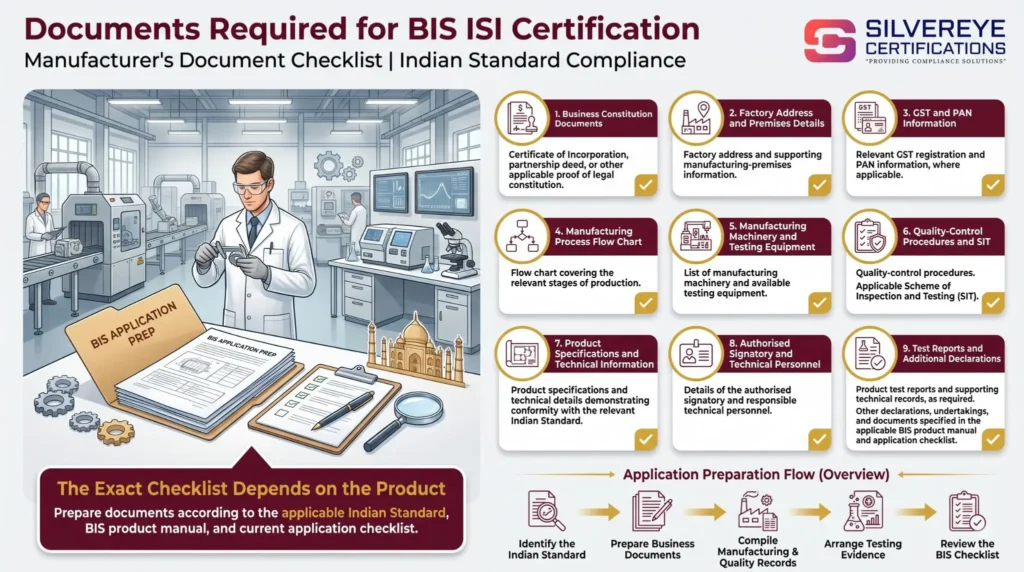
Use the current BIS application checklist to confirm which documents are mandatory for your specific application. A general checklist should not replace the official requirements.
BIS Certification Process for Dishwashers: Step by Step
The following steps outline the general process for obtaining a BIS license under Scheme-I for covered dishwashers.
- Map your models to the QCO: Confirm whether each product falls under Serial No. 40 for Dishwashers or Serial No. 59 for Commercial Electric Dishwashing Machines. Assess other entries separately if your product is a different type of commercial kitchen appliance.
- Confirm the applicable standards: Identify the relevant Indian Standards and testing scope for each model before booking laboratory testing.
- Finalize product specifications: Prepare the bill of materials and identify critical components. Changes to components or product design may affect the assessment and should be reviewed against the applicable BIS requirements.
- Complete laboratory testing: Submit the required samples to a laboratory recognised for the relevant testing scope and obtain the required reports.
- Submit the BIS application: File through the prescribed BIS application process, provide the required documents and pay the applicable fees.
- Complete the factory assessment: BIS assesses the manufacturing facility, quality-control arrangements and testing capabilities as required. For foreign manufacturers, assessment may involve the overseas factory.
- Complete any additional testing or corrective action: Respond to queries, address non-conformities and provide additional information when requested.
- Obtain the license: If the application satisfies the applicable requirements, BIS may grant the license with the relevant CM/L number and license conditions.
- Apply the ISI Mark: Mark the covered products according to the license and applicable marking requirements.
- Maintain ongoing compliance: Keep production and marking records, comply with surveillance requirements and manage license renewals or amendments as required.
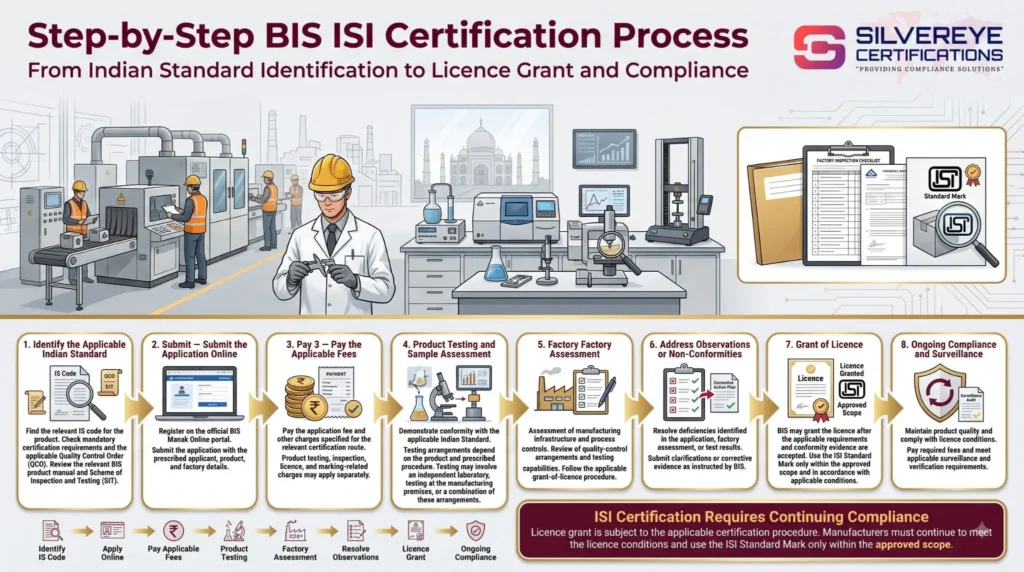
Important: A successful laboratory test alone does not authorize the use of the ISI Mark. The manufacturer must obtain the applicable BIS license before using the mark on products subject to mandatory certification.
How Long Does BIS Certification for Dishwashers Take?
The BIS certification timeline for dishwashers depends on laboratory availability, document readiness, sample testing and factory inspection scheduling. The following estimates are indicative and are not guaranteed timelines from BIS.
| Stage | Indicative Time |
|---|---|
| Model mapping and document preparation | 1–2 weeks |
| Testing at a recognised laboratory | 2–4 weeks, depending on the number of models and lab queue |
| Application submission and scrutiny | 1–2 weeks |
| Factory inspection scheduling and visit | 2–4 weeks |
| Licence grant after compliance | 1–2 weeks |
| Overall estimated timeline | Approximately 2–3 months, provided documents and samples are ready |
Because dishwashers are bulky appliances, sample transportation and laboratory scheduling can take additional time. Manufacturers should plan these steps early to avoid delays.
BIS Certification Fees for Dishwashers
The BIS certification cost for dishwashers depends on the applicable fee schedule, testing requirements, number of models, factory location and marking fees. The following table provides an indicative breakdown. Confirm the current charges with BIS before preparing your budget.
| Fee Component | Indicative Amount or Basis | Notes |
|---|---|---|
| Application fee | ₹1,000, as reported in the referenced fee information | Confirm the current amount on the BIS portal |
| Annual licence fee | ₹1,000 per year, as reported in the referenced fee information | Check the applicable payment requirements |
| Minimum marking fee | As specified in the applicable BIS marking-fee schedule | Confirm the correct product and production category |
| Marking fee payment | Depends on the applicable BIS guidelines | Verify the current payment schedule |
| MSME concessions | Subject to applicable eligibility criteria | Confirm the current concession rates and validity |
| Laboratory testing | Charged by the laboratory | Depends on the models, tests and sample requirements |
| Factory inspection | Depends on the inspection arrangements | Overseas inspections may involve additional travel costs |
| Consultant fee | Based on the project scope | Depends on the number of models, factory location and support required |
Important: BIS fees, concessions and payment procedures can change. Verify the latest applicable regulations and fee schedule before relying on any quoted amount. Laboratory charges and consultancy fees are separate from statutory BIS fees.
Where permitted by BIS product-grouping guidelines, similar dishwasher models may be considered together for an application. However, models with different heaters, pumps, control boards or other safety-related features may require separate technical evaluation. Confirm the grouping eligibility before finalising the testing plan.
BIS License Validity and Renewal
The validity and renewal requirements for a dishwasher's BIS license depend on the applicable conformity assessment regulations and the conditions specified in the license.
| Aspect | Details |
|---|---|
| Initial validity | Verify the validity period under the applicable BIS regulations and the licence issued |
| Renewal | Apply under the applicable BIS renewal requirements |
| Annual payments | Check the licence and marking-fee payment obligations applicable to your licence |
| When to apply for renewal | Start the renewal process well before expiry to allow time for documentation and scrutiny |
| Typical renewal documents | Production and marking records, compliance details, applicable fees and clearance of outstanding dues, as required |
| What happens if a licence lapses | Manufacturing or selling products under an expired, suspended or cancelled licence may create compliance issues |
| New models and variants | Obtain the necessary approval to include additional models in the licence scope before applying the ISI Mark |
A longer license validity period does not remove ongoing compliance obligations. Manufacturers must maintain accurate production records, pay applicable fees, comply with surveillance requirements and use the ISI Mark only as authorized.
Importing Dishwashers: What Changes?
Importers and overseas manufacturers should consider the following requirements when planning BIS certification for dishwashers.
- Foreign manufacturer certification: Overseas manufacturers generally need to follow the applicable Foreign Manufacturers Certification Scheme (FMCS) requirements under BIS Scheme-I. The manufacturer must complete the applicable certification process and comply with the marking requirements before commercial sale in India.
- Existing stock manufactured or imported before implementation: Any transitional relief must be assessed against the exact wording of the applicable Quality Control Order, including eligibility conditions, the relevant implementation date and any required declaration to BIS. Do not assume that every shipment or inventory item qualifies automatically.
- Research and development samples: The QCO provides a conditional exemption for importing up to 200 units per year for research and development, subject to the applicable conditions. These units must not be sold commercially, and importers should maintain the required records.
- Supplier and purchase-order planning: Include the applicable BIS certification requirement in supplier agreements and purchase orders. Confirm the certification status and implementation timeline before dispatch to avoid shipment delays, storage costs or compliance issues.
Common Mistakes to Avoid
Manufacturers and importers should avoid these common mistakes when applying for BIS Certification for Dishwashers:
- Assuming compact or countertop dishwashers are automatically exempt because of their size.
- Applying under the wrong certification route instead of the applicable Scheme-I requirements.
- Testing one model and selling variants with different heaters, pumps, control boards or other safety-related components without checking whether additional evaluation or approval is needed.
- Overlooking applicable wireless approval requirements for connected models that use radio-frequency technology.
- Treating transitional stock provisions as permission to manufacture new products after the applicable implementation date.
- Budgeting only for the application fee while overlooking laboratory testing, sample transportation, inspection and marking fees.
- Confusing dishwashers (Serial No. 40) with food waste disposers (Serial No. 42) when checking the product scope under the QCO.
Careful product classification, model mapping and early preparation can help manufacturers reduce avoidable delays and support a smoother BIS certification process.
Why Choose Silvereye Certifications?
BIS certification projects can face delays because of small but important details, such as incorrect product classification, missing critical component records or inadequate factory preparation before inspection. Silvereye Certifications provides regulatory compliance support for BIS, CDSCO, WPC and related approvals, helping manufacturers and importers navigate the certification process with greater clarity.
Here is how we can support your dishwasher certification project:
- Accurate Model Mapping: Identify the applicable QCO entry for your dishwasher models and assess whether connected features or components require additional compliance checks before testing.
- Laboratory Coordination: Assist with sample submission, testing schedules and eligible model grouping to help manage costs and timelines.
- Application and Documentation Support: Help prepare the required documents, submit the application and track progress throughout the process.
- Factory Audit Preparation: Provide a pre-inspection checklist to help your manufacturing facility prepare for the BIS inspection.
- Importer Support: Guide overseas manufacturers and importers on applicable FMCS requirements, Indian representative coordination and eligible transitional stock declarations.
- Post-Certification Assistance: Support renewal planning, marking-fee compliance and the addition of eligible models to the licence scope.
Planning to obtain BIS Certification for Dishwashers? Contact Silvereye Certifications with your product and model details to understand the applicable requirements, documentation and estimated project costs.
Conclusion
BIS Certification for Dishwashers is an important compliance requirement for manufacturers and importers supplying covered household and commercial dishwashing machines in India. Under the Safety of Household, Commercial and Similar Electrical Appliances (Quality Control) Order, 2026, the applicable requirements and implementation dates depend on the product category and the manufacturer's enterprise classification.
To prepare effectively, identify the correct product entry, review the applicable Indian Standards, confirm critical components, arrange testing and submit a complete application. Manufacturers should also plan for factory inspection, applicable marking fees, licence maintenance and renewal.
Transitional stock provisions should be used only when the products and circumstances meet the specific conditions of the order. With proper planning and accurate documentation, businesses can reduce avoidable delays and work towards meeting the applicable BIS requirements.
Silvereye Certifications can assist with model assessment, documentation, laboratory coordination and certification support, helping your business approach the process with greater confidence.
Frequently Asked Questions
Is BIS certification mandatory for dishwashers in India?
Yes, under the 2026 order. Dishwashers are listed at serial no. 40 and commercial electric dishwashing machines at serial no. 59, so both must conform to IS 302 (Part 1):2024 and bear the ISI Standard Mark, subject to the implementation dates and exemptions.
Which standard applies to dishwashers?
The order specifies IS 302 (Part 1):2024, which corresponds to IEC 60335-1:2020, and says the latest version of the Indian Standards applies. Your lab confirms any product-specific parts.
What are the deadlines of BIS Certification For Dishwashers?
1 October 2026 for general manufacturers, 1 January 2027 for small enterprises and 1 April 2027 for micro enterprises.
Are commercial dishwashing machines covered?
Yes. Commercial Electric Dishwashing Machines are at serial no. 59, and commercial rinsing sinks and kitchen machines are at serial nos. 62 and 63.
What is the voltage limit for Dishwashers?
Up to 250 V for single-phase appliances and up to 480 V for other appliances.
Do countertop dishwashers need the ISI Mark?
The order lists dishwashers without a size exclusion, so a compact household dishwasher falls under serial no. 40. Confirm your exact model with your lab.
Can I sell my existing stock after the deadline?
Goods made or imported before the implementation date by a BIS-certified manufacturer, or one who has applied, can be sold or offered for sale for up to six months from that date. A declaration to BIS is required.
Can I import sample dishwashers for R&D?
Up to 200 units per year can be imported for R&D by manufacturers of household and similar electrical appliances. They cannot be sold commercially, and records must be kept.
Are export-only dishwashers exempt?
Goods manufactured domestically for export are outside the order.
How much does BIS certification for a dishwasher cost?
Government fees include a Rs 1,000 application fee, a Rs 1,000 annual license fee and a product-specific minimum marking fee. Testing and inspection are charged at actuals. Verify current figures on the BIS portal.
How long is the license valid?
Under the 2026 amendment, up to 5 years initially and renewable for up to 5 years. Annual fees still apply.
Can a foreign dishwasher manufacturer apply?
Yes, through FMCS with an Indian representative. BIS may inspect the overseas factory.
What is the penalty for non-compliance?
The order says contravention is punishable under the BIS Act, 2016.