
- Mandatory Certification: Electric Heating Tools are listed at Sl. No. 11 in the covered appliances list under the Safety of Household, Commercial and Similar Electrical Appliances Quality Control Order, 2026.
- Implementation Deadlines:
- General manufacturers: 1 October 2026 — deadline has passed.
- Small enterprises: 1 January 2027.
- Micro enterprises: 1 April 2027.
- Applicable Standard: IS 302 (Part 1):2024, aligned with IEC 60335-1:2020, covering general electrical safety requirements. The relevant product-specific Part 2 standard should also be considered where applicable.
- Certification Route: BIS Scheme-I (ISI Mark Scheme). Manufacturers must complete the applicable testing and factory assessment requirements and obtain a BIS license to use the Standard Mark before placing covered products on the market, subject to applicable exemptions.
Introduction
BIS Certification for Electric Heating Tools is the process of obtaining a license from the Bureau of Indian Standards (BIS) to use the ISI Mark on covered products, such as soldering irons, glue guns and hot-air tools. Under the 2026 Quality Control Order (QCO), “Electric Heating Tools” is listed at Sl. No. 11, with implementation deadlines of 1 October 2026 for general manufacturers, 1 January 2027 for small enterprises and 1 April 2027 for micro enterprises.

Certification involves testing against the applicable Indian Standards, factory assessment and obtaining a valid BIS license before manufacturing, importing or selling covered products in India, subject to applicable exemptions.
What Is BIS Certification for Electric Heating Tools?
BIS Certification for Electric Heating Tools is the process of obtaining a license from the Bureau of Indian Standards (BIS) to use the ISI Mark on products covered by the applicable Quality Control Order (QCO). The certification process helps demonstrate that electrical heating tools meet the relevant safety requirements.

Under the 2026 Quality Control Order, electric heating tools are listed at Serial No. 11 in the table of covered appliances. The listed general safety standard is IS 302 (Part 1):2024, aligned with IEC 60335-1:2020. Depending on the product's classification, the relevant product-specific safety requirements must also be assessed.
In simple terms, BIS certification provides a framework for assessing whether a covered tool is designed and manufactured to meet applicable electrical safety requirements.
The certification process generally involves:
- A BIS license, not just a test report: A laboratory test report alone does not authorize a manufacturer to use the ISI Mark. The manufacturer must obtain the applicable BIS license.
- Product testing: Samples are tested for relevant safety requirements, which may include temperature rise, electrical insulation, protection against electric shock and abnormal operation.
- Factory assessment: BIS assesses the manufacturing facility and quality-control arrangements under the applicable certification procedure.
- ISI Mark and license details: Once licensed, the manufacturer must use the Standard Mark and license details in accordance with BIS requirements.
Electric heating tools covered by the QCO follow the BIS Scheme-I (ISI Mark Scheme), rather than the Compulsory Registration Scheme (CRS) used for specified product categories under a different certification framework.
What Does the 2026 Quality Control Order Say About Electric Heating Tools?
On 6 April 2026, the Ministry of Commerce and Industry, through the Department for Promotion of Industry and Internal Trade (DPIIT), issued S.O. 1739(E), titled the Safety of Household, Commercial and Similar Electrical Appliances (Quality Control) Order, 2026. The Order was issued under Section 16 of the Bureau of Indian Standards Act, 2016.
The Order identifies electric heating tools as one of the appliance categories covered by its requirements.
| Requirement | Details |
|---|---|
| Product category | Electric Heating Tools, listed at Serial No. 11 |
| General scope | Covered household, commercial or similar electrical appliances within the voltage limits specified in the Order |
| Listed safety standard | IS 302 (Part 1):2024, aligned with IEC 60335-1:2020 |
| Product-specific requirements | Assess the applicable particular standard based on the tool's design and classification |
| Certification route | BIS Scheme-I, subject to the applicable QCO and certification requirements |
| Standard version | The Order contains a note concerning the latest version of the applicable Indian Standards |
| Regulatory authority | Bureau of Indian Standards |
| Non-compliance | Consequences may apply under the BIS Act, 2016 and relevant provisions |
Implementation Deadlines for BIS Certification
The 2026 Order specifies different implementation dates for general manufacturers, small enterprises and micro enterprises.
| Business category | Implementation date |
|---|---|
| General manufacturers and importers, other than micro and small enterprises | 1 October 2026 |
| Small enterprises | 1 January 2027 |
| Micro enterprises | 1 April 2027 |
As of 26 October 2026, the general implementation date has passed. Small and micro enterprises have later dates under the Order. Businesses should verify their MSME classification, eligibility for any applicable exemptions and the exact scope of the QCO before relying on a later deadline.
Looking at other appliances covered by the QCO? Explore our related BIS certification guides for personal care appliances, including shavers, massagers and oral care devices.
What Counts as an Electric Heating Tool?
The 2026 Order lists Electric Heating Tools as a category but does not provide a detailed product-by-product list within that entry. Classification should therefore be based on the actual product, its intended use, electrical ratings and the applicable Indian Standards.
The IEC 60335 safety standards include product-specific requirements for portable heating tools and similar appliances. The corresponding Indian standard listing includes IS 302 (Part 2/Sec 45):1994, which concerns the safety of electric heating tools. Confirm the current applicable standard and its relationship to the QCO with BIS or a suitably qualified testing laboratory.
Examples of products that may require a classification assessment include:
| Example product | Typical function |
|---|---|
| Soldering irons and soldering guns | Heat solder for electronics assembly and repair |
| Hot-melt glue guns | Heat and dispense adhesive |
| Hot-air guns and heat guns | Produce hot air for applications such as heat-shrink work and paint removal |
| Heat-shrink tools | Apply heat to shrink tubing or wrapping materials |
| Wood-burning pens | Heat a tip for decorative burning or pyrography |
This is an illustrative list, not a definitive legal classification. A product's commercial name alone does not establish whether it falls under Serial No. 11, another entry in the Order or an exclusion.
Tools designed exclusively for specialized industrial use may require a different scope assessment from household, commercial or similar appliances. Before arranging testing or applying for a BIS license, confirm the product's classification, applicable standards and any relevant exemptions with BIS or an appropriate testing laboratory.
Who Needs a BIS License for Electric Heating Tools?
BIS certification requirements depend on who manufactures the product, where it is manufactured and whether the product falls within the scope of the applicable Quality Control Order (QCO).
- Indian manufacturers: Manufacturers of covered electric heating tools must obtain the applicable BIS license and comply with the QCO before manufacturing or selling products subject to the mandatory requirements.
- Foreign manufacturers: Overseas manufacturers exporting covered tools to India generally apply under the Foreign Manufacturers Certification Scheme (FMCS) and must fulfil the applicable BIS requirements. An Authorized Indian Representative (AIR) is required where prescribed.
- Importers and brand owners: An importer or brand owner cannot simply obtain an ISI license in its own name to cover a different manufacturer's factory. The overseas manufacturer must follow the applicable certification route. Importers should verify that the manufacturer and the exact product are covered by a valid license.
- Sellers and distributors: Businesses selling covered electric heating tools must ensure that the products comply with the applicable requirements once the relevant implementation date takes effect.
The exact obligations depend on the product classification, manufacturing arrangement, applicable exemptions and current BIS requirements.
Why Is BIS Certification Important for Electric Heating Tools?
Electric heating tools generate heat during normal operation, so electrical safety is a key consideration. BIS certification provides a framework for assessing whether covered products meet the applicable Indian Standard.
Key benefits include:
- Regulatory compliance: Helps manufacturers meet mandatory certification requirements for products covered by the QCO.
- Electrical safety assessment: Testing evaluates applicable risks, including electric shock, excessive temperatures, insulation failure and abnormal operation.
- Retail and buyer confidence: A valid BIS license and authorized ISI Mark can help demonstrate compliance to buyers, distributors and procurement teams.
- Quality-control discipline: Factory assessment and applicable surveillance requirements help manufacturers maintain consistent production quality.
- Brand credibility: Proper certification and marking provide buyers with a recognized indication that the product has undergone the required conformity assessment.
The ISI Mark must only be used in accordance with the valid BIS license and applicable marking requirements. It should not be applied merely because a sample has passed a laboratory test.
Applicable BIS Standards for Electric Heating Tools
The 2026 Quality Control Order lists IS 302 (Part 1):2024, aligned with IEC 60335-1:2020, for the covered appliance category. This standard addresses general electrical safety requirements.
Electric heating tools may also require assessment against the relevant product-specific standard. BIS laboratory information lists IS 302 (Part 2/Sec 45):1994, covering particular safety requirements for electric heating tools and corresponding to IEC 60335-2-45.
Before testing, ask the laboratory or BIS to confirm:
- The exact classification of your product.
- The applicable general and product-specific Indian Standards.
- The current editions and any applicable amendments.
- The required test scope and sample configuration.
- The certification and marking requirements for your product category.
Important: Do not assume that IS 302 (Part 1):2024 alone covers every product-specific safety requirement. The applicable standard combination must be confirmed for the exact tool.
Latest Update: What the 2026 Order Means for Manufacturers
The Safety of Household, Commercial and Similar Electrical Appliances (Quality Control) Order, 2026, issued as S.O. 1739(E) on 6 April 2026, superseded the 2025 Order and came into force on 1 October 2026. Electric Heating Tools appear at Serial No. 11 in its table.
Implementation deadlines
| Business category | Implementation date | What to do |
|---|---|---|
| General manufacturers and importers, other than micro and small enterprises | 1 October 2026 | The general deadline has passed. Confirm your product's compliance status and take the required action promptly. |
| Small enterprises | 1 January 2027 | Confirm eligibility and prepare the application, testing and factory documentation in advance. |
| Micro enterprises | 1 April 2027 | Verify your classification and plan testing and certification early. |
The later dates for small and micro enterprises apply according to the definitions and conditions in the relevant legislation. Confirm your enterprise classification before relying on an extended implementation date.
Can existing stock be sold after the implementation date?
The 2026 QCO contains a conditional six-month provision for certain goods manufactured domestically or imported before the relevant implementation date. The provision applies to qualifying stock associated with a manufacturer that is already BIS-certified or has applied to BIS for certification of the relevant goods, and requires a declaration to BIS. It should not be treated as an unconditional grace period for all importers, sellers or stock.
Before relying on this provision, confirm the product's eligibility, the declaration procedure and the applicable end date with BIS.
Transition Facilitation Order, 2026
DPIIT also issued the Transition Facilitation (Quality Control) Order, 2026, dated 25 June 2026. This introduces a separate, conditional mechanism involving Scheme-II certification for eligible applicants and specified QCO-covered products. It does not automatically exempt every electric heating tool from the ordinary QCO requirements or change the published deadlines for every business.
Manufacturers considering this route should review the official Order and implementation guidelines to establish whether they qualify.
Documents Required for BIS Certification
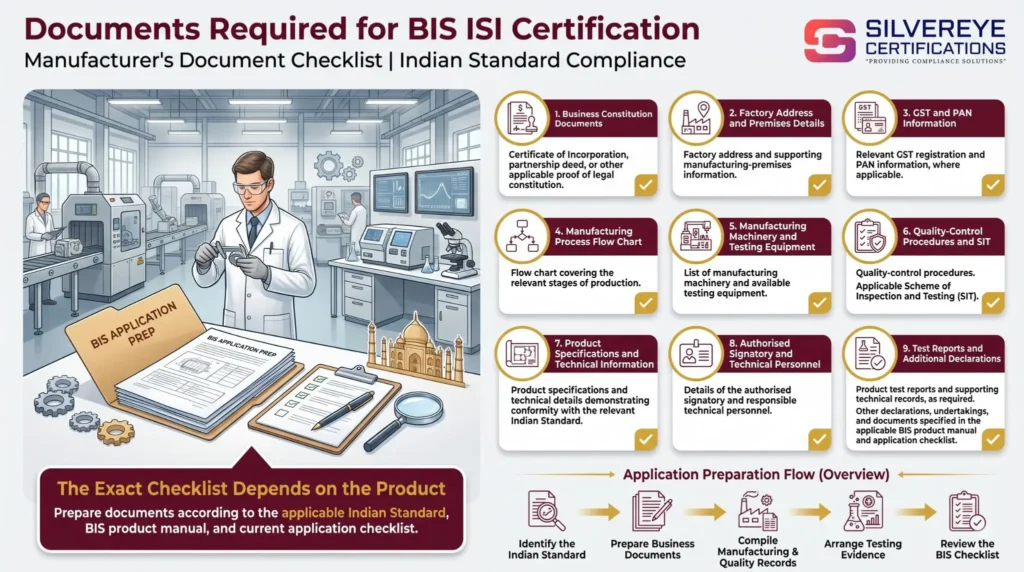
The precise document list depends on the product, the applicant's location, the certification route and the current BIS application requirements. Use the following as a preparation checklist, then confirm the final list on the BIS portal.
| Document or information | Purpose |
|---|---|
| BIS application | Initiates the relevant Scheme-I certification application. |
| Business registration documents | Establish the applicant's legal identity and business details. |
| MSME/Udyam certificate, if applicable | Supports an enterprise's claim to small or micro enterprise status, where relevant. |
| Factory address and premises documents | Identify the manufacturing location and support the factory assessment. |
| Factory layout and manufacturing process flow chart | Explain the production process and factory arrangements. |
| Machinery and testing equipment lists | Demonstrate manufacturing and quality-control capabilities. |
| Calibration records | Help establish the reliability of relevant measuring and testing equipment. |
| Quality-control plan and inspection records | Explain how product conformity is monitored during production. |
| Product test documentation | Supports assessment against the applicable Indian Standards, as required by BIS. |
| Product specifications | Include model numbers, electrical ratings, circuit diagrams, critical components and user manuals, as applicable. |
| Authorised signatory documents | Establish the authority of the person handling the application. |
| Foreign manufacturer documents | Include manufacturer details and AIR appointment documents where required under FMCS. |
Before you submit
- Confirm the correct product category and applicable Indian Standards.
- Check that the model details and electrical ratings match across the application and technical documents.
- Prepare the factory and quality-control records required for assessment.
- Confirm the applicable testing procedure and laboratory requirements.
- Use the current BIS application checklist rather than relying solely on a generic online list.
A complete and consistent application helps reduce avoidable clarification requests, although certification timelines and outcomes remain subject to BIS assessment.
BIS Certification Process for Electric Heating Tools: Step by Step
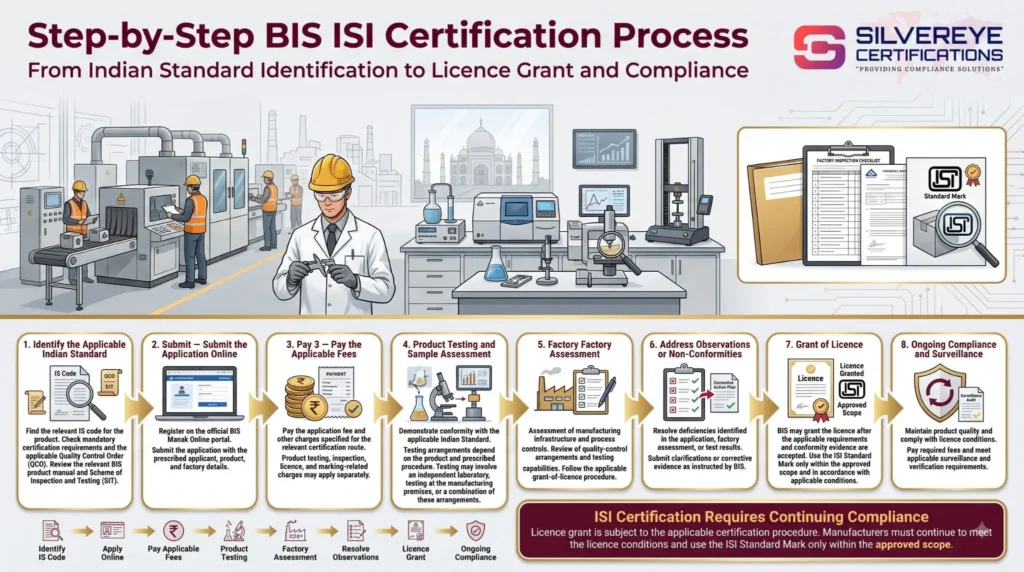
Obtaining BIS certification for electric heating tools involves product classification, laboratory testing, factory assessment and license approval. The following steps outline the general BIS Scheme-I (ISI Mark) certification process.
- Confirm your product category: Check whether your tool falls under Serial No. 11 of the 2026 Quality Control Order and identify the applicable Indian Standards.
- Prepare your factory: Establish production controls, maintain calibrated measuring instruments and organise quality-control and test records.
- Submit the BIS application: Apply through the official BIS portal using the applicable Scheme-I procedure and submit the required documents and fees.
- Complete product testing: Arrange sample testing through an appropriate BIS-recognised laboratory against the applicable standards.
- Complete the factory assessment: BIS assesses the manufacturing process, quality-control arrangements and testing facilities, as applicable.
- Resolve non-conformities: Respond to queries and complete any corrective actions required by the laboratory or BIS.
- Obtain the licence: Once the applicable requirements are satisfied, BIS may grant the licence with the relevant CM/L number.
- Apply the ISI Mark: Mark covered products in accordance with the licence and BIS marking requirements.
- Maintain compliance: Follow applicable surveillance, record-keeping, renewal and product-change requirements.
How Long Does BIS Certification Take?
The timeline depends on laboratory availability, sample testing, factory readiness, inspection scheduling and the time taken to resolve queries. Some applicants plan for approximately two to three months, but this is only a planning estimate, not a guaranteed processing period.
Preparing complete documentation and ensuring that the factory is inspection-ready can help reduce avoidable delays.
BIS Certification Fees, Validity and Renewal
The total cost of BIS certification for electric heating tools depends on the applicable government fees, testing requirements, factory inspection and certification route. Obtain an itemized quotation using the current BIS fee schedule and laboratory charges before preparing your budget.
| Cost component | What it covers |
|---|---|
| Application fee | Processing the Scheme-I application |
| Inspection fee | Factory assessment and applicable inspection expenses |
| Licence and marking fees | Fees associated with granting and maintaining the licence and use of the Standard Mark |
| Laboratory testing charges | Testing of the product against the applicable standards |
| FMCS-related costs | Applicable certification requirements and fees for foreign manufacturers |
| Consultancy fees | Optional professional assistance with documentation and coordination |
Consultancy charges are separate from BIS and laboratory fees. Confirm which services are included before appointing a service provider.
BIS License Validity and Renewal
BIS Scheme-I licenses may initially be granted for up to two years. Renewal can generally be requested for a period ranging from one to five years, subject to the applicable conditions and payment requirements.
| License aspect | What you should know |
|---|---|
| Initial validity | Up to two years, as applicable to the licence granted |
| Renewal period | Generally one to five years, subject to BIS requirements |
| Renewal application | Submit through the BIS portal with the required documents and fees |
| Production records | Production details may be required for marking-fee calculations |
| Changes during validity | Inform BIS of relevant changes to the product, factory or other licence particulars, as required |
| Expired licence | Do not assume that an expired licence permits continued marking or sale of products subject to mandatory certification |
Apply for renewal well before expiry and follow the current instructions in the licence-holder dashboard.
Exemptions and Transition Provisions Under the 2026 Order
The 2026 Quality Control Order contains specific provisions and implementation dates that may affect certain products and businesses. An exemption or transition provision should only be relied on after confirming that your product and circumstances meet its conditions.
- Export-only goods: The Order provides an exclusion for goods manufactured domestically for export, subject to the applicable wording and conditions.
- Research and development imports: The Order provides for the import of up to 200 units per year for specified research and development purposes, subject to conditions. These units cannot be sold commercially, and applicable record-keeping and disposal requirements must be followed.
- Certain existing stock: A conditional provision allows qualifying goods manufactured domestically or imported before the relevant implementation date to be sold, displayed or offered for sale for a limited period. Eligibility, the manufacturer's certification status and the required declaration to BIS must be confirmed before relying on this provision.
- Later implementation dates for smaller enterprises: The stated deadlines are 1 January 2027 for small enterprises and 1 April 2027 for micro enterprises, subject to the applicable definitions and conditions.
Keep supporting documents and declarations on record if your business relies on an exemption or transition arrangement. Confirm the exact requirements against the current QCO and any subsequent applicable orders.
Penalties for Non-Compliance With BIS Requirements
Manufacturing, importing or selling covered electric heating tools without meeting applicable mandatory certification requirements can expose a business to regulatory and legal consequences.
The Bureau of Indian Standards Act, 2016 contains penalty provisions for specified contraventions, including provisions relating to the unauthorized use of the Standard Mark and the manufacture or sale of goods in violation of Section 17. The applicable penalty depends on the nature of the contravention and the relevant statutory provision.
Possible business consequences include:
- Regulatory action against non-compliant products.
- Restrictions on selling or distributing covered goods.
- Costs associated with product withdrawal, corrective action or additional testing.
- Delays in supply contracts and retail onboarding.
- Financial and reputational damage.
Importers and sellers should also verify product certification status before placing covered goods on the market. Do not assume that a supplier's test report or a pending application is equivalent to a valid BIS licence.
Common Mistakes to Avoid During BIS Certification
Avoid these common errors when preparing your electric heating tool for certification:
- Assuming the product is exempt: Confirm its classification and intended use rather than relying on its commercial description as an industrial tool.
- Using the wrong standard: Check whether the general safety standard and a product-specific standard apply.
- Choosing an unsuitable laboratory: Verify that the laboratory is recognised for the relevant testing scope.
- Misunderstanding foreign manufacturer certification: Ensure that the actual manufacturing facility follows the applicable certification route.
- Changing critical components without review: Changes to heating elements, switches, cords or other critical components may affect the licence scope or require BIS approval or an amendment.
- Missing renewal dates: Track the licence validity and submit renewal applications on time.
- Relying on unverified transition claims: Confirm the eligibility and documentation requirements before selling stock under a transition provision.
Why Choose Silvereye Certifications for BIS Certification?
BIS certification involves more than submitting an application. Correct product classification, appropriate testing, complete documentation and factory readiness can all affect the process.
Silvereye Certifications supports manufacturers and businesses preparing for BIS certification of electric heating tools.
- Product and standard mapping: Assistance in identifying the applicable QCO entry and relevant Indian Standards.
- Document preparation: Help organising and reviewing application documents and technical information.
- Laboratory coordination: Support with planning sample submission and understanding the applicable testing requirements.
- Factory inspection preparation: Guidance on organising manufacturing records, testing arrangements and quality-control documentation.
- Transparent cost planning: A clear breakdown of expected documentation, testing and professional service requirements.
- Post-certification support: Assistance with renewal planning, licence amendments and ongoing compliance tracking.
Share your product list, manufacturing location and target launch date with Silvereye Certifications to discuss the applicable certification route and prepare a realistic action plan.
Conclusion
BIS Certification for Electric Heating Tools is an important compliance requirement for covered products under the Safety of Household, Commercial and Similar Electrical Appliances (Quality Control) Order, 2026. Manufacturers should begin by confirming their product classification, identifying the applicable Indian Standards and preparing for laboratory testing and factory assessment.
The implementation dates are 1 October 2026 for general manufacturers, 1 January 2027 for small enterprises and 1 April 2027 for micro enterprises, subject to the applicable provisions. Since the general deadline has passed, affected businesses should review their current compliance status promptly.
Accurate documentation, appropriate testing and timely licence management can help reduce avoidable delays. Before acting, verify the latest requirements, fees, standards and transition provisions through BIS or a qualified compliance professional.
Frequently Asked Questions
Is BIS certification mandatory for electric heating tools?
Yes. "Electric Heating Tools" is Sl. No. 11 in the Table of the 2026 Order, and the ISI Mark is compulsory from the dates given above.
What is the deadline For Electric Heating Tools?
1 October 2026 for general manufacturers, 1 January 2027 for small enterprises and 1 April 2027 for micro enterprises.
Which standard applies For BIS Certification For Electric Heating Tools?
IS 302 (Part 1): 2024, aligned with IEC 60335-1:2020, usually tested with the product-specific part for portable heating tools.
Does a soldering iron need BIS certification?
Soldering irons are typically treated as heating tools, but confirm your exact model and intended use with a lab, because industrial-only tools may be out of scope.
Are glue guns and heat guns covered?
They are commonly assessed as portable heating tools. Confirm classification before applying.
Can an importer get the license?
The licence is issued to the manufacturer. A foreign manufacturer applies under FMCS, usually with an Authorized Indian Representative.
How long is the BIS Certification license valid?
Generally one or two years, at the manufacturer's option, and it must be renewed before expiry
How long does certification take?
There is no fixed time. Many applicants plan for roughly two to three months, depending on testing and inspection.
Can I sell stock made before the deadline?
Possibly. Certified manufacturers, or those who have applied, may sell declared stock for up to six months from the implementation date, subject to a declaration to BIS.
Are export-only products exempt?
Yes. The Order does not apply to goods manufactured domestically for export.