
- Mandatory Compliance: The Safety of Household, Commercial and Similar Electrical Appliances (Quality Control) Order, 2026, specifies implementation from 1 October 2026 for general manufacturers, subject to the order's scope and applicable conditions.
- Products Covered: Relevant categories include electric shavers and trimmers, massage appliances, electric toothbrushes, skin beauty care appliances and certain laser- or IPL-based devices. Applicability depends on the product's classification under the order.
- Applicable Standard: IS 302 (Part 1):2024, aligned with IEC 60335-1:2020, covers general electrical safety requirements. Additional product-specific standards may apply.
- Upcoming Deadlines: The stated implementation dates are 1 January 2027 for small enterprises and 1 April 2027 for micro enterprises, subject to eligibility and the official QCO provisions.
Introduction
BIS Certification for Personal Care Appliances involves obtaining a license to use the ISI Mark for products covered by the applicable Quality Control Order, such as electric shavers, hair clippers, massage appliances, electric toothbrushes and certain skin beauty care devices.
Under the Safety of Household, Commercial and Similar Electrical Appliances (Quality Control) Order, 2026, the stated implementation dates are 1 October 2026 for general manufacturers, 1 January 2027 for small enterprises and 1 April 2027 for micro enterprises, subject to the order's scope and applicable conditions.

Where Scheme-I applies, the certification process generally involves product testing against the relevant Indian Standards, factory assessment and obtaining a BIS license before using the ISI Mark. IS 302 (Part 1):2024 covers general electrical safety requirements; additional product-specific standards may also apply.
Manufacturers and importers should first confirm whether their particular product falls within the order and identify the applicable certification requirements. Products covered by a mandatory QCO must comply with its requirements before being manufactured, imported, distributed or sold in India, subject to any applicable exemptions or transitional provisions.
What Is BIS Certification for Personal Care Appliances?
BIS Certification for Personal Care Appliances is the process of obtaining a license from the Bureau of Indian Standards (BIS) to use the ISI Standard Mark on electrical products covered by applicable Indian regulations. These products may include electric shavers, hair clippers, massagers, electric toothbrushes and certain skin beauty care devices.

Under the Safety of Household, Commercial and Similar Electrical Appliances (Quality Control) Order, 2026, products covered by the Order must meet the applicable Indian Standards and comply with the relevant BIS licensing and marking requirements. The general safety standard identified in the Order is IS 302 (Part 1):2024, aligned with IEC 60335-1:2020. Additional product-specific requirements may also apply, depending on the appliance.
Certification generally involves confirming the product's regulatory scope, arranging laboratory testing, preparing the required documentation and completing the applicable factory assessment. The exact requirements depend on the appliance category and its intended use.
What Changed in 2026: The New Quality Control Order
On 6 April 2026, the Ministry of Commerce and Industry's Department for Promotion of Industry and Internal Trade (DPIIT) published S.O. 1739(E), the Safety of Household, Commercial and Similar Electrical Appliances (Quality Control) Order, 2026. According to the supplied Order details, it was issued under Section 16 of the Bureau of Indian Standards Act, 2016, and supersedes the 2025 Order of the same name, subject to the applicable saving provisions.
Here is what the 2026 Order says in plain language:
| Point | What the 2026 Order says |
|---|---|
| Scope | Electrical appliances for household, commercial or similar use, subject to the specified voltage limits and exclusions |
| Voltage limits | Up to 250 V for single-phase appliances and 480 V for other appliances, including DC-supplied and battery-operated appliances |
| Standard | IS 302 (Part 1):2024, aligned with IEC 60335-1:2020 |
| Marking | Standard Mark (ISI Mark) under a BIS licence, as per Scheme-I of Schedule-II of the BIS (Conformity Assessment) Regulations, 2018 |
| Products listed | The Order's Table lists appliance categories covered by its provisions |
| Standard version | The supplied Order details state that the latest applicable version of the Indian Standards applies |
| Enforcement | BIS is identified as the certifying and enforcing authority for listed goods |
| Exclusions | Appliances covered by another Quality Control Order or notified for mandatory BIS certification under another Act, as specified in the Order |
Effective dates
| Business category | Stated implementation date |
|---|---|
| General manufacturers, excluding micro and small enterprises | 1 October 2026 |
| Small enterprises | 1 January 2027 |
| Micro enterprises | 1 April 2027 |
Small and micro enterprise classifications must be determined under the applicable MSME provisions and the conditions of the Order.
As of 26 October 2026, the stated general implementation date has passed. Businesses selling personal care appliances should promptly verify whether their products fall within the Order and whether they meet the applicable requirements.
Which Personal Care Appliances Need BIS Certification?
“Personal care appliances” is not a single formal product category in the supplied Order details. Instead, its Table identifies individual appliance categories. The following entries are identified as potentially relevant to personal care products.
| Sl. No. in Order | Appliance category | Typical products to assess |
|---|---|---|
| 4 | Electrical shavers, hair clippers and similar appliances | Mains-powered shavers and hair clippers |
| 85 | DC-supplied or battery-operated shavers, trimmers, clippers and similar appliances | Cordless beard trimmers and rechargeable clippers |
| 9 | Massage appliances | Body massagers and handheld massage devices |
| 86 | DC-supplied or battery-operated massage appliances | Rechargeable massage guns and cordless massagers |
| 55 | Oral hygiene appliances | Electric toothbrushes and water flossers |
| 88 | DC-supplied or battery-operated toothbrushes and other oral hygiene appliances | Rechargeable electric toothbrushes |
| 44 | Appliances for skin exposure to optical radiation | Light-based skin treatment devices |
| 78 | Beauty care appliances incorporating lasers and intense light sources | Laser and IPL hair-removal or beauty devices |
| 80 | Skin beauty care appliances | Facial cleansing and skin-care devices |
| 68 | Foot warmers and heating mats | Electric foot warmers |
| 89 | DC-supplied or battery-operated foot warmers and heating mats | Rechargeable foot warmers |
| 43 | Blankets, pads, clothing and similar flexible heating appliances | Heating pads |
What about hair dryers and hair straighteners?
The supplied Order details do not identify hair dryers or hair straighteners by name in the listed entries above. Whether a particular product falls under a relevant category, including any category covering similar appliances, must be confirmed against the official Table and applicable standards. Do not assume that a product is either covered or exempt without checking its classification.
Why BIS Certification Matters for Your Business
- Regulatory compliance: Products covered by the Order must comply with the applicable requirements from the implementation date relevant to the manufacturer and product.
- Reduced enforcement risk: Contravention may attract penalties under the BIS Act, 2016. The applicable consequences depend on the circumstances and statutory provisions.
- Retailer and marketplace readiness: Retailers and online marketplaces may request licence details or evidence of regulatory compliance before accepting products.
- Consumer confidence: An authorized ISI Mark can help demonstrate that a covered product has been assessed under the applicable BIS certification requirements.
- Electrical safety: The relevant safety standards address hazards such as electric shock, excessive heating, abnormal operation and mechanical risks. Compliance supports product safety and quality control.
Applicable Standards for BIS Certification of Personal Care Appliances
The Safety of Household, Commercial and Similar Electrical Appliances (Quality Control) Order, 2026 identifies IS 302 (Part 1):2024, aligned with IEC 60335-1:2020, as the general safety standard for covered electrical appliances.
This standard addresses important safety requirements, including protection against electric shock, excessive heating, mechanical hazards and abnormal operation.
Depending on the product category, additional product-specific safety requirements may apply. The IEC 60335-2 series includes particular standards for different types of personal care appliances.
| Personal care appliance | Relevant IEC standard for consideration |
|---|---|
| Electric shavers, trimmers and hair clippers | IEC 60335-2-8 |
| Skin and hair care appliances | IEC 60335-2-23 |
| Massage appliances | IEC 60335-2-32 |
| Electric toothbrushes and oral hygiene appliances | IEC 60335-2-52 |
| Appliances for skin exposure to optical radiation | IEC 60335-2-27 |
| Foot warmers and heating mats | IEC 60335-2-81 |
| Beauty care appliances incorporating lasers or intense light sources | IEC 60335-2-113 |
Important: These IEC references are provided to help identify potentially relevant product-specific safety requirements. They do not automatically establish the applicable Indian Standards or editions for every product.
Before testing, manufacturers should confirm the current Indian Standard, applicable particular requirements and product classification with BIS or a BIS-recognised laboratory.
Who Can Apply for BIS Certification of Personal Care Appliances?
Manufacturers and businesses dealing with personal care appliances should understand the applicable eligibility requirements before starting the certification process.
- Indian manufacturers: Manufacturing units with suitable production facilities, quality control arrangements and applicable testing capabilities can apply for BIS certification.
- Foreign manufacturers: Overseas manufacturers supplying covered products to India may apply through the Foreign Manufacturers Certification Scheme (FMCS). Appointment of an Authorized Indian Representative (AIR) is generally required under the applicable scheme conditions.
- Importers and traders: The BIS product license is generally issued to the manufacturing unit rather than an importer acting solely as a trader. Importers should verify that the supplying manufacturer holds the required license covering the relevant products.
- Small and micro enterprises: Eligible enterprises may benefit from the implementation dates specified for their categories under the applicable Quality Control Order. They must still meet the relevant certification requirements.
- Brand owners using contract manufacturers: Businesses selling products manufactured by another company should confirm the licensing arrangement, approved models and brand details before placing products on the market.
Documents Required for BIS Certification of Personal Care Appliances
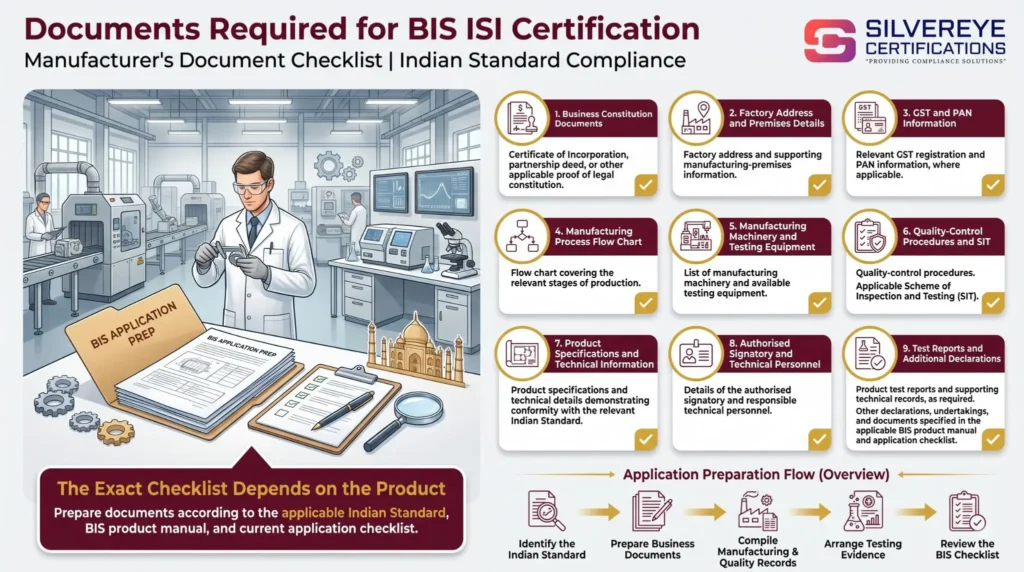
The documents required for BIS Certification for Personal Care Appliances depend on the product, manufacturer and applicable certification route.
The following checklist covers commonly required documents.
| Required document | Purpose |
|---|---|
| BIS application through the applicable online portal | Initiates the certification process |
| Business registration documents, GST details and Udyam registration, where applicable | Establishes business identity and relevant enterprise classification |
| Factory address proof, layout and ownership or lease documents | Provides details of the manufacturing premises |
| Manufacturing process flow chart | Explains the production process |
| List of manufacturing machinery and testing equipment | Demonstrates available production and testing facilities |
| Calibration records | Supports the reliability of testing equipment |
| Quality control plan and inspection records | Demonstrates manufacturing quality controls |
| Test report from a BIS-recognised laboratory, where required | Provides evidence of conformity with applicable standards |
| Product model details, ratings, circuit diagrams, critical component lists and user manuals | Supports technical assessment of the product |
| Authorised signatory details and authorisation documents | Identifies the person authorised to submit the application |
| AIR appointment and other applicable FMCS documents | Supports applications by foreign manufacturers |
Tip: Prepare complete product specifications and critical component details before submitting samples for testing. Missing technical information or changes to important components may result in additional queries or testing.
BIS Certification Process for Personal Care Appliances: Step-by-Step Guide
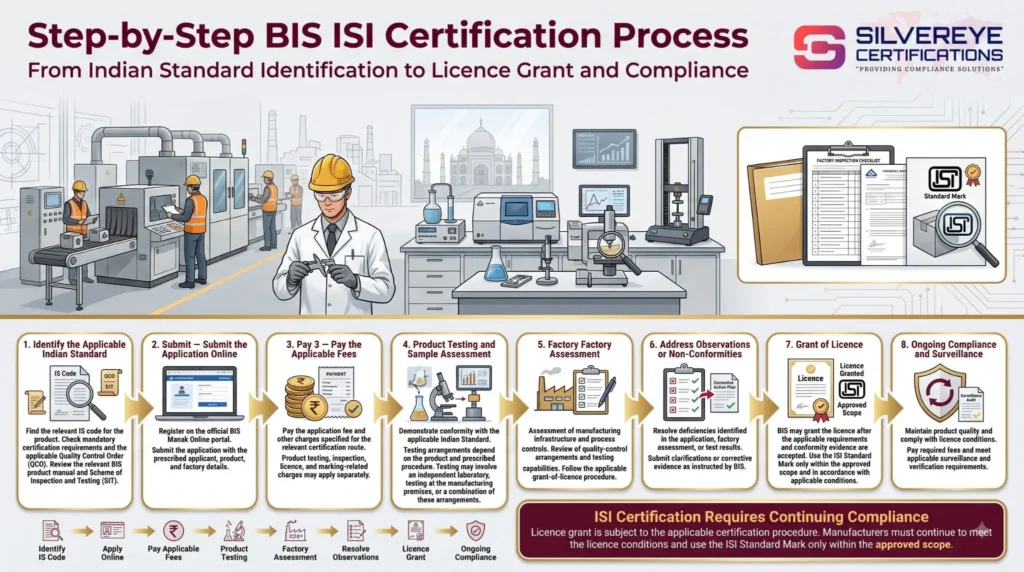
The process for obtaining BIS Certification for Personal Care Appliances generally involves the following steps:
- Confirm the product category and applicable standards. Identify the relevant entry under the Quality Control Order and determine which Indian Standards apply to the product.
- Prepare the manufacturing facility. Ensure the factory has appropriate production arrangements, testing equipment, calibration records and quality control procedures.
- Submit the BIS application. Apply through the applicable BIS online portal with the required documents and prescribed fees.
- Complete product testing. Arrange testing through a BIS-recognized laboratory against the applicable Indian Standards and testing requirements.
- Undergo factory assessment. BIS may inspect the manufacturing facility, quality control procedures, testing capabilities and production records. Samples may also be drawn for verification.
- Resolve queries or non-conformities. Submit any additional documents, corrective action reports or testing evidence requested during the assessment.
- Obtain the BIS license. Once the applicable requirements are satisfied and BIS approves the application, the manufacturer receives a license with a CM/L number.
- Apply the ISI Mark. Use the authorized ISI Standard Mark and required license details only on products covered by the license, following the applicable marking requirements.
- Maintain ongoing compliance. Continue maintaining quality records, meeting applicable testing requirements and complying with BIS surveillance, inspection and licence conditions.
How Long Does BIS Certification for Personal Care Appliances Take?
There is no guaranteed timeline for completing BIS certification. The duration depends on laboratory availability, product testing requirements, factory readiness, inspection scheduling and the time needed to resolve queries.
Manufacturers may use approximately two to three months as an initial planning estimate for a well-prepared application. However, the actual timeline may be shorter or longer depending on the product and certification circumstances.
Preparing complete documents, finalising product models and ensuring factory readiness before applying can help minimise avoidable delays.
BIS Certification Fees, License Validity and Renewal
The Bureau of Indian Standards (BIS) publishes the applicable certification fee schedule, which may be revised through official notifications. Before budgeting for BIS Certification for Personal Care Appliances, request an itemised estimate based on your product category, manufacturing location and certification requirements.
BIS Certification Fee Structure
| Fee component | What it covers | Important details |
|---|---|---|
| Application fee | Filing the Scheme-I application | Payable to BIS as prescribed |
| Inspection fee | Factory assessment by BIS | Depends on applicable inspection requirements and location |
| Licence and marking fees | Licence maintenance and use of the ISI Mark | Calculated according to the applicable BIS fee schedule |
| Laboratory testing charges | Testing at a BIS-recognised laboratory | Varies by product, testing requirements and number of models |
| Foreign manufacturer certification charges | Applicable FMCS requirements | May involve additional costs for overseas factory assessment and representation |
| Consultant or filing support fees | Optional professional assistance | Agreed separately with the consultant |
Budgeting tip: Obtain a written breakdown of government fees, laboratory charges, inspection-related expenses and professional fees before starting the application.
BIS License Validity and Renewal
The license validity and renewal conditions depend on the applicable BIS regulations and the terms under which the licence is granted.
| Licence aspect | Details |
|---|---|
| Initial validity | Confirm the validity period under the current regulations and the licence issued by BIS |
| Renewal | Apply through the BIS portal in accordance with the applicable renewal procedure |
| Renewal requirements | May include prescribed fees, updated documents, production records and evidence of continued compliance |
| Expiry | Do not use the ISI Mark on products unless the licence remains valid and authorises such use |
| Changes during validity | Notify BIS of changes to the product, manufacturing premises, ownership or other relevant details where required |
Practical advice: Track your license expiry date well in advance. Keep production records, testing documents and other compliance information organized to help avoid renewal delays.
Exemptions and Transitional Provisions Under the 2026 Quality Control Order
The Quality Control Order describes certain exclusions and transitional provisions. Their application depends on the exact wording of the Order and the manufacturer's circumstances.
- Export-only goods: The supplied Order details state that the Order does not apply to goods manufactured domestically for export.
- Small and micro enterprises: Eligible enterprises follow the implementation dates specified for their categories: 1 January 2027 for small enterprises and 1 April 2027 for micro enterprises, according to the supplied details.
- Research and development imports: The supplied text describes an allowance of up to 200 units per year for qualifying R&D purposes. The goods must not be sold commercially, and applicable recordkeeping and disposal conditions must be followed.
- Existing stock: A transitional provision may permit eligible goods manufactured domestically or imported before the relevant implementation date to be sold, displayed or offered for sale for up to six months, subject to the Order's eligibility conditions and declaration requirements.
If you intend to rely on an exemption or existing-stock provision, review the official notification and maintain the required supporting records. Do not assume that the provision automatically covers every product or manufacturer.
Common Mistakes to Avoid During BIS Certification
Avoid these common errors when applying for BIS Certification for Personal Care Appliances:
- Starting too late: Delays in product testing or design changes can affect your compliance schedule.
- Ignoring product-specific standards: Check whether additional requirements apply alongside the general electrical safety standard.
- Using an unsuitable laboratory: Confirm that the laboratory is recognised by BIS for the relevant testing scope.
- Misunderstanding the applicant's role: Confirm who must hold the license under the applicable certification scheme, especially for imported products.
- Missing renewal deadlines: Track license validity and prepare renewal documents in advance.
- Changing critical components without review: Changes to motors, batteries, switches or other important components may require evaluation or approval under BIS procedures.
Why Choose Silvereye Certifications?
Preparing a BIS application involves more than submitting documents. Product classification, applicable standards, laboratory testing and factory readiness all need careful attention.
Silvereye Certifications supports businesses with regulatory compliance and certification-related services, helping them understand the requirements for personal care appliances.
- Product and standard mapping: Assistance with identifying potentially applicable QCO entries and standards before testing.
- Documentation support: Help preparing and reviewing the required application documents.
- Laboratory and inspection coordination: Assistance with sample planning and factory inspection preparation.
- Clear communication: A practical overview of the certification route, expected stages and cost components.
- Post-licence support: Assistance with renewal planning, amendments and ongoing compliance tracking.
To get started, share your product list, manufacturing details and target launch date with Silvereye Certifications. Our team can help you understand the applicable certification route and plan the next steps.
Conclusion
The Safety of Household, Commercial and Similar Electrical Appliances (Quality Control) Order, 2026 introduces mandatory compliance requirements for personal care appliances that fall within its scope. Products such as shavers, trimmers, massage appliances, oral hygiene devices and certain beauty care appliances may require BIS certification and the authorized ISI Mark, depending on their classification under the Order.
Manufacturers should begin by confirming the applicable product category and Indian Standards, followed by preparing the required documents, arranging laboratory testing and completing the applicable factory assessment. It is also important to track the relevant implementation deadline—1 October 2026 for general manufacturers, 1 January 2027 for small enterprises and 1 April 2027 for micro enterprises, as stated in the Order details—and maintain a schedule for license renewal and ongoing compliance.
This guide is intended for general informational purposes and is based on the notification details cited for 6 April 2026. As BIS procedures, fees and standards may change, verify the latest official requirements with BIS or a qualified compliance consultant before making certification or business decisions.
Frequently Asked Questions
Is BIS certification mandatory for personal care appliances in 2026?
Yes, for the products listed in the 2026 Order's Table. It applied from 1 October 2026 for general manufacturers, and applies from 1 January 2027 for small enterprises and 1 April 2027 for micro enterprises.
Which standard applies?
The Order specifies IS 302 (Part 1): 2024, aligned with IEC 60335-1:2020. Product-specific parts are usually tested alongside it, and your lab will confirm which ones apply.
Does a hair trimmer need a BIS license?
Yes. Shavers, clippers and trimmers appear in the Table, in both mains-powered and DC/battery-operated entries.
Are electric toothbrushes covered?
Yes. Oral hygiene appliances, including DC/battery-operated toothbrushes, are listed.
Do massage guns and massagers need the ISI Mark?
Yes. Massage appliances, including DC/battery-operated ones, are listed.
Are laser or IPL beauty devices included?
Yes. Beauty care appliances incorporating lasers and intense light sources are listed, along with skin beauty care appliances.
Can an importer apply for BIS certification?
The license is granted to the manufacturer. A foreign manufacturer applies under FMCS, usually through an Authorized Indian Representative.
How long is the BIS license valid?
Generally one or two years, at the manufacturer's option, and it must be renewed before expiry.
Can I sell stock I made before the deadline?
Possibly. The Order allows certified manufacturers, or those who have applied, to sell declared stock for up to six months from the implementation date, subject to a declaration to BIS.
What happens if I sell without certification?
The Order says violations are punishable under the BIS Act, 2016. Penalties can include fines and, in serious cases, imprisonment.
Is this the same as CRS registration?
No. This Order uses Scheme-I (ISI Mark with factory inspection). CRS is a separate registration scheme for certain electronics.
Are goods made only for export exempt?
Yes. The Order does not apply to goods manufactured domestically for export.