
- Mandatory BIS Certification from 1 October 2026: Under the Safety of Household, Commercial and Similar Electrical Appliances (Quality Control) Order, 2026, massage appliances covered by the order must comply with the applicable BIS requirements. DC-supplied and battery-operated massage appliances are specifically listed at Sr. No. 86. The implementation date is 1 October 2026 for general manufacturers, including medium and large enterprises; separate deadlines apply to small and micro enterprises.
- Applicable IS Standards: Massage appliances are covered by IS 302 (Part 1):2024 for general electrical safety requirements and the relevant particular requirements under IS 302 (Part 2/Sec 32) for massage appliances, as applicable to the product and current BIS certification guidance.
- Products Potentially Covered: Depending on their design, intended use and classification, products may include handheld electric massagers, percussion massage guns, massage chairs, foot massagers and other electrically powered massage devices. Confirm the applicable standard and scope for each product model before applying.
- Consequences of Non-Compliance: Products covered by the QCO must meet the applicable requirements and bear the Standard Mark under a valid BIS license, subject to the order's exemptions and transitional provisions. Non-compliance may attract action under the BIS Act, 2016, including applicable penalties and enforcement measures. Manufacturers and importers should verify their compliance obligations before manufacturing, importing or selling affected products.
Introduction
BIS Certification for Massage Appliances and Massage Guns is a mandatory safety compliance requirement for products covered under India's applicable Quality Control Order (QCO). Certification is granted under Scheme I of the BIS (Conformity Assessment) Regulations, 2018, with the applicable Indian Standards determining the product's safety requirements.
The relevant standards include IS 302 (Part 1):2024, which covers general safety requirements for household and similar electrical appliances, and IS 302 (Part 2/Section 32), which specifies particular safety requirements for massage appliances. The applicable standard and testing requirements should be confirmed against the product's design and current BIS guidance.
Products potentially covered include handheld electric massagers, percussion massage guns, massage chairs and foot massagers, depending on their design, intended use and classification. Manufacturers generally need to complete the prescribed product testing and factory assessment before obtaining a BIS license and using the ISI Mark.

Under the 2026 QCO, the implementation date for general manufacturers is 1 October 2026. Separate implementation dates apply to small and micro enterprises, and applicable exemptions must also be considered. Manufacturers and importers should verify their obligations before placing covered products on the Indian market.
What Is BIS Certification for Massage Appliances and Massage Guns?
Massage appliances have become a popular category of personal-wellness products in India. These include handheld massagers, foot massagers, massage chairs and percussion massage guns sold through retail stores, e-commerce marketplaces and direct-to-consumer (D2C) brands.
These products use electrical components, motors and, in many cases, rechargeable batteries. Their design must address potential electrical and mechanical safety risks during normal use and foreseeable operating conditions.
BIS Certification for Massage Appliances and Massage Guns is the conformity assessment process through which covered products demonstrate compliance with applicable Indian Standards. Under the relevant Quality Control Order (QCO), manufacturers must obtain the required BIS licence before manufacturing or selling products covered by the order, subject to the applicable implementation dates and exemptions.
Under the Scheme I certification route, the process generally involves product testing, assessment of manufacturing facilities and quality-control arrangements, and review of the prescribed documentation. Once a licence is granted, the manufacturer can use the ISI Mark on covered products in accordance with the licence conditions.
This requirement is particularly relevant to battery-operated massage appliances, which are explicitly listed at Serial No. 86 in the illustrative product list under the Safety of Household, Commercial and Similar Electrical Appliances (Quality Control) Order, 2025. The applicable implementation date and requirements should be checked against the latest official notification.
The Standards That Apply: IS 302 (Part 1):2024 and IS 302 (Part 2/Section 32):1994
Massage appliances must be assessed against the applicable safety requirements for their product category. Two relevant Indian Standards are outlined below.
IS 302 (Part 1):2024 — General Safety Requirements
IS 302 (Part 1):2024 covers general safety requirements for household and similar electrical appliances. It is identical under dual numbering to IEC 60335-1:2020. The standard establishes general requirements addressing hazards associated with electrical appliances, including protection against electric shock, heating, mechanical strength, internal wiring, insulation and construction.
For massage appliances, the applicable general requirements help assess whether the product's electrical design and construction provide the required level of safety.
IS 302 (Part 2/Section 32):1994 — Particular Requirements for Massage Appliances
IS 302 (Part 2/Section 32):1994 specifies particular safety requirements for electrical appliances primarily intended for massage purposes under household and similar conditions. Its scope also includes certain appliances used by laypeople outside the home that may present risks to the public. Appliances primarily intended for another function but supplied with massage accessories may fall under the standard applicable to their primary function.
The particular requirements address risks associated with the construction and operation of massage appliances, including mechanical hazards, abnormal operation, endurance, internal wiring and other applicable safety provisions.
The relevant test requirements depend on the product's design and the applicable standard. Manufacturers should confirm the applicable clauses and testing scope with BIS and an appropriately recognised laboratory before submitting a product for certification.
Where Do Massage Guns Fit In?
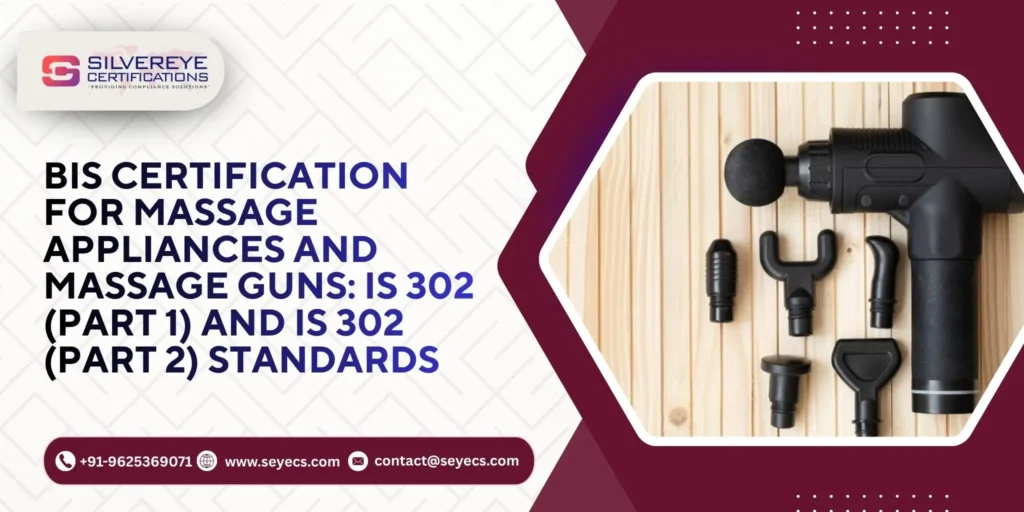
Massage guns are also marketed as percussion massagers, deep-tissue massagers and percussive therapy devices. These products typically use a motor-driven attachment to deliver repeated mechanical movements to the body.
The QCO's illustrative list explicitly identifies DC-supplied and battery-operated massage appliances at Serial No. 86. A massage gun may fall within this category when its design, primary function and product classification meet the applicable scope.
For manufacturers and importers, this means the product should be assessed according to its actual design and intended function rather than its marketing name alone. Describing a product as a fitness recovery device does not, by itself, establish an exemption from applicable BIS requirements.
Before applying, manufacturers should verify the relevant product classification, applicable Indian Standards, testing requirements and QCO implementation date for their specific model.
Latest 2026 Update: QCO Timeline for Massage Appliances
The mandatory BIS certification requirement for massage appliances has been affected by successive Quality Control Orders (QCOs). Manufacturers and importers should refer to the latest notification rather than relying on deadlines mentioned in older articles.
- 17 September 2024 — Earlier QCO framework: The initial Quality Control Order for household, commercial and similar electrical appliances established a framework for bringing specified appliance categories under compulsory certification.
- 19 May 2025 — QCO 2025: The earlier order was superseded by the Safety of Household, Commercial and Similar Electrical Appliances (Quality Control) Order, 2025, with implementation dates scheduled for 2026.
- 6 April 2026 — QCO 2026: DPIIT issued S.O. 1739(E) under Section 16 of the BIS Act, 2016, superseding the 2025 order. The current order includes DC-supplied and battery-operated massage appliances at Serial No. 86 in its illustrative list.
BIS Certification Deadlines Under QCO 2026
The implementation schedule published for this QCO is as follows:
| Enterprise Category | Implementation Date |
|---|---|
| General category, including medium and large enterprises | 1 October 2026 |
| Small enterprises | 1 January 2027 |
| Micro enterprises | 1 April 2027 |
Important: As of October 2026, the general-category implementation date has passed. Manufacturers and importers should check the current notification, applicable enterprise classification, transitional provisions and any relevant exemptions before manufacturing, importing or selling covered products. The QCO includes provisions for products manufactured in India exclusively for export; verify the precise conditions in the official order.
Why Is BIS Certification Mandatory for Massage Appliances?
Section 16 of the Bureau of Indian Standards Act, 2016 empowers the Central Government to make conformity with specified Indian Standards and use of the Standard Mark compulsory for notified products.
Massage appliances contain electrical and mechanical components that must meet applicable safety requirements. Depending on the design, these products may involve risks associated with electric shock, overheating, moving parts and abnormal operating conditions.
The QCO establishes a mandatory conformity assessment framework for the covered appliance categories. Under this framework, products must conform to the applicable Indian Standard and bear the Standard Mark under a valid BIS license, subject to the order's scope, implementation dates and exemptions.
Who Needs BIS Certification for Massage Appliances and Massage Guns?
The certification route depends on who manufactures the product, where the manufacturing facility is located and the applicable BIS scheme.
- Indian manufacturers: Manufacturers of covered massage appliances must obtain the applicable BIS licence for the manufacturing unit and product before the relevant compliance deadline.
- D2C and private-label brands: Brands sourcing finished massage guns from contract manufacturers should confirm who is legally identified as the manufacturer and whether the existing licence covers the specific product, manufacturing location and brand arrangements.
- Importers: Businesses importing covered massage appliances must verify that the overseas manufacturer holds the appropriate BIS licence before importing products subject to the QCO.
- Foreign manufacturers: Overseas manufacturers generally apply through the Foreign Manufacturers Certification Scheme (FMCS) and meet the applicable requirements, including the appointment of an Authorised Indian Representative where required.
A brand name, supplier declaration or existing licence for a different model does not automatically establish compliance. Verify the scope of the licence and the applicable requirements for the exact product and manufacturing facility.
Does enterprise size affect certification? Enterprise classification affects the implementation schedule where the QCO provides different dates. It does not, by itself, establish a permanent exemption from certification.
What's Covered and What May Fall Outside the QCO?
The QCO's illustrative list includes DC-supplied and battery-operated massage appliances. The exact scope of a product must be established from the order and the applicable Indian Standard.
Products Potentially Covered
- Handheld electric massagers and percussion massage guns
- Electrically powered foot massagers
- Shoulder, neck and body massagers
- Electric massage chairs and massage cushions
- Other DC-supplied or battery-operated massage appliances that fall within the notified scope
Product classification should be based on the appliance's construction, intended function, rated voltage and applicable standard—not solely on its marketing description.
Products or Situations Requiring Separate Scope Checks
- Manual massage tools: Non-electric rollers and massage sticks may fall outside this electrical-appliance QCO if they do not meet its scope.
- Products manufactured exclusively for export: The QCO contains an export-related provision; verify the conditions before relying on the exclusion.
- Products covered by another QCO: Appliances falling under another applicable mandatory certification order may be excluded from this order's scope, as specified in the notification.
- Medical devices: Products regulated under separate medical-device legislation require an assessment of the applicable regulatory framework. Do not assume that every product marketed for recovery or therapy is automatically excluded from the electrical-appliance QCO.
For any borderline product, confirm the classification with BIS or a competent compliance professional before making a market-access decision.
Key Benefits of BIS Certification for Massage Appliance and Massage Gun Brands
For products covered by the QCO, BIS certification is primarily a compliance requirement. It can also help manufacturers and brands establish a structured approach to product safety and market readiness.
- Regulatory compliance: Helps businesses meet the applicable mandatory certification requirements before placing covered products on the Indian market.
- Product safety assurance: Requires assessment against the applicable Indian Standard and the prescribed conformity assessment process.
- Buyer confidence: The authorised ISI Mark provides evidence that the product is covered by a valid BIS licence, subject to the licence's scope and conditions.
- Import planning: Verifying certification before shipment helps importers reduce the risk of compliance-related delays or other enforcement action.
- Manufacturing quality systems: The certification process encourages documented quality-control procedures and ongoing compliance with licence conditions.
- Market readiness: Completing certification requirements early helps brands plan product launches, supplier arrangements and distribution more effectively.
Before launching a massage gun or other massage appliance in India, verify the applicable Indian Standards, QCO implementation date, product classification and BIS licence requirements. This is especially important for private-label brands and importers relying on overseas manufacturing partners.
Documents Required for BIS Certification of Massage Appliances and Massage Guns
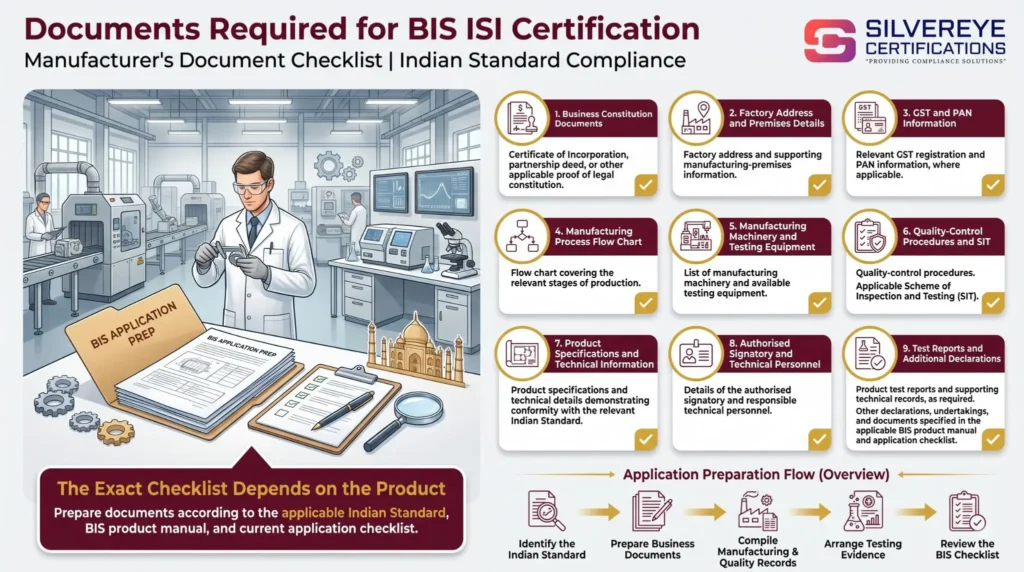
Before applying for BIS Certification Documents for Massage Appliances and Massage Guns, manufacturers should prepare the documents relevant to their product, manufacturing unit and selected certification procedure. The exact checklist depends on the current BIS application requirements and the applicable Indian Standards.
Commonly required documents and technical records may include:
- Business Registration Proof: Certificate of incorporation, partnership deed, LLP registration or other proof of legal constitution, as applicable.
- GST Registration: GST certificate and relevant business identification details, where applicable.
- Manufacturing Unit Address Proof: Ownership documents, lease or rent agreement, or other accepted address evidence.
- Manufacturing Process Flow Chart: A diagram showing assembly, motor and battery installation, inspection stages and final quality checks.
- Quality-Control and Testing Equipment List: Details of in-house testing facilities, measuring instruments and calibration records, where required.
- Technical Documentation: Circuit diagrams, bill of materials, battery and charger specifications, motor details, product drawings and relevant construction information.
- Product Test Reports: Reports covering the applicable Indian Standards, obtained through the testing route accepted under the current BIS certification procedure.
- Authorised Signatory Details: Identity and authorisation documents, including a board resolution or power of attorney where applicable.
- Brand or Trademark Documents: Brand ownership or authorisation evidence, where required by the application or licence conditions.
- Foreign Manufacturer Documents: Where applicable, documents relating to the overseas manufacturing unit, Authorised Indian Representative (AIR) and the FMCS application.
Important: A previous test report from a BIS-recognised or otherwise accepted laboratory does not automatically replace testing required during the BIS certification process. Confirm the accepted laboratory, test-report validity and submission requirements before applying.
Step-by-Step BIS Certification Process
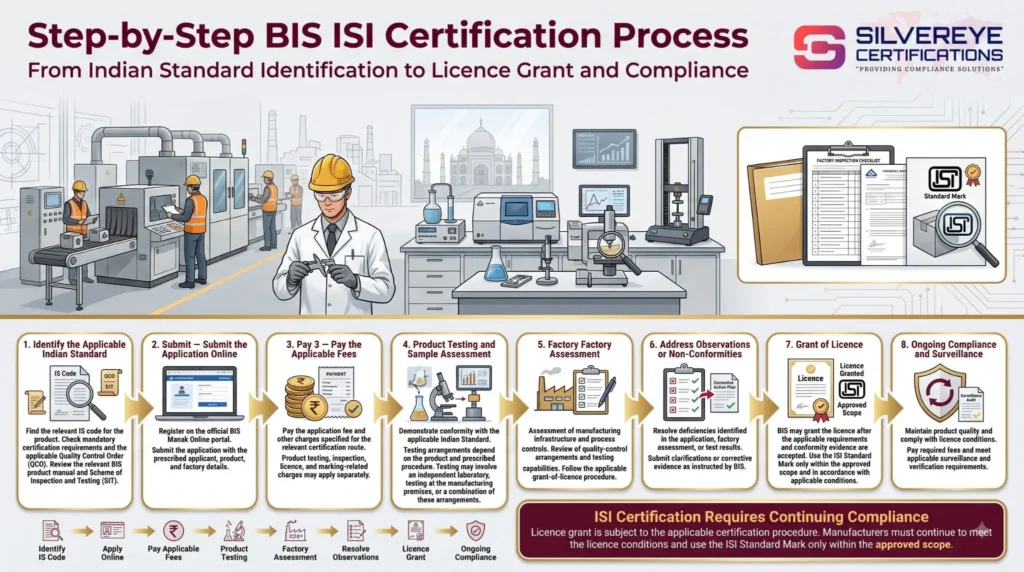
BIS certification Process for covered massage appliances generally follows Scheme I under the BIS (Conformity Assessment) Regulations, 2018. The process involves establishing the product's conformity with the applicable Indian Standards and assessing the manufacturer's production and quality-control capabilities.
Step 1: Confirm the Product Scope
Check whether the massage appliance or massage gun falls under the relevant QCO entry. Confirm the applicable Indian Standards, product classification and implementation date for the manufacturer's enterprise category.
Step 2: Prepare the Technical File
Compile the product specifications, circuit diagrams, component details, manufacturing process flow, quality-control records and other documents required for the application.
Step 3: Conduct Preliminary Testing, Where Appropriate
Preliminary testing can help identify design or safety issues before formal assessment. For massage guns, the manufacturer should evaluate the applicable requirements for the motor, battery, charger, housing and other relevant components.
Preliminary testing is a risk-reduction measure; it does not replace the formal testing and assessment required by BIS.
Step 4: Submit the Application
Apply through the official BIS Manakonline portal under the applicable Scheme I procedure. Submit the required documents and pay the applicable fees.
Step 5: Application Scrutiny
BIS reviews the application and supporting information. The applicant may need to clarify details or provide additional documents if the submission is incomplete.
Step 6: Factory Assessment and Product Testing
BIS assesses the manufacturing infrastructure, production controls and quality-control arrangements in accordance with the selected certification procedure. Product conformity is established through the applicable testing route, which may involve third-party laboratory testing, testing at the manufacturing premises or a combination of these methods.
Step 7: License Grant
If the application, assessment and test results satisfy the applicable requirements, BIS may grant the license. The manufacturer must follow the license conditions, including the permitted use of the ISI Mark.
Step 8: Ongoing Compliance and Surveillance
After certification, the manufacturer must maintain conformity with the applicable standard and licence conditions. BIS may conduct surveillance, assess manufacturing controls and arrange product testing as permitted under the certification framework.
BIS Certification Cost for Massage Appliances and Massage Guns (2026)
The cost of BIS Certification for Massage Appliances and Massage Guns depends on the applicable application and inspection fees, product testing, marking fees and other requirements under the current certification procedure.
BIS's published FAQ lists the following general fee amounts. Treat these as published reference figures, not a final quotation; confirm the current schedule and product-specific marking fee before applying.
| Fee Head | Published Reference Amount / Basis |
|---|---|
| Application Fee | ₹1,000 |
| Inspection Fee | ₹7,000 per man-day, plus applicable travel and boarding expenses |
| Annual Licence Fee | ₹1,000 |
| Marking Fee | Product-specific, according to the applicable BIS fee schedule |
| Laboratory Testing Charges | Charged according to the testing laboratory's applicable rates and scope |
| Technical or Consultancy Support | Optional; depends on the services engaged |
The total cost can vary with the product design, number of models, testing requirements, factory assessment, corrective actions and any additional technical work.
How to Confirm the Current Fees
Before preparing a budget:
- Check the latest fee schedule on the official BIS website.
- Confirm the applicable marking fee for the product and certification category.
- Obtain a testing quotation from a laboratory accepted for the relevant certification procedure.
- Confirm the applicable assessment, travel and other charges with BIS.
- Verify whether any current fee concessions apply to your enterprise and product category.
Do not assume that a concession is available simply because the applicant is an MSME or startup. Eligibility must be confirmed under the current applicable provisions.
Validity, Renewal and Surveillance
A Scheme I license is granted and renewed subject to the applicable BIS regulations, license conditions and fee requirements. Manufacturers should check the validity period stated in the license and follow the current renewal procedure.
- Licence Validity: The licence specifies the period for which it is valid. Do not assume that every licence automatically receives the same initial term.
- Annual Licence Fee and Marking Fee: Pay the applicable fees according to the current requirements and maintain the necessary production and marking records.
- Surveillance: BIS may conduct factory assessments, surveillance activities and product testing under the applicable certification framework.
- Renewal: Start preparing the renewal application well before the licence expiry date. Confirm the applicable submission window and supporting documents with BIS.
- Use of the ISI Mark: The manufacturer must not use the mark outside the scope or validity of the licence.
Maintaining quality-control records and monitoring product changes can help manufacturers prepare for surveillance and renewal.
How Long Does BIS Certification Take?
The time required for BIS Certification for Massage Appliances and Massage Guns depends on the application route, document completeness, factory-assessment arrangements, laboratory capacity and whether corrective action is required.
BIS's published FAQ gives indicative average timelines of approximately one month under Option 2 and four months under Option 1, measured from receipt and recording of a complete application. These are general reference figures, not guaranteed timelines for every product or application.
Factors that can extend the process include:
- Incomplete technical documentation or application details.
- Delays in arranging factory assessment.
- Laboratory testing queues or additional testing requirements.
- Product failures that require design changes and retesting.
- Delays in responding to BIS queries or completing prescribed formalities.
Preliminary testing and an organised technical file can help identify potential problems early, but neither guarantees approval within a particular period.
What Happens If You Sell Without the Required Certification?
Once the applicable QCO requirement takes effect for a covered product and enterprise category, businesses must comply with the relevant certification and marking conditions, subject to the order's exemptions and transitional provisions.
Contraventions may attract enforcement action under the Bureau of Indian Standards Act, 2016. Section 29(3), which addresses contraventions of Section 17, provides for imprisonment of up to two years and a fine of at least ₹2 lakh for a first contravention, increasing to at least ₹5 lakh for subsequent contraventions, with the fine potentially reaching ten times the value of the goods. The court may impose imprisonment, a fine or both, as provided by the Act.
Depending on the circumstances and applicable legal provisions, non-compliance may also result in enforcement action involving affected products or stock.
Do not assume that stock manufactured or imported before a compliance deadline can automatically be sold afterwards. Any transitional allowance must be expressly supported by the current QCO and its conditions.
Common Mistakes Manufacturers and Brands Should Avoid
- Assuming a massage gun is exempt because it is marketed as a fitness or recovery product: Verify the actual product scope under the QCO.
- Considering only the general safety standard: Confirm all applicable Indian Standards and product-specific requirements.
- Starting too close to the compliance deadline: Allow time for application scrutiny, assessment, testing and corrective action.
- Leaving licence ownership unclear in private-label arrangements: Establish which entity is the manufacturer and verify the licence scope before production or import.
- Submitting an incomplete technical file: Include the relevant battery, charger, motor, circuit and construction details.
- Relying solely on an old test report: Confirm that the report is acceptable under the current BIS procedure and covers the relevant product and standards.
- Budgeting without checking current fees: Verify the applicable application, inspection, laboratory and marking fees before committing to a launch date.
Why Choose Silvereye Certifications for BIS Certification?
BIS Certification for massage appliances and massage guns requires careful preparation of technical documents, product testing and compliance with the applicable Indian Standards. For manufacturers, importers and D2C wellness brands, understanding the certification requirements early can help reduce avoidable delays and identify potential compliance gaps.
Silvereye Certifications supports businesses through the certification process with services that may include:
- Product Scope Assessment: Guidance on assessing your massage appliance against IS 302 (Part 1):2024 and the applicable particular requirements under IS 302 (Part 2/Section 32).
- Documentation Support: Assistance with preparing technical files, manufacturing process details and quality-control documents.
- Laboratory Coordination: Guidance on arranging product testing through a laboratory accepted under the applicable BIS certification procedure.
- Application Assistance: Support with the Scheme I application process for eligible domestic manufacturers and FMCS requirements for eligible foreign manufacturers.
- Compliance Planning: Help understanding applicable QCO deadlines, testing requirements, licence conditions and renewal obligations.
- Ongoing Compliance Guidance: Assistance with understanding surveillance, licence maintenance and renewal requirements.
If your massage appliance or massage gun range has not yet been assessed, reviewing the applicable standards, product documentation and testing requirements is a practical starting point. Silvereye Certifications can help you understand the steps involved and plan your application according to your product and manufacturing arrangements.
Conclusion: Prepare Your Massage Appliances for BIS Compliance
BIS Certification for Massage Appliances and Massage Guns is an important compliance requirement for products covered by the applicable Quality Control Order. Manufacturers and importers must verify the relevant implementation date, product classification and any applicable exemptions before placing covered products on the Indian market.
The certification process involves assessing the product against the applicable Indian Standards, preparing the required technical documentation, completing the prescribed testing and assessment procedures, and obtaining a valid BIS licence before using the ISI Mark.
For manufacturers of covered products, early preparation can help identify design issues, organise documentation and plan for testing and assessment. Checking the latest QCO provisions and BIS certification requirements is especially important when planning a product launch or importing massage appliances.
If you need assistance with product assessment, documentation or the certification application, Silvereye Certifications can help you navigate the process and understand the compliance steps relevant to your business.
Frequently Asked Questions
Do massage guns really need BIS certification, or only traditional massagers?
Both. Massage guns are treated as handheld, battery-operated massage appliances under the existing scope of IS 302 (Part 2/Section 32) and are explicitly captured under QCO 2026 as battery-operated massage appliances at Sr. No. 86 — there is no separate or lighter requirement for the newer form factor.
Which standards apply to massage appliances and massage guns?
Two standards apply together: IS 302 (Part 1):2024 for general electrical safety requirements, and IS 302 (Part 2/Section 32):1994 for particular requirements specific to massage appliances.
What is the current compliance deadline?
Under QCO 2026, general/medium and large manufacturers must comply by 1 October 2026, small enterprises by 1 January 2027, and micro enterprises by 1 April 2027. This order has already been revised twice, so confirm the live notification on bis.gov.in before relying on any single date.
My massage gun is marketed as a fitness recovery tool, not a medical device — does that change anything?
No. What the product is called in marketing doesn't determine which regulation applies; what matters is that it's an electrically or battery-powered device used to massage the body, which places it within the existing massage appliances scope unless it is formally classified as a medical device under separate law.
How much does BIS certification cost for a massage gun brand?
Government fees typically include an application fee of around Rs 1,000, a factory inspection fee of around Rs 7,000 per man-day, an annual licence fee of around Rs 1,000, plus a product-linked marking fee and separate lab testing charges across both applicable standards. The exact current schedule is published on bis.gov.in.
Can a D2C brand that outsources manufacturing still get certified?
Yes, but the BIS licence is tied to the manufacturing unit named on the application, so the brand and its contract manufacturer or white-label supplier need a clear written agreement on who applies, whose factory is inspected, and who manages ongoing surveillance compliance.
Do imported massage guns need certification, or only ones made in India?
Both. Once the category is under compulsory certification, imported massage guns need the overseas factory to hold a valid BIS license, typically obtained through the Foreign Manufacturers Certification Scheme (FMCS) via an Authorized Indian Representative.
How long is a BIS license valid once granted?
It is usually granted for an initial term and can be renewed for up to five years at a time, provided the annual licence fee, marking fees and surveillance requirements are kept current.
What usually causes a massage appliance to fail BIS lab testing?
Common failure points relate to the Part 2/Section 32 clauses covering motor safety, resistance to overheating during sustained high-intensity use, and mechanical stability — issues that matter more for a percussion massage gun than for a low-power seated massager.
Are products made in India purely for export exempt?
Yes. Goods manufactured domestically solely for export are explicitly exempt from the Quality Control Order. Anything sold within India, whether made locally or imported, needs certification.
Do small and micro massage-gun brands get more time or lower fees?
They get a later compliance date — 1 January 2027 for small enterprises and 1 April 2027 for micro enterprises under QCO 2026 — and, historically, fee concessions on certain BIS charges for eligible micro units and DPIIT-recognised startups. They are not exempt from certification itself.
What's the most practical first step for a massage-gun brand that hasn't started yet?
Confirm your product's classification against both IS 302 (Part 1):2024 and IS 302 (Part 2/Section 32), get an informal lab pre-test done to catch motor or battery design gaps early, and start your documentation file in parallel — running testing and paperwork together is what keeps most applicants inside the QCO 2026 deadline.