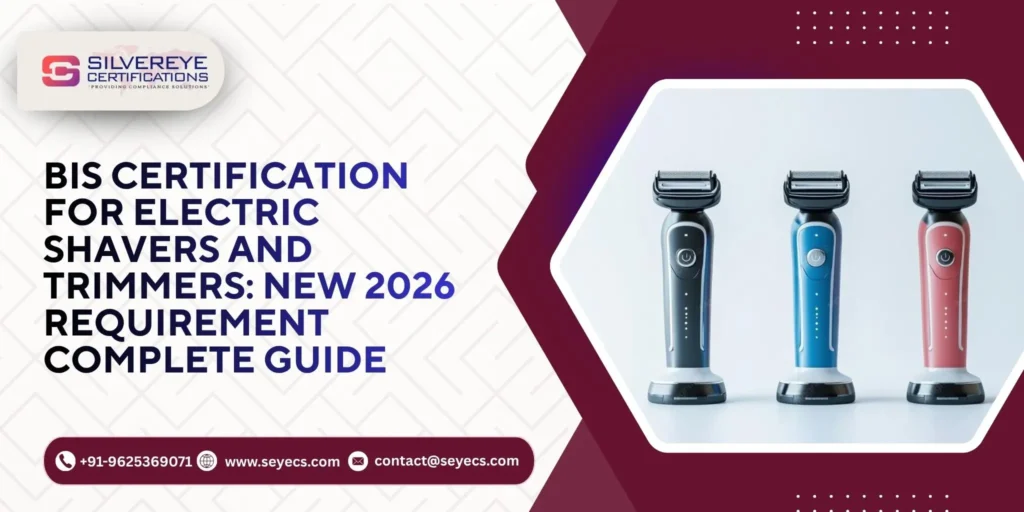
- Mandatory Compliance Deadline: BIS certification becomes mandatory from 1 October 2026 for covered shavers and trimmers manufactured by general, medium, and large enterprises, subject to the applicable QCO provisions. Shavers and trimmers are listed at Serial No. 85 in the QCO 2026 appliance list.
- Applicable Indian Standards: Products must be assessed against the applicable requirements of IS 302 (Part 1):2024, covering general electrical safety, and IS 302 (Part 2/Section 8), covering particular safety requirements for shavers, hair clippers, and similar appliances, as applicable.
- Products Covered: The requirements may apply to electric shavers, beard trimmers, hair trimmers, and hair clippers intended for personal grooming and other covered uses. Confirm the precise product scope and any exclusions under the QCO before determining applicability.
- Penalties for Non-Compliance: Manufacturing, importing, distributing, or selling covered products without the required BIS licence after the applicable deadline may lead to enforcement action under the BIS Act, 2016, including penalties under Section 29 where its provisions apply.
Introduction
BIS certification for electric shavers and trimmers is a mandatory safety certification for covered grooming appliances under India's applicable Bureau of Indian Standards (BIS) regulations. The assessment involves IS 302 (Part 1):2024, which specifies general safety requirements for household and similar electrical appliances, along with IS 302 (Part 2/Section 8), which addresses particular requirements for shavers, hair clippers, and similar appliances, as applicable.
Certification is granted under Scheme-I of the BIS (Conformity Assessment) Regulations, 2018. Manufacturers must complete the applicable product testing, factory assessment, and licensing process before using the ISI Mark on certified products. Under the QCO 2026, the stated implementation deadline for covered products manufactured by general enterprises is 1 October 2026. Applicability should be confirmed against the exact product scope and relevant QCO provisions.
What Is BIS Certification for Electric Shavers and Trimmers?
Electric shavers, beard trimmers, and hair clippers are widely used personal-care electrical appliances. Because these devices contain electrical components and moving cutting parts, their design and construction must meet the applicable safety requirements when covered by India's compulsory certification regulations.
BIS certification for electric shavers and trimmers verifies conformity with the relevant Indian Standard through the applicable testing and certification process. Under the Bureau of Indian Standards (BIS) framework, covered products must meet the prescribed requirements and carry the Standard Mark (ISI Mark) under a valid BIS license before being marketed in India, subject to the applicable QCO provisions.
The relevant safety standards include IS 302 (Part 1):2024, which sets general safety requirements for household and similar electrical appliances, and IS 302 (Part 2/Sec 8):2024, which specifies particular safety requirements for shavers, hair clippers, and similar appliances. The particular standard is intended to be used together with Part 1.
Under Scheme-I of the BIS (Conformity Assessment) Regulations, 2018, manufacturers of covered products must follow the applicable certification procedure, including product testing and factory assessment as required by BIS, before using the Standard Mark.
The Two Standards That Apply Together
For electric shavers and hair clippers, the applicable safety assessment uses the general requirements alongside the appliance-specific requirements.
IS 302 (Part 1):2024 — General Safety Requirements
IS 302 (Part 1):2024 is the general safety standard for household and similar electrical appliances. It addresses safety matters such as protection against electric shock, temperature-related hazards, moisture resistance, mechanical strength, internal wiring, insulation, and product marking, as applicable to the appliance.
The standard is based on IEC 60335-1:2020. It provides the general requirements that are applied alongside the relevant particular standard.
IS 302 (Part 2/Sec 8):2024 — Shavers and Hair Clippers
IS 302 (Part 2/Sec 8):2024 is the particular safety standard for shavers, hair clippers, and similar appliances. It is aligned with IEC 60335-2-8:2022 and must be used in conjunction with IS 302 (Part 1):2024.
The particular standard supplements or modifies the general requirements where necessary for this appliance category. Depending on the product design, the applicable assessment may address construction, electrical insulation, protection from moving or live parts, temperature limits, and other relevant safety considerations.
In practice, the laboratory evaluates the product against the applicable requirements of both standards. Meeting only the general standard or only the particular standard does not establish conformity with the combined requirements.
Latest 2026 Update: Where the QCO Deadline Stands
The Safety of Household, Commercial and Similar Electrical Appliances (Quality Control) Order, 2026, notified through S.O. 1739(E) on 6 April 2026, superseded the 2025 order. It specifies the applicable Indian Standard and implementation dates for the electrical appliances within its scope.
The relevant timeline is:
- 20 September 2024: The earlier 2024 Quality Control Order was notified.
- 19 May 2025: The 2025 Quality Control Order superseded the 2024 order and established revised implementation dates.
- 6 April 2026: The 2026 Quality Control Order, S.O. 1739(E), superseded the 2025 order and set out the current schedule shown below.
| Enterprise category | Implementation date under the 2026 QCO |
|---|---|
| General enterprises, excluding micro and small enterprises | 1 October 2026 |
| Small enterprises | 1 January 2027 |
| Micro enterprises | 1 April 2027 |
The QCO's illustrative list distinguishes between electrical shavers, hair clippers and similar appliances at Serial No. 4 and DC-supplied or battery-operated shavers, trimmers, clippers and similar appliances at Serial No. 85. Businesses should identify the correct entry for their product and check whether another QCO or mandatory BIS requirement applies.
The order also contains provisions for certain goods manufactured domestically for export, specified research-and-development imports, and declared legacy stock. These provisions have conditions and should not be treated as blanket exemptions. Confirm the applicable rules against the official notification before planning manufacturing, importing, or sales.
Why Grooming Appliances Were Brought Under Compulsory Certification
The legal basis for the Quality Control Order is Section 16 of the BIS Act, 2016, which empowers the Central Government to require conformity with Indian Standards and the use of a Standard Mark for specified goods when necessary in the public interest.
For grooming appliances, the applicable safety assessment helps address risks associated with electrical components, insulation, temperature, moving parts, and product construction. The specific requirements depend on the design and intended use of the appliance.
The 2026 QCO establishes a compulsory certification framework for the products it covers. Manufacturers and importers should therefore confirm the relevant product-list entry, applicable standard, enterprise category, and implementation date well in advance. Preparing documentation and arranging the required testing and certification steps early can help reduce the risk of delays to product launches and market entry.
Who Needs BIS Certification? (Eligibility)
- Indian manufacturers: Businesses manufacturing covered electric shavers, trimmers, or hair clippers for the Indian market must obtain the applicable BIS Scheme-I licence for their manufacturing premises and product scope.
- Importers and brand owners: Businesses sourcing finished grooming appliances from overseas must ensure that the products are manufactured at a facility holding the required valid BIS licence. The importer does not ordinarily apply for a manufacturing licence on behalf of the overseas factory.
- Foreign manufacturers: Overseas manufacturers supplying covered products to India can apply under the Foreign Manufacturers Certification Scheme (FMCS). They must appoint an eligible Authorised Indian Representative (AIR) in accordance with BIS requirements.
- Private-label and salon-equipment brands: Businesses selling products under their own brand should establish who the actual manufacturer is and confirm the licence scope, manufacturing location, and brand documentation before proceeding. The BIS licence is linked to the manufacturing premises and the products covered by it.
Important: Enterprise size affects the applicable implementation deadline under the QCO; it does not automatically exempt a covered product from certification. Importers, distributors, and retailers must ensure that products subject to mandatory certification are sourced from appropriately licensed manufacturers.
What's Covered and What Falls Outside Scope
Products that may be covered
- Electric shavers, including applicable foil and rotary models.
- Beard and hair trimmers, including corded and cordless models within the relevant product scope.
- Hair clippers and similar electrical grooming appliances covered by the applicable Indian Standard and QCO entry.
- DC-supplied and battery-operated grooming appliances, subject to the relevant category and provisions of the QCO.
Products requiring separate scope assessment
- Manual razors and non-electric blades: These are not electrical appliances covered by this electrical safety standard.
- Products manufactured exclusively for export: The QCO provides an export-related exemption subject to its conditions; confirm the exact requirements before relying on it.
- Medical devices: Products regulated under a separate medical-device framework require an assessment of their intended use and applicable regulations. Do not assume that every such product is automatically excluded from BIS requirements.
- Industrial or specialised equipment: Products falling under a different specific Indian Standard or regulatory order require separate classification.
The exact applicability depends on the product's construction, intended use, relevant QCO entry, and any applicable exclusions.
Key Benefits of BIS Certification for Shaver and Trimmer Brands
- Regulatory compliance: For products covered by the QCO, obtaining the required BIS licence by the applicable implementation date helps businesses meet mandatory Indian market requirements.
- Consumer confidence: The ISI Mark indicates that a covered product has been certified against the applicable Indian Standard under BIS's licensing framework.
- Retail and marketplace readiness: Having the required certification documentation available can help businesses respond to compliance checks from retailers and online marketplaces. Listing requirements vary by platform and product category.
- Reduced import compliance risks: Sourcing products from a properly licensed manufacturing facility helps reduce the risk of regulatory issues associated with non-compliant consignments. Certification does not guarantee customs clearance.
- A recognised safety benchmark: The applicable Indian Standards are aligned with corresponding IEC standards. However, BIS certification does not automatically establish compliance with every international market's requirements; separate destination-country approvals may still be necessary.
Documents Required For BIS Certification For Electric Shavers and Trimmers
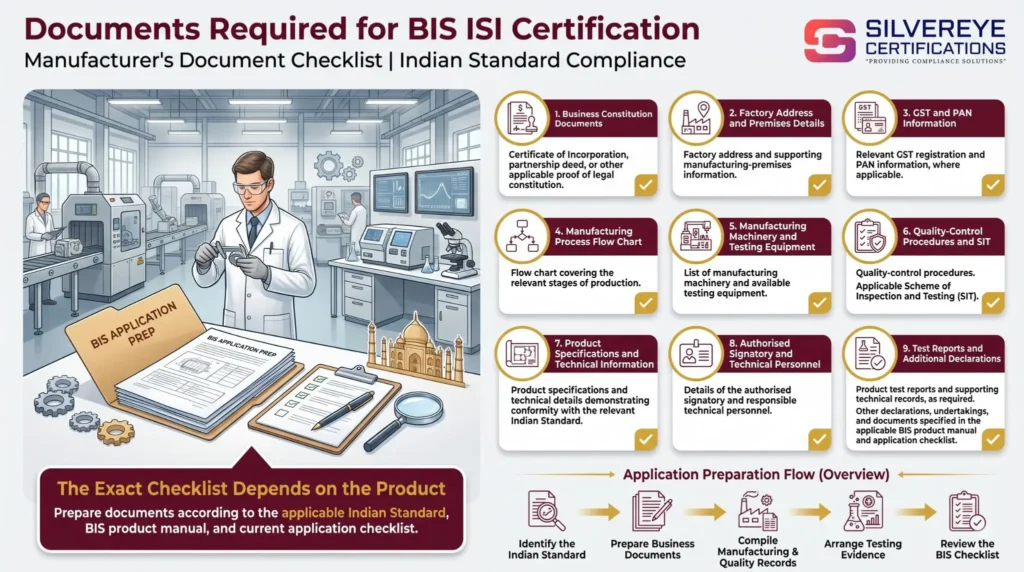
The precise documentation depends on the application route, manufacturing arrangement, and current BIS guidelines. Commonly relevant documents include:
- Business registration documents, such as a certificate of incorporation or other proof of legal constitution.
- GST registration details, where applicable.
- Manufacturing premises proof, such as ownership documents or a lease agreement.
- Manufacturing process flow chart showing assembly, cutting-head installation, quality checks, and other relevant production stages.
- Quality-control and testing details, including information about available equipment and calibration records, as applicable.
- Technical file, including circuit diagrams, bill of materials, charger and battery specifications, and relevant product drawings.
- Product test reports and samples, as required under the applicable BIS certification procedure.
- Authorised signatory documents, including a board resolution or authorisation letter where applicable.
- Brand or trademark documents, or the required brand undertaking, as applicable to the application.
- For foreign manufacturers: the prescribed AIR nomination and supporting documents required under FMCS.
A test report from a NABL-accredited laboratory should not automatically be treated as a substitute for testing required under the BIS procedure. Confirm the laboratory's recognition and the applicable testing route through BIS before arranging tests.
Step-by-Step BIS Certification Process
- Confirm the product scope: Identify the correct QCO category and confirm whether the model falls under IS 302 (Part 1):2024 and IS 302 (Part 2/Sec 8):2024. Check the implementation date applicable to the manufacturer.
- Review the technical requirements: Examine the relevant BIS product manual, testing requirements, and quality-control provisions. Consider preliminary testing to identify potential design or safety issues before the formal assessment.
- Submit the application: Apply through the official Manakonline portal under Scheme-I, following the current application procedure and submitting the required documents and fees.
- Application scrutiny: BIS examines the application and supporting documentation. Any deficiencies or queries may need to be addressed before the process can proceed.
- Manufacturing-premises assessment: BIS assesses the relevant manufacturing infrastructure, production controls, quality-control systems, and testing capabilities as required by the applicable certification procedure.
- Product testing: Samples are tested through the testing route prescribed by BIS. Depending on the applicable procedure, testing may involve a third-party laboratory, testing at the manufacturing premises, or a combination of both.
- Licence grant: If the applicable assessment and testing requirements are satisfactorily completed, BIS may grant the licence covering the specified products and manufacturing premises. The ISI Mark may be used only in accordance with the licence conditions.
- Ongoing compliance and surveillance: After the licence is granted, the manufacturer must maintain conformity with the applicable requirements and comply with BIS surveillance, testing, and renewal conditions.
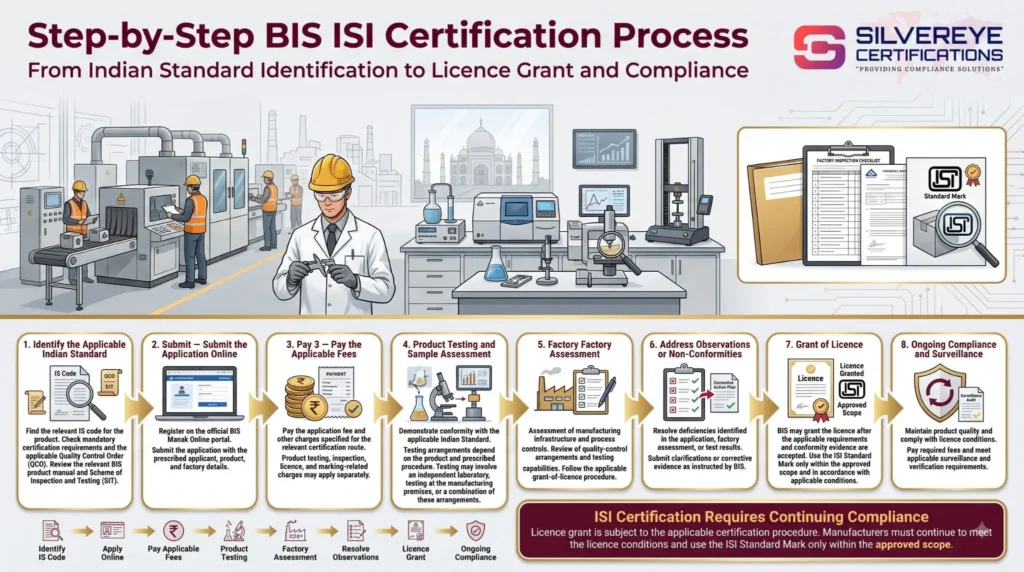
The exact sequence and requirements can vary depending on the certification option and applicable product-specific guidelines. Check the current BIS procedure before estimating the timeline or committing to a launch date.
BIS Certification Cost for Electric Shavers and Trimmers (2026)
The Bureau of Indian Standards (BIS) publishes its official fee structure for product certification under Scheme-I, including application, inspection, annual licence, and product-specific marking fees. The total cost of BIS certification for electric shavers and trimmers depends on the applicable fee schedule, testing requirements, manufacturing location, and certification route.
The following table provides a planning overview. Confirm the current rates and any applicable concessions on the official BIS Product Certification Fee page before preparing your final budget.
| Fee Head | Typical Amount / Basis |
|---|---|
| Application fee | ₹1,000 per application; non-refundable |
| Factory inspection fee | Generally ₹7,000 per man-day, plus applicable travel and related expenses |
| Annual licence fee | ₹1,000 |
| Marking fee | Product-specific, based on the applicable BIS marking-fee schedule |
| Laboratory testing charges | Variable, depending on the product, applicable standards, and testing requirements |
| Renewal application fee | Confirm the current applicable fee on the BIS portal |
| Eligible enterprise concessions | Concessions may apply to eligible micro and small enterprises or other qualifying applicants, subject to the current notification and conditions |
Important cost considerations:
- Marking fees: These are product-specific and should be checked against the latest BIS marking-fee schedule and amendments.
- Laboratory testing: The amount depends on the testing scope and applicable procedure. Additional testing may be necessary if a sample fails or a product design changes.
- Enterprise concessions: Do not assume every startup or MSME automatically qualifies. Check the latest BIS concession notification and eligibility requirements.
- Foreign manufacturers: FMCS applications can involve additional costs, including overseas factory inspection, sample transportation, testing, and other prescribed requirements.
For the latest fee schedule, marking-fee documents, and active concessions, visit the official BIS fee page. Treat estimates as budget guidance rather than a final quotation.
Validity, Renewal and Surveillance
- Initial licence validity: A Scheme-I licence may initially be granted for a period of up to two years, subject to the applicable requirements and licence conditions.
- Renewal period: Renewal may be requested for a period of one to five years, subject to the applicable BIS requirements, fees, and supporting documents.
- Licence and marking fees: The licensee must meet the applicable fee and reporting requirements for the requested period. An expired, suspended, or otherwise invalid licence does not authorise continued use of the ISI Mark.
- Surveillance inspections: BIS may conduct factory surveillance and arrange product-sample testing to verify continued conformity with the relevant Indian Standards.
- Renewal planning: Start preparing well before expiry. A buffer of 60–90 days is a practical planning recommendation, not a universal statutory deadline.
How Long Does the BIS Certification Process Take?
The time required to obtain BIS certification for electric shavers and trimmers depends on the certification option, completeness of the application, factory readiness, laboratory capacity, and whether the product passes testing on the first attempt.
- Domestic manufacturers: The timeline depends on the applicable Scheme-I option and the required assessment and testing stages. BIS publishes indicative timelines for its certification options, but these should not be treated as guaranteed completion dates.
- Factory inspection: Delays can occur if manufacturing records, testing facilities, or quality-control arrangements are incomplete.
- Product testing: Testing may take longer if the sample fails a requirement, additional tests are requested, or a revised sample must be submitted.
- Foreign manufacturers under FMCS: Allow additional time for overseas factory inspection, sample transportation, independent laboratory testing, and completion of the prescribed documentation.
One effective way to reduce avoidable delays is to review the applicable requirements of IS 302 (Part 1):2024 and IS 302 (Part 2/Sec 8):2024 before formal testing. Preliminary testing may help identify design issues, but it does not replace the testing and assessment required under the applicable BIS procedure.
What Happens If You Sell Without Certification?
Once the applicable QCO deadline has passed, manufacturing or selling a covered product without the required BIS certification may result in enforcement action under the Bureau of Indian Standards Act, 2016.
Under Section 29(3), which addresses contraventions of Section 17, the potential penalties include:
- First contravention: A fine of at least ₹2 lakh.
- Second and subsequent contraventions: A fine of at least ₹5 lakh.
- Maximum financial penalty: The fine may extend to ten times the value of the goods covered by the relevant provision.
- Imprisonment: The provision allows imprisonment for a term of up to two years, or a fine, or both, as specified by the Act.
The Act also provides for seizure in circumstances covered by its enforcement provisions. The precise consequences depend on the nature of the violation and the applicable legal provisions; penalties should not be presented as automatic in every case.
Businesses importing or selling covered grooming appliances should confirm that the manufacturing facility holds the required licence and that the product is included within its scope. For legal interpretation of a specific case, consult the applicable legislation and a qualified legal professional.
Common Mistakes Manufacturers Make
- Ignoring the particular standard: Reviewing only IS 302 (Part 1):2024 without checking the applicable requirements of IS 302 (Part 2/Sec 8):2024.
- Starting too late: Beginning the certification process close to the relevant QCO deadline, leaving insufficient time for testing or corrective action.
- Assuming MSME status means exemption: Enterprise classification affects the applicable implementation date, but it does not automatically exempt a covered product from certification.
- Submitting incomplete documentation: Missing technical drawings, battery or charger specifications, manufacturing details, or quality-control records can delay application processing.
- Not clarifying licence responsibility: Failing to establish the actual manufacturing entity, factory location, product scope, and brand documentation before applying.
- Budgeting only for government fees: Overlooking laboratory testing, inspection-related expenses, possible retesting, and applicable marking fees.
- Relying on outdated fee information: Using an older marking-fee schedule or assuming a concession remains active without checking the latest BIS notification.
A careful review of the applicable standards, current fee schedule, product scope, and manufacturing documentation can help businesses plan their certification process more effectively.
Why Choose Silvereye Certifications?
BIS certification for electric shavers and trimmers requires careful attention to product classification, applicable safety standards, laboratory testing, and documentation. For covered appliances, the assessment involves IS 302 (Part 1):2024 and IS 302 (Part 2/Sec 8):2024, which address general and appliance-specific safety requirements, respectively.
Silvereye Certifications supports grooming-appliance manufacturers, importers, and private-label brands with a structured approach to certification, including:
- Product Scope and Gap Assessment: Review your shaver, trimmer, or hair clipper against the applicable standards and QCO requirements to identify potential compliance gaps early.
- Laboratory Testing Coordination: Get assistance arranging testing through an appropriate recognised laboratory and understanding the applicable testing requirements.
- Technical Documentation Support: Prepare and organise product specifications, circuit diagrams, manufacturing details, and quality-control documents for the certification process.
- Factory Inspection Preparation: Review manufacturing processes, quality-control arrangements, and relevant records before the applicable factory assessment.
- Scheme-I and FMCS Application Support: Receive guidance on the appropriate certification route, whether you manufacture in India or operate an eligible overseas manufacturing facility.
- Renewal and Ongoing Compliance Assistance: Get support with licence renewal, applicable surveillance requirements, and changes to the certified product scope.
With the 1 October 2026 implementation date approaching for general enterprises under the applicable QCO provisions, businesses should confirm their product coverage and begin preparing for certification early. Preliminary testing can help identify potential design issues before formal assessment, reducing the risk of avoidable retesting and delays.
Silvereye Certifications can help you review your product documentation, identify potential gaps, and plan the next steps towards obtaining the required BIS licence. Early preparation can make the certification process more manageable and help protect your product launch schedule.
Conclusion
BIS certification for electric shavers and trimmers is an important regulatory requirement for products covered by the applicable Quality Control Order (QCO). Under the QCO 2026, the stated implementation dates are 1 October 2026 for general enterprises, 1 January 2027 for small enterprises, and 1 April 2027 for micro enterprises.
The applicable assessment involves IS 302 (Part 1):2024 and IS 302 (Part 2/Sec 8):2024, as relevant to the product. Manufacturers and importers should confirm the correct product category, applicable standard, licensing route, and implementation date before planning production or market entry.
Preparing technical documents, reviewing product safety requirements, arranging the required testing, and budgeting for application, inspection, laboratory, and marking fees can help businesses avoid preventable delays. Rather than waiting until the deadline approaches, confirm your product's BIS certification requirements and begin preparing early.
For assistance with product-scope assessment, documentation, laboratory coordination, and the applicable BIS certification process, Silvereye Certifications can help you plan your next steps with greater clarity.
Frequently Asked Questions
Is BIS certification mandatory for electric shavers and trimmers sold in India?
Yes. Under QCO 2026, shavers and trimmers are listed at Sr. No. 85 of the notified appliance list, and every unit sold in India needs a valid BIS ISI Mark once the compliance date for your enterprise category arrives.
Which standards apply to shavers, trimmers and hair clippers?
Two standards apply together: IS 302 (Part 1):2024 for general electrical safety requirements, and IS 302 (Part 2/Section 8) for particular requirements specific to shavers, hair clippers and similar appliances.
What is the current compliance deadline?
Under QCO 2026, general/medium and large manufacturers must comply by 1 October 2026, small enterprises by 1 January 2027, and micro enterprises by 1 April 2027. This order has already been revised twice, so it's worth checking the live notification on bis.gov.in before relying on any single date.
Are hair clippers used in salons treated differently from household trimmers?
No. The applicable standards and certification requirement don't distinguish by end-use setting — a hair clipper sold for salon use and one sold for home use are certified the same way, under the same Scheme-I licence route.
How much does BIS certification cost for a trimmer or shaver?
Government fees typically include an application fee of around Rs 1,000, a factory inspection fee of around Rs 7,000 per man-day, an annual licence fee of around Rs 1,000, plus a product-linked marking fee and separate lab testing charges across both applicable standards. The exact current schedule is published on bis.gov.in.
Can importers sell shavers made overseas without local certification?
No. Once the category is under compulsory certification, the overseas factory needs its own valid BIS license, typically obtained through the Foreign Manufacturers Certification Scheme (FMCS) via an Authorized Indian Representative based in India.
How long is a BIS license valid, and what does renewal involve?
The license is usually granted for an initial term and can be renewed for up to five years at a time, provided the annual license fee, marking fees and surveillance requirements are kept current.
Do micro and small manufacturers get more time or lower fees?
They get a later compliance date — 1 January 2027 for small enterprises and 1 April 2027 for micro enterprises under QCO 2026 — and, historically, fee concessions on certain BIS charges for eligible micro units and DPIIT-recognised startups. They are not exempt from certification itself.
Are shavers and trimmers made in India purely for export exempt?
Yes. Goods manufactured domestically solely for export are explicitly exempt from the Quality Control Order. Anything sold within India, whether made locally or imported, needs certification.
What usually causes a shaver or trimmer to fail BIS lab testing?
The most frequent failure points relate to the appliance-specific clauses in IS 302 (Part 2/Section 8) — protection against access to the moving cutting head, temperature rise near the skin, and insulation/leakage current performance — rather than the general Part 1 clauses.
Is there a difference between CRS and the ISI Mark route for this category?
Yes. Shavers and trimmers are certified under Scheme-I (ISI Mark), which involves both product testing and factory inspection, not the Compulsory Registration Scheme (CRS) used mainly for electronics and IT hardware.
What's the most practical first step for a brand that hasn't started yet?
Confirm your product's classification against both IS 302 (Part 1):2024 and IS 302 (Part 2/Section 8), get an informal lab pre-test done to catch design gaps early, and start your documentation file in parallel — running testing and paperwork together is what keeps most applicants inside the QCO 2026 deadline.