- Mandatory BIS Certification: Electric steam cookers, electric forced-convection ovens, steam-convection ovens and commercial combi ovens may fall under the Safety of Household, Commercial and Similar Electrical Appliances (Quality Control) Order, 2026, notified by DPIIT on 6 April 2026 through S.O. 1739(E). Covered products must comply with the applicable Indian Standard and obtain a BIS license to use the Standard Mark under Scheme I.
- Household and Commercial Products Covered: The QCO separately lists electric forced-convection ovens, steam cookers and steam-convection ovens, electric steam cookers, and commercial electric forced-convection ovens, steam cookers and steam-convection ovens. Confirm the applicable product category and any relevant exclusions before applying.
- BIS Compliance Deadlines: The notified implementation dates are 1 October 2026 for general manufacturers, 1 January 2027 for small enterprises, and 1 April 2027 for micro enterprises. Manufacturers should prepare their applications and testing plans according to the deadline applicable to their enterprise category.
- BIS Certification Fees: The application fee starts at ₹1,000, while product testing, factory inspection, license fees and marking fees may be charged separately, depending on the applicable BIS certification procedure and product scope. Confirm the current fee schedule and laboratory charges before budgeting.
Introduction
BIS certification for steam cookers and steam-convection ovens is required under the Safety of Household, Commercial and Similar Electrical Appliances (Quality Control) Order, 2026, notified by the Department for Promotion of Industry and Internal Trade (DPIIT) on 6 April 2026 through S.O. 1739(E).
The applicable safety standard is IS 302 (Part 1):2024, covering electric forced-convection ovens, steam cookers and steam-convection ovens within its scope. Manufacturers must obtain a BIS Scheme-I license to use the ISI Mark before selling covered appliances in India, subject to the applicable implementation dates and exemptions.
- Products covered: The order separately lists electric forced-convection ovens, steam cookers, steam-convection ovens and electric steam cookers. Both household and commercial applications may be covered, depending on the product category and scope of the order.
- Compliance deadlines: The general implementation date is 1 October 2026. Small enterprises have until 1 January 2027, and micro enterprises until 1 April 2027, subject to the eligibility conditions in the QCO.
- BIS certification fees: The application fee starts at ₹1,000, but the total certification cost may also include product testing, factory inspection, licence fees and marking charges. These additional costs depend on the product and applicable BIS fee schedule.
What Is BIS Certification for Steam Cookers and Steam-Convection Ovens?
If your business manufactures or imports electric steam cookers, combi ovens or steam-convection ovens for household kitchens, hotels, restaurants or catering establishments, understanding the applicable BIS certification requirements is essential before selling these products in India.
The Bureau of Indian Standards (BIS) is India's national standards body and operates product certification schemes. Under the Safety of Household, Commercial and Similar Electrical Appliances (Quality Control) Order, 2026, notified by the Department for Promotion of Industry and Internal Trade (DPIIT) on 6 April 2026 through S.O. 1739(E), covered appliances must comply with the applicable Indian Standard and bear the BIS Standard Mark under a valid license.
The relevant standard is IS 302 (Part 1):2024 — Household and Similar Electrical Appliances: Safety, Part 1: General Requirements. The QCO separately lists household electric forced-convection ovens, steam cookers and steam-convection ovens; electric steam cookers; and commercial electric forced-convection ovens, steam cookers and steam-convection ovens. The applicable category depends on the product's design, intended use and technical specifications.
This requirement is particularly relevant to manufacturers and importers supplying commercial kitchen equipment. Before placing a covered appliance on the Indian market, businesses should confirm its classification, identify the applicable testing requirements and plan for BIS licensing within the relevant implementation timeline.
Understanding IS 302 (Part 1):2024 — The Standard That Applies
IS 302 (Part 1):2024 is titled Household and Similar Electrical Appliances — Safety, Part 1: General Requirements. It is aligned with IEC 60335-1:2020, the international general safety standard for household and similar electrical appliances.
The QCO covers specified electrical appliances intended for household, commercial or similar applications, with rated voltages not exceeding 250 V for single-phase appliances and 480 V for other appliances, including applicable DC-powered and battery-operated appliances. The order also contains exclusions for products covered by other applicable mandatory certification orders.
For steam cookers and steam-convection ovens, the applicable assessment depends on the appliance category and relevant product-specific requirements. Part 1 establishes general electrical safety requirements; the applicable Part 2 standard or product-specific clauses may also need to be considered.
Depending on the product and applicable test requirements, safety assessment may cover:
- Protection against electric shock during normal operation and foreseeable use.
- Temperature limits and overheating protection for accessible surfaces and internal components.
- Steam release and scalding risks, where applicable to the appliance's design.
- Earthing, leakage current and electric strength under specified test conditions.
- Heating elements, motors and moving parts, including protection against relevant electrical and mechanical hazards.
Testing must follow the applicable BIS requirements and relevant product-specific test methods. It is not simply a documentation exercise, so manufacturers should allow time for sample preparation, testing, corrective action and factory assessment where required.
Why BIS Certification Is Now Mandatory — The QCO 2026 Update
The mandatory certification framework for covered electrical appliances has undergone several revisions. The latest order relevant to this section is the Safety of Household, Commercial and Similar Electrical Appliances (Quality Control) Order, 2026, notified through DPIIT notification S.O. 1739(E), dated 6 April 2026.
The 2026 order supersedes the 2025 QCO and establishes implementation dates for the covered product categories. Under the order, the applicable appliances must conform to IS 302 (Part 1):2024 and bear the BIS Standard Mark under a licence granted through Scheme I of Schedule II of the BIS (Conformity Assessment) Regulations, 2018.
QCO 2026 — Implementation Timeline
| Enterprise category | Compliance deadline | Applicable standard |
|---|---|---|
| General enterprises (other than micro and small enterprises) | 1 October 2026 | IS 302 (Part 1):2024 |
| Small enterprises | 1 January 2027 | IS 302 (Part 1):2024 |
| Micro enterprises | 1 April 2027 | IS 302 (Part 1):2024 |
These dates are specified in the official QCO. Businesses should verify their enterprise classification and eligibility for the extended deadlines before relying on them.
The order also provides a limited transition arrangement for certain stock manufactured domestically or imported before the applicable implementation date by a manufacturer holding a BIS license or having applied for the relevant certification. The order sets conditions, including a declaration to BIS, for the permitted sale of such stock for up to six months after the implementation date. This is a conditional transition provision, not a blanket exemption for all existing inventory.
Domestic vs. Commercial Equipment — Two Related but Distinct Listings
The QCO separately lists the following categories:
- Household/general-purpose appliances: Electric forced-convection ovens, steam cookers and steam-convection ovens.
- Electric steam cookers: A separate listed category.
- Commercial appliances: Commercial electric forced-convection ovens, steam cookers and steam-convection ovens.
If your product range includes both a compact household steam cooker and a commercial combi oven, confirm the correct category for each model. Product classification, applicable test requirements and the scope of the BIS licence should reflect the appliance being manufactured or imported.
Hybrid appliances also require careful assessment. For example, a microwave oven with forced-convection or steam functions should not automatically be treated as covered or exempt based solely on its additional functions. Review its construction, intended use, applicable product standards and any relevant exclusions before determining the certification route.
Who Needs This Certification? (Eligibility)
BIS certification for steam cookers and steam-convection ovens applies to manufacturers of appliances covered under the relevant Quality Control Order (QCO). The exact requirement depends on the product category, applicable standard and implementation deadline.
The following businesses should assess their compliance obligations:
- Indian manufacturers: Businesses manufacturing domestic steam cookers, steam-convection ovens or other covered appliances for the Indian market.
- Commercial kitchen equipment manufacturers: Indian manufacturers and assemblers producing covered combi ovens and steam-convection units for hotels, restaurants, cloud kitchens and catering establishments.
- Foreign manufacturers: Overseas manufacturers exporting covered appliances to India must apply under the Foreign Manufacturers Certification Scheme (FMCS), where applicable, rather than the domestic manufacturer route.
- Importers and distributors: Importers, wholesalers, dealers and retailers do not obtain the product licence in their own capacity merely because they import or sell the appliance. They must ensure that covered products are sourced from manufacturers holding the appropriate valid BIS licence.
If your appliance combines electric heating with steam generation or forced-air convection, do not assume that it is automatically covered—or exempt. Confirm the applicable product listing, Indian Standard and any relevant exclusions before finalising a product launch or import shipment.
Benefits of BIS Certification for Your Steam Cooker or Convection Oven
Obtaining BIS certification before the applicable deadline helps manufacturers demonstrate conformity with the relevant safety standard and prepare their products for the Indian market.
- Regulatory compliance: A valid BIS licence is required for covered products once the applicable QCO provisions take effect. Non-compliance may attract action under the BIS Act, 2016.
- Institutional and B2B confidence: BIS certification documentation can support supplier qualification and procurement checks by hotels, restaurant chains and catering companies.
- Retail and marketplace readiness: Having the appropriate licence and product documentation helps businesses meet applicable regulatory and retailer requirements for covered electrical appliances.
- Import planning: Importers can verify the manufacturer's licence and product scope before shipment, helping reduce the risk of delays associated with non-compliant goods.
- Documented safety conformity: Certification provides evidence that the licensed product conforms to the applicable standard within the scope of the licence.
- Better compliance management: Early preparation gives manufacturers time to address testing issues, improve quality controls and organise technical documentation before the applicable deadline.
Important: Certification does not guarantee that an appliance can never cause an accident. Products must continue to meet the standard and comply with the conditions of their BIS license.
Documents Required for BIS Certification
The exact document checklist depends on the product, manufacturing location and application route. The following are common documents and technical records manufacturers may need to prepare.
- Business registration documents: Applicable company registration, GST, Udyam/MSME and factory details.
- Manufacturing address and factory layout: Details of the manufacturing premises and production facilities.
- Product technical specifications: Rated voltage, wattage, heating elements, steam-generation system, convection fan, controls and relevant model information.
- Circuit diagrams and technical drawings: Electrical schematics, construction drawings and other information required by the applicable product standard.
- Component and supplier details: Information on relevant components, such as heating elements, motors, steam-generator components, door seals and control boards.
- Manufacturing and quality-control information: Production processes, inspection arrangements, testing facilities and quality-control procedures.
- Product test documentation: Test reports and samples as required under the applicable BIS certification procedure. BIS may require testing through a recognised laboratory.
- Brand and trademark documents: Relevant trademark ownership or brand authorisation documents, where applicable.
- Authorised signatory documents: Identity, authorisation and other application documents required by BIS.
- Foreign manufacturer documents: An Authorised Indian Representative (AIR) nomination and the additional declarations and documents required under FMCS.
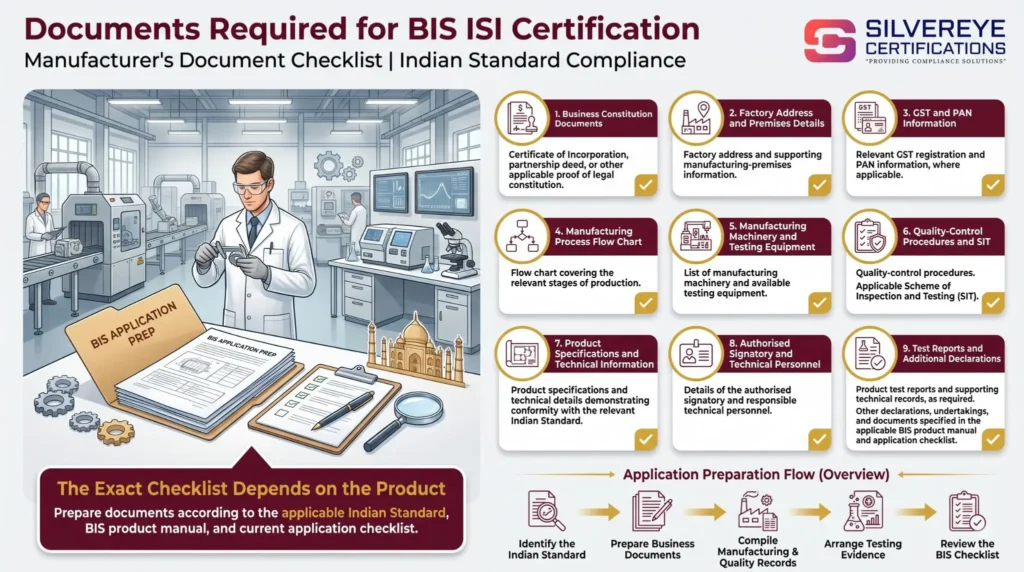
An applicant may need to provide additional information during application scrutiny, factory assessment or testing. Missing technical details can delay the process, so check the current BIS product manual and application checklist before submission.
Step-by-Step BIS Certification Process (Scheme I)
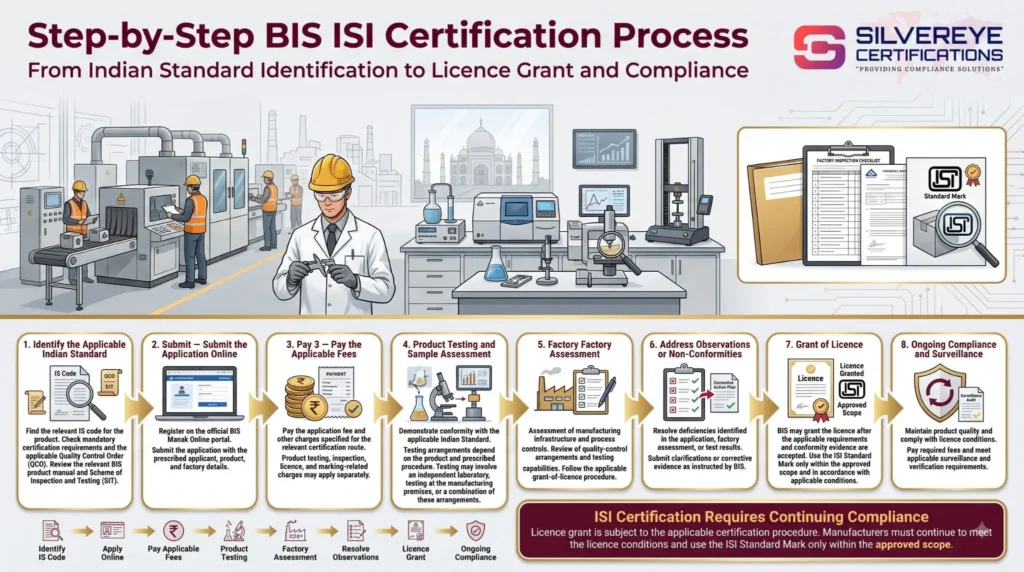
BIS certification for steam cookers and steam-convection ovens follows the applicable product-certification procedure under Scheme I of Schedule II of the BIS (Conformity Assessment) Regulations, 2018. The exact sequence and testing arrangements depend on the product and application route.
1. Confirm the product scope and applicable standard
Identify whether your appliance falls under the household or commercial listing and confirm the relevant requirements of IS 302 (Part 1):2024, together with any applicable product-specific standard or clauses.
2. Prepare the technical documentation
Compile the product specifications, drawings, component information, manufacturing details and quality-control records required by BIS.
3. Submit the application
File the application through the official Manakonline portal and pay the applicable fees. Foreign manufacturers must follow the FMCS application procedure and nominate an eligible AIR.
4. Application scrutiny
BIS reviews the application and supporting documents. If information is incomplete or clarification is required, the applicant must respond to the queries.
5. Factory assessment
BIS assesses the manufacturing premises, production facilities, quality controls and testing capabilities under the applicable procedure.
6. Product sampling and testing
Samples are drawn or submitted according to the certification procedure and tested against the applicable Indian Standard. Additional testing or corrective action may be required if the product does not meet the specified requirements.
7. License decision
BIS considers the application, factory-assessment findings and test results. Once all requirements are satisfied and applicable fees and formalities are completed, BIS may grant the licence for the approved product scope.
8. Marking and ongoing compliance
After the licence is granted, the manufacturer may use the BIS Standard Mark (ISI Mark) only in accordance with the licence conditions. The manufacturer must continue to comply with applicable testing, production-control, marking and surveillance requirements.
How long does BIS certification take?
There is no single guaranteed processing time for every steam cooker or steam-convection oven application. The duration depends on the application route, completeness of the documents, factory-assessment scheduling, laboratory testing and the resolution of any non-conformities.
Manufacturers should therefore plan certification well ahead of the applicable QCO deadline, rather than relying on a fixed four-to-eight-week estimate.
BIS Certification Cost for Steam Cookers and Steam-Convection Ovens (Official Fee Structure)
One of the most common questions manufacturers and importers ask is how much BIS certification for steam cookers and steam-convection ovens costs. There is no single all-inclusive price. The total expense depends on the official BIS fees, product testing, factory inspection, marking fees and any optional consultancy services.
Official BIS Government Fees Under Scheme I
| Fee component | Amount or basis | Important notes |
|---|---|---|
| Application fee | ₹1,000 | Non-refundable fee payable when applying for a licence |
| Annual licence fee | ₹1,000 per year | Payable as specified under the applicable BIS procedure |
| Factory inspection fee | ₹7,000 per man-day | Inspection charges depend on the time and assessment required |
| Product testing charges | As quoted by the laboratory | Depend on the applicable standard, test scope and product configuration |
| Marking fee | Product-specific rate | May include a minimum annual marking fee and a unit-based rate, as applicable |
| Renewal application fee | Confirm the current applicable fee | Payable with the renewal application under the prevailing rules |
| Addition of a new model or variety | Depends on the applicable change-of-scope procedure | Confirm the processing fee and testing requirements with BIS |
These figures reflect BIS's published general Scheme-I fee guidance. Confirm the current fee schedule, applicable taxes and product-specific marking rates before preparing your budget. The fee for adding a model should not be assumed to be ₹5,000 for every product category.
In addition to government fees, budget separately for laboratory testing and any optional professional assistance. Testing expenses for commercial combi ovens can be substantial, particularly when the testing scope includes several models or configurations. Obtain a quotation from the relevant laboratory rather than relying on a fixed estimate.
Validity, Renewal and Timeline
A BIS Scheme-I license is generally granted for an initial period of one year, subject to the applicable conditions. Renewal can be requested for a period of one to five years, in accordance with BIS's renewal procedure. Continued validity depends on compliance with the license conditions, applicable fees and surveillance requirements.
- Initial licence validity: Generally one year, subject to the licence conditions.
- Renewal planning: Apply well before expiry and submit the applicable fees and documents through Manakonline.
- Late renewal: Check the current BIS rules for the applicable late fee and consequences of a lapse. Do not assume that a lapsed licence permits continued use of the Standard Mark.
- Model or capacity additions: Apply for a change in the scope of the licence when required. BIS may require additional documentation, testing or assessment.
- Surveillance: Maintain the required production controls, testing records and conformity documentation throughout the licence period.
Latest 2026 Regulatory Updates You Should Know
Manufacturers and importers should track the following regulatory developments before making certification or import-scheduling decisions.
- QCO 2026: The Safety of Household, Commercial and Similar Electrical Appliances (Quality Control) Order, 2026, notified through S.O. 1739(E) on 6 April 2026, supersedes the 2025 order and establishes revised implementation dates for covered appliances, including the relevant steam-cooker and steam-convection-oven categories.
- Implementation deadlines: The general deadline is 1 October 2026, followed by 1 January 2027 for small enterprises and 1 April 2027 for micro enterprises, subject to the order's eligibility conditions.
- Consolidated licensing: Whether multiple product categories can be covered under one licence depends on the applicable BIS rules, product scope and grouping guidelines. Confirm the current procedure before assuming that a single licence covers every appliance.
- Additional models and product variants: Changes to the licence scope may require further documentation, testing or assessment. The exact process depends on the product and applicable BIS instructions.
- Marking fees: BIS marking fees are product-specific and may be amended. Check the current rate applicable to the relevant product and enterprise category before finalising equipment pricing.
Because the appliance category has undergone changes to its implementation schedule, verify the current QCO and applicable deadline before planning manufacture, import or sale. The original notification and any subsequent amendments should take precedence over older articles or summaries.
Common Mistakes Steam Cooker and Oven Manufacturers Make
Avoid these common mistakes when preparing for BIS certification:
- Assuming CE marking is sufficient: CE marking or another country's approval does not replace a mandatory Indian BIS licence.
- Confusing household and commercial product categories: Confirm the correct listing, applicable standard and product-specific requirements for each appliance.
- Ignoring separate food-contact requirements: Electrical safety certification does not automatically establish compliance with any separately applicable food-contact material or food-safety requirements.
- Starting testing too late: Allow sufficient time for sample preparation, laboratory testing, corrective action and factory assessment before the applicable QCO deadline.
- Underestimating the total certification cost: Budget for testing, inspection, annual licence fees, product-specific marking fees and any additional model assessments.
- Assuming every model is automatically covered: Check the approved licence scope before manufacturing or selling a different capacity, configuration or product variant.
- Relying on outdated deadlines or fee tables: Verify the latest official BIS and DPIIT notifications before committing to a launch date or import shipment.
Why Choose Silvereye Certifications?
Getting a BIS license for steam cookers and steam-convection ovens involves more than submitting an application. It requires identifying the correct product category, coordinating with a BIS-recognised laboratory, preparing technical documentation, and ensuring the manufacturing facility meets applicable quality and safety requirements. Silvereye Certifications supports domestic appliance manufacturers, commercial kitchen equipment manufacturers, and importers with their BIS certification requirements.
- BIS, CRS, and FMCS Expertise: Get guidance on applicable BIS certification schemes, product standards, documentation, and factory assessment requirements for electrical appliances.
- Accurate Product Classification: Silvereye Certifications helps assess whether your steam cooker or steam-convection oven falls within the applicable household or commercial product category before the application is submitted.
- Complete Documentation Support: Get assistance preparing technical documents, coordinating product testing, and organising factory records to help minimise avoidable application delays.
- Laboratory Testing and Factory Audit Coordination: Receive support with sample testing, applicable heating and steam-safety requirements, and preparation for the factory inspection process.
- Transparent Cost Guidance: Understand the applicable government fees, laboratory testing charges, professional service fees, and potential additional costs for models or variants before proceeding.
- End-to-End Certification Assistance: From initial product-scope assessment and documentation to application support, licence grant, renewal, and model additions, Silvereye Certifications helps you navigate the certification process.
If your compliance deadline is approaching and you are unsure whether your steam cooker or combi oven falls under the household or commercial listing, which documents you need, or how testing costs may vary across multiple models, consider arranging a BIS scope assessment early. Taking action in advance can help reduce the risk of avoidable delays affecting import shipments, product launches, or institutional tenders.
Conclusion
BIS certification for steam cookers and steam-convection ovens requires careful attention to electrical safety standards, product classification, testing, and applicable regulatory deadlines. The Quality Control Order (QCO) 2026, notified on 6 April 2026, introduces implementation timelines for covered products, with the stated deadlines of 1 October 2026 for general manufacturers, 1 January 2027 for small enterprises, and 1 April 2027 for micro enterprises. The applicable requirements depend on the product's precise classification, the QCO's scope, and any relevant exclusions.
Manufacturers should begin by confirming whether their products are covered, identifying the applicable Indian Standard and certification scheme, and preparing the required documents and testing arrangements. Businesses supplying multiple models or capacity variants should also check whether additional testing or scope approval is needed for each variant.
Planning early can help manufacturers and suppliers prepare for compliance, reduce avoidable delays, and protect product launch schedules, import operations, and tender opportunities. Confirm the applicable BIS requirements before manufacturing, importing, or placing a covered product on the market, rather than waiting until the deadline is close.
Frequently Asked Questions
Is BIS certification mandatory for steam cookers and steam-convection ovens in India?
Yes. Under the Safety of Household, Commercial and Similar Electrical Appliances (Quality Control) Order, 2026, steam cookers and steam-convection ovens fall under IS 302 (Part 1):2024, and BIS certification with the ISI mark is mandatory before manufacturing, importing, or selling them in India.
What is the deadline for BIS certification of these appliances?
General manufacturers and foreign importers must comply by 1 October 2026, small enterprises by 1 January 2027, and micro enterprises by 1 April 2027, as per the current QCO 2026 timeline.
Does commercial catering equipment need a different certification from home steam cookers?
Both sit under the same base standard, IS 302 (Part 1):2024, but commercial equipment — like hotel-grade combi ovens — is treated as a separate listed category from domestic steam cookers and forced convection ovens, with its own applicable clauses and voltage scope. Confirm the correct listing for each product.
Which BIS scheme applies to steam cookers and convection ovens?
Domestic manufacturers apply under Scheme-I (ISI Mark Scheme) of Schedule-II of the BIS (Conformity Assessment) Regulations, 2018. Foreign manufacturers exporting to India typically apply under the Foreign Manufacturers Certification Scheme (FMCS).
How much does BIS certification cost for a steam-convection oven?
Official government fees start at ₹1,000 for the application and ₹1,000 per year for the licence, plus ₹7,000 per man-day for factory audits. Lab testing and marking fees are additional and typically higher for commercial-grade units given their power rating and steam-safety testing scope. Always verify current fees on the official BIS website.
How long does the BIS certification process take?
For applicants with complete documentation, the process — from sample testing to licence grant — typically takes about four to eight weeks for a single model, though multi-variant commercial oven ranges can take longer.
What documents are required to apply for BIS certification?
Common requirements include company registration proof, factory layout, technical drawings of the heating and steam-generation system, component and supplier details, test reports from a BIS-recognised lab, and authorised signatory details. Foreign manufacturers also need an Authorised Indian Representative.
Can hotels or restaurants install imported combi ovens without BIS certification?
Once the applicable compliance deadline passes, installing or operating equipment without a valid BIS licence is non-compliant, and reputable equipment suppliers and institutional buyers are increasingly requiring BIS documentation as part of procurement, independent of the exact enforcement date.
Is the BIS license valid permanently once granted?
No. The license is typically valid for one year and must be renewed annually, along with payment of the renewal fee and, where applicable, updated test reports.
Do imported steam cookers and combi ovens also need BIS certification?
Yes. Imported units need certification through the FMCS route for foreign manufacturers, and customs clearance is generally linked to holding a valid BIS license for the specific product and capacity variant.
Does BIS certification also cover food-contact safety of the cooking chamber?
No. IS 302 (Part 1):2024 covers electrical, thermal, and mechanical safety only. Food-contact material safety for surfaces that touch food falls under FSSAI regulations, which is a separate compliance requirement for cooking equipment manufacturers.