

APEDA Export Registration (RCMC) is an important requirement for businesses exporting scheduled agricultural and processed food products from India.
- Online Registration: Apply for the Registration-cum-Membership Certificate (e-RCMC) through the DGFT portal using a valid Import Export Code (IEC).
- Registration Fee and Validity: The stated fee is ₹5,900, and the RCMC is generally valid for five financial years, subject to applicable rules and renewal requirements.
- Financial Assistance: Eligible registered exporters may apply for support under APEDA’s Financial Assistance Scheme for approved infrastructure development, quality improvement, and market promotion activities. Assistance is subject to scheme guidelines and eligibility criteria.
- Additional Export Compliance: APEDA registration is only one part of the export process. Depending on the product and destination country, exporters may also need an FSSAI licence, phytosanitary certificate, and shipping or customs documentation.
Introduction
APEDA Export Registration (RCMC) involves obtaining a Registration-Cum-Membership Certificate from the Agricultural and Processed Food Products Export Development Authority (APEDA). It is required for exporters dealing in products covered under APEDA’s scheduled categories, including fruits, vegetables, meat, dairy products, cereals, beverages, cashews, honey, and other agricultural and processed food products.
To apply, businesses generally need a valid Import Export Code (IEC) and must submit their application through the DGFT e-RCMC portal, along with the required business and bank documents. The stated government fee is ₹5,900, and the certificate is generally valid for five financial years, subject to applicable rules.

APEDA-registered exporters may also be eligible to apply for financial assistance under APEDA’s schemes for export infrastructure, quality improvement, certification, and market development, depending on the scheme’s eligibility criteria. In 2026, APEDA registration remains an important compliance step for eligible agri-exporters planning to access international markets.
What Is APEDA Export Registration?
The Agricultural and Processed Food Products Export Development Authority (APEDA) is a statutory body under India's Ministry of Commerce and Industry, established under the APEDA Act, 1985. Its primary role is to promote and develop exports of scheduled agricultural and processed food products.
APEDA Export Registration, formally known as the Registration-Cum-Membership Certificate (RCMC), registers eligible exporters dealing in APEDA-scheduled products. Exporters generally need a valid RCMC where required under the Foreign Trade Policy. However, under DGFT Notification No. 36/2026-27 dated 15 September 2026, consignments with an FOB value not exceeding ₹3,00,000 are exempt from the RCMC or Certificate of Registration requirement.
Why APEDA Export Registration Matters Beyond Compliance
APEDA registration can provide more than regulatory recognition. Registered exporters may access APEDA's export-promotion resources, trade information, buyer-related initiatives, and eligible financial assistance schemes.
Depending on the applicable scheme and eligibility criteria, financial assistance may support areas such as export infrastructure, quality development, and market promotion. However, registration does not guarantee a subsidy or financial assistance; exporters must apply separately and meet the relevant conditions.
Who Needs APEDA Export Registration?
Businesses exporting APEDA-scheduled products should check whether RCMC is required for their shipments and business activities. Eligible applicants may include:
- Proprietorships and individual exporters
- Partnership firms and LLPs
- Private and public limited companies
- Merchant exporters and trading firms
- Manufacturer-exporters and food processing units
- Farmer Producer Organisations (FPOs) exporting directly
- Export-focused startups and D2C food brands
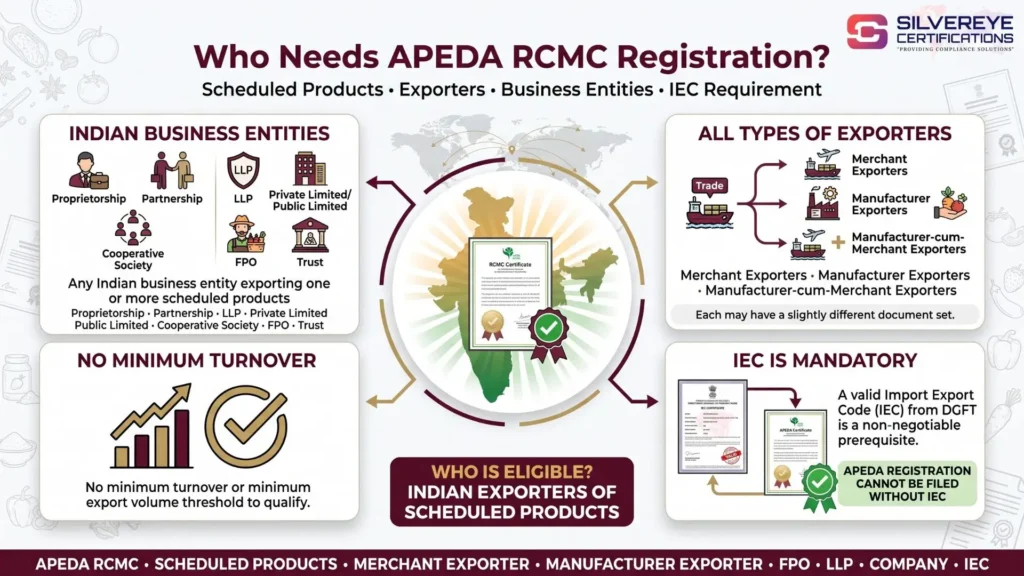
A valid Import Export Code (IEC) from the Directorate General of Foreign Trade (DGFT) is generally required before applying for APEDA e-RCMC. Under Section 12 of the APEDA Act, exporters of scheduled products are required to apply for registration within the prescribed period, generally within one month of undertaking the export. Check the applicable rules and exemptions before planning a shipment.
Products That Require APEDA Export Registration
APEDA's First Schedule covers the following broad product categories. Basmati rice is included in the Second Schedule of the APEDA Act. Confirm the exact product classification before applying.
| S.No. | Scheduled Product Category |
|---|---|
| 1 | Fruits, vegetables and their products |
| 2 | Meat and meat products |
| 3 | Poultry and poultry products |
| 4 | Dairy products |
| 5 | Confectionery, biscuits and bakery products |
| 6 | Honey, jaggery and sugar products |
| 7 | Cocoa products and chocolates |
| 8 | Alcoholic and non-alcoholic beverages |
| 9 | Cereals and cereal products |
| 10 | Groundnuts, peanuts and walnuts |
| 11 | Pickles, papads and chutneys |
| 12 | Guar gum |
| 13 | Floriculture and floriculture products |
| 14 | Herbal and medicinal plants |
| 15 | De-oiled rice bran |
| 16 | Green pepper in brine |
| 17 | Cashew nuts and their products |
What about other food exports? Spices, marine products, tea and coffee generally fall under the respective export-promotion bodies, such as the Spices Board, Marine Products Export Development Authority (MPEDA), Tea Board and Coffee Board. Confirm the applicable registration requirements for your specific product rather than assuming APEDA is the responsible authority.
Documents Required for APEDA Export Registration
The required documents depend on whether you are applying as a merchant exporter or a manufacturer/manufacturer-exporter. APEDA's published e-RCMC guidance lists the following requirements.
For Merchant Exporters
- Import Export Code (IEC): A signed and sealed copy of the IEC issued by DGFT, as specified in APEDA's guidance.
For Manufacturers and Manufacturer-Exporters
- IEC certificate: A signed and sealed copy of the IEC.
- Manufacturing proof: Documents supporting manufacturing activity for the relevant product category.
- Product-specific supporting documents: Depending on the category, these may include an FSSAI licence, Udyam registration, a certificate from the Ministry of MSME, a Department of Horticulture certificate, or an Excise Commissioner document for alcoholic beverages.
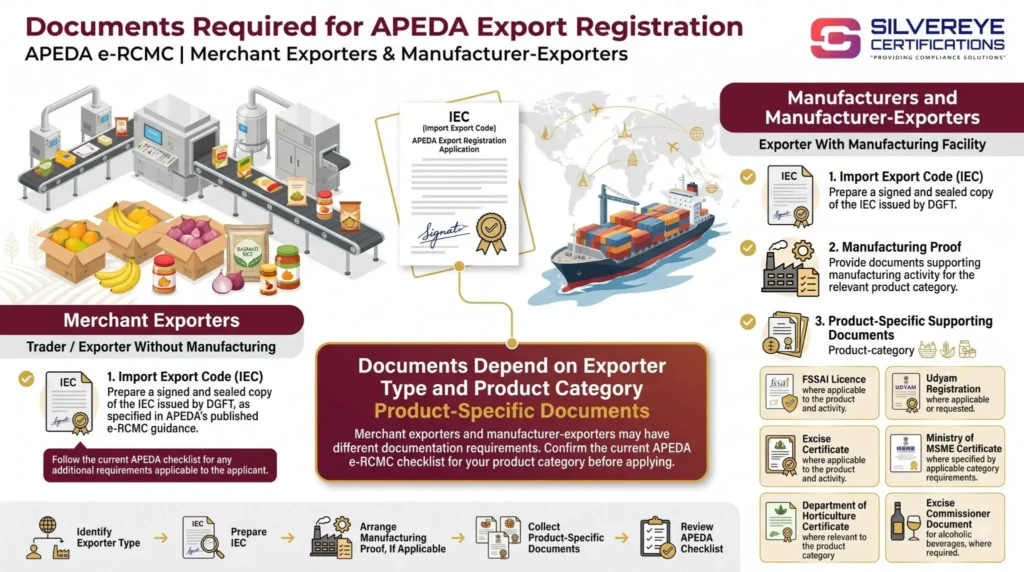
Important: Do not assume that PAN, GST registration, a cancelled cheque, bank statements or every other general business document is mandatory in all cases. Check the current requirements on the DGFT e-RCMC portal and follow any additional document requests applicable to your product and applicant type.
APEDA Export Registration Process (Step-by-Step)
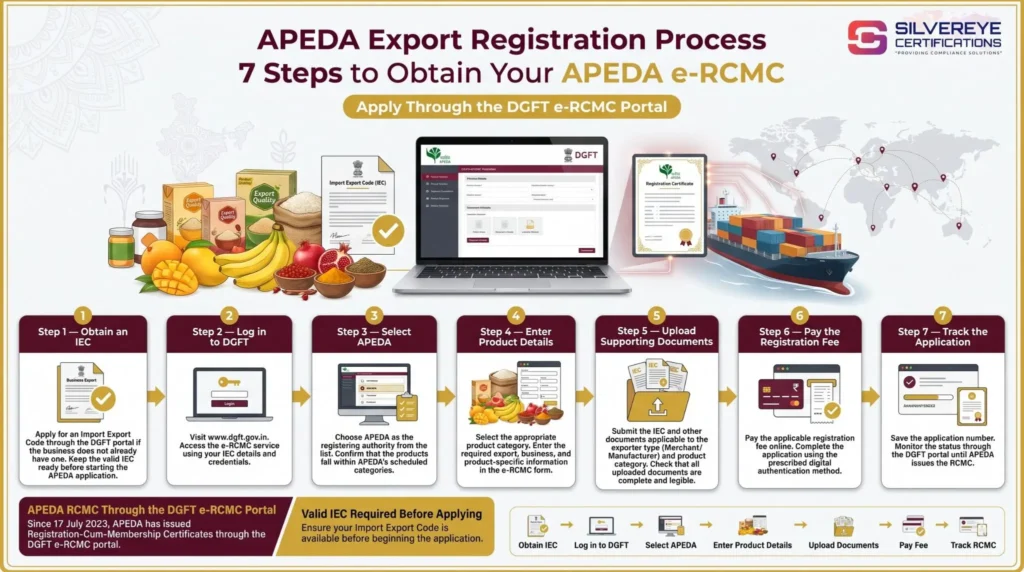
Since 17 July 2023, APEDA has issued Registration-Cum-Membership Certificates (RCMCs) through the DGFT e-RCMC portal. Exporters need a valid Import Export Code (IEC) before applying.
Follow these steps to apply:
- Obtain an IEC: Apply for an Import Export Code through the DGFT portal if your business does not already have one.
- Log in to DGFT: Visit www.dgft.gov.in and access the e-RCMC service.
- Select APEDA: Choose APEDA as the registering authority for products covered under its scheduled categories.
- Enter product details: Select the appropriate product category and provide the required export and business information.
- Upload documents: Submit the IEC and other supporting documents applicable to your exporter and product category.
- Pay the registration fee: Pay the applicable fee online and complete the application using the prescribed digital authentication method.
- Track your application: Keep the application number and monitor the status through the portal until APEDA issues the RCMC.
APEDA Export Registration Fees and Validity
APEDA's published e-RCMC circular lists the following fee structure.
| Particular | Details |
|---|---|
| Fresh Registration Fee | ₹5,900, including ₹5,000 registration fee and ₹900 GST |
| Renewal Fee | ₹5,900, including GST, as stated in APEDA's published circular |
| Amendment/Modification | No fee, according to APEDA's published circular |
| Validity | Five years, subject to the certificate's validity terms |
| Application Timing | Apply within the prescribed period and check any applicable exemptions |
Note: Confirm the fee, validity and renewal requirements displayed on the DGFT portal before submitting your application. Notification No. 36/2026–27, dated 15 September 2026, introduced an exemption from RCMC requirements for certain low-value exports, so exporters should check whether their shipments qualify.
Beyond RCMC: What Else Do You Need to Export?
APEDA registration is one part of the export compliance process. The additional licences and certificates depend on the product, its classification and the importing country's rules.
Common requirements may include:
- FSSAI Licence: Food businesses must meet applicable Indian food-safety licensing requirements. Exporters should confirm the licence category applicable to their operations.
- Phytosanitary Certificate: May be required for plants and plant products, depending on the importing country's plant-health conditions.
- Certificate of Origin: Required where specified by the importing country, buyer or applicable preferential trade agreement.
- Health or Sanitary Certificate: May be required for certain meat, dairy and other animal-origin products.
- Shipping Bill and Customs Documents: Exporters must complete the applicable customs clearance and shipping formalities.
- NPOP Organic Certification: Required where applicable for products exported or marketed as certified organic under the relevant Indian organic export framework.
Important: RCMC does not replace product-specific licences, destination-country approvals or customs documentation. Confirm the applicable requirements before dispatch to help avoid clearance delays or shipment rejection.
APEDA Financial Assistance Scheme: What Exporters Should Know
APEDA operates financial assistance programmes to support the export development of eligible agricultural and processed food products. These programmes can help eligible businesses improve infrastructure, product quality and access to international markets.
APEDA published the Financial Assistance Scheme (FAS) guidelines under Bharat Krishi Niryat Yojana for the 16th Finance Commission cycle, covering FY 2026–27 to 2030–31, on 6 October 2026. Exporters should consult these current guidelines rather than relying on subsidy percentages or ceilings quoted under earlier schemes.
| Support Area | Examples of Potential Activities |
|---|---|
| Export Infrastructure | Eligible pack-house facilities, storage, handling and transportation infrastructure |
| Quality Development | Applicable quality assurance, testing and compliance-related improvements |
| Market Development | Eligible trade promotion, market access and export development activities |
How Much Financial Assistance Can You Receive?
The amount of assistance depends on the current scheme guidelines, eligible project components, applicant category, location and applicable financial limits. Earlier scheme provisions should not automatically be treated as the rates for the 2026–31 cycle.
Before preparing a project budget, review the latest documents on APEDA's official announcements page and Financial Assistance Schemes page. Registration alone does not guarantee approval or payment of a subsidy.
Benefits of APEDA Export Registration
Obtaining an APEDA RCMC can provide several practical benefits for eligible exporters:
- Regulatory compliance: Helps meet the applicable RCMC requirement for scheduled products.
- Financial assistance opportunities: Allows eligible exporters to apply under relevant APEDA support schemes.
- Export promotion resources: Provides access to APEDA's trade information, export initiatives and industry resources.
- Market development: May help exporters participate in eligible trade fairs and buyer-seller initiatives.
- Business credibility: Provides evidence of registration with the relevant export-promotion authority.
- Quality improvement: Can help eligible businesses explore support for quality and export infrastructure upgrades.
The availability of specific benefits depends on the applicable scheme, programme conditions and eligibility criteria.
Renewing and Amending Your APEDA Export Registration
APEDA's published circular specifies a five-year validity period and provides for online renewal through the DGFT e-RCMC system. It also states that amendments or modifications after issuance can be made without a fee.
To manage your RCMC effectively:
- Check the expiry date shown on your certificate.
- Start the renewal process well before expiry and confirm the current portal requirements.
- Verify the applicable renewal fee and document list before submitting.
- Update relevant registration details, such as business information or authorised signatory details, through the prescribed process.
- Keep your IEC and supporting business records up to date.
Do not assume that every amendment requires the same documents or that a fixed 60-day renewal deadline applies universally. Follow the latest APEDA and DGFT instructions.
Common Mistakes Exporters Make With APEDA Registration
Avoid these common errors when applying for or maintaining your RCMC:
- Assuming an IEC automatically fulfils every applicable RCMC requirement.
- Selecting the wrong APEDA product category.
- Uploading incomplete or unsuitable supporting documents.
- Overlooking the prescribed registration timeline or an applicable exemption.
- Failing to check the certificate's expiry date and renewal requirements.
- Assuming RCMC replaces FSSAI, phytosanitary, health or destination-specific approvals.
- Budgeting for financial assistance using outdated subsidy rates.
- Assuming registration automatically guarantees approval under APEDA's financial assistance schemes.
What's New for APEDA Export Registration in 2026?
Two developments are particularly relevant to exporters.
1. Updated e-RCMC procedure: APEDA's e-RCMC system continues to operate through the DGFT portal. APEDA published a circular on the procedure for e-RCMC on 27 March 2026, reinforcing the importance of checking the current document requirements and application process.
2. New financial assistance guidelines: On 6 October 2026, APEDA published the Bharat Krishi Niryat Yojana Financial Assistance Scheme guidelines for FY 2026–27 to 2030–31. Exporters planning infrastructure or export-development projects should consult these new guidelines for the applicable support components, eligibility conditions and financial limits.
Additionally, DGFT Notification No. 36/2026–27, dated 15 September 2026, introduced a de minimis exemption from RCMC requirements for qualifying low-value exports. Businesses should review the notification and confirm whether the exemption applies to their shipments before relying on it.
Final takeaway: Before applying for APEDA export registration in 2026, verify your product category, IEC details, current fee, document requirements and applicable exemptions. If you intend to seek financial assistance, review the latest Bharat Krishi Niryat Yojana guidelines separately because the RCMC itself does not guarantee subsidy eligibility or approval.
Conclusion: Make Your APEDA Registration Work for Your Export Business
APEDA export registration is an important compliance step for eligible agricultural and food exporters in India. Beyond meeting applicable registration requirements, it can help businesses explore export promotion initiatives, quality development opportunities and financial assistance schemes, subject to eligibility and current guidelines. Completing the application accurately, keeping registration details updated and checking renewal requirements can help exporters manage compliance as their business grows.
Silvereye Certifications assists exporters with the APEDA registration process, including eligibility checks, document preparation, e-RCMC applications, renewals, amendments and guidance on financial assistance schemes. Whether you're entering international markets for the first time or expanding your existing export operations, professional guidance can help you navigate the registration process and understand the support opportunities available to your business.
Frequently Asked Questions
Is APEDA export registration compulsory for small exporters?
Yes. There's no exemption based on business size or export value — even a small home-based food brand shipping one carton needs a valid RCMC to export a scheduled product.
Can I export without APEDA registration if I already have an IEC?
No. IEC is a general import-export license, while APEDA RCMC is a separate, product-specific authorization required in addition to IEC for scheduled agricultural and processed food products.
How much does APEDA export registration cost?
The government fee is ₹5,900 (₹5,000 plus 18% GST), the same amount applying to both fresh registration and renewal.
How long does APEDA export registration remain valid?
The RCMC is valid for five financial years from its date of issue, after which it needs to be renewed through the DGFT e-RCMC portal.
What financial support can APEDA-registered exporters access?
Registered exporters can apply for the Financial Assistance Scheme, which offers subsidy support across Export Infrastructure Development, Quality Development, and Market Development components, subject to current scheme eligibility and caps.
Do I need FSSAI licensing along with APEDA registration?
Yes, if you're exporting processed food products. FSSAI licensing and APEDA registration are separate requirements that typically apply together for food exporters.
What products don't need APEDA registration?
Spices, marine products, tea, and coffee are handled by the Spice Board, MPEDA, Tea Board, and Coffee Board respectively, not APEDA. Basmati rice falls under APEDA's separate Second Schedule.
How soon must I register after starting to export?
You're required to apply within one month of undertaking export business. Extensions are granted only for valid reasons, at APEDA's discretion.
Is amendment of RCMC details free?
Yes. Once your RCMC is issued, updates to details like address, bank account, or product category can be filed online without any government fee.
Can Farmer Producer Organizations (FPOs) register directly with APEDA?
Yes. FPOs exporting scheduled agricultural products directly are eligible to apply for APEDA registration the same way as other business entities.
Does APEDA registration guarantee smooth customs clearance?
No. RCMC authorises you to export but doesn't replace destination-specific requirements like phytosanitary certificates, health certificates, or Certificate of Origin, which are handled separately.
What happens if my RCMC expires and I keep exporting?
Exporting scheduled products without a valid, current RCMC isn't permitted, and it can also affect your eligibility for Foreign Trade Policy benefits tied to your registration status