


- APEDA Registration: Exporters of APEDA-scheduled food products apply through the DGFT e-RCMC portal.
- Government Fee: ₹5,900 (₹5,000 registration fee + ₹900 GST), with 5-year validity, as stated in APEDA’s circular.
- Product Eligibility: Not all food products fall under APEDA. Spices and tea are handled by their respective boards.
- 2026 RCMC Exemption: Consignments up to ₹3 lakh FOB may be exempt from RCMC, subject to applicable rules.
- FSSAI Licensing: Check the latest requirements for license validity, annual fees and return filing.
- IEC Requirement: A valid Importer Exporter Code (IEC) is required before applying.
- Manufacturing Proof: Manufacturers may need supporting documents such as FSSAI or Udyam registration, depending on the product.
Introduction
APEDA registration for food exporters involves obtaining a Registration-cum-Membership Certificate (RCMC) through the DGFT e-RCMC portal for eligible APEDA-scheduled products, including processed food, dairy, meat, fruits, vegetables and cereals. Exporters need a valid Importer Exporter Code (IEC) before applying, while manufacturers may also need to submit supporting documents such as FSSAI or Udyam registration, depending on the product.

The registration fee is ₹5,900, with five-year validity, as stated in APEDA’s circular. Since 15 September 2026, consignments with an FOB value of up to ₹3 lakh are stated to be exempt from RCMC, subject to applicable rules. Silvereye Certifications can review your product eligibility, check your documents and assist with filing.
What Is APEDA Registration for a Food Exporter?
The Agricultural and Processed Food Products Export Development Authority (APEDA) registers exporters dealing in its scheduled products and issues a Registration-cum-Membership Certificate (RCMC). For eligible food exporters, this certificate confirms registration with the authority responsible for their product category.
Since 17 July 2023, applications and payments have been handled through the DGFT e-RCMC portal, following DGFT Trade Notice 35/2021-22.
APEDA registration is one part of the export compliance process. Food exporters may also need a valid Importer Exporter Code (IEC), the appropriate FSSAI license or registration, and product-specific certificates required by the destination country.
APEDA RCMC for Food Exporters at a Glance
| Point | What to Know |
|---|---|
| Certificate | Registration-cum-Membership Certificate (RCMC) for APEDA-scheduled products |
| Application portal | DGFT e-RCMC portal: dgft.gov.in |
| Prerequisite | Valid Importer Exporter Code (IEC) |
| Government fee | ₹5,900, including ₹5,000 registration fee and ₹900 GST at 18%, as stated in APEDA’s circular |
| Validity | Five years, subject to the applicable rules and certificate conditions |
| Exporter categories | Merchant exporter, manufacturer exporter and manufacturer-cum-merchant exporter |
| Manufacturing proof | Applicable FSSAI, Udyam, horticulture or excise documents, depending on the product category |
Which Food Products Need APEDA Registration?
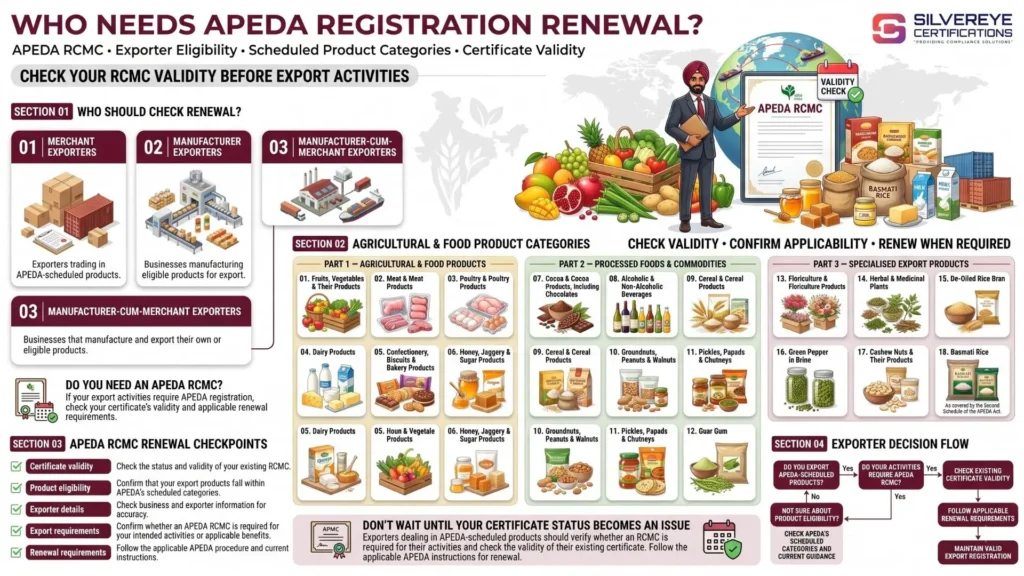
APEDA registration applies to products included in its scheduled product list. Before applying, confirm that your products fall under APEDA rather than another export promotion council or commodity board.
| Scheduled Products — Part 1 | Scheduled Products — Part 2 | Scheduled Products — Part 3 |
|---|---|---|
| Fruits, vegetables and their products | Cocoa and cocoa products, including chocolates | Floriculture and floriculture products |
| Meat and meat products | Alcoholic and non-alcoholic beverages | Herbal and medicinal plants |
| Poultry and poultry products | Cereal and cereal products | De-oiled rice bran |
| Dairy products | Groundnuts, peanuts and walnuts | Green pepper in brine |
| Confectionery, biscuits and bakery products | Pickles, papads and chutneys | Cashew nuts and their products |
| Honey, jaggery and sugar products | Guar gum | Basmati rice covered by the APEDA Act |
Food Products Covered by Other Authorities
One common source of confusion for new exporters is that not every food product falls under APEDA. The appropriate RCMC authority depends on the product and the relevant export promotion framework.
| If You Export | Typical Registering Authority | What to Do |
|---|---|---|
| Processed food, dairy, meat, fruits, vegetables, cereals and confectionery | APEDA, where the product is scheduled | Check eligibility for APEDA RCMC |
| Spices | Spices Board | Check the Spices Board registration requirements |
| Tea | Tea Board | Check the Tea Board registration requirements |
| Coffee or marine products | Relevant authority, such as the Coffee Board or MPEDA | Confirm the applicable RCMC route |
| Products across multiple categories | More than one authority may be relevant | Map each product to its respective authority |
If you are unsure which authority covers your product, confirm the classification before paying the APEDA registration fee. An APEDA RCMC does not replace registration required from another authority.
Eligibility and Requirements for APEDA Registration for Food Exporters
Businesses exporting APEDA-scheduled products may apply for an RCMC if they meet the applicable requirements, including holding a valid IEC where required. APEDA recognizes different exporter categories, and the supporting documents depend on the applicant’s business model.
- Merchant exporter: Purchases products from other businesses and exports them. APEDA’s stated document requirements include a signed and sealed copy of the IEC.
- Manufacturer exporter: Manufactures and exports products. The application generally requires the IEC copy and applicable manufacturing proof.
- Manufacturer-cum-merchant exporter: Both manufactures and exports products. The application generally requires the IEC copy and applicable manufacturing proof.
Select the correct exporter category when completing the application. If your category or supporting documents do not match your business activities, the registering authority may raise a query.
FSSAI and APEDA: How They Work Together for Food Exporters
FSSAI and APEDA serve different purposes. FSSAI regulates food safety and licences or registers eligible food businesses, while APEDA registers exporters dealing in its scheduled products.
For manufacturers, APEDA’s cited circular lists FSSAI or Udyam registration as manufacturing proof for many food product categories. Merchant exporters may have different document requirements. Always follow the current checklist for your product and exporter category.
Some guidance also states that a separate FSSAI NOC is not required merely because a business exports food. However, the business may still need the appropriate FSSAI licence or registration for its activities. Confirm the requirements with FSSAI for your specific business category.
| Registration or Certificate | Issuing Authority | Role for a Food Exporter |
|---|---|---|
| IEC | DGFT | Required for export activities and relevant RCMC applications |
| FSSAI licence or registration | FSSAI | Covers applicable food-safety licensing requirements and may serve as manufacturing proof for APEDA |
| APEDA RCMC | APEDA through the DGFT portal | Registers eligible exporters of APEDA-scheduled products |
| Product- and destination-specific certificates | Relevant authorities | May include phytosanitary, health or other certificates depending on the product and destination country |
Before exporting, check the requirements of the destination market as well as Indian registration requirements. An APEDA RCMC alone does not satisfy every food-safety, labelling, testing or import requirement.
What Is New for Food Exporters in 2026?
Several reported developments in 2026 may affect APEDA registration for food exporters, food-safety licensing and export documentation. Businesses should verify the latest official notifications before relying on any exemption or regulatory change.
1. The ₹3 Lakh RCMC Exemption
According to the cited DGFT Notification 36/2026-27, dated 15 September 2026, export consignments with an FOB value of up to ₹3,00,000 are exempt from the RCMC or Certificate of Registration requirement where the Foreign Trade Policy would otherwise require it.
The reported exemption applies to individual consignments rather than annual turnover. Exporters should confirm the notification's scope and conditions before deciding whether they need an RCMC.
| Your Situation | RCMC Position | What to Do |
|---|---|---|
| Small sample or e-commerce parcels up to ₹3 lakh FOB | May qualify for exemption | Confirm eligibility under the current notification. |
| Regular commercial shipments above ₹3 lakh FOB | RCMC may still be required | Check the applicable Foreign Trade Policy provisions. |
| Applying for APEDA programmes | Programme-specific conditions apply | Check eligibility requirements; selected BHARATI applicants may need a valid RCMC. |
| Product-specific requirements, such as residue limits or traceability | Separate requirements may apply | Verify the rules for your product and destination market. |
2. FSSAI Amendment Regulations 2026: License Validity
Reports on the FSSAI Licensing and Registration of Food Businesses Amendment Regulations, 2026 describe changes to licence validity and compliance obligations, including annual fees and food-safety returns.
This matters for APEDA applicants because FSSAI documentation may serve as manufacturing proof for certain product categories. However, a licence with no fixed expiry date does not necessarily mean the business has met its ongoing compliance obligations.
Before uploading an FSSAI licence, check its status, applicable fee payments and return-filing requirements through the FoSCoS portal. Also verify the current turnover thresholds and effective dates applicable to your business category.
3. Residue Compliance for Fresh-Produce Exports
Reported court proceedings concerning pomegranate consignments highlight the importance of meeting applicable pesticide maximum residue limits (MRLs) and destination-market requirements.
An APEDA RCMC establishes exporter registration where required, but it does not guarantee that every shipment will be accepted. Fresh-produce exporters should check testing requirements, phytosanitary documentation and the residue limits applicable in the destination country.
4. Scheme Updates: BHARATI and Bharat Krishi Niryat Yojana
APEDA's BHARATI programme may require selected applicants to hold a valid APEDA RCMC before entering the acceleration phase. Separately, APEDA reportedly issued a request for proposals on 20 July 2026 for a Project Management Unit for the Bharat Krishi Niryat Yojana, covering 2026–27 to 2030–31.
Businesses interested in these programmes should consult APEDA's latest notices for confirmed eligibility conditions and application requirements.
Documents Required for APEDA Registration for Food Exporters
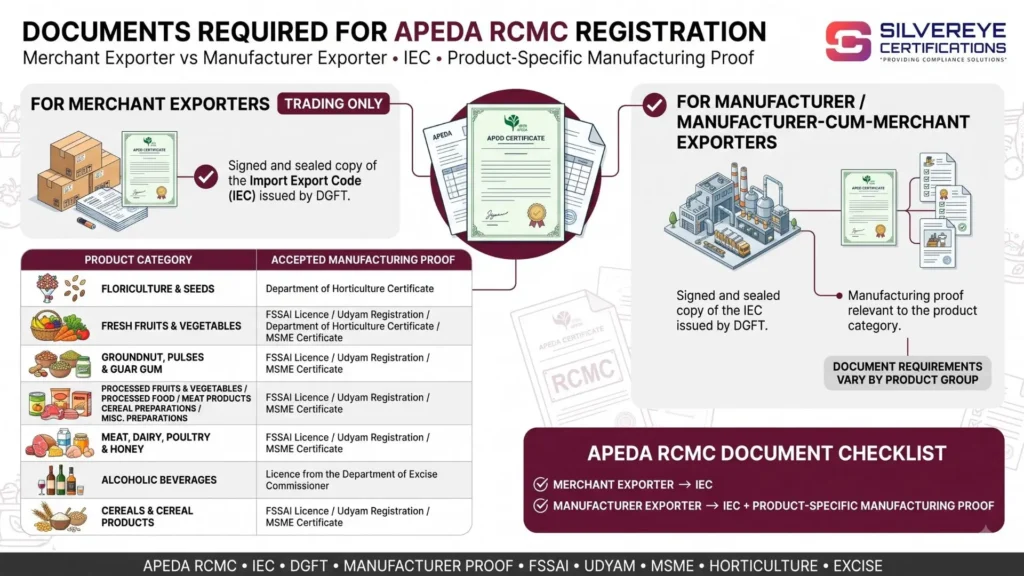
The required documents depend on whether you operate as a merchant exporter, manufacturer or manufacturer-cum-merchant exporter.
| Exporter Type | Documents to Prepare |
|---|---|
| Merchant exporter | Signed and sealed copy of the Importer Exporter Code (IEC), as specified by APEDA. |
| Manufacturer exporter | Signed and sealed IEC copy and applicable manufacturing proof. |
| Manufacturer-cum-merchant exporter | Signed and sealed IEC copy and applicable manufacturing proof. |
Manufacturing Proof by Food Product Group
APEDA's document requirements can vary by product category. The following table summarises the document types identified in the cited guidance; confirm the currently accepted documents for your specific product before applying.
| Product Group | Potential Supporting Document or Authority |
|---|---|
| Floriculture and seeds | Department of Horticulture documentation |
| Fresh fruits and vegetables | Accepted FSSAI, Udyam, horticulture or MSME documentation |
| Groundnuts, pulses and guar gum | Accepted FSSAI or Udyam documentation |
| Processed fruits and vegetables, processed food, meat products and cereal preparations | Applicable FSSAI or Udyam documentation |
| Meat, dairy, poultry and honey | Applicable FSSAI documentation |
| Cereals and cereal products | Applicable FSSAI documentation |
| Alcoholic beverages | Relevant Excise Commissioner documentation |
As a practical measure, also keep your authorised signatory details, export product list, destination countries and digital-signing access ready. The e-RCMC application may request product and country details.
APEDA Registration Fees and Validity for Food Exporters
| Item | Amount | Source |
|---|---|---|
| Registration fee before GST | ₹5,000 | Cited APEDA circular |
| GST at 18% | ₹900 | Cited APEDA circular |
| Total APEDA registration fee | ₹5,900 | Cited APEDA circular |
| Renewal fee | ₹5,900 | Cited APEDA circular |
| Amendment after issuance | No fee, as stated in the circular | Cited APEDA circular |
| New IEC, if required | ₹500, as stated for a new application | DGFT portal fee |
| Consultant fee | Depends on the provider | Not fixed by APEDA |
The cited APEDA circular states five-year validity. If third-party websites quote an annual membership fee or lifetime validity, compare those claims with the latest APEDA circular and the details displayed in your DGFT account before making a payment.
Step-by-Step APEDA Registration Process for Food Exporters
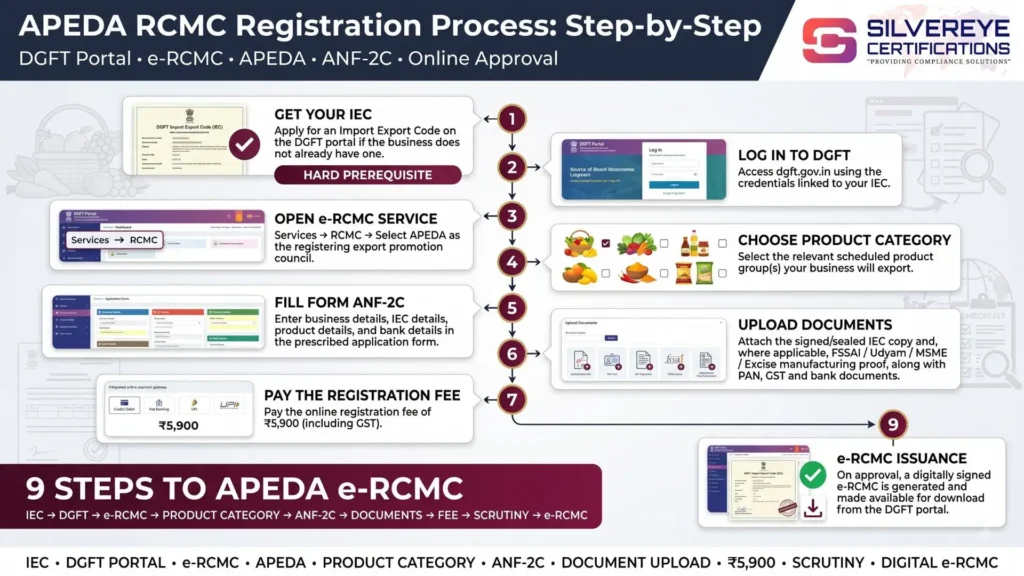
The following steps summarise the application process through the DGFT e-RCMC portal. Portal labels and document requirements may change.
- Identify your product authority. Confirm which products fall under APEDA and which belong to another export promotion council or commodity board.
- Confirm your IEC. Ensure you have a valid Importer Exporter Code and that your DGFT profile is up to date.
- Prepare your documents. Collect the IEC copy and, for manufacturers, the applicable manufacturing proof.
- Log in to DGFT. Visit dgft.gov.in and navigate to Services → e-RCMC → Apply for e-RCMC.
- Select APEDA. Start a fresh application and choose APEDA as the registering authority.
- Enter application details. Select your exporter category, review the fee information, choose the applicable office and add your export products.
- Complete your profile. Add authorised representatives, destination countries, firm details and website information where required.
- Upload and sign. Upload the required documents, accept the declaration and complete the prescribed digital-signing process.
- Pay the fee. Pay the applicable amount through the portal's payment gateway and save the e-payment receipt.
- Track your application. Check My Dashboard → Submitted Applications, respond to queries and download the RCMC when issued.
APEDA Registration for Food Exporters: Timeline From First Document to Download
| Stage | Suggested Timeline | Notes |
|---|---|---|
| Product mapping and document collection | 2–5 working days | Depends on document readiness and product categories. |
| FSSAI status check, if used as manufacturing proof | During document preparation | Confirm the licence status and applicable fee and return requirements. |
| DGFT portal application | Same day, if documents are ready | Includes application signing and payment. |
| Application scrutiny and certificate issuance | Allow additional processing time | Third-party estimates of 7–15 working days are not an official guaranteed turnaround. |
| Renewal reminder | Around 60 days before expiry | Check the certificate and current renewal requirements; the cited APEDA circular lists a ₹5,900 renewal fee. |
APEDA Registration Validity and Renewal for Food Exporters
Check the validity period printed on your APEDA Registration-cum-Membership Certificate (RCMC). The cited APEDA circular states a validity of five years, while DGFT's e-RCMC help file describes validity in terms of financial years, subject to the applicable conditions.
Renewal is handled through the DGFT e-RCMC portal, and the cited APEDA circular lists a fee of ₹5,900. The renewal options displayed in your account may depend on the certificate's status, so follow the current portal instructions.
For changes to details such as products or addresses, check the applicable amendment process. The cited APEDA circular states that amendments after issuance carry no fee.
Benefits of APEDA Registration for Food Exporters
- Recognised exporter registration: Confirms registration with APEDA for eligible scheduled products.
- Support for applicable export requirements: An RCMC may be required where the Foreign Trade Policy makes it necessary.
- Access to eligible APEDA programmes: Some programmes, including BHARATI, may require selected applicants to hold a valid APEDA RCMC.
- Multi-year validity: The cited circular states five-year validity, subject to applicable rules.
- Online application process: The DGFT e-RCMC portal allows applicants to submit applications and make payments electronically.
Common APEDA Registration Mistakes Food Exporters Make
- Assuming every food product falls under APEDA: Spices and tea, for example, are handled by their respective boards.
- Treating FSSAI as the only requirement: FSSAI covers applicable food-safety licensing, while APEDA RCMC serves a separate exporter-registration purpose.
- Uploading an inactive FSSAI licence: Check the licence status and applicable compliance obligations before submitting it as supporting evidence.
- Selecting the wrong exporter category: Merchant, manufacturer and manufacturer-cum-merchant exporters may have different document requirements.
- Submitting incomplete documents: Follow APEDA's current requirements for signed, sealed or otherwise authenticated copies.
- Ignoring product-specific rules: Residue limits, destination-country certificates and other requirements may apply separately.
- Applying without checking possible exemptions: Certain consignments may qualify for an RCMC exemption under the applicable Foreign Trade Policy provisions. Verify the current rules before applying.
Should You Use a Consultant for APEDA Registration?
Businesses with one product category and complete documentation may be able to complete APEDA registration independently. Professional support may be helpful if you export multiple product groups, are unsure which authority covers your products, need to verify manufacturing proof or want assistance responding to application queries.
Before hiring a consultant, ask for a written quotation that separates the government fee from professional charges. Keep control of your DGFT login credentials and digital signature, and ensure that your business retains access to its registration records.
How Silvereye Certifications Helps Food Exporters
Silvereye Certifications assists manufacturers, importers, exporters and brand owners with Indian regulatory registrations. For APEDA registration, our support can include mapping products to the appropriate authority, checking whether an RCMC is required, reviewing IEC and manufacturing documents, preparing the application and assisting with follow-up through the DGFT e-RCMC portal.
Our professional fee is quoted in writing before work begins, with the government payment shown separately. The amount payable should always be confirmed on the official portal before payment.
Conclusion
APEDA registration for food exporter businesses becomes easier when you understand which authority covers your products, which documents apply to your exporter category, and how FSSAI requirements fit into the process. The application is submitted through the DGFT e-RCMC portal. Before filing, verify the applicable registration fee, exemption rules and FSSAI licence validity requirements against the latest official notifications.
If you need help before applying, Silvereye Certifications can review your product list, check your documents and assess whether any exemption applies. Share your product details, IEC information and shipment pattern to receive a written quote.
Get Your APEDA Registration Checked by Silvereye Certifications
Silvereye Certifications supports manufacturers, importers, exporters and brand owners with regulatory services, including APEDA RCMC registration, amendments and renewals through the DGFT e-RCMC portal.
Send us your product list, IEC details and shipment pattern to get a written quote and assistance with your application.
Frequently Asked Questions
Is APEDA registration mandatory for food exporters?
It applies to exporters of APEDA scheduled products where an RCMC is required. Consignments up to ₹3 lakh FOB are exempt under Notification 36/2026-27, and products belonging to other boards need that board’s registration.
Which food products come under APEDA?
APEDA’s published categories include fruits and vegetables, meat, poultry, dairy, confectionery and bakery, honey and jaggery, cocoa products, beverages, cereals, groundnuts, pickles and papads, cashew and others. Basmati rice is in the Second Schedule.
Are spices covered by APEDA registration?
Not in APEDA’s published categories. DGFT’s help file refers to the Spices Board separately, so spices exporters should check that route.
Do I need an FSSAI license for APEDA registration?
For manufacturers of most food groups, APEDA’s circular accepts FSSAI or Udyam registration as manufacturing proof. Merchant exporters need only the IEC copy. You still need the right FSSAI license to run a food business.
Do I need an IEC first?
Yes. The e-RCMC application is tied to your IEC. A new IEC has a ₹500 fee on the DGFT portal.
How much is APEDA registration for a food exporter?
APEDA’s circular lists ₹5,900, made up of ₹5,000 plus ₹900 GST. Confirm the amount on the DGFT payment page.
How long is the APEDA RCMC valid?
APEDA’s circular says 5 years. DGFT’s help file describes five financial years from 1 April of the licensing year of issue to 31 March, unless otherwise specified. Read the date on your certificate.
Do FSSAI licenses still need renewal in 2026?
FSSAI’s 2026 amendment regulations, gazetted 10 March 2026, are reported to give perpetual validity, with an annual fee and compliance return still required. Confirm your own licence status on FoSCoS.
Where do I apply for APEDA registration?
On the DGFT portal at dgft.gov.in, under Services > e-RCMC > Apply for e-RCMC. APEDA has issued RCMCs through it since 17 July 2023.
How long does APEDA registration take?
Neither APEDA nor DGFT publishes an official turnaround time. Consultancies commonly report about 7 to 15 working days after a clean filing.
Does APEDA registration cover phytosanitary or residue compliance?
No. The RCMC registers you as an exporter. Product and destination requirements, such as residue limits and phytosanitary certificates, are separate.
Can I export food without an RCMC?
Consignments up to ₹3 lakh FOB are exempt from the RCMC requirement under the 15 September 2026 notification, where it would otherwise apply. Above that, check whether your product needs one.