

- Registration for scheduled products: Exporters dealing in APEDA-scheduled products can apply for an electronic Registration-cum-Membership Certificate (e-RCMC) through the DGFT portal, subject to applicable requirements.
- Government fee and validity: The stated government fee is ₹5,900, including GST, and the certificate is described as valid for five financial years. Confirm the current fee and validity details against official instructions.
- Documents depend on exporter type: Merchant exporters and manufacturer exporters may need different supporting documents, and certain product categories require additional certificates or proof.
- 2026 regulatory update: Check APEDA's 27 March 2026 e-RCMC circular and the latest DGFT notifications before relying on the stated procedure or any proposed ₹10,000 low-value RCMC exemption.
Introduction
APEDA registration for agricultural products involves obtaining a Registration-cum-Membership Certificate (RCMC) from the Agricultural and Processed Food Products Export Development Authority (APEDA) for eligible exporters of scheduled products, such as fresh fruits, vegetables, cereals, basmati rice and floriculture products.
Exporters generally need a valid Import Export Code (IEC) and can apply through the DGFT e-RCMC portal. The stated government fee is ₹5,900 (₹5,000 plus 18% GST), subject to confirmation against the current official fee schedule. The certificate is generally described as valid for five financial years. Processing may take around 7–15 working days, but this is an estimate, not a guaranteed official timeline.

An APEDA RCMC does not, by itself, clear an export shipment. Depending on the product and destination, exporters may also need to meet FSSAI, phytosanitary, customs and importing-country requirements.
What Is APEDA Registration for Agricultural Products?
The Agricultural and Processed Food Products Export Development Authority (APEDA) was established under the APEDA Act, 1985, and operates under the Department of Commerce, Ministry of Commerce and Industry. The Act came into force on 13 February 1986. One of APEDA's key responsibilities is registering exporters of products covered by its schedules.
The document commonly called an APEDA certificate is an electronic Registration-cum-Membership Certificate (e-RCMC). It confirms that an eligible exporter is registered with the relevant authority for the applicable product category.
The legal framework includes:
- APEDA Act, Section 12: Provides for registration of exporters of scheduled products, subject to the Act's provisions.
- APEDA Rules, 1986 (Rules 9–11): Address the application process, grant or refusal of registration and cancellation.
- Foreign Trade Policy 2023, Paragraph 2.57: Sets out RCMC-related requirements in relevant export-policy contexts, including certain authorisations and benefits.
Therefore, APEDA registration for agricultural products is an important compliance step for exporters dealing in scheduled products. Other export requirements, including customs documentation and destination-country rules, may also apply.
Which Agricultural Products Require APEDA Registration?
APEDA covers specified scheduled products, not every agricultural commodity. Some products are administered by other commodity boards or authorities. Before applying, confirm your product description and HS code to identify the correct registering authority.
| Product Group | Relevant Authority |
|---|---|
| Fresh fruits, vegetables and their products | APEDA |
| Cereals and cereal products | APEDA, where covered by its schedule |
| Basmati rice covered by the APEDA Act | APEDA |
| Groundnuts, peanuts and walnuts | APEDA, where covered by its schedule |
| Cashew nuts and cashew products | APEDA, where covered by its schedule |
| Floriculture products | APEDA |
| Herbal and medicinal plants | APEDA, where covered by its schedule |
| Honey, jaggery and sugar products | APEDA, where covered by its schedule |
| Guar gum | APEDA |
| De-oiled rice bran | APEDA, where covered by its schedule |
| Pickles, papads, chutneys, dairy, poultry, meat, confectionery, cocoa and beverages | APEDA, where covered by its schedule |
| Spices | Spices Board, where applicable |
| Tea, coffee and rubber | Relevant commodity boards, depending on the product |
| Marine products | Marine Products Export Development Authority (MPEDA) |
If your product is not listed above, do not guess the registering authority. Check the current APEDA schedule, exact HS code and product description before filing. Products that appear similar may be regulated by different authorities.
What Are the Benefits of APEDA Registration for Agricultural Exporters?
- Regulatory compliance: Helps exporters meet applicable registration requirements for APEDA-scheduled products.
- Export documentation: Provides registration evidence where required for relevant export procedures.
- Access to APEDA programmes: Eligible registered exporters may apply for financial assistance, training, market-development initiatives and trade-fair participation, subject to each programme's conditions.
- Foreign Trade Policy requirements: An RCMC may be required for certain authorisations or benefits under the applicable export policy.
- Business credibility: Registration documentation can support discussions with overseas buyers, banks and business partners.
- Export development support: APEDA undertakes activities related to quality, packaging, marketing and the promotion of scheduled products.
Registration alone does not guarantee incentives, buyer acceptance or customs clearance. Each benefit and shipment remains subject to its own requirements.
Who Is Eligible for APEDA Registration?
Eligible business entities exporting APEDA-scheduled products can apply, subject to the applicable requirements and a valid Import Export Code (IEC). Potential applicants include:
- Proprietorship firms: Including eligible individual exporters who hold an IEC.
- Partnership firms and LLPs.
- Private and public limited companies: Including eligible farmer producer companies.
- Cooperative societies and other eligible entities: Subject to the applicable registration requirements.
The exporter category selected in the application should accurately reflect the business's activities.
| Exporter Type | What It Means |
|---|---|
| Merchant exporter | Purchases products from farmers or processors and exports them in its own name |
| Manufacturer exporter | Manufactures, processes or packs products at its own facility before exporting, where applicable |
| Manufacturer-cum-merchant exporter | Manufactures or processes some products and sources other products for export |
Selecting the manufacturer exporter category without the required manufacturing or processing evidence may lead to application queries or a deficiency notice. Review the current APEDA documentation requirements before submitting the application.
What Documents Are Required for APEDA Registration?
The documents required for APEDA registration depend on the exporter category and the products being exported. The following checklist can help you prepare, but confirm the latest requirements in APEDA's current instructions before applying.
What Are the Basic Documents Required for APEDA RCMC?
- Signed and stamped copy of the Import Export Code (IEC), where required.
- PAN details of the applicant entity.
- Registered or business address details.
- Valid email address and mobile number.
- Bank account details, where requested.
- Authorised signatory details.
What Additional Documents Do Manufacturer Exporters Need?
| Product Category | Typical Supporting Documents |
|---|---|
| Fresh fruits and vegetables | Applicable FSSAI licence, Udyam or MSME certificate, Department of Horticulture certificate, and relevant processing or handling proof |
| Processed agricultural and food products, including cereal preparations, groundnut products, honey and guar gum | Applicable FSSAI licence, Udyam or MSME certificate, manufacturing or processing proof, and product-specific approvals where required |
| Floriculture products and seeds | Department of Horticulture certificate, nursery or seed registration where applicable, and proof of the cultivation or handling facility |
Merchant exporters generally need the required IEC copy and applicant details, subject to the current APEDA checklist and product-specific requirements.
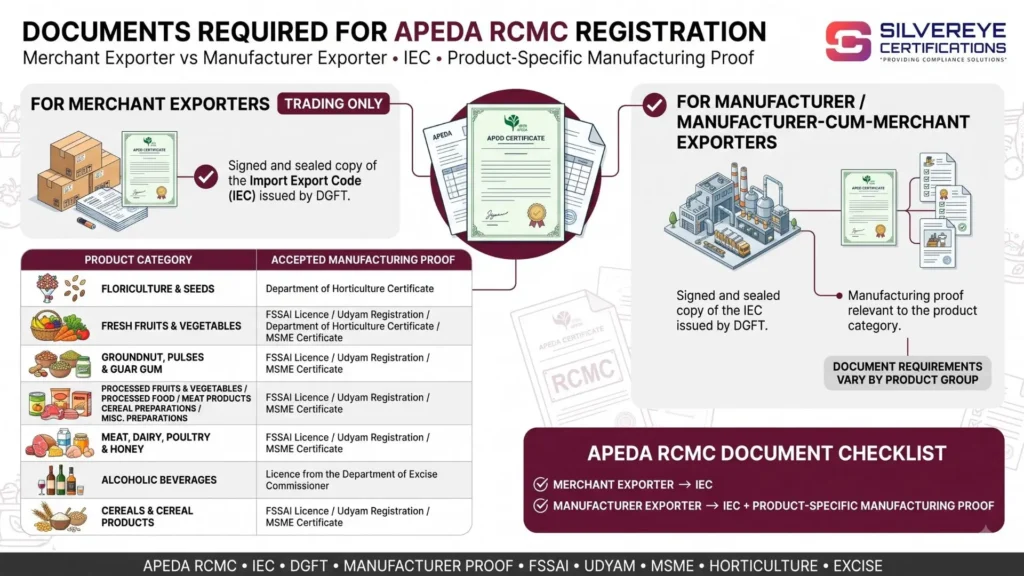
Important tip: Ensure that the legal name, PAN, address and business constitution match across your IEC and supporting documents. Some information may be populated from your IEC profile. Outdated details can lead to application queries. Do not submit another entity's manufacturing licence as your own proof unless the arrangement is legally valid and accepted by APEDA.
How to Apply for APEDA Registration Online: Step-by-Step Process
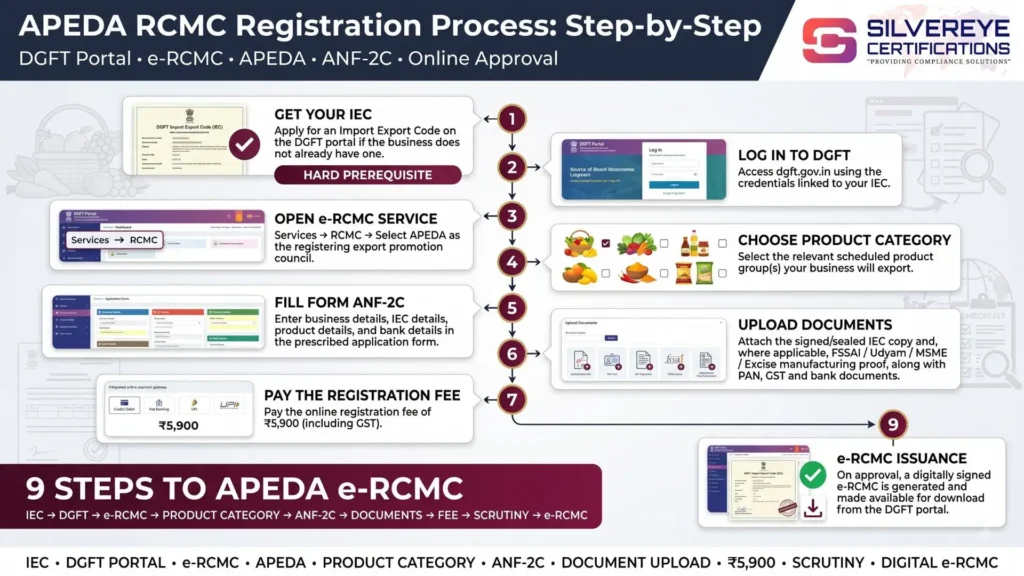
APEDA RCMC applications are processed through the DGFT e-RCMC portal. The following steps outline the general process; portal options may change.
- Obtain or update your IEC: Check that the legal name, PAN, address and business details are correct.
- Log in to the DGFT portal: Visit dgft.gov.in and use your registered credentials.
- Open the e-RCMC service: Select the option to apply for a new e-RCMC.
- Select APEDA as the registering authority: Confirm that APEDA covers your principal export products.
- Enter exporter and product details: Provide the business constitution, exporter category, main line of business and relevant products.
- Upload the supporting documents: Submit clear, valid documents applicable to your exporter category.
- Pay the applicable fee: The stated fee is ₹5,000 plus 18% GST (₹900), totalling ₹5,900. Confirm the amount displayed on the official payment screen.
- Sign and submit: Complete the required digital signature or Aadhaar e-Sign process, as supported by the portal.
- Track the application: Monitor your DGFT dashboard and registered email. If APEDA raises a query, respond with the correct explanation and supporting documents. Once approved, download your e-RCMC.
How Long Does APEDA Registration Take?
Some service providers report processing times of around 7–15 working days for complete applications. Treat this as an estimate rather than a guaranteed or statutory timeline. Processing may take longer if details do not match, manufacturing proof is incomplete or the authority requests clarification.
What Are the APEDA Registration Fees?
The following table reflects the amounts stated in the draft. Confirm the current fee schedule and applicable charges before payment.
| Fee Component | Amount |
|---|---|
| New registration — stated government fee | ₹5,000 |
| GST at 18% | ₹900 |
| Total stated payment | ₹5,900 |
| Renewal | Confirm the current fee through the official portal |
| Amendment after issue | Confirm whether a fee applies under the current procedure |
| Consultant or professional fee | Varies by provider and scope of work |
Some websites may quote the fee before GST. Always verify the final payable amount on the DGFT e-RCMC payment screen. Consultant fees, if any, should be listed separately from government charges.
What Are the APEDA RCMC Validity, Renewal and Amendment Requirements?
| Topic | What to Know |
|---|---|
| Validity | Generally described as five financial years. Check the validity dates and terms on your certificate. |
| Renewal | Submit through the DGFT e-RCMC module when the renewal option is available for your certificate. Keep your IEC active and review business and product details. |
| When to start renewal | As a practical precaution, review the expiry date and prepare documents 60–90 days in advance. This is a planning recommendation, not an official deadline. |
| Amendment | May be needed when business details, address, constitution, product information or authorised signatory details change. Confirm the applicable amendment process. |
| Fresh registration | A change in legal entity or PAN, such as conversion from a proprietorship to a company, may require a new IEC and a fresh registration. Confirm the correct route before applying. |
| Cancellation | Registration may be cancelled under applicable provisions, including where information is incorrect or registration conditions are breached. Check the relevant rule and procedure for the specific circumstances. |
If your APEDA RCMC expires, your ability to rely on it for applicable export-policy benefits or programmes may be affected. Check the current renewal procedure and any separate requirements that apply to your products and shipments.
What Does an Agricultural Exporter Need After APEDA Registration?
An APEDA RCMC confirms your registration as an exporter for the relevant scheduled products. However, it does not independently certify that your produce is safe, organic or residue-free, and it does not replace the importing country's requirements.
- Returns and records: Under Section 14 of the APEDA Act, exporters may need to provide information and returns requested by APEDA. Maintain records of products, quantities, destinations, invoices and shipping bills, and comply with applicable inspection requirements.
- Food safety: An appropriate FSSAI licence or registration may be required for food businesses, depending on their activities and applicable rules.
- Plant health documentation: Fresh produce exports may require phytosanitary certification, along with compliance with the destination country's pest-control and pesticide-residue requirements.
- Organic certification: Products exported with organic claims must meet the applicable certification and importing-country requirements. India's National Programme for Organic Production (NPOP) may apply to relevant exports.
- Product-specific requirements: Meat, dairy, fresh produce, groundnuts and basmati rice may be subject to establishment approvals, traceability, residue monitoring or consignment-specific documentation.
- Export policy checks: The export status of a product may change through DGFT notifications. Check its current ITC (HS) classification and export policy status before confirming a buyer's order.
- Banking and customs setup: Depending on your export arrangements, you may need an Authorised Dealer (AD) code, customs registration and other shipment-related formalities.
What Are the Important 2026 APEDA and Export Policy Updates?
The following updates are mentioned in the draft. Verify their details and current status against official APEDA and DGFT publications before relying on them.
| Date | Reported Update | What It Means for Exporters |
|---|---|---|
| 27 March 2026 | APEDA issued a general circular on the e-RCMC procedure | Review the circular for the applicable exporter-category documents, fees, renewal and amendment procedures. |
| 26 June 2026 | Jan Vishwas amendment framework reportedly took effect | Check the relevant amended legislation and provisions concerning enforcement, adjudication and appeals before relying on older penalty information. |
| 20 July 2026 | DGFT Trade Notice No. 14/2026-27 reportedly invited comments on a proposed amendment to Paragraph 2.57(c) | The draft reportedly proposed an RCMC-related exemption for export consignments up to ₹10,000 FOB in certain FTP-benefit contexts, with exclusions. Confirm whether a final notification has been issued and what it covers. |
Important: Do not treat a consultation draft as an operative exemption. Even if a low-value exemption is finalised, its scope must be read carefully to determine how it interacts with APEDA registration requirements, export-policy benefits and product-specific rules.
What Common Mistakes Can Delay APEDA Registration?
- Choosing the wrong authority: Applying to APEDA when the product falls under another commodity board or registering authority.
- Confusing IEC with RCMC: The IEC identifies the exporter for import-export purposes; the RCMC relates to registration with the relevant authority.
- Selecting the wrong exporter category: Applying as a manufacturer exporter without the required manufacturing or processing evidence.
- Mismatched business details: Differences in the legal name, PAN or address across IEC and supporting records.
- Incomplete documents: Submitting expired licences, unclear scans or documents missing required signatures.
- Incorrect deficiency replies: Re-uploading the same document without addressing the authority's actual query.
- Assuming registration covers everything: An APEDA RCMC does not automatically authorise every product or replace other export permissions.
- Missing the renewal date: Failing to check certificate validity and the applicable renewal procedure in time.
How Do You Choose an APEDA Registration Consultant?
You can apply for an APEDA e-RCMC yourself through the DGFT portal. A consultant may be helpful if you export several product categories, have complex documentation or are working towards a deadline.
Before hiring a service provider, ask:
- Will you verify the correct authority? The consultant should check your product description and HS code before filing.
- Are the fees transparent? Request a written professional-fee quote separate from the applicable government fee.
- Is follow-up included? Confirm whether deficiency responses, application tracking and renewal reminders are part of the service.
- Are the claims realistic? Prefer consultants who refer to official APEDA and DGFT instructions rather than promising guaranteed approval.
- Can they explain related requirements? Ask whether they can guide you on relevant FSSAI, phytosanitary, customs and destination-country requirements.
Be cautious of anyone promising a guaranteed approval date. APEDA registration is subject to review, and the outcome and processing time depend on the application and applicable requirements.
Conclusion
APEDA registration for agricultural products is a straightforward online process, but it requires careful preparation. Confirm your product eligibility, keep your IEC details accurate, select the correct exporter category, ensure all documents match your legal name and address, and track your five-year renewal period. Then, complete any additional export compliance requirements applicable to your products.
If you need professional assistance with product eligibility checks, HS code verification, document preparation, e-RCMC filing, application follow-ups, or renewal, Silvereye Certifications supports agricultural exporters throughout the registration process.
Silvereye Certifications – Your partner for APEDA registration and export compliance.
Frequently Asked Questions
Is APEDA registration mandatory to export agricultural products?
It is required if you export products scheduled under the APEDA Act. Products covered by another board, such as spices or tea, need that board’s registration instead.
Do I need APEDA registration to export vegetables?
Yes, fresh fruits and vegetables are scheduled products. You also need an active IEC and, as a manufacturer exporter, the relevant FSSAI and horticulture proofs.
Can a farmer get APEDA registration?
Yes. A farmer can apply as a proprietor with an IEC, or through a partnership, cooperative or producer company. The exporter type must match how the business actually works.
Is the IEC the same as APEDA registration?
No. The IEC is a general trade code from DGFT and is the prerequisite. The RCMC is the product-specific registration with APEDA.
What is the APEDA registration fee in 2026?
The current fee is ₹5,000 plus 18% GST, so ₹5,900. Confirm the amount on the portal at the time of payment.
How long does APEDA registration take?
A clean application is commonly reported to clear in about 7 to 15 working days. Deficiencies extend this.
How long is the APEDA RCMC valid?
Five financial years. Check the exact dates on your certificate.
Where do I apply?
On the DGFT portal, through the e-RCMC service, by selecting APEDA as the registering authority
Can I change my details after getting the RCMC?
Yes, through the amendment service. Under the current procedure, amendments carry no additional fee. A change of legal entity or PAN may need a fresh registration.
Can APEDA cancel my registration?
Yes, if it was obtained with false information, if conditions are violated, or under the other grounds in Rule 11. You are ordinarily given a chance to respond first.
Does the RCMC allow me to ship immediately?
No. FSSAI, plant health certification, organic certification where claimed, customs and destination-country rules may still apply.
Is the ₹10,000 RCMC exemption in force?
It was proposed in DGFT Trade Notice 14/2026-27 dated 20 July 2026 as a draft. Check DGFT for a final notification before relying on it.