
- Skincare is a major cosmetic category in India, including moisturisers, sunscreens, face washes, serums and toners. Products must comply with applicable CDSCO or State Licensing Authority requirements before being manufactured, imported or sold.
- Importers apply using Form COS-1 to obtain Form COS-2, while domestic manufacturers use Form COS-5 to obtain Form COS-8. The applicable route depends on where the product is manufactured.
- Restricted ingredients and UV filters: Certain ingredients, including mercury and lead compounds, are prohibited or restricted under applicable cosmetic rules. Hydroquinone and sunscreen UV filters must be assessed against the applicable Indian requirements and approved ingredient lists.
- Product claims matter: Claims such as “treats melasma” or “reduces hyperpigmentation” may affect whether a product qualifies as a cosmetic or falls under drug regulation, depending on its formulation, intended use and claims.
Introduction
CDSCO Cosmetic License For Skincare products — including moisturizers, face washes, sunscreens, serums, toners and face masks — are regulated as cosmetics under India's applicable cosmetic regulations. Before they can be marketed, businesses must meet the relevant CDSCO or State Licensing Authority requirements. Importers apply through Form COS-1 via the CDSCO SUGAM portal and, upon approval, receive Form COS-2, while domestic manufacturers apply through Form COS-5 to obtain Form COS-8 from the State Licensing Authority. The applicable validity, retention fee and compliance conditions should be confirmed under the current rules.
Skincare products are subject to specific ingredient restrictions and safety requirements. Ingredients such as mercury compounds and certain lead compounds are prohibited under applicable cosmetic rules, while hydroquinone and sunscreen UV filters must be assessed against the relevant Indian requirements and permitted ingredient lists. Products making claims to treat skin conditions, such as melasma or acne, may be classified as drugs rather than cosmetics, depending on their formulation, intended use and claims.
Skincare is a major category in India's cosmetics market, making product classification, ingredient compliance and licensing important considerations for businesses planning a launch. Sunscreen formulations require careful review of their UV filters, skin-lightening products need particular attention to ingredient restrictions, and anti-ageing serums must use claims that accurately reflect their intended cosmetic purpose.
This guide covers the key aspects of skincare product licensing in India, including product classification, prohibited and restricted ingredients, the import route (COS-1/COS-2), the domestic manufacturing route (COS-5/COS-8), fees, validity, retention requirements and claims that may cause a cosmetic to be classified as a drug.
What Is a CDSCO Cosmetic License for Skincare Products?
A CDSCO Cosmetic License is a commonly used term for the regulatory approval or registration required for certain activities involving cosmetic products in India. Skincare products such as moisturizers, face creams, cleansers, serums, sunscreens and lotions may fall under the definition of cosmetics under the Drugs and Cosmetics Act, 1940 and the Cosmetics Rules, 2020, depending on their intended use, composition and claims.
The Central Drugs Standard Control Organization (CDSCO) regulates the import of cosmetics into India through the Central Licensing Authority. In contrast, the manufacture of cosmetics for sale or distribution is regulated by the relevant State Licensing Authority.
Therefore, the applicable approval depends on whether a business imports skincare products, manufactures them in India or distributes them through wholesale channels.
Types of Cosmetic Approvals for Skincare Products
| Business Activity | Applicable Approval or Requirement | Relevant Authority |
|---|---|---|
| Importing skincare products from another country | Import Registration Certificate in Form COS-2, or the applicable registration route for already-registered cosmetics | CDSCO / Central Licensing Authority |
| Manufacturing skincare products in India | Manufacturing license in Form COS-8 | State Licensing Authority |
| Manufacturing through another licensed manufacturer | Loan manufacturing license in Form COS-9, where applicable | State Licensing Authority |
| Wholesaling skincare products | Compliance with applicable cosmetic sale, stock, distribution and labelling requirements; confirm any premises-specific requirements with the State Licensing Authority | Relevant State Licensing Authority |
Important: A wholesaler should not automatically apply for a CDSCO import registration or manufacturing license merely because it sells skincare products. The requirements depend on whether the business only distributes products, imports them directly, manufactures them or undertakes multiple activities.
Why Do Skincare Products Need CDSCO Registration?
Under the Drugs and Cosmetics Act, 1940, products intended to clean, condition, protect or beautify the skin may qualify as cosmetics when they meet the applicable legal definition and are not classified as drugs. Skincare products are subject to the Cosmetics Rules, 2020, including the relevant provisions and standards for their category. Importers and domestic manufacturers must obtain the applicable CDSCO or State Licensing Authority approval before marketing products in India.
Skincare requires careful regulatory review for two main reasons. First, certain ingredients, including hydroquinone, specific UV filters and prescription-strength retinoids, may be prohibited, restricted or subject to conditions under Indian requirements. Second, skincare marketing can involve claims such as “reduces hyperpigmentation,” “treats acne” or “repairs the skin barrier,” which must be assessed in context to determine whether the product remains a cosmetic or may fall under drug regulation.
Which Skincare Products Require CDSCO Approval? Product Categories and Regulatory Notes
The table below summarises common skincare products and key compliance considerations. The final classification depends on the formulation, intended use, claims and applicable regulatory requirements.
| Product Type | Typical Cosmetic Purpose | Regulatory Notes |
|---|---|---|
| Moisturiser / face cream | Skin conditioning and moisturising | Avoid unsupported disease-treatment claims, such as “heals eczema” |
| Face wash / cleanser | Skin cleansing | Products with medicinal ingredients or therapeutic claims may require drug classification |
| Toner / essence | Skin conditioning and refreshing | Review active ingredients and claims, particularly where prescription medicines are involved |
| Sunscreen (SPF products) | Sun protection | Verify permitted UV filters and substantiate SPF claims with appropriate testing |
| Serum | Skin conditioning and appearance-related benefits | Claims should accurately reflect cosmetic effects rather than imply disease treatment |
| Face mask / sheet mask | Cleansing, moisturising or skin conditioning | Review the ingredient list, safety information and intended use |
| Exfoliant / scrub | Removing dead skin cells and improving skin feel | Check ingredient restrictions and applicable environmental requirements |
| Skin-brightening cream | Improving the appearance of uneven skin tone | Check all brightening ingredients against Indian requirements; hydroquinone requires particular scrutiny |
| Anti-ageing cream / serum | Improving the appearance of fine lines and skin texture | Avoid claims that imply treatment of a disease or an unapproved physiological effect |
| Body lotion | Moisturising and conditioning body skin | Confirm the product's classification, formulation and applicable compliance requirements |
Which Skincare Ingredients Are Prohibited or Restricted in India?
India's cosmetic ingredient requirements include prohibited, restricted and permitted ingredients. These requirements must be checked against the applicable provisions of the Cosmetics Rules, 2020, relevant BIS standards such as IS 4707, and current official guidance.
- Hydroquinone: Do not assume that hydroquinone is permitted in cosmetic skin-lightening products. Check the current Indian ingredient requirements and intended use before importing or manufacturing a formulation containing it.
- Mercury and mercury compounds: Certain mercury compounds are prohibited in cosmetics under applicable rules. Review the formulation and supporting ingredient documentation carefully.
- Lead compounds: Check the applicable restrictions and impurity requirements. Do not assume every lead-related substance has identical regulatory treatment without reviewing the relevant provision.
- UV filters in sunscreens: Confirm that each UV filter is permitted under Indian requirements and complies with any applicable concentration or use conditions. Approval in the EU or US does not automatically establish compliance in India.
Ingredient requirements and regulatory guidance can change. Before filing an application, verify the current status of relevant skin-brightening agents, exfoliating acids, retinoids and UV filters using the latest official sources rather than relying only on approvals in other markets.
When Can a Skincare Product Be Classified as a Drug Instead of a Cosmetic?
Product classification depends on the formulation, intended purpose, ingredients, labelling and marketing claims. Claims that imply the treatment or prevention of a disease may trigger closer scrutiny and could affect the applicable regulatory pathway.
| Claim Area | Example of an Appearance-Focused Claim | Claim That May Require Further Classification Review |
|---|---|---|
| Skin tone / pigmentation | “Helps improve the appearance of uneven skin tone” | “Treats melasma” |
| Acne / blemishes | “Helps reduce the appearance of blemishes” | “Treats acne infection” |
| Sun protection | “Helps protect skin from UV exposure,” where properly substantiated | Claims to treat or prevent a specific UV-related disease |
| Anti-ageing | “Reduces the appearance of fine lines” | Claims to correct a medical or physiological condition |
These examples are indicative, not definitive legal classifications. A phrase such as “reduces hyperpigmentation” or “repairs the skin barrier” is not automatically a drug claim in every context. The full formulation, intended use and presentation must be considered.
Review product labels, packaging and marketing copy before filing. This can help identify classification issues early and reduce the risk of application queries or delays.
Import vs. Manufacture: Which Licensing Route Applies to Your Skincare Product?
The applicable route depends primarily on where the skincare product is manufactured.
| Parameter | Import Route (COS-1 → COS-2) | Domestic Manufacturing Route (COS-5 → COS-8) |
|---|---|---|
| Applies to | Skincare products manufactured outside India and imported for sale | Skincare products manufactured in India |
| Licensing authority | CDSCO / Central Licensing Authority | Relevant State Licensing Authority |
| Applicant | Eligible Indian authorised agent, subsidiary or importer, as applicable | Indian entity responsible for the manufacturing facility |
| Validity / retention | Generally 5 years, subject to applicable rules | Subject to applicable retention-fee and compliance requirements |
How Does the Skincare Import Process Work? Form COS-1 to Form COS-2
Foreign skincare brands entering India, along with Indian importers sourcing moisturisers, sunscreens, serums and other skincare products, must obtain the applicable import registration before marketing the products in India.
- Eligibility: The foreign manufacturer generally applies through an eligible Indian authorised agent or other permitted applicant, in accordance with the applicable rules.
- Core documents: Depending on the product and application, documents may include a Certificate of Free Sale, manufacturer's GMP evidence, a complete ingredient list, relevant safety and test data, sunscreen SPF reports where applicable, proposed labels and a Power of Attorney or authorisation document.
- Ingredient screening: Check active ingredients, particularly UV filters and skin-brightening ingredients, against Indian requirements before submitting the application.
- Application process: Identify the correct product category, compile the supporting documents, submit Form COS-1 through the applicable CDSCO portal process, respond to queries and obtain Form COS-2 if the application is approved.
Document requirements can vary by product and application. Confirm the current checklist and portal instructions before filing. For a detailed walkthrough, refer to our companion guides on cosmetic import registration in India.
How Does the Domestic Manufacturing Route Work? Form COS-5 to Form COS-8
Domestic skincare manufacturers, including contract manufacturers producing moisturisers, sunscreens and serums for other brands, must obtain the applicable manufacturing licence from their State Licensing Authority before starting production.
- Eligibility: The manufacturing facility must meet applicable requirements for qualified technical personnel and competent supervision.
- Core documents: Depending on the application, documents may include a Site Master File, plant layout, equipment list, product list, technical staff qualifications and GMP-related declarations.
- Application process: Submit Form COS-5 with the required supporting documents and Form COS-7 declaration, where applicable. The authority reviews the application and may inspect the facility before granting Form COS-8.
- Loan licence option: Brands that do not operate their own manufacturing facility may explore the loan-licence route, generally Form COS-6 to Form COS-9, subject to the applicable requirements and the suitability of the third-party facility.
Inspection and approval timelines depend on the application, documentation and authority's review. Confirm the current requirements and timelines before planning a product launch.
Documents Required for CDSCO Cosmetic Registration for Importers
Businesses importing skincare products into India must follow the applicable cosmetic import registration process. The application is generally submitted in Form COS-1 to obtain an Import Registration Certificate in Form COS-2. For cosmetics already registered in India, the applicable Form COS-4/COS-4A route may be relevant.
The following documents are commonly required, depending on the product, manufacturer and application type.
- Business Registration Documents: Certificate of incorporation, partnership deed or proprietorship details, as applicable.
- IEC Certificate: Importer Exporter Code issued by the Directorate General of Foreign Trade.
- GST Registration Certificate: GSTIN details of the Indian applicant, where applicable.
- Authorization Letter or Power of Attorney: Authorization from the overseas manufacturer appointing the Indian agent, importer or authorized representative, prepared and authenticated as required under the rules.
- Manufacturer and Manufacturing Site Details: Legal name, full address and details of the actual manufacturing premises.
- Product Information: Product names, brand names, cosmetic categories, pack sizes and variants proposed for import.
- Ingredient Composition: List of ingredients using standard nomenclature, including their percentages.
- Proposed Product Labels: Labels demonstrating compliance with applicable Indian cosmetic labelling requirements.
- Product Specifications and Test Methods: Relevant quality specifications and testing methods.
- Free Sale Certificate: Certificate for the products from the relevant authority or other acceptable organisation, as applicable.
- Manufacturing or Marketing Authorization: Copy of the applicable license, registration or marketing authorization from the country of origin, where available.
- Animal Testing Undertaking: Required undertaking regarding compliance with applicable animal-testing restrictions.
- Quality and Safety Undertakings: Applicable declarations concerning raw materials, pigments, heavy metals and other regulatory requirements.
- Application Documents and Fee Receipt: Completed application, covering letter, supporting documents and applicable fee payment acknowledgement.

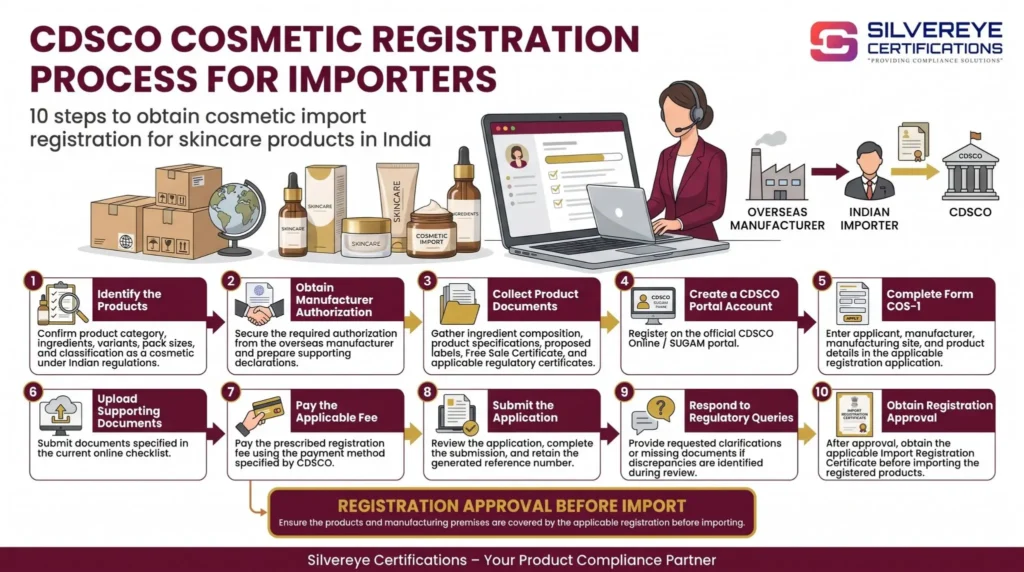
Process for CDSCO Cosmetic Registration for Importers
Follow these steps when applying to import skincare products into India.
- Identify the Products: Confirm the product category, ingredients, variants, pack sizes and whether the product is treated as a cosmetic under Indian regulations.
- Obtain Manufacturer Authorization: Secure the required authorization from the overseas manufacturer and prepare the supporting declarations.
- Collect Product Documents: Obtain the ingredient composition, product specifications, proposed labels, free sale certificate and applicable regulatory certificates.
- Create a CDSCO Portal Account: Register on the official CDSCO Online/SUGAM portal.
- Complete Form COS-1: Enter the applicant, manufacturer, manufacturing site and product details in the applicable registration application.
- Upload Supporting Documents: Submit the documents specified in the current online checklist.
- Pay the Applicable Fee: Pay the prescribed registration fee through the payment method specified by CDSCO.
- Submit the Application: Review the application, complete the submission and retain the generated reference number.
- Respond to Regulatory Queries: If the reviewing officer identifies missing documents or discrepancies, submit the required clarifications.
- Obtain Registration Approval: Once the application is approved, obtain the applicable Import Registration Certificate before importing the registered products.
Note: If a skincare product qualifies as a new cosmetic under the Cosmetics Rules, 2020, prior permission in Form COS-3 may be required. The product's regulatory classification should be checked before filing.
Documents Required for a Cosmetic Manufacturing License
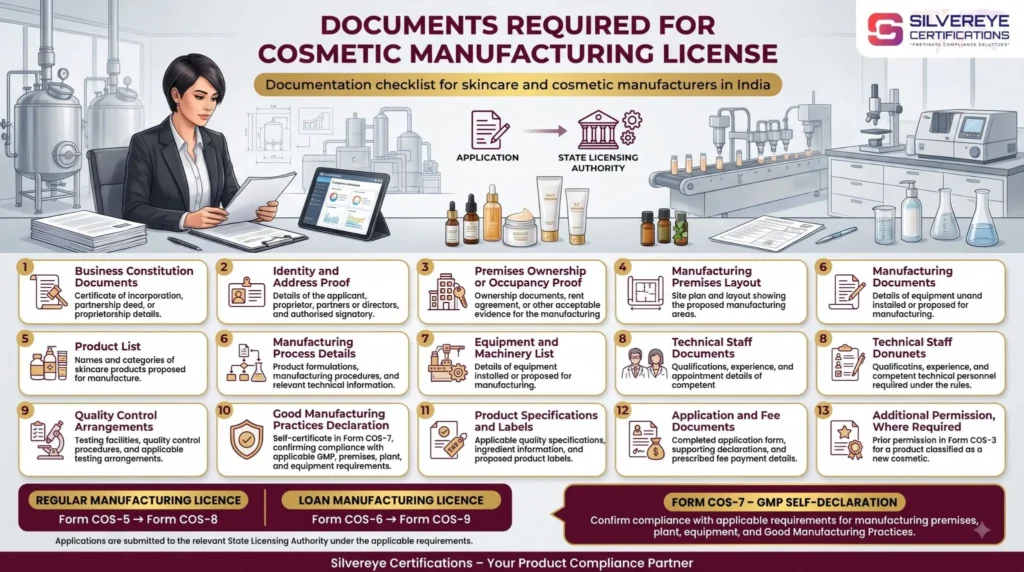
Businesses manufacturing skincare products in India must apply to the State Licensing Authority for the applicable manufacturing license. A regular manufacturing application is made in Form COS-5, while a loan license application is made in Form COS-6. The corresponding licenses are issued in Form COS-8 and Form COS-9, respectively.
Commonly required documents include:
- Business Constitution Documents: Certificate of incorporation, partnership deed or proprietorship details.
- Identity and Address Proof: Details of the applicant, proprietor, partners or directors and authorized signatory.
- Premises Ownership or Occupancy Proof: Ownership documents, rent agreement or other acceptable evidence for the manufacturing premises.
- Manufacturing Premises Layout: Site plan and layout showing the proposed manufacturing areas.
- Product List: Names and categories of skincare products proposed for manufacture.
- Manufacturing Process Details: Product formulations, manufacturing procedures and relevant technical information.
- Equipment and Machinery List: Details of the equipment installed or proposed for manufacturing.
- Technical Staff Documents: Qualifications, experience and appointment details of the competent technical personnel required under the rules.
- Quality Control Arrangements: Testing facilities, quality control procedures and arrangements for testing, as applicable.
- Good Manufacturing Practices Declaration: Self-certificate in Form COS-7, confirming compliance with applicable GMP, premises, plant and equipment requirements.
- Product Specifications and Labels: Applicable quality specifications, ingredient information and proposed labels.
- Application and Fee Documents: Completed application form, supporting declarations and prescribed fee payment details.
- Additional Permission, Where Required: Prior permission in Form COS-3 for a product classified as a new cosmetic.
The State Licensing Authority may request additional documents or clarification based on the product category, facility and application.
Process for Obtaining a Cosmetic Manufacturing License
- Select the Manufacturing Model: Decide whether to manufacture at your own facility or use another licensed manufacturer's facility under the applicable loan-license route.
- Prepare the Manufacturing Premises: Ensure that the facility, equipment, storage areas and quality control arrangements meet the applicable requirements.
- Appoint Qualified Technical Staff: Arrange the technical supervision required under the Cosmetics Rules, 2020.
- Prepare the Documentation: Collect the premises layout, machinery details, product list, manufacturing information and technical staff records.
- Complete the Application: Apply in Form COS-5 for a manufacturing licence or Form COS-6 for a loan licence through the applicable state process.
- Submit Form COS-7: Provide the required self-declaration regarding Good Manufacturing Practices and compliance with the applicable premises and equipment requirements.
- Pay the Prescribed Fee: Submit the application with the applicable fee and supporting documents.
- Respond to Scrutiny: Provide any additional information or corrections requested by the State Licensing Authority.
- Receive the Licence: If the requirements are met, the authority may grant the manufacturing licence in Form COS-8 or the loan licence in Form COS-9.
- Complete Post-License Requirements: Comply with applicable requirements, including uploading the license to the CDSCO website as prescribed and cooperating with the relevant inspection and verification process.
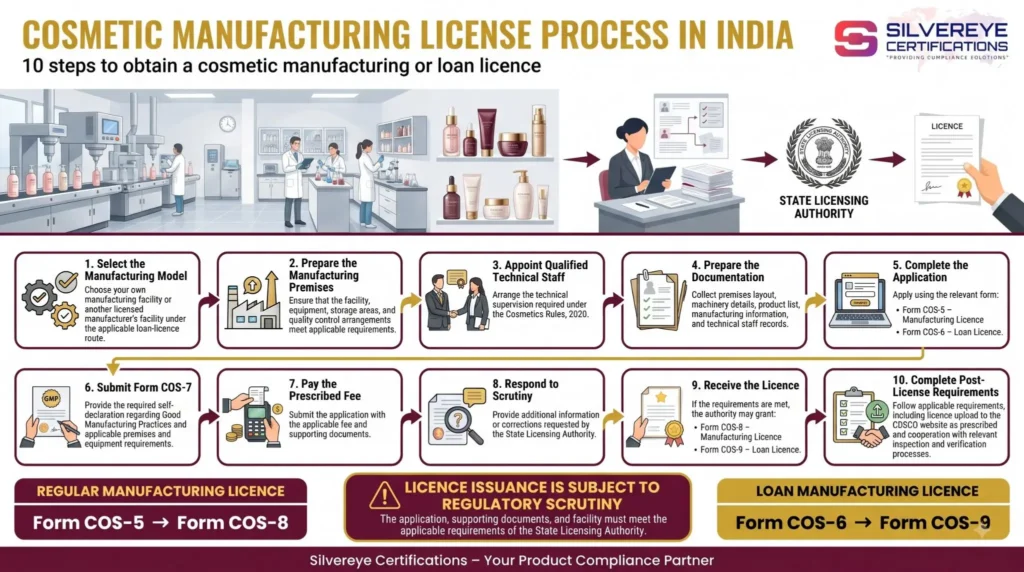
Under Rule 23, the rules provide for grant of a license within 45 days after receipt of a compliant application and required documents, subject to the conditions specified in the rules. Actual processing may depend on scrutiny and the applicable state procedure.
Documents Required for Skincare Product Wholesalers
A wholesaler purchases skincare products in bulk and supplies them to retailers, distributors, salons or other businesses. The applicable requirements differ from those for a manufacturer or direct importer.
The Cosmetics Rules, 2020 place the regulation of cosmetic sale, stock and distribution under the relevant State Licensing Authority. Wholesalers should confirm the specific requirements applicable to their business premises and activities with the State Drugs Control Department.
The following documents are useful for establishing and operating a wholesale skincare business:
- Business Registration Proof: Proprietorship, partnership, LLP or company registration documents, as applicable.
- PAN and Identity Proof: PAN and identity/address documents of the proprietor or authorized persons.
- GST Registration Certificate: GST registration details, where applicable to the business.
- Premises Proof: Ownership documents, rent agreement or other acceptable proof of the business or warehouse address.
- Supplier Invoices: Purchase invoices and records showing the source of the skincare products.
- Supplier and Manufacturer Details: Details of the manufacturers, authorised distributors or importers supplying the products.
- Product Compliance Records: Copies of relevant manufacturing licences or import registration details, as applicable to the products sourced.
- Stock and Distribution Records: Records of purchases, stock movement, sales and distribution.
- Storage Information: Details of storage arrangements appropriate for the products and their labelled storage conditions.
- Local Registrations: Shop and Establishment registration or other local permissions, where required.
- Additional State-Specific Documents: Any application, declaration or premises documents requested by the relevant State Licensing Authority.

Important: This is a practical document checklist, not a universal statutory application list for every wholesaler. Confirm whether a separate state approval or registration is required for the specific wholesale activity and location before commencing operations.
Process for Starting a Skincare Wholesale Business
- Register the Business: Establish the appropriate business structure and obtain the applicable business and tax registrations.
- Confirm State Requirements: Contact the relevant State Drugs Control Department to check the requirements for stocking, selling and distributing cosmetics.
- Arrange Suitable Premises: Ensure that the shop or warehouse is suitable for storing skincare products according to their labelling and storage requirements.
- Choose Compliant Suppliers: Purchase products from legitimate manufacturers, registered importers or authorised distributors.
- Verify Product Documents: Check applicable manufacturing licences, import registration details, product labels, invoices and supplier records.
- Set Up Inventory Records: Maintain purchase invoices, batch or lot details, stock records and distribution records to support traceability.
- Complete Applicable Registrations: Obtain any state-level or local permissions required for the business.
- Follow Labelling and Sale Requirements: Ensure that products are properly labelled and comply with applicable standards before supplying them to customers.
- Maintain Ongoing Compliance: Monitor stock condition, expiry dates, product complaints and regulatory updates.
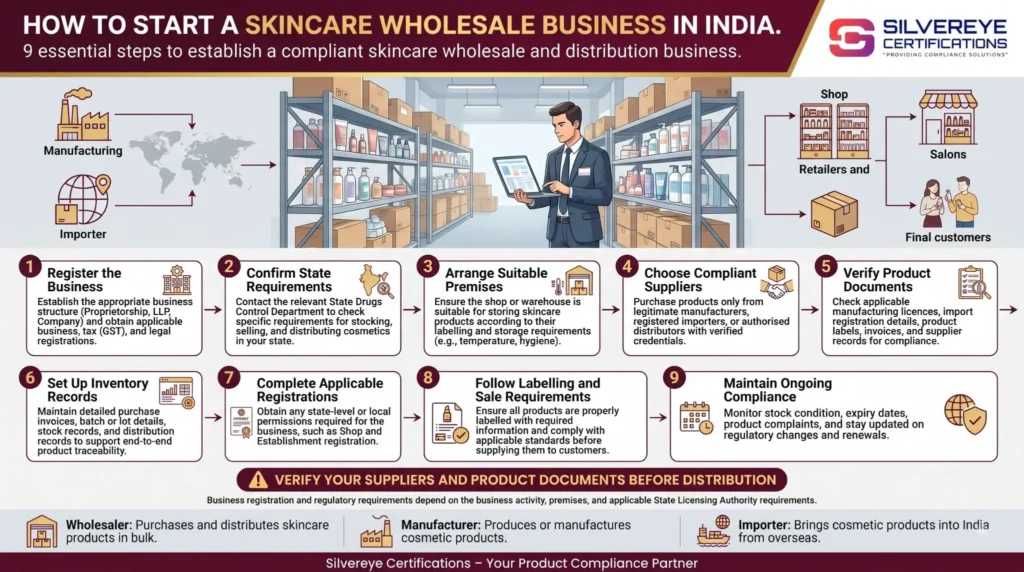
A wholesaler who also imports skincare products directly must assess the applicable CDSCO import registration requirements separately. Similarly, a wholesaler who manufactures or repackages products may have additional regulatory obligations depending on the activity.
What Are the Fees for Skincare Product Registration?
The fees depend on whether you are importing skincare products or manufacturing them in India. The figures below are indicative and should be verified against the current official fee schedule before filing.
| Route | Fee Component | Indicative Amount in the Draft |
|---|---|---|
| Import (COS-1/COS-2) | Per product category, such as skincare | USD 1,000 |
| Import (COS-1/COS-2) | Per foreign manufacturing site | USD 500 |
| Import (COS-1/COS-2) | Per product variant, where applicable | USD 50 |
| Manufacturing (COS-5/COS-8) | Manufacturing licence fee | Approximately ₹2,500–₹5,000; varies by applicable fee schedule |
| Manufacturing (COS-5/COS-8) | Retention fee | Confirm the current amount and payment schedule with the relevant authority |
A skincare brand selling several products, such as a cleanser, moisturiser and sunscreen, should confirm how each product is categorised and charged. Do not assume that all products or variants can be covered under a single category fee without checking the applicable CDSCO requirements.
What Are the Validity and Renewal Requirements for Skincare Product Licenses?
| Aspect | COS-2 — Import Registration | COS-8 — Manufacturing Licence |
|---|---|---|
| Validity | Generally 5 years, subject to applicable rules | Generally perpetual, subject to compliance and retention requirements |
| Renewal or retention | Follow the applicable renewal procedure and submit the required documents | Pay the applicable retention fee within the prescribed period |
| Risk of non-compliance | Expiry or non-compliance may affect imports and market access | Failure to meet retention or licensing conditions may affect the licence |
Confirm the applicable renewal form, fee, due date and supporting documents against the current Cosmetics Rules and official portal instructions before filing.
How Long Does Skincare Product Approval Take?
The approval timeline varies depending on the route, completeness of the application, authority review and any inspection or additional queries.
| Stage | Import Route | Manufacturing Route |
|---|---|---|
| Document preparation | Allow time to compile the product dossier and supporting evidence | Prepare facility, personnel and product documentation |
| Authority review | Depends on the applicable rules and review process | Application and document verification by the State Licensing Authority |
| Site inspection | Generally not part of the domestic manufacturing-site inspection process for an import application | May be required to assess manufacturing and GMP compliance |
| Grant of registration or licence | After the application meets the applicable requirements | After the application, inspection and other applicable requirements are satisfied |
Treat any specific processing period as an estimate unless it is supported by a current official rule or published service timeline. Avoid planning a launch around an unverified guaranteed approval date.
What Common Skincare Product Registration Mistakes Should You Avoid?
- Ignoring ingredient restrictions: Check skin-lightening formulations containing hydroquinone against India's current ingredient requirements before filing.
- Assuming foreign approval is sufficient: A UV filter accepted in the EU or US is not automatically permitted for use in an Indian sunscreen.
- Using therapeutic marketing claims: Claims such as “treats melasma” or “heals acne” may trigger closer scrutiny of the product's classification.
- Submitting incomplete test data: Missing or inadequate SPF, safety or supporting technical documentation may delay a sunscreen application.
- Overlooking product classification: Review anti-ageing and brightening products based on their formulation, intended use, labelling and claims rather than assuming they automatically qualify as cosmetics.
What Are the Benefits of Proper Skincare Product Licensing?
- Regulatory compliance: Appropriate approvals help businesses meet applicable requirements before importing or manufacturing skincare products.
- Retail and marketplace readiness: Valid regulatory documentation may be required by e-commerce platforms, distributors and organised retailers.
- Consumer confidence: Clear documentation and ingredient compliance support responsible product marketing and quality assurance.
- Fewer classification issues: Reviewing formulation, labelling and claims before filing can help reduce avoidable queries, rework and delays.
How Can Silvereye Certifications Help with Skincare Product Licensing?
Silvereye Certifications, a Noida-based regulatory compliance consultancy, supports manufacturers, importers and direct-to-consumer cosmetic brands with BIS Certification, CDSCO Registration, EPR Authorisation and related compliance services across India.
For skincare product licensing, Silvereye Certifications can assist with:
- Ingredient screening: Reviewing formulations for potentially prohibited or restricted ingredients, including hydroquinone, mercury compounds and UV filters.
- Claims and label review: Assessing product claims and labelling for potential classification concerns.
- Application support: Assisting with the applicable COS-1/COS-2 import route or COS-5/COS-8 manufacturing route, including loan-licence applications where applicable.
- Sunscreen documentation: Helping organise SPF test reports and relevant safety documentation.
Whether you plan to import finished skincare products or manufacture them in India, contact Silvereye Certifications for an initial review of your formulation, product claims and applicable licensing route before filing.
Conclusion
Skincare products in India require careful attention to product classification, ingredient compliance and licensing requirements. Ingredients such as hydroquinone and mercury compounds, as well as UV filters that do not meet Indian requirements, can create regulatory issues. Similarly, therapeutic marketing claims may affect whether a product is classified as a cosmetic or a drug. Getting these details right from the beginning can help reduce avoidable delays during product registration.
Whether you are importing skincare products through the COS-1/COS-2 route, manufacturing them in India through the COS-5/COS-8 route, or exploring a loan licence to use a third-party manufacturing facility, ingredient screening, claims review and the correct application route are essential parts of the process.
For a category-specific review of your skincare products, Silvereye Certifications can help assess your formulation, product claims, documentation and applicable licensing requirements before you file.
Frequently Asked Questions
Do I need CDSCO registration to sell face cream in India?
Yes. Face creams and moisturisers fall under CDSCO's skincare cosmetic category, and need COS-2 (if imported) or COS-8 (if manufactured domestically) before they can be legally sold.
Is hydroquinone banned in India?
It's prohibited as a skin-lightening active in cosmetics; it is reported to be permitted only in artificial nail systems at a very low concentration, not in leave-on skin-lightening or brightening products. Confirm the current status with CDSCO before formulating or importing.
Is sunscreen regulated as a cosmetic or a drug in India?
Sunscreens making cosmetic sun-protection claims (e.g., protecting against sunburn) are regulated as cosmetics, provided the UV filters used are on India's approved list and SPF claims are substantiated with accredited testing. Claims to treat or prevent a specific UV-related medical condition can shift a product toward drug classification.
Can an anti-aging serum be registered as a cosmetic?
Yes, as long as its claims stay cosmetic in nature — such as reducing the appearance of fine lines — rather than claiming a physiological or medical skin-barrier repair, which risks drug classification.
What documents do I need to import a skincare brand into India?
The standard COS-1 dossier applies: Certificate of Free Sale, manufacturer's GMP certificate, ingredient list, safety/test data (including SPF reports for sunscreens), English-language labels, Power of Attorney, and IEC.
Are all UV filters used abroad accepted in Indian sunscreens?
No. A UV filter approved in the EU or US isn't automatically accepted in India — every UV filter should be checked against India's permitted list before formulation and registration.
How long does it take to get a skincare product registered?
Import registration (COS-2) can take up to 180 working days; manufacturing licenses (COS-8) generally take around 45 days after document verification, following a 30–60 day inspection window.
Can I manufacture skincare products without owning a factory?
Yes — through the loan license route (Form COS-6 with a GMP self-declaration in Form COS-7), which grants Form COS-9 and lets you manufacture at a third party's already-licensed facility.
What claims should I avoid on skincare product labels?
Avoid therapeutic or medical language such as "treats melasma," "heals acne," or "repairs skin barrier" — these can shift a product from the cosmetic route into stricter drug regulation. Cosmetic-appropriate alternatives include "evens skin tone" or "reduces the appearance of blemishes."
How much does it cost to register a skincare product line?
Import fees are commonly around USD 1,000 per category plus USD 500 per manufacturing site and USD 50 per variant; manufacturing license fees are typically ₹2,500–₹5,000 at the state level, varying by state.
Are mercury and lead allowed in Indian cosmetics?
No. Mercury and mercury compounds, along with lead compounds, are prohibited in cosmetics sold in India, including in certain traditional or Ayurvedic-origin skincare formulations that may contain trace amounts.
Can one CDSCO filing cover multiple skincare products?
Often yes, as variants within the same skincare category — for example, a moisturizer and a sunscreen filed as variants — which can be more cost-efficient than separate category filings. Confirm the applicable categorization with CDSCO or a regulatory consultant during filing.