
- Exporter registration is a one-time setup that should be completed before applying for a phytosanitary certificate for your first consignment.
- You need an active IEC and accurate business details, and the information should match the names and details shown on your shipping and export documents.
- Registration is not the phytosanitary certificate itself. Each export consignment generally requires a separate application, inspection where applicable, and certificate issuance.
- Complete the registration and profile setup well before your first shipment. Correcting incomplete or incorrect details later can cause delays to an active consignment.
Introduction
The phytosanitary certificate registration process is the one-time setup where an Indian exporter creates an account on the government's plant quarantine portal and links their business details, mainly the Importer Exporter Code (IEC). After registering, you can file a separate application for each consignment, which is then inspected before the certificate is issued.
Keep your business name, contact details and IEC consistent everywhere. Screens and requirements can change, so follow the current portal instructions or confirm with your Plant Quarantine Station.
What Is the Phytosanitary Certificate Registration Process?
Many exporters use these words as if they mean the same thing, and that confusion causes wasted time. Here is the difference.
| Stage | What it means | How often |
|---|---|---|
| Registration | Creating your exporter profile on the plant quarantine portal with business and contact details | Once, then keep it updated |
| Application | Requesting inspection and certification for one specific consignment | For every shipment |
| Certificate | The official document issued after the required inspection and certification process | One per consignment |
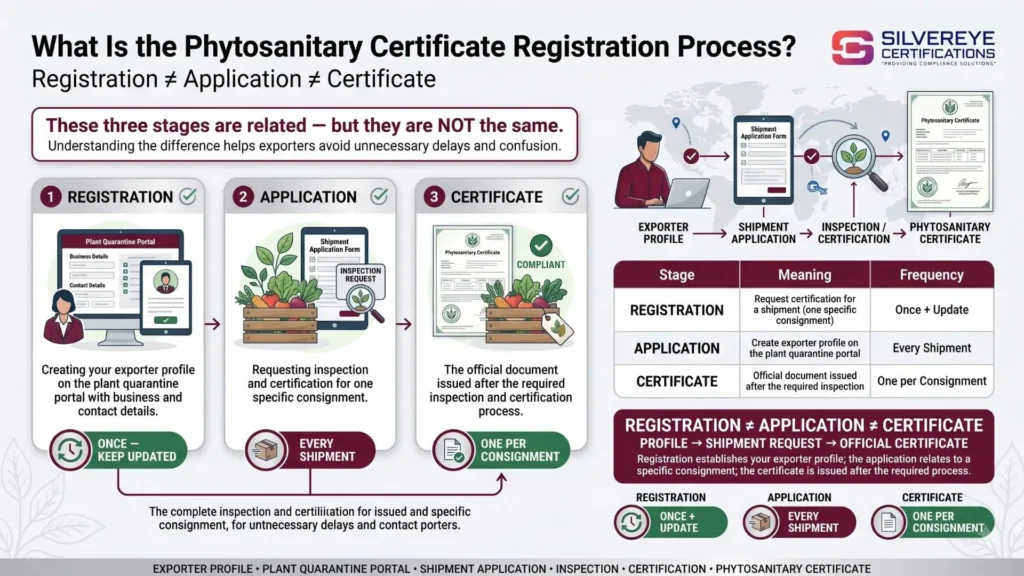
If someone tells you that you are "registered for phytosanitary", it means you can apply. It does not mean any shipment is already cleared.
Who Needs to Complete the Phytosanitary Certificate Registration Process?
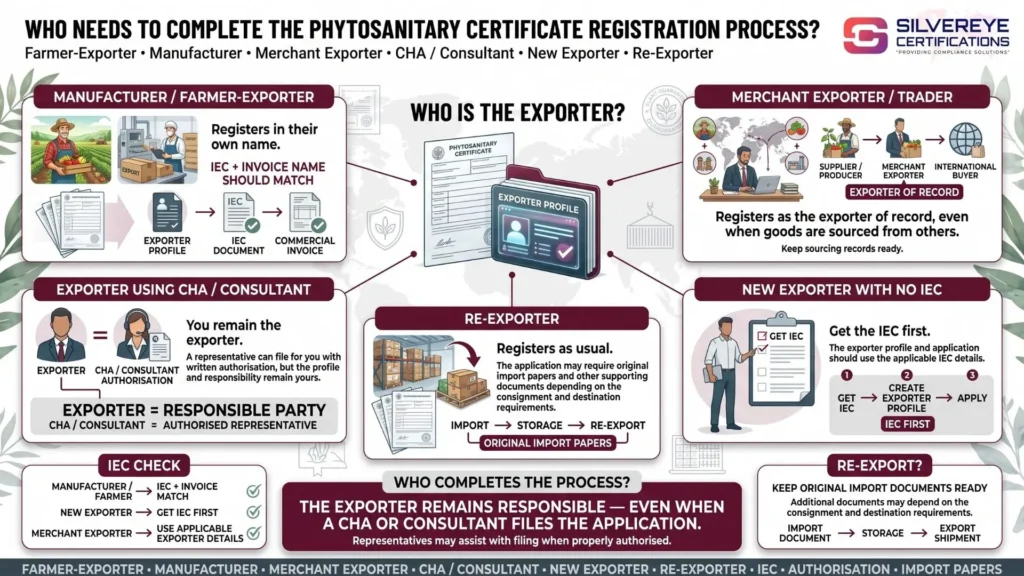
| Type of exporter | What to know |
|---|---|
| Manufacturer or farmer-exporter | Registers in their own name. The IEC and the invoice name should match. |
| Merchant exporter or trader | Registers as the exporter of record, even if goods are sourced from others. Keep sourcing records ready. |
| Exporter using a CHA or consultant | You are still the exporter. The representative can file for you with a written authorisation, but the profile and responsibility remain yours. |
| New exporter with no IEC | Get the IEC first. The exporter profile/application should use the applicable IEC details. |
| Exporter re-exporting imported goods | Registers as usual. The application may require original import papers and other supporting documents, depending on the consignment and destination requirements. |
What Should You Check Before Registering for a Phytosanitary Certificate?
- An active IEC in the name of the business or person who will appear on the invoice.
- A valid business identity and address that can be matched with your IEC and shipping papers.
- A working email address and mobile number you check regularly, because notices and updates may come there.
- Goods that fall under plants, plant products or regulated articles for which the importing country requires phytosanitary certification.
- Awareness of the destination country's import conditions, so you have the right product and certification requirements in mind before applying.
How Do You Complete the Phytosanitary Certificate Registration Process?
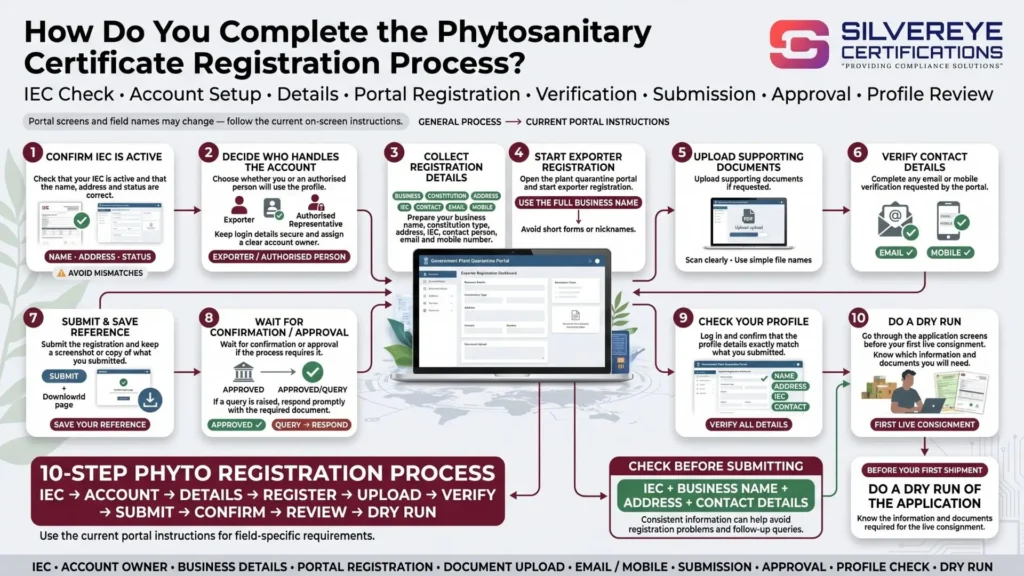
Portal screens and field names can change from time to time, so treat the steps below as the general path and rely on the current on-screen instructions for anything specific.
- Confirm your IEC is active. Check that the name, address and status are correct. A mismatch here can cause registration problems later.
- Decide who will handle the account. Choose whether you or an authorised person will use the profile, and keep the login details in a safe place with a clear owner.
- Collect your registration details. Business name, constitution type, address, IEC, contact person, email and mobile number.
- Open the government plant quarantine portal and start exporter registration. Fill in the requested details carefully. Do not use short forms or nicknames for the business name.
- Upload supporting documents if asked. Scan them clearly and keep file names simple.
- Verify your contact details. Complete any email or mobile verification the portal asks for.
- Submit and note your reference. Keep a screenshot or copy of what you submitted.
- Wait for confirmation or approval if the process requires it. Some profiles or applications may be checked by the concerned office. If there is a query, reply promptly with the required document.
- Log in and check your profile. Confirm that the details shown are exactly what you submitted.
- Do a dry run before the first shipment. Go through the application screens without rushing, so you know which information and documents you will need for your first live consignment.
What Happens After You Complete Phytosanitary Registration?
Registration only opens the door. For each shipment, you will file a fresh application with the product, quantity, consignee and shipping details, upload the required documents, pay the prescribed fee, and arrange inspection where required. The certificate is issued only if the goods and documents comply with the applicable requirements. The full sequence is explained in our main guide, and the document list is on our required documents page.
What Other Registrations or Approvals May Be Needed Alongside Phytosanitary Certification?
Depending on your product and destination, phytosanitary registration may be only one of several requirements. Here is how they usually fit together.
| Registration or approval | Why it may matter |
|---|---|
| IEC | Basic requirement for commercial exporters |
| Product-specific registration | For example, Spices Board registration for applicable spice exporters, or registration with the relevant authority for other agricultural products |
| Treatment operator approval | If fumigation or another treatment is required, use an approved or authorised operator, as applicable |
| Packhouse or source registration | Some fresh produce markets or importing countries may require registered farms or packhouses and traceability |
| Buyer-country import permit | Required by many destinations for seeds, plants and certain fresh produce |
What Are the Fees, Validity and Renewal Requirements for Phytosanitary Registration?
There are three fee-related questions exporters usually ask. First, whether registration itself has a charge. This should be checked on the official portal at the time you register, since fee schedules can change. Second, there are per-consignment inspection and certificate charges, where applicable, which are notified by the government and paid through the prescribed process. Third, there may be additional costs outside the government fee, such as treatment, testing and service charges.
For validity and renewal, treat your registration profile as something that should be kept current, rather than something to forget after the initial setup. If your business address, contact person, IEC details or authorised representative changes, update the profile promptly.
Whether a registration requires periodic renewal or re-validation should be confirmed from the current portal instructions or with the concerned Plant Quarantine Station. It is safer to check the current requirement than to rely on a general rule.
The phytosanitary certificate is different from registration. The certificate relates to a specific consignment, and its acceptance is subject to the requirements of the importing country.
How Long Does Phytosanitary Registration Take?
There is no single guaranteed processing time. It can depend on the accuracy of your details, whether any office review is required, and how quickly you respond to queries.
A complete submission with accurate and matching information is usually the best way to avoid unnecessary delays. Give yourself a comfortable gap of days or weeks, rather than hours, before your first shipment date.
What Are the Common Phytosanitary Registration Mistakes to Avoid?
| Mistake | How to avoid it |
|---|---|
| Business name differs from the IEC | Copy the name exactly as it appears on the IEC |
| Using an email or phone number nobody monitors | Use a contact that the responsible person checks regularly |
| Sharing one login across many people with no owner | Assign a single account owner and record who has access |
| Waiting until the shipment is packed | Register and check the account before the goods are ready |
| Not updating changes in address or authorised person | Update the profile when the business details change |
| Confusing registration with clearance | Remember that every consignment still needs its own application and applicable inspection/certification process |
What Practical Tips Should Exporters Follow in 2026?
- Register early, ideally when you close your first export order rather than when the container is already booked.
- Keep a simple record sheet with your login owner, registered email, registered mobile and profile details.
- Ask your buyer for the written import conditions and note the product requirements before you begin.
- Check the official portal for updated instructions, as digital processes and portal requirements can change over time.
- Save screenshots or copies of important submissions and confirmations.
- If you use a consultant or authorised representative, provide appropriate written authorisation and ask for copies of everything filed on your behalf.
Need Help With the Phytosanitary Certificate Registration Process? Silvereye Certifications
A smooth registration is mostly about accurate details and good preparation. Silvereye Certifications supports exporters with certification and registration paperwork, including guidance for Spices Board registration, so your profile, documents and shipment plan line up before your first application.
Share your business type, product and destination country with Silvereye Certifications, and ask for a registration checklist that fits your shipment.
Frequently Asked Questions
What is the phytosanitary certificate registration process?
It is the one-time setup where an exporter creates a profile on the government plant quarantine portal so that they can apply for certificates for their consignments.
Is registration the same as getting the certificate?
No. Registration lets you apply. The certificate is issued separately for each consignment after inspection.
Do I need an IEC to register?
An IEC is normally expected for commercial exporters, so get it first. Confirm your specific case with the Plant Quarantine Station.
Can a consultant register on my behalf?
A representative can help with the process, but the exporter remains responsible. Give a written authorization and keep copies of what is filed.
How long does registration take?
It varies with the accuracy of your submission and any review or queries. Register well before your first shipment.
Is there a fee to register?
Check the portal at the time of registration, since fee schedules can change. Per-consignment charges are separate.
Do I have to register again for every shipment?
No. Registration is one-time, but you must file a new application for every consignment.
What should I do if my business details change?
Update the profile promptly and keep proof of the change, especially if the name or IEC details are affected.
Does registration guarantee that my goods will be cleared?
No. Clearance depends on inspection and on meeting the importing country's conditions.
What if my registration is rejected or queried?
Read the reason carefully, correct the detail, and resubmit with clear supporting documents.
Do all exporters of plant products need it?
Only if the importing country requires a phytosanitary certificate for the product. Check the destination's import conditions.
Where can I get help with the process?
You can contact your local Plant Quarantine Station or work with a compliance consultant such as Silvereye Certifications.