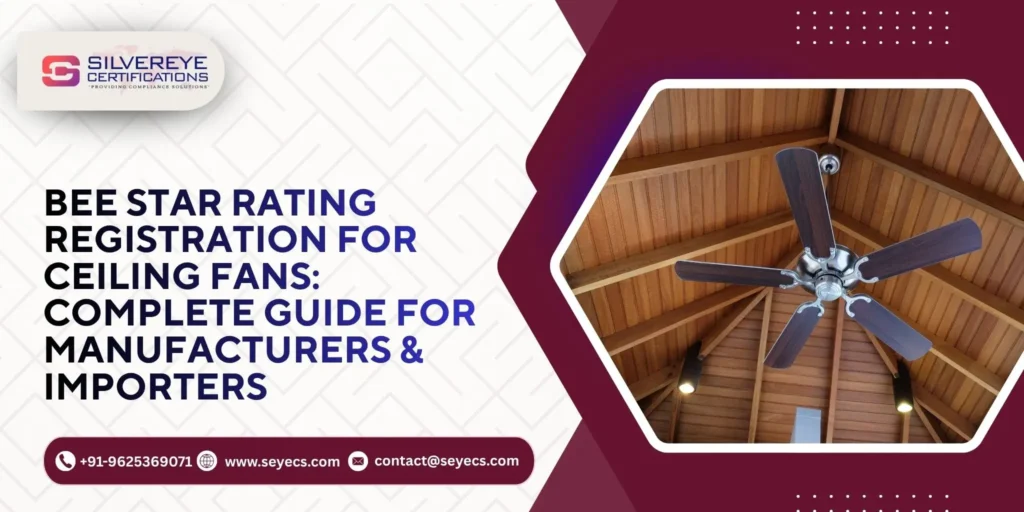
BEE Star Rating Registration for ceiling fans is mandatory in India since January 2023 under the Bureau of Energy Efficiency (BEE) Standards & Labelling programme, governed by IS 374:2019.
Manufacturers and importers first complete company registration on the BEE portal, followed by testing of each fan model at a NABL-accredited laboratory to determine its Service Value — calculated using air delivery (CMM) divided by power consumption (Watts).
Based on the Service Value, BEE assigns a 1-to-5 star rating under the applicable 2026–2028 star rating table. After model registration and fee payment, BEE issues the star label, which must be affixed to the fan and its packaging before sale.
What is BEE Star Rating Registration for Ceiling Fans?
The Bureau of Energy Efficiency (BEE) is a statutory body under India's Ministry of Power, set up under the Energy Conservation Act, 2001. Through its Standards & Labelling (S&L) programme, BEE tests how efficiently an appliance converts electricity into useful output and puts a 1-to-5 star label on it so buyers can compare models at a glance — the more stars, the more energy-efficient the product.
For electric ceiling fans, this star rating has not been optional since January 2023. Every ceiling-type fan — whether it runs on a conventional induction motor or a Brushless DC (BLDC) motor — must conform to the performance requirements laid down in IS 374:2019 (including its amendments) and must carry a valid BEE star label before it is manufactured, imported, or sold in India. In practice, this also means the fan needs a valid BIS licence for IS 374, because BEE registration for fans is built on top of BIS product certification, not in place of it.
This is why the topic is genuinely a two-part compliance journey: BIS certifies that the fan is safe and meets the Indian Standard; BEE certifies how energy-efficient that same fan is, and issues the star label that must sit on the box and the fan itself.
How Is a Ceiling Fan's BEE Star Rating Calculated?
Unlike appliances rated on a single consumption number, a ceiling fan's star rating is based on a ratio called the Service Value:
Service Value (CMM/W) = Air Delivery (m³/min) ÷ Power Consumption (Watts)
A fan that pushes more air for every watt it draws gets a higher service value — and a higher star rating. This is exactly why BLDC ceiling fans dominate the 4-star and 5-star bands: a typical BLDC fan draws roughly 28–35W against a conventional induction fan's 70–75W for a similar or better air delivery, which pushes its service value well above the induction fan's.
BEE revised the ceiling fan star-rating tables for the current labelling cycle, which now runs from 1 January 2026 to 31 December 2028. Thresholds differ by sweep size (fan diameter), so a 1200mm fan and a 600mm fan are not judged against the same number. The table below gives an illustrative picture — always confirm the exact star-wise threshold for your specific sweep size against the current BEE/IS 374:2019 schedule before you commit to a design.
| Sweep Category | Common Sweep Sizes | Approx. 5-Star Threshold (2026–2028 period) | Typical Entry-Level (1-Star) Threshold |
|---|---|---|---|
| 600–750 mm (small fans) | e.g., 600mm | ~4.0 CMM/W | Set separately per BEE schedule |
| 750–1050 mm | e.g., 900mm | ~5.6 CMM/W | Set separately per BEE schedule |
| 1050–1500 mm (most common) | 1200mm, 1400mm, 1500mm | ~6.5 CMM/W | ~4.1 CMM/W (1400mm) / ~4.3 CMM/W (1500mm) |
These figures are for orientation only — BEE's official star-wise service value table under IS 374:2019 is the binding document for your test lab and your application. Your NABL-accredited lab report should state the exact service value achieved for your fan's sweep size, and BEE assigns the star band based on that reading, not on the motor type alone.
Who Needs BEE Registration for Ceiling Fans?
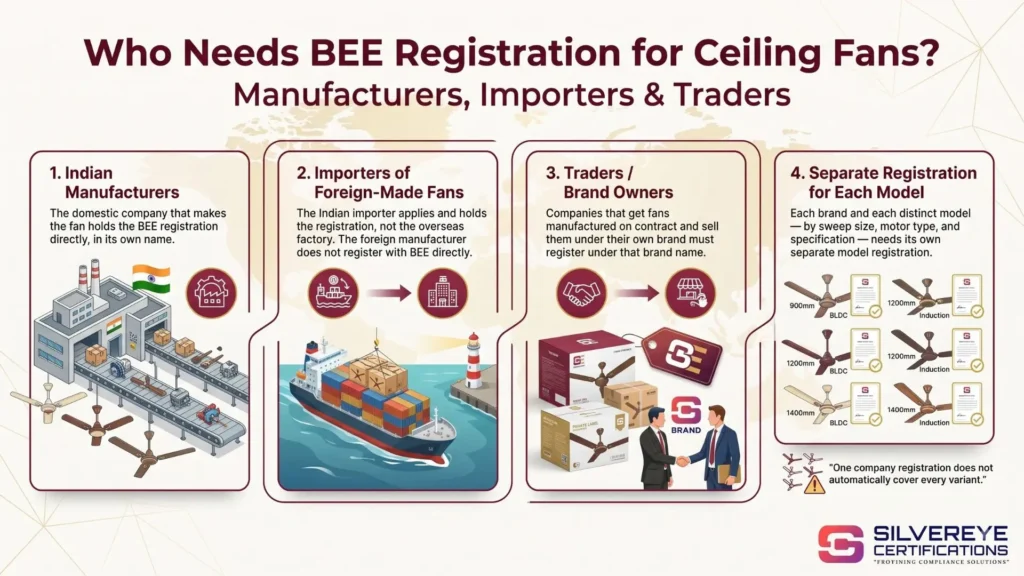
BEE registration for ceiling fans is not limited to large factories. It applies to every business that puts a fan into the Indian market under its own brand:
- Indian manufacturers — the domestic company that makes the fan holds the BEE registration directly, in its own name.
- Importers of foreign-made fans — the Indian importer applies and holds the registration, not the overseas factory. The foreign manufacturer does not register with BEE directly.
- Traders / brand owners — companies that get fans manufactured on contract and sell them under their own brand must register under that brand name.
- Each brand and distinct model (by sweep size, motor type, and specification) needs its own separate model registration — one company registration does not automatically cover every variant you sell.
Which Types of Fans Are Covered Under BEE's Star Labelling Programme?
"Ceiling fan" is the flagship mandatory category, but BEE's broader fan labelling schedule also touches other common household fan types. Here is how the coverage typically breaks down:
| Fan Type | BEE Coverage Status | Notes |
|---|---|---|
| Electric ceiling-type fans (induction motor) | Mandatory | Covered under IS 374:2019; all standard sweep sizes |
| BLDC ceiling fans | Mandatory | Same IS 374:2019 scope; typically rate higher due to lower wattage |
| Decorative / designer ceiling fans | Mandatory | If ceiling-mounted and within IS 374:2019 scope |
| Pedestal, table & wall fans | Covered under BEE's fan labelling schedule | BEE periodically issues validity-extension advisories for this category — confirm current mandatory/voluntary status before you apply |
| Exhaust fans | Check current notification | Not part of the core ceiling-fan mandate — verify separately with BEE/BIS before assuming coverage |
If you manufacture or import more than one fan type, don't assume one applicability check covers all of them — confirm each category's current status separately, since BEE updates its mandatory list periodically.
How Do You Complete BEE Registration for a Ceiling Fan?
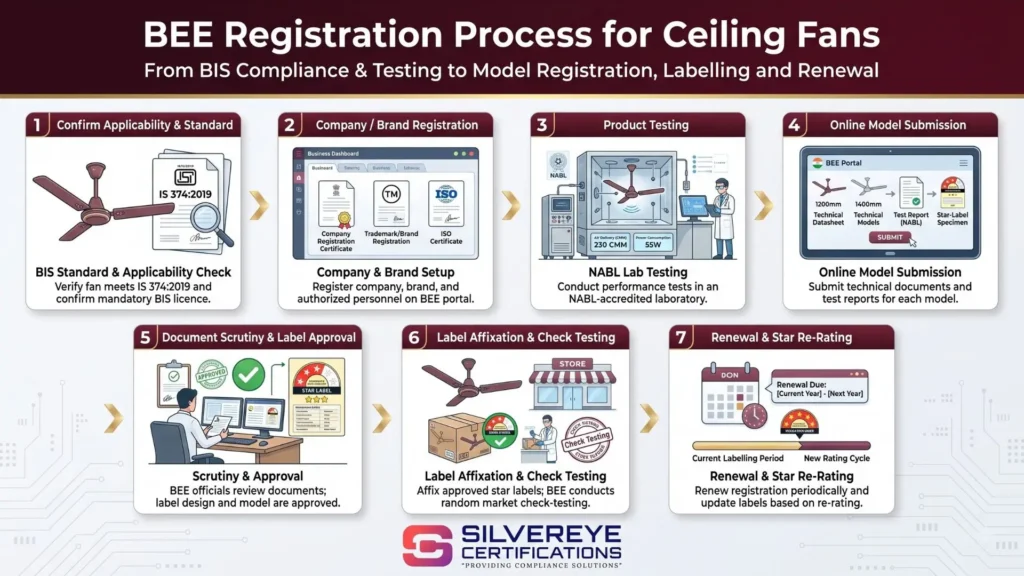
BEE registration for ceiling fans runs through the online portal in two structured stages — company registration first, then model registration — followed by ongoing compliance. Here is the full sequence:
Step 1: How Do You Confirm BEE Applicability and the Applicable Standard?
Verify that your fan falls within IS 374:2019 and confirm you already hold (or are applying for) the corresponding BIS licence, since a valid BIS licence is a prerequisite document for BEE registration of ceiling fans.
Step 2: How Do You Register Your Company or Brand on the BEE Portal?
Register your company on BEE's online labelling portal, submitting details such as your Certificate of Incorporation, trademark, ISO 9001 certificate, and authorised-signatory letter. This stage carries a company registration fee — indicatively ₹1,00,000 for large-scale industries or ₹25,000 for MSMEs — payable online, with hard copies of the originals submitted to the Bureau. On approval, BEE emails portal login credentials to proceed to model registration.
Step 3: Where Do You Get the Ceiling Fan Tested?
Before applying for model registration, get each fan model tested at a NABL-accredited or ILAC MRA-recognised laboratory. The lab measures air delivery (CMM) and power consumption (Watts) to compute the Service Value, and issues a report in BEE's prescribed format. This report must not be older than 90 days at the time you submit your model registration application.
Step 4: How Do You Register Each Fan Model?
Once testing is complete, file the model registration application online for each distinct fan model, attaching the test report, technical datasheet, and specimen of the proposed star label. A model registration fee (indicatively around ₹2,000 per model) is payable to BEE. Submit hard-copy originals along with the payment receipt to the department.
Step 5: How Does BEE Approve the Model and Star Label?
BEE officials scrutinise the submitted documents for completeness and accuracy. Any discrepancy triggers a clarification request. Once satisfied, BEE grants the final registration/licence, allowing you to generate and print the official star label for that model.
Step 6: What Happens After the BEE Star Label Is Approved?
The approved star label must be affixed to the fan and its packaging before the unit reaches the market. BEE (or its designated agency) can pick up samples of your registered model directly from retail outlets for "check and challenge" testing at a NABL-accredited lab, to verify the fan still performs as declared.
Step 7: When Do You Need BEE Renewal or Re-Rating?
Registration validity is tied to the labelling period BEE notifies for that product. The ceiling fan rating tables in force for 1 January 2026 to 31 December 2028 replaced the tables that expired on 31 December 2025. Apply for renewal or re-rating if BEE has revised the service-value thresholds, well before your current label period lapses, so your stock is never caught without a valid label.
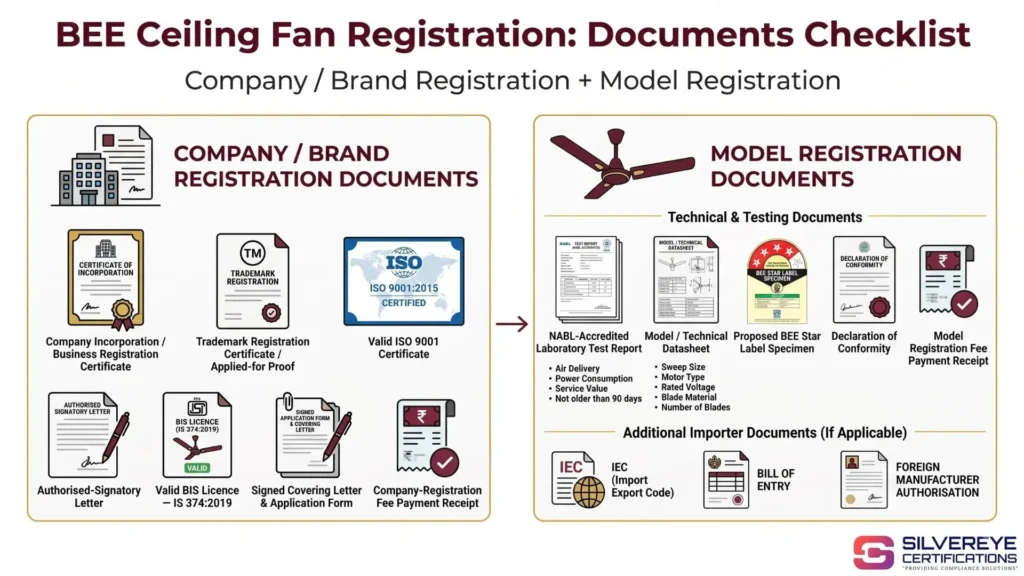
What Documents Are Required for BEE Ceiling Fan Registration?
Which Documents Are Needed for Company or Brand Registration?
- Company incorporation / business registration certificate
- Trademark registration certificate (or applied-for proof)
- Valid ISO 9001 certificate for the manufacturing unit
- Authorised-signatory letter
- Valid BIS licence covering IS 374:2019
- Signed covering letter and application form
- Company-registration fee payment receipt
Which Documents Are Required for Each Fan Model?
- NABL-accredited lab test report (air delivery, power consumption, service value) — not older than 90 days
- Model / technical datasheet: sweep size, motor type (induction or BLDC), rated voltage, blade material, number of blades
- Sample of the proposed BEE star label as per the specimen format
- Declaration of conformity signed by the authorised signatory
- Model registration fee payment receipt
- For importers: Import Export Code (IEC), bill of entry, and a signed authorization letter from the foreign manufacturer naming the Indian importer as the registrant
How Much Does BEE Registration for Ceiling Fans Cost?
| Fee Head | Indicative Amount | When Payable |
|---|---|---|
| Company / brand registration | ₹1,00,000 (large-scale industry) or ₹25,000 (MSME) | At company registration, before login credentials are issued |
| Model registration | ≈ ₹2,000 per model | At each model registration, along with test report |
| NABL lab testing charges | Varies by lab and sample volume | Before applying for model registration |
| Renewal / re-rating | Set by BEE circular at the time of renewal | Before the current label period expires |
BEE periodically revises fee heads and deposit levels through fresh circulars, and exact amounts can vary by applicant category and product scope. Treat the figures above as indicative and always confirm the current fee schedule on the official BEE labelling portal before you budget or pay.
How Long Is BEE Ceiling Fan Registration Valid and When Does It Need Renewal?
- Current ceiling fan star rating tables are valid from 1 January 2026 to 31 December 2028.
- Labels issued under the previous cycle expired on 31 December 2025 — any model still relying on the old table needed a fresh application or continuation filing before that date.
- BEE typically sends a renewal communication ahead of expiry; renew within the notified window so your registration doesn't lapse.
- Any change to a fan's design, motor, blade set, or sweep size that affects air delivery or power draw requires fresh NABL testing and either a new model registration or a registered variant update — selling a modified fan under the old registration number is a compliance violation.
- When BEE revises the service-value thresholds, as it did for the 2026–2028 cycle, previously registered models may need re-rating against the new table to keep their star claim accurate.
How Long Does BEE Ceiling Fan Registration Take?
Lab testing is usually the biggest time factor — expect roughly 2 to 6 weeks depending on lab backlog and sample turnaround. Once the test report is in hand, company and model registration, document scrutiny, and label approval typically take the overall process to about 4 to 8 weeks for straightforward, well-documented applications, though it can extend further if documents are incomplete or clarifications are requested.
What Are the Benefits of BEE Star Rating Registration for Ceiling Fans?
- Legal market access — for a mandatory product, the star label is the licence to manufacture, import, and sell; without it, your stock can be blocked or seized.
- Consumer trust — shoppers increasingly compare fans by star rating and CMM/W before buying, especially for BLDC models.
- Institutional and government tenders — public procurement listings, including GeM bids, frequently specify a minimum BEE star rating, sometimes 5-star, for eligibility.
- Premium positioning for BLDC fans — a genuine 5-star, government-verified rating is a strong, hard-to-fake marketing claim.
- Lower running-cost story — a validated service value gives you real numbers to show customers what they save on electricity.
- Future-proofing — BEE periodically tightens thresholds and widens mandatory categories, so early, accurate registration keeps you prepared for the next revision.
What Are the Penalties for Non-Compliance With BEE Ceiling Fan Requirements?
Manufacturing, importing, or selling a ceiling fan without a valid BEE star label is a violation under the Energy Conservation Act, 2001, and can lead to the Bureau withdrawing permission to affix labels, along with fines and market action against non-compliant stock.
What Common BEE Compliance Mistakes Should You Avoid?
- Assuming one sweep size's test result covers every variant you sell — each sweep size and motor type needs its own registered test report.
- Letting a label period lapse — the 2025 expiry and 2026–2028 transition caught manufacturers who didn't renew in time.
- Submitting a lab report older than the 90-day validity window at the time of application.
- Skipping the BIS license prerequisite before applying for BEE registration.
- Continuing to sell a redesigned fan under its old registration number instead of filing for a fresh model or variant update.
What Should You Know Before Completing BEE Ceiling Fan Registration?
BEE Star Rating registration for ceiling fans is no longer a box-ticking exercise — it is a legal precondition for selling in India, and the 2026–2028 rating cycle has tightened the numbers that a fan must hit at every sweep size. Getting it right means treating it as a sequence: confirm your fan sits inside IS 374:2019, hold a valid BIS licence, complete company registration, get an NABL-accredited test report inside the 90-day window, register each model separately, and track your label's renewal date so it never lapses.
Done properly, the same process that keeps you compliant also becomes a genuine selling point — a validated star rating is one of the few energy-saving claims a customer can actually trust.
If the documentation, lab coordination, or constantly updated BEE and BIS notifications feel like more than your team wants to manage in-house, Silvereye Certifications is a compliance and certification consultancy that works specifically in this space. Silvereye Certifications supports manufacturers, importers, and startups across BIS (ISI Mark & CRS), WPC, EPR, BEE, TEC (MTCTE), CDSCO, and other mandatory regulatory frameworks in India — handling documentation, NABL testing coordination, portal filing, and follow-through to final approval, so that a ceiling fan brand can focus on the product while the registration is managed end-to-end.
Whether you manufacture ceiling fans in India or import them for the Indian market, getting BEE registration structured correctly the first time — right sweep-size testing, complete documentation, and a tracked renewal date — is what helps keep your fans moving through customs and onto shelves without last-minute surprises.
Frequently Asked Questions
Is BEE star rating mandatory for ceiling fans in India?
Yes. BEE star labelling has been mandatory for electric ceiling-type fans since January 2023, covering both induction-motor and BLDC fans under IS 374:2019. A fan cannot legally be manufactured, imported, or sold in India without a valid BEE star label.
What is "Service Value" and why does it decide the star rating?
Service Value is the fan's air delivery in CMM (cubic metres per minute) divided by its power consumption in Watts. It measures how much airflow the fan produces for every unit of electricity it uses — the higher the service value, the higher the star rating a fan can qualify for.
Do I need BIS certification in addition to BEE registration for ceiling fans?
Yes. A ceiling fan must first conform to IS 374:2019 and carry a valid BIS licence; that licence is itself one of the required documents for BEE company registration. BIS certifies safety and quality; BEE certifies and labels energy efficiency.
Who applies for BEE registration — the manufacturer or the importer?
The domestic manufacturer applies in its own name for India-made fans. For foreign-made fans, the Indian importer applies and holds the registration — the overseas factory does not register with BEE directly.
How long does BEE registration for a ceiling fan take?
Lab testing typically takes about 2 to 6 weeks, and the full process — from company registration through model registration and label approval — usually runs around 4 to 8 weeks for a well-documented application, longer if documents or test reports need rework.
What is the current validity period for ceiling fan star ratings?
The rating tables in force now run from 1 January 2026 to 31 December 2028. Labels issued under the earlier cycle expired on 31 December 2025, so any model still on the old table needed renewal or fresh registration.
How much does BEE registration cost for ceiling fans?
Indicatively, company registration is around ₹1,00,000 for large-scale industries or ₹25,000 for MSMEs, and model registration is roughly ₹2,000 per model, plus separate NABL lab testing charges. Fees are revised by BEE circulars, so confirm the current schedule before budgeting.
Are table fans, wall fans, and pedestal fans covered under BEE too?
They fall under BEE's broader fan labelling schedule, and BEE has issued validity-extension advisories specifically for pedestal and table/wall fans. However, ceiling fans remain the flagship mandatory category — always confirm the current mandatory/voluntary status of your specific fan type before applying.
What documents are needed for model registration of a ceiling fan?
You typically need the NABL lab test report (not older than 90 days), the model's technical datasheet (sweep size, motor type, rated voltage), a sample of the proposed star label, a signed declaration of conformity, and the model registration fee receipt.
What happens if I change my ceiling fan's design after it's registered?
Any change that affects air delivery or power consumption — a new blade design, a different motor, a new sweep size — requires fresh NABL testing and a new model registration or a registered variant update. Selling the changed fan under the old registration number is a violation.
Can BEE re-test a ceiling fan after it's already on the market?
Yes. BEE or its designated agency can pick up samples of a registered model directly from retail outlets for "check and challenge" testing at a NABL-accredited lab, to confirm the fan still performs at its declared service value and star rating.
Do BLDC fans automatically get a higher BEE star rating than induction fans?
Not automatically — the star rating is decided purely by the tested service value, not by motor type. In practice, BLDC fans tend to post higher service values because they draw far less power for similar or better air delivery, so most (though not all) top-rated fans happen to be BLDC models.