

- Big 2026 change: licenses and registrations applied for from 1 April 2026 onward carry perpetual validity and never need renewal again.
- If your current license still has an expiry date, you'll likely need one last renewal — after that, it stops expiring altogether.
- Renewal window opens 180 days before expiry; apply by 30 days before expiry to avoid a late fee and business disruption.
- Even after perpetual validity is granted, you must keep paying the annual fee — missing it results in automatic suspension, not renewal, of your license.
Introduction
FSSAI license renewal is the process of extending a Food Business Operator's registration, State License, or Central License before it expires, filed online through the FoSCoS portal. Under the Food Safety and Standards (Licensing and Registration of Food Businesses) Amendment Regulations, 2026 — gazetted 10 March 2026 — FSSAI has introduced perpetual validity, meaning any license or registration applied for on or after 1 April 2026 no longer expires at all.
If your existing license still carries an expiry date from before this change, you generally need to renew it one final time; the renewed license then becomes perpetual. The renewal window opens 180 days before expiry, and you should apply at least 30 days before expiry to avoid a late fee. Renewal fees match the original license fees — ₹100/year for Registration, ₹2,000–₹5,000/year for State License, and ₹7,500/year for Central License.
What Is FSSAI License Renewal?
FSSAI license renewal is the process by which a Food Business Operator (FBO) extends the validity of an existing FSSAI Registration, State License, or Central License before its expiry date, so the business can continue operating legally without interruption. It is filed online through the FoSCoS (Food Safety Compliance System) portal, using the same license number rather than starting a fresh application.
Historically, every FSSAI approval was valid for a period of 1 to 5 years, chosen by the FBO at the time of the original application, after which renewal was mandatory to keep the business compliant under the Food Safety and Standards Act, 2006. That system has now changed significantly for 2026, and understanding exactly which rules apply to your license is the single most important part of getting renewal right this year.
The Big 2026 Update: Perpetual Validity Replaces the Renewal Cycle
On 10 March 2026, the Gazette of India published the Food Safety and Standards (Licensing and Registration of Food Businesses) Amendment Regulations, 2026, which came into force on the date of publication. This was followed by an implementation order dated 13 March 2026 (F. No. RCD-01002/1/2021-Regulatory-FSSAI-Part(1)) setting revised turnover thresholds effective 1 April 2026. Together, these changes replace the old fixed-term validity model with perpetual validity for FSSAI approvals.
In plain terms: once a FSSAI license or registration is issued under the new framework, it continues indefinitely. There is no expiry date and no recurring renewal cycle — the old system of 1-to-5-year validity periods has been abolished going forward. This is a genuine structural shift, not just a fee or process tweak, so it's worth understanding exactly where your business stands.
| Old System (pre-2026) | New System (from 1 April 2026) | |
| Validity period | Fixed term of 1 to 5 years, chosen by the FBO | Perpetual — no expiry date |
| Renewal requirement | Mandatory before every expiry, indefinitely | Not required once perpetual validity is granted |
| What keeps the license active | Renewal filed before expiry | Timely payment of the annual license fee |
| Consequence of non-payment | License simply expires | License is deemed suspended under Regulation 2.1.7(2) |
Which Population Does Your Business Fall Into?
This transition isn't retrospective, so two groups of FBOs currently exist side by side:
- Newer applicants: Anyone who applies for a fresh FSSAI Registration or License on or after 1 April 2026 receives an approval with perpetual validity from day one — nothing to renew, ever.
- Existing FBOs with an expiry date: If your current license or registration still shows a fixed expiry date because it was issued under the older rules, that date still binds you. You will generally need to file one more renewal application before that date; the license you get back is then issued under the new framework and carries no further expiry.
As of 30 June 2026, roughly 74.33 lakh FSSAI licenses and registrations were active across India, and a large share of them still fall into the second group — meaning a huge number of FBOs have exactly one renewal cycle left to complete before they're free of the process permanently.
When to Apply for FSSAI License Renewal: The Timeline
| Milestone | Timing |
| Renewal window opens | 180 days before the license/registration expiry date |
| Recommended filing deadline | At least 30 days before expiry (Regulation 2.1.7 of the FSS Licensing and Registration Regulations, 2011) |
| Late filing (before expiry) | Still possible, but may attract a late fee depending on current FoSCoS rules — verify the live fee on the portal before paying |
| Filing after expiry | The FoSCoS portal currently allows renewal up to 180 days after expiry with a penalty; beyond that, a fresh application may be required |
One area where you should double-check current information rather than rely on any single source: the exact late-fee amount has been inconsistent in 2026. Older guidance cites a flat ₹100-per-day penalty for late renewal.
However, a 2025 FSSAI consultation paper indicates this per-day penalty structure may have been discontinued following the rollout of instant online renewals, with some reports describing penalties of three to five times the standard fee for renewals filed after expiry instead. Because this directly affects your cost of delay, confirm the live late-fee calculation shown on your FoSCoS renewal screen before you pay, rather than assuming a fixed per-day rate.
Documents Required for FSSAI License Renewal
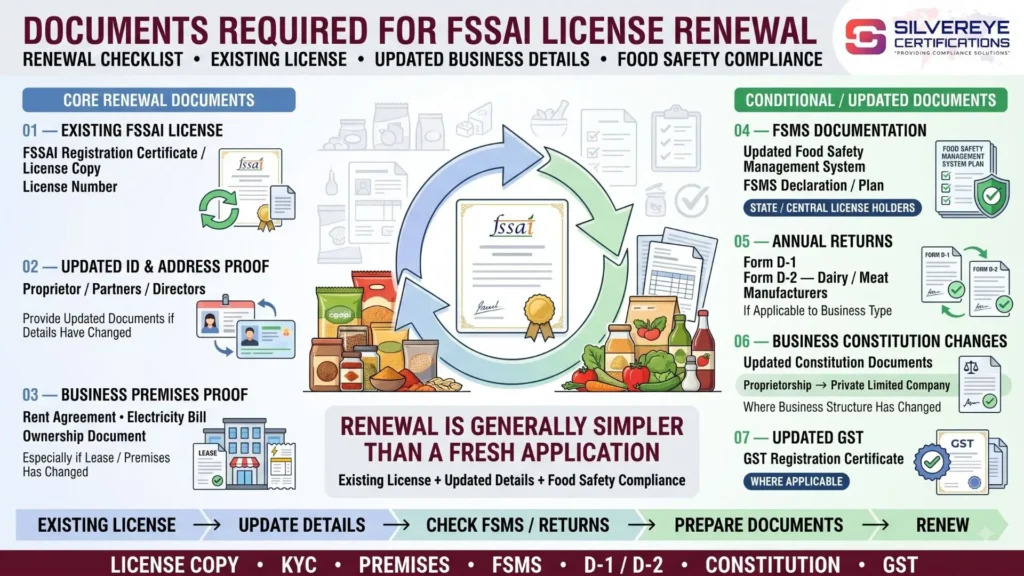
Renewal is generally simpler than a fresh application since your business is already verified, but you'll still need to have the following ready:
- Your existing FSSAI Registration Certificate or License copy and license number
- Updated ID and address proof of the proprietor/partners/directors, if any details have changed
- Updated proof of business premises (rent agreement, electricity bill, or ownership document), especially if the lease has been renewed or the premises has changed
- Updated Food Safety Management System (FSMS) declaration or plan for State/Central License holders
- Proof of annual returns filed (Form D-1 and, for dairy/meat manufacturers, Form D-2), if applicable to your business type
- Any change of business constitution documents — for example, if a proprietorship has since converted into a private limited company
- Updated GST registration certificate, where applicable
Step-by-Step FSSAI License Renewal Process (FoSCoS)
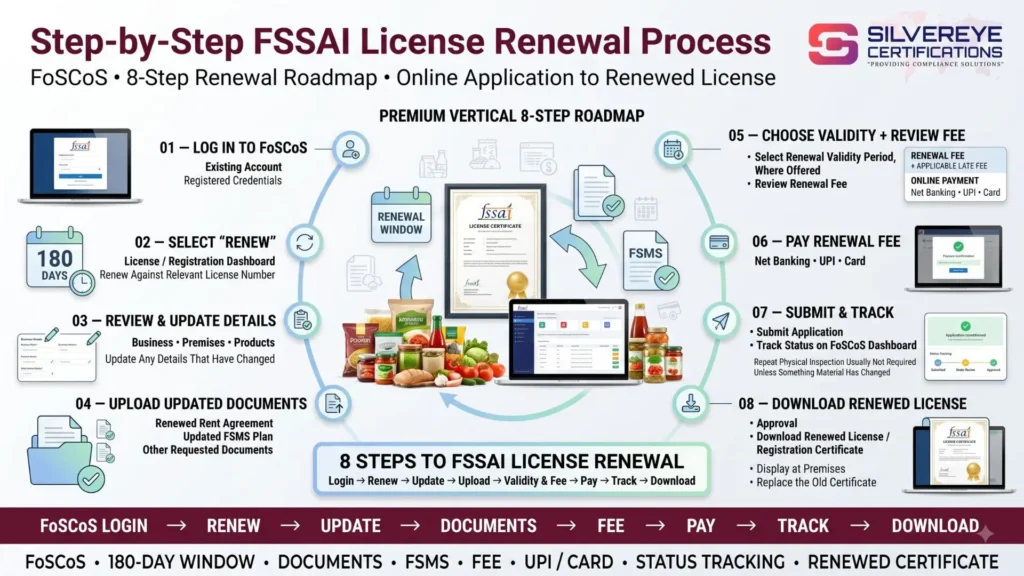
Log in to your existing account on the FoSCoS portal using your registered credentials.
- Go to your license/registration dashboard and select the "Renew" option against the relevant license number — this becomes available once you're within the 180-day renewal window.
- Review your existing business, premises, and product details, and update anything that has changed since your last application.
- Upload any updated or additional documents requested, such as a renewed rent agreement or updated FSMS plan.
- Choose your renewal validity period, where the option is still offered, and review the renewal fee shown on the portal, including any applicable late fee.
- Pay the renewal fee online via net banking, UPI, or card.
- Submit the application and track its status on your FoSCoS dashboard — most renewals are processed faster than fresh applications since a repeat physical inspection isn't usually required unless something material has changed.
- Download your renewed License or Registration Certificate once approved, and display it at your premises in place of the old one.
FSSAI License Renewal Fees
| License Type | Renewal Fee (per year) | Notes |
| FSSAI Registration | ₹100 | Same as the original registration fee; can typically be paid up to 5 years upfront |
| FSSAI State License | ₹2,000 – ₹5,000 | Renewal fee matches the original state license fee, varying by business type and capacity |
| FSSAI Central License | ₹7,500 | Renewal fee matches the original central license fee |
Renewal fees are the same as the original license/registration fees — there's no separate, higher "renewal-only" fee — but a late fee applies on top if you file after the recommended 30-day-before-expiry deadline. These are official government fees on FoSCoS and exclude any professional or consultancy charges.
What Happens If Your FSSAI License Expires Without Renewal?
Letting your FSSAI license or registration lapse is a serious compliance gap, not a minor administrative miss. Once the expiry date passes without a completed renewal, your business is no longer legally permitted to manufacture, store, distribute, or sell food — even if day-to-day operations look exactly the same as before. Practical consequences typically include:
- Food delivery platforms, e-commerce marketplaces, and retail partners suspending your listings until a valid license is restored
- Exposure to penalties and enforcement action under the FSS Act, 2006 for operating without a valid license
- A late fee or penalty added to your renewal cost, calculated based on how many days have passed since expiry
- If the lapse continues beyond the window the FoSCoS portal allows for post-expiry renewal (commonly cited as up to 180 days), you may be required to file a completely fresh license application instead of a renewal, losing continuity on your existing license number
If your license has already expired, the safest step is to log in to FoSCoS immediately, check whether the renewal option is still available against your license number, and complete it as soon as possible rather than waiting — the penalty typically grows the longer you delay.
Renewal Nuances by License Type
FSSAI Basic License Renewal
Basic Registration renewal is the simplest of the three, generally involving minimal documentation and, per some current guidance, may not attract the same late-fee structure as State or Central License renewals. Small food businesses, home-based sellers, and petty vendors typically complete this within a few days on FoSCoS.
FSSAI State License Renewal
State License renewal for mid-sized manufacturers, restaurants, and distributors generally requires an updated FSMS declaration and may involve additional scrutiny if your turnover has moved you into a different threshold slab under the 2026 rules — in which case a category modification, not just a renewal, may be the correct filing.
FSSAI Central License Renewal
Central License renewal for large manufacturers, importers/exporters, and multi-state operators tends to take longer and may involve closer document review, given the scale and risk profile of these businesses. Applying well within the 180-day window is especially important here to avoid any operational disruption.
Life After Perpetual Validity: What You Still Need to Do
Getting your license converted to perpetual validity doesn't mean compliance stops — it shifts from a renewal obligation to an ongoing payment and reporting obligation. Under the 2026 regulations:
- Annual fee payment is still mandatory. Regulation 2.1.7(2) states that if an FBO fails to pay the annual license or registration fee as specified, the license is deemed suspended, and the business cannot legally operate during suspension.
- Annual returns still apply. Manufacturers must continue filing Form D-1 by 31 May each year, and dairy/meat product manufacturers must additionally file the half-yearly Form D-2 return.
- Business closure must be reported. If you shut down operations, Regulation 2.1.7(3) requires you to inform the licensing authority in writing within 30 days and formally surrender the license or registration — no fee refund is admissible on surrender.
- Category changes still require action. If your turnover moves into a different slab, you must file a category modification on FoSCoS rather than assuming your existing perpetual license automatically covers the new category.
Benefits of Timely FSSAI License Renewal
- Uninterrupted legal operation — no risk of enforcement action, product seizure, or forced closure due to an expired license
- Continuity on food delivery apps, e-commerce platforms, and with B2B buyers who verify license validity before onboarding
- Avoids late fees and the far more disruptive risk of having to file a completely fresh application if the lapse runs too long
- For pre-2026 license holders, timely renewal is also your one-time opportunity to move onto the perpetual validity framework and permanently close out the renewal cycle
Common Mistakes to Avoid
- Waiting until the last few days before expiry instead of using the full 180-day window to resolve document issues calmly
- Assuming perpetual validity already applies to a license that still shows an expiry date from before April 2026
- Forgetting that perpetual validity still requires annual fee payment — non-payment leads to suspension, not a graceful continuation
- Not updating premises or business constitution documents at renewal time when they've genuinely changed
- Relying on outdated late-fee figures instead of checking the live penalty calculation shown on the FoSCoS portal at the time of filing
Conclusion
FSSAI license renewal in 2026 looks very different from what most FBOs are used to. The core takeaway is simple: if your license still has an expiry date, treat your next renewal as likely your last, since the amendment regulations move approvals onto a perpetual validity framework that removes the recurring renewal cycle going forward.
That said, perpetual validity is not the same as zero compliance — annual fees, returns, and category updates remain mandatory, and missing the annual fee now triggers suspension rather than a quiet lapse. The safest approach for any FBO is to check your license's current expiry status on FoSCoS today, renew well within the 180-day window if a date still applies, and build the ongoing annual-fee and return obligations into your compliance calendar going forward.
Frequently Asked Questions
Is FSSAI license renewal still required in 2026?
It depends on your license. If your existing license or registration still carries a fixed expiry date, yes — you generally need to renew it one final time. Once that renewal is processed under the new framework, or if you apply fresh on or after 1 April 2026, your license carries perpetual validity and never needs renewal again.
What is perpetual validity for FSSAI licenses?
Perpetual validity means an FSSAI license or registration issued under the Food Safety and Standards (Licensing and Registration of Food Businesses) Amendment Regulations, 2026 has no expiry date and continues indefinitely, as long as the annual fee is paid and the business remains compliant.
When should I apply for FSSAI license renewal?
The renewal window opens 180 days before your license's expiry date, and you should apply at least 30 days before expiry to avoid a late fee and any business disruption.
What is the FSSAI license renewal fee?
Renewal fees match the original license fees: ₹100 per year for Registration, ₹2,000–₹5,000 per year for State License, and ₹7,500 per year for Central License, depending on the validity period chosen.
What happens if my FSSAI license expires before I renew it?
Operating without a valid license becomes illegal immediately, food delivery and e-commerce platforms typically suspend your listings, and a late fee or penalty applies to your renewal — the exact rate should be confirmed on FoSCoS at the time of filing.
Can I renew an FSSAI license after it has already expired?
Yes, in most cases. The FoSCoS portal currently allows renewal up to 180 days after expiry with a penalty; beyond that window, you may need to file a fresh application instead of a renewal.
Do I need to pay a late fee for FSSAI renewal?
A late fee generally applies if you file after the recommended 30-day-before-expiry deadline, though the exact calculation has changed in 2026 with the introduction of instant renewals — always check the live fee shown on your FoSCoS renewal screen.
Does my FSSAI license need renewal if I already applied after April 2026?
No. Licenses and registrations applied for on or after 1 April 2026 carry perpetual validity from the start and don't need renewal, though the annual fee still applies.
What documents are needed for FSSAI license renewal?
You'll typically need your existing license copy, updated ID and premises proof if anything has changed, an updated FSMS declaration for State/Central License holders, and proof of annual returns filed, where applicable.
Does perpetual validity mean I never have to do anything again after renewal?
No. You still must pay the annual license fee, file required returns like Form D-1, update your license if your turnover or business details change, and formally surrender the license within 30 days if you close the business.
Where do I renew my FSSAI license online?
All renewals are filed through the official FoSCoS portal at foscos.fssai.gov.in, using your existing login and license number rather than creating a new application.