

- WPC ETA Approval is mandatory for every wireless device sold, imported, or manufactured in India — there's no exemption for small brands, low-cost products, or personal-use imports once goods enter commercial channels.
- Most devices on de-licensed bands (Wi-Fi, Bluetooth, BLE) qualify for the faster self-declaration process on the Saral Sanchar portal, at a flat government fee of ₹10,000 per model.
- The RF test report from a NABL or TEC-accredited lab is the backbone of the entire process — nearly every delay traces back to an incomplete or mismatched report.
- Once granted, WPC ETA Approval carries lifetime validity for that model, so the approval process is a one-time investment per product, not a recurring compliance task.
Introduction
The WPC ETA approval process is how the Wireless Planning & Coordination (WPC) Wing, Department of Telecommunications (DoT), clears wireless devices for import, manufacture, or sale in India. In short: identify the device's wireless technology and frequency band, get an RF test report from an accredited lab, register on the Saral Sanchar portal, upload technical documents, pay the government fee of ₹10,000 per model, and submit the self-declaration application.
Most Wi-Fi, Bluetooth, and similar de-licensed-band devices are approved within 2–6 weeks through self-declaration, without needing a separate wireless operating license. Once granted, WPC ETA Approval is valid for the product's lifetime, with no periodic renewal required unless the device's RF specifications change.
What Is the WPC ETA Approval Process?
WPC ETA Approval (Equipment Type Approval) is issued by the Wireless Planning & Coordination Wing, the national radio spectrum regulator under India's Department of Telecommunications, Ministry of Communications, established in 1952. The approval process is the defined sequence of technical testing, documentation, and government filing that a wireless device must go through before it can legally enter the Indian market.
At its core, the process exists to answer one regulatory question: does this device operate strictly within its permitted frequency band and power limit, without interfering with critical communication infrastructure such as defense networks, aviation systems, and emergency services? Every step in the WPC ETA Approval process — RF testing, documentation, self-declaration, and fee payment — builds toward answering that question for a specific product model.
Who Needs to Go Through the WPC ETA Approval Process?
The process applies broadly across the wireless product ecosystem, not just to a handful of large electronics brands.
- Importers bringing wireless devices into India from overseas factories or distributors
- Domestic manufacturers and contract manufacturers assembling wireless products in India
- D2C and private-label brands sourcing white-labelled wireless products for the Indian market
- E-commerce sellers and distributors listing wireless products, who are increasingly asked for ETA proof by marketplaces
- Foreign manufacturers, through an Authorized Indian Representative (AIR), since ETA certificates are issued only to Indian entities
Which Products Go Through the WPC ETA Approval Process?
WPC ETA covers virtually any product with a radio-frequency transmitter or transceiver. The table below gives a representative overview of major categories.
| Product Category | Typical Wireless Technology | Usual Approval Route |
| Wi-Fi routers & access points | 2.4 GHz, 5 GHz, 6 GHz (Wi-Fi 6E) | Self-declaration |
| Bluetooth devices (earbuds, speakers, headphones) | Bluetooth, 2.4 GHz | Self-declaration |
| Smartwatches & fitness bands | Bluetooth Low Energy (BLE), 2.4 GHz | Self-declaration |
| Walkie-talkies & two-way radios | VHF (136–174 MHz), UHF (400–470 MHz) | Self-declaration for license-exempt bands; ETA + Wireless Operational Licence for licensed bands |
| Mobile phones, tablets & laptops | 2G/3G/4G/5G, Wi-Fi, Bluetooth | Self-declaration, subject to applicable telecom equipment rules |
| Wireless keyboards, mice & IoT peripherals | Bluetooth or 2.4 GHz proprietary RF | Self-declaration |
| Smart home & Zigbee/Z-Wave devices | 2.4 GHz, sub-GHz ISM bands | Self-declaration |
| RFID readers and tags | UHF/HF RFID bands | Self-declaration, category-dependent |
| Drones (UAVs) | Wi-Fi/RF control and telemetry links | WPC ETA for RF systems, plus separate DGCA type certification |
| GPS trackers and telematics devices | GPS reception + GSM/BLE transmission | Self-declaration for the transmitting module |
Because approval routes vary by frequency band and power output, the safest first step for any new product is to confirm its exact RF specifications before assuming which category or route it falls under.
Types of WPC Licenses and Where ETA Fits In
WPC issues more than one type of authorisation, and understanding where ETA sits in this system helps avoid applying for the wrong one.
| License Type | Who It's For | What It Covers |
| Equipment Type Approval (ETA) | Manufacturers, importers, and their Authorised Indian Representatives | Approves a specific wireless device model for de-licensed band operation |
| Import License (IL) | Businesses importing wireless equipment into India | Permission to import a specific quantity of wireless goods, tied to a purchase order |
| Dealer Possession License (DPL) | Distributors and dealers of wireless products | Permission to stock, distribute, and sell wireless equipment within India |
| Non-Dealer Possession License (NDPL) | Entities that use wireless equipment in-house but don't sell it | Permission to possess wireless devices without being a licensed dealer |
| Network License | Companies providing communication services (mobile, DTH, cable) | Use of India's restricted radio frequency spectrum for network services |
| Experimental License | Individuals/organisations conducting R&D or trials | Temporary use of wireless equipment for testing and research |
| Wireless Operational Licence | Operators of licensed-band radios (e.g., professional VHF/UHF walkie-talkies) | Right to operate specific equipment on a regulated, non-exempt frequency |
Most importers and manufacturers of consumer wireless products — Wi-Fi devices, Bluetooth gadgets, fitness bands — only need ETA. Import License and Dealer Possession License become relevant depending on business role and shipment structure, and are usually assessed alongside ETA rather than instead of it.
Self-Declaration Route vs Regional Licensing Office (RLO) Route
Since DoT's self-declaration reforms, most wireless devices no longer need to go through WPC's Regional Licensing Offices for a full manual review. A product qualifies for the faster self-declaration route when it meets both conditions:
- It is exempt from import licensing requirements under the DGFT Import Policy
- It operates entirely within India's de-licensed frequency bands (such as 2.4 GHz, 5 GHz, or 6 GHz)
Only a narrow set of equipment — radar systems, jamming devices, and certain licensed-band communication equipment — is excluded from self-declaration and must instead go through the applicable Regional Licensing Office for detailed review and, where relevant, an operating licence.
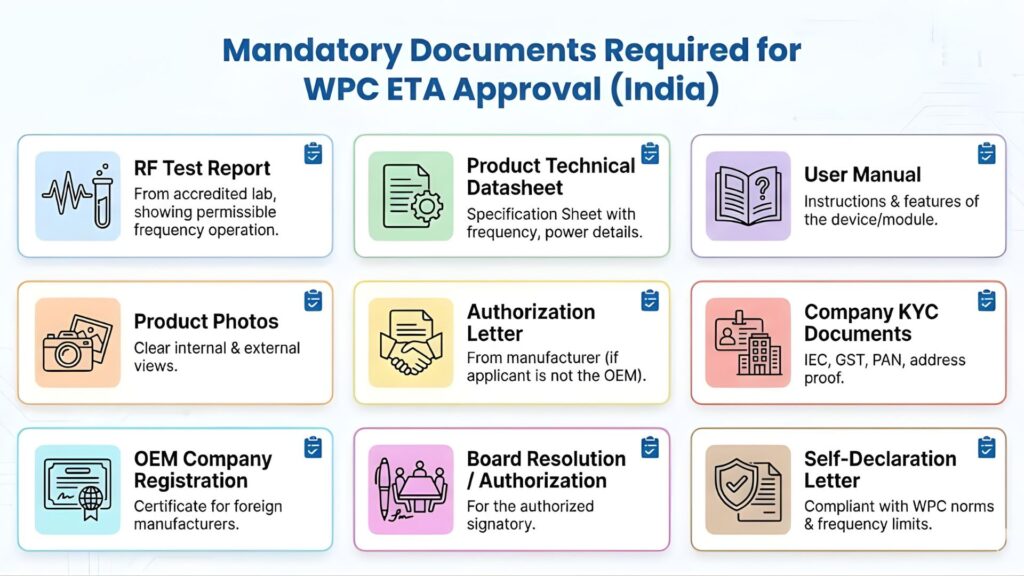
Documents Required for the WPC ETA Approval Process
| Document | Purpose |
| RF Test Report | From a NABL or TEC-accredited Indian laboratory, covering every wireless module in the device. |
| Authorisation Letter | From the manufacturer or head of the manufacturing unit, authorising the applicant/AIR to file on their behalf. |
| Technical Literature / Datasheet | Frequency band(s), transmit output power, and antenna specifications. |
| Product Photographs | Clear images of the product, its label, and model/serial number. |
| User Manual | Manual describing the product's intended use and wireless functions. |
| Self-Declaration Form | Signed declaration confirming the product meets de-licensed band conditions, filed per model. |
| Company/Import Documents | IEC (Importer-Exporter Code), GST registration, and company PAN, as applicable. |
| Bharatkosh Payment Receipt | Proof of the ₹10,000 government fee payment, uploaded separately on the portal. |
Step-by-Step WPC ETA Approval Process
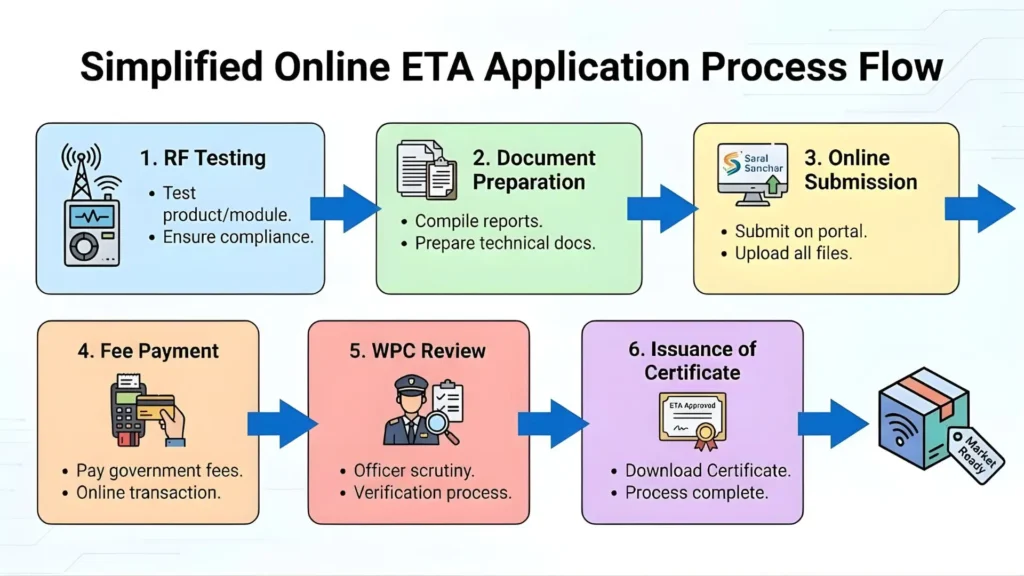
- Identify the wireless technology: List every RF-transmitting technology in the product — Wi-Fi, Bluetooth, Zigbee, GPS transmission, cellular — since each determines the applicable approval category and technical standard.
- Confirm the frequency band and power output: This decides whether the product qualifies for self-declaration or needs to go through a Regional Licensing Office, and whether any additional operating license applies.
- Get RF testing done: Testing must be conducted at a NABL or TEC-accredited Indian laboratory; since 2021, WPC has required Indian-accredited lab reports for most self-declaration filings.
- Register on the Saral Sanchar portal: This is DoT's official platform for all WPC ETA and licensing applications.
- Prepare and upload documents: Compile the RF test report, authorization letter, technical literature, product photographs, user manual, and self-declaration form, all in PDF format.
- Pay the government fee: The ETA fee of ₹10,000 per model is paid through the Bharatkosh (NTRP) portal; the receipt is uploaded on Saral Sanchar.
- Submit the application: The system generates an Import ID/application reference number for tracking progress.
- Respond to WPC queries: Address any clarification requests promptly — incomplete RF reports and model-number mismatches are the leading causes of delay.
- Download the ETA certificate: Once WPC completes its review, the certificate becomes available for download directly from the Saral Sanchar portal.
WPC ETA Approval Fees
| Fee Component | Amount | Paid To |
| Government ETA fee (per model) | ₹10,000 | Bharatkosh (NTRP) portal, DoT |
| RF/EMC laboratory testing fee | Varies by lab and number of wireless modules tested | NABL/TEC-accredited testing laboratory |
| Modification fee (for changes to an existing ETA) | Varies by the nature of the change | WPC, as applicable |
| Consultant/professional fee (optional) | Varies by service provider and product complexity | WPC compliance consultant, if engaged |
The ₹10,000 government fee is charged per model, not per shipment or unit, so a brand with multiple product variants needs a separate ETA filing and fee for each model with distinct RF characteristics. Laboratory, modification, and consultant fees are not fixed by the government and vary by provider or case — always confirm current figures directly.
WPC ETA Approval Timeline
| Scenario | Typical Timeline |
| Self-declaration route, complete documents | A few days to about 2–3 weeks |
| Standard case with minor WPC queries | 3 to 6 weeks |
| Complex cases (multiple RF modules, foreign AIR setup, licensed-band products) | 6 to 9 weeks or more |
Timelines depend heavily on how complete and consistent the documentation is at first submission, which is why importers and manufacturers should start the WPC ETA process as soon as a product's final hardware specification is locked, well before shipment or launch dates are fixed.
WPC ETA Approval Validity, Renewal, and Modification
A WPC ETA certificate is valid for the lifetime of the product model — there is no periodic renewal requirement. However, the certificate is tied to the exact specifications on file, so a fresh application or a formal modification becomes necessary if any of the following change:
- The RF module, wireless chipset, or frequency band
- The maximum transmit output power
- Addition of a new wireless technology to an existing model (for example, adding Bluetooth to a Wi-Fi-only device)
- The product's model number or brand name
Minor, non-RF changes — such as a new colour option or casing design — generally do not require a fresh ETA filing, but this is worth confirming case by case with the testing lab or WPC directly.
Benefits of Completing the WPC ETA Approval Process
- Legal market access: ETA is what allows a wireless product to clear Indian customs and be sold through retail, B2B, and e-commerce channels without risk.
- Avoids shipment delays and demurrage: Products without valid ETA are a common trigger for customs holds, which get expensive quickly.
- Builds distributor and marketplace trust: Retailers and online marketplaces increasingly ask for ETA proof before onboarding a new wireless product listing.
- One-time investment: Because ETA carries lifetime validity, the compliance effort protects a product line for as long as its RF specifications stay unchanged.
Penalties for Skipping the WPC ETA Approval Process
Importing, manufacturing, or selling a wireless device without valid WPC ETA Approval is a violation under the Indian Wireless Telegraphy Act, 1933, and related DoT regulations. Consequences can include:
- Detention or seizure of goods at the port of entry
- Financial penalties and fines
- Legal proceedings under applicable telecom and wireless laws
- Extended demurrage costs while compliance is retroactively arranged
- Removal of listings from e-commerce marketplaces that now actively cross-check wireless product compliance
Common Mistakes That Delay the WPC ETA Approval Process
- Assuming CE or FCC certification from another market is sufficient for India — it isn't, since India runs its own frequency allocation plan
- Submitting an RF test report from a lab that isn't NABL/TEC-accredited in India
- Testing only the primary wireless module and overlooking a secondary radio (e.g., BLE plus NFC, or Wi-Fi plus Bluetooth) in the same product
- Model number or brand name mismatches between the RF report, invoice, packaging, and the Saral Sanchar application
- Delaying the Authorized Indian Representative (AIR) appointment for foreign brands until after goods are already in transit
- Starting the process only after production or shipment is already underway, instead of at the product-design stage
Conclusion
The WPC ETA approval process is a structured, learnable sequence — not a black box — once you understand where your product sits in it: identify the wireless technology, confirm the frequency band, get accredited RF testing, file complete documentation on Saral Sanchar, and pay the government fee per model.
Most importers and manufacturers who face delays aren't stuck because the process is unclear; they're stuck because of an incomplete RF report, a mismatched model number, or starting the filing too late in their production timeline. Since the resulting ETA carries lifetime validity, getting the process right once protects a wireless product for as long as its specifications stay the same.
Frequently Asked Questions
What is the WPC ETA approval process?
It's the government process that clears a wireless device for legal sale, import, or manufacture in India: identify the device's wireless technology, get it RF tested at an accredited lab, file the application with documents on the Saral Sanchar portal, pay the government fee, and receive the ETA certificate.
How long does the WPC ETA approval process take?
With complete documentation, the self-declaration route typically takes a few days to about 2–3 weeks. Standard cases take 3 to 6 weeks, and complex or licensed-band cases can take 6 to 9 weeks or more.
How much does the WPC ETA approval process cost?
The government fee is ₹10,000 per model, paid through the Bharatkosh portal. RF laboratory testing, and any consultant fees, are additional and vary by provider — they aren't fixed by the government.
Where do I apply for WPC ETA?
Applications are filed online through the Saral Sanchar portal (saralsanchar.gov.in), the Department of Telecommunications' official system for all WPC licensing and ETA.
Do all wireless products qualify for the self-declaration route?
Most consumer devices on de-licensed bands (Wi-Fi, Bluetooth, BLE) do. Products using licensed frequency bands, or falling outside DGFT exemptions, need to go through a Regional Licensing Office and may require an additional operating license.
What's the difference between WPC ETA and an Import License?
ETA approves the device model itself for use in India. An Import License is a separate authorization tied to bringing in a specific quantity of goods against a purchase order, and is valid for six months or until the order is fulfilled, whichever comes first.
Does WPC ETA expire and need renewal?
No. Once granted, ETA is valid for the lifetime of the product model. A fresh application or modification is only needed if the RF module, frequency band, output power, or model/brand name changes.
Can a foreign manufacturer apply for WPC ETA directly?
No. WPC ETA is issued only to Indian entities. A foreign manufacturer must appoint an Authorized Indian Representative (AIR) to file the application, hold the certificate, and act as WPC's point of contact.
Is factory inspection required for WPC ETA?
No. WPC ETA approval is based on the RF test report and submitted documentation; a physical factory inspection is not part of the standard process.
What happens if a wireless product is sold in India without WPC ETA?
The business risks shipment seizure at customs, fines and legal action under the Indian Wireless Telegraphy Act, 1933, marketplace delisting, and additional costs from demurrage or retroactive compliance.
Which laboratory should conduct RF testing for WPC ETA?
Testing should be conducted at a NABL or TEC-accredited Indian laboratory. WPC's 2021 guidelines require Indian-accredited lab reports for most self-declaration filings, so confirm current lab-acceptance policy before testing abroad.
Do I need a separate license along with WPC ETA?
It depends on the product. Most de-licensed-band consumer devices only need ETA. Products on licensed frequency bands, or businesses acting as importers or dealers, may also need an Import License, Dealer Possession License, or Wireless Operational License alongside ETA.