

- As of the FoSCoS Kind of Business matrix updated 1 April 2026, vegetable oil processing units are now categorized purely by annual turnover — the older '2 MT per day' processing-capacity rule has been replaced by the same turnover slabs used across the food sector.
- New 2026 thresholds: Basic Registration up to ₹1.5 crore, State License above ₹1.5 crore up to ₹50 crore (₹5,000/year), and Central License above ₹50 crore (₹7,500/year).
- Packaged refined edible vegetable oil sold in packs up to 15 kg must be fortified with Vitamin A and Vitamin D, in line with FSSAI's mandatory oil fortification standards.
- Blended cooking oils cannot be sold under a single-oil name like 'mustard oil' or 'sunflower oil' — FSSAI requires such products to be labelled 'Multi-source Edible Vegetable Oil.'
Introduction
An FSSAI license for vegetable oil processing units is the mandatory food safety approval every oil expeller, solvent extraction plant, and refinery needs before producing or packaging edible oil in India.
As of the FoSCoS Kind of Business matrix updated 1 April 2026, this category is now classified purely by annual turnover — Basic Registration up to ₹1.5 crore, State License up to ₹50 crore (₹5,000/year), or Central License above ₹50 crore (₹7,500/year) — replacing the older rule that triggered a Central License once a unit processed more than 2 MT of oil per day. Beyond licensing, every unit must also follow FSSAI's mandatory Vitamin A and D fortification standards for packaged refined oil.
What Is an FSSAI License for Vegetable Oil Processing Units?
An FSSAI license for vegetable oil processing units is the approval issued by the Food Safety and Standards Authority of India to any business that produces vegetable/edible oil through solvent extraction, mechanical expelling, or refining — including oil expeller units, solvent extraction plants, and refineries. FSSAI defines vegetable oil processing broadly enough to cover the entire chain from crude oil extraction through refining and final packaging.
Edible oil carries specific food safety risks — adulteration, rancidity, incorrect labelling of blended oils, and micronutrient fortification compliance — which is why FSSAI applies both its general licensing framework and edible-oil-specific product standards to this sector.
Why Vegetable Oil Processing Units Need This License
- Legal requirement: Processing or selling vegetable oil without a valid FSSAI license is a punishable offence under the FSS Act, 2006, with penalties of up to ₹5 lakh and imprisonment of up to six months.
- Consumer safety: Edible oil is a high-adulteration-risk category — FSSAI licensing and inspection help ensure oils aren't cut with cheaper, unsafe substitutes.
- Distribution and retail access: Retail chains, FMCG distributors, and export buyers require a valid FSSAI license and compliance with fortification/labelling standards before stocking an oil brand.
- BIS and export alignment: A valid FSSAI license, alongside any applicable BIS/AGMARK certification, is typically the starting documentation for institutional supply contracts and export orders.
2026 Update: Vegetable Oil Licensing Is Now Turnover-Based, Not Capacity-Based
This is the single most important regulatory change for this sector in years. For a long time, FSSAI categorized vegetable oil processing units by installed processing capacity — units processing up to 2 MT per day qualified for a State License, while anything above 2 MT per day automatically required a Central License, regardless of turnover.
FSSAI's Order No. RCD-01002/1/2021-Regulatory-FSSAI-Part(1), dated 13 March 2026, revised the turnover thresholds for food business categorization generally under the Food Safety and Standards (Licensing and Registration of Food Businesses) Amendment Regulations, 2026 (Gazette notification dated 10 March 2026), effective 1 April 2026.
The subsequent FoSCoS Kind of Business Eligibility Matrix, updated 1 April 2026, confirms that vegetable oil processing units — including units producing oil by solvent extraction, expelling, and refining — are now classified purely by annual turnover, the same way most other food businesses are:
| License Type | Old Criterion (pre-2026) | New Criterion (from 1 April 2026) | Annual Fee |
| Basic Registration | Turnover up to ₹12 lakh, or up to 100 kg/litre per day | Annual turnover up to ₹1.5 crore | ₹100 |
| State License | Up to 2 MT/day processing capacity, turnover above ₹12 lakh | Annual turnover above ₹1.5 crore up to ₹50 crore | ₹5,000 |
| Central License | More than 2 MT/day processing capacity, or turnover above ₹20 crore | Annual turnover above ₹50 crore | ₹7,500 |
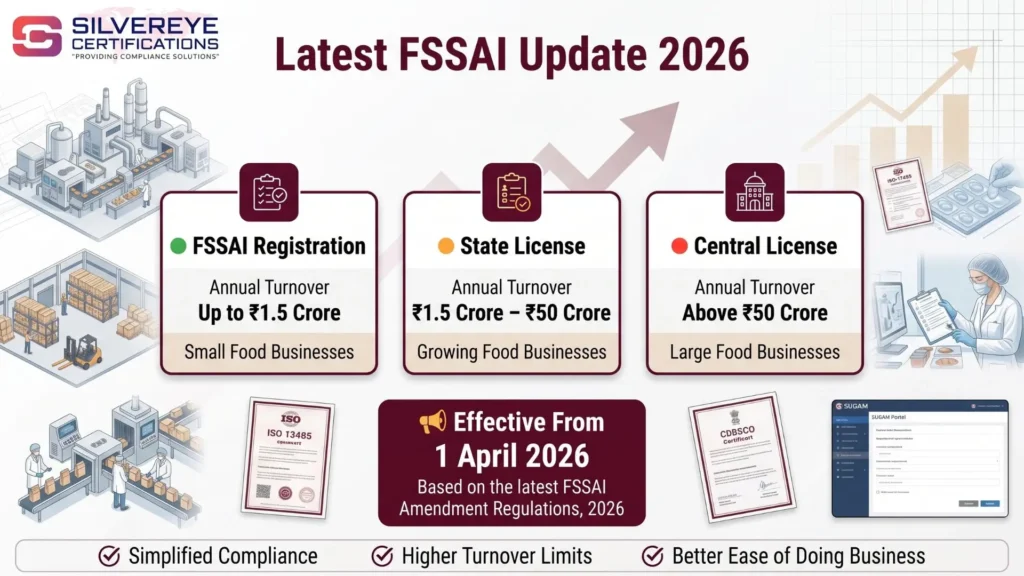
Practical impact: A mid-sized oil expeller unit that previously needed a Central License purely because it processed slightly more than 2 MT per day — even with modest turnover — may now qualify for a State License instead, if its annual turnover falls within the ₹1.5 crore–₹50 crore band. This removes a common source of over-licensing that smaller and mid-sized oil processors faced under the old capacity-based rule.
Two other 2026 changes apply here as well:
- Perpetual validity: licenses granted after 1 April 2026 no longer expire on a fixed 1–5 year term, subject to risk-based inspections.
- Automatic category upgrade: if turnover crosses your current slab, FSSAI upgrades you automatically at no extra cost, retaining your existing 14-digit number.
A word of caution: because this is a genuinely recent shift away from a long-standing capacity-based rule, plenty of older guides and consultants still describe vegetable oil licensing using the '2 MT/day' criterion. Always cross-check your category against the current FoSCoS Kind of Business matrix before applying, rather than relying on older published material.
Eligibility and Compliance Requirements For FSSAI License For Vegetable Oil Processing Units
- Premises must be suitable for oil extraction, expelling, or refining operations, with appropriate machinery, ventilation, and hygienic processing flow.
- A documented Food Safety Management System (FSMS) is required, covering raw material sourcing, extraction/refining process controls, and finished product handling.
- Fortification compliance: packaged refined edible vegetable oil in packs up to 15 kg must be fortified with Vitamin A and Vitamin D, meeting FSSAI's prescribed nutrient levels.
- Blended/multi-source oil labelling: products combining more than one type of vegetable oil cannot be marketed under a single oil's name and must be labelled 'Multi-source Edible Vegetable Oil.'
- Packaging requirement: edible oil is among the food categories that must be sold only in sealed, tamper-proof, clearly labelled packaging under the FSS (Prohibition and Restriction on Sales) Regulations, 2011 — loose, unpackaged sale is restricted.
Documents Required for FSSAI License for Vegetable Oil Processing Units
Common documents (all categories)
- Photo ID proof of the Food Business Operator (Aadhaar, PAN, Voter ID, Passport, or Driving License)
- Proof of possession of the processing unit premises (ownership document or rental/lease agreement)
- Photograph of the processing/production unit
- List of food products (oils) to be manufactured, refined, or expelled
Additional documents for State/Central License
- Business constitution certificate — Partnership Deed, Certificate of Incorporation, GST registration, or Udyam Registration
- Outline/layout plan of the processing unit, showing dimensions and area allocation by operation (extraction, refining, packaging, storage)
- List of machinery and equipment installed, with number, capacity, and horsepower
- Names and complete contact details of all directors (for companies)
- Food Safety Management System (FSMS) plan
- Water testing report from an NABL-accredited laboratory, where applicable
Additional documents for Central License
- Turnover proof — audited financial statements or a CA certificate
- Form IX — nomination of the authorized responsible person
- Food recall plan
- Fortification compliance declaration for packaged refined oil

Step-by-Step FSSAI Application Process
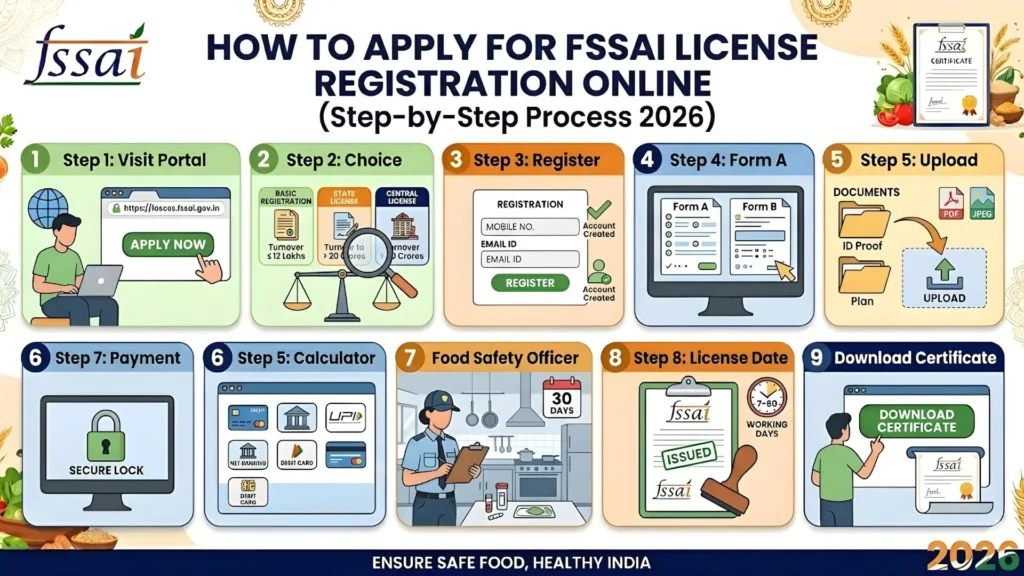
- Register on the FoSCoS portal using your business email and mobile number.
- Select 'Vegetable Oil Processing Unit' as your Kind of Business, specifying whether your operation covers extraction, expelling, refining, or a combination.
- Confirm your license category against the current turnover-based thresholds — Registration, State, or Central — using the live FoSCoS eligibility matrix rather than older capacity-based references.
- Fill Form A (Basic Registration) or Form B (State/Central License) with business, premises, machinery, and product details.
- Upload all required documents, including the layout plan, machinery list, and FSMS plan.
- Pay the applicable government fee online.
- For State/Central applications, a Food Safety Officer inspects the processing unit before approval, checking hygiene, machinery, and process controls.
- On approval, display your FSSAI certificate at the premises and print the 14-digit number on all oil packaging, along with mandatory fortification and multi-source labelling declarations where applicable.
FSSAI Fee and Timeline Chart for Vegetable Oil Processing Units
| License Category | Government Fee (per year) | Typical Timeline |
| Basic Registration | ₹100 | 7–10 working days |
| State License | ₹5,000 | 30–60 working days (includes premises inspection) |
| Central License | ₹7,500 | 60–90 working days (includes premises inspection) |
These are government fees only; consultancy charges, if you use an agent, are billed separately.
Fortification and Labelling Compliance for Edible Oil
| Compliance Requirement | What It Means for Processors |
| Vitamin A & D fortification | Packaged refined edible vegetable oil in packs up to 15 kg must be fortified with Vitamin A and Vitamin D, meeting the nutrient levels prescribed under the FSS (Fortification of Foods) Regulations, 2020 |
| +F logo eligibility | Fortified oils that meet the prescribed standards can carry FSSAI's '+F' fortification logo, subject to compliance verification |
| Multi-source oil labelling | Blended oils combining more than one type of vegetable oil cannot be branded as a single oil (e.g., cannot be called 'mustard oil' if blended) and must be labelled 'Multi-source Edible Vegetable Oil' |
| Tamper-proof packaging | Edible oil must be sold in sealed, tamper-proof, clearly labelled packaging — not as loose, unpackaged product, under the FSS (Prohibition and Restriction on Sales) Regulations, 2011 |
| Standard label declarations | FSSAI logo and license number, ingredient/oil-blend composition, batch number, manufacturing/best-before dates, and net quantity must all appear on the pack |
Renewal and Ongoing Compliance
- Perpetual validity: licenses granted after 1 April 2026 no longer expire on a fixed 1–5 year term, subject to risk-based inspections.
- Older, fixed-term licenses: renew at least 30 days before expiry to avoid the ₹100-per-day late fee.
- Annual Return (Form D-1): due by 31 May every year for State/Central License holders.
- Ongoing fortification compliance: processors should periodically verify their fortified oil batches meet the prescribed Vitamin A/D levels, since compliance is checked on an ongoing basis, not just at the time of licensing.
- Suspension risk: licenses/registrations can be deemed suspended if annual fees or required returns aren't filed on time.
Penalties for Non-Compliance
Processing or selling vegetable oil without a valid FSSAI license is a punishable offence under the FSS Act, 2006 — penalties of up to ₹5 lakh and imprisonment of up to six months apply for operating without a license. Separately, mislabelling blended oil as a single-source oil, or failing to meet mandatory fortification and packaging standards, can trigger action for misbranding or non-conformance under the Act, independent of any licensing penalty.
Frequently Asked Questions
Is FSSAI license mandatory for vegetable oil processing units?
Yes. Any unit involved in oil extraction, expelling, refining, or packaging vegetable oil needs FSSAI Basic Registration or a State/Central License, based on annual turnover.
Is vegetable oil licensing still based on processing capacity (2 MT/day)?
No, not as the primary criterion anymore. As of the FoSCoS Kind of Business matrix updated 1 April 2026, vegetable oil processing units are categorised purely by annual turnover — the older 2 MT/day capacity rule has been replaced by the same turnover slabs used across the food sector.
What is the FSSAI license fee for a vegetable oil processing unit?
₹100 per year for Basic Registration (turnover up to ₹1.5 crore), ₹5,000 per year for a State License (₹1.5 crore–₹50 crore turnover), and ₹7,500 per year for a Central License (above ₹50 crore turnover).
Do all packaged edible oils need to be fortified with Vitamin A and D?
Packaged refined edible vegetable oil sold in packs up to 15 kg must be fortified with Vitamin A and Vitamin D, meeting the levels prescribed under the FSS (Fortification of Foods) Regulations, 2020.
Can I sell a blended cooking oil under a single oil's name, like 'sunflower oil'?
No. If the product blends more than one type of vegetable oil, it must be labelled 'Multi-source Edible Vegetable Oil' rather than being marketed under a single-oil name.
Can edible oil be sold loose, without packaging?
Generally no — edible oil is among the food categories required to be sold in sealed, tamper-proof, clearly labelled packaging under the FSS (Prohibition and Restriction on Sales) Regulations, 2011.
How long does it take to get an FSSAI license for an oil processing unit?
Basic Registration typically takes 7–10 working days. State and Central Licenses usually take 30–90 working days, since both involve a premises and machinery inspection.
What documents are required for an FSSAI vegetable oil processing license?
At minimum: photo ID, premises proof, a photograph of the unit, and a product list. State and Central applications additionally need a layout plan, machinery list, FSMS plan, and — for Central — turnover proof and a food recall plan.
Does an oil expeller unit need a different license from a solvent extraction plant?
No — FSSAI groups solvent extraction, mechanical expelling, and refining together under the single 'Vegetable Oil Processing Unit' Kind of Business, with the same turnover-based categorisation applying to all of them.
Is the FSSAI license for oil units now valid for a lifetime?
Licenses granted under the 2026 amended regulations carry perpetual validity, subject to periodic risk-based inspections — they no longer need renewal every 1–5 years.
What is the penalty for selling edible oil without an FSSAI license?
Operating without a valid FSSAI license can attract a penalty of up to ₹5 lakh and imprisonment of up to six months under the FSS Act, 2006, in addition to possible unit shutdown orders.
What happens if my oil doesn't meet the required fortification levels?
Non-compliant fortification can trigger action for non-conformance with FSSAI's food product standards, separate from any general licensing penalty — processors should verify fortification levels on an ongoing basis, not just at the time of initial approval.