- New 2026 turnover slabs apply directly to bakery and confectionery: Registration up to ₹1.5 crore, State License ₹1.5 crore–₹50 crore, Central License above ₹50 crore.
- Home bakers, cloud kitchens, and small cake/sweet sellers usually qualify for low-cost Basic Registration, not a full license.
- All bakery products made with fats, oils, or shortening must meet FSSAI's mandatory 2% industrial trans-fat limit.
- FSSAI approvals granted from 1 April 2026 carry perpetual validity — no renewal filing, only an annual fee and yearly return.
Introduction
FSSAI registration for bakery and confectionery products is mandatory for anyone manufacturing or selling bread, biscuits, cakes, pastries, chocolates, candies, or sweets in India. Unlike dairy or packaged water, bakery wares and confectionery follow the standard 2026 turnover-based categorization, with no separate high-risk capacity override: FSSAI Registration applies up to ₹1.5 crore annual turnover, State License from ₹1.5 crore to ₹50 crore, and Central License above ₹50 crore, effective 1 April 2026.
Most home bakers, cloud bakeries, and small cake or sweet shops only need Basic Registration, while commercial bakeries and confectionery manufacturers typically need a State License. Government fees range from ₹100 to ₹7,500 a year, and licenses issued from 1 April 2026 carry perpetual validity. Bakery products using fats or oils must also comply with FSSAI's 2% trans-fat cap.
What Is FSSAI Registration for Bakery and Confectionery Products?
FSSAI registration for bakery and confectionery products is the government approval every food business operator must hold before manufacturing, packaging, storing, distributing, or selling bakery wares (bread, buns, cakes, pastries, biscuits, cookies) or confectionery items (chocolates, candies, toffees, and Indian sweets) in India. It is issued by the Food Safety and Standards Authority of India under the Food Safety and Standards Act, 2006, and applied for through the FoSCoS (Food Safety Compliance System) portal.
Under FSSAI's Food Product Categories, bakery wares fall under Category 07 and confectionery under Category 05, both of which follow the standard turnover-based licensing criteria — unlike dairy, meat, or grain milling, which carry separate capacity-based rules regardless of turnover. This makes bakery and confectionery one of the more straightforward FSSAI categories to navigate once you know your expected annual turnover.
Latest FSSAI Update (2026): Revised Turnover Thresholds
On 13 March 2026, FSSAI's Regulatory Compliance Division issued Order No. RCD-01002/1/2021-Regulatory-FSSAI-Part(1), implementing revised turnover thresholds for categorizing food businesses under the Food Safety and Standards (Licensing and Registration of Food Businesses) Regulations, 2011. This followed the Food Safety and Standards (Licensing and Registration of Food Businesses) Amendment Regulations, 2026, notified 10 March 2026, based on recommendations of the NITI Aayog High-Level Committee on Non-Financial Regulatory Reforms. The revised thresholds took effect from 1 April 2026 and supersede all earlier turnover-based categorization rules.
| License / Registration Type | Revised Turnover Threshold (from 1 April 2026) |
| FSSAI Registration | Annual turnover up to ₹1.5 crore |
| FSSAI State License | Annual turnover above ₹1.5 crore and up to ₹50 crore |
| FSSAI Central License | Annual turnover above ₹50 crore |
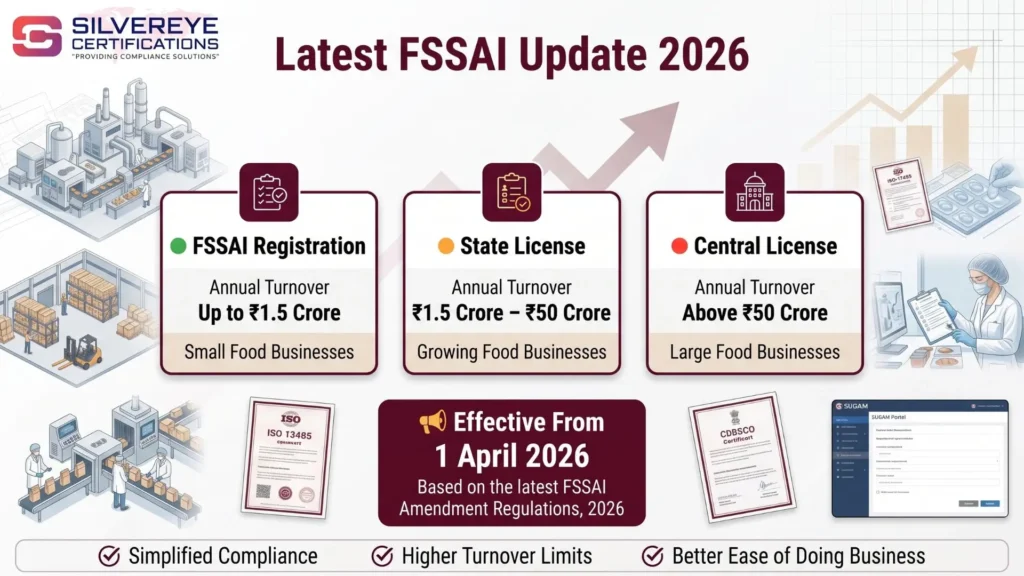
This is a significant jump from the earlier limits (₹12 lakh for Registration and ₹20 crore for State License), and it directly benefits home bakers, small confectionery makers, and neighbourhood cake or sweet shops that previously had to pay for a State License they didn't really need. The amendment also introduced perpetual validity of licenses and a risk-based inspection model, replacing the older fixed renewal cycle.
Bakery and Confectionery Product Categories Covered Under FSSAI
FSSAI's Food Products Standards and Food Additives Regulations, 2011 set compositional and quality standards for the main bakery and confectionery items. Meeting these standards is a condition of holding a valid license, and mislabelling a product against its defined composition can attract penalties even when the FSSAI number itself is valid.
| Product | Key FSSAI Standard / Requirement | Notes |
| Bread | Standards for alcoholic acidity and ash insolubility; permitted ingredients include flour, water, yeast, sugar, oils, fruits, nuts, and approved emulsifiers | May contain oligofructose dietary fibre up to 15% with label declaration |
| Biscuits / Cookies | Standards for ash insolubility and acidity of extracted fat; permitted ingredients include maida, oils, butter, milk powder, sugar, fruits, nuts, and emulsifiers | Same oligofructose (up to 15%) allowance as bread, with declaration |
| Cakes / Pastries | Falls under "fine bakery wares"; must comply with general food additive and labelling regulations | Shortening/fat content is subject to the 2% trans-fat cap |
| Dark (Plain) Chocolate | Minimum 35% total cocoa solids, of which at least 18% cocoa butter and 14% non-fat cocoa solids | Below-minimum products must be labelled "chocolate flavoured," not "chocolate" |
| Milk Chocolate | Minimum 25% total cocoa solids + minimum 12% milk solids + minimum 2.5% non-fat milk solids | — |
| White Chocolate | Minimum 20% cocoa butter + minimum 14% milk solids + maximum 55% sugar | — |
| Confectionery / Candy | Only FSSAI-approved additives permitted (e.g., lecithin as an emulsifier; approved colours such as tartrazine, sunset yellow, carmoisine) | Non-permitted vegetable fats used instead of cocoa butter must be declared as "chocolate substitute" |
One rule that catches many small bakers off guard: any product using hydrogenated vegetable fat, margarine, or bakery shortening must comply with FSSAI's cap on industrial trans-fatty acids, set at a maximum of 2% of total fat/oil content since 1 January 2022. A "trans fat free" claim can only be used if the product contains less than 0.2g of trans fat per 100g or 100ml.
Why Bakery and Confectionery Businesses Need FSSAI Registration
- Legal requirement: Selling bread, cakes, biscuits, chocolates, or sweets without valid FSSAI registration is an offence under the FSS Act, 2006, with fines and possible penalties for repeat violations.
- Consumer trust: The 14-digit FSSAI number on packaging or premises reassures customers that ingredients, hygiene, and additive limits are being followed.
- Market access: Supermarkets, e-commerce platforms, cloud kitchen aggregators, and event caterers require a valid FSSAI license number before they will list or order from you.
- Business scaling: A valid registration or license supports GST registration, MSME scheme eligibility, and financing for bakery equipment or a confectionery unit.
- Compliance protection: Following FSSAI's compositional and trans-fat standards protects your business from mislabelling and adulteration penalties, which are actively enforced for packaged bakery and confectionery items.
Types of FSSAI Registration/License for Bakery and Confectionery Businesses
| Type | Who It's For | Typical Turnover Band (2026) |
| FSSAI Registration | Home bakers, cloud bakeries, small cake or sweet shops, tiffin/dessert sellers, small confectionery stalls | Up to ₹1.5 crore |
| FSSAI State License | Commercial bakeries, mid-sized confectionery manufacturers, bakery chains operating within one state, biscuit/bread manufacturing units | ₹1.5 crore to ₹50 crore |
| FSSAI Central License | Large bakery and confectionery manufacturers, multi-state chains, chocolate/candy exporters and importers | Above ₹50 crore |

If your bakery or confectionery business already holds an FSSAI approval and your turnover has since moved into a different slab under the 2026 rules, you can apply for a category modification on FoSCoS instead of starting a fresh application.
Eligibility Criteria for FSSAI Registration for Bakery and Confectionery Products
- The applicant must be a legally constituted entity — proprietorship, partnership, LLP, private limited company, or home-based sole proprietor — engaged in baking, confectionery-making, or selling such products.
- The kitchen or manufacturing premises must meet Schedule 4 hygiene standards, including clean food-preparation surfaces, pest control, and safe storage of raw materials like flour, sugar, and fats.
- Products made with fats or oils must be formulated to stay within FSSAI's 2% industrial trans-fat limit.
- Confectionery and chocolate products must use only FSSAI-approved additives, colours, and flavours, with correct disclosure on the label.
- Businesses selling through e-commerce or food delivery platforms must ensure their FSSAI number and category match their actual scale of production.
Documents Required for FSSAI Registration for Bakery and Confectionery Products
Basic Documents (for Registration — home bakers, small shops)
- Passport-size photograph and ID proof (Aadhaar, PAN, voter ID, or passport)
- Proof of business/kitchen premises — rent agreement, electricity bill, or property document
- A simple declaration of the food products being made and sold (bakery, confectionery, or both)
- Business PAN, and GST registration if applicable
Additional Documents for State / Central License
- Food Safety Management System (FSMS) plan and layout plan of the bakery/manufacturing unit
- List of machinery and equipment (ovens, mixers, chocolate tempering machines) with production capacity
- Business constitution proof — partnership deed, MOA & AOA, or certificate of incorporation
- List of directors/partners with address and contact details
- Water testing report and NOC from the local municipal body, where applicable
- Product recall plan for manufacturers

Step-by-Step FSSAI Registration Process for Bakery and Confectionery
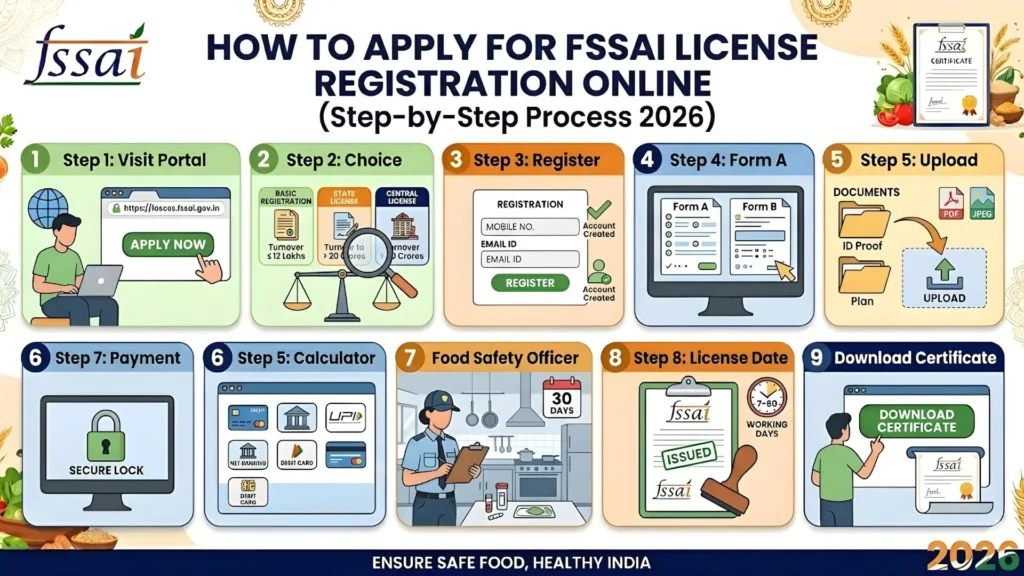
- Determine your correct category — Registration, State License, or Central License — based on your expected annual turnover.
- Create an account on the FoSCoS portal using your mobile number and email ID.
- Select "Apply for New License/Registration," choose your state, and pick the correct Kind of Business (e.g., "Bakery," "Confectionery Unit," "Home Bakery," or "Cloud Kitchen — Bakery & Desserts").
- Fill Form A (for Registration) or Form B (for State/Central License) with business, premises, and product details.
- Upload all required documents in the prescribed PDF/JPEG format.
- Pay the applicable government fee online via UPI, net banking, or card, and select your validity period where renewal still applies.
- Await scrutiny and, for State/Central License applications, a premises inspection by a Food Safety Officer, typically within 30 days.
- Download your FSSAI Registration Certificate or License from FoSCoS on approval and display it at your premises.
- Print your 14-digit FSSAI number on all packaged bakery and confectionery products before sale or dispatch.
FSSAI Fees for Bakery and Confectionery License (2026)
| License Type | Government Fee | Notes |
| FSSAI Registration | ₹100 per year | Can be paid for up to 5 years upfront (₹500 total) — ideal for home bakers and small shops |
| FSSAI State License | ₹2,000 – ₹5,000 per year | Varies by production capacity and business type |
| FSSAI Central License | ₹7,500 per year | Applies to large manufacturers and multi-state bakery/confectionery chains |
These are official government fees payable directly on FoSCoS and don't include any professional or consultancy charges. GST at 18% applies on select FSSAI service fees such as the Central License.
Validity and Renewal: Perpetual Validity in 2026
Before the 2026 amendment, FSSAI registrations and licenses had a fixed validity of 1 to 5 years and needed renewal before expiry, with a ₹100-per-day penalty for late renewal. Under the Food Safety and Standards (Licensing and Registration of Food Businesses) Amendment Regulations, 2026, approvals granted from 1 April 2026 onward carry perpetual validity — they do not expire automatically and don't require a fresh renewal application, as long as the annual fee is paid and the business stays compliant.
You are still required to pay the applicable annual fee, file your Annual Return (Form D-1) by 31 May each year if you're a manufacturer, and apply for a category modification on FoSCoS if your turnover crosses into a new slab. A license can be suspended or cancelled for non-payment, non-compliance, or a failed inspection.
Labeling Requirements for Bakery and Confectionery Products
- 14-digit FSSAI license/registration number, clearly printed on the label
- Correct product name matching FSSAI's compositional standard (e.g., "Chocolate" only if cocoa content meets the minimum; otherwise "chocolate flavoured")
- Complete ingredient list, including any hydrogenated fat, margarine, or bakery shortening used, with the mandatory trans-fat disclosure where applicable
- Batch number, manufacturing date, and best-before/expiry date
- Net quantity/weight, storage instructions, and full manufacturer address
- Declaration of permitted additives, colours, and allergens (especially nuts, milk, and egg — common bakery allergens)
Penalties for Operating Without FSSAI Registration
Manufacturing or selling bakery or confectionery products without a valid FSSAI registration or license is an offence under the FSS Act, 2006. Penalties can include fines, product seizure, and closure of the unit until compliance is restored, with harsher consequences for cases involving unsafe or adulterated ingredients or exceeding the trans-fat limit. Given how affordable Basic Registration is at ₹100 a year, most home bakers and small confectionery sellers have no practical reason to delay getting registered.
Common Mistakes to Avoid
- Assuming home bakery or dessert sales don't need FSSAI registration just because the business is small or seasonal
- Selling loose confectionery or bakery items past their best-before date, which is a labelling and safety violation
- Using non-permitted vegetable fats in chocolate without declaring the product as a "chocolate substitute"
- Ignoring the 2% trans-fat cap when using bakery shortening, margarine, or vanaspati in recipes
- Applying for the wrong Kind of Business on FoSCoS, which can delay approval or require re-filing
Conclusion
FSSAI registration for bakery and confectionery products is one of the more approachable licensing categories in India's food regulatory system — the 2026 turnover thresholds apply cleanly, without the extra capacity-based triggers that complicate dairy or grain milling.
Whether you're running a home bakery, a neighbourhood confectionery shop, or a growing biscuit or chocolate manufacturing unit, the process comes down to matching your turnover to the right category, keeping your recipes within FSSAI's compositional and trans-fat standards, and staying current with your annual fee and returns. Because thresholds and Kind of Business classifications can be revised by FSSAI over time, always confirm your category on foscos.fssai.gov.in before applying.
Frequently Asked Questions
Is FSSAI registration mandatory for home bakers in India?
Yes. Anyone selling homemade cakes, cookies, or desserts commercially — including through Instagram, WhatsApp, or food delivery apps — needs at least FSSAI Basic Registration, which typically costs ₹100 a year for a turnover up to ₹1.5 crore.
Which FSSAI license is needed for a bakery or confectionery manufacturing unit?
It depends on annual turnover: Registration up to ₹1.5 crore, State License from ₹1.5 crore to ₹50 crore, and Central License above ₹50 crore, following the standard 2026 turnover thresholds that apply to bakery wares and confectionery.
What are the new 2026 FSSAI turnover limits?
Effective 1 April 2026: Registration applies up to ₹1.5 crore turnover, State License applies between ₹1.5 crore and ₹50 crore, and Central License applies above ₹50 crore, per FSSAI Order No. RCD-01002/1/2021-Regulatory-FSSAI-Part(1) dated 13 March 2026.
Do bakery and confectionery businesses have any special turnover exception, like dairy or milling?
No. Unlike dairy or grain milling, which have separate high-risk or capacity-based rules, bakery wares and confectionery follow the standard turnover-based categorization with no override, making the process more predictable for bakers.
How much does FSSAI registration cost for a bakery business?
Government fees range from ₹100 per year for Basic Registration to ₹2,000–₹5,000 per year for a State License and ₹7,500 per year for a Central License, excluding consultancy charges.
Is there a trans-fat limit for bakery products in India?
Yes. FSSAI caps industrial trans-fatty acids at a maximum of 2% of total oil/fat content in any food product, effective since 1 January 2022 — this applies directly to bakery shortening, margarine, and vanaspati used in baked goods.
What documents are needed for FSSAI registration for a bakery or confectionery unit?
Common requirements include ID and address proof, premises proof, a product declaration, and for State/Central License applicants, an FSMS plan, machinery list, and business constitution documents.
Can I sell chocolates or sweets online without an FSSAI license?
No. E-commerce platforms and food delivery apps require a valid FSSAI registration or license number before listing any bakery or confectionery product for sale.
Does my FSSAI registration for a bakery business expire?
Approvals granted from 1 April 2026 carry perpetual validity and don't expire automatically, but you must still pay the annual fee and stay compliant to avoid suspension or cancellation.
What happens if I sell bakery or confectionery products without FSSAI registration?
It's a punishable offence under the FSS Act, 2006, and can lead to fines, product seizure, and forced closure of the business until a valid registration or license is obtained.
Where do I apply for FSSAI registration for bakery and confectionery products?
All applications are filed online through the official FoSCoS portal at foscos.fssai.gov.in, which replaced the earlier FLRS system.