- All pain management medical devices sold or imported in India require CDSCO registration under the Medical Devices Rules, 2017.
- Devices are classified into Class A, B, C, and D based on risk level — from low-risk acupressure bands to high-risk implantable pumps.
- The CDSCO registration process involves document preparation, Form MD-14/MD-15 submission, technical review, and license issuance.
- Registration validity is typically 5 years and must be renewed before expiry to avoid market disruption.
What Is CDSCO Registration for Pain Management Medical Devices?
If you manufacture or import a pain management medical device in India, you simply cannot sell it without a CDSCO licence. The Central Drugs Standard Control Organization (CDSCO), which operates under India's Ministry of Health and Family Welfare, is the apex regulatory authority that oversees the approval, safety, and quality of medical devices across the country.
The Medical Devices Rules, 2017 (amended in 2020 and 2023) brought all medical devices — including the full range of pain management products — under mandatory registration. Whether it is a basic ice bag sold at a pharmacy or an implantable intrathecal infusion pump used in a hospital, every device must be classified and registered before it enters the Indian market.
In this complete guide, you will find everything you need to know about CDSCO registration for pain management medical devices — the classification system, the full list of devices under MD-12-16, the eligibility criteria, documents required, step-by-step process, fees, validity, and renewal.
Understanding the Category: Pain Management Medical Devices
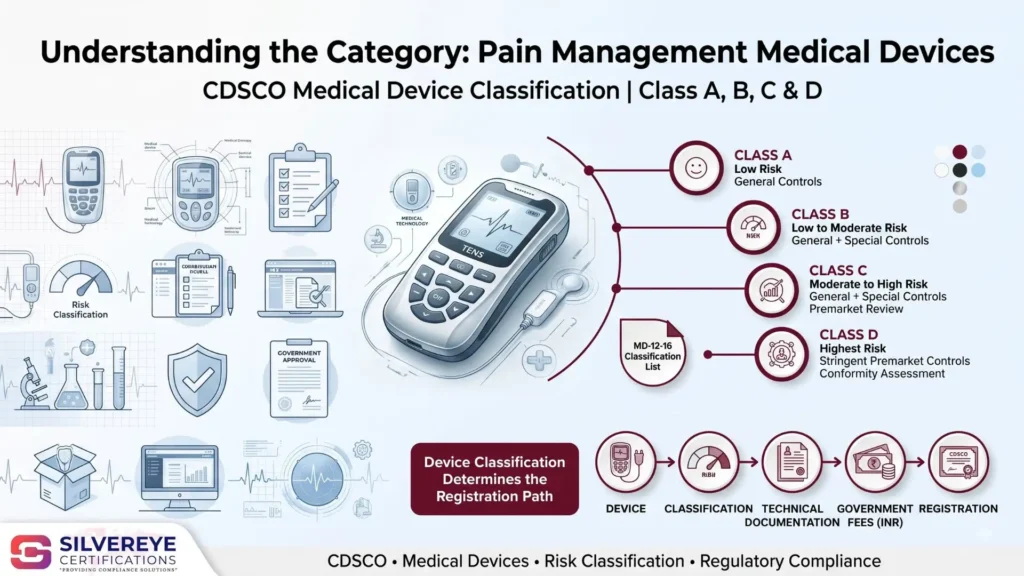
The CDSCO classifies medical devices based on intended use and risk. Pain management devices fall under a specific category in the Medical Device Schedule — commonly referred to as MD-12-16 in the classification list. This category includes 69 distinct medical devices, ranging from wearable therapeutic devices to complex implantable systems.
The classification follows a four-tier system:
- Class A — Low risk, general controls only
- Class B — Low to moderate risk, general and special controls
- Class C — Moderate to high risk, general, special controls, and premarket review
- Class D — Highest risk, requires the most stringent premarket controls and conformity assessments
Understanding which class your device falls into is the very first and most critical step in the registration journey. The class determines the complexity of the application, the documents you need, and the fees you will pay.
Why Is CDSCO Registration Mandatory for Pain Management Devices in India?
India has consistently been tightening its medical device regulatory framework to align with global standards like the EU MDR 2017 and ISO 13485. Here is why registration is non-negotiable:
- Legal Compliance — Selling an unregistered medical device in India is a punishable offence under the Drugs and Cosmetics Act, 1940, as amended.
- Market Access — Distributors, hospitals, and procurement agencies require a valid CDSCO registration certificate before purchasing devices.
- Consumer Safety — Registration ensures devices meet safety, performance, and quality benchmarks before reaching patients.
- Import Clearance — Customs authorities require a valid import license for any pain management medical device entering India.
- Investor and Partner Confidence — Global partners and domestic investors expect regulatory compliance as a baseline requirement.
CDSCO registration means no legal market access in India. This applies to both domestic manufacturers and foreign companies importing pain management devices.
Class A Pain Management Medical Devices — Complete List (Low Risk)
Class A pain management devices carry the lowest risk and require basic regulatory controls. These are typically non-invasive, external-use products that pose minimal risk to the patient when used as intended. Examples include acupressure bands, ice bags, massage tables, and static magnetic products.
Class A devices are registered with the State Licensing Authority (SLA) rather than the Central CDSCO office. The registration process is simpler, the documentation requirements are lighter, and approvals are generally faster.
| Sr. No. | Medical Device Name | Intended Use / Application |
| 1 | Acupressure Calf Band | Relieves low back pain, sciatica, piriformis syndrome |
| 2 | Acupressure Wristband | Relieves nausea via Nei-kuan (P6) acupressure point |
| 3 | Bite Relief Pad | Relieves pain/discomfort after orthodontic treatment |
| 4 | Ear Microsystem Needle | Auriculotherapy — stimulates meridian pressure points |
| 5 | Ice Bag | Alleviates pain and promotes healing in minor body injuries |
| 6 | Ice Collar | Alleviates pain in neck, throat, head; soothes sore throat |
| 7 | Intubation Teeth Protector | Protects teeth during endotracheal intubation |
| 8 | Inversion Table | Provides spinal traction; alleviates back pain |
| 9 | Massage Table/Couch | Used for complementary therapy procedures |
| 10 | Pain-Relief Phototherapy Skin Patch | Temporary relief of body aches via infrared phototherapy |
| 11 | Pain-Relief Static Magnet | Localised temporary relief of body aches and pains |
| 12 | Sitz Bath | Relieves pain/pruritus; heals perianal/perineal tissue |
| 13 | Sitz Bath Chair | Supports patient in powered sitz bath for hydrotherapy |
| 14 | Static Magnetic Bed Mattress Overlay | Relieves pain, muscle tension, poor blood circulation |
| 15 | Static Magnetic Belt | Alleviates body aches and pains around the waist area |
| 16 | Static Magnetic Bracelet | Alleviate body aches and pains from wrist surface |
| 17 | Static Magnetic Massager | Localised temporary relief from minor aches via static magnets |
| 18 | Traction System Belt | Provides traction to lower spine; relieves low back pain |
Class B Pain Management Medical Devices — Complete List (Low to Moderate Risk)
Class B pain management devices present a low to moderate risk and are regulated by the State Licensing Authority with some oversight from CDSCO. These include electrical stimulation systems, thermal therapy systems, hydrotherapy devices, acupuncture kits, and a wide range of magnetic therapeutic devices.
If you are a manufacturer or importer of Class B devices, you need to prepare a more detailed technical file, including clinical evaluation data (where applicable), and comply with applicable IS/IEC standards.
| Sr. No. | Medical Device Name | Intended Use / Application |
| 1 | Acupuncture Electrical Stimulation System | Applies electrical stimuli to acupuncture sites |
| 2 | Acupuncture Kit | Instruments and supplies for acupuncture procedures |
| 3 | Acupuncture Point Detector | Electronic probe to precisely locate acupuncture points |
| 4 | Analgesic PENS System | Relieves chronic neuropathic pain via percutaneous electrical nerve stimulation |
| 5 | Analgesic TENS System | Reduces pain perception by stimulating peripheral nerves transcutaneously |
| 6 | Arthritis TENS System | Adjunctive therapy for rheumatoid/osteoarthritis pain & stiffness |
| 7 | Arthritis Transcutaneous Electrical Joint Stimulation System | Reduces arthritis pain/stiffness; defers or avoids surgery |
| 8 | Bed/Chair Electric Massager | Therapeutic massage for body aches and pains |
| 9 | Blue/Red/Infrared Phototherapy Lamp | Treats mild skin disorders and musculoskeletal symptoms |
| 10 | Circulating-Fluid Thermal Therapy System | Hot/cold therapy for musculoskeletal injury |
| 11 | Cold-Air Therapy Unit | Treats musculoskeletal/rheumatic disorders; reduces pain/inflammation |
| 12 | Deep-Tissue Electromagnetic Stimulation System | Treats musculoskeletal disorders and body pain; facilitates healing |
| 13 | Electric Pad Localized-Body Heating System | Transcutaneous heat to relieve musculoskeletal pain |
| 14 | Endothermic Cold Therapy Pack | Reduces fever, pain, inflammation from joint/muscle/tissue injury |
| 15 | Exothermic Heat Therapy Pack | Reduces muscle spasms, cramps, joint/muscle stiffness and pain |
| 16 | Foot Bath | Therapeutic heat treatment for feet; relieves foot pain, headaches |
| 17 | Heat Therapy Gel | Warming effect for underlying tissues; reduces pain and muscle tension |
| 18 | Hydrotherapy Bath/Tank | Water jet massage/aquatic exercise for musculoskeletal pain |
| 19 | Inflatable Hot/Cold Therapy Pack/Electric Pump | Localised thermal and compression therapy for musculoskeletal injury |
| 20 | Inhalational Analgesia Unit | Administers analgesic gases or produces analgesic vapours for inhalation |
| 21 | Interferential Electrical Stimulation System | Stimulates peripheral nerves via cross-over transcutaneous currents |
| 22 | Intervertebral Disc Prolapse Therapy Pack | Reduces pain from prolapsed/herniated intervertebral disc |
| 23 | Musculoskeletal Infrared Phototherapy Unit | Infrared heat for musculoskeletal pain; improves blood circulation |
| 24 | Physical Therapy Paraffin Wax Bath | Relieves arthritis/joint pain, stiffness; stimulates circulation |
| 25 | Short-Wave Diathermy Treatment System | Deep heat for pain, muscle spasms, joint contractures |
| 26 | Static Magnetic Back/Spine Insulator | Relieves pain, muscle tension, poor blood circulation on back/spine |
| 27 | Static Magnetic Elbow Orthosis | Supports elbow; magnetic flux to alleviate elbow aches and pains |
| 28 | Static Magnetic Foot Arch Orthosis | Supports foot arch; magnetic flux to alleviate foot aches |
| 29 | Static Magnetic Joint Insulator | Relieves pain, tension, poor circulation around hip/limb joints |
| 30 | Static Magnetic Knee Orthosis | Supports knee; magnetic flux to alleviate knee aches and pains |
| 31 | Static Magnetic Lumbar Spine Orthosis | Supports lower back; magnetic flux for lower back pain relief |
| 32 | Static Magnetic Shoulder Orthosis | Supports shoulder; magnetic flux to alleviate shoulder aches and pains |
| 33 | Static Magnetic Thoracic Spine Orthosis | Supports central/upper spine; magnetic flux for pain relief |
| 34 | Wearable Cervical Spine Traction Device | Applies traction to cervical spine/neck for pain from non-bone injuries |
| 35 | Wearable Lumbar Spine Traction Device | Applies traction to lumbar spine to relieve back pain and sciatica |
Class C Pain Management Medical Devices — Complete List (Moderate to High Risk)
Class C pain management devices are moderate to high-risk products that require CDSCO Central Licence (Form MD-15 for imports or Form MD-14 for manufacture). These include spinal cord electrical stimulation systems, cryogenic analgesia units, diathermy systems, laser therapy units, and TENS devices under certain specifications.
A full technical dossier, clinical evidence, and compliance with the relevant Indian Standards (IS) or IEC standards are mandatory for Class C devices. Performance and safety testing reports from a NABL-accredited or CDSCO-notified laboratory are also required.
| Sr. No. | Medical Device Name | Intended Use / Application |
| 1 | Analgesic Peripheral Nerve Electrical Stimulation System | Electrically stimulates peripheral nerve to relieve severe intractable pain |
| 2 | Analgesic Spinal Cord Electrical Stimulation System | Applies electrical stimulus to spinal cord to relieve pain |
| 3 | Cryogenic Analgesia Unit | Extremely low temperatures applied to tissues for post-operative and chronic pain |
| 4 | Electromechanical Orthopaedic Extracorporeal Shock Wave / Pneumatic Pressure Wave Therapy System | Treats musculoskeletal disorders via shock wave and pressure wave therapy |
| 5 | Medium-Wave Diathermy Treatment System | Therapeutic deep heat via RF electromagnetic energy (0.5–1 MHz) for pain and spasms |
| 6 | Microwave Diathermy Treatment System | High-frequency EM energy for tissue healing and pain relief (subcutaneous heat) |
| 7 | Multi-Modality Physical Therapy System | Applies multiple energies to treat soft-tissue, neuromuscular, musculoskeletal disorders |
| 8 | Musculoskeletal Intense Therapeutic Ultrasound System | Intense ultrasound to ablate subcutaneous tissue; reduces inflammation and pain |
| 9 | Musculoskeletal/Physical Therapy Laser | Noninvasive laser therapy for musculoskeletal conditions and non-needle acupuncture |
| 10 | Neurophysiologic Monitoring System | Monitors/stimulates spinal nerves intraoperatively to reduce accidental injury |
| 11 | Transcutaneous ElectroNeuro Stimulator (TENS) Devices | Stimulates nerves for pain relief via transcutaneous electrical stimulation |
Class D Pain Management Medical Devices — Complete List (Highest Risk)
Class D pain management devices are the highest-risk category. These are implantable or life-sustaining devices that require the most rigorous regulatory scrutiny. Currently, the MD-12-16 list includes two Class D pain management devices — both implantable systems intended for long-term intractable pain management.
Class D device registration requires a CDSCO Central Licence, clinical investigation data (or equivalence justification), audit by a CDSCO-notified certification body, and often a local clinical trial or bridging study if the device is not already approved in a reference country.
| Sr. No. | Medical Device Name | Intended Use / Application |
| 1 | Implantable Intrathecal Infusion Pump | Implanted device for subarachnoid (intrathecal) administration of narcotics/drugs to manage intractable pain and muscle spasms |
| 2 | Implantable Lumbar Neuromuscular Electrical Stimulation System | Delivers episodic electrical stimulation to lumbar nerves for chronic low back pain (CLBP) treatment |
Who Is Eligible to Apply for CDSCO Registration for Pain Management Devices?
The eligibility criteria depend on whether you are a domestic manufacturer or an importer:
For Domestic Manufacturers
- Must be a legally registered business entity in India (company, partnership, LLP, or proprietorship)
- Must have a manufacturing facility that complies with Medical Device Good Manufacturing Practices (GMP) as per Schedule 5 of MDR 2017
- The facility must be inspected and approved by the State Licensing Authority or CDSCO depending on the device class
- Must appoint a qualified technical person responsible for manufacturing quality
For Importers / Foreign Manufacturers
- The foreign manufacturer must appoint an Authorized Indian Representative (AIR) who holds a valid import license in India
- The manufacturing site must hold a valid approval from the regulatory authority of the country of manufacture (e.g., FDA, CE, TGA)
- The AIR must be responsible for post-market surveillance, complaints, and vigilance reporting in India
- A Free Sale Certificate (FSC) from the country of origin is required for most device classes
Documents Required for CDSCO Registration of Pain Management Medical Devices
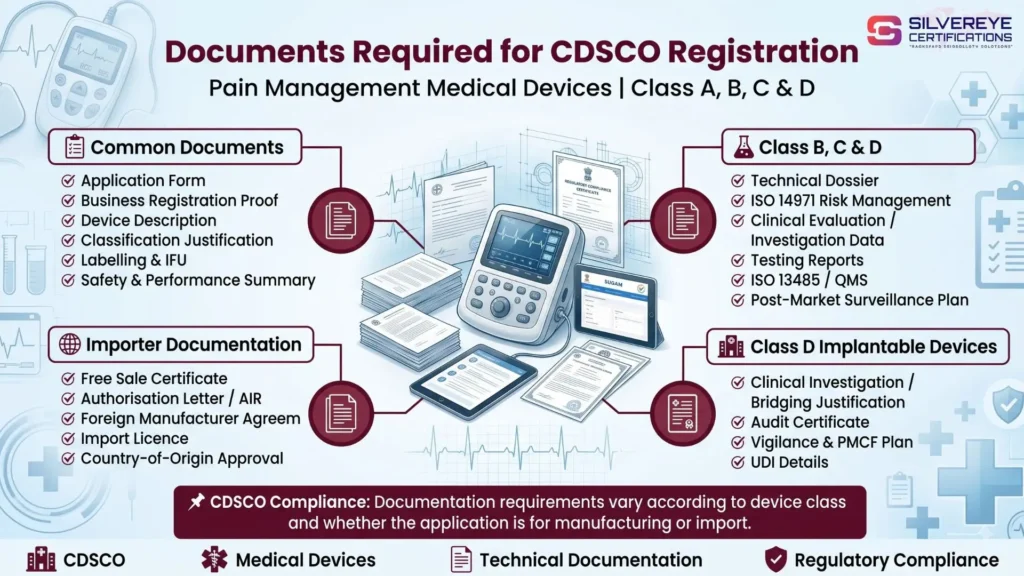
The exact documents required depend on the device class and whether you are a manufacturer or importer. Here is a comprehensive list covering all categories:
Common Documents for All Classes (A, B, C, D)
- Duly filled application form — Form MD-14 (manufacture) or Form MD-15 (import) on the SUGAM portal
- Proof of business registration — Certificate of Incorporation, GSTIN, PAN card
- Device description — intended use, indications, model numbers, technical specifications
- Device classification justification referencing the Medical Devices Rules, 2017 Schedule
- Labelling and Instructions For Use (IFU) in English and, where applicable, in regional languages
- Summary of safety and performance data
Additional Documents for Class B, C, and D Devices
- Full technical dossier including design and development documentation
- Risk management file as per ISO 14971
- Clinical evaluation report (CER) or clinical investigation data
- Testing reports from NABL-accredited or CDSCO-notified test labs (electrical safety, biocompatibility, EMC, performance)
- Manufacturing quality management system certificate — ISO 13485 or equivalent
- Post-market surveillance plan
Additional Documents for Importers (All Classes)
- Free Sale Certificate (FSC) / Certificate to Foreign Government issued by the country of origin's regulatory authority
- Authorization letter appointing the Indian Authorized Representative (AIR)
- Agreement between the foreign manufacturer and the AIR
- Import License of the AIR (Form MD-17 or equivalent)
- Country of origin approval certificate — FDA 510(k), CE Certificate, TGA registration, etc.
Additional Documents for Class D Implantable Devices
- Clinical investigation data conducted in India OR bridging study justification
- Audit certificate from a CDSCO-notified certification body
- Vigilance and post-market clinical follow-up plan
- Unique Device Identification (UDI) system details
Step-by-Step CDSCO Registration Process for Pain Management Medical Devices
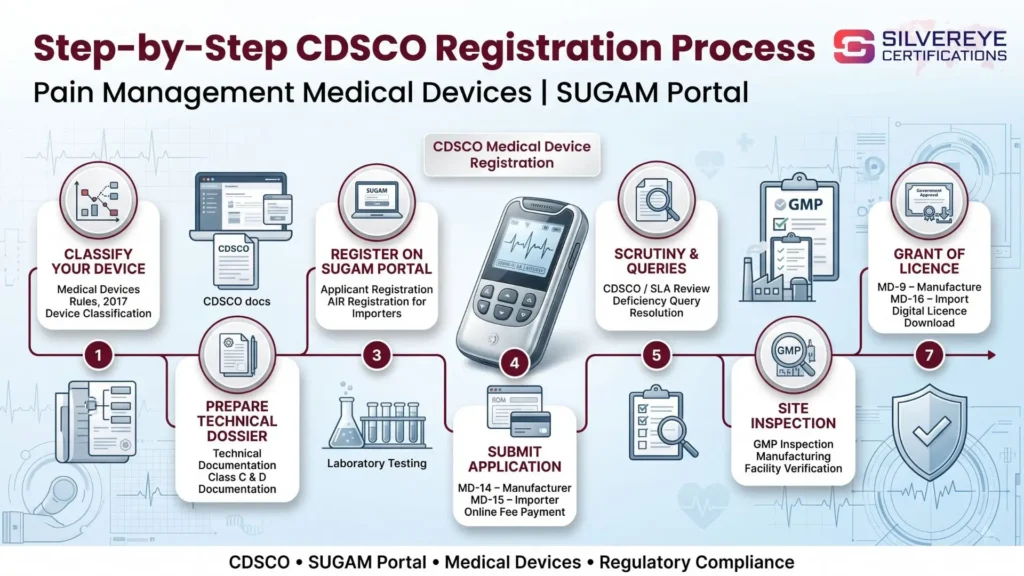
The CDSCO medical device registration process is conducted online through the SUGAM portal. Here is the step-by-step process:
- Step 1 — Classify Your Device: Confirm the correct class of your pain management device using the Medical Devices Rules, 2017 Schedule and the MD-12-16 classification list.
- Step 2 — Prepare Your Technical Dossier: Compile all required documents as per your device class. For Class C and D devices, engage a regulatory consultant to ensure completeness.
- Step 3 — Register on SUGAM Portal: Create an account on the SUGAM portal. Register your entity and the AIR (for importers).
- Step 4 — Submit the Application: Fill in Form MD-14 (manufacturer) or Form MD-15 (importer). Upload all documents. Pay the prescribed application fee online.
- Step 5 — Scrutiny and Queries: CDSCO or SLA officials scrutinise the application. They may raise deficiency queries. Respond within the stipulated timeline (usually 30–60 days).
- Step 6 — Site Inspection (if required): For Class C and D devices and some Class B devices, a GMP inspection of the manufacturing site may be conducted by CDSCO/SLA inspectors.
- Step 7 — Grant of License: Once satisfied, CDSCO/SLA grants the registration certificate (Form MD-9 for manufacture, Form MD-16 for import). The license is available for download on the SUGAM portal.
CDSCO Registration Fees for Pain Management Medical Devices
The registration fees are prescribed under the Second Schedule of the Medical Devices Rules, 2017. The fees vary by device class and applicant type (manufacturer vs. importer, Indian vs. foreign entity).
| Device Class | Domestic Manufacturer (INR) | Importer — Indian AIR (INR) | Importer — Foreign Manufacturer (USD) |
| Class A | Rs. 5,000 | Rs. 3,000 | USD 1,000 |
| Class B | Rs. 10,000 | Rs. 5,000 | USD 2,000 |
| Class C | Rs. 30,000 | Rs. 10,000 | USD 3,000 |
| Class D | Rs. 50,000 | Rs. 15,000 | USD 5,000 |
Note: The fees mentioned above are indicative and based on the Medical Devices Rules, 2017 fee schedule. Always verify the current fee structure on the official CDSCO website or SUGAM portal at the time of application, as these may be revised by the government.
Validity and Renewal of CDSCO Medical Device Registration
Validity Period
- Class A and B devices: Registration is valid for 5 years from the date of grant.
- Class C and D devices: Registration is valid for 5 years from the date of grant.
- The validity period is indicated on the face of the registration certificate.
Renewal Process and Timeline
- Renewal applications must be submitted at least 9 months before the expiry date to avoid a gap in registration.
- Applications submitted within the last 9 months before expiry are treated as fresh applications and may not benefit from the continuity provisions.
- Renewal is submitted through the SUGAM portal with updated documents, updated FSC (for importers), and renewal fees.
- If the registration lapses, you must stop selling the device in India immediately and re-apply as a fresh application.
- Keep track of post-market surveillance data, adverse event reports, and any design/labelling changes — these need to be updated on the portal and may require CDSCO approval before implementation.
Benefits of CDSCO Registration for Pain Management Device Manufacturers and Importers
- Legal Right to Market — Only registered devices can be legally manufactured, imported, sold, or distributed in India.
- Access to Government Tenders — Central and state government hospital procurement mandates CDSCO-registered devices.
- Hospital and Institutional Sales — Private hospital chains and corporate healthcare networks only procure registered devices.
- Brand Credibility and Trust — A CDSCO registration demonstrates commitment to quality and patient safety, building confidence among healthcare professionals and patients.
- Export Facilitation — A CDSCO Certificate of Registration can be used to support regulatory submissions in neighbouring markets that reference Indian approvals.
- Investor Readiness — Venture capital, private equity, and strategic partners require regulatory compliance as a prerequisite for investment or partnership.
- Reduced Legal Risk — Registered manufacturers and importers enjoy protection from enforcement action as long as they remain compliant.
Key Standards and Regulations Applicable to Pain Management Medical Devices in India
Compliance with applicable standards is a core requirement for CDSCO registration, especially for Class B, C, and D devices. The following standards are commonly applicable to pain management medical devices:
| Standard / Regulation | Applicability |
| Medical Devices Rules, 2017 (India) | Primary regulation governing all medical device registration in India |
| ISO 13485:2016 | Quality Management System for medical device manufacturers |
| ISO 14971:2019 | Risk management for medical devices |
| IEC 60601-1 (IS 13450) | Electrical safety for medical electrical equipment (TENS, diathermy, stimulators) |
| IEC 60601-1-2 | Electromagnetic compatibility (EMC) for electrical pain management devices |
| IEC 60601-2-10 | Safety of nerve and muscle stimulators (TENS, PENS, spinal cord stimulators) |
| ISO 10993 | Biological evaluation (biocompatibility) of medical devices |
| ISO 14155 | Clinical investigation of medical devices for human subjects |
| BIS Standards (IS equivalent of IEC) | Applicable where notified by CDSCO under the MDR 2017 |
Conclusion — Getting Your Pain Management Device Registered in India
India is one of the fastest-growing medical device markets in the world, with a healthcare sector expected to reach USD 50 billion by 2025. Pain management devices — from simple ice packs to sophisticated spinal cord stimulators — are in growing demand across hospitals, clinics, physiotherapy centres, and homecare settings.
But accessing this market legally requires one thing: a valid CDSCO registration. The process is clear, the requirements are documented, and the SUGAM portal has made online filing significantly more accessible. Whether you are a startup medical device company, an established manufacturer, or a foreign company looking to enter India through an authorized representative, the pathway exists — and it starts with understanding which class your device belongs to.
Use this guide as your roadmap. Start with accurate classification, build a complete technical dossier, engage a qualified Authorised Indian Representative if needed, and file through the SUGAM portal with complete, accurate documentation.
If you need expert assistance with CDSCO registration for your pain management medical device — whether it is a Class A acupressure band or a Class D implantable pump — consult a CDSCO-registered regulatory affairs professional who can guide you through every step of the process.
Frequently Asked Questions
Do all pain management medical devices need CDSCO registration in India?
Yes. As per the Medical Devices Rules, 2017, all medical devices — including all 69 pain management devices listed under the MD-12-16 category — require registration or license before they can be manufactured, imported, or sold in India.
How long does the CDSCO registration process take for a pain management device?
Timelines vary by device class. Class A devices registered with SLA may take 3–6 months. Class B typically takes 6–9 months. Class C and D devices can take 12–24 months, especially if clinical data review or factory inspection is involved. Timely and complete document submission is the most important factor.
What is the difference between Form MD-14 and Form MD-15?
Form MD-14 is the application form for domestic manufacturers seeking a licence to manufacture a medical device. Form MD-15 is the application form for importers seeking a licence to import a medical device into India. Both are submitted through the SUGAM portal.
Is a Free Sale Certificate (FSC) mandatory for all imported pain management devices?
Yes, for most device classes. An FSC or equivalent document from the competent regulatory authority of the country of manufacture is typically required. CDSCO uses this to verify that the device is legally marketed in its home country with regulatory oversight.
Can a Class A pain management device be registered without a quality management system certificate?
Class A device registration requirements are lighter. While ISO 13485 is not always mandated for Class A devices, manufacturers must still comply with basic GMP requirements as set out in Schedule 5 of the MDR 2017. It is advisable to implement a QMS regardless, as it simplifies future upgrades and audits.
What happens if I sell a pain management device in India without CDSCO registration?
Selling an unregistered medical device in India is a violation of the Drugs and Cosmetics Act, 1940 and the Medical Devices Rules, 2017. Penalties include seizure of the device, cancellation of business licences, fines, and in serious cases, criminal prosecution. Importers may also face customs detention and destruction of consignments.
Do I need a separate CDSCO registration for each model of my pain management device?
Generally, registration is done at the device type or generic device name level as per the classification schedule. However, if different models have materially different intended uses or technical specifications that place them in different risk classes, separate registrations may be required.
Is CDSCO registration required for TENS devices and acupuncture kits?
Yes. TENS devices (transcutaneous electrical nerve stimulators) are classified as Class C under the MD-12-16 list, while acupuncture kits are Class B. Both require CDSCO registration. The specific form and process depend on whether you are manufacturing in India or importing.
How do I renew my CDSCO registration for a pain management device?
Log into the SUGAM portal and apply for renewal at least 9 months before your current registration expires. Submit updated documents, a renewed FSC (if importer), and pay the applicable renewal fees. CDSCO reviews the renewal application and, if satisfied, issues a fresh registration certificate for the next 5-year period.
Is clinical data mandatory for all Class C pain management devices?
Clinical data or a robust clinical evaluation report (CER) is required for Class C devices. However, CDSCO does allow equivalence-based clinical evaluation — meaning if you can demonstrate substantial equivalence to a predicate device that has been clinically validated, you may not need to conduct a new clinical trial.