
- RoHS testing analyses a product's actual materials in a lab to confirm hazardous substances like lead, cadmium, and mercury stay under legal limits.
- Most labs run a two-stage approach: fast XRF screening first, then confirmatory ICP-OES/ICP-MS or GC-MS testing for borderline or organic substances.
- A typical RoHS lab testing cycle takes about 3 to 5 working days once samples are received, separate from the documentation and declaration steps that follow.
- Choosing an ISO/IEC 17025-accredited lab (NABL-accredited in India) makes your test report far more likely to be accepted by buyers and customs without a retest.
Introduction
RoHS testing is the laboratory process of checking whether a product's materials contain restricted hazardous substances — lead, mercury, cadmium, hexavalent chromium, PBB, PBDE, and, for EU RoHS 3, four phthalates — above legal limits. Labs typically run a two-step process under the IEC 62321 series of standards: fast, non-destructive X-ray fluorescence (XRF) screening first, followed by confirmatory wet-chemical testing (ICP-OES or ICP-MS) for metals and GC-MS for flame retardants and phthalates when results are borderline or need precise confirmation.
A standard RoHS lab testing cycle takes roughly 3 to 5 working days once samples are received, and results are compiled into a signed test report that becomes part of the manufacturer's compliance documentation.
What Is RoHS Testing?
RoHS testing is the practical, evidence-gathering half of RoHS compliance. Anyone can write a sentence claiming a product is RoHS compliant — testing is what actually proves it, by sending samples of the product's materials into a lab and measuring exactly how much lead, cadmium, mercury, or other restricted substances they contain.
It's worth separating this from the paperwork side of compliance. A Declaration of Conformity is a legal statement; RoHS testing is the scientific work that statement is supposed to be based on. Skip the testing, and the declaration is just an assumption with a signature on it.
Testing happens at the material level, not just on the finished product as a whole. A phone charger, for example, isn't tested as one lump — the lab looks separately at the plastic casing, the internal wiring, the solder joints, and the metal contacts, because RoHS limits apply to each “homogeneous material” individually.
Why is RoHS Testing Matters?
- It's the only real evidence behind a compliance claim — a Declaration of Conformity without test data is difficult to defend during a buyer audit or customs check.
- It catches problems before shipment, not after — finding a non-compliant plating or solder batch in a lab is far cheaper than finding it after a shipment gets rejected.
- It protects your buyer relationships — OEMs and EU distributors increasingly expect to see the underlying test reports, not just a signed declaration.
- It supports your legal filings — in India, RoHS self-declarations tied to EPR registration are expected to be backed by genuine testing if CPCB or an SPCB asks to verify them.
- It protects against supplier drift — testing periodically catches substance changes introduced quietly through a new supplier batch or material substitution.
What Substances RoHS Testing Actually Checks For
A RoHS test isn't a vague “safety check” — it's measured against a specific, named list of substances and thresholds.
| Substance | Threshold | Typically Found In |
| Lead (Pb) | 0.1% by weight | Solder, PVC stabilisers, glass, cable insulation |
| Mercury (Hg) | 0.1% by weight | Switches, relays, fluorescent backlighting |
| Cadmium (Cd) | 0.01% by weight | Battery contacts, plastic pigments, plating |
| Hexavalent Chromium (Cr VI) | 0.1% by weight | Metal coatings, corrosion-resistant finishes |
| Polybrominated Biphenyls (PBB) | 0.1% by weight | Flame retardants in plastic casings |
| Polybrominated Diphenyl Ethers (PBDE) | 0.1% by weight | Flame retardants in plastics and foam |
| DEHP, BBP, DBP, DIBP (phthalates) | 0.1% by weight each | Plasticisers in cables, casings, and soft plastics (EU RoHS 3 only) |
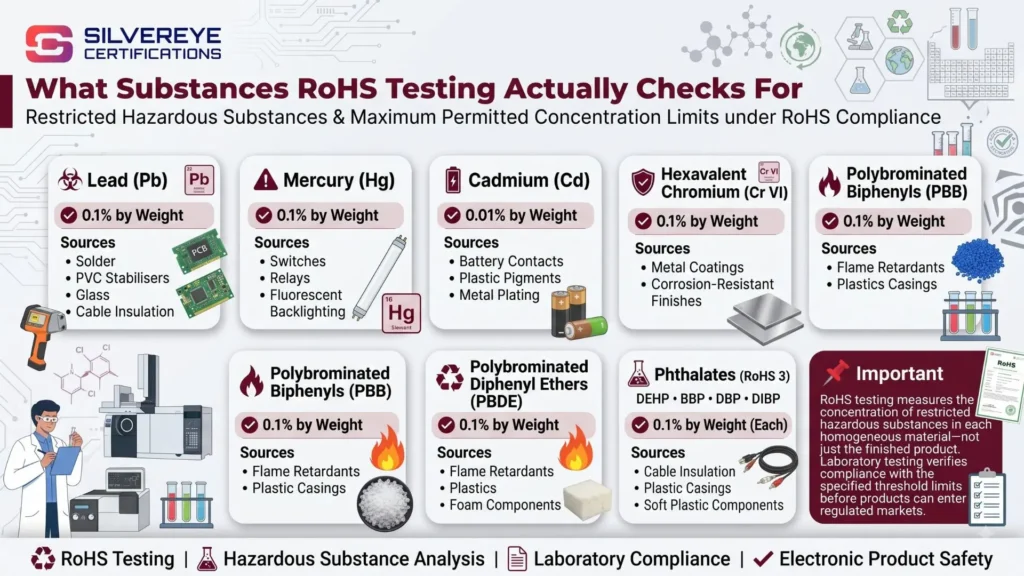
India's current RoHS rules cover the first six substances. The four phthalates are specific to EU RoHS 3, so if you're exporting to Europe, make sure your lab tests for all ten, not just the six required domestically.
RoHS 4, RoHS 6, RoHS 10 — What Your Lab Report Is Actually Covering
Ask any testing lab for “a RoHS test” and the next question back should be: which one? “RoHS 6,” “RoHS 10,” and occasionally “RoHS 4” get used as if they were three separate test packages you pick off a menu — and functionally, that’s not far off, even though there’s no such thing as a “RoHS 4 law” sitting alongside RoHS 1, 2, and 3. These numbers are lab-industry shorthand for how many substances a given test run actually screens for, and the number you order changes both what shows up on your report and what it costs.
RoHS 6 testing — screening the original panel
RoHS 6 testing covers the six substances the original 2002/95/EC directive restricted from the start: lead, mercury, cadmium, hexavalent chromium, PBB, and PBDE. This is the standard panel most Indian labs run by default, because it’s also the exact scope of India’s own E-Waste (Management) Rules, 2022. On the lab floor, RoHS 6 testing means XRF screening for the metals, with confirmatory ICP-OES or a colorimetric method pulled in if cadmium or hexavalent chromium reads close to its threshold. It doesn’t touch GC-MS at all, because none of the six original substances need it.
RoHS 10 testing — the full panel EU buyers expect
RoHS 10 testing runs the same six-substance panel and adds GC-MS analysis for the four phthalates brought in under RoHS 3 — DEHP, BBP, DBP, and DIBP. Because phthalates are organic compounds rather than metals, XRF can’t detect them at all; a lab has to run a separate GC-MS cycle specifically to cover this part of the panel. That’s the practical reason a “RoHS 10 test” takes longer and costs more than a “RoHS 6 test” on the same sample — it isn’t extra paperwork, it’s a genuinely different instrument and method added to the workflow. If your product is going anywhere in the EU, ask for RoHS 10 by name when you submit samples, since some labs default to RoHS 6 unless told otherwise.
RoHS 4 testing — the phthalate add-on by itself
“RoHS 4 testing” isn’t a directive-linked term at all — it’s what labs call it when a client only wants the GC-MS phthalate panel run, separate from the metals. This comes up most often when a product already has a valid RoHS 6 report on file and a buyer suddenly asks for phthalate data to round it out to RoHS 10 coverage. Rather than re-running the whole six-substance panel again, the lab just adds the four-phthalate GC-MS test on top of the existing data. It’s a genuinely useful shortcut when your original testing is recent and nothing in the product has changed — but it only works as a top-up, not as a standalone substitute for full RoHS 10 testing on a new product.
What this means when you’re booking a test
If you manufacture only for the Indian market, RoHS 6 testing is sufficient and keeps your lab bill lower. If any part of your product line is EU-bound, book RoHS 10 testing from the first submission rather than adding RoHS 4 (the phthalate panel) as an afterthought — sending a second sample for GC-MS later means paying a second sample-handling fee and losing several extra working days you probably don’t have once a shipment date is set.
| Test Package | Substances Covered | Method(s) Used | Best For |
| RoHS 6 | Lead, mercury, cadmium, hexavalent chromium, PBB, PBDE | XRF screening + ICP-OES/colorimetric confirmation | Domestic Indian sale under the E-Waste Rules |
| RoHS 4 | DEHP, BBP, DBP, DIBP (phthalates only) | GC-MS | Adding phthalate data to an existing RoHS 6 report |
| RoHS 10 | RoHS 6 substances + the four phthalates | XRF + ICP-OES/colorimetric + GC-MS | EU export, CE-marked products, full buyer compliance files |
The RoHS Lab Testing Process: Step-by-Step
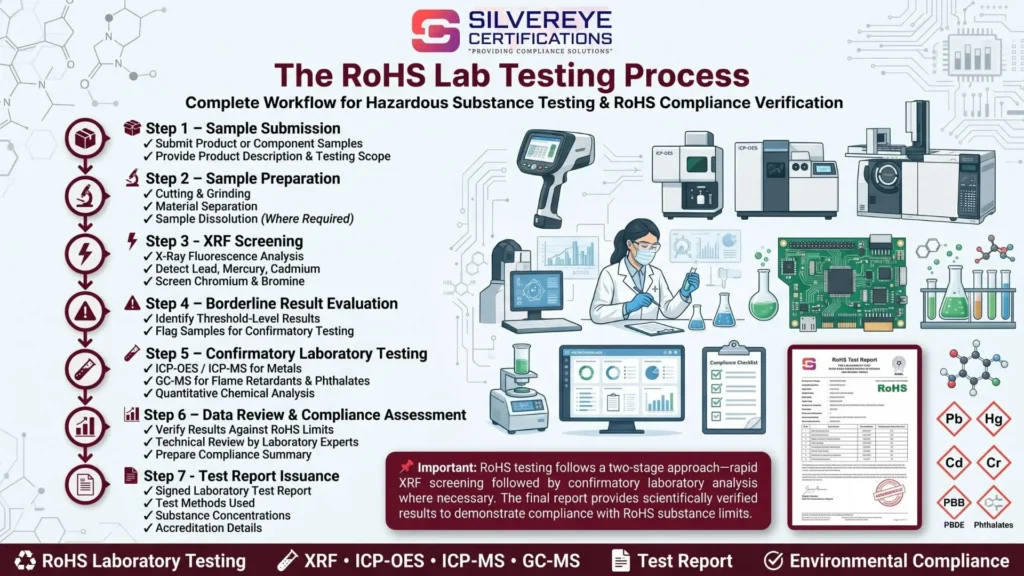
- Sample submission: You send physical samples of the product, or specific components/materials, to the lab along with a description of what needs testing.
- Sample preparation: The lab reduces the sample to a testable form — cutting, grinding, or dissolving it, depending on the material and the method that will be used.
- Screening (XRF): The prepared sample is scanned using X-ray fluorescence for a fast read on metal content — lead, mercury, cadmium, and total chromium and bromine.
- Flagging borderline results: Any reading close to the legal threshold, or any substance XRF can't isolate precisely, gets flagged for confirmatory testing.
- Confirmatory testing: The lab runs wet-chemical methods — ICP-OES or ICP-MS for metals, GC-MS for flame retardants and phthalates — to get a precise, quantitative result.
- Data review: A lab technician checks results against RoHS thresholds and compiles findings into a structured report.
- Report issuance: A signed test report is issued, listing methods used, substances measured, results, and the lab's accreditation details.
RoHS Testing Methods Explained
| Method | What It Detects | Speed | Limitations |
| XRF (X-ray Fluorescence) | Lead, mercury, cadmium, total chromium, total bromine | Seconds to minutes; non-destructive | Detects elements, not compounds — can't distinguish hexavalent chromium from total chromium; accuracy drops for cadmium near its lower 0.01% threshold |
| ICP-OES / ICP-MS | Precise quantities of lead, cadmium, mercury, chromium | Hours (sample prep + analysis) | Destructive to the sample; requires dissolving the material first |
| GC-MS (Gas Chromatography-Mass Spectrometry) | PBB, PBDE, and the four RoHS 3 phthalates | Hours to a day | More time-consuming; needed specifically for organic compounds XRF can't measure |
| Colorimetric / UV-Vis methods | Hexavalent chromium (Cr VI) specifically | Hours | Used when XRF flags total chromium and Cr VI needs to be isolated |
| FTIR (Fourier-Transform Infrared Spectroscopy) | Organic compounds like flame retardants and plastics composition | Minutes to hours | Best used alongside other methods, not as a sole confirmatory test |
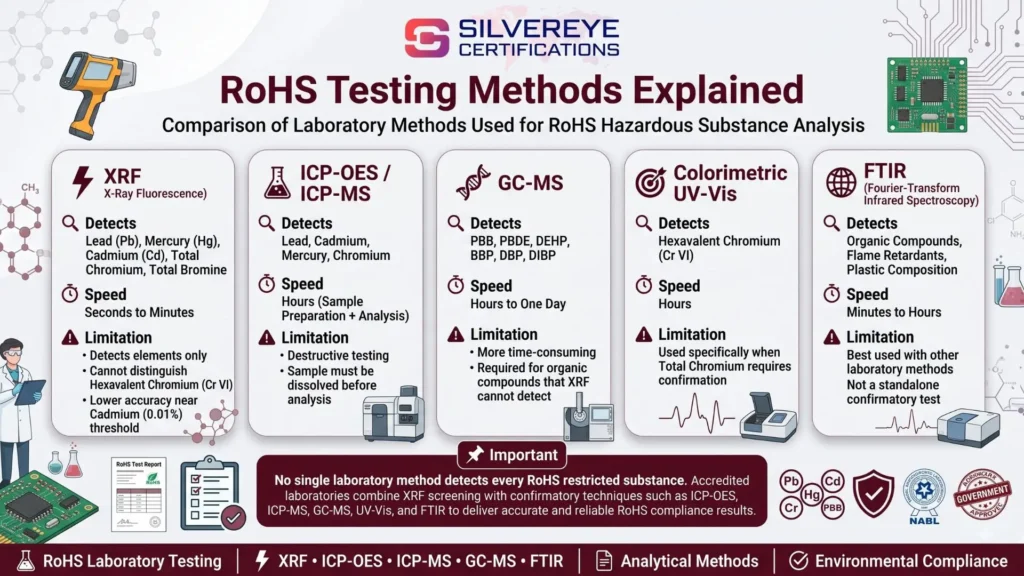
In practice, most labs combine XRF for speed with confirmatory wet-chemical or GC-MS testing for accuracy — XRF alone is a good first filter, but it isn't precise enough on its own to serve as final proof of compliance for every substance, especially cadmium near its threshold or hexavalent chromium specifically.
Sample Preparation: What Happens Before Testing
Sample prep is where a lot of testing accuracy is actually won or lost, even though it happens before any instrument gets involved.
- Reduction: Larger components are cut, ground, or shredded down into a small, uniform sample that represents the homogeneous material being tested.
- Weighing: The exact sample weight is recorded, since results are reported as a percentage or concentration relative to that weight.
- Dissolution: For wet-chemical methods, the sample is dissolved in an appropriate acid or solvent so the target substances can be measured in solution.
- Method matching: The prep approach differs depending on whether the material is a metal, plastic, or coating, and which substance is being tested for — there isn't one universal prep method for every sample type.
This is also why sample selection matters on your end. Sending a lab a single connector when the product has three connector variants from different suppliers only tells you about the one you sent — not the other two.
How Long Does RoHS Testing Take?
Once a lab actually has your samples in hand, testing itself is relatively quick. XRF screening can return results within minutes to hours. Confirmatory testing — ICP-OES/MS or GC-MS — typically adds a few more days for sample prep and analysis.
| Stage | Typical Duration |
| XRF screening | Minutes to a few hours per sample |
| Confirmatory testing (ICP/GC-MS) | 1 to 3 additional working days |
| Full lab testing cycle (screening + confirmatory + reporting) | 3 to 5 working days, expedited services can shorten this to 2 to 3 days |
| Full compliance process (testing + documentation + declaration) | 2 to 6 weeks, depending on product complexity |
The bigger time variable is usually on the manufacturer's side — how quickly samples are shipped, how many product variants need separate testing, and how fast any flagged issues get resolved and retested.
What's in a RoHS Test Report
A proper RoHS test report isn't a one-line pass/fail note. It's a structured document meant to stand up to scrutiny from customs officials, buyers, and regulators.
- Product and sample description, including which component or material was tested
- Testing methods used (e.g., XRF per IEC 62321-3-1, GC-MS per IEC 62321-6)
- Measured concentrations for each substance tested, reported as a percentage by weight (for example, “Lead: 0.05% w/w”)
- A clear pass/fail determination against the applicable RoHS threshold for each substance
- The testing lab's accreditation details (such as ISO/IEC 17025 or NABL accreditation number)
- Date of testing, report issue date, and an authorised signatory
This report becomes one of the core documents in your technical file, referenced directly in your Declaration of Conformity.
Choosing a RoHS Testing Lab
Not all lab reports carry equal weight, especially once export markets get involved. A few things worth checking before you send samples anywhere:
- Accreditation: Look for ISO/IEC 17025 accreditation, which confirms the lab follows recognised procedures for accuracy and competence. In India, this typically means NABL accreditation.
- Method coverage: Confirm the lab can run both XRF screening and confirmatory testing (ICP-OES/MS, GC-MS) in-house, rather than outsourcing part of the work, which can add delays.
- Standard alignment: Check that testing is performed against the IEC 62321 series specifically, since this is the standard buyers and regulators recognise for RoHS.
- International recognition: If you're exporting, ask whether the lab's reports are accepted in your destination market, or whether your buyer requires a specific accredited lab.
- Turnaround transparency: A lab that gives you a clear, realistic timeline upfront is generally easier to plan shipments around than one that's vague about it.
RoHS Testing Cost
Cost depends heavily on how many materials or components you're testing and how much confirmatory testing is needed beyond initial screening.
| Testing Scope | Typical Cost Range (INR) | What Drives the Cost |
| XRF screening only (per sample/BOM) | ₹3,400 – ₹9,999+ | Number of components, sample volume |
| Confirmatory ICP-OES/MS testing | Additional, quoted per substance/sample | Number of borderline results flagged during screening |
| GC-MS testing (PBB/PBDE/phthalates) | Additional, quoted per sample | Whether EU RoHS 3's four phthalates are included |
| Full testing package (screening + confirmatory) | ₹3,500 – ₹20,000+ | Product complexity, number of variants, lab chosen |
Testing every component individually on a complex assembly gets expensive fast, which is why many manufacturers use a risk-based approach — testing high-risk materials (solder, platings, connectors, plastics) directly, while relying on verified supplier declarations for lower-risk, well-documented parts.
RoHS Testing vs RoHS Certification: How They Relate
Testing and certification aren't the same step, even though they're closely linked. RoHS testing is the lab work that generates evidence. RoHS certification, or the Declaration of Conformity, is the document that formally states compliance, referencing that test evidence.
You can't skip straight to a credible declaration without testing behind it, and testing alone — without a declaration tying it to a specific product and signed by a responsible party — isn't a finished compliance package either. Both pieces need to exist together for a defensible RoHS compliance file.
Common Mistakes During RoHS Testing
- Relying on XRF screening alone as final proof, when borderline or organic-substance results actually need confirmatory testing
- Testing only one sample from a product line with multiple variants or supplier sources
- Sending samples without clear labelling of which specific material or component they represent
- Choosing a lab without checking ISO/IEC 17025 or NABL accreditation, resulting in a report that may not be accepted by buyers or customs
- Not retesting after a supplier, material, or design change, assuming an old report still applies
- Skipping phthalate testing for EU-bound products because it isn't mandatory under India's current domestic RoHS rules
Conclusion
RoHS testing is the part of compliance that turns a claim into evidence. Every Declaration of Conformity, every self-declaration filed with a regulator, and every buyer assurance about hazardous substances ultimately traces back to a lab result — a specific sample, tested under a recognized method, against a defined threshold. Skip that step or treat it as a formality, and the paperwork built on top of it doesn't hold up when someone actually checks.
The manufacturers who get this right treat testing as an ongoing habit rather than a one-time hurdle: choosing an accredited lab, testing the materials that actually carry risk, retesting when something in the supply chain changes, and keeping a full record of what was tested and how. Do that consistently, and RoHS testing stops being a bottleneck before shipment — it becomes the quiet, reliable proof that your product does exactly what your paperwork says it does.
Frequently Asked Questions
What is RoHS testing in simple terms?
RoHS testing is lab analysis that measures whether a product's materials contain restricted hazardous substances — like lead, cadmium, and mercury — above legally allowed limits.
What methods are used for RoHS testing?
Labs typically use XRF for fast screening, followed by confirmatory ICP-OES or ICP-MS for metals and GC-MS for flame retardants and phthalates, all performed under the IEC 62321 series of standards.
How long does RoHS testing take?
A typical lab testing cycle, from sample receipt to report issuance, takes about 3 to 5 working days, with expedited services sometimes shortening this to 2 to 3 days.
How much does RoHS testing cost?
Costs generally range from about ₹3,400 for basic XRF screening to ₹20,000 or more for a full testing package including confirmatory testing, depending on product complexity and the number of components tested.
Is XRF testing enough to prove RoHS compliance?
Not on its own for every substance. XRF is excellent for fast screening but can't reliably distinguish hexavalent chromium from total chromium and loses accuracy near cadmium's lower threshold, so borderline results need confirmatory wet-chemical testing.
What is the difference between XRF and GC-MS testing?
XRF is a fast, non-destructive screening method for metals, while GC-MS is a more detailed, slower method used specifically to detect organic compounds like PBB, PBDE, and phthalates that XRF cannot measure.
Do I need to test every component in my product?
Ideally yes, but many manufacturers use a risk-based approach, testing high-risk materials like solder, platings, and plastics directly, while relying on verified supplier declarations for lower-risk components.
What accreditation should a RoHS testing lab have?
Look for ISO/IEC 17025 accreditation, which confirms the lab meets recognized standards for testing competence. In India, this is typically demonstrated through NABL accreditation.
What does a RoHS test report include?
A proper report includes the product and sample description, testing methods used, measured concentrations for each substance, pass/fail results against RoHS thresholds, and the lab's accreditation details.
Does RoHS testing check for phthalates?
Only if specifically requested or required. India's current domestic RoHS rules cover six substances and don't mandate phthalate testing, but EU RoHS 3 requires testing for four additional phthalates, so exporters should request this explicitly.