

- RNI registration (now issued by the Press Registrar General of India, or PRGI) is the mandatory government approval required to legally publish a newspaper, magazine, or periodical in India.
- Since March 2024, the entire process runs online through the Press Sewa Portal under the Press and Registration of Periodicals Act, 2023 — no more running between district offices.
- You need a unique title, valid identity/address proof, a declaration, and a government fee of ₹1,000 to complete registration; approval usually takes around 3–4 months.
- Registered publishers must file an Annual Statement every year to keep the registration active — skipping it for two consecutive years can lead to suspension.
Introduction
RNI registration is the official government process that gives a newspaper, magazine, or periodical the legal right to be published in India. It was earlier handled by the Registrar of Newspapers for India (RNI) under the 1867 press law. Since March 2024, it is managed by the Press Registrar General of India (PRGI) under the Press and Registration of Periodicals Act, 2023, through the online Press Sewa Portal. Registration involves title verification, document submission, a ₹1,000 fee, and issuance of a Certificate of Registration — required before any periodical can legally print, circulate, or claim readership.
What Is RNI Registration?
If you open any newspaper or magazine in India, you'll usually notice a small line somewhere on the front or last page mentioning an "RNI No." That number is proof that the publication has been legally registered with the government. RNI registration — officially called PRGI registration today — is this exact process: getting your newspaper, magazine, journal, or any periodical containing public news or comments on public news officially recorded and authorized for publication.
The body that handles this was earlier known as the Registrar of Newspapers for India (RNI), set up way back on 1 July 1956 on the recommendation of the First Press Commission. It functioned under the colonial-era Press and Registration of Books Act, 1867. In 2024, the Government of India replaced that old law with the Press and Registration of Periodicals Act, 2023 (PRP Act), and the office was renamed the Press Registrar General of India (PRGI).

Even so, most publishers, consultants, and search engines still call it "RNI registration" out of habit — the two terms mean the same thing today. Throughout this guide, we'll use RNI and PRGI interchangeably so it's easy to follow either way.
Why Is RNI/PRGI Registration Matters?
- Legal recognition: Your publication gets an official government record and a unique registration number — proof that it's a genuine, lawfully operating periodical.
- Title protection: Once your title is approved, no other publisher in the same language and region can use the same or a deceptively similar name.
- Access to government advertising and DAVP/BOC empanelment: Central and state government advertising schemes require a valid RNI/PRGI registration and a minimum circulation history.
- Credibility with advertisers and readers: An RNI number signals authenticity, which helps when approaching advertisers, sponsors, or applying for press accreditation.
- Legal protection: Registration is your defence against unauthorised use of your masthead and helps establish ownership in case of a title dispute.
- Avoids penalties: Publishing news periodicals without registration is an offence under the PRP Act, 2023 and can attract fines or forced closure.
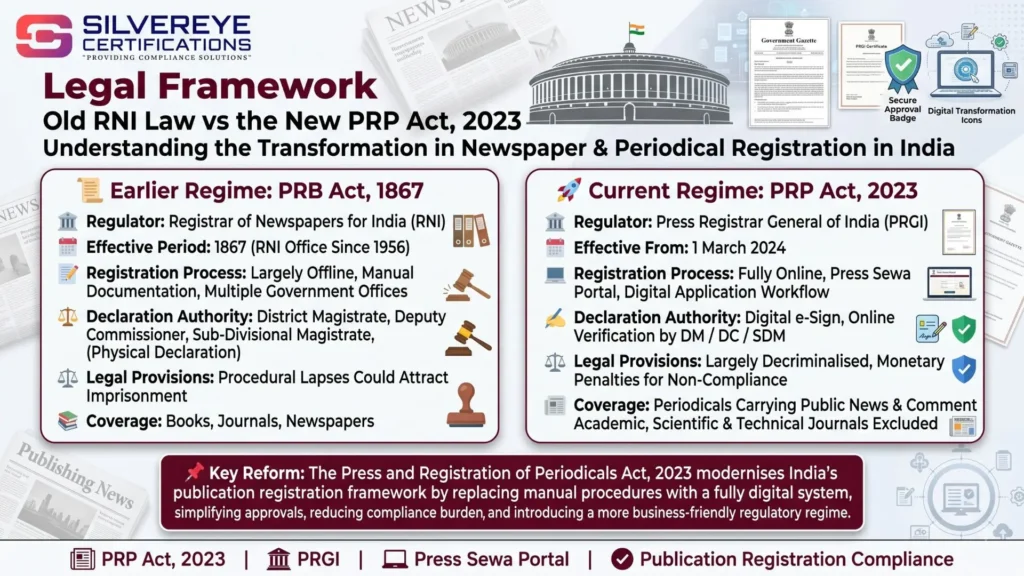
Legal Framework: Old RNI Law vs the New PRP Act, 2023
Understanding the legal shift matters because it changed almost every part of the registration process — from where you apply to how long it takes.
| Aspect | Earlier Regime (PRB Act, 1867) | Current Regime (PRP Act, 2023) |
| Regulator | Registrar of Newspapers for India (RNI) | Press Registrar General of India (PRGI) |
| Effective from | 1867 (RNI office since 1956) | 1 March 2024 |
| Process | Largely offline/manual, multiple offices | Fully online via Press Sewa Portal |
| Declaration authority | District Magistrate/DC/SDM in person | Digital e-Sign, DM/DC/SDM verifies online |
| Criminal liability | Imprisonment for procedural lapses | Largely decriminalised; monetary penalties instead |
| Scope | Books, journals & newspapers | Only periodicals with public news/comments (academic, scientific & technical journals excluded) |
Who Needs RNI Registration?
RNI/PRGI registration applies broadly to anyone planning to legally publish a periodical carrying public news or commentary on public news in India. Here's who typically needs it:
- Individuals or companies planning to launch a new newspaper, magazine, tabloid, or news-based periodical (print or its digital e-paper replica).
- Existing publishers who have changed their title, language, periodicity, place of publication, or ownership and need to update their registration.
- Owners who already run a print/vernacular publication without formal registration and want to regularise it.
- Printing presses that print periodicals — they must send intimation to PRGI within 30 days of commencing operations.
Pure academic, scientific, and technical journals (that don't cover public news or current-affairs commentary) fall outside the scope of the PRP Act and generally do not require RNI/PRGI registration. Purely digital-only news websites (with no print edition) are separately governed under the IT Rules, 2021, though many digital publishers still secure a title registration to protect their brand name.
Basic Requirements Before You Apply
- A unique, non-offensive proposed title that isn't already registered or deceptively similar to an existing one.
- A designated owner, publisher, and printer/printing press for the periodical.
- A registered place of publication and clearly defined periodicity (daily, weekly, monthly, etc.).
- Valid identity and address proof for the owner/publisher, and PAN details if applying as a company or firm.
Documents Required for RNI Registration
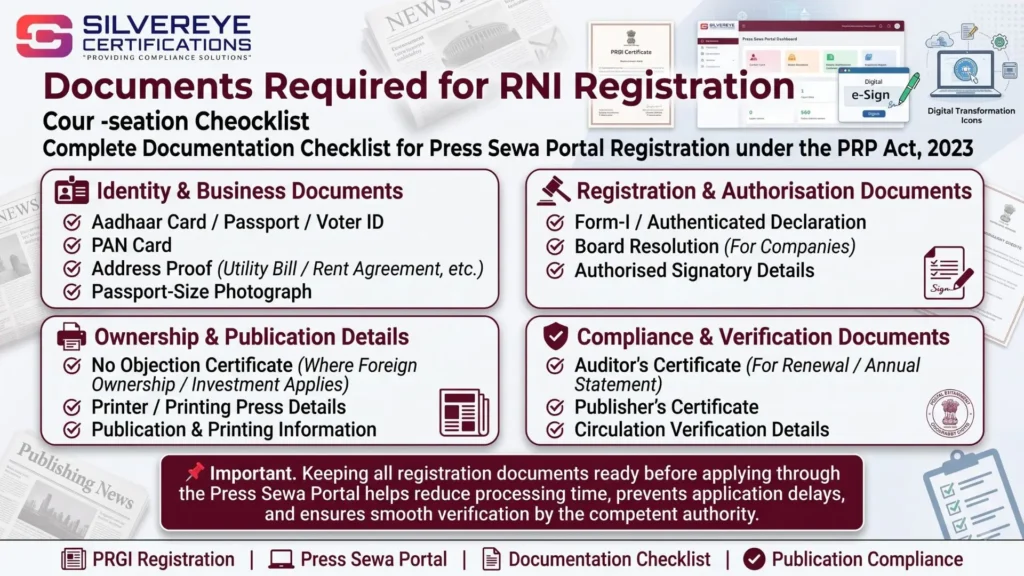
Keeping these RNI documents ready in advance considerably speeds up the Press Sewa Portal process:
| Document | Purpose |
| Aadhaar Card / Passport / Voter ID | Identity proof of owner, publisher & directors/partners |
| PAN Card | Mandatory for companies, firms & commercial entities |
| Address proof (utility bill, rent agreement, etc.) | Verifies registered address of publication |
| Declaration (Form-I / authenticated declaration) | e-Signed and verified by the local authority (DM/DC/SDM) |
| Passport-size photograph | Owner/publisher identification |
| Board resolution (if applicant is a company) | Authorises the company to apply for registration |
| No Objection Certificate (if foreign ownership/investment involved) | Confirms compliance with FDI/foreign publication norms |
| Printer/printing press details | Confirms where and how the periodical will be printed |
| Auditor's/Publisher's Certificate (for renewals & annual statement) | Verifies claimed circulation figures |
Note: For claimed circulation of 25,000 copies or more, a Chartered Accountant's certificate verifying the figures is generally required. For circulation below that threshold, a simpler self-declared Publisher's Certificate is usually accepted — always check the latest requirement on the Press Sewa Portal, as thresholds are periodically reviewed.
Step-by-Step RNI Registration Process (Press Sewa Portal)
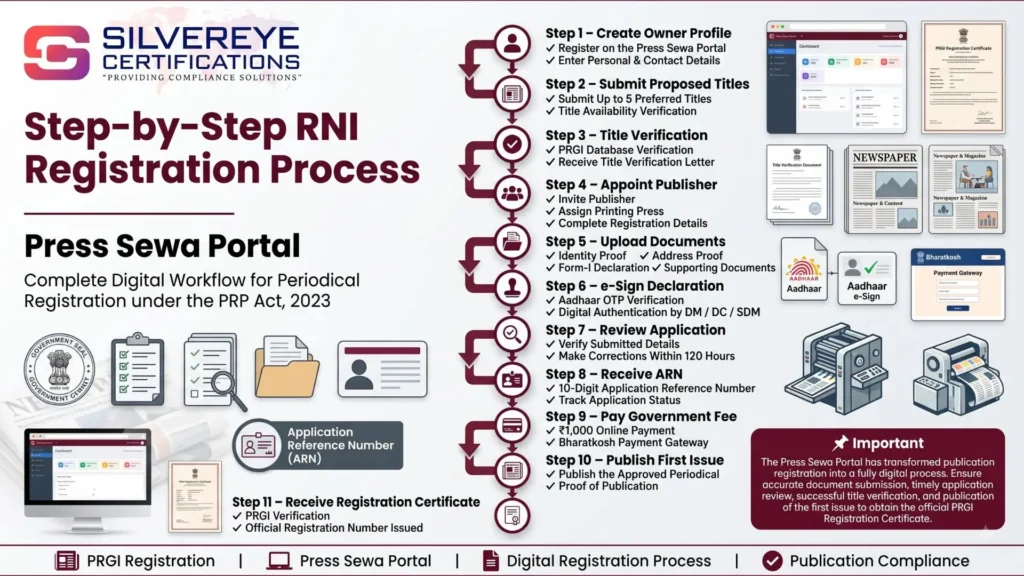
Here's how the modern, fully online RNI/PRGI registration process actually works, step by step:
- Create a profile on the Press Sewa Portal as the "Owner" of the proposed periodical, filling in your basic personal and contact details.
- Submit up to 5 proposed titles in order of preference. Titles must be unique, non-offensive, and not identical or deceptively similar to any existing registered periodical in the same language/state.
- Wait for title verification against the PRGI database. Once a title is cleared, you receive a Title Verification Letter confirming approval.
- Appoint a publisher through the portal. The owner invites the publisher to sign up; the publisher then fills the main registration form and designates a printer/printing press.
- Upload all required documents — identity proof, address proof, declaration (Form-I), and other supporting papers — as scanned copies on the portal.
- e-Sign the declaration using Aadhaar-based OTP verification, or have it authenticated digitally by the DM/DC/SDM, who can now e-sign and forward it online.
- Review your application within 120 hours (5 days) of submission — this is the window during which corrections can still be made before it locks for processing.
- Receive your Application Reference Number (ARN) — a unique 10-digit number generated automatically, used for all further tracking and correspondence.
- Pay the government fee of ₹1,000 online through the integrated Bharatkosh payment gateway.
- Publish your first issue (this is usually required as proof of actual publication before final certification in many cases).
- Receive the Certificate of Registration once PRGI verifies all documents and confirms compliance — this certificate carries your official RNI/PRGI number.
Because the Press Sewa Portal is a single-window system, the Press Registrar General and the concerned District (Specified) Authority can both view and act on your application simultaneously, which has meaningfully cut down the older back-and-forth delays.
RNI Registration Fees
| Fee Component | Approximate Amount | Paid Via |
| Registration application fee | ₹1,000 | Bharatkosh online gateway |
| Late annual statement filing (per year, where applicable) | Penalty as per current PRGI advisory | Press Sewa Portal |
| Professional/consultant charges (optional) | Varies by service provider | N/A — third-party service |
The government fee itself is modest, but incomplete documentation or an unclear title choice is what usually causes delays — not the cost. Always verify the latest fee structure on the Press Sewa Portal, since PRGI periodically issues advisories that may revise components like penalty amounts.
RNI Registration Timeline: How Long Does It Take?
On average, RNI/PRGI registration takes around 3–4 months from application to certificate issuance, depending on how quickly your title gets cleared and how complete your documentation is. Title verification is typically the step where most delays happen — generic, common, or closely similar titles are far more likely to be rejected or sent back for resubmission.
- Faster approvals: Unique, well-thought-out titles with complete documents and prompt e-Sign verification.
- Slower approvals: Common/generic titles, missing declarations, unclear ownership structure, or delayed authority verification.
Validity, Renewal & Annual Statement Filing
Unlike a licence with a fixed expiry date, RNI/PRGI registration doesn't need to be "renewed" in the traditional sense — but it must be kept active through consistent annual compliance.
- Every registered owner/publisher must file an Annual Statement each year on the Press Sewa Portal, generally by 31 May, reporting circulation and publication details for the previous financial year (deadlines are occasionally extended via official PRGI advisories).
- Failure to file the Annual Statement can attract a penalty per year of default, as notified by PRGI from time to time.
- Under the PRP Act, 2023, continuous failure to file correct details for two consecutive years can lead to suspension of the registration.
- Any change in title, ownership, periodicity, printer, or place of publication must be updated on the portal — running these changes without informing PRGI can also invite penalties.
In short: think of it less as a one-time renewal and more like an annual compliance habit that keeps your registration in good standing.
Penalties for Non-Compliance
The PRP Act, 2023 substantially decriminalised procedural lapses compared to the old 1867 law — imprisonment for minor irregularities has largely been removed. That said, monetary penalties and enforcement action still apply:
- Publishing a periodical with public news content without registration.
- Not filing the Annual Statement within the prescribed period.
- Providing inaccurate circulation figures or other false disclosures.
- Continuing to publish under a title after registration has been suspended or cancelled.
Chapter V of the PRP Act, 2023 empowers the Press Registrar General to impose penalties in such cases, though publishers are entitled to an opportunity for hearing before any penalty or suspension is finalised.
Common Mistakes to Avoid During RNI Registration
- Choosing a generic or overly common title (like "India News" or "City Times") that's likely to clash with existing registrations.
- Submitting only one or two title options instead of using the full 5-title preference list, which reduces your chances of quick approval.
- Uploading mismatched or unclear identity documents — Aadhaar name mismatches are a common reason for e-Sign failures.
- Forgetting the 120-hour correction window and missing the chance to fix errors before the application locks.
- Not updating the portal after a change in printer, address, or ownership, which can create compliance gaps later.
- Ignoring the Annual Statement deadline year after year, risking suspension of an otherwise valid registration.
RNI vs PRGI: Quick Clarification
This is one of the most common points of confusion, so here's the short version: RNI (Registrar of Newspapers for India) was the older name and older legal framework (1867 Act). PRGI (Press Registrar General of India) is the current name and current legal framework (PRP Act, 2023), effective from 1 March 2024. The registration process, the certificate, and the underlying purpose remain conceptually the same — only the name, the law, and the (now fully digital) procedure have changed. Most people, including search engines and everyday publishers, still search for and refer to this as "RNI registration," so both terms are used interchangeably in practice.
Conclusion
RNI registration — now formally PRGI registration — remains the single most important legal step for anyone serious about launching a newspaper, magazine, or journal in India. The shift to the Press Sewa Portal under the Press and Registration of Periodicals Act, 2023 has made the process considerably faster, more transparent, and largely paperless compared to the old, office-heavy system. The real key to a smooth approval isn't the fee (which is a modest ₹1,000) — it's picking a genuinely unique title, keeping your documents accurate and complete, and staying consistent with your Annual Statement filings once you're registered. Get these right, and your publication's registration with Silvereye Certifications should move through the system without unnecessary delay.
Frequently Asked Questions
What is RNI registration in simple terms?
RNI registration is the government process that legally authorises a newspaper, magazine, or periodical to be published in India. It is now handled online by the Press Registrar General of India (PRGI) under the Press and Registration of Periodicals Act, 2023.
Is RNI and PRGI registration the same thing?
Yes. PRGI is simply the renamed, updated version of the RNI office and process, following the 2024 replacement of the old 1867 press law. The terms are used interchangeably.
Who needs to apply for RNI/PRGI registration?
Anyone planning to publish a newspaper, magazine, journal, or periodical carrying public news or commentary on public news in India needs registration, along with printing presses that print such periodicals.
Do digital-only news websites need RNI registration?
Purely digital news portals with no print edition are governed separately under the IT Rules, 2021, and don't strictly need RNI/PRGI registration — though many still register a title to legally secure their brand name.
How long does RNI registration take?
On average, it takes around 3–4 months from application submission to certificate issuance, depending on title verification speed and completeness of documents.
What is the government fee for RNI registration?
The core registration fee is ₹1,000, payable online through the Bharatkosh gateway integrated with the Press Sewa Portal.
How many title options should I submit?
You can submit up to 5 proposed titles in order of preference. Submitting all 5 with genuinely unique options improves your chances of faster title approval.
What happens if I don't file my Annual Statement?
You may face a penalty for each year of non-filing, and under the PRP Act, 2023, continuous default for two consecutive years can lead to suspension of your registration.
Can I make changes after submitting my RNI application?
Yes, but only within 120 hours (5 days) of submission on the Press Sewa Portal. After this window, the application is locked for further processing.
Is a Chartered Accountant's certificate mandatory for RNI registration?
It's mainly required for circulation reporting: publications claiming 25,000 copies or more generally need a CA-certified circulation figure, while those below this threshold can often use a self-declared Publisher's Certificate.