
- TEC approval is the mandatory DoT certification every telecom device needs before sale, import, or use in India.
- MTCTE certification is issued only after testing at a TEC-designated lab (CAB) against official Essential Requirements.
- A regular MTCTE certificate is valid for 10 years; provisional certificates run for 2 years.
- The process runs on the mtcte.tec.gov.in portal — application, lab testing, fee payment, and certificate issuance.
Introduction
TEC approval is the official certification granted by India's Telecommunication Engineering Centre (TEC), under the Department of Telecommunications (DoT), confirming that a telecom product meets India's mandatory safety, network, and radio-frequency standards. It is issued under the Mandatory Testing and Certification of Telecom Equipment (MTCTE) scheme, based on the Indian Telegraph (Amendment) Rules, 2017.

Any manufacturer, importer, or distributor selling routers, modems, IoT devices, set-top boxes, or similar telecom equipment in India must first get the product tested at a TEC-designated lab and certified through the MTCTE portal before it can legally enter the Indian market.
If you manufacture, import, or distribute telecom or networking hardware in India — routers, ONTs, IP cameras, IoT gateways, set-top boxes, or 5G equipment — you cannot legally sell that product without TEC approval. This guide walks through what TEC approval and MTCTE certification actually mean, who needs them, the exact application process, the documents and fees involved, how long the certificate lasts, and how to renew it — based on the current MTCTE Procedure v3.0 (TEC 93009:2024) and the Telecommunications (Framework to Notify Standards, Conformity Assessment and Certification) Rules, 2025.
What Is TEC Approval (Telecommunication Engineering Centre)?
The Telecommunication Engineering Centre (TEC) is the technical wing of India's Department of Telecommunications (DoT), functioning under the Ministry of Communications. TEC sets the technical standards — called "Essential Requirements" (ERs) — that telecom equipment must meet before it can be used on Indian networks. TEC also designates the accredited labs (called Conformity Assessment Bodies, or CABs) that test products, and it issues the final certificate once a product clears testing.
TEC is the regulator, MTCTE is the scheme it runs, and "TEC approval" or "TEC certification" is the outcome — the official green light that lets a telecom product be sold, imported, or deployed in India.
TEC approval (also called a TEC certificate or MTCTE certificate) is the formal confirmation from TEC that a specific telecom equipment model has been tested and found compliant with India's Essential Requirements. Once granted, the product receives a unique registration number, and the manufacturer or importer must display the required certification label on the product or its packaging.
TEC approval is not a quality guarantee — it does not certify that a product is the "best" in its category. It only confirms the product meets the minimum mandatory safety, network-protection, and radio-frequency thresholds set by the regulator. Quality and reliability beyond that remain the responsibility of the OEM.
Why TEC Approval Exists — The Core Objectives
- Network protection: Ensures a connected device doesn't degrade the performance of India's existing telecom networks.
- User safety: Confirms the equipment is electrically and physically safe for end-users.
- RF emission control: Ensures radio-frequency emissions stay within limits safe for the public.
- Standards compliance: Confirms the product meets relevant national and international technical standards (the Essential Requirements).
What Is MTCTE? (Mandatory Testing and Certification of Telecom Equipment)
MTCTE is the regulatory scheme through which TEC approval is actually granted. It was introduced through the Indian Telegraph (Amendment) Rules, 2017 (notified 5 September 2017), which made it mandatory for telecom equipment to be tested and certified before sale, import, or use in India. The scheme has since been updated by the Telecommunications (Framework to Notify Standards, Conformity Assessment and Certification) Rules, 2025, aligned with the Telecommunications Act, 2023, and is currently governed by MTCTE Procedure v3.0 (TEC 93009:2024).
MTCTE does not cover every electronic product — only telecom equipment that connects to, or communicates over, a public or private telecom network. TEC has been rolling this out in phases since 2018, gradually adding more product categories.
MTCTE Rollout: Phase-Wise Coverage
| Phase | Approx. Timeline | Example Product Categories |
| Phase I & II | 2018–2019 | Mobile handsets, GPON/GPS devices, VoIP equipment, wireless routers |
| Phase III & IV | Mandated from July 2022 | Optical transport equipment, LAN switches, IP-based devices, set-top boxes, PON equipment |
| Phase V | Mandated from July 2024 | 5G core, 5G base stations, hybrid set-top boxes, hypervisors, IP terminals, C-MSAAE |
| Phase VI | Applicable from 24 August 2025 | Newly notified telecom equipment categories per the Feb 2025 DoT notification |
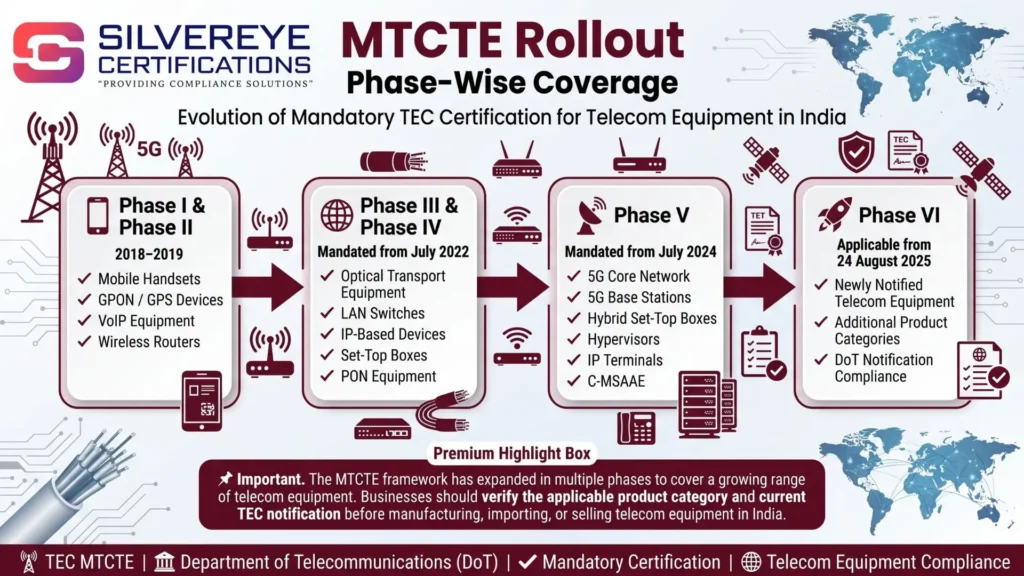
New products keep getting added, so it's worth checking the "Phase-Wise Products List" on the official MTCTE portal (mtcte.tec.gov.in) for your exact product category before assuming it's covered — or exempt.
Who Needs TEC Approval?
TEC approval is required by anyone placing notified telecom equipment into the Indian market:
- Manufacturers (Indian OEMs) producing telecom equipment for the Indian market.
- Importers and foreign OEMs bringing telecom products into India.
- Distributors and brand owners rebranding or reselling telecom hardware under their own name.
- System integrators and telecom service providers deploying uncertified equipment on live networks.
Foreign manufacturers cannot apply directly. They must appoint an Authorized Indian Representative (AIR) — an India-registered entity (a subsidiary, distributor, or consultant) that applies on their behalf and takes on the compliance responsibility with TEC.
Benefits of TEC Approval
- Legal market access: Without it, selling, importing, or using the equipment in India is illegal.
- Buyer and tender eligibility: Government tenders, telecom operators, and large enterprise buyers routinely ask for a valid TEC/MTCTE certificate.
- Reduced regulatory risk: Avoids product seizures, import holds at customs, and penalties under the Telegraph Rules.
- Network and brand credibility: Signals to partners and customers that the product meets India's safety and interference standards.
- Long validity: A regular certificate is valid for 10 years, reducing the compliance burden compared to shorter-cycle approvals elsewhere.
Eligibility Criteria for MTCTE Certification
There's no "pass/fail" eligibility test to apply — any legitimate OEM, AIR, or importer can apply. But TEC does expect the applicant to meet certain structural conditions before a certificate can be granted:
- The applicant must be a company registered in India (or a foreign OEM represented by a registered Indian AIR).
- The product must fall under a phase/category already notified under MTCTE with published Essential Requirements.
- Testing must be completed at a TEC-designated CAB (or an ILAC-accredited lab where TEC currently permits it for specific technical parameters).
- The product must pass all applicable ERs — safety, EMI/EMC, RF, network, and (where applicable) security parameters.
- Where a product touches network security (e.g., ONT/OLT, routers, IoT gateways), applicants may also need security certification, sometimes via TEC or the Indian Common Criteria Certification Scheme (IC3S).
Certification Schemes Under MTCTE: GCS vs SCS
TEC classifies products into two certification tracks depending on testing complexity and risk profile:
| Parameter | General Certification Scheme (GCS) | Simplified Certification Scheme (SCS) |
| Applies to | Most telecom equipment requiring full lab testing | Selected lower-risk product categories notified by TEC |
| Basis of approval | Full test reports against all Essential Requirements from a CAB | Compliance checklist plus a Self-Declaration of Conformity (SDoC), backed by testing per ERs |
| Typical processing | Around 40–45 working days after complete documentation | Generally faster, since evaluation is lighter |
| Best suited for | Complex/high-risk equipment (base stations, core network gear) | Simpler CPE-type devices where TEC allows reduced testing |
Both schemes still require testing at a TEC-recognised lab — SCS simply reduces the depth of documentation and evaluation TEC performs, it does not remove testing.
Provisional vs Regular Certification
- Provisional certification: Issued in limited cases where certain requirements are temporarily relaxed; historically valid for up to 2 years. Note: TEC's Procedure v3.0 (2024) has removed issuance of new provisional certificates for most categories — check the current MTCTE Procedure for your product before assuming this route is open.
- Regular certification: Issued after full compliance with all applicable Essential Requirements; currently valid for 10 years from the date of issue (extended from the earlier 5-year validity via a TEC notification effective July 2022, and carried forward in Procedure v3.0).
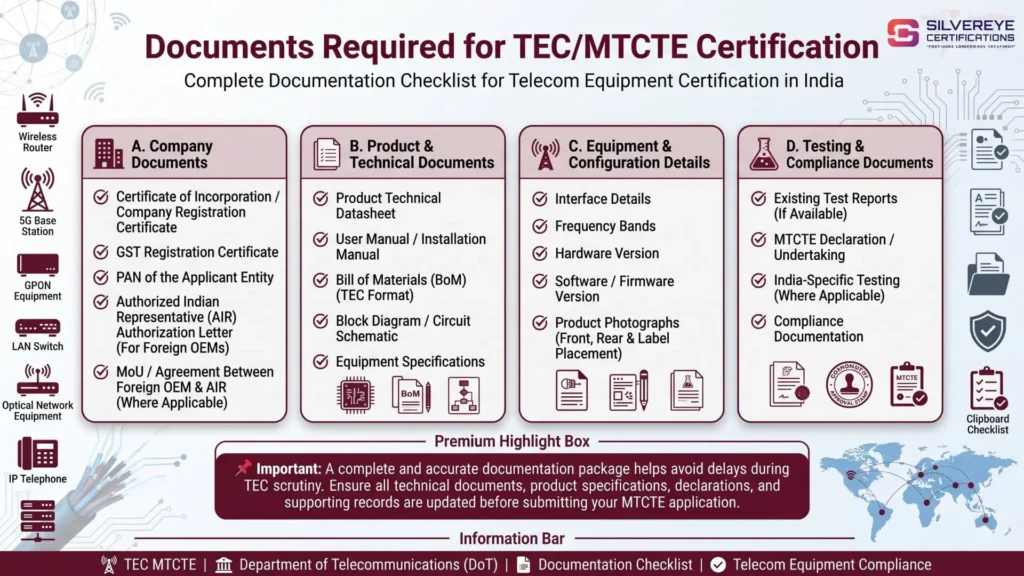
Documents Required for TEC/MTCTE Certification
- Company registration certificate / Certificate of Incorporation
- GST registration and PAN of the applicant entity
- Authorized Indian Representative (AIR) authorization letter, for foreign OEMs
- MoU/agreement between the foreign OEM and the Indian AIR, where applicable
- Product technical datasheet and user/installation manual
- Bill of Materials (BoM) in the prescribed TEC format
- Block diagram / circuit schematic of the equipment
- Details of interfaces, frequency bands, and software/hardware version
- Existing test reports, if any (India-specific re-testing is still generally required)
- Photographs of the equipment (front, back, and label placement)
- Declaration/undertaking as prescribed on the MTCTE portal
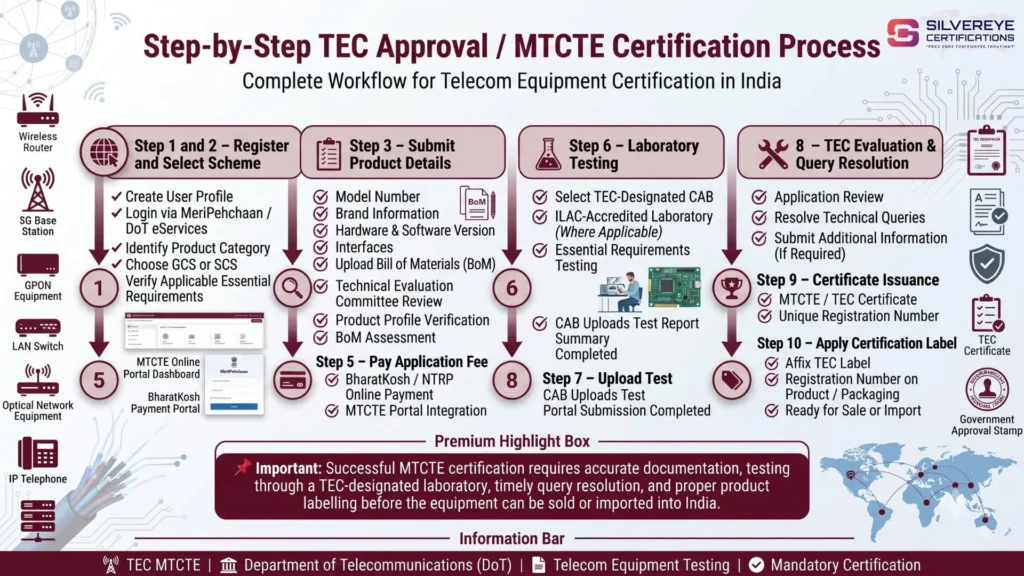
Step-by-Step TEC Approval / MTCTE Certification Process
- Register on the MTCTE portal: Create a user profile on mtcte.tec.gov.in (login via the MeriPehchaan/DoT eServices portal). This profile is used for all future applications.
- Select the certification scheme: Identify whether your product falls under GCS or SCS, based on the phase-wise product list and applicable Essential Requirements.
- Submit product and company details: Enter model number, brand, hardware/software version, interfaces, and upload the Bill of Materials.
- Pre-check / Technical Evaluation Committee (TEC) review: TEC reviews the submitted product profile and BoM before allowing the application to move to testing and payment.
- Pay the application fee: Fees are paid online through the BharatKosh / NTRP (Non-Tax Receipt Portal), integrated with the MTCTE portal.
- Select a lab and complete testing: Choose a TEC-designated CAB (or an accepted ILAC-accredited lab for eligible parameters) and submit your sample for testing against the applicable Essential Requirements.
- Upload test reports: The CAB uploads the test report summary directly to the MTCTE portal on completion.
- TEC evaluation and query resolution: TEC reviews the test report and application; any deficiencies are raised as queries through the portal, which the applicant must resolve.
- Certificate issuance: On successful evaluation, TEC issues the MTCTE/TEC certificate along with a unique registration number for the model.
- Apply the certification label: The prescribed TEC label (with the registration number) must be affixed to the product or its packaging before sale or import.
TEC Approval / MTCTE Certification Fees
MTCTE fees are not a single flat number — they depend on the product group (based on testing time and complexity), the certification scheme (GCS or SCS), and whether it's a fresh application, an associated-model addition, or a renewal. TEC publishes the exact fee schedule in Annexure-C of the MTCTE Procedure, which is revised periodically, so always confirm current rates on the official portal before budgeting.
Broadly, the fee structure includes:
- Application/processing fee: Charged per application, varying by product group/category.
- Test report evaluation and lab testing charges: Payable to the TEC-designated lab (CAB) for actual product testing, separate from the TEC application fee.
- Annual Certification Fee (ACF): A recurring fee applicable to keep a certificate active, payable through BharatKosh.
- Renewal fee: Payable when applying for certificate renewal ahead of expiry.
All MTCTE fees are paid online through the BharatKosh/NTRP portal, are generally non-refundable once processing begins, and (per current procedure) are not subject to additional GST since the amount goes directly into the Consolidated Fund of India.
TEC Approval Timeline: How Long Does It Take?
| Stage | Typical Duration |
| Portal registration & profile setup | 1–2 days |
| Application submission & TEC pre-check | 1–2 weeks |
| Lab testing (GCS, full testing) | 3–6 weeks, depending on product complexity |
| Lab testing/evaluation (SCS, reduced testing) | Generally faster than GCS |
| TEC evaluation and query resolution | 1–2 weeks (longer if queries are raised) |
| Total time to certificate (typical) | Roughly 6–8 weeks for straightforward products; longer for complex or first-time categories |
Delays usually come from incomplete BoM documentation, mismatched product declarations, or lab backlogs — not from the TEC review itself. Submitting a clean, complete application on the first attempt is the single biggest lever you have over the timeline.
MTCTE Certificate Validity and Renewal
A regular MTCTE certificate is currently valid for 10 years from the date of issue, per TEC's July 2022 notification (carried forward into Procedure v3.0). This is a significant relief compared to the original 5-year validity that applied when MTCTE first launched.
How to Renew a TEC/MTCTE Certificate
- Apply for renewal on the MTCTE portal before the existing certificate expires — starting the process early avoids a compliance gap.
- Confirm whether the applicable Essential Requirements have been revised since original certification; if standards changed, fresh or supplementary testing may be required.
- Pay the applicable renewal fee through BharatKosh/NTRP.
- Submit updated company/product documentation if there have been any changes (ownership, AIR, hardware revision, etc.).
- TEC reviews and reissues the certificate with an updated validity period.
Selling equipment with an expired certificate carries the same legal risk as selling without any certificate at all — treat renewal as a hard deadline, not a formality.
Labelling Requirements and Penalties for Non-Compliance
Every certified product must carry the prescribed TEC certification label, showing the unique registration/certificate number, either on the device itself or its packaging, as specified in Annexure-D of the MTCTE Procedure.
Selling, importing, distributing, or using MTCTE-notified telecom equipment without valid certification is a violation of the Indian Telegraph (Amendment) Rules and the newer Telecommunications Act, 2023 framework. Consequences can include:
- Rejection or seizure of shipments at customs
- Mandatory product recall from the market
- Regulatory penalties and enforcement action by DoT/TEC
- Loss of eligibility for government and telecom-operator tenders
What's New in TEC Approval / MTCTE Certification for 2026
- The Telecommunications (Framework to Notify Standards, Conformity Assessment and Certification) Rules, 2025 have replaced parts of the older Telegraph Rules framework, aligning certification with the Telecommunications Act, 2023.
- MTCTE Procedure v3.0 (TEC 93009:2024) remains the operating procedure, with periodic amendments — most recently affecting clause 17.2 and related annexures.
- Phase VI product categories became mandatory from 24 August 2025, expanding the list of equipment that now requires certification.
- Security certification (for network-facing equipment like ONT/OLT, routers, and IoT gateways) continues to gain emphasis alongside the traditional safety/RF testing.
- Applicants should track notifications directly on tec.gov.in and mtcte.tec.gov.in, since product lists, fee schedules, and accepted lab lists are updated through periodic notifications rather than a single static rulebook.
Conclusion
TEC approval is not optional paperwork — it's the legal gate that decides whether your telecom product can enter the Indian market at all. Getting MTCTE certification right the first time comes down to three things: confirming which phase and scheme your product falls under, preparing complete documentation (especially the BoM) before you submit, and building the 6–8 week testing-and-review window into your India launch plan. Treat the 10-year validity as a long runway, not a reason to delay renewal planning until the certificate is about to lapse.
Frequently Asked Questions
What does TEC approval mean?
TEC approval means India's Telecommunication Engineering Centre has certified that a telecom product meets the country's mandatory safety, network, and radio-frequency standards under the MTCTE scheme, allowing it to be legally sold, imported, or used in India.
What is the full form of MTCTE?
MTCTE stands for Mandatory Testing and Certification of Telecom Equipment — the DoT scheme under which TEC approval is granted.
Is TEC approval mandatory for all electronic products?
No. TEC/MTCTE only applies to telecom equipment notified under the scheme — devices that connect to or communicate over a telecom network, such as routers, modems, IoT gateways, and base stations. General electronics without telecom connectivity typically fall under BIS instead.
How long does MTCTE certification take?
Most straightforward products take roughly 6–8 weeks from a complete application to certificate issuance, though complex equipment or first-time product categories can take longer, mainly due to lab testing time.
How long is a TEC/MTCTE certificate valid?
A regular MTCTE certificate is currently valid for 10 years from the date of issue, following TEC's 2022 notification extending validity from the earlier 5-year period.
Can a foreign manufacturer apply for TEC approval directly?
No. A foreign OEM must appoint an Authorized Indian Representative (AIR) — an India-registered entity — to apply on its behalf and manage compliance with TEC.
What is the difference between GCS and SCS under MTCTE?
GCS (General Certification Scheme) requires full lab testing and evaluation against all Essential Requirements, typically taking 40–45 working days. SCS (Simplified Certification Scheme) applies to selected lower-risk products and uses a compliance checklist with a Self-Declaration of Conformity, usually processed faster.
What happens if I sell telecom equipment without TEC approval in India?
It's a violation of the Indian Telegraph (Amendment) Rules and the Telecommunications Act framework. Consequences can include customs seizure, mandatory recalls, and regulatory penalties from DoT/TEC.
Can I use overseas test reports for MTCTE certification?
Generally, testing must be done at a TEC-designated Indian lab (CAB). TEC has, at times, accepted ILAC-accredited overseas lab reports for specific technical parameters, but security-related testing typically still requires an Indian TEC or IC3S-recognised lab. Check current acceptance notifications before relying on foreign reports.
How do I renew an expiring MTCTE certificate?
Apply for renewal on the MTCTE portal before expiry, pay the applicable renewal fee via BharatKosh, and submit any updated product or company documentation. If the Essential Requirements have changed since original certification, additional testing may be needed.
Does TEC approval also cover Wi-Fi or wireless equipment?
TEC/MTCTE covers the telecom and network-related Essential Requirements. Equipment that also transmits on radio frequencies (like Wi-Fi routers) typically needs WPC equipment type approval in addition to TEC/MTCTE certification.
Where do I apply for TEC approval?
Applications are submitted online through the official MTCTE portal at mtcte.tec.gov.in, using a MeriPehchaan/DoT eServices login.