

- RF testing checks whether a wireless device's frequency, power, and emissions stay within the limits allowed in India.
- It is mandatory for Wi-Fi, Bluetooth, GPS, RFID, IoT, and every other radio-enabled product sold or imported into India.
- Testing must happen at a NABL-accredited Indian lab — foreign-only test reports are no longer accepted for most categories.
- 2026 update: a newly de-licensed 6 GHz band, a fresh radar frequency window, and a shift toward DoT's new Authorization Portal
Introduction
RF testing (Radio Frequency testing) is the laboratory process that measures whether a wireless or radio-enabled device — a Wi-Fi router, Bluetooth earbud, GPS tracker, smartwatch, or IoT sensor — operates within the frequency bands, transmit power, and emission limits India allows.
It is carried out at a NABL-accredited laboratory using ISO/IEC 17025 methods, and the resulting RF test report is the core technical document behind the WPC Equipment Type Approval (ETA) certificate issued by the Wireless Planning and Coordination Wing, Department of Telecommunications. Without a valid RF test report, a wireless product cannot get ETA, and customs can detain shipments at the port of entry.
What Is RF Testing?
Every product that sends or receives a wireless signal — a fitness band talking to a phone over Bluetooth, a smart meter reporting readings over a cellular link, or a walkie-talkie switching channels on a job site — uses a slice of the radio frequency spectrum to do it. That spectrum is a shared, finite national resource. A device that transmits on the wrong frequency, spills power into a neighbouring band, or radiates unwanted spurious emissions can interfere with licensed services such as aviation communication, defence radar, or public mobile networks.
RF testing is how a regulator confirms, before a device ever reaches a shelf or a shipping container, that it will not cause this kind of interference. In practical terms, RF testing is a set of laboratory measurements — transmit power, operating frequency and its tolerance, spurious and harmonic emissions, occupied bandwidth, antenna characteristics, and modulation behaviour — carried out on a sample unit inside an anechoic chamber or a shielded test setup, using calibrated spectrum analysers and EMI receivers.
In India, RF testing is the technical foundation of WPC Equipment Type Approval (ETA), issued by the Wireless Planning and Coordination (WPC) Wing under the Department of Telecommunications (DoT), Ministry of Communications. No wireless-enabled product, however small or inexpensive, can be legally manufactured, imported, or sold in India without first clearing RF testing at a recognized laboratory.
Why Is RF Testing Mandatory in India?
- Spectrum protection: India allocates its radio spectrum through the National Frequency Allocation Plan (NFAP). RF testing confirms a device stays inside its designated band and does not bleed into spectrum reserved for defence, aviation, satellite, or public telecom use.
- Interference prevention: a device transmitting above permitted power, or outside its declared band, can disrupt nearby wireless networks, medical telemetry, or safety-of-life communication.
- Legal market access: selling or importing a radio-enabled product without WPC ETA is a compliance violation — customs can hold, seize, or demand re-export of non-compliant consignments.
- Buyer and marketplace trust: a properly RF-tested, ETA-certified product signals genuine engineering and regulatory maturity, which increasingly matters to marketplaces, distributors, and B2B buyers evaluating a supplier.
What Does RF Testing Actually Check?
RF testing is not one single measurement — it's a battery of parameters, each checked against the Essential Requirements applicable to that product category and frequency band.
| Parameter Tested | What It Measures | Why It Matters |
| Operating frequency & tolerance | Whether the device transmits inside its declared/allocated band | Prevents interference with adjoining licensed spectrum |
| Transmit power / EIRP | Maximum radiated power (dBm/EIRP) | Keeps signal strength within India's permitted limits |
| Spurious emissions | Unwanted signals outside the intended band | Stops leakage into aviation, defence, or public-safety bands |
| Occupied bandwidth | How much spectrum the signal actually uses | Confirms the device fits its allocated channel width |
| Modulation & duty cycle | How the signal is coded and how often it transmits | Confirms compatibility with the declared wireless standard |
| Antenna characteristics | Gain, radiation pattern, connector type | Confirms the antenna matches the tested power output |
| Receiver characteristics | Sensitivity, blocking, selectivity (where applicable) | Relevant for licensed-band and safety-critical radios |
Note: RF testing is distinct from SAR (Specific Absorption Rate) testing, which measures human RF exposure for handheld devices, and from general EMC/safety testing under BIS. A single product often needs more than one type of test — RF testing is specifically the one that clears WPC ETA.
Who Needs RF Testing?
RF testing applies to virtually any product carrying a radio module. Common categories include:
- Wi-Fi and Bluetooth devices — routers, speakers, earbuds, smart TVs, laptops
- GPS trackers, fleet telematics units, and IoT/M2M sensors
- RFID and NFC tags, readers, and access-control systems
- Walkie-talkies, two-way radios, and other PMR (private mobile radio) devices
- Smartwatches, fitness bands, and other wireless-enabled wearables
- Drones/UAVs and their radio-control links
- Wireless chargers and other short-range devices (SRDs)
- Zigbee, LoRa, Z-Wave, and other IoT mesh-network devices
- Cordless phones, baby monitors, and radio-controlled toys
- Cellular-enabled modules (2G/3G/4G/5G) embedded in consumer or industrial products
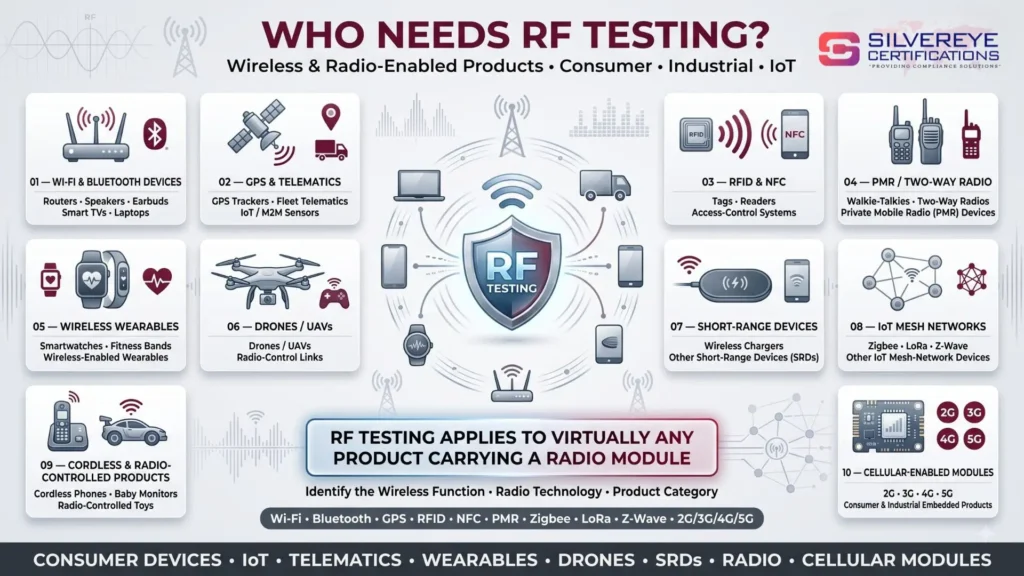
If a product transmits or receives on radio frequency in any form, assume RF testing applies and confirm the requirement before finalising a launch or import timeline.
Regulatory Framework Governing RF Testing in India
RF testing in India sits inside a layered regulatory framework:
- WPC Wing (DoT, Ministry of Communications) — The nodal authority that issues Equipment Type Approval (ETA) once it reviews RF test results and supporting documents.
- National Frequency Allocation Plan (NFAP) — Defines which bands are licensed, de-licensed, or restricted, and therefore what limits a device's RF testing must be measured against.
- NABL-accredited laboratories — Since 2021, WPC has generally required RF test reports for most product categories to come from a NABL-accredited Indian laboratory, or an ILAC-accredited foreign lab operating to ISO/IEC 17025, rather than accepting an overseas-only report.
- Telecommunication Act, 2023 — India's current overarching telecom law, progressively replacing the erstwhile Indian Telegraph Act, 1885 as the legal basis for wireless authorisations, including the equipment-approval framework WPC administers.
It helps to keep RF testing separate from two adjacent, easily confused schemes. TEC MTCTE (Telecommunication Engineering Centre's Mandatory Testing and Certification of Telecom Equipment) applies to network-facing telecom gear — routers, ONTs, telecom antennas — against a broader set of Essential Requirements. BIS CRS/registration, meanwhile, covers electrical safety, EMC, and energy performance, and is often required alongside — not instead of — WPC ETA for the same product.
RF Testing Process: Step by Step
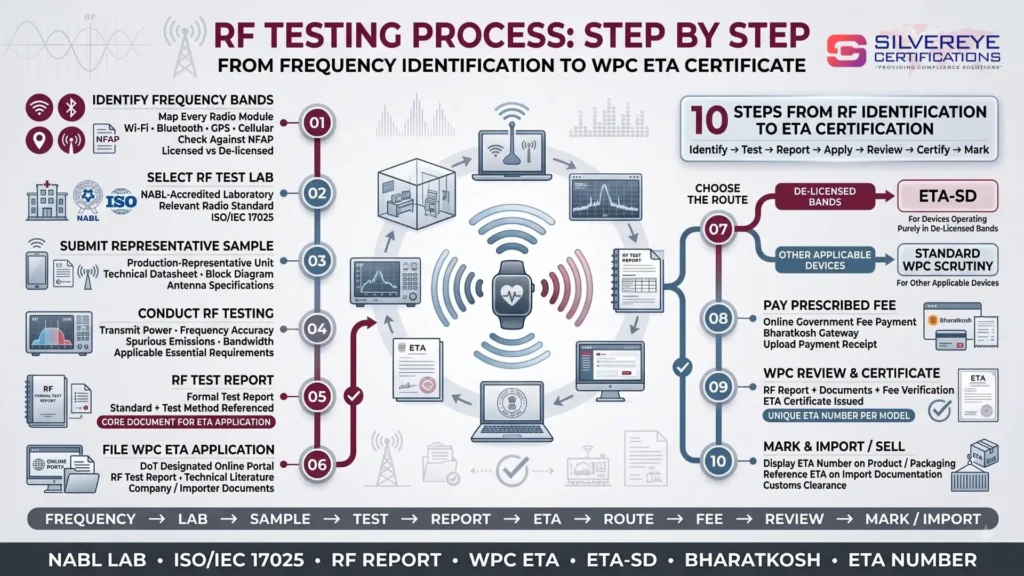
Identify the applicable frequency band(s) — map every radio module in the product (Wi-Fi, Bluetooth, GPS, cellular, etc.) against the NFAP to confirm which are licensed and which are de-licensed.
- Select a NABL-accredited RF test lab — choose a laboratory accredited for the relevant radio standard, operating to ISO/IEC 17025.
- Submit a representative sample — provide a production-representative unit, technical datasheet, block diagram, and antenna specifications to the lab.
- RF testing is conducted — the lab measures transmit power, frequency accuracy, spurious emissions, bandwidth, and other parameters against the applicable Essential Requirements.
- RF test report is issued — a formal report referencing the standard and method used is generated; this is the core document behind the ETA application.
- File the WPC ETA application — apply through DoT's designated online portal, attaching the RF test report, technical literature, and company/importer documents.
- Choose the route — devices operating purely in de-licensed bands typically use ETA Self-Declaration (ETA-SD); others go through standard WPC scrutiny.
- Pay the prescribed fee — the government fee is paid online, typically through the Bharatkosh gateway, and the receipt uploaded with the application.
- WPC review and certificate issue — WPC verifies the RF test report, documentation, and fee, then issues an ETA certificate with a unique ETA number per model.
- Mark and import/sell — the ETA number is displayed on the product/packaging and referenced on import documentation for customs clearance.
ETA via Self-Declaration (ETA-SD) vs Standard ETA
| Aspect | ETA – Self Declaration (ETA-SD) | Standard ETA |
| Applicable to | Devices operating only in de-licensed bands (e.g. 2.4 GHz, 5 GHz, now 6 GHz Wi-Fi) | Devices in licensed bands, or excluded categories |
| Excluded categories | Not applicable | Radar, jamming devices, drones/UAVs, satellite communication equipment |
| WPC scrutiny | Minimal — largely a declaration backed by the RF test report | Detailed technical review of the RF test report and specs |
| Typical timeline | A few days to about two weeks | Roughly 4 to 12 weeks, depending on complexity |
| Best suited for | Wi-Fi/Bluetooth consumer electronics, most IoT devices | Radar systems, drones, licensed-band radios, satellite terminals |
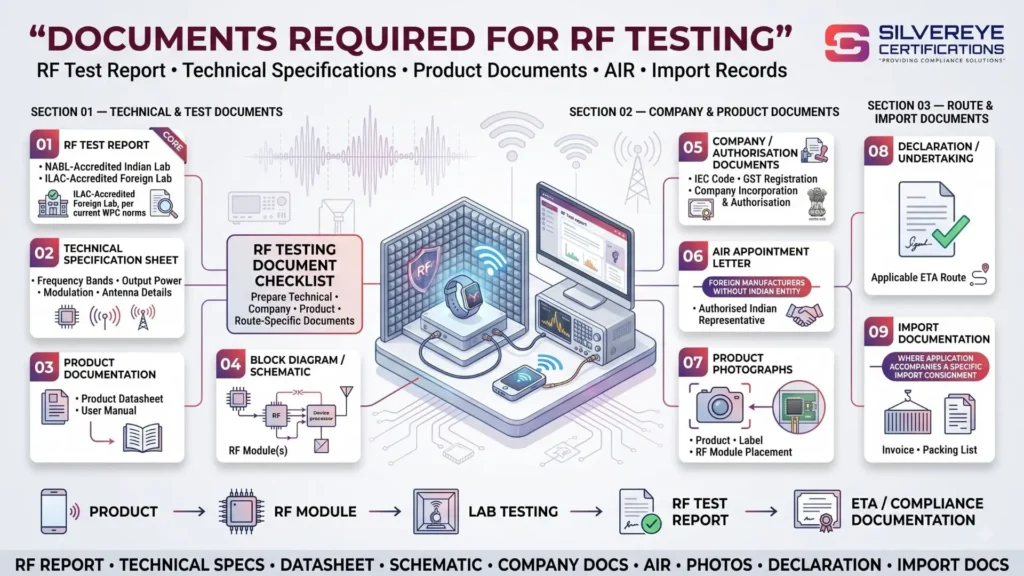
Documents Required for RF Testing
- RF test report from a NABL-accredited Indian lab (or an ILAC-accredited foreign lab, per current WPC norms)
- Technical specification sheet — frequency bands, output power, modulation, antenna details
- Product datasheet and user manual
- Block diagram / schematic showing the RF module(s)
- Company incorporation and authorization documents (IEC code, GST registration, etc.)
- Authorized Indian Representative (AIR) appointment letter, for foreign manufacturers without an Indian entity
- Photographs of the product, label, and RF module placement
- Declaration/undertaking for the applicable ETA route
- Import documentation (invoice, packing list), where the application accompanies a specific import consignment
RF Testing and WPC ETA Fees (Indicative)
- ETA government fee: reported at around ₹10,000 per model/application (covering one or more RF modules in that model), paid via the Bharatkosh portal
- NABL lab testing charges: reported in the broad range of roughly ₹15,000 to ₹40,000 per product, varying with the number of radio interfaces tested, the standard applied, and the laboratory chosen
- No separate factory-inspection fee — WPC ETA, unlike BIS ISI-mark certification, does not require a factory audit
These figures move with the lab, product complexity, and periodic portal updates. Always confirm current fees on WPC's official portal and directly with your chosen NABL lab before finalising a budget.
Timeline, Validity, and Renewal
- ETA-SD route: RF testing plus filing can often complete within a few days to roughly two weeks once the RF test report is ready
- Standard ETA route: typically 4 to 12 weeks, depending on product complexity, category, and completeness of the application
- Validity: ETA is issued per product model rather than for a fixed multi-year term the way a BIS licence works; there is no blanket calendar renewal, but any change to the RF module, frequency, or power output requires fresh RF testing and an updated ETA
- Renewal trigger: a redesign, a new antenna, a different chipset, or a change in power output all call for retesting rather than relying on the original ETA
Always verify current validity terms for your specific product category directly with WPC, since Essential Requirements and category rules are revised periodically.
2026 Regulatory Updates in RF Testing
RF testing in India has moved through several genuine, verifiable changes through 2026 — worth tracking before you plan a launch:
- 6 GHz band de-licensed (GSR 47(E), 20 January 2026): DoT opened the lower 6 GHz band (5945–6425 MHz) for low-power, indoor, contention-based wireless use, clearing the regulatory path for Wi-Fi 6E and Wi-Fi 7 products to be RF-tested and launched in India through the ETA-SD route — subject to power limits (30 dBm EIRP for low-power indoor devices, 14 dBm EIRP for very-low-power outdoor devices) and a restriction against use in vehicles, drones, or UAVs.
- 77–81 GHz radar band opened (notification G.S.R. 468(E)): DoT notified this millimetre-wave range for radar-type applications, giving automotive and industrial radar RF testing a clearly defined frequency window.
- Migration to DoT's new Authorization Portal: under the Telecommunication Act, 2023, DoT has been progressively moving wireless authorizations off the older Saral Sanchar / Indian Telegraph Act, 1885 framework and onto a new Authorization Portal, with new applications for various authorizations shifting over through mid-to-late 2026. Applicants filing RF-tested products for ETA should confirm which portal is current at the time of filing, since this transition has been rolling out in phases.
- Public consultation on 2.4/5/6 GHz Essential Requirements: WPC's MTCTE-linked consultation process has been reviewing Essential Requirements for these bands, which may translate into revised RF test parameters for Wi-Fi and Bluetooth products going forward.
- Tighter scrutiny of RF test reports: WPC has been verifying test reports more closely to ensure declared frequency bands genuinely match tested operation — making an accurate, complete RF test report more important than ever for a smooth ETA approval.
Because several of these changes are still rolling out, always cross-check the applicable notification and the current filing portal with WPC/DoT — or with a compliance partner like Silvereye Certifications — before you file.
Common Reasons RF Test Reports Get Rejected
- A single combined test report covering multiple wireless interfaces, instead of one report per RF technology (Wi-Fi, Bluetooth, and cellular typically each need distinct treatment)
- Frequency band or power figures in the test report that don't match the technical datasheet submitted with the application
- Testing performed at a lab that isn't NABL-accredited for the relevant standard
- A missing antenna specification, or a mismatch between the tested antenna and the one shipped with the product
- Model-number inconsistencies across the test report, datasheet, and application form
- Applying through the wrong route — filing ETA-SD for a device that actually needs standard ETA scrutiny, for instance because it also carries a licensed-band radio
Benefits of Getting RF Testing Right the First Time
- Faster market entry — a clean, correctly scoped RF test report is the single biggest lever for a fast ETA approval
- Avoided customs delays — a valid ETA number tied to an accurate RF test report clears shipments without demurrage or detention risk
- Fewer redesign costs — catching frequency or power issues at the RF testing stage is far cheaper than a post-launch recall or redesign
- Stronger buyer and marketplace trust — RF-tested, ETA-certified products meet the compliance checks increasingly required by e-commerce marketplaces and B2B buyers
- Regulatory headroom — accurate baseline RF data makes it easier to extend a product line (a new colour or SKU) without starting compliance from zero
How Silvereye Certifications Helps
Silvereye Certifications supports manufacturers, importers, and brand owners through the entire RF testing and WPC ETA journey — mapping every radio module in a product against India's frequency allocation rules, coordinating testing with NABL-accredited laboratories, preparing and filing the ETA application through the self-declaration or standard route, and tracking the application through to certificate issuance.
For businesses juggling RF testing alongside BIS, CDSCO, or other regulatory requirements, Silvereye Certifications also helps sequence multi-scheme compliance so products reach the Indian market without avoidable delays.
| Need Help With RF Testing and WPC ETA Approval? Silvereye Certifications helps manufacturers, importers, and brand owners navigate RF testing, WPC ETA (self-declaration and standard), and related compliance schemes end to end — from lab coordination to certificate issuance. Talk to our regulatory team before you plan your next India launch. |
Frequently Asked Questions
What is RF testing?
RF testing is a laboratory check that confirms a wireless device transmits and receives radio signals within the frequency, power, and emission limits allowed in India.
Is RF testing the same as WPC ETA?
Not exactly. RF testing is the laboratory test itself; WPC ETA is the certificate WPC issues once it reviews that RF test report along with the rest of the application.
Which lab can perform RF testing for India?
Generally a NABL-accredited Indian laboratory, since WPC has largely stopped accepting foreign-only RF test reports since 2021. Some ILAC-accredited foreign labs may still be accepted for specific categories, so confirm before testing.
How long does RF testing and WPC ETA approval take?
The self-declaration route can complete in a few days to about two weeks once the RF test report is ready, while the standard ETA route usually takes roughly 4 to 12 weeks.
Does every wireless product need RF testing?
Yes — if a product transmits or receives on radio frequency, from a Bluetooth speaker to an industrial IoT sensor, it needs RF testing before it can be legally imported or sold in India.
What is the difference between ETA-SD and standard ETA?
ETA-SD is a faster, largely self-declared route available for devices operating only in de-licensed bands. Standard ETA involves fuller WPC scrutiny and covers licensed-band devices, radars, drones, and satellite equipment.
Is a factory inspection required for RF testing or WPC ETA?
No. Unlike BIS ISI-mark certification, WPC ETA does not require a factory inspection; approval is based on the RF test report and application documents.
What happens if a product is sold in India without RF testing or ETA?
It's a compliance violation. Customs can detain or seize non-compliant shipments, and products already in the market can face regulatory action.
Does RF testing cover mobile network (cellular) products too?
RF testing covers cellular modules as part of the overall RF compliance picture, though network-facing telecom equipment may additionally fall under TEC MTCTE requirements — check both frameworks for cellular-enabled products.
Do foreign manufacturers need an Indian representative for RF testing and ETA?
Yes, in most cases. A foreign manufacturer without an Indian entity typically needs an Authorized Indian Representative (AIR) to file the WPC ETA application on their behalf.
What's new in RF testing rules for 2026?
Key 2026 changes include the de-licensing of the lower 6 GHz band for Wi-Fi 6E/7, a newly opened 77–81 GHz radar band, and DoT's ongoing migration of wireless authorizations to a new Authorization Portal under the Telecommunication Act, 2023.
Does RF testing expire, and does it need renewal?
ETA doesn't follow a fixed renewal calendar the way some other certificates do, but any change to the RF module, frequency, or power output requires fresh RF testing and an updated ETA — so treat a design change as a retesting trigger, not a formality.