

- RF testing is mandatory for any GPS tracker or IoT sensor with a wireless transmitter — GSM/LTE, Wi-Fi, Bluetooth, Zigbee, LoRa, or NB-IoT — sold, imported, or manufactured in India.
- Valid RF test reports must come from a NABL or TEC-accredited Indian laboratory and must cover frequency band, output power, bandwidth, and spurious emission limits.
- WPC Equipment Type Approval (ETA) is filed online through the Saral Sanchar portal and, once granted, generally remains valid for the life of the product model unless the RF module or frequency changes.
- Skipping RF testing risks customs seizure, import bans, and penalties — start testing at least 8 to 12 weeks before your planned launch or shipment date.
Introduction
RF testing for GPS trackers and IoT sensors is the mandatory radio-frequency evaluation that checks a device's operating frequency, output power, bandwidth, and spurious emissions against India's wireless regulations. Any GPS tracker or IoT sensor with a transmitting module — GSM, LTE, Wi-Fi, Bluetooth, Zigbee, LoRa, or NB-IoT — must be tested at a NABL or TEC-accredited Indian laboratory before applying for WPC Equipment Type Approval (ETA) through the Saral Sanchar portal.
Pure GPS receivers that only receive signals are exempt, but the transmitting module inside a tracker still needs approval. This guide covers eligibility, documents, process, fees, validity, and 2026 requirements.
What Is RF Testing for GPS Trackers and IoT Sensors?
RF (Radio Frequency) testing is a laboratory process that measures how a wireless device transmits and receives signals, and confirms that it stays within the frequency bands, power limits, and emission thresholds set by India's telecom regulator. For GPS trackers and IoT sensors, this matters because these devices rarely use only GPS — the GPS chip inside a tracker only receives satellite signals to calculate location, while a separate module (GSM, LTE, Wi-Fi, Bluetooth, LoRa, NB-IoT, or Zigbee) transmits that location or sensor data back to a server or app.
It is this transmitting module that brings a GPS tracker or IoT sensor under India's wireless regulatory framework. Once a device sends a radio signal into the airwaves, it can interfere with other spectrum users, which is why the Department of Telecommunications (DoT) requires proof — in the form of an accredited RF test report — that the device operates safely within its assigned band before it reaches the Indian market.
If your GPS tracker, asset tag, fleet monitoring device, smart agriculture sensor, or industrial IoT sensor transmits data wirelessly, RF testing is the technical foundation for its WPC Equipment Type Approval (ETA) — the certificate that legally allows the product to be imported, manufactured, and sold in India.
Why RF Testing Matters for GPS Trackers and IoT Sensors
- Legal market access: Without a valid RF test report and WPC ETA, GPS trackers and IoT sensors cannot be legally imported, distributed, or sold in India.
- Customs clearance: Shipments without RF compliance documentation are commonly detained or seized at Indian ports and airports.
- Spectrum safety: RF testing confirms the device will not cause harmful interference to other licensed and unlicensed wireless users sharing the same frequency bands.
- Product reliability: EMI/EMC and RF performance testing together catch design issues — weak antenna tuning, excess emissions, poor immunity — before mass production.
- Buyer and channel trust: E-commerce marketplaces, government tenders, and enterprise IoT buyers increasingly ask for WPC ETA proof before onboarding a vendor.
- Avoiding rework costs: Identifying RF or frequency-band issues at the testing stage is far cheaper than a product recall or redesign after launch.
Who Needs RF Testing and WPC ETA?
The requirement applies to any product with a radio transmitter or transceiver operating in a frequency band regulated by the WPC Wing. In practice, this covers a wide range of GPS and IoT product categories sold in the Indian market:
- Vehicle and fleet GPS trackers with GSM/LTE or Bluetooth modules
- Personal and pet GPS trackers with cellular or Wi-Fi connectivity
- Asset-tracking tags using LoRa, NB-IoT, or Bluetooth Low Energy (BLE)
- Smart agriculture and environmental sensors (soil, weather, water-level monitors)
- Industrial IoT sensors for temperature, pressure, vibration, and energy monitoring
- Smart metering and utility IoT devices using RF mesh or cellular modules
- Wearable trackers and smart bands with Bluetooth or Wi-Fi radios
- IoT gateways and routers that aggregate sensor data and connect to public telecom networks
A pure GPS receiver module — one that only receives satellite signals and never transmits — is generally exempt from WPC ETA, since only receivers are outside the approval requirement. However, almost every commercial GPS tracker also carries a transmitting radio, so the exemption rarely applies to the finished product.
Regulatory Framework Governing RF Testing in India
Three government bodies typically come into play for GPS trackers and IoT sensors, depending on the wireless technologies and network connections involved:
| Authority | Role | Applies To |
| WPC Wing (Dept. of Telecommunications) | Issues Equipment Type Approval (ETA) based on the RF test report; regulates use of frequency spectrum | Wi-Fi, Bluetooth, Zigbee, LoRa, RFID, and other de-licensed band devices |
| TEC — MTCTE (Telecommunication Engineering Centre) | Mandatory Testing and Certification of Telecom Equipment for devices connecting to the public telecom network | IoT gateways, routers, and cellular (GSM/LTE) modules |
| STQC IoTSCS (MeitY) | Voluntary IoT System Certification Scheme covering physical, communication, and application-layer security | IoT sensors used in critical or sensitive data applications |
For most consumer and commercial GPS trackers and IoT sensors, the WPC ETA route (based on RF testing) is the mandatory approval. TEC/MTCTE becomes relevant when the device includes a cellular module or connects directly to India's public telecom network. The STQC scheme is a voluntary, security-focused layer that some enterprise or government IoT deployments request in addition to WPC ETA.
What Does RF Testing Actually Measure?
An RF test report is not a single pass/fail check — it is a set of measurements taken in an anechoic chamber using calibrated spectrum analysers and signal generators. For GPS trackers and IoT sensors, the accredited lab typically evaluates:
| Parameter | What It Checks |
| Operating frequency band | Confirms the device transmits only within its assigned de-licensed or licensed band (e.g., 2.4 GHz, 5.8 GHz, 433 MHz, cellular bands) |
| Output (transmit) power | Ensures RF power stays within the maximum limit permitted for that band |
| Occupied bandwidth | Verifies the signal does not spread beyond its allocated channel width |
| Spurious emissions | Detects unwanted signals outside the intended band that could interfere with other spectrum users |
| Frequency stability | Confirms the transmitter holds its assigned frequency under varying temperature and voltage conditions |
| EMI/EMC (emission & immunity) | Checks the device does not emit excess electromagnetic noise and can function reliably near other electronics |
| Antenna and modulation characteristics | Verifies antenna gain and modulation scheme match the technical filing |
Documents Required for RF Testing and WPC ETA
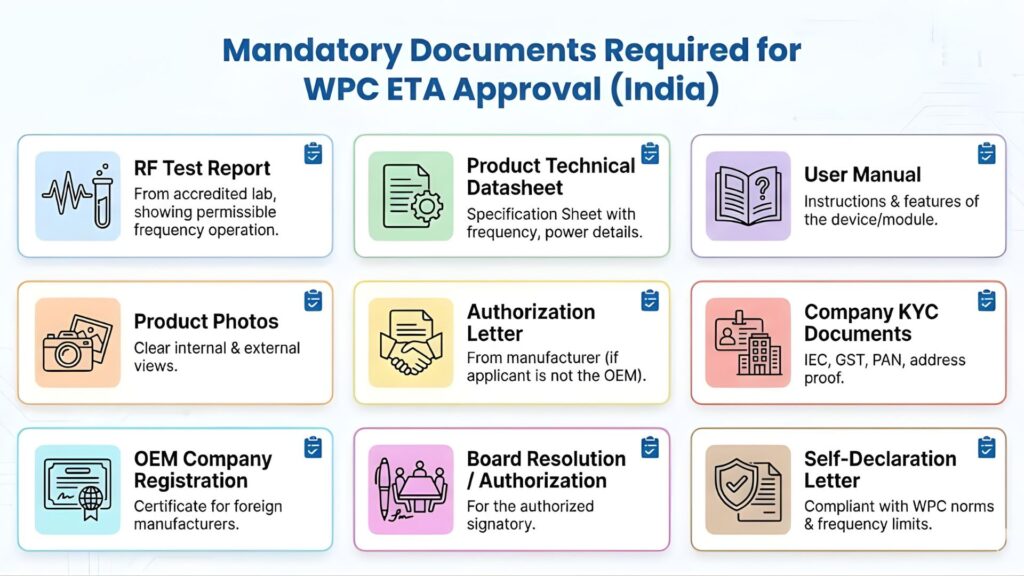
Preparing accurate documentation upfront is the single biggest factor in a smooth approval. A typical WPC ETA application for a GPS tracker or IoT sensor needs:
RF test report from a NABL or TEC-accredited Indian laboratory (or an ILAC-accredited foreign lab, where accepted, for the specific frequency band)
- Technical datasheet of the product — frequency bands used, transmit power, antenna type and gain, modulation scheme
- User manual and product photographs (front, back, internals showing the RF/wireless module)
- Company registration proof, GST/IEC (Import Export Code) details
- Authorization letter appointing an Authorized Indian Representative (AIR), if the manufacturer is based outside India
- Declaration of conformity / self-certification form as applicable to the product category
- Any existing FCC, CE-RED, or other foreign type-approval certificates, where available, to support the technical filing
- Duly filled WPC ETA application form submitted through the Saral Sanchar portal (saralsanchar.gov.in)
Step-by-Step RF Testing and WPC ETA Process
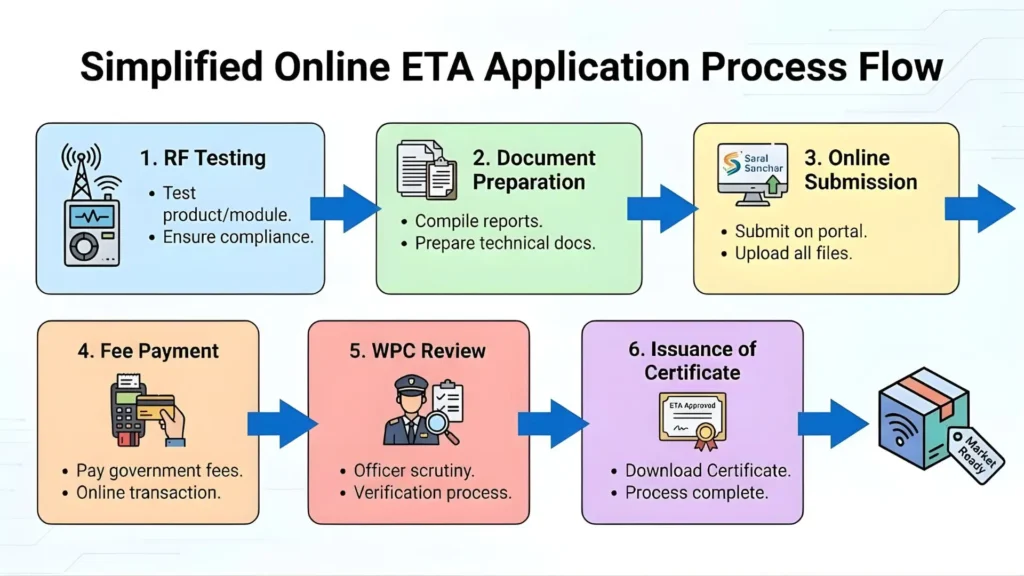
Step 1: Identify Every Wireless Technology in the Device
List every radio inside the GPS tracker or IoT sensor — GPS receiver, plus any GSM/LTE, Wi-Fi, Bluetooth, Zigbee, LoRa, or NB-IoT transmitter. Each transmitting technology and its frequency band decides which WPC category and technical standard applies. Getting this mapping right avoids duplicate applications later.
Step 2: Conduct RF Testing at an Accredited Laboratory
Send a working sample to a NABL or TEC-accredited RF/EMC testing lab. The lab tests frequency, power, bandwidth, spurious emissions, and (where required) EMI/EMC parameters, then issues a formal RF test report referencing the applicable Indian and international standards.
Step 3: Compile the Technical File
Assemble the test report alongside the datasheet, user manual, company documents, and (for foreign manufacturers) the AIR authorization letter. Cross-check that model numbers, frequency figures, and company details match exactly across every document — mismatches are a leading cause of processing delays.
Step 4: File the Application on Saral Sanchar
Submit the WPC ETA application online through the Saral Sanchar portal, upload the technical file, and pay the applicable government fee for the product model.
Step 5: Respond to WPC Queries
WPC Wing officers review the RF test report and documentation. If they raise a query — for example, asking for clarification on a test parameter or a corrected document — respond promptly with accurate information to keep the timeline on track.
Step 6: Receive the ETA Certificate
Once WPC is satisfied that the application and RF test data are complete and compliant, it issues the Equipment Type Approval (ETA) certificate through the portal. The product can then be legally imported, manufactured, and sold in India for the validity period of that approval.
RF Testing and WPC ETA Fees (Indicative)
Total cost has three components: RF testing charges at the accredited lab, the WPC government application fee, and optional professional consultancy charges. Figures below are indicative — always confirm current charges on the Saral Sanchar portal and with your chosen testing lab before budgeting.
| Cost Component | Typical Indicative Range |
| RF/EMC lab testing charges | Varies by number of wireless modules, frequency bands, and test parameters required |
| WPC government application fee | Charged per product model through the Saral Sanchar portal; amount depends on device category |
| Authorized Indian Representative (AIR) service | Applicable only for foreign manufacturers without an Indian entity |
| Consultancy / documentation support | Optional, based on scope of support required |
Because fee schedules and lab charges are revised periodically, treat any number quoted online as indicative until verified against the live Saral Sanchar fee structure at the time of filing.
Validity and Renewal of WPC ETA
A WPC ETA certificate is generally treated as valid for the life of the approved product model, with no fixed renewal date, as long as the device is not altered. A fresh RF test report and a new ETA application become necessary if any of the following change after the original approval:
- The RF module, wireless chipset, or transmitter is changed or replaced
- The operating frequency band or output power level is modified
- A new wireless technology is added (for example, adding Wi-Fi to a Bluetooth-only tracker)
- The product's model number, hardware revision, or brand name changes
Minor firmware updates that do not alter RF transmission behaviour typically do not require a fresh ETA. Because validity terms and any category-specific renewal rules can be updated by WPC from time to time, confirm the exact validity condition stated on your specific ETA certificate and cross-check current policy on the Saral Sanchar portal before relying on it long-term.
How Long Does the Process Take?
| Stage | Typical Duration |
| RF/EMC lab testing | Varies with lab schedule and number of parameters/frequency bands to be tested |
| Document compilation and application filing | A few days, once test report and technical file are ready |
| WPC Wing review and query resolution | Ranges from about 1–2 weeks (self-declaration route, where eligible) up to several weeks for standard scrutiny |
| Overall, end-to-end | Commonly 4–8 weeks for straightforward products with complete documentation; longer for complex, multi-radio devices |
Start the RF testing and ETA process at least 8 to 12 weeks before your planned import, launch, or tender submission date to leave room for lab scheduling and any WPC query cycles.
Common Mistakes to Avoid
- Assuming the GPS receiver exemption covers the whole product — it only applies if the device has no separate transmitting module at all.
- Submitting an RF test report from a lab that is not NABL or TEC accredited, leading to outright rejection.
- Mismatched model numbers or specifications across the test report, datasheet, and application form.
- Skipping the Authorized Indian Representative requirement for foreign-manufactured devices.
- Changing the RF module or frequency band after approval without filing a fresh ETA application.
- Leaving RF testing until the shipment is already booked, causing customs delays at the port.
Choosing an Accredited RF Testing Laboratory
Since 2021, WPC has increasingly required RF test reports to originate from an Indian NABL- or TEC-accredited laboratory for many de-licensed and licensed band products, rather than accepting only a foreign report. When shortlisting a lab, check for:
- Valid NABL accreditation under ISO/IEC 17025 for RF and EMC testing
- TEC designation, if the device also needs MTCTE testing for telecom connectivity
- Anechoic chamber and calibrated spectrum-analyser facilities covering your device's frequency range
- Experience testing GPS, cellular (GSM/LTE), Wi-Fi, Bluetooth, Zigbee, LoRa, and NB-IoT modules specifically
- Realistic turnaround-time commitments and transparent, itemised cost quotations
Conclusion
RF testing is the technical backbone of WPC Equipment Type Approval for every GPS tracker and IoT sensor sold, imported, or manufactured in India. Whether your device uses GSM, Wi-Fi, Bluetooth, Zigbee, LoRa, or NB-IoT, an accredited RF test report — followed by a correctly filed Saral Sanchar application — is what stands between your product and a legal, uninterrupted presence in the Indian market. Planning RF testing early, keeping documentation consistent, and choosing a properly accredited lab are the three factors most likely to keep your GPS tracker or IoT sensor launch on schedule.
Frequently Asked Questions
What is RF testing for GPS trackers and IoT sensors?
RF testing is a laboratory evaluation that measures a wireless device's operating frequency, transmit power, bandwidth, and spurious emissions to confirm it complies with India's wireless regulations before it can receive WPC Equipment Type Approval (ETA).
Is RF testing mandatory for every GPS tracker sold in India?
It is mandatory for any GPS tracker that includes a transmitting module — such as GSM, LTE, Wi-Fi, or Bluetooth — used to send location data. A device that only receives GPS signals and has no transmitter is generally exempt, but this rarely applies to a complete tracker product.
Do pure GPS receiver modules need RF testing or WPC approval?
No. Devices that only receive satellite signals and do not transmit are outside the WPC ETA requirement. However, once a transmitting radio (cellular, Wi-Fi, Bluetooth, etc.) is added to send the location data onward, that transmitting module needs RF testing and approval.
Which frequency bands do GPS trackers and IoT sensors commonly use?
Common bands include 2.4 GHz (Wi-Fi/Bluetooth/Zigbee), 5.8 GHz (Wi-Fi), 433 MHz and 868/915 MHz (LoRa, in line with regional allocation), and cellular bands used for GSM/LTE/NB-IoT connectivity. The exact bands must be confirmed against India's spectrum allocation for the applicable technology.
Which laboratory can issue a valid RF test report in India?
A NABL-accredited (ISO/IEC 17025) Indian laboratory, or a TEC-designated lab for telecom-related testing, is generally required. Some categories may also accept ILAC-accredited foreign lab reports, but this should be confirmed for your specific product and frequency band before testing.
What documents are needed for WPC ETA certification?
Core documents include the RF test report, technical datasheet, user manual and photographs, company registration/IEC details, the completed Saral Sanchar application form, and — for foreign manufacturers — an Authorized Indian Representative authorization letter.
How much does RF testing and WPC ETA cost?
Cost depends on the number of wireless modules and frequency bands tested, the lab's charges, the WPC government application fee per model, and any consultancy support used. Because fee schedules change periodically, always verify current charges on the Saral Sanchar portal and with your testing lab.
How long does the RF testing and ETA approval process take?
Straightforward products with complete documentation commonly take around 4 to 8 weeks end-to-end, including lab testing, filing, and WPC review. Complex, multi-radio devices or incomplete applications can take longer, so starting 8 to 12 weeks ahead of launch is advisable.
How long is the WPC ETA certificate valid?
A WPC ETA certificate is generally treated as valid for the lifetime of the approved product model, provided the RF module, frequency band, and output power remain unchanged. A fresh application is needed only if these technical specifications change.
Do foreign manufacturers need a local representative for WPC ETA?
Yes. WPC ETA certificates are issued to Indian entities, so a foreign manufacturer must appoint an Authorized Indian Representative (AIR) to file and hold the approval on its behalf.