
- WPC ETA For Bluetooth Audio Devices (Equipment Type Approval) is mandatory before importing any Bluetooth or Wi-Fi audio device into India in 2026.
- Products covered: TWS earbuds, neckband earphones, over-ear headphones, gaming headsets, portable speakers, soundbars, smart speakers, karaoke mics & home theatre systems.
- BIS certification under IS 616:2017 runs parallel to WPC approval — both are required for most consumer Bluetooth audio products.
- Non-compliance leads to customs hold, product seizure, and penalties up to ₹10 lakh under Indian Wireless Telegraphy Act.
Introduction
If you plan to import TWS earbuds, Bluetooth headphones, wireless speakers, or soundbars into India in 2026, understanding the WPC ETA (Wireless Planning & Coordination Equipment Type Approval) process is non-negotiable. The Indian government has tightened compliance norms significantly over the last two years, and the penalties for skipping approvals are steep. This guide breaks down exactly what you need, product by product, so you can import legally, quickly, and without nasty surprises at customs.
Whether you are a D2C brand launching a new audio product, a large importer sourcing 10,000 units from China, or a startup entering the Indian market for the first time — this is the most complete, up-to-date resource you will find on WPC ETA for Bluetooth audio devices in India.
What Is WPC ETA and Why Does Every Bluetooth Audio Device Need It?
The Wireless Planning & Coordination (WPC) Wing operates under India's Ministry of Communications. Any device that uses radio frequency (RF) spectrum — including Bluetooth, Wi-Fi, or any other wireless protocol — must receive Equipment Type Approval (ETA) from WPC before it is legally imported, manufactured, or sold in India.
This is not optional. Under the Indian Wireless Telegraphy Act, 1933 and the Telegraph Act, 1885, operating or selling an unapproved wireless device is a criminal offence. As of 2026, WPC has strengthened its coordination with customs authorities, and shipments without valid ETA certificates are flagged at the port of entry itself.
For audio products, this matters because every single modern consumer audio device uses Bluetooth (2.4 GHz band), and many now also use Wi-Fi, ANT+, or proprietary 2.4 GHz protocols. All of these require WPC ETA.
| Device Type | Wireless Protocol Used | WPC ETA Required? | Additional BIS Needed? |
| TWS Earbuds | Bluetooth 5.x | Yes | Yes (IS 616:2017) |
| Neckband Earphones | Bluetooth 5.x | Yes | Yes (IS 616:2017) |
| Over-Ear Headphones | Bluetooth 5.x | Yes | Yes (IS 616:2017) |
| Gaming Headsets | Bluetooth / 2.4 GHz Dongle | Yes | Yes (IS 616:2017) |
| Portable Speakers | Bluetooth 5.x | Yes | Yes (IS 616:2017) |
| Soundbars | Bluetooth + Wi-Fi (many) | Yes (both protocols) | Yes |
| Smart Speakers | Wi-Fi + Bluetooth | Yes (both) | Yes |
| Karaoke Mics (BT) | Bluetooth | Yes | Yes (IS 616:2017) |
| Home Theatre (BT) | Bluetooth + Wi-Fi | Yes | Yes |
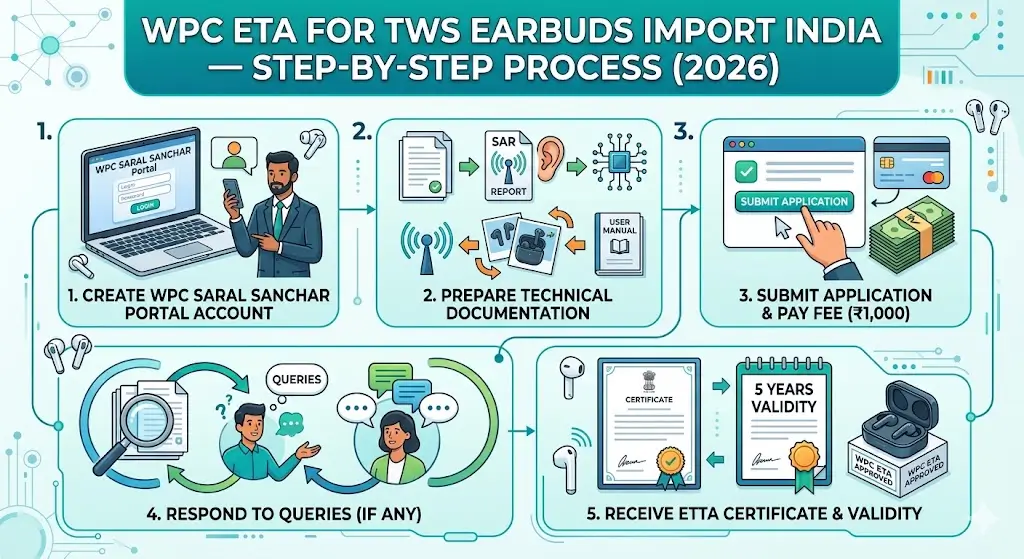
WPC ETA for TWS Earbuds Import India — Step-by-Step Process (2026)
TWS (True Wireless Stereo) earbuds are the single highest-volume Bluetooth audio product imported into India. Brands like Boat, Noise, and dozens of private-label importers collectively bring in tens of millions of units every year. Every single unit requires a valid WPC ETA certificate before it clears customs.
Step 1 — Create Your WPC SARAL SANCHAR Portal Account
The WPC has migrated all ETA applications to its Saral Sanchar Portal. You will need a valid Indian entity (company, LLP, or proprietorship) to apply. Foreign manufacturers cannot apply directly — they need an Indian authorized representative.
Step 2 — Prepare Your Technical Documentation
This is where most applicants lose time. Collect the following before you start:
• FCC ID / CE / SRRC test report (RF conducted and radiated tests for 2.4 GHz Bluetooth)
• SAR (Specific Absorption Rate) report if the device is worn close to the body — mandatory for earbuds and neckbands
• Block diagram and circuit schematic of the RF section
• Antenna gain and return loss data
• User manual in English
• Declaration of Conformity (DoC) from the manufacturer
• Product photos (all six sides + label photo)
Step 3 — Submit Application and Pay Fee
As of April 2026, the WPC ETA fee for Bluetooth devices (non-licensed spectrum) is ₹1,000 per model. Payment is made online through the SARAL portal. Processing time is typically 15 to 30 working days for a complete application.
Step 4 — Respond to Queries (if any)
WPC may raise queries about your application — usually around test report details, antenna specifications, or labelling requirements. Respond promptly through the portal. Delays in responding restart the clock.
Step 5 — Receive ETA Certificate and Validity
Once approved, you receive a WPC ETA certificate that is valid for 5 years from the date of issue. The certificate number must appear on the product label and/or packaging for all units sold or imported into India.
BIS CRS Certification (IS 616:2017) for Earbuds and Headphones — 2026 Standards Update
BIS (Bureau of Indian Standards) CRS (Compulsory Registration Scheme) certification under IS 616:2017 is the primary mandatory standard for all wireless earphones, TWS earbuds, headphones, and neckbands sold or imported in India. This is enforced under the Electronics and IT Goods (Requirement for Compulsory Registration) Order and has been mandatory since 1 June 2016. WPC ETA and BIS CRS are two completely separate approvals — you need both.
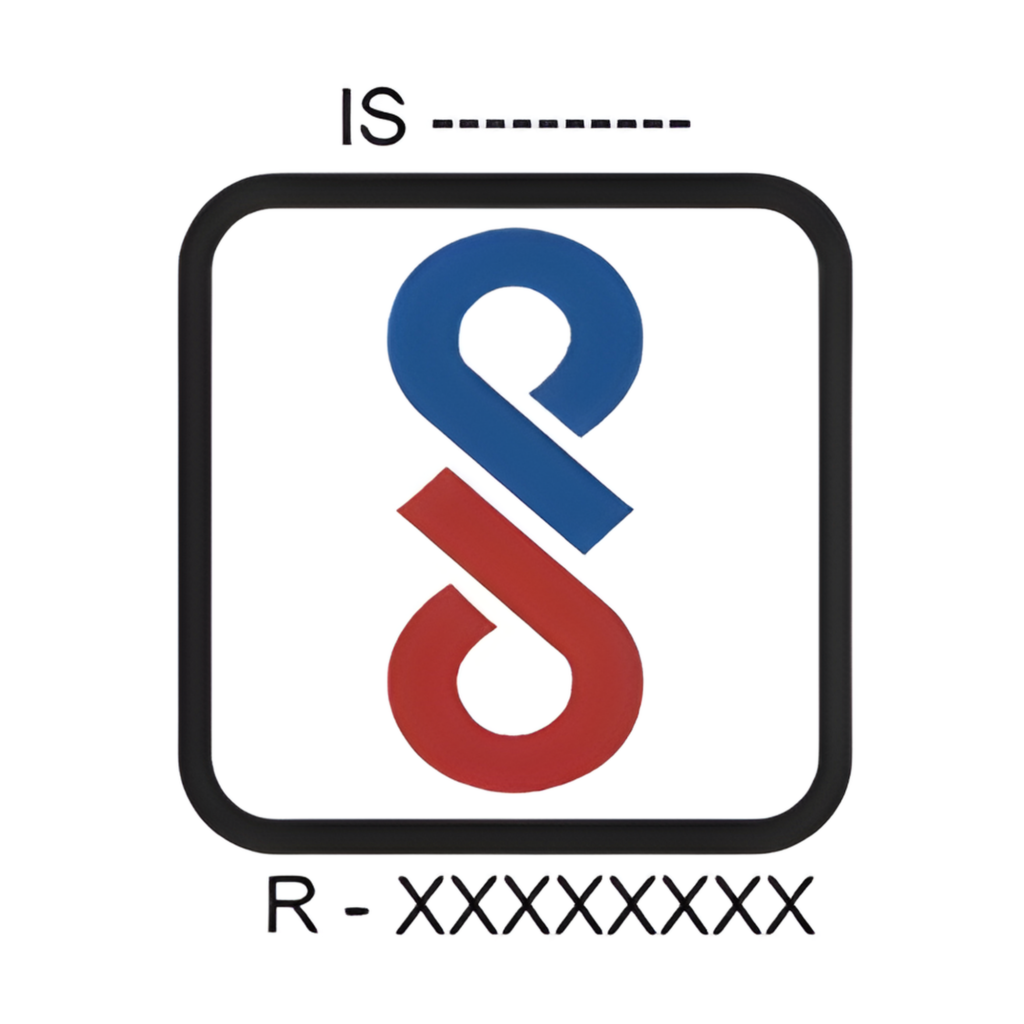
Critical 2026 update — IS 616:2017 transitioning to IS/IEC 62368-1:2023: Following a MeitY notification in October 2025, BIS has announced that IS 616:2017 will be replaced by IS/IEC 62368-1:2023 as the applicable safety standard. Both standards run concurrently until 1 November 2028. New applicants are encouraged to test and register under IS/IEC 62368-1:2023, but existing IS 616:2017 registrations remain valid through the transition period.
As of April 2026, the following audio product categories are under compulsory BIS CRS registration:
• TWS earbuds and True Wireless Stereo headphones
• Wired and wireless headphones and headsets (including gaming headsets)
• Bluetooth and Wi-Fi-enabled portable speakers
• Soundbars with Bluetooth/Wi-Fi connectivity
• Smart speakers with voice assistant capability
| Standard | Scope | Testing Lab |
| IS 616:2017 | PRIMARY standard — mandatory BIS CRS for wireless headphones, earphones, TWS earbuds & neckbands (enforced since June 2016) | NABL-accredited or BIS-recognised lab |
| IS/IEC 62368-1:2023 | Successor to IS 616:2017 — concurrent validity period until 1 Nov 2028; new registrations encouraged under this standard | NABL-accredited lab |
| IS 13252 (Part 1):2010 | Safety for IT & office equipment — applies to smart speakers, soundbars with embedded computing | NABL-accredited lab |
| IS 16046-2:2018 | Lithium-ion / lithium-polymer battery safety — mandatory for rechargeable earbuds, portable speakers, karaoke mics | NABL-accredited lab |
| IS 1293:2005 | Plugs and socket-outlets — required for mains-powered soundbars and home theatre systems | NABL-accredited lab |
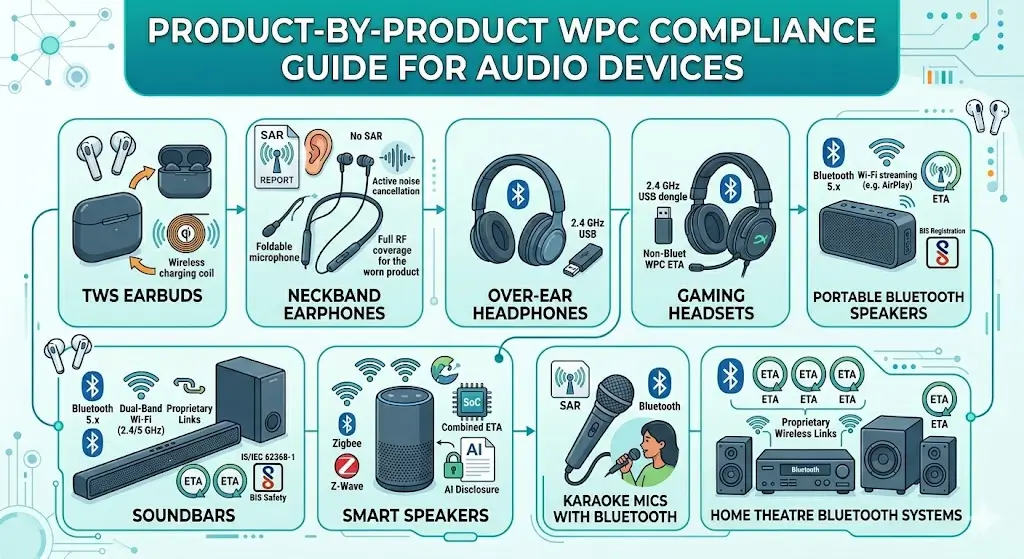
Product-by-Product WPC Compliance Guide for Audio Devices
TWS Earbuds — WPC ETA India
TWS earbuds present a unique challenge: the charging case sometimes also has Bluetooth or a wireless charging coil (Qi / WPC standard). If the charging case has any wireless functionality, it may require its own separate WPC ETA. Always declare both the earbuds AND the charging case in your application if the case has any RF component.
SAR testing is mandatory for TWS earbuds because they are worn inside or near the ear canal. Indian norms follow ICNIRP guidelines with a SAR limit of 2.0 W/kg (10g averaging). Ensure your SAR test report meets this specific limit — US FCC allows 1.6 W/kg (1g), but India follows the European 10g average metric.
Neckband Earphones — WPC India
Neckband earphones are simpler from a compliance standpoint — no SAR concern as they sit on the collarbone, away from the head. However, if the neckband has a foldable microphone or active noise cancellation processing, ensure the RF test report covers the full product as worn.
Over-Ear Headphones — Bluetooth Headphones WPC Certificate
Over-ear headphones with Bluetooth need the same WPC ETA certificate as earbuds. SAR testing is required because the device is worn on the head. If your headphones also have 2.4 GHz dongle connectivity (common in gaming models), the dongle needs a separate ETA as a distinct model/SKU.
Gaming Headsets — ETA Approval India
Gaming headsets are a rapidly growing category. Many gaming headsets use a 2.4 GHz USB dongle rather than standard Bluetooth, which means they fall outside the Bluetooth class exemption (if any) and need a full WPC ETA. Budget ₹50,000–₹1.5 lakh for testing + certification depending on whether new RF testing is needed.
Portable Bluetooth Speakers
Portable speakers with Bluetooth 5.x or earlier need WPC ETA for Bluetooth speaker and a separate BIS registration. If the speaker also supports Wi-Fi streaming (e.g., AirPlay 2 or Spotify Connect), a second WPC ETA is needed for the Wi-Fi radio module. Many manufacturers save time and cost by getting a combined ETA for multi-radio devices — check with your compliance consultant on whether your device model qualifies.
Soundbars — Soundbar WPC ETA Certificate
Soundbars are the most complex from a compliance perspective. A modern soundbar may have: Bluetooth 5.x, Wi-Fi (2.4 GHz + 5 GHz), HDMI ARC, optical, and proprietary wireless subwoofer links. Each radio protocol requires its own WPC ETA. The Wi-Fi module, if it supports both 2.4 GHz and 5 GHz bands (dual-band), needs testing on both bands.
Additionally, soundbars are mains-powered devices, which means BIS certification applies under IS 616:2017 (or the successor IS/IEC 62368-1:2023) for audio/IT safety, and IS 1293:2005 for plug and socket safety. Always confirm the full list of applicable standards with a BIS consultant before initiating testing.
Smart Speakers — Smart Speaker WPC Wi-Fi BT Approval India
Smart speakers combine voice processing, Wi-Fi, Bluetooth, and sometimes Zigbee or Z-Wave for smart home connectivity. Each of these radio protocols needs separate WPC ETA. In practice, most smart speaker brands apply for a combined ETA application that covers all integrated radios under one product model, which WPC allows if the RF modules are integrated into a single SoC (System on Chip).
2026 note: The Department of Telecommunications (DoT) has started scrutinizing smart speakers more closely due to data privacy concerns. Expect additional declarations regarding data localization and AI processing disclosures as part of the import compliance paperwork, even though these are separate from WPC ETA.
Karaoke Mics with Bluetooth
Bluetooth karaoke microphones are treated the same as any other BT device. SAR testing is required if the device is held close to the mouth during use (which it always is). Ensure your test report specifies the device-to-body distance used in SAR testing.
Home Theatre Bluetooth Systems
Home theatre systems with Bluetooth connectivity face the same multi-radio challenge as soundbars. The additional complication is that home theatre systems often include subwoofers or satellite speakers connected via a proprietary 2.4 GHz wireless link, which must also be included in the ETA application as a system.
How to Get WPC ETA for Headphones India — Common Mistakes to Avoid
Having helped dozens of audio brands through this process, here are the most common mistakes that lead to delays or rejections:
- Submitting FCC test reports without verifying they cover the specific RF configuration of your unit — Indian-market variants with different antenna designs need fresh testing.
- Overlooking SAR testing for near-ear products. This is the single most common rejection reason for earbuds and headphones.
- Applying for WPC ETA before BIS, then discovering the product needs modifications that change the RF characteristics — forcing a fresh WPC application.
- Not registering the ETA number on the product label before the shipment leaves the factory — customs has authority to hold the shipment even with a valid ETA if the label is not compliant.
- Using the wrong applicant type on the SARAL portal (Indian importer vs. foreign manufacturer applying through an Indian authorized signatory — the latter requires a specific form).
- Applying for a single ETA when the device has multiple radios — Wi-Fi + Bluetooth each need their own ETA entry.
WPC ETA Timeline and Cost Breakdown
| Activity | Estimated Time | Estimated Cost (INR) |
| RF / EMC Testing (if new tests needed) | 3–6 weeks | ₹40,000 – ₹1,20,000 |
| SAR Testing (earbuds / headphones) | 2–4 weeks | ₹30,000 – ₹80,000 |
| BIS Testing (IS 616:2017) | 4–8 weeks | ₹50,000 – ₹1,50,000 |
| WPC ETA Application Fee (per model) | — | ₹1,000 |
| WPC Processing Time | 15–30 working days | — |
| BIS R-Number Registration | 30–60 days after testing | ₹10,000 – ₹20,000 (govt fee) |
| Total (typical, new product) | 8–16 weeks end-to-end | ₹1,50,000 – ₹4,00,000 |
| Renewal (existing ETA, 5-year cycle) | 7–14 working days | ₹1,000 + testing if changed |
Note: If your product already has FCC, CE, or SRRC certification and the RF configuration matches the Indian-market unit exactly, you can often use the existing test reports for WPC ETA without fresh testing — cutting timelines significantly.
Import Earbuds India Compliance — The Complete 2026 Regulatory Checklist
Before your audio product clears Indian customs in 2026, make sure you have ticked every box on this compliance checklist:
| Compliance Item | Applicable To | Status Check |
| WPC ETA (Bluetooth radio) | All BT audio devices | Certificate in hand |
| WPC ETA (Wi-Fi radio) | Smart speakers, soundbars with Wi-Fi | Separate certificate |
| BIS CRS Registration (IS 616:2017 or IS/IEC 62368-1:2023) | Wireless earbuds, headphones, speakers, soundbars, smart speakers | R-number obtained |
| SAR Test Report | Earbuds, headphones, headsets, karaoke mics | ≤2.0 W/kg (10g avg) |
| E-Waste compliance (PWM Rules 2022) | All electronic products | Producer registration |
| Legal Metrology Declaration | All packaged goods | MRP, importer details on label |
| GST Registration / IEC Code | Indian importer | Active |
| Country of Origin (CoO) Certificate | For customs clearance | For each shipment |
| IS 616:2017 or IS/IEC 62368-1:2023 test report | Safety certification for all wireless audio devices | From NABL-accredited lab |
| RoHS Compliance Declaration | EU + India requirement | DoC in file |
2026 Regulatory Updates — What Is New for Bluetooth Audio Imports
January 2026 — Revised BIS Scope: The MeitY (Ministry of Electronics and IT) expanded the compulsory BIS registration scope to include true wireless earbuds and neckband earphones that were previously under voluntary certification. If you were importing these products on a voluntary BIS registration, you need to upgrade to mandatory registration by Q2 2026.
March 2026 — SARAL Portal Upgrade: The WPC SARAL SANCHAR portal received a major upgrade in March 2026, including a new track-and-trace feature for ETA applications and automated deficiency notices. Applications with incomplete documentation now receive an automated deficiency notice within 5 working days instead of the earlier manual process that could take weeks.
April 2026 — Import Policy Tightening: The DGFT (Directorate General of Foreign Trade) revised the import policy for wireless devices under HS Code 8518 (audio devices) to include mandatory WPC ETA declaration at the time of customs filing, not after. This means you cannot file the Bill of Entry without quoting the valid ETA number.
Expected H2 2026 — Type Approval Reciprocity: India and the EU are in advanced discussions on a bilateral MRA (Mutual Recognition Agreement) for RF type approvals. If finalized, CE-marked devices from EU manufacturers may be eligible for expedited WPC ETA processing. Watch this space — it could significantly reduce timelines for European-origin products.
Choosing the Right Compliance Partner for WPC ETA in India
Navigating WPC ETA and BIS compliance simultaneously is complex. The right compliance partner can save you 4–8 weeks and ₹1–2 lakh in rework costs. When evaluating a compliance consultant or testing laboratory, look for:
- NABL accreditation for RF/EMC testing (mandatory for reports accepted by WPC and BIS)
- In-house SAR testing capability — not all labs have this; outsourcing adds time
- Demonstrated experience with audio product certifications (ask for reference client names)
- Strong working knowledge of SARAL portal procedures and query response
- Ability to handle multi-radio ETA applications (Bluetooth + Wi-Fi in single submission)
- Clear fee transparency with no hidden charges for re-testing or application amendments
Conclusion — Do Not Skip WPC ETA in 2026
The Indian market for Bluetooth audio devices crossed ₹15,000 crore in FY2025 and is growing at over 20% annually. The regulatory environment has grown proportionally more rigorous. WPC ETA is not a bureaucratic box-tick — it is the legal foundation of your business in India.
The good news is that the process, while detailed, is predictable. With the right testing partner, complete documentation, and a well-prepared application, most standard Bluetooth audio devices can get WPC ETA within 6–8 weeks. Start early, plan for potential queries, and keep your certification documents organized — and importing audio products into India in 2026 is entirely manageable.
If you have specific questions about WPC ETA for earbuds India, Bluetooth headphones WPC certification, or soundbar WPC ETA requirements, consult a NABL-accredited laboratory or a WPC-registered compliance consultant for product-specific advice.
Frequently Asked Questions
Do Bluetooth speakers need WPC ETA in India?
Yes, absolutely. Any device that uses Bluetooth or any other RF wireless technology must have WPC ETA before it is legally imported or sold in India. There are no exemptions for Bluetooth audio devices below a certain price point or for promotional/gift samples.
My speaker model already has WPC ETA — can I import a color variant as the same model?
It depends. If the color variant has the same model number and identical RF hardware, it may fall under the same ETA. However, if the model number differs or any hardware component is different, a separate application is required. When in doubt, consult a WPC-authorized compliance consultant before placing the order.
Can a foreign manufacturer apply for WPC ETA directly?
No. Foreign manufacturers must appoint an Indian authorized representative who holds an Indian entity registration. The authorized representative applies on behalf of the manufacturer and becomes legally responsible for the product's compliance in India.
What happens if my shipment arrives without WPC ETA?
Customs authorities at Indian ports can detain, confiscate, or order re-export of the shipment. Under the Indian Wireless Telegraphy Act, the importer can face a penalty of up to ₹10 lakh. Repeat offences can result in criminal prosecution. In practice, most first-time detentions result in a customs hold and an opportunity to produce the ETA — but this process can take 3–6 months and incur demurrage costs that exceed the value of the shipment.
Does a wired-only product (no Bluetooth) need WPC ETA?
No. A purely wired audio device with no wireless radio has no WPC ETA requirement. However, if the product has any wireless charging, NFC, or any other RF function, it will need ETA for those specific radios.
How long does WPC ETA remain valid?
WPC ETA certificates for Bluetooth devices are valid for 5 years from the date of issue. Renewal applications should be filed at least 60 days before the expiry date.