
- WPC ETA Approval For Wearables And Smartwatch is mandatory for every wearable device with Bluetooth, Wi-Fi, LTE, or BLE before it can be legally imported or sold in 2026.
- BIS CRS registration under IS 13252 (Part 1) applies to smartwatches; fitness bands, smart rings, CGM transmitters, and smart glasses each follow specific standards covered in this guide.
- Smartwatches qualify for WPC ETA-SD (Self-Declaration) via the Saral Sanchar portal — but LTE/cellular variants require a separate WPC import license on top of ETA.
- Non-compliance means customs detention, penalties up to ₹10 lakh, and e-commerce delisting — Indian enforcement has tightened significantly through 2025 and 2026.
Introduction
India's wearable technology market is one of the fastest-growing segments in consumer electronics. Smartwatches, fitness bands, smart rings, ECG watches, CGM transmitters, posture correctors, sports earbuds with HRM, and smart glasses — all of these need regulatory clearance before a single unit crosses an Indian customs checkpoint in 2026. If you have been searching for WPC ETA for smartwatch India, whether you are a brand manager, an importer, or a compliance officer, this guide covers everything you need — verified, product-by-product, with 2026 regulatory updates built in.
Two mandatory approvals govern every wearable device import into India: WPC ETA (Equipment Type Approval) from the (Wireless Planning & Coordination Wing) and BIS CRS registration (Bureau of Indian Standards), Compulsory Registration Scheme). This guide explains both, clarifies which BIS standard applies to each wearable category, and tells you exactly what the process looks like in April 2026.
What is WPC ETA Approval For Wearables And Smartwatch?
The Wireless Planning & Coordination (WPC) Wing under India's Department of Telecommunications (DoT) is the national radio regulatory authority. Under the Indian Wireless Telegraphy Act, 1933, any device that uses a radio frequency — Bluetooth, Wi-Fi, BLE, NFC, LTE, GPS, ANT+ — must hold a valid Equipment Type Approval (ETA) before it can be imported, manufactured for sale, or sold in India.
Every wearable device on the market in 2026 — from a ₹799 fitness band to a ₹50,000 ECG smartwatch — uses at least one RF wireless technology. That makes WPC ETA unavoidable for this entire product category.
| Wireless Technology | Common Wearables Using It | WPC ETA Required? | Licence Type |
| Bluetooth / BLE (2.4 GHz) | All smartwatches, bands, rings, earbuds | Yes | ETA-SD (Self-Declaration) |
| Wi-Fi 2.4 GHz / 5 GHz | Smart glasses, some smartwatches | Yes | ETA-SD |
| Wi-Fi 6E / 6 GHz (5945–6425 MHz) | Next-gen wearables, glasses | Yes — new band added Jan 2026 | ETA-SD (GSR 47(E)) |
| LTE / 4G Cellular | LTE smartwatches, kids GPS watches | Yes — ETA + Import Licence | ETA + WPC Import Licence |
| NFC | Payment rings, payment watches | Yes (embedded in BT/Wi-Fi ETA) | ETA-SD |
| ANT+ / Proprietary 2.4 GHz | Sports earbuds HRM, cycling sensors | Yes | ETA-SD |
| GPS (receive-only) | Smartwatches, fitness bands | No ETA needed (receive only) | No licence required |
| CGM RF link (transmitter) | CGM transmitters (Dexcom, Libre, Ultrahuman) | Yes — BLE/proprietary RF link | ETA-SD |
Important — January 2026 update: India enabled the 6 GHz band (5945–6425 MHz) as a de-licensed spectrum band under GSR 47(E) dated 20 January 2026. The Saral Sanchar portal was updated in March 2026 to allow ETA-SD applicants to declare 6 GHz band operation. Wearables and smart glasses with Wi-Fi 6E capability need to include this band declaration in their ETA-SD filing.
WPC ETA — Self-Declaration vs. Full Application: Which Route for Wearables?
This is one of the most common points of confusion for wearable importers. WPC ETA has two routes, and choosing the wrong one wastes weeks.
| Route | Applicable To | Key Condition | Processing Time | Fee |
| ETA-SD (Self-Declaration) | Smartwatches, fitness bands, smart rings, BLE earbuds, CGM transmitters, smart glasses (BT/Wi-Fi only) | Device operates on de-licensed bands AND is exempt from DGFT import licensing | Instant / same-day via Saral Sanchar portal | ₹10,000 per model (all RF modules combined) |
| Full ETA (Routine) | LTE/4G cellular smartwatches, kids GPS-cellular watches, specialised wearable cameras | Device uses licensed spectrum OR is not DGFT-exempt | 15–30 working days via Regional Licensing Office (RLO) | ₹10,000 per model + possible additional fees |
- Smartwatches with only BLE + GPS: Qualify for ETA-SD. Fast, done online, no RF test report submission required for the portal — but you must have a valid RF test report on file.
- Smartwatches with LTE/4G: Require full ETA AND a separate WPC Import Licence. A WPC Import Licence is necessary for importing equipment that uses licensed spectrum (cellular bands). This is separate from ETA and adds time and cost to the process.
- BLE-only smart rings: Straightforward ETA-SD. These devices operate only on 2.4 GHz de-licensed band and are explicitly listed as examples on the Saral Sanchar portal.
BIS CRS Standards for Wearable Technology — Product-by-Product Breakdown
BIS CRS (Compulsory Registration Scheme) registration is a separate mandatory requirement from WPC ETA. It is issued by the Bureau of Indian Standards under MeitY. The key thing wearable importers frequently get wrong is using the wrong IS standard for their product category. Here is the verified mapping for each wearable product type:
| Product Category | BIS CRS Standard | Standard Title (Plain Language) | Enforced Since |
| Smartwatches | IS 13252 (Part 1):2010 | IT Equipment — Safety: General Requirements | MeitY CRS notification |
| ECG Watches | IS 13252 (Part 1):2010 | IT Equipment — Safety (same as smartwatch; ECG is a feature, not a separate category) | MeitY CRS notification |
| Fitness Bands / Activity Trackers | IS 13252 (Part 1):2010 | IT Equipment — Safety | MeitY CRS notification |
| Smart Rings (BLE health rings) | IS 13252 (Part 1):2010 | IT Equipment — Safety (wearable electronics) | MeitY CRS notification |
| Smart Glasses (BT/Wi-Fi) | IS 13252 (Part 1):2010 / IS 616:2017 (audio) | IT equipment + audio apparatus (dual classification possible) | MeitY CRS notification |
| CGM Transmitters | IS 13252 (Part 1):2010 | IT Equipment — Safety (wireless medical-adjacent device) | MeitY CRS notification |
| Posture Correctors (electronic, BLE) | IS 13252 (Part 1):2010 | IT Equipment — Safety | MeitY CRS notification |
| Sports Earbuds with HRM | IS 616:2017 | Audio, Video and Similar Electronic Apparatus — Safety | 1 April 2021 |
Transition to IS/IEC 62368-1:2023: As of October 2025 (MeitY notification), IS/IEC 62368-1:2023 is being introduced as the successor to both IS 13252 (Part 1) and IS 616:2017 for audio, video, and ICT equipment. Both old and new standards are accepted until 1 November 2028. New product registrations in 2026 may still use IS 13252 (Part 1), but BIS expects applicants to transition before the deadline.
WPC ETA Smartwatch India — Step-by-Step Process (2026)
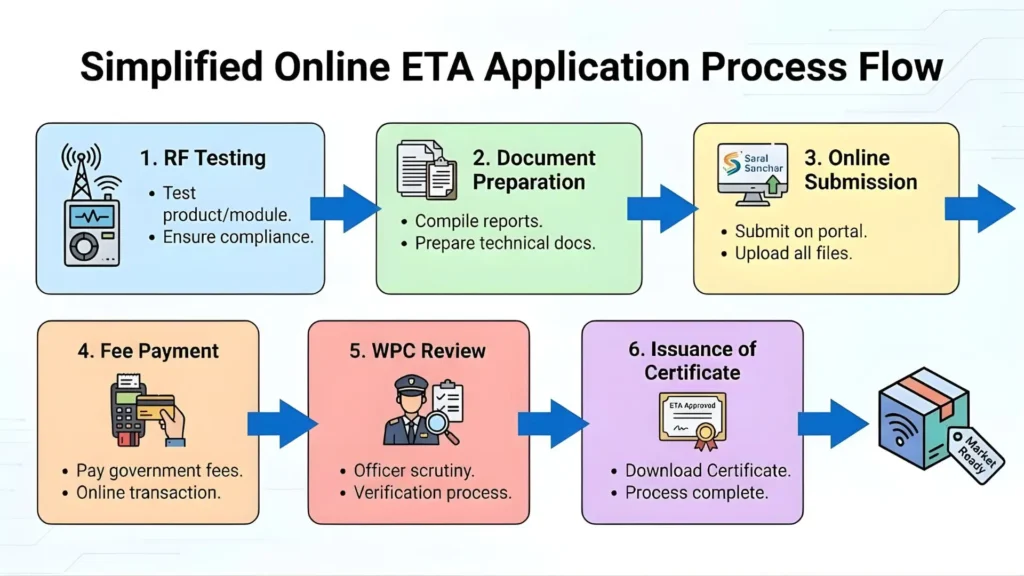
Here is the exact sequence a brand or importer follows to get WPC ETA for a smartwatch or any BLE wearable in India as of April 2026:
Step 1 — Identify Your Route (ETA-SD or Full ETA)
Check whether your smartwatch is BLE/Wi-Fi only or has LTE. BLE-only = ETA-SD. LTE = full ETA + WPC Import Licence. This single decision determines your timeline and cost.
Step 2 — Appoint an Authorized Indian Representative (AIR)
Foreign manufacturers must appoint an Indian AIR before filing. The AIR can be: (1) the manufacturer's own Indian liaison or branch office, (2) the Indian proprietor or registered user of the brand/trademark, or (3) a third-party importer, distributor, or compliance consultant with a marketing tie-up. The AIR is legally responsible for compliance in India and must match the entity named in the WPC ETA application.
Step 3 — Gather RF Documentation
For ETA-SD, you do not upload test reports to the portal, but you must have them on file for customs and potential WPC inspection. Collect:
- RF conducted and radiated test report for the Bluetooth/Wi-Fi module (FCC, CE, or SRRC accepted if India-unit configuration is identical)
- SAR test report — required for smartwatches and any wearable worn on the wrist or body (India follows ICNIRP 10g average metric, limit 2.0 W/kg)
- Block diagram of all RF modules in the device
- Product photos — all six sides plus label showing model number and RF module details
- User manual in English
Step 4 — File on Saral Sanchar Portal
The ETA-SD application is filed online at saralsanchar.gov.in. The applicant declares all RF modules, their frequency bands, and confirms the device meets de-licensed band technical standards. As of the March 2026 portal upgrade, applicants can also declare 6 GHz band operation (5945–6425 MHz) for devices that support Wi-Fi 6E.
Step 5 — ETA-SD Certificate Generated
For qualifying devices, the ETA-SD certificate is generated instantly or within the same session. The certificate number must be printed on the product label and/or packaging. The fee is ₹10,000 per model, regardless of the number of RF modules.
Step 6 — WPC ETA Certificate Validity
WPC ETA (for de-licensed band devices) does not expire unless the product undergoes hardware modification. However, if the RF module, antenna design, firmware, or frequency configuration changes, a fresh ETA-SD must be filed. Best practice: treat it as a model-specific certification and re-file for every new hardware revision.
LTE Smartwatch WPC Approval India — What's Different
LTE / cellular smartwatches are a growing segment in India — popular for kids GPS tracking, senior wellness devices, and standalone fitness use. If you are importing an LTE smartwatch, the compliance process is significantly more complex than a BLE-only model.
| Compliance Requirement | BLE-only Smartwatch | LTE Smartwatch |
| WPC ETA | ETA-SD (self-declaration) | Full ETA via Regional Licensing Office |
| WPC Import Licence | Not required | Required — separate application |
| BIS CRS | IS 13252 (Part 1) | IS 13252 (Part 1) |
| SAR Testing | Yes (body-worn — wrist) | Yes — cellular SAR + wrist SAR |
| TEC Type Approval | Not required for BLE-only | Required for LTE-capable devices (TSDSI standards) |
| Timeline | 2–4 weeks total | 8–16 weeks total |
| Approximate Cost | ₹1.5–3 lakh | ₹4–8 lakh |
TEC (Telecom Engineering Centre) Type Approval is a third mandatory certification for LTE wearables, separate from both WPC ETA and BIS CRS. TEC verifies that the cellular radio interface meets Indian telecom network compatibility standards (TSDSI). Many importers miss this step, which is why LTE smartwatch launches frequently get delayed at customs.
Fitness Band WPC ETA India — Does a Fitness Band Need WPC ETA?
Yes — and this is one of the most searched questions from smaller brands and importers. Every fitness band sold or imported into India needs WPC ETA because every fitness band uses Bluetooth to sync data to a smartphone. There are no exemptions for low-cost bands, fitness-only products, or bands without a display.
The good news is that most fitness bands qualify for the fast ETA-SD route because they operate only on BLE (2.4 GHz de-licensed band). The process is straightforward — file on the Saral Sanchar portal, get the ETA-SD certificate, and print the certificate number on the product label.
BIS CRS for fitness bands: IS 13252 (Part 1):2010. If the band has a built-in Li-ion battery, the battery may additionally need separate compliance under IS 16046 (Li-ion battery safety). Confirm with your testing lab whether the battery is in scope of the IS 13252 report or needs a standalone battery certification.
BLE Smart Ring WPC Self-Declaration India — What You Need to Know
Smart rings are the fastest-growing wearable category in India in 2026. Brands like Ultrahuman, boAt, Noise, Samsung (Galaxy Ring), and Amazfit are all active in this space. From a compliance standpoint, smart rings are the simplest wearable category to certify — provided they use only BLE.
WPC ETA for Smart Rings
BLE smart ring WPC self-declaration via the ETA-SD route is applicable. Smart rings operate on 2.4 GHz Bluetooth Low Energy — de-licensed band, DGFT-exempt — which puts them squarely in the ETA-SD category. The Saral Sanchar portal lists BLE accessories including rings as qualifying products. File the ETA-SD, pay ₹10,000, and get the certificate in the same session.
SAR for Smart Rings
SAR testing for smart rings is required because the device is worn on the finger — in contact with the body. However, the SAR profile of a ring is different from a smartwatch. Most smart rings have very low transmit power levels that result in SAR values well below the 2.0 W/kg limit. Your test lab will confirm this during testing.
NFC Payment Rings
Smart rings with NFC (like the 7 Ring / RuPay payment rings popular in India) also need WPC ETA because NFC operates at 13.56 MHz. This frequency is typically handled within the BLE ETA application as a combined declaration. Confirm with your compliance consultant that the NFC module is explicitly declared in the ETA-SD.
CGM Transmitter WPC ETA India — Continuous Glucose Monitors
CGM (Continuous Glucose Monitoring) devices are a medically significant category growing rapidly in India. Brands like Dexcom, Abbott FreeStyle Libre, and Indian brand Ultrahuman's CGM integration all involve a CGM transmitter — a small wireless device worn on the body (typically the arm) that sends glucose readings to a smartphone or smartwatch receiver via BLE or a proprietary RF link.
WPC ETA for CGM transmitters: Required. The transmitter is a wireless device operating on BLE or a proprietary 2.4 GHz link — ETA-SD route applies. The receiver app runs on a smartphone (which has its own ETA), but the CGM transmitter hardware itself needs its own model-specific WPC ETA.
BIS CRS for CGM transmitters: IS 13252 (Part 1):2010 applies as the IT equipment safety standard. However, CGM devices that are classified as medical devices in India may additionally fall under the Medical Devices Rules, 2017 under CDSCO (Central Drugs Standard Control Organisation). Medical device classification is separate from WPC/BIS compliance — brands should confirm the regulatory pathway with a medical device compliance specialist if the device makes specific diagnostic claims.
Smart Glasses BT Wi-Fi WPC India — The Most Complex Wearable Category
Smart glasses are the most compliance-intensive wearable product in 2026. Devices like the Ray-Ban Meta glasses, Xiaomi AI glasses, and upcoming Android XR glasses combine Bluetooth, Wi-Fi (2.4 GHz + 5 GHz + potentially 6 GHz), cameras, microphones, and speakers in a single wearable form factor. Each radio needs a separate WPC ETA declaration or application.
| Smart Glasses Feature | WPC Compliance Required | BIS Standard | Additional Note |
| Bluetooth audio (speakers/mic) | Yes — ETA-SD (2.4 GHz BT) | IS 616:2017 (audio apparatus) | SAR testing if device rests near face |
| Wi-Fi 2.4 GHz | Yes — ETA-SD | IS 13252 (Part 1) | Can be combined in single ETA-SD |
| Wi-Fi 5 GHz | Yes — ETA-SD | IS 13252 (Part 1) | Declare both 2.4 and 5 GHz bands |
| Wi-Fi 6E (6 GHz) | Yes — ETA-SD (new Jan 2026) | IS 13252 (Part 1) | Portal updated March 2026 for 6 GHz |
| Camera module | No WPC for camera itself | IS 13252 (Part 1) | Camera is passive; RF module needs ETA |
| NFC (if any) | Yes — within BT ETA-SD declaration | Included in IS 13252 | Declare NFC frequency explicitly |
SAR testing for smart glasses is particularly important because the device sits on the face — near the eyes, temples, and ears. Test your device with the actual wear position and confirm SAR compliance before filing.
Sports Earbuds with HRM — WPC ETA & BIS for Heart-Rate Monitoring Earbuds
Sports earbuds with built-in heart rate monitoring (HRM) straddle two compliance worlds: IS 616:2017 (audio apparatus) for BIS CRS and standard BLE ETA-SD for WPC. They are not the same as a smartwatch and should not be filed under IS 13252.
The HRM sensor (typically a PPG optical sensor) does not require a separate WPC ETA — it is a passive sensor, not a radio transmitter. What WPC ETA needs is the Bluetooth module that sends the HRM data to a phone or watch. Most sports earbuds with HRM qualify for ETA-SD.
SAR testing is mandatory for sports earbuds worn in the ear canal — the same rules that apply to TWS earbuds apply here. India follows ICNIRP 10g averaging at 2.0 W/kg. US FCC reports (1g averaging) are not directly transferable for Indian SAR compliance.
ECG Watches — Wearable Device WPC Certificate India
ECG watches (electrocardiogram-capable smartwatches) like the Apple Watch Series 10, Samsung Galaxy Watch Ultra, and Indian market equivalents follow the same compliance pathway as standard smartwatches. The ECG functionality uses a bioelectrical sensor — not a radio transmitter — so it does not require a separate WPC ETA. WPC ETA covers the Bluetooth and/or LTE radios in the watch.
BIS CRS for ECG watches: IS 13252 (Part 1):2010 applies — same as all smartwatches. The ECG feature does not change the applicable BIS standard. However, if the device makes specific medical claims (e.g., AFib detection, clinical arrhythmia detection) and is positioned as a medical device, CDSCO medical device registration may additionally apply.
Complete Wearable Import Compliance Checklist India 2026
| Compliance Item | Applicable Products | Regulator / Authority | Standard / Act |
| WPC ETA-SD (BLE/Wi-Fi de-licensed) | Smartwatches, bands, rings, CGM, glasses (BLE/Wi-Fi) | WPC Wing, DoT | IWT Act 1933 |
| WPC Full ETA + Import Licence (LTE) | LTE/cellular smartwatches | WPC Wing / RLO | IWT Act 1933 |
| TEC Type Approval | LTE/cellular wearables | TEC, DoT | TSDSI standards |
| BIS CRS — IS 13252 (Part 1):2010 | Smartwatches, bands, rings, CGM, posture correctors | BIS / MeitY | IS 13252 (Part 1) |
| BIS CRS — IS 616:2017 | Sports earbuds with HRM, smart glasses (audio component) | BIS / MeitY | IS 616:2017 |
| SAR Test Report | All body-worn wearables (2.0 W/kg, 10g avg) | WPC / BIS (supporting) | ICNIRP guidelines |
| IS 16046 (Battery Safety) | Devices with Li-ion battery — if not covered in IS 13252 report | BIS | IS 16046:2018 |
| CDSCO Medical Device Reg. | CGM transmitters with diagnostic claims, ECG watches with medical claims | CDSCO, MoHFW | Medical Devices Rules 2017 |
| E-Waste / EPR (PWM Rules 2022) | All electronic products | CPCB | E-Waste Mgmt Rules 2022 |
| Legal Metrology / LMPC | All pre-packaged retail imports | DPIIT / State Legal Metrology | Legal Metrology Act 2009 |
| IEC Code + GST Registration | Indian importer | DGFT / GST Dept. | — |
| Country of Origin Certificate | Each import shipment | Customs / Chamber of Commerce | — |
WPC ETA Cost & Timeline for Wearables
| Activity | Est. Time | Est. Cost (INR) |
| RF / EMC Testing — BLE/Wi-Fi (if new test needed) | 2–5 weeks | ₹35,000 – ₹1,00,000 |
| SAR Testing (wrist-worn, in-ear, or face-worn) | 2–4 weeks | ₹30,000 – ₹80,000 |
| BIS Testing — IS 13252 (Part 1) | 4–8 weeks | ₹50,000 – ₹1,50,000 |
| WPC ETA-SD filing fee (per model) | Same day | ₹10,000 |
| WPC Full ETA (LTE products) | 15–30 working days | ₹10,000 + RLO processing |
| WPC Import Licence (LTE only) | 15–30 working days additional | Separate govt fee |
| TEC Type Approval (LTE only) | 4–8 weeks | ₹50,000 – ₹2,00,000 |
| BIS CRS R-number registration | 20–45 working days after testing | ₹10,000 – ₹20,000 (govt fee) |
| AIR charges (annual, foreign manufacturer) | Ongoing | ₹40,000 – ₹1,20,000/year |
| Total — BLE-only wearable (new product, new testing) | 6–12 weeks end-to-end | ₹1,25,000 – ₹3,50,000 |
| Total — LTE smartwatch (new product) | 14–22 weeks end-to-end | ₹4,00,000 – ₹8,00,000 |
| Reuse of existing FCC/CE test reports (BLE-only) | Cuts testing phase entirely | Saves ₹35,000–₹1,00,000 |
2026 Regulatory Updates — Wearables Import India
January 2026 — 6 GHz Band De-Licensed (GSR 47(E)): India opened the 6 GHz band (5945–6425 MHz) as de-licensed spectrum. Wearables and smart glasses with Wi-Fi 6E capability can now include this band in ETA-SD filings. The Saral Sanchar portal was updated in March 2026 to support 6 GHz declarations.
October 2025 — IS/IEC 62368-1:2023 Transition Notification: MeitY notified the phase-in of IS/IEC 62368-1:2023 to replace IS 13252 (Part 1) and IS 616:2017. Concurrent validity runs until 1 November 2028. New wearable product applications in 2026 should plan to transition to IS/IEC 62368-1:2023 to avoid a repeat certification cycle before the 2028 deadline.
2025 — Tightened Customs Enforcement: Indian customs has strengthened coordination with WPC and BIS databases. Shipments now require the WPC ETA number to be declared at the time of filing the Bill of Entry. Products without a valid, queryable ETA on the WPC database are flagged automatically.
2025 — MeitY CRS Expansion for Wearables: MeitY's October 2024 notification confirmed BIS CRS mandatory registration for wireless earbuds, which are relevant to sports earbuds with HRM. Smartwatches and fitness bands have been under mandatory CRS since earlier notifications. Smart rings are increasingly scrutinized at Conclusion — Get Compliance Right Before You Ship
Conclusion — Get Compliance Right Before You Ship
India's wearable technology market grew past ₹8,000 crore in FY2025 and is on track for double-digit growth through 2026. Brands that understand WPC ETA smartwatch India requirements — and the correct BIS CRS standards for each wearable category — launch faster, clear customs cleanly, and avoid the costly detention and rework cycles that have tripped up even large brands.
The rules are clear once you know them: BLE-only wearables go through ETA-SD on the Saral Sanchar portal — fast and inexpensive. LTE wearables need full ETA plus a WPC Import Licence plus TEC Type Approval — plan 16–22 weeks. BIS CRS for smartwatches and fitness bands uses IS 13252 (Part 1):2010, transitioning to IS/IEC 62368-1:2023 before November 2028. Sports earbuds with HRM use IS 616:2017. Smart glasses may need both.
Start your compliance process before the product order is placed — not after. The test reports, AIR appointment, and portal filings take time. Budget that time into your launch planning, and India becomes a well-managed, rewarding market rather than a regulatory minefield.