
- WPC ETA Certification for Smart Home Devices using Bluetooth, Wi-Fi, BLE, or Zigbee before importing or selling in India.
- 14 product types — from smart bulbs to game controllers — each follow specific WPC approval pathways updated for 2026.
- Self-Declaration or Type Approval — knowing which route applies to your device saves weeks of compliance time and avoids customs detention.
- BIS + WPC dual compliance is now enforced for several smart home categories; non-compliance attracts seizure and heavy fines at Indian ports.
Introduction: Why WPC ETA Is Non-Negotiable in India
If you are importing or selling smart home devices in India, the single most costly compliance mistake is assuming that CE or FCC certification from other markets is sufficient. It is not. India operates its own mandatory wireless approval framework governed by the Wireless Planning and Coordination (WPC) Wing under the Ministry of Communications. Every product that uses Bluetooth, Wi-Fi, BLE, Zigbee, or any unlicensed radio frequency must carry a valid WPC Equipment Type Approval (ETA) before it can legally enter the Indian market.
The Indian Wireless Telegraphy Act, 1933 is the legal backbone of this requirement. Under this Act, operating or importing a wireless transmitter without a valid license or type approval is a punishable offence. For smart home and lifestyle devices, the WPC ETA is the specific instrument that grants permission to use the radio spectrum inside the device. Without it, your product does not belong in India — legally or commercially.
This guide covers all 14 product types that fall under Category 3 — Smart Home and Lifestyle Devices, explains the exact compliance pathway for each, and answers the most common questions that importers, brand owners, and compliance managers ask before they run into trouble at Indian customs.
What Is WPC ETA Certification For Smart Home Devices?
The WPC Wing is the regulatory authority in India that manages the use of radio frequency (RF) spectrum. Any device that transmits or receives over a wireless frequency — even passively — must receive an Equipment Type Approval (ETA) from the WPC before it is imported, manufactured, sold, or distributed in India.
For smart home and lifestyle devices, this requirement covers the following wireless technologies:
- Bluetooth Classic and BLE — used in smart locks, keyboards, mice, game controllers, BT mesh hubs
- Wi-Fi 2.4 GHz and 5 GHz — used in smart TVs, smart plugs, doorbells, and gateways
- Zigbee and Z-Wave — used in smart bulbs, LED strip controllers, and home automation hubs
- Thread and Matter — emerging protocols used in next-generation smart home ecosystems
- Proprietary 2.4 GHz RF — used in certain game controllers and wireless mice
Key Legal Point: If your product has any wireless radio inside it, WPC ETA is not optional. The penalty for non-compliance includes confiscation at Indian ports, fines under the Indian Wireless Telegraphy Act 1933, and potential product recall obligations if non-compliant goods have already reached the market.
WPC ETA vs. BIS CRS — Understanding the Dual Compliance Reality
Many importers confuse WPC ETA with BIS CRS certification. These are two completely separate regulatory frameworks. Understanding the difference is critical before you plan your India market entry:
| Regulation | Authority | What It Covers | Who It Applies To |
| WPC ETA | WPC Wing, Dept. of Telecom | Wireless radio frequency use & transmission | All wireless devices |
| BIS CRS | Bureau of Indian Standards | Product safety, EMI/EMC, quality standards | Listed electronic products |
| BEE Star Rating | Bureau of Energy Efficiency | Energy consumption labelling | Lighting & electrical products |
| WPC + BIS (Dual) | Both authorities | Combined compliance for complex devices | Smart TVs, smart plugs, Wi-Fi products |
Two WPC Approval Routes: Self-Declaration vs. Type Approval
Before diving into each product category, it is essential to understand the two main approval pathways the WPC offers in 2026. Choosing the wrong route wastes time and money — choosing the right one is the first step toward efficient compliance.
Route 1 — Self-Declaration (SD)
- Applies to devices using BLE (Bluetooth Low Energy) operating at or below 1 milliwatt (0 dBm) output power
- No third-party lab testing required — the importer or brand submits a declaration online via the WPC portal (saralsanchar.gov.in)
- Supporting technical documents must be accurate; misrepresentation is treated as a serious compliance violation
- Typical processing time: 7 to 15 working days after complete submission
Route 2 — Type Approval (TA)
- Applies to devices using Wi-Fi, standard Bluetooth above 1 mW, dual-radio devices, Zigbee, Z-Wave, Thread, or any product not meeting SD criteria
- Requires test reports from a NABL-accredited lab or an internationally recognised lab accepted by WPC
- Full technical documentation package must be submitted including circuit diagrams, frequency tables, and user manual drafts
- Typical processing time: 30 to 60 working days — can extend if queries are raised or documents are incomplete
| Criteria | Self-Declaration | Type Approval |
| Wireless Technology | BLE only at ≤ 0 dBm | Wi-Fi, BT Classic, Zigbee, dual-radio |
| Lab Testing Required | No | Yes — NABL or recognised international lab |
| Processing Time | 7–15 working days | 30–60 working days |
| Cost (approx.) | Lower — documentation only | Higher — includes lab testing fees |
| Risk if Misapplied | High — treated as falsification | Low — comprehensive route |
| Renewal Period | 5 years | 5 years |
Category 3 — Product-by-Product WPC ETA Compliance Breakdown
The following section covers each of the 14 product types in Category 3 with their specific wireless technologies, applicable approval routes, dual compliance requirements, and key watch-outs for 2026.
1. Smart Bulbs (BLE / Zigbee / Wi-Fi)
Smart bulbs are among the highest-volume smart home imports in India and among the most frequently flagged at customs. The lighting function itself is not regulated by WPC — but every wireless radio inside the bulb is.
What triggers the WPC ETA requirement:
- Any BLE chip used for phone app pairing or mesh network participation
- Zigbee radio used for smart home hub integration
- Wi-Fi module used for direct cloud connectivity or voice assistant control
| Radio Technology | WPC Route | Additional Compliance | Special Note |
| BLE only (≤ 0 dBm) | Self-Declaration | BEE Star Rating (if applicable) | Most basic smart bulbs qualify here |
| Zigbee | Type Approval | None typically | Common in Philips Hue-style ecosystems |
| Wi-Fi 2.4 GHz | Type Approval | BIS CRS (IS 13252) | Direct-connect bulbs use this |
| Wi-Fi + BLE combo | Type Approval | BIS CRS + BEE | Most premium smart bulbs fall here |
| Zigbee + BLE dual | Type Approval | None typically | Matter-ready bulbs use this combo |
2026 Update: BEE has expanded its mandatory star rating scheme to smart LED products. Many smart bulbs now require both WPC ETA and BEE registration — dual compliance is no longer optional for this category.
2. LED Strips — Smart & Addressable
Smart LED strips with Wi-Fi or BLE app control follow the same WPC ETA logic as smart bulbs. The wireless radio inside the LED controller is what triggers the requirement — not the strip itself.
Critical compliance point that importers frequently miss:
Many LED strip kits include a separate BLE or Wi-Fi controller module
- Even if the LED strip itself has no wireless function, the controller counts as a standalone wireless device and requires its own WPC ETA
- If you bundle LED strips with a smart hub, each wireless component in the bundle needs its own ETA number on packaging and documentation
- BLE-controlled strips operating at ≤ 0 dBm can use Self-Declaration; Wi-Fi 2.4 GHz controlled strips require Type Approval and BIS CRS
3. Smart Plugs (Wi-Fi / BLE)
Smart plugs are high-volume imports in India, driven by the rapid adoption of voice assistants and home automation platforms. Every smart plug with wireless capability requires WPC ETA, regardless of which smart home ecosystem it supports.
'My smart plug is Alexa-certified or Works with Google Home certified. Does that replace WPC ETA?' The answer is categorically no. Platform certifications from Amazon, Google, or Apple are entirely separate from WPC ETA and have no bearing on Indian regulatory compliance.
| Smart Plug Feature | WPC Compliance Required | BIS CRS Required | Notes |
| Wi-Fi 2.4 GHz control | Type Approval | Yes (IS 13252) | Most common type in India market |
| BLE control only | Self-Declaration | Generally No | Less common, limited range |
| Wi-Fi + BLE dual mode | Type Approval (covers both) | Yes | Covers all use cases |
| Power monitoring add-on | Not separately required | Check BIS schedule | Hardware feature, not wireless |
| Voice assistant integration | WPC ETA still mandatory | Per device schedule | Platform cert ≠ WPC ETA |
| 16A heavy-duty smart plug | Type Approval | Yes — mandatory | Higher wattage triggers BIS |
Important: The WPC ETA certificate is product-specific, not brand-specific. If you sell five SKUs with different wireless modules or different wattage ratings, each may require a separate ETA unless the wireless module, output power, and frequency bands are identical across variants.
4. Smart Door Locks (BLE / Zigbee / Wi-Fi)
Smart door lock WPC compliance in India sits at the intersection of multiple regulatory frameworks, making it one of the more complex categories to navigate correctly. The wireless component of the lock — not the mechanical or electronic lock mechanism — is what WPC regulates.
| Lock Type | Wireless Technology | WPC Route | Remote Access Capable |
| BLE proximity unlock only | BLE ≤ 0 dBm | Self-Declaration | No — phone must be nearby |
| BLE + Wi-Fi bridge | BLE + Wi-Fi 2.4 GHz | Type Approval | Yes — via Wi-Fi gateway |
| Zigbee smart lock | Zigbee 2.4 GHz | Type Approval | Via Zigbee hub |
| Full Wi-Fi cloud lock | Wi-Fi 2.4 GHz | Type Approval + BIS | Yes — direct cloud |
| Z-Wave lock | Z-Wave (868 MHz) | Type Approval | Via Z-Wave gateway |
| Matter-compatible lock | Thread + BLE | Type Approval | Via Matter hub |
A practical note for B2B importers: Smart locks intended for commercial buildings, offices, or housing projects in India may also require compliance review under local building codes and security standards beyond WPC ETA. Always verify end-use requirements with your local compliance consultant.
5. Smart Doorbells (Wi-Fi / BLE)
Video doorbells have seen rapid adoption across Indian residential and commercial markets. Most smart doorbells combine a camera, Wi-Fi for live video streaming, and BLE for local pairing — making Type Approval the standard route for virtually all models in this category.
Full compliance checklist for importing smart doorbells into India:
1. WPC ETA — Type Approval (Wi-Fi models, which is nearly all of them)
2. BIS CRS registration under IS 13252 — applicable for most Wi-Fi enabled IT/electronic devices
3. Correct country of origin marking — mandatory on product and packaging
4. WPC ETA certificate number — must appear on product label and all packaging
5. Importer name and address — required on Indian market packaging
6. Dual-band Wi-Fi models (2.4 GHz + 5 GHz) — both frequency bands must be covered in the single Type Approval
Battery Power Myth: A battery-powered doorbell is not exempt from WPC ETA. The wireless radio is what triggers the requirement, not the power source. Solar-powered, battery-operated, or wired doorbells with Wi-Fi or BLE all need WPC ETA.
6. Bluetooth Keyboards
Bluetooth keyboards are among the highest-volume wireless peripheral imports in India. They are also a category where enforcement has noticeably tightened — brands that previously operated in a compliance grey zone are now finding goods detained at ports with greater frequency.
| Keyboard Type | BT Version / Technology | WPC Route | Notes |
| Standard BT keyboard | BT 4.x / 5.x Classic | Type Approval | Most consumer keyboards fall here |
| BLE-only keyboard | BLE ≤ 0 dBm | Self-Declaration | Rare in practice — very limited range |
| Multi-device BT keyboard | BT 5.x (3+ device pairing) | Type Approval | Type covers all BT modes |
| BT + 2.4 GHz dongle combo | Dual radio (BT + RF) | Type Approval | Both radios covered in one ETA |
| Foldable travel BT keyboard | BT 5.x | Type Approval | Form factor irrelevant to WPC |
| Mechanical BT keyboard | BT 5.x | Type Approval | Switch type irrelevant to WPC |
2026 Enforcement Update: The WPC and Indian customs authorities have been actively cross-checking Bluetooth keyboard shipments against ETA databases. E-commerce platforms including Amazon India and Flipkart now increasingly require compliance documentation before allowing wireless peripheral listings. Brands without valid ETA documentation risk both customs holds and marketplace delistings.
7. Bluetooth Mice & Wireless Mice
Wireless mice require WPC ETA whether they use Bluetooth or a proprietary 2.4 GHz USB dongle. This is a point of confusion — dongle-based mice are not Bluetooth devices, but they still operate on an unlicensed radio frequency that requires WPC approval.
| Mouse Type | Wireless Technology | WPC Route | Common Examples |
| Standard BT mouse | BT 4.x / 5.x | Type Approval | Logitech MX Anywhere style |
| BLE-only mouse | BLE ≤ 0 dBm | Self-Declaration | Power-saving BLE mice |
| 2.4 GHz USB dongle mouse | Proprietary RF | Type Approval | Nano-receiver mice |
| BT + 2.4 GHz switchable | Dual radio | Type Approval | Multi-connection mice |
| Ergonomic vertical mouse (BT) | BT 5.x | Type Approval | Design irrelevant to WPC |
8. Smart TVs (Bluetooth + Wi-Fi)
Smart TVs are the most compliance-complex product in Category 3. A modern smart TV typically combines multiple wireless radios simultaneously — Wi-Fi (2.4 GHz and 5 GHz), Bluetooth for remote controls and audio devices, and sometimes Zigbee or Thread for smart home integration.
This multi-radio architecture means virtually all smart TVs require Type Approval, and both WPC ETA and BIS CRS compliance are mandatory — there is no exception.
| Smart TV Wireless Feature | WPC Requirement | BIS Requirement | Notes |
| Wi-Fi 2.4 GHz | Type Approval — mandatory | BIS CRS IS 13252 | Covers internet connectivity |
| Wi-Fi 5 GHz (dual-band) | Type Approval — both bands | BIS CRS IS 13252 | Both bands in same application |
| Bluetooth (Classic/BLE) | Type Approval — included | Via BIS registration | BT remote pairing & audio |
| HDMI / USB / AV ports | Not regulated by WPC | Covered under BIS | Physical ports only |
| OTT streaming apps | Not a WPC concern | Not a BIS concern | Software — no hardware radio |
| Wi-Fi + BT + Thread (future) | Type Approval all radios | BIS CRS updated | Matter-capable TVs |
A critical point for TV brands entering India: WPC ETA is India-specific and not transferable. A certificate from China, the EU, or the United States has absolutely no legal standing with Indian customs or the WPC. Every smart TV model intended for the Indian market requires its own India-specific WPC ETA.
9. Game Controllers (Bluetooth / 2.4 GHz RF)
Bluetooth game controllers and 2.4 GHz wireless gaming accessories are a rapidly growing import category in India, and WPC ETA enforcement in this space has tightened significantly alongside the growth of India's gaming market.
The gaming accessories segment has historically been a compliance blind spot for smaller importers. Controllers arriving through informal channels or sold via online marketplaces without valid ETA documentation expose both the seller and the marketplace platform to liability under Indian wireless regulations.
| Controller Type | Wireless Technology | WPC Route | Platform Relevance |
| BT 5.x game controller | Bluetooth Classic | Type Approval | Mobile, PC, cloud gaming |
| BLE game controller | BLE ≤ 0 dBm | Self-Declaration | Basic/casual gaming controllers |
| 2.4 GHz RF controller | Proprietary 2.4 GHz | Type Approval | Console-adjacent, low latency |
| BT console controller | BT 5.x / BLE | Type Approval | Compatible with multiple platforms |
| Mobile BT gamepad (clamp) | BT 5.x | Type Approval | Phone clip-on style controllers |
| Arcade stick (BT) | BT 5.x | Type Approval | Fighting game peripherals |
2026 Market Note: Major Indian e-commerce platforms have begun requesting compliance documentation from sellers listing game controllers, headsets, and gaming peripherals. Brands without valid WPC ETA now face listing removals, not just customs risk.
10. Bluetooth Mesh Hubs / Smart Home Gateways
Smart home hubs and gateways are the backbone of connected home systems — and also the most complex product type from a WPC ETA perspective. These devices typically combine multiple wireless radios to bridge local device networks with cloud platforms.
Common radio combinations found in smart home hubs sold in India:
- Zigbee + Wi-Fi — the most common combination in current-generation hubs
- BLE Mesh + Wi-Fi — used in Tuya-based and similar ecosystems
- Thread + Wi-Fi + Bluetooth — used in Matter-compatible hubs (Apple HomePod, Google Nest, Amazon Echo with Thread)
- Z-Wave + Wi-Fi — used in premium western smart home hubs
- Zigbee + Z-Wave + Wi-Fi + BLE — used in multi-protocol universal hubs
| Hub / Gateway Type | Wireless Protocols | WPC Requirement | Additional Notes |
| Zigbee + Wi-Fi gateway | Zigbee + Wi-Fi 2.4 GHz | Type Approval (both radios) | Most common India import type |
| BLE Mesh + Wi-Fi hub | BLE + Wi-Fi 2.4 GHz | Type Approval (both radios) | Tuya, eWeLink based devices |
| Matter hub (Thread + BT + Wi-Fi) | Thread + BLE + Wi-Fi | Type Approval (all radios) | WPC guidelines being clarified |
| Z-Wave + Wi-Fi gateway | Z-Wave + Wi-Fi | Type Approval (both radios) | Premium western ecosystems |
| Universal 4-protocol hub | Zigbee + Z-Wave + BT + Wi-Fi | Type Approval (all radios) | Full technical dossier required |
2026 Matter Protocol Note: Matter-compatible devices entering India use Thread (an 802.15.4-based protocol), Wi-Fi, and Bluetooth LE simultaneously. The WPC is in the process of developing clearer guidelines for multi-radio approval covering Thread specifically. Brands importing Matter hubs should work with a WPC-authorized consultant to ensure all radios are covered in a single or coordinated approval application.
Master Compliance Reference: All 14 Product Types at a Glance
| Product | Common Wireless Tech | WPC Route | BIS CRS Also Required? | BEE Required? |
| Smart Bulbs | BLE / Zigbee / Wi-Fi | SD or TA | Yes — Wi-Fi models | Yes — smart LED |
| LED Strips (Smart) | BLE / Wi-Fi controller | SD or TA | Yes — Wi-Fi models | Check BEE schedule |
| Smart Plugs | Wi-Fi / BLE | TA (Wi-Fi) / SD (BLE only) | Yes — Wi-Fi models | No |
| Smart Door Locks | BLE / Zigbee / Wi-Fi | SD or TA | Check BIS schedule | No |
| Smart Doorbells | Wi-Fi + BLE | Type Approval | Yes | No |
| BT Keyboards | BT Classic / BLE | TA (Classic) / SD (BLE) | Generally No | No |
| BT Mice | BT / 2.4 GHz RF | Type Approval | Generally No | No |
| Smart TVs | Wi-Fi + BT (dual) | Type Approval | Yes — mandatory | Check BEE TV schedule |
| Game Controllers | BT / 2.4 GHz RF | Type Approval | Generally No | No |
| BT Mesh Hubs | Multi-radio | Type Approval (all radios) | Yes | No |
SD = Self-Declaration | TA = Type Approval. This table is for general guidance. Always verify current requirements with a WPC-authorised consultant before filing applications.
WPC ETA Application Process — Step-by-Step for 2026
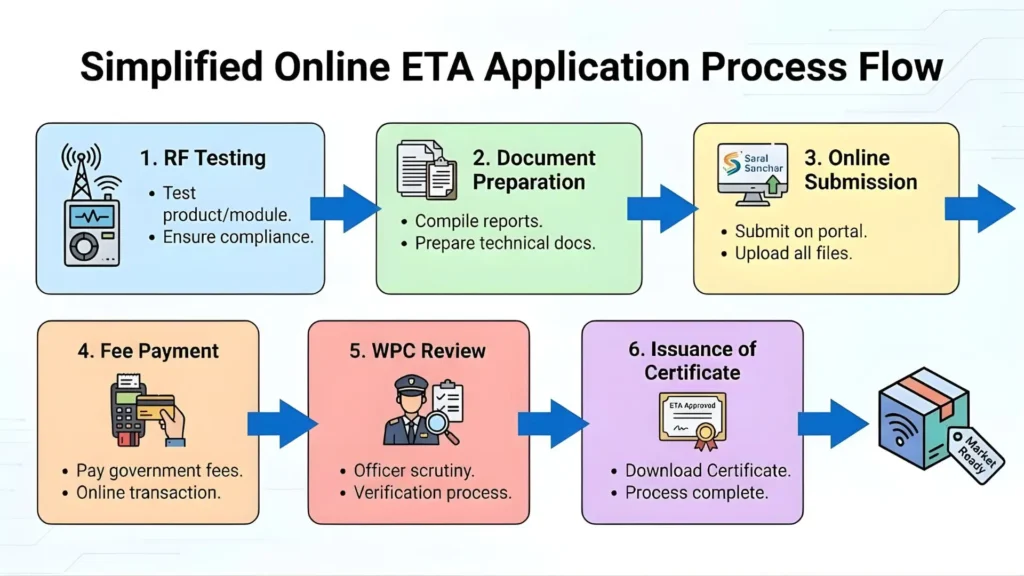
Whether you are applying for Self-Declaration or Type Approval, the workflow follows a defined sequence. Skipping steps or submitting incomplete documentation is the most common cause of delays and rejections.
| Step | Action Required | Who Is Responsible | Typical Timeframe |
| Step 1 | Identify all wireless radios in the device — frequency bands, output power (dBm or mW), BT version, modulation type | Brand / Importer / Technical team | 1–2 days |
| Step 2 | Determine approval route — SD or TA — based on wireless tech and output power specifications | Compliance consultant | 1 day |
| Step 3 | Commission lab testing at NABL-accredited or WPC-accepted international lab (for Type Approval only) | Brand / Testing lab | 15–30 days |
| Step 4 | Compile full documentation package — test reports, circuit diagrams, technical parameters sheet, user manual draft | Brand / Consultant | 3–5 days |
| Step 5 | Register on Saral Sanchar Portal (saralsanchar.gov.in) and create organisation account | Brand / Authorised signatory | 1–2 days |
| Step 6 | Submit online application with documents and pay WPC fee per the current fee schedule | Authorised representative | 1 day |
| Step 7 | Respond to WPC technical queries promptly if raised during review | Technical team / Consultant | Within 7 days of query |
| Step 8 | Receive WPC ETA certificate with unique registration number | WPC Wing issues certificate | SD: 7–15 days | TA: 30–60 days |
| Step 9 | Apply WPC ETA number to product labels and packaging before shipment from country of origin | Brand / Manufacturer | Pre-shipment |
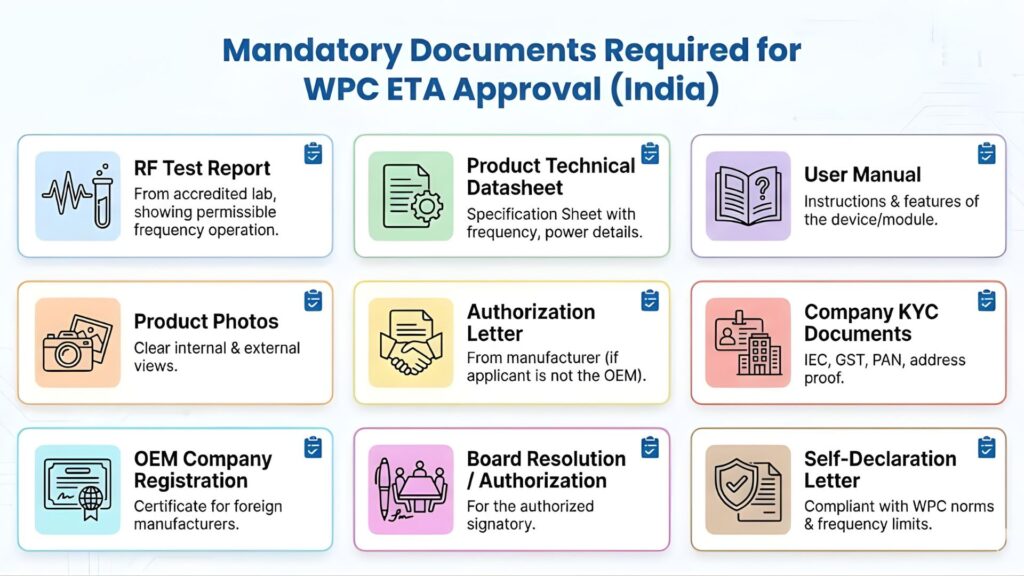
Documents Required for WPC ETA — Type Approval Route
A complete and well-organised documentation package is the single biggest factor in reducing WPC ETA processing time. The following table lists all required documents:
| Document | Details / Specifications | Mandatory? |
| Test Report | From NABL-accredited or WPC-accepted international lab (SGS, TUV, Intertek, Bureau Veritas) | Yes |
| Technical Parameters Sheet | Frequency bands, output power, modulation type, channel spacing, duty cycle | Yes |
| Circuit / Block Diagram | Showing the wireless module and its connections within the device | Yes |
| User Manual (Draft) | In English, must mention WPC ETA number will be included post-approval | Yes |
| Declaration of Conformity | Signed by authorised signatory confirming accuracy of submitted data | Yes |
| Authorization Letter | If filing through an agent or third-party compliance consultant | If applicable |
| Import Export Code (IEC) | Issued by DGFT — required for commercial import applications | Yes for importers |
| GST Registration Certificate | For Indian entities filing applications | Yes for Indian entity |
| Photographs of the device | Showing labels, ports, and physical construction | Recommended |
| WPC Fee Payment Receipt | As per current fee schedule published on saralsanchar.gov.in | Yes |
WPC ETA Labelling Requirements for Smart Home Devices
Once the WPC ETA certificate is issued, the approved certificate number must appear on the product and its packaging before the device ships to India. The WPC specifies the following labelling requirements:
- WPC ETA Certificate Number — mandatory on product label; must be clearly legible
- Model Number and Variant — as registered on the ETA certificate
- Manufacturer Name and Registered Address — on packaging if space is insufficient on device
- Country of Origin — mandatory on both product and packaging per Indian import rules
- Frequency Band(s) Used — listed for consumer awareness
- Small device exception — for devices like smart bulbs, BLE mice, or game controllers where label space is limited, some information can shift to packaging, but the WPC ETA number must still appear on the device at minimum
2026 Regulatory Updates Affecting Smart Home Device Compliance
| Update Area | Details | Impact Level |
| Customs Scrutiny | Indian customs have intensified checks on BT and Wi-Fi device imports across all categories. Products that previously moved with minimal documentation are now facing stricter verification at major ports including JNPT, Chennai, and Delhi Air Cargo. | High |
| Matter Protocol Devices | WPC is developing clearer multi-radio approval guidelines specifically for Matter-compatible devices using Thread + BLE + Wi-Fi. Brands importing Matter hubs and controllers should seek expert guidance before filing. | High |
| BIS CRS Expansion | BIS has been expanding the list of smart home products requiring mandatory registration. Devices currently needing only WPC ETA may fall under BIS CRS in upcoming notifications. | Medium |
| EPR Compliance | Extended Producer Responsibility (EPR) registration under E-Waste Management Rules is now a practical requirement for electronic product importers alongside WPC and BIS compliance. | Medium |
| Marketplace Enforcement | Amazon India, Flipkart, and other major platforms are increasingly requiring compliance documentation before approving new wireless product listings or renewing existing ones. | High |
| 5 GHz Wi-Fi Clarifications | WPC has clarified documentation requirements for 5 GHz Wi-Fi devices, with greater scrutiny on channel range and power levels. Dual-band devices should ensure both bands are explicitly covered. | Medium |
Why WPC ETA Compliance Is a Commercial Advantage in 2026
Beyond legal obligation, there is a strong commercial case for getting WPC ETA compliance right before entering the Indian smart home market:
| Business Benefit | Why It Matters |
| Uninterrupted market access | Clean customs clearance means predictable delivery timelines — critical for launch planning and retailer relationships |
| Marketplace listing approval | Amazon India, Flipkart, and emerging platforms require valid ETA before approving or maintaining wireless product listings |
| Brand protection | A customs seizure or marketplace delisting is a reputational event in a competitive, fast-moving market |
| Investor and partner confidence | B2B buyers, distributors, and retail chains increasingly run compliance checks before signing purchase agreements |
| Platform integration readiness | Smart home ecosystem partners (e.g., Google, Amazon, Apple) prefer working with brands that have full regional compliance in place |
| Long-term scalability | Getting compliance right on the first SKU creates a repeatable process for launching additional products faster |
The cost of WPC ETA compliance — typically ranging from approximately Rs. 15,000 to Rs. 1,50,000 per product depending on the approval route and lab testing requirements — is a fraction of the cost of a single shipment detention or marketplace delisting. Treat compliance as an investment in market access, not a cost to minimise.
Conclusion: Build Compliance Into Your India Launch Plan
The brands winning in India's smart home market in 2026 are not the ones trying to navigate around WPC ETA compliance — they are the ones that have built it into their product launch timelines from day one. India is one of the fastest-growing smart home markets in Asia, with millions of consumers actively adopting connected lighting, security, and automation devices. The regulatory infrastructure has caught up with this growth.
Whether you are launching a single smart bulb SKU or a full ecosystem of 14 smart home products, the path forward is clear: understand which approval route applies to each product, engage a WPC-authorised compliance partner early in your development cycle, and build ETA timelines into your launch roadmap — not as an afterthought, but as a pre-launch gate.
For brands that do this consistently, WPC ETA compliance becomes a competitive moat — a barrier that keeps less serious competitors out of the market while you build brand equity, channel relationships, and consumer trust with products that are fully cleared to sell.
Frequently Asked Questions on WPC ETA for Smart Home Devices
Do smart home devices need WPC ETA approval to sell in India?
Yes. Any device using Bluetooth, Wi-Fi, BLE, or Zigbee requires WPC ETA before it can be legally imported or sold in India. No exceptions — not even for small or low-cost products.
Does FCC or CE certification replace WPC ETA in India?
No. FCC and CE have no legal standing with Indian customs. You still need a separate India-specific WPC ETA for every model. However, existing lab test reports may sometimes be reused in your WPC Type Approval application to save testing costs.
What's the difference between Self-Declaration and Type Approval?
BLE-only devices at ≤ 0 dBm use Self-Declaration — no lab testing needed, approved in 7–15 working days. Wi-Fi, standard Bluetooth, Zigbee, or dual-radio devices need Type Approval — requires NABL-accredited lab testing and takes 30–60 working days.
Can one WPC ETA certificate cover multiple product variants?
Only if all variants share the exact same wireless module, output power, and frequency bands. Any difference means a separate ETA application. When in doubt, file separately — it costs far less than a customs detention.
Does a BLE smart door lock need the same WPC approval as a Wi-Fi lock?
Both need WPC ETA, but through different routes. A BLE-only lock at ≤ 0 dBm qualifies for Self-Declaration. Wi-Fi, Zigbee, Z-Wave, or Matter locks all require Type Approval. The locking mechanism is irrelevant — WPC only cares about the wireless radio inside.
What WPC compliance does a smart TV need for India?
Smart TVs need WPC Type Approval covering all wireless radios — typically dual-band Wi-Fi and Bluetooth. BIS CRS registration is also mandatory. No foreign certification replaces either of these. Both 2.4 GHz and 5 GHz bands must be explicitly listed in the same application.
Do Bluetooth keyboards and wireless mice need WPC ETA?
Yes. BT Classic keyboards and 2.4 GHz dongle mice both require Type Approval. As of 2026, Indian customs and platforms like Amazon India and Flipkart actively verify ETA status before clearing shipments or approving marketplace listings.
What happens if devices arrive at Indian customs without WPC ETA?
Goods get detained at the port. If documentation can't be produced, shipments are seized under the Indian Wireless Telegraphy Act, 1933. Financial penalties apply, and marketplace platforms will delist your products.
How long is a WPC ETA certificate valid?
5 years from the date of issue. Renewal is required after expiry. Any hardware change to the wireless module — chipset, output power, or frequency band — requires re-approval before the 5-year term ends.
Do smart home gateways need separate WPC ETA for each wireless protocol?
Not separate certificates, but every radio inside must be covered in one application. A Zigbee + Wi-Fi hub needs both covered under Type Approval. Matter-compatible hubs combining Thread, BLE, and Wi-Fi need all three radios covered. WPC guidelines for multi-radio Matter devices are still being finalised — consult a WPC-authorised expert before filing.