

- PESO license is mandatory for any hospital, clinic, or supplier that stores or supplies medical gases like oxygen, nitrous oxide, or carbon dioxide in India.
- Governed by the Petroleum and Explosives Safety Organization under the Gas Cylinders Rules 2016 and Static and Mobile Pressure Vessels Rules 2016.
- Hospitals above a defined gas storage capacity threshold must obtain separate licenses for storage, pipeline systems, and bulk supply.
- Application is filed online via the PESO portal — processing takes 30–90 days depending on inspection schedules and completeness of documentation.
What is the PESO License for Medical Gas Supply?
An PESO license (issued by the Petroleum and Explosives Safety Organization) is the statutory permission required in India to store, handle, supply, or distribute compressed medical gases — including oxygen, nitrous oxide, carbon dioxide, and medical air — in cylinders or bulk tanks. Hospitals, nursing homes, medical gas distributors, and pipeline system operators all need this license under the Gas Cylinders Rules 2016. The license is class- and capacity-specific, and failure to obtain it is a punishable offence. Applications are submitted online, inspected physically, and renewed every 1–3 years depending on license type.
What is PESO and Why Does It License Medical Gas Supply?
PESO stands for the Office of the Petroleum and Explosives Safety Organization. Until 2022, the regulatory body was known as PESO — the Petroleum and Explosives Safety Organization. The name change reflects an organizational restructuring, but the regulatory mandate remains unchanged.
PESO operates under the Ministry of Commerce and Industry, Government of India. It is responsible for the safe storage, handling, and transport of all compressed gases — including medical gases such as oxygen, nitrous oxide (N₂O), carbon dioxide (CO₂), and medical air — under the Explosives Act 1884, the Gas Cylinders Rules 2016 (GCR), and the Static and Mobile Pressure Vessels (Unfired) Rules 2016 (SMPV Rules).
Medical gases are classified as 'compressed gases' and are regulated as pressure vessels. Because a gas cylinder or bulk cryogenic tank poses explosion risk, fire hazard, and life-safety implications — especially in healthcare environments — PESO licensing is mandatory before any facility can legally receive, store, or supply these gases.
Which Medical Gases Require an PESO License?
- Medical Oxygen (O₂) — cylinders and bulk liquid tanks
- Nitrous Oxide (N₂O) — anesthetic gas used in operation theatres
- Carbon Dioxide (CO₂) — used in laparoscopic surgery and respiratory therapy
- Medical Air / Compressed Air — used in ICUs, ventilators, and anesthesia machines
- Nitrogen (N₂) — used for cryosurgery and laboratory purposes
- Helium-Oxygen Mixtures (Heliox) — used in respiratory therapy
- Entonox (50% O₂ + 50% N₂O) — pain relief in labor and emergency settings
Who Needs an PESO License for Medical Gas Supply?
Any entity that stores compressed medical gas beyond the threshold quantities defined in the Gas Cylinders Rules 2016 must hold a valid PESO license. This includes:
| Entity Type | License Requirement | Applicable Rule |
| Government and Private Hospitals (with cylinder storage) | License to store medical gas cylinders above 100 m³ aggregate water capacity | Gas Cylinders Rules 2016, Rule 31 |
| Nursing Homes & Small Clinics | Exempted if storage < 100 m³ aggregate water capacity; check local state rules | GCR 2016, Rule 31 proviso |
| Medical Gas Distributors / Dealers | License to store and supply medical gas cylinders at depot level | GCR 2016, Rule 31 |
| Bulk Liquid Oxygen (LOX) Storage Facilities | SMPV (Unfired) Rules license for cryogenic tank above 1000 litres water capacity | SMPV Rules 2016 |
| Medical Gas Pipeline System (MGPS) Operators | License for bulk storage that feeds the pipeline; pipeline itself may need separate approval | GCR / SMPV + local authority |
| Oxygen Generation Plant at Hospital | License for pressure vessel (PSA/VPSA plant) under SMPV Rules | SMPV Rules 2016 |
| Medical Gas Manufacturers & Fillers | Factory license under GCR 2016 for filling compressed gas into cylinders | GCR 2016, Rule 4 and Rule 7 |
Types of PESO Licenses for Medical Gas
PESO issues different categories of licenses based on the nature of activity and the type and capacity of gas storage. Here is what you need to know:
| License Type | Applicable Activity | Governing Rule |
| License to Store Compressed Gas Cylinders | Storage of medical gas cylinders (O₂, N₂O, CO₂, etc.) at hospital or depot — above threshold capacity | Gas Cylinders Rules 2016, Rule 31 |
| License for Bulk Storage (SMPV) | Storage of liquid oxygen or other liquefied gases in cryogenic tanks above 1000 litres water capacity | SMPV (Unfired) Rules 2016 |
| License for Compressed Gas Filling | For manufacturers who fill medical gases into cylinders | Gas Cylinders Rules 2016, Rule 7 |
| Import License for Gas Cylinders | For import of compressed gas cylinders into India | GCR 2016, Rule 6 |
| Approval for New Cylinder Design/Type | For new cylinder patterns not yet approved by PESO | GCR 2016, Rule 4 |
| Approval for Pipeline Systems (Indirect) | Bulk storage feeding pipeline system — storage license plus NABH and local body approvals typically needed | GCR / SMPV + State authority |

Eligibility Criteria for PESO License — Hospitals & Clinics
To be eligible for an PESO license to store or supply medical gases, an applicant must meet the following conditions:
- The applicant must be a registered legal entity — company, partnership, trust, or individual — with a valid business registration (GST, incorporation certificate, or trade license)
- The premises must comply with safety separation distances specified in Schedule VI of the Gas Cylinders Rules 2016 (minimum distances from buildings, public thoroughfares, and ignition sources)
- The storage area must have adequate ventilation, fire safety equipment, non-sparking flooring, and clearly marked gas identification signage
- A qualified and designated Safety Officer or Person-in-Charge must be named in the application — hospitals typically nominate the Medical Superintendent or Engineering Head
- All gas cylinders proposed for storage must have valid PESO cylinder approval marks (BIS marking, test date, and working pressure stamped)
- For bulk liquid oxygen (LOX) tanks, the tank manufacturer must hold SMPV approval from PESO, and the tank installation must be on a stable, fire-resistant platform
- For hospitals with a Medical Gas Pipeline System (MGPS), the system must conform to HTM 02-01 (UK standard) or equivalent — this is referenced by NABH and BIS standards
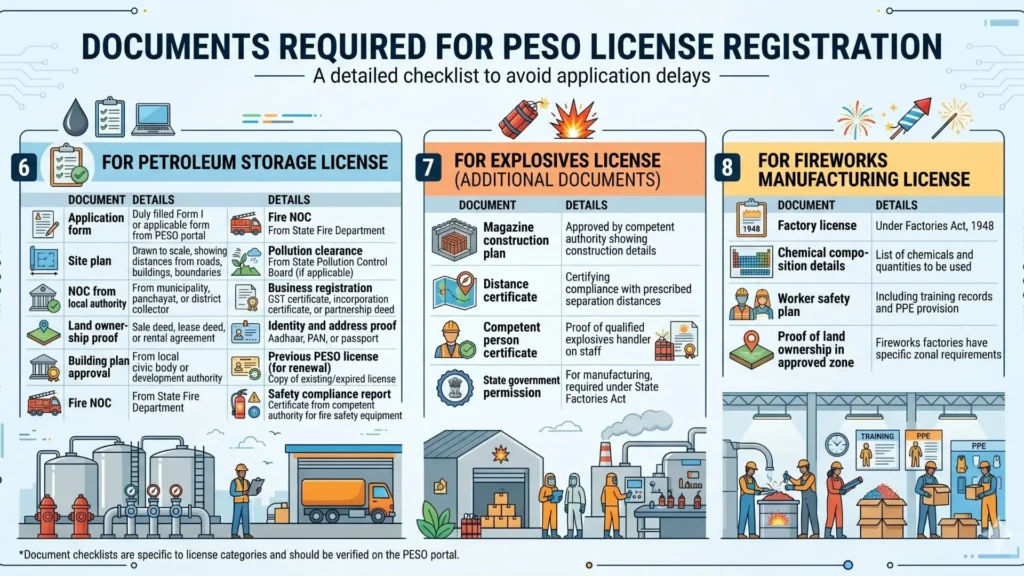
Documents Required for PESO Medical Gas License
Prepare these documents before starting your PESO license application. Missing even one document can trigger a deficiency notice and delay your license by weeks.
Identity & Business Documents
- Application in prescribed Form (Form Q for cylinder storage license or Form as per SMPV Rules) — submitted via PESO online portal
- Proof of legal entity: Certificate of Incorporation / Partnership Deed / Trust Deed / GST Registration
- Ownership or lease agreement of the premises where gas storage is proposed
- ID and address proof of the applicant / authorized signatory
Site & Safety Layout Documents
- Site plan (to scale) showing the storage area, distances from buildings, roads, drains, and ignition sources — conforming to Schedule VI of GCR 2016
- Building layout drawing showing ventilation openings, gas cylinder storage cage dimensions, and fire safety equipment placement
- Electrical wiring diagram confirming flame-proof fittings in the storage zone
- Photograph of the existing/proposed storage premises
Technical & Equipment Documents
- List of gas cylinders proposed to be stored — type, gas name, water capacity (litres), maximum working pressure, and quantity
- Cylinder approval certificates — BIS marking reference or PESO approval for cylinder design
- For bulk LOX tanks: SMPV approval certificate of the tank, tank installation drawing, and safety relief valve test certificate
- For pipeline systems: Schematic diagram of MGPS, manifold room layout, and inspection certificate from a competent person
Safety & Compliance Documents
- Fire NOC from the State Fire Department
- Safety audit report or self-certification for small hospitals (class-specific — check local requirement)
- Details of Safety Officer / Person-in-Charge: name, designation, qualification
- Emergency response plan and fire fighting equipment inventory
- Previous PESO license copy (for renewal applications)
Step-by-Step Process to Get PESO License for Medical Gas
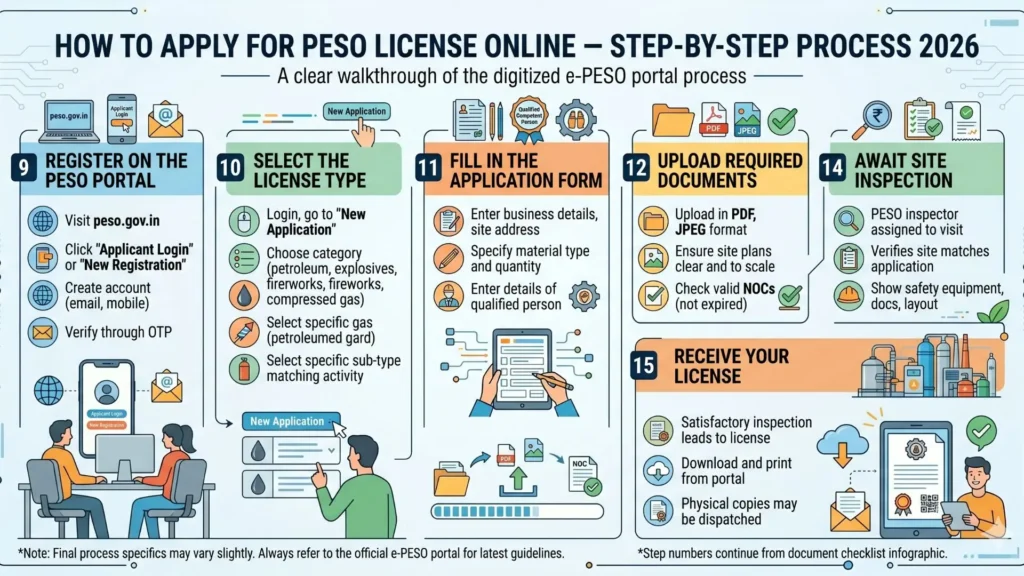
- Determine the correct license type based on your gas storage activity — cylinder storage (GCR) or bulk storage (SMPV).
- Register on the PESO online portal: peso.gov.in — create an applicant account for the facility.
- Prepare the complete document set (see Documents section above) including site plan, BIS-marked cylinder list, and Fire NOC.
- Fill in the prescribed application form online — Form Q for cylinder storage or the relevant SMPV application form for bulk storage.
- Pay the prescribed license fee online through the portal — fee varies by storage class and capacity.
- Submit the application — PESO assigns a reference number and allocates the case to the regional PESO office.
- PESO issues an acknowledgment and schedules a physical inspection of the premises by an Inspector of Explosives.
- The Inspector verifies safety layout, separation distances, cylinder marking, and fire safety compliance on-site.
- If deficiencies are found, PESO issues a notice — rectify and submit compliance report within the stipulated time.
- Upon satisfactory inspection, PESO grants the license — delivered digitally via the portal and by post.
- Display the license prominently at the licensed premises — it is a legal requirement.
PESO License Fees for Medical Gas Storage
Fees are prescribed under the Gas Cylinders Rules 2016 and SMPV Rules 2016. The following are indicative standard fees as per current rules — always verify the latest amounts on peso.gov.in before applying, as fees are subject to revision.
| License Type | Capacity / Category | Indicative Fee (INR) |
| Storage of Compressed Gas Cylinders | Aggregate water capacity up to 500 m³ | ₹1,000 – ₹2,500 |
| Storage of Compressed Gas Cylinders | Aggregate water capacity 500 m³ to 2,500 m³ | ₹2,500 – ₹5,000 |
| Storage of Compressed Gas Cylinders | Aggregate water capacity above 2,500 m³ | ₹5,000 – ₹10,000 |
| Bulk Liquid Gas Storage (SMPV) | Tank water capacity up to 5,000 litres | ₹2,000 – ₹4,000 |
| Bulk Liquid Gas Storage (SMPV) | Tank water capacity 5,000–50,000 litres | ₹4,000 – ₹8,000 |
| Compressed Gas Filling License | Per filling plant | ₹5,000 – ₹15,000 |
| Renewal Fee | All categories — approximately 50% of fresh license fee | Varies by class |
| Inspection Fee (if applicable) | Charged per inspection visit in some regions | As per state schedule |
Note: Fees may vary slightly by state (since some licensing powers are delegated to State authorities for smaller facilities). Confirm the current fee schedule on the OPESO portal before payment.
PESO License Validity and Renewal — What You Must Know
| Aspect | Details |
| Validity Period — Cylinder Storage License | 1 to 3 years depending on storage class and state authority decision (most Class A/B storage licenses: 3 years) |
| Validity Period — SMPV (Bulk Storage) | Typically 3 years; may be linked to statutory pressure vessel inspection cycle |
| Renewal Timeline | Apply for renewal at least 3 months before expiry — late renewal attracts penalty and may require fresh inspection |
| Renewal Form | Same portal (peso.gov.in) — renewal application with updated documents and fee payment |
| Inspection on Renewal | Physical inspection is typically re-conducted at renewal — ensure ongoing compliance |
| Consequences of Lapsed License | Storing or supplying gas without a valid license is a criminal offence under the Explosives Act 1884 — penalties include fines and imprisonment |
| Change of Premises / Capacity | Any change in storage location, capacity increase, or change in gas type requires a fresh variation application — do not assume your existing license covers it |
| Cylinder Periodic Testing | All gas cylinders must undergo periodic hydrostatic testing as per GCR 2016 — expired test certificates are a ground for license cancellation |
Safety Requirements and Standards for Medical Gas Storage
PESO compliance is not just about paperwork — it mandates physical safety standards that every licensed premises must maintain at all times. Here is what inspectors check:
Storage Area Requirements
- Dedicated, lockable gas cylinder storage cage or room — separate from general storage
- Minimum separation distances from doors, windows, drains, ignition sources, and public access areas — as per Schedule VI of GCR 2016
- Adequate cross-ventilation — at least two ventilation openings at floor and ceiling level
- Non-sparking (anti-static) flooring and no electrical fittings inside the storage zone unless flame-proof
- Clear gas identification labels on all cylinders — full and empty cylinders stored separately
- Cylinders chained or clamped to prevent falling — mandatory safety practice
Fire Safety Requirements
- Minimum one CO₂ or DCP fire extinguisher per 50 m² of storage area
- Smoke/fire detection system recommended for storage areas above 50 cylinders
- No-Smoking and No-Naked-Flame signage prominently displayed
- Emergency shut-off valves clearly labelled and accessible
- Staff training records for fire emergency response
Medical Gas Pipeline System (MGPS) Standards
- MGPS must conform to BIS IS 3166 or HTM 02-01 (UK standard adopted by NABH)
- Zone Valve Box Units (ZVBUs), Area Valve Service Units (AVSUs), and Alarm Panels must be installed and certified
- Annual validation and pressure testing by a MGPS-competent person is mandatory
- NABH-accredited hospitals face additional MGPS audit requirements during accreditation surveys
PESO License vs. Other Regulatory Approvals for Medical Gas
Medical gas supply in hospitals involves multiple regulatory touchpoints. PESO licensing is the primary requirement, but it sits alongside — not above — these other approvals:
| Regulatory Approval | Issuing Authority | Scope | Relation to PESO |
| PESO / PESO License | PESO (Central / Regional) | Storage and supply of compressed medical gas cylinders and bulk tanks | Primary — mandatory for all |
| CDSCO Registration | Central Drugs Standard Control Organisation | Medical oxygen, nitrogen, nitrous oxide as 'drugs' under the Drugs & Cosmetics Act | Separate — manufacturers and importers of medical gases need CDSCO registration; hospitals typically rely on supplier's registration |
| Fire NOC | State Fire Department | Fire safety compliance of the storage premises | Prerequisite for PESO license application |
| Factory License (if applicable) | State Labour / Factory Dept. | Required if gas cylinders are filled or processed on-site | Parallel — needed alongside PESO filling license |
| NABH Accreditation Requirements | National Accreditation Board for Hospitals | Mandates MGPS standards, medical gas safety protocols, and documented gas management procedures | NABH compliance typically requires a valid PESO license as documentary evidence |
| Pollution Control NOC | State Pollution Control Board | Required for gas filling plants with emissions or effluents | Parallel requirement for filling operations |
Common Mistakes to Avoid When Applying for PESO Medical Gas License
| Mistake | Impact | How to Avoid It |
| Applying for the wrong license type (GCR vs SMPV) | Application rejected; delays of weeks | Correctly classify your storage — cylinders = GCR, bulk tank = SMPV |
| Incorrect site plan — missing scale or separation distances | Inspection fails; deficiency notice issued | Get site plan drawn by a licensed architect or engineer with all GCR Schedule VI distances marked |
| BIS-marking absent on cylinders listed in application | Inspector rejects unlabelled cylinders; usable capacity is reduced | Only list cylinders with valid BIS marks and current periodic test dates |
| Fire NOC expired or not obtained before PESO application | Application returned; must reapply | Obtain Fire NOC first — it is a prerequisite, not a parallel process |
| Failing to renew license before expiry | Criminal liability; gas supply may be disrupted | Set renewal reminder 4 months before expiry; inspect renewal documents 3 months before |
| Not reporting capacity changes to PESO | License invalidated for excess storage | Any increase in cylinder count or tank capacity above licensed limit needs a variation application |
Key Benefits of Obtaining PESO License for Medical Gas
- Legal compliance — Avoids criminal liability under the Explosives Act 1884 and Gas Cylinders Rules 2016
- Patient safety — Licensed facilities meet minimum safety standards that protect patients, staff, and visitors from gas-related hazards
- NABH and JCI accreditation support — A valid PESO license is required documentary evidence for NABH accreditation surveys
- Operational continuity — Licensed suppliers give priority delivery to licensed hospitals, reducing gas supply disruption risk
- Insurance coverage — Most general and fire insurance policies for hospitals require PESO compliance for gas storage areas to be covered
- Reputation and trust — Licensed facilities demonstrate safety commitment, building confidence with patients and regulatory authorities
State vs. Central PESO Authority — Who Issues Your License?
India's PESO licensing structure has both central and state-level jurisdiction. Understanding which authority handles your application is important:
| Storage Capacity / Type | Licensing Authority |
| Cylinder storage — aggregate water capacity above 5,000 m³ | Chief Controller of Explosives, PESO (Central) — Nagpur HQ |
| Cylinder storage — aggregate water capacity 500 m³ to 5,000 m³ | Joint / Deputy Controller of Explosives, PESO Regional Office |
| Cylinder storage — aggregate water capacity below 500 m³ (small hospitals/clinics) | State Chief Inspector of Explosives (in states with delegated authority) or PESO Regional Office |
| Bulk LOX tank — water capacity above 1,000 litres | PESO Regional / Central depending on capacity and state delegation |
| Gas filling plants | Chief Controller of Explosives, PESO (Central) |
PESO has six regional offices across India: Nagpur (HQ), Mumbai, Kolkata, Chennai, Delhi, and Faridabad. Applications are routed based on the state of the premises.
How to Apply for PESO License Online — PESO Portal Guide
- Visit the official portal
- Click on 'Online Services' and select 'Apply for License' — choose GCR 2016 or SMPV Rules as applicable.
- Register as a new applicant with your organization's details — provide PAN, GST, and authorized signatory details.
- Select the license type (Form Q for cylinder storage or equivalent for SMPV) and fill all mandatory fields.
- Upload scanned copies of all required documents — site plan, Fire NOC, BIS cylinder list, entity proof.
- Review the application carefully — errors in storage capacity, gas type, or address will cause deficiency notices.
- Pay the prescribed fee online via NEFT, UPI, or credit/debit card through the payment gateway.
- Submit — note down the application reference number for tracking.
- Track application status and respond to any PESO queries through the portal's messaging system.
- Download the granted license from the portal once approved — keep both digital and physical copies.
Conclusion
Getting a PESO license for medical gas supply isn't the kind of paperwork you can rush through in an afternoon. Between figuring out whether you need a GCR license, an SMPV license, or both, pulling together site plans that actually match Schedule VI distances, and getting your Fire NOC sorted before you even touch the PESO portal — it's easy for a hospital or clinic to lose weeks to a single deficiency notice. And once you're licensed, the work doesn't stop. Renewals, capacity changes, cylinder testing cycles — all of it needs to stay on your radar, because a lapsed license isn't just an administrative headache, it's a legal risk with real consequences for patient safety and insurance coverage.
Firms like Silvereye Certifications work specifically with healthcare facilities on this kind of regulatory compliance — helping map out which license class actually applies to your storage setup, getting site documentation inspection-ready the first time, and keeping renewal timelines from sneaking up on you. If your hospital is setting up a new oxygen storage facility, expanding an existing one, or just realized your current license is due for renewal, it's worth having a quick conversation with a team that does this day in and day out rather than treating your first PESO inspection as a learning experience.
At the end of the day, the license itself is just proof of something more important — that the oxygen, nitrous oxide, and other gases running through your hospital are being stored and handled in a way that won't put patients or staff at risk. That's worth getting right the first time.
Frequently Asked Questions
Is PESO license mandatory for a small clinic that uses just one or two oxygen cylinders?
Generally, very small quantities — typically below 100 m³ aggregate water capacity — may be exempt under the provisos of Gas Cylinders Rules 2016, Rule 31. However, exemption thresholds can vary by state and gas type. A clinic using only 1–2 standard oxygen cylinders for emergency use may fall below the threshold. Always verify with your regional PESO office or a regulatory consultant, since holding an unregistered surplus stock still carries risk.
Does a hospital need a separate PESO license for every type of medical gas?
No. A single license can cover multiple types of compressed medical gases (O₂, N₂O, CO₂, medical air) stored at the same premises — the license schedule lists each gas type and the approved storage quantity for each.
What is the difference between the GCR license and the SMPV license for medical gas?
The Gas Cylinders Rules (GCR) license covers storage of gas in portable cylinders (high-pressure steel or composite cylinders). The SMPV (Static and Mobile Pressure Vessels) Rules license covers stationary bulk storage — such as liquid oxygen cryogenic tanks installed permanently at the hospital. Many hospitals need both: a GCR license for backup cylinders and an SMPV license for their bulk LOX tank.
Can a hospital store medical oxygen without CDSCO registration?
PESO licensing and CDSCO registration are separate requirements. CDSCO registration for medical oxygen (as a drug under Schedule C of the Drugs & Cosmetics Act) is required for manufacturers and importers — not for hospitals that purchase and use it. Hospitals must hold a valid PESO storage license but typically do not need CDSCO registration for their end-use storage. They should, however, purchase from CDSCO-registered suppliers only.
How long does it take to get an PESO license for a hospital?
From complete document submission to license grant, the typical timeline is 30 to 90 days. This includes the inspection visit by the Inspector of Explosives, which is often the longest bottleneck. Complex sites or those with deficiency notices may take up to 120 days. Starting the application 3–4 months before you need the license operationally is strongly advised.
What happens if a hospital supplies or stores medical gas without an PESO license?
Storing or supplying compressed gas without a valid PESO license is a criminal offence under Section 9B of the Explosives Act 1884 and the Gas Cylinders Rules 2016. Penalties include fines, seizure of cylinders, prosecution of the responsible persons, and in serious cases, imprisonment
Can a medical gas license be transferred if the hospital changes ownership?
An PESO license is premises-specific and person/entity-specific. If ownership of the hospital changes, the new owner must apply for a fresh license in their name. The existing license of the previous owner cannot be transferred. Notify PESO immediately upon change of ownership and apply for a new license before resuming gas storage.
Is an PESO license required for a Pressure Swing Adsorption (PSA) oxygen plant at a hospital?
Yes. A PSA or VPSA oxygen generation plant produces oxygen under pressure and the storage vessel (receiver tank) is a pressure vessel regulated under the SMPV Rules 2016. The hospital needs an SMPV license for the oxygen receiver vessel. If the plant also feeds a MGPS, additional PESO compliance checks may apply.
How do I renew my PESO medical gas license?
Log in to the PESO portal (peso.gov.in), navigate to 'Renewal of License', and submit the renewal application with updated documents — updated site plan if anything has changed, current Fire NOC, and fresh fee payment. Apply at least 3 months before expiry. PESO will conduct a renewal inspection if the license has a large storage capacity or if changes have been made to the premises.
Does my Medical Gas Pipeline System (MGPS) need a separate PESO license?
The pipeline itself (the pipe network) does not require a separate PESO license. However, the bulk gas storage (bulk LOX tank or cylinder manifold room) that feeds the MGPS does require an PESO license — GCR for manifold-fed cylinders, SMPV for bulk LOX tanks.