
- PESO (Petroleum and Explosives Safety Organization) approval is legally mandatory in India for all imported gas appliances — including LPG stoves, gas heaters, and gas geysers — under the Gas Cylinder Rules, 2016.
- Imported gas appliances must also comply with BIS (Bureau of Indian Standards) certification and relevant IS standards before they can be sold or used commercially in India.
- The approval process involves product testing at a NABL-accredited or BIS-recognized laboratory, documentation submission, and inspection — typically taking 90 to 180 days for importers.
- Selling imported gas appliances in India without valid PESO approval and BIS certification is a punishable offense with penalties including product seizure, import ban, and fines.
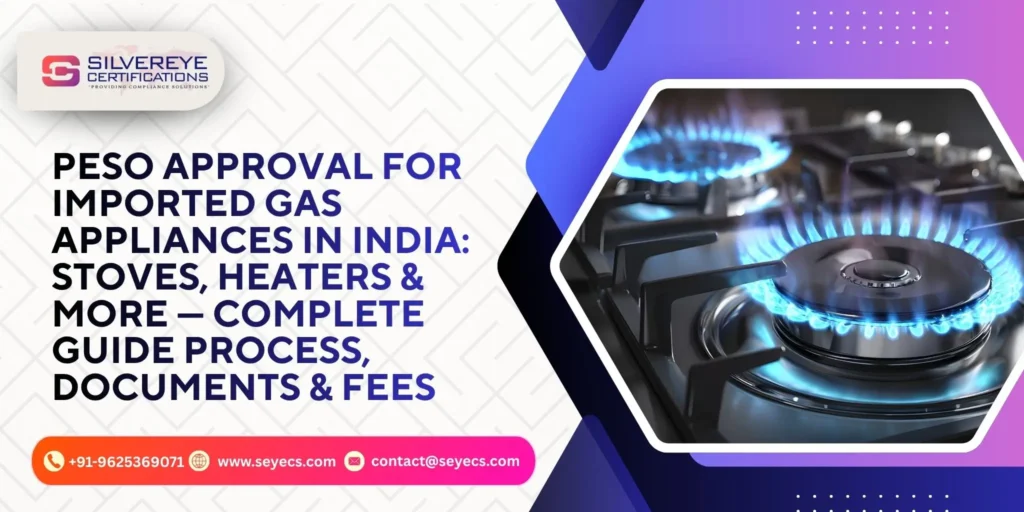
PESO approval for imported gas appliances — stoves, heaters, and geysers — is mandatory in India under the Gas Cylinder Rules, 2016, and the Petroleum Act, 1934. The Petroleum and Explosives Safety Organization (PESO) under DPIIT regulates the import and use of gas appliances that operate on LPG or PNG. Importers must get their products tested against applicable IS standards (such as IS 4246 for stoves and IS 6175 for heaters), obtain BIS certification, and submit an application to PESO. Without this approval, imported gas appliances cannot legally be sold, distributed, or used in India
What is PESO and Why Does It Regulate Gas Appliances?
PESO — the Petroleum and Explosives Safety Organization — is a statutory body under the Department for Promotion of Industry and Internal Trade (DPIIT), Ministry of Commerce and Industry, Government of India. It is headquartered in Nagpur and operates regional offices across the country.
PESO is responsible for administering and enforcing safety regulations related to petroleum, compressed gases, explosives, and pressure vessels in India. This includes setting approval standards for gas appliances that use LPG (liquefied petroleum gas) or PNG (piped natural gas), since these appliances directly interface with flammable gases and pose a significant fire and explosion risk if they are poorly designed or manufactured.
Gas stoves, heaters, geysers, and burners — whether domestically produced or imported — must comply with PESO requirements to ensure they are safe for use in Indian households and commercial establishments. The regulation of gas appliances by PESO is a safety-first framework, not merely a trade formality.
PESO works closely with BIS (Bureau of Indian Standards) on product standards compliance and with state governments on enforcement at the retail and distribution level.
Legal Framework: Gas Cylinder Rules, BIS Act & Petroleum Act
The regulation of imported gas appliances in India is governed by the following key legislations and rules:
- Petroleum Act, 1934 — The foundational legislation authorizing PESO to regulate petroleum and flammable gas products and equipment in India.
- Gas Cylinder Rules, 2016 (as amended) — Specifically governs the design, manufacture, import, testing, filling, and use of gas cylinders and gas appliances connected to them. Rule 11 mandates that all gas appliances meet specified safety standards before use.
- Bureau of Indian Standards (BIS) Act, 2016 — Mandates BIS certification for products listed under the Compulsory Registration Order (CRO) or Quality Control Orders (QCOs), which include gas stoves and related appliances.
- LPG Stoves Quality Control Order, 2020 — Issued by DPIIT, this order makes BIS certification mandatory for domestic LPG stoves (IS 4246) sold or imported in India.
- Foreign Trade Policy (FTP) 2023–2028 — Governs import procedures and conditions for restricted or regulated products, including gas appliances requiring safety approvals.
- Standards of Weights and Measures Act — Governs labelling requirements for gas appliances sold in the Indian retail market.
Which Imported Gas Appliances Need PESO Approval?
Any gas appliance intended for use with LPG cylinders, PNG supply lines, or compressed gas in India requires PESO approval. This includes but is not limited to the following product categories:
| Gas Appliance Type | PESO Approval Required? | Applicable IS Standard |
| LPG cooking stoves / gas burners | Yes — mandatory | IS 4246 |
| Domestic gas ovens (LPG/PNG) | Yes — mandatory | IS 6360 |
| Commercial gas ranges & burners | Yes — mandatory | IS 4246 / IS 15567 |
| Gas space heaters (radiant/convective) | Yes — mandatory | IS 6175 |
| Gas water heaters (geysers) | Yes — mandatory | IS 8395 |
| Gas instantaneous water heaters | Yes — mandatory | IS 8395 |
| Gas barbeque grills (domestic) | Yes — mandatory | IS 4246 |
| Gas room heaters (catalytic) | Yes — mandatory | IS 6175 |
| Industrial gas burners | Yes — mandatory | IS 15567 |
| Portable gas camping stoves | Yes — mandatory | IS 4246 |
Note: Appliances powered by natural gas (CNG/PNG) also fall under PESO purview if they are connected to gas supply infrastructure. Even if an imported appliance has CE marking or UL certification from another country, those approvals do not substitute for PESO approval and BIS certification in India.
PESO Approval vs BIS Certification: What Is the Difference?
Many importers confuse PESO approval with BIS certification. They are distinct regulatory requirements that serve different purposes — and both are typically required for gas appliances.
PESO Approval
- Issued by: Petroleum and Explosives Safety Organization (PESO), Nagpur
- Purpose: Safety clearance for gas appliances to be connected to gas cylinders or piped gas supply in India
- Basis: Compliance with Gas Cylinder Rules 2016 and relevant IS standards
- Who reviews: PESO regional offices and central technical officers
- Output: PESO approval letter / approval number assigned to the appliance model
BIS Certification
- Issued by: Bureau of Indian Standards (BIS), under DPIIT
- Purpose: Product quality and safety certification confirming the product meets the relevant Indian Standard (IS)
- Basis: Third-party testing at NABL-accredited or BIS-recognized laboratory
- Who reviews: BIS product certification division
- Output: BIS license with a Standard Mark (ISI mark) on the product
For most imported gas appliances, both PESO approval and BIS certification are required before sale and distribution. BIS certification is often a prerequisite or accompanying document for PESO approval. In cases where a Quality Control Order (QCO) specifically mandates BIS certification (such as for domestic LPG stoves), BIS certification becomes the primary compliance requirement, with PESO approval as the additional operational clearance.
Eligibility: Who Can Apply for PESO Approval for Imported Gas Appliances?
Indian Importers / Authorized Distributors
- Must be a legally registered business entity in India (company, LLP, or proprietorship)
- Must hold a valid Import Export Code (IEC) issued by DGFT
- Must be authorized by the foreign manufacturer to import and distribute the appliance in India
- Must have a registered office or operational address in India for correspondence with PESO
Foreign Manufacturers Selling Directly
- Foreign manufacturers cannot directly apply for PESO approval — they must appoint an authorized Indian agent or importer who holds an IEC and is responsible for local compliance
- The authorization letter from the foreign principal is a mandatory document for PESO applications
General Eligibility Requirements
- The appliance model must be physically available for inspection or testing if PESO requires it
- The product must be tested at a NABL-accredited or BIS-recognized laboratory as per the applicable IS standard
- The product must not be a banned or restricted import under the Foreign Trade Policy
- The applicant must not have had a previous PESO approval cancelled or suspended for the same or similar product
Documents Required for PESO Approval (Imported Gas Appliances)
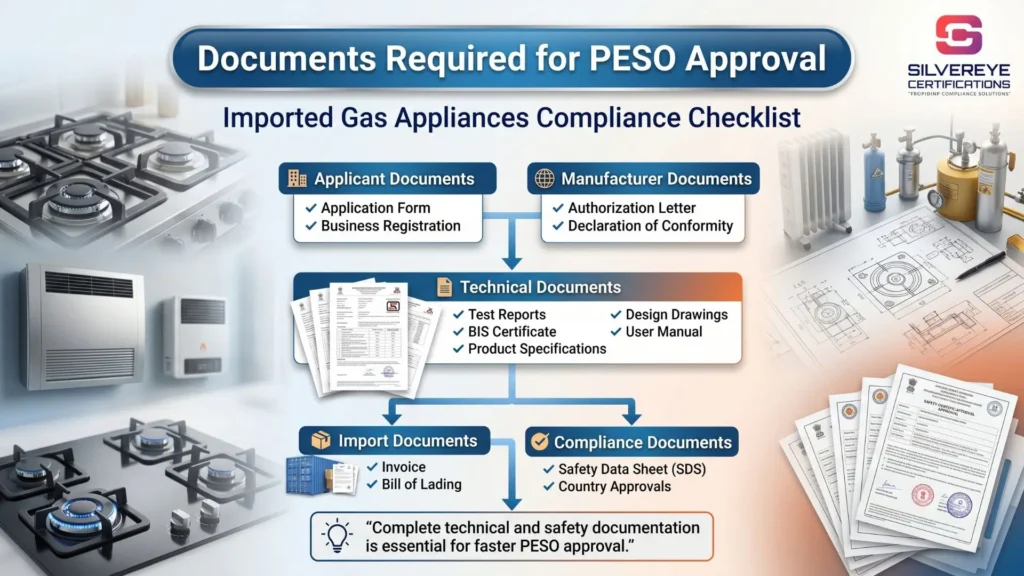
The documentation checklist for PESO approval of imported gas stoves, heaters, and gas appliances is as follows:
| Document | Mandatory? | Notes |
| Application form (PESO prescribed format) | Yes | Online via PESO portal |
| Certificate of Incorporation / Business registration | Yes | Applicant's legal identity |
| Authorization letter from foreign manufacturer | Yes | For importers/agents |
| Test report from BIS-approved / NABL lab | Yes | As per applicable IS standard |
| BIS certification or test certificate | Yes | Mandatory for notified products |
| Product technical specifications / catalogue | Yes | Model-wise details |
| Drawings / design schematics of the appliance | Yes | For PESO review |
| Declaration of conformity from manufacturer | Yes | Signed by authorized signatory |
| Import documents (Bill of Lading / Invoice) | Yes (importers) | For imported appliances |
| Safety data sheet (SDS) for materials used | Conditional | If special materials used |
| User / installation manual (English) | Yes | Must include safety warnings |
| List of countries where product is approved | Conditional | Strengthens application |
All documents must be submitted in English. Foreign-language documents must be accompanied by a certified English translation. Submissions are made through the PESO online portal at peso.gov.in or to the relevant PESO regional office depending on the applicant's location.
Key Document Notes:
- Test Report: Must be from a NABL-accredited laboratory or a laboratory recognized by BIS. Reports from CE or UL labs are not automatically accepted — PESO requires compliance with the relevant Indian Standard.
- Authorization Letter: Must clearly state the Indian importer's name, the appliance models covered, and the territory of authorization. It must be on the foreign manufacturer's official letterhead and signed by an authorized signatory.
- User Manual: Must include safety instructions, gas type compatibility (LPG/PNG), installation instructions, and emergency procedures in English. Vernacular language versions are recommended for Indian market compliance.
Step-by-Step PESO Approval Process for Importers of Gas Appliances
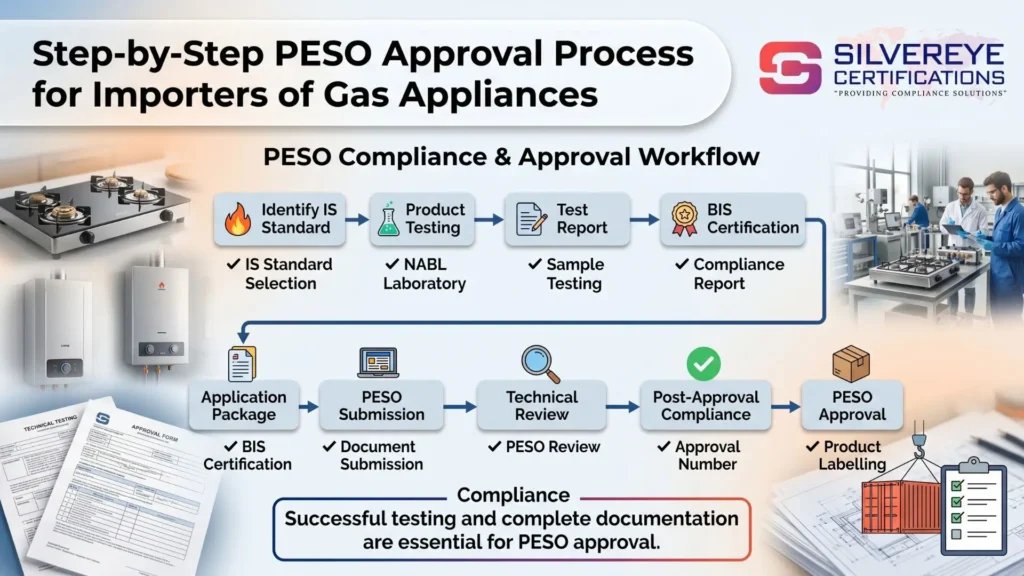
Here is the complete, updated process for obtaining PESO approval for imported gas stoves, heaters, and other gas appliances in India as of 2026:
- Identify applicable IS standard: Determine which IS standard applies to your gas appliance (e.g., IS 4246 for LPG stoves, IS 6175 for gas heaters, IS 8395 for water heaters). This determines the test parameters.
- Select a NABL / BIS-recognized laboratory: Identify an accredited testing laboratory in India that is equipped to test your appliance category against the applicable IS standard.
- Submit product samples for testing: Send representative samples of each appliance model to the selected laboratory. Testing typically covers gas tightness, combustion performance, thermal efficiency, heat input, and safety features.
- Obtain test report: Once testing is complete, the laboratory issues a test report. Ensure it explicitly states compliance with the relevant IS standard and covers all mandatory parameters.
- Apply for BIS certification (if applicable): For appliances covered under a Quality Control Order or Compulsory Registration Order, apply for BIS product certification simultaneously. BIS certification requires factory inspection for Indian manufacturers but may have an alternative pathway for importers.
- Prepare application package: Compile Form PESO (as prescribed), authorization letter from foreign manufacturer, test report, BIS certificate or test certificate, technical specs, drawings, and import documents.
- Submit application to PESO: File the application online via the PESO portal (peso.gov.in) or submit to the regional PESO office. Pay the prescribed application fee.
- PESO technical review: PESO officers review the submitted documents. They may request additional information, product samples, or a physical inspection of the importer's premises.
- Approval issuance: Upon successful review, PESO issues the approval letter with an assigned approval number for the specific appliance model(s). This approval number must be referenced on the product label and in import documentation.
- Post-approval compliance: Mark approved products with the PESO approval number and BIS Standard Mark (if applicable). Maintain records for audit by PESO or BIS inspectors.
Estimated Processing Timeline:
- Laboratory testing: 30 to 60 days (depending on lab workload and product complexity)
- BIS certification: 60 to 90 days (additional for factory inspection if required)
- PESO application review: 45 to 90 days from submission of complete documents
- Total end-to-end (importers): 90 to 180 days for a new product model
Applicable IS Standards for Imported Gas Stoves and Heaters
The following Indian Standards (IS) are most commonly applicable to imported gas appliances requiring PESO approval:
| IS Standard | Appliance Type | Key Requirements Covered |
| IS 4246 | Domestic LPG cooking stoves & gas burners | Gas tightness, heat input, thermal efficiency, safety devices |
| IS 6175 | Gas space & room heaters (LPG/PNG) | Combustion performance, CO emission, flame supervision |
| IS 8395 | Gas water heaters and geysers | Water heating performance, thermostat, pressure relief |
| IS 6360 | Domestic gas ovens and cooking ranges | Oven temperature uniformity, gas safety, door seals |
| IS 15567 | Commercial cooking appliances / burners | Commercial gas use, high BTU burners, industrial safety |
| IS 16176 | Gas appliances — general safety requirements | General design, construction, and safety requirements |
Important: Always verify the current version of the applicable IS standard with BIS before initiating testing, as standards are periodically revised. The applicable IS version at the time of testing is the one that applies to your approval.
Indian Manufacturer vs Importer: Key Differences in PESO Approval Process
| Aspect | Indian Manufacturer | Importer / Foreign Brand |
| Regulatory body | PESO + BIS (DPIIT) | PESO + BIS (DPIIT) |
| Primary law | Gas Cylinder Rules 2016 | Gas Cylinder Rules 2016 + Foreign Trade Policy |
| Test standard compliance | IS standard (tested in India) | IS standard (tested in India or recognized lab) |
| Factory / facility inspection | Yes — mandatory | May be waived; importer's premises inspected |
| Authorization letter needed | No | Yes — from foreign principal |
| BIS certification | Mandatory for notified goods | Mandatory for notified goods |
| Processing time | 60–120 days (typical) | 90–180 days (typical) |
PESO Approval Fees and BIS Certification Costs
The total cost of obtaining PESO approval for imported gas appliances includes PESO application fees, laboratory testing charges, and BIS certification costs. Here is an indicative breakdown:
| Fee Component | Approximate Amount | Remarks |
| PESO application processing fee | As per PESO schedule | Payable online at peso.gov.in |
| BIS product certification fee | Varies by product & lab | Payable to BIS / NABL lab |
| Third-party testing charges (per model) | ₹15,000 – ₹60,000+ | Depends on IS standard & lab |
| Factory inspection fee (if applicable) | As applicable | For manufacturing units |
| Renewal fee (every 3 years) | As per current schedule | Check peso.gov.in for latest |
Note: Fee amounts are subject to revision by PESO and BIS. Always verify the current fee schedule on peso.gov.in and bis.gov.in before applying. Testing costs vary significantly by laboratory, appliance type, and number of models being tested. Engage the laboratory early to get a detailed cost estimate before importing samples.
Validity and Renewal of PESO Approval for Gas Appliances
- PESO approval for gas appliances is typically valid for 3 years from the date of issuance, after which renewal is required.
- Renewal must be applied for before the expiry of the current approval to avoid a lapse. A lapsed approval means the product cannot legally be sold until renewal is granted.
- Any change to the appliance design, materials, gas valve, burner specification, or manufacturer requires a fresh PESO approval or a variation application — continuing to sell a modified product under the original approval is not permitted.
- BIS certifications are typically valid for 1 year for importers and 2–3 years for manufacturers, renewable annually subject to surveillance audits.
- PESO may conduct periodic market surveillance to verify that approved appliances continue to comply with the approved specifications and IS standards.
- Adding new models or variants of an approved appliance family requires a separate PESO application for each new model — approvals are model-specific, not brand-wide.
Benefits of Getting PESO Approval for Imported Gas Appliances
- Legal market access: Enables lawful import, distribution, and sale of gas stoves, heaters, and related appliances across all Indian states.
- Customs clearance: PESO approval number is required for smooth customs clearance — unapproved gas appliances are frequently held or destroyed at Indian ports.
- Retailer and distributor confidence: Large retail chains and distributors require PESO-approved, BIS-certified appliances before listing — approval opens up organized retail and e-commerce channels.
- Consumer trust: The BIS Standard Mark (ISI mark) and PESO approval build consumer confidence, especially in a safety-sensitive product category like gas appliances.
- Insurance and liability protection: Using PESO-approved appliances protects both the importer and the end user in case of gas-related accidents — using unapproved appliances voids standard property and liability insurance.
- Long-term brand equity: PESO approval and BIS certification position your brand as a quality, safety-compliant choice, supporting premium pricing and repeat purchases in the Indian market.
Common Mistakes That Delay PESO Approval for Imported Gas Appliances
- Testing against wrong IS standard: Submitting a test report for an incorrect or outdated IS standard is the single most common reason for PESO rejection. Always verify the applicable standard before testing.
- Using non-recognized laboratory: Test reports from laboratories that are not NABL-accredited or BIS-recognized are not accepted by PESO. Confirm laboratory recognition before sending samples.
- Incomplete authorization letter: Authorization letters that do not specify the exact appliance models, the Indian importer's name, or the period of authorization are routinely rejected.
- Missing BIS certification: Applying for PESO approval without the accompanying BIS certificate (where mandatory under a QCO) leads to automatic deficiency notices.
- No PESO approval number on product label: Importing and selling approved appliances without the PESO approval number on the product label is a compliance violation even after approval is granted.
- Testing a non-representative sample: Testing a pre-production prototype that differs from the mass-produced model in any material way invalidates the test report for the commercial product.
- Not accounting for lead time: Many importers underestimate the 90–180 day timeline and launch sales activities before approval is in hand, creating legal exposure.
Conclusion
PESO approval for imported gas appliances — stoves, heaters, geysers, and burners — is one of the most critical regulatory requirements for anyone looking to enter India's booming kitchen and home appliance market. With over 300 million LPG connections in India and a rapidly growing organized retail sector, the demand for quality, safety-certified gas appliances has never been higher.
Getting your PESO approval right the first time saves months of delay, prevents costly customs holds, and positions your brand as a trusted, compliant choice in the Indian market. Start early, use the right testing laboratory, and ensure your documentation is complete before submitting. In 2026 and beyond, regulatory compliance is not just a legal obligation — it is a competitive advantage.
Frequently Asked Questions
Is PESO approval mandatory for all imported gas stoves and heaters in India
Yes. All gas appliances that connect to LPG cylinders or PNG supply lines — including cooking stoves, room heaters, water heaters, and industrial burners — require PESO approval under the Gas Cylinder Rules, 2016. This applies to both domestically manufactured and imported appliances.
Can I use CE marking or UL certification instead of PESO approval for gas appliances in India?
No. CE marking (European) and UL certification (American) are not substitutes for PESO approval or BIS certification in India. Indian regulations require compliance with Indian Standards (IS) and approval from Indian authorities.
How long does PESO approval take for an imported gas stove?
For importers, the end-to-end process — from laboratory testing to final PESO approval — typically takes 90 to 180 days for a new product model. This includes laboratory testing (30–60 days), BIS certification (if required, 60–90 days), and PESO review (45–90 days).
Do I need a separate PESO approval for each model of gas appliance I import
Yes. PESO approvals are model-specific. If you import multiple models or variants of a gas stove or heater — even from the same manufacturer — each model requires its own PESO approval application and supporting test report.
What IS standard applies to imported LPG cooking stoves?
Imported domestic LPG cooking stoves must comply with IS 4246 (Specification for Domestic Gas Stoves for Use with Liquefied Petroleum Gases). This is also the standard under which BIS certification is mandatory following the LPG Stoves Quality Control Order, 2020.
What happens if I import gas appliances without PESO approval?
Importing, selling, or distributing gas appliances without PESO approval is a violation of the Gas Cylinder Rules, 2016, and the Petroleum Act, 1934. Penalties include product seizure at customs, destruction of goods, cancellation of IEC (Import Export Code), and fines or prosecution against responsible individuals.
Can a foreign manufacturer apply for PESO approval directly without an Indian partner?
No. Foreign manufacturers must appoint an authorized Indian importer or agent who holds a valid Import Export Code (IEC). The Indian entity submits the PESO application, takes regulatory responsibility for the product in India, and is the point of contact for PESO
Is BIS certification the same as PESO approval for gas appliances?
No, they are distinct but complementary. BIS certification confirms the product meets the relevant Indian Standard (IS) in terms of quality and safety parameters. PESO approval is the operational clearance to sell and use gas appliances connected to gas cylinders or pipeline gas in India. For most gas appliances, both are required.
How often does PESO approval need to be renewed?
PESO approval for gas appliances is typically valid for 3 years. Renewal must be applied for before the expiry date. Additionally, any change in the appliance design, gas valve, burner, or manufacturing source requires a fresh PESO application — renewals do not automatically cover modified products.
Where do I submit the PESO approval application for imported gas appliances?
Applications are submitted online through the PESO portal at peso.gov.in or to the relevant PESO regional office based on your registered business location. The Chief Controller of Explosives, PESO, Nagpur, is the central authority. Regional offices in Mumbai, Kolkata, Chennai, and other cities handle applications for their respective jurisdictions.