- LMPC registration is filed on your state's Legal Metrology portal (or the NSWS portal for multi-state operations), not through CDSCO or the customs portal.
- The process runs through five clear stages: portal sign-up, form selection, document upload, fee payment, and certificate download — usually completed in 15–20 working days.
- Choosing the wrong applicant category (importer vs packer vs manufacturer) or the wrong state jurisdiction is the most common reason applications get sent back.
- If you sell in more than one state, you can apply centrally instead of registering separately with every state Legal Metrology office.
Introduction
The LMPC registration process is completed on your state Legal Metrology department's online portal, or through the National Single Window System (NSWS) if you plan to sell across multiple states. In practice, it involves five steps: creating a portal login, selecting your applicant category (importer, packer, or manufacturer), uploading KYC and label documents, paying the prescribed fee, and downloading the certificate once approved.

A complete, correctly filed application is usually cleared in 15 to 20 working days. Most delays happen not because of missing paperwork, but because applicants pick the wrong category or file with the wrong state office.
What Is the LMPC Registration Process?
LMPC registration is not one single national form you fill out once. It is a state-administered process under Rule 27 of the Legal Metrology (Packaged Commodities) Rules, 2011 — meaning each state's Legal Metrology department runs its own portal, though the underlying requirements are largely the same everywhere. If your business sells pre-packaged goods, including imported cosmetics, food items, electronics, or any retail-packed product, in just one state, you apply to that state's Controller of Legal Metrology. If you sell in more than one state, the rules allow you to apply centrally instead of repeating the process state by state.
This is where a lot of importers get stuck — not because the paperwork is complicated, but because they don't know which portal to use, which form applies to them, or how long each stage actually takes. This guide walks through the process the way it plays out in practice, from the first login to the final downloaded certificate.
Before You Start: Single-State vs Multi-State Registration
This decision shapes which portal you use, so it's worth settling first.
| Scenario | Where You Apply | Typical Route |
| You sell/distribute in only one state | That state's Legal Metrology Department portal | State-specific online portal or, in a few states, an in-person filing at the Controller's office |
| You sell/distribute across multiple states | Central registration route | National Single Window System (NSWS) or the central Legal Metrology registration process, depending on current departmental guidance |
| You import through a single Indian entity but distribute pan-India | Central registration route (most common for cosmetic importers) | NSWS portal, since a single certificate then supports customs clearance nationwide |
Most cosmetic and skincare importers end up on the multi-state route, since e-commerce and general trade distribution rarely stay confined to one state. Confirming this before you start saves you from filing on the wrong portal and having to restart.
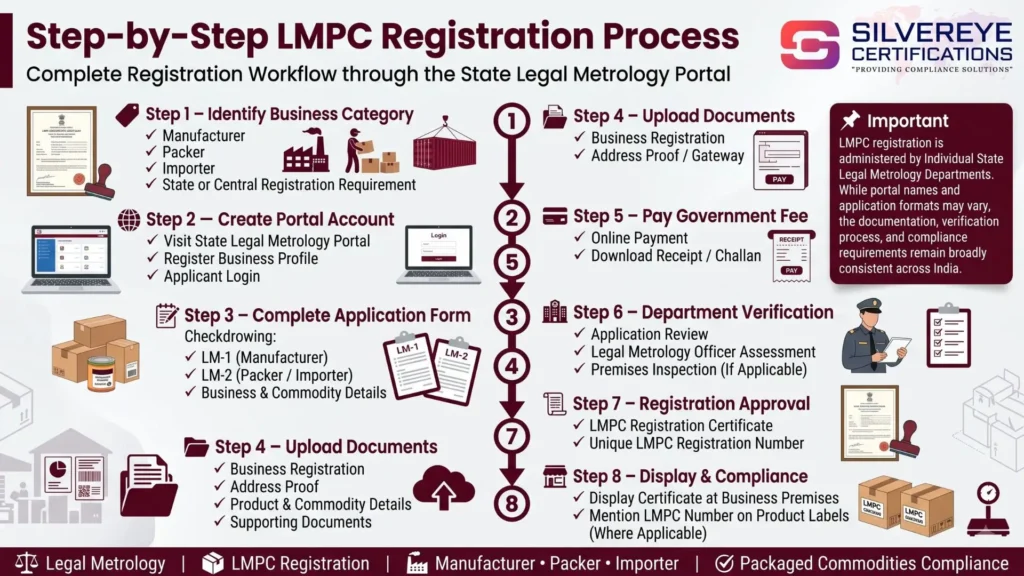
Step-by-Step LMPC Registration Process on the Portal
Step 1: Create Your Portal Login
- Go to your state Legal Metrology department's official website, or the NSWS portal if you're registering centrally.
- Register as a new user with your business email ID, mobile number, and a password — keep these details consistent with your GST and IEC records to avoid mismatch flags later.
- Verify your account through the OTP sent to your email or mobile before proceeding to the application form.
Step 2: Select the Correct Applicant Category
- Choose the category that matches your business activity — Importer, Packer, Manufacturer, or Dealer. Cosmetic importers who bring in finished, pre-packed products almost always fall under 'Importer.'
- If your business also repacks or relabels products within India before sale, you may need to register under 'Packer' as well — check this carefully, since applying under the wrong category is the single biggest reason applications are rejected or delayed.
Step 3: Fill the Application Form
- Enter your business details exactly as they appear on your Certificate of Incorporation, GST certificate, and IEC — small mismatches (like a shortened business name) can trigger manual review.
- Declare all premises used for storage, warehousing, or distribution of the imported products, since the rules require every relevant location to be listed.
- List the product categories you intend to import — for cosmetics, this typically covers skincare, haircare, makeup, and personal care sub-categories.
Step 4: Upload Documents and Label Samples
- Upload identity and business proof: PAN, GST certificate, IEC certificate, and Certificate of Incorporation or partnership deed.
- Upload sample label artwork showing the MRP, net quantity, batch/import details, and 'imported by' declaration exactly as they will appear on the retail pack.
- Upload address proof for each declared premises, and an authorization letter if a consultant or agent is filing on your behalf.
Step 5: Pay the Fee and Submit
- Pay the prescribed government fee through the portal's integrated payment gateway — this is typically a fixed nominal amount, with state-level variation.
- Review the application summary carefully before final submission; most portals do not allow edits once the application is submitted, only clarifications requested by the department.
- Note your application reference number — this is what you'll use to track status and respond to any query raised by the reviewing officer.
Step 6: Track Status and Respond to Queries
- Use the reference number to check application status on the portal periodically; incomplete or unclear applications are typically returned within about 7 working days with specific corrections requested.
- Respond promptly to any department query — label clarifications and address verification are the most common follow-ups for cosmetic importers.
Step 7: Download Your LMPC Certificate
- Once approved, the certificate is generated on the portal and available for download as a digital copy — keep both a digital and printed copy for customs and warehouse records.
- Cross-check the certificate details (business name, address, category, validity dates) against your records immediately; requesting a correction early is far easier than doing it after a shipment is already at port.
How Long Does Each Stage Typically Take?
| Stage | Typical Timeline |
| Portal registration and login setup | Same day |
| Application form filling and document upload | 1–2 days (depending on how ready your documents and label artwork are) |
| Departmental scrutiny of a complete application | 10–15 working days |
| Response window if department raises a query | Adds 5–10 working days, depending on how quickly you respond |
| Certificate issuance after approval | Immediate to a few working days |
| Overall, for a complete and accurate application | 15–20 working days |
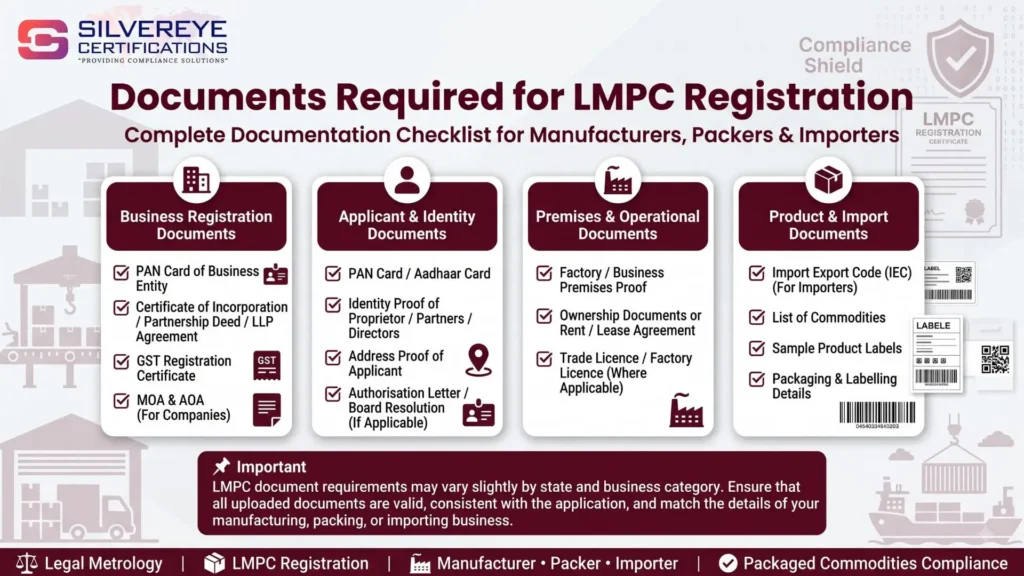
Documents You'll Be Asked to Upload on the Portal
- PAN card and GST registration certificate of the applicant business.
- Import Export Code (IEC) certificate for importers.
- Certificate of Incorporation, partnership deed, or proprietorship proof, depending on your business structure.
- Address proof for every declared business or warehouse premises.
- Sample product label artwork showing all mandatory Legal Metrology declarations.
- Authorization letter if the application is being filed by a consultant or authorized representative.
- Passport-size photograph of the authorized signatory.
Fees You'll Pay on the Portal
| Fee Component | Approximate Amount |
| Government registration fee (importer/manufacturer/packer) | Around ₹500, varies slightly by state |
| Dealer/repairer category fee (where applicable) | Around ₹100 |
| Late filing fee (applying after the permitted window from first import) | Up to ₹5,000, depending on the state |
| Renewal fee | Broadly similar to the original registration fee |
Portal payment is usually integrated (net banking, card, or UPI), so you rarely need a separate challan. Keep the payment receipt generated by the portal — some states ask for it again at the certificate collection or renewal stage.
Validity and Renewal on the Portal
Once issued, your LMPC certificate's validity is shown directly on the document — commonly ranging from 1 to 5 years depending on the issuing state. Track this date the moment your certificate is issued.
- Log back into the same portal account to file a renewal application before the expiry date; most portals retain your earlier submission, so renewal is usually faster than the original filing.
- Update any changed business details — new premises, updated label format, or a changed authorised signatory — as part of the renewal, not after.
- If your certificate has already lapsed, treat the filing as a fresh application; the portal generally does not allow a lapsed certificate to be simply extended.
Common Portal Errors and How to Avoid Them
- Business name mismatch: If your portal profile name doesn't exactly match your GST/IEC records, the system may flag the application for manual review — copy details exactly rather than retyping from memory.
- Wrong applicant category: Selecting 'Manufacturer' when you are only an importer (or vice versa) leads to the application being returned; if you're unsure, 'Importer' is correct for finished, pre-packed cosmetics brought in from abroad without further repacking in India.
- Incomplete premises declaration: Leaving out a warehouse or distribution centre used for the imported goods is a common reason for a query from the department after submission.
- Non-compliant label artwork: Uploading a label draft that doesn't yet show the final MRP, net quantity, and importer declaration in the correct format is one of the most frequent causes of delay.
- Missed application deadline: Filing well after your first import shipment has already landed can trigger a late fee — it's better to start the portal process before your first consignment ships from origin.
Benefits of Getting the Portal Process Right the First Time
- Avoids repeat submissions and the 7–10 day delay each returned application adds to your timeline.
- Keeps your customs clearance timeline predictable, since a valid, portal-issued certificate number supports your Bill of Entry filing.
- Saves on late fees and the cost of shipment holds, which usually far exceed the effort of filing correctly the first time.
- Gives you a clean digital record (application number, payment receipt, certificate) that's easy to produce during any future audit or marketplace compliance check.
How Silvereye Certifications Can Help
Even with the process laid out step by step, the portal experience varies from state to state — form fields, upload formats, and even the applicant categories are not identical everywhere. Silvereye Certifications, a Noida-based regulatory compliance consultancy, handles LMPC registration filings on behalf of importers and brands, alongside related approvals like CDSCO cosmetic registration, BIS certification, and EPR authorization.
The team reviews your label artwork and business documents against the specific state portal's requirements before submission, so the application goes in clean the first time instead of bouncing back for corrections. For businesses filing across multiple states or through the NSWS route, this kind of hands-on portal experience is often what keeps the registration timeline on track.
Conclusion
The LMPC registration process itself isn't complicated once you know which portal to use and which applicant category fits your business — the real challenge is usually the small details: matching business names across documents, declaring every premises, and getting the label artwork format right before you upload it. Get those details right, and a complete application typically clears in 15 to 20 working days without a single back-and-forth with the department.
If you're preparing your first LMPC filing, or expanding into new states and product categories, it's worth having your documents and label artwork reviewed before you start the portal application, not after a query comes back. Silvereye Certifications can guide you through the correct portal, the right applicant category, and a clean first submission, so your registration — and your shipments — keep moving without avoidable delays.
Frequently Asked Questions
Which portal do I use for LMPC registration?
You apply through your state Legal Metrology department's official portal if you sell in only one state, or through the National Single Window System (NSWS) if your products are sold across multiple states.
Do I need a separate LMPC registration for each state I sell in?
Not necessarily. If you distribute across multiple states, you can register centrally instead of filing separately with every state's Legal Metrology department.
What applicant category should a cosmetic importer choose on the portal?
Most cosmetic importers bringing in finished, pre-packed products should register under the 'Importer' category. If you also repack or relabel goods within India, you may additionally need the 'Packer' category.
How long does the LMPC portal process take from start to finish?
For a complete, accurately filed application, the process typically takes 15 to 20 working days. Incomplete applications are usually returned within about 7 working days with corrections needed.
What documents does the portal ask me to upload?
Typically PAN, GST certificate, IEC certificate, incorporation/partnership proof, address proof for each premises, sample label artwork, and an authorization letter if filed through a consultant.
Can I edit my application after submitting it on the portal?
Generally, no. Most state portals lock the application after submission, allowing only responses to specific department queries rather than open edits.
What happens if the department raises a query on my application?
You'll be notified through the portal and need to respond with the requested clarification or corrected document, usually within a set window. This typically adds 5–10 working days to your timeline.
How do I pay the LMPC registration fee online?
Most state portals and the NSWS have an integrated payment gateway supporting net banking, cards, or UPI, so you can pay directly during the application submission step.
How do I download my LMPC certificate once approved?
Once your application is approved, the certificate becomes available for download directly from your portal account under your application or dashboard section.
Can I renew my LMPC certificate through the same portal account?
Yes. Renewal is generally filed through the same portal login used for the original registration, and it's usually faster since much of your business information is already on record.