
Compliance for Handmade Candles can include a GMP License for Handmade Candles, which focuses on:
- Maintaining hygienic and controlled manufacturing conditions.
- Proper handling and storage of wax, fragrances, dyes, and other raw materials.
- Following consistent and documented candle manufacturing processes.
- Conducting appropriate quality checks and batch controls.
- Maintaining records to support product quality and consistency.
- Demonstrating adherence to Good Manufacturing Practices (GMP).
- Building customer and buyer confidence in handmade candle production.
- Supporting credibility with retailers, marketplaces, and export buyers.
Introduction
Compliance for Handmade Candles is becoming increasingly important as candle businesses move from small-scale home production to organized manufacturing, retail, e-commerce, and export markets. Customers and business buyers are not only interested in the appearance and fragrance of candles but also in the consistency, quality, and reliability of the products they purchase. Maintaining proper manufacturing practices can therefore help candle brands establish a more professional and trustworthy production system.
A GMP License for Handmade Candles provides a structured framework based on Good Manufacturing Practices (GMP). It focuses on maintaining hygienic production conditions, controlling manufacturing processes, handling raw materials appropriately, and maintaining consistent product quality. For handmade candle manufacturers, this can include proper storage and handling of waxes, fragrances, dyes, containers, and other production materials, along with suitable quality-control procedures and production records.
GMP certification can be particularly useful for handmade candle businesses that want to demonstrate that their manufacturing processes are organized, controlled, and consistently maintained. It can also support a brand's credibility when dealing with retailers, distributors, marketplaces, corporate buyers, or international customers who may request evidence of structured quality practices.
Understanding GMP requirements for handmade candles, the certification process, documentation, manufacturing controls, and quality practices can help businesses prepare effectively and build a more consistent production system.
What Is a GMP License for Handmade Candles?
Good Manufacturing Practices (GMP) are a set of practices designed to help businesses maintain consistent manufacturing, hygiene, quality control, and proper documentation. For handmade candle businesses, GMP-based practices can help ensure that raw materials such as wax, fragrance oils, dyes, and wicks are properly stored, handled, and used during production.
A GMP certification for handmade candles is generally obtained through a third-party certification or conformity-assessment body, depending on the specific GMP standard or certification scheme being offered. The assessment may review the manufacturer's production area, hygiene practices, raw-material storage, manufacturing procedures, quality checks, batch records, product identification, and documentation.
It is important to understand that India does not currently have a dedicated central government “GMP License for Candles” specifically mandated for handmade candle manufacturers. Therefore, businesses should distinguish between a voluntary GMP certification and a statutory government licence. The exact scope, standard, audit requirements, and certificate issued depend on the certification body and the applicable certification scheme.
For a handmade candle business, implementing GMP-based controls can provide a more structured and documented manufacturing process. This may include maintaining Standard Operating Procedures (SOPs), recording production batches, controlling the handling of raw materials, maintaining suitable workplace conditions, conducting quality checks, and keeping relevant manufacturing records.
Benefits of GMP Certification For Handmade Candles
Many handmade candle businesses begin on a small scale without formal certification, particularly when selling directly to local customers or through personal networks. As a business expands into e-commerce, retail, B2B sales, corporate gifting, or export markets, buyers may place greater importance on documented quality and manufacturing practices. A GMP certification can help demonstrate that a candle manufacturer follows structured procedures for production, hygiene, quality control, and documentation.
| Benefit | What It Can Help With |
| Buyer Trust | Provides documented evidence of controlled manufacturing practices, helping customers and business buyers understand how products are made and quality is maintained. |
| Marketplace & B2B Onboarding | Can support vendor onboarding and buyer evaluations where a quality certificate or documented manufacturing system is requested. Requirements vary by marketplace and buyer. |
| Export Readiness | Can help demonstrate structured quality-management practices when overseas buyers or importers request certification or supporting manufacturing documentation. |
| Consistent Product Quality | Standardised SOPs and production records can help improve consistency in areas such as wax handling, fragrance measurement, pouring, curing, and finished-product inspection. |
| Safety & Documentation | Documented procedures for handling hot wax, fragrance materials, dyes, and production equipment can support a more organised approach to manufacturing and workplace practices. |
| Brand Positioning | Where accurately represented, GMP certification can demonstrate a commitment to organised manufacturing and quality practices, helping a brand present itself more professionally. |
Who Should Apply for a GMP License?
There's no size cut-off that legally forces a candle maker into GMP certification, so this is really a business-stage decision. Based on how certification bodies scope candle audits, you're a strong candidate if any of the following apply to you:
- You sell on Amazon, Flipkart, Meesho, or a similar marketplace and want a quality badge that supports premium pricing
- You supply or want to supply hotels, spas, event planners, or corporate-gifting companies
- You're preparing to export handmade candles, or an overseas buyer has already asked for quality documentation
- You've scaled from a hobby set-up to a dedicated workshop with multiple staff handling wax and fragrance
- You use fragrance oils, essential oils, or dyes and want documented proof of safe handling and consistent dosing
- You've had recurring quality complaints (frosting, tunnelling, weak scent throw, uneven burn) and want a structured fix, not guesswork
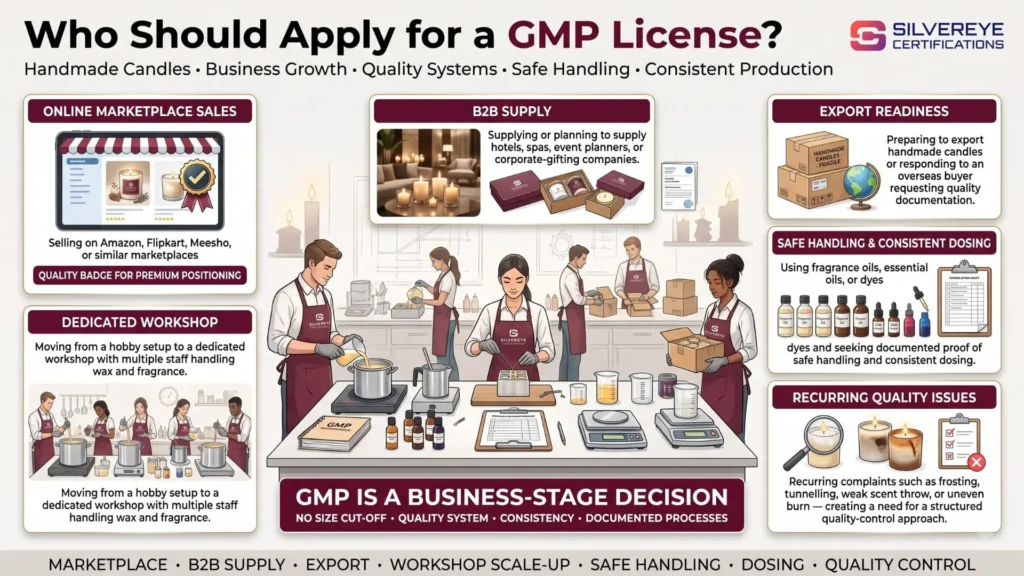
If you're a very early-stage home seller doing a handful of orders a month with no marketplace or B2B ambitions, GMP certification can usually wait — the cost and audit effort are better invested once volume and buyer expectations justify it.
Documents Required for GMP Certification
Certification bodies vary slightly in their exact checklist, but for a handmade candle unit, the documentation typically falls into these categories:
| Category | Typical Documents |
| Business proof | Business registration / Udyam (MSME) certificate, GST registration, PAN, address proof of the manufacturing unit |
| Facility details | Workshop layout plan, photographs of the melting, pouring, curing, and packing areas, fire-safety arrangement for wax heating equipment |
| Raw material records | Invoices and safety data sheets (SDS) for wax, fragrance oils, essential oils, dyes, wicks, and containers sourced from suppliers |
| Standard Operating Procedures | Written SOPs for wax melting temperature control, fragrance blending ratios, pouring, cooling/curing time, wick-centring, quality inspection, and packaging |
| Batch & traceability records | Batch numbering system, production log sheets, and a sample of finished-goods labels showing batch code and manufacturing date |
| Staff & hygiene records | Basic staff training records on hot-wax handling and hygiene, cleaning schedule for equipment and workspace |
| Sample product | One or more finished candle samples from a recent batch, for the auditor's physical inspection |
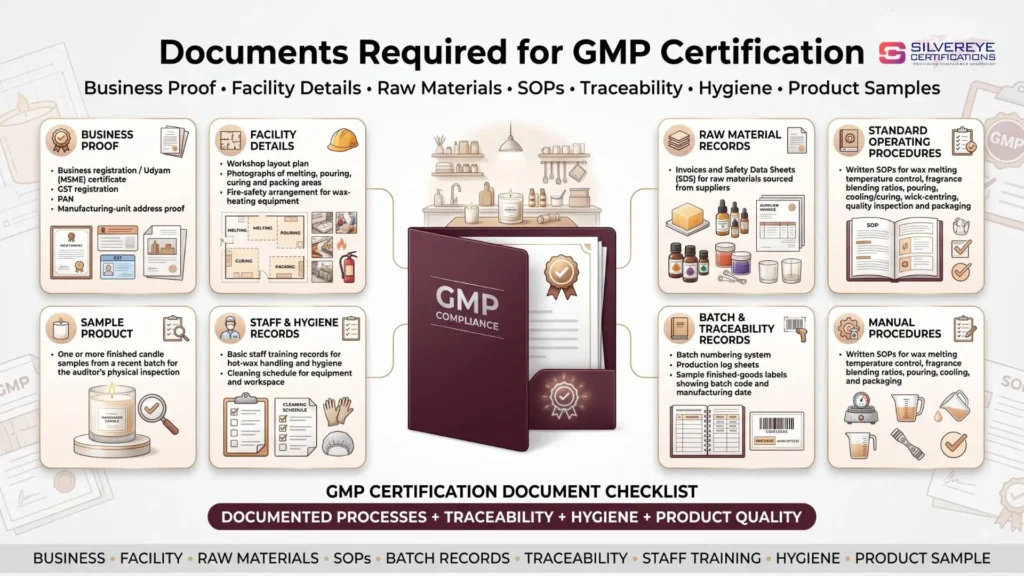
Most first-time applicants don't have all of this ready-made — that's normal. A large part of the certification timeline is spent writing SOPs and setting up a basic batch-log system rather than waiting on the auditor.
Step-by-Step GMP Certification Process for Candle Makers
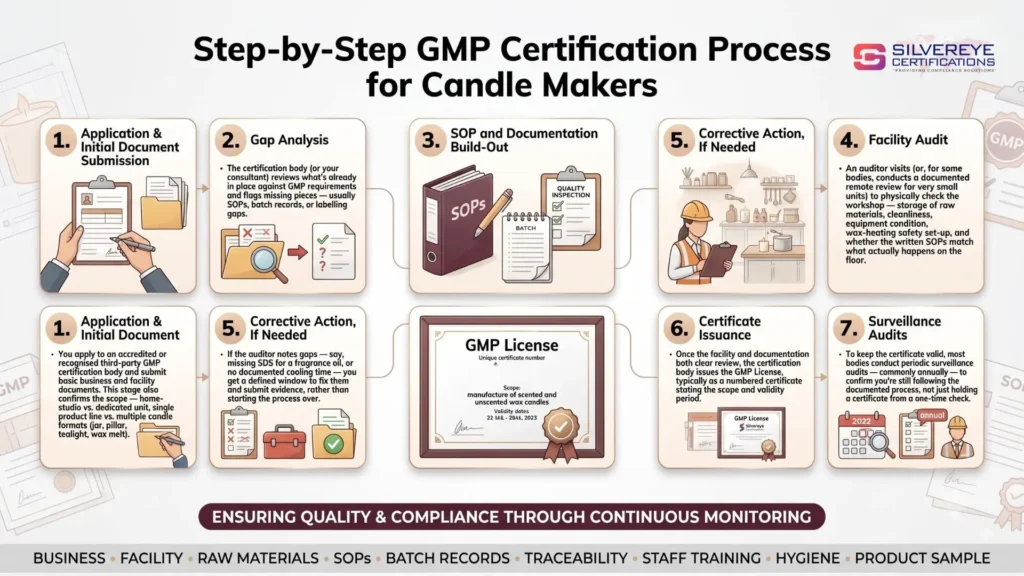
Step 1: Application and Initial Document Submission
You apply to an accredited or recognised third-party GMP certification body and submit basic business and facility documents. This stage also confirms the scope — home-studio vs. dedicated unit, single product line vs. multiple candle formats (jar, pillar, tealight, wax melt).
Step 2: Gap Analysis
The certification body (or your consultant) reviews what's already in place against GMP requirements and flags missing pieces — usually SOPs, batch records, or labelling gaps. This is the stage where most of the actual preparation work happens.
Step 3: SOP and Documentation Build-Out
You draft or finalise SOPs for each production stage, set up a batch-numbering and log system, and prepare your quality-inspection checklist. For most small candle units, this is the longest step in the process.
Step 4: Facility Audit
An auditor visits (or, for some bodies, conducts a documented remote review for very small units) to physically check the workshop — storage of raw materials, cleanliness, equipment condition, wax-heating safety set-up, and whether the written SOPs match what actually happens on the floor.
Step 5: Corrective Action, If Needed
If the auditor notes gaps — say, missing SDS for a fragrance oil, or no documented cooling time — you get a defined window to fix them and submit evidence, rather than starting the process over.
Step 6: Certificate Issuance
Once the facility and documentation both clear review, the certification body issues the GMP License, typically as a numbered certificate stating the scope (e.g., "manufacture of scented and unscented wax candles") and validity period.
Step 7: Surveillance Audits
To keep the certificate valid, most bodies conduct periodic surveillance audits — commonly annually — to confirm you're still following the documented process, not just holding a certificate from a one-time check.
GMP Certification Fees for Handmade Candle Businesses
The cost of GMP certification for handmade candles is not fixed by the Government of India. The certification fee is generally determined by the certification body based on the type of candle products, number of product variants, manufacturing process, facility size, audit scope, and documentation requirements.
| Candle Product / Business Scope | Factors Affecting Certification Cost |
| Basic Handmade Candles – Jar, pillar, tealight and votive candles | Product range, manufacturing process and facility assessment |
| Scented & Fragrance Candles | Number of fragrances, formulations, raw materials and production controls |
| Decorative & Specialty Candles | Product variations, materials, colours, shapes and manufacturing complexity |
| Multiple Candle Formats | Number of SKUs, product categories and overall certification scope |
| Premium / D2C Candle Brands | Documentation, quality-control procedures, facility requirements and audit scope |
| Large-Scale Candle Manufacturing | Production capacity, facility size, multiple product lines and audit requirements |
| GMP Documentation & SOP Support | Number of SOPs, quality documents and level of implementation support |
| Renewal / Surveillance Audit | Certification validity, audit scope and requirements of the certification body |
Note: GMP certification fees for handmade candles are not governed by a standard government tariff. The final fee is quoted by the selected certification body after reviewing the product range, manufacturing facility, documentation and certification scope.
Validity, Renewal & Timeline
| Aspect | Typical Range for Candle Units |
| Processing timeline | 15–45 days for a well-prepared small unit; longer if SOPs and records need to be built from scratch |
| Certificate validity | 1–3 years, depending on the issuing body's policy |
| Surveillance audit frequency | Typically annual, sometimes half-yearly for larger units |
| Renewal effort | Lighter than the first certification if SOPs and batch records have been maintained consistently |
The single biggest factor that speeds up or slows down your timeline is documentation readiness. A candle unit that walks in with SOPs, batch logs, and SDS sheets already organised can often clear certification in under three weeks; one starting from zero paperwork should budget closer to six to eight weeks.
What Does a GMP Auditor Check in a Candle Manufacturing Unit?
Because candle manufacturing involves hot wax, fragrance oils, open-flame risks, and container safety, auditors typically review GMP hygiene practices and product-specific controls, including:
- Wax storage away from direct sunlight and contamination sources
- Temperature control and monitoring during melting and fragrance addition
- Fragrance oil dosing accuracy according to your stated SOP percentage
- Wick-centering and container compatibility checks before pouring
- Curing and cooling time before batch inspection and packing
- Container and label accuracy — net weight, burn-time warning, fire-safety caution, batch code, and manufacturing date
- Housekeeping — spill control, pest management, and overall workspace cleanliness
- Staff awareness of hot-wax handling safety and basic hygiene practices
Get GMP Certification for Your Candle Business
Silvereye Certifications helps handmade candle brands prepare for GMP certification with practical documentation and audit support. From SOP preparation and documentation to facility audit coordination and renewal support, we help you understand and complete the required steps.
Whether you are preparing for marketplace onboarding, B2B compliance requirements, or export opportunities, our team can assess your business and guide you through the certification process.
Frequently Asked Questions
Is a GMP License mandatory for handmade candle makers in India?
No. There is no single government mandate requiring candle makers to hold a GMP License. It's a voluntary, third-party quality certification that becomes practically important once you sell through marketplaces, supply B2B buyers, or export.
Who issues the GMP certificate for candle businesses?
Accredited third-party certification bodies issue it, following the same GMP framework used for cosmetic and small-batch FMCG manufacturing, scoped to candle-specific production steps.
How long does GMP certification take for a small candle unit?
Typically 15–45 days for a reasonably prepared unit. Timelines stretch if SOPs, batch records, and safety data sheets need to be created from scratch.
What is the validity period of a GMP License for candles?
Most certification bodies issue it for 1–3 years, with periodic surveillance audits (commonly annual) required to keep it active.
Can a home-based candle business apply for GMP certification?
Yes. Many certification bodies certify home-based or micro units, scoping the audit to the size and layout of the actual workspace rather than requiring a factory-style facility.
Does GMP certification cover the fragrance oils and dyes used in candles?
It covers how you source, store, and dose them — including whether you maintain safety data sheets and follow a documented dosing SOP — rather than testing the fragrance oil itself.
What happens during a GMP facility audit for candle manufacturing?
An auditor reviews your documentation and physically inspects the workshop — storage, temperature control, wick-centring, curing time, labelling, and housekeeping — to confirm practice matches your written SOPs.
Is GMP certification required to sell candles on Amazon or Flipkart?
It's generally not a blanket requirement for every seller, but it strengthens your seller profile and is increasingly requested for premium listings, brand registry, or B2B/bulk selling programmes.
What's the difference between a GMP License and other quality certifications for candles?
GMP focuses specifically on manufacturing process control — hygiene, SOPs, batch traceability — rather than broader business management systems, which is why buyers often treat it as more directly relevant to a hands-on product like candles.
Do I need GMP certification to export handmade candles?
It isn't a customs requirement by itself, but many overseas buyers and import agents ask for it as proof of consistent, documented manufacturing before placing orders.
What documents are needed for GMP certification renewal?
Updated batch and production records, any revised SOPs, current fragrance/dye safety data sheets, and evidence from your most recent surveillance audit, if applicable.
Can a GMP certificate be cancelled or suspended?
Yes. If a surveillance audit finds you've stopped following your documented SOPs or safety practices, the certification body can suspend or withdraw the certificate until corrective action is completed.