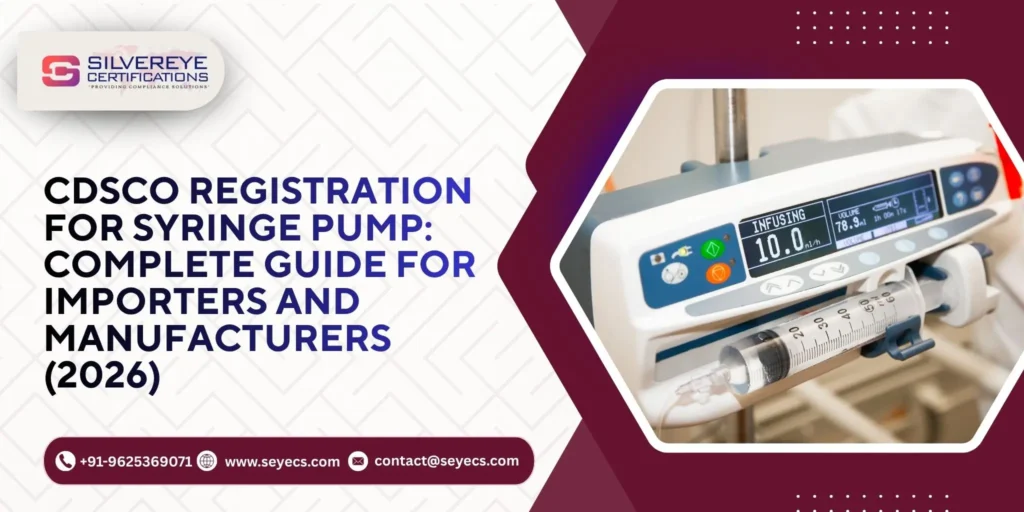
- Syringe pumps are regulated as medical devices under MDR 2017 — classified as Class C or Class D based on clinical use and patient risk, with CDSCO central approval mandatory.
- Importers must file Form MD-14 and obtain an MD-15 import license from CDSCO before clearing any syringe pump shipment at Indian customs.
- Domestic manufacturers of Class C/D syringe pumps must file Form MD-7 and obtain an MD-9 manufacturing licence approved centrally by CDSCO — not the State Licensing Authority.
- Wholesale distributors need a separate MD-41 application and MD-42 wholesale license from the State Licensing Authority before supplying syringe pumps in India.
Introduction
CDSCO registration for syringe pumps is mandatory under India's Medical Devices Rules (MDR), 2017. Syringe pumps are classified as Class C or Class D medical devices depending on their intended clinical use. Importers file Form MD-14 and receive an MD-15 import license from CDSCO. Manufacturers of Class C/D syringe pumps file Form MD-7 and receive an MD-9 license. Wholesale distributors apply via MD-41 and receive an MD-42 license from the State Licensing Authority. All central license applications are filed through the CDSCO Sugam portal.
What Is a Syringe Pump and Why Does CDSCO Regulate It?
A syringe pump is a precision medical device that delivers controlled volumes of fluid, medication, or nutrition directly into a patient's bloodstream or body cavity at a programmed flow rate. By driving the plunger of a syringe at a controlled speed, these devices ensure that highly potent drugs — including anaesthetics, vasopressors, chemotherapy agents, insulin, and anticoagulants — are administered accurately over time.
Because errors in infusion rate or volume can cause serious patient harm, including drug overdose, underdose, or air embolism, syringe pumps are classified as high-risk medical devices in India. The Central Drugs Standard Control Organization (CDSCO), operating under the Drugs and Cosmetics Act, 1940 and the Medical Devices Rules, 2017 (MDR 2017), brings all syringe pumps under mandatory registration and licensing before they can be legally imported, manufactured, or sold in the Indian market.
CDSCO registration for syringe pumps ensures that every device used in Indian hospitals, ICUs, operation theatres, and home care settings meets verified safety, performance, and quality standards.
Medical Device Classification Under MDR 2017: Class A, B, C, and D
MDR 2017 classifies all medical devices into four risk-based classes. The classification drives the entire regulatory pathway — which authority approves the license, what documents are required, and how long the process takes.
| Class | Risk Level | Regulatory Authority | Licence Forms |
| Class A | Low risk | State Licensing Authority (SLA) | MD-3 (mfg) / MD-5 (licence) |
| Class B | Low-moderate risk | State Licensing Authority (SLA) | MD-3 (mfg) / MD-5 (licence) |
| Class C | Moderate-high risk | CDSCO (Central) | MD-7 (mfg) / MD-9 (licence); MD-14/MD-15 (import) |
| Class D | High risk | CDSCO (Central) | MD-7 (mfg) / MD-9 (licence); MD-14/MD-15 (import) |
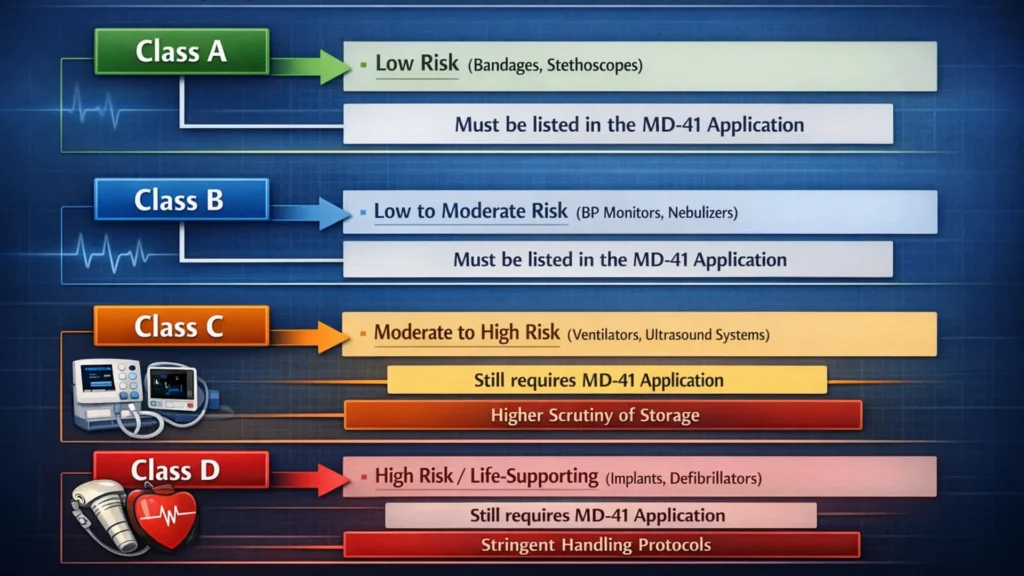
| Note: The vast majority of syringe pumps — including standard infusion syringe pumps, ICU syringe drivers, PCA pumps, and chemotherapy pumps — are classified as Class C or Class D. This means their licenses are approved centrally by CDSCO, not by the State Licensing Authority. |
Syringe Pump Classification Under CDSCO MDR 2017: Class A, B, C, and D
CDSCO classifies syringe pumps and related infusion devices under the Medical Devices Rules, 2017 Third Schedule. Classification is determined by intended clinical use, degree of patient contact, whether the device is active or passive, and the potential risk to the patient if the device fails or malfunctions.
Class A Syringe Pump Related Devices — Low Risk
Class A covers basic, non-powered, non-invasive accessories with minimal patient risk. Standalone syringe pumps are not Class A, but certain ancillary accessories and non-powered consumables used alongside syringe pump systems may fall here.
| CLASS A — Low Risk Syringe Pump Accessories | |||
| Device / Accessory | Typical Use | Patient Contact | Regulated By |
| Syringe pump pole clamps / mounting brackets | Securing pump to IV pole or rail | None — indirect | State Licensing Authority |
| Non-sterile syringe pump carry bags / cases | Transport and storage of pump | None | State Licensing Authority |
| Manual syringe barrel holders (non-motorised) | Manual fluid administration aid | Indirect | State Licensing Authority |
| Basic reusable syringe holders (no drive mechanism) | Positioning syringes for gravity flow | Indirect | State Licensing Authority |
Class B Syringe Pump Related Devices — Low to Moderate Risk
Class B includes devices with slightly elevated risk profiles — typically non-powered gravity infusion accessories, basic manual infusion aids, and simple fluid delivery components that do not directly drive or programme drug delivery rates.
| CLASS B — Low to Moderate Risk Syringe and Infusion Accessories | |||
| Device / Accessory | Typical Use | Patient Contact | Regulated By |
| Gravity infusion sets (non-electronic) | Basic IV fluid administration by gravity | Indirect — vascular | State Licensing Authority |
| Burette infusion sets | Measured-volume gravity infusion, paediatric use | Indirect — vascular | State Licensing Authority |
| Sterile infusion tubing sets (non-pump specific) | IV fluid delivery without electronic pump | Indirect — vascular | State Licensing Authority |
| Non-return valves / anti-reflux valves for infusion lines | Preventing backflow in IV lines | Indirect — vascular | State Licensing Authority |
| Needleless connectors for infusion systems | Safe IV access without needle | Indirect — vascular | State Licensing Authority |
| Luer lock / luer slip syringes (standard medical grade) | Fluid withdrawal and manual injection | Short-term patient contact | State Licensing Authority |
Class C Syringe Pumps — Moderate to High Risk
Class C is the primary classification for the vast majority of syringe pumps used in Indian hospitals and clinical settings. These are active, motorised, programmable devices that directly control the rate and volume of medication delivery into patients. Any malfunction — such as a free-flow error, incorrect rate delivery, or occlusion failure to alarm — can cause serious patient harm. CDSCO approves all import and manufacturing licences for Class C syringe pumps centrally.
| CLASS C — Moderate to High Risk Syringe Pumps (CDSCO Regulated) | |||
| Syringe Pump Type | Clinical Application | Key Feature | Regulated By |
| Standard Hospital Syringe Pump | ICU, ward-based continuous drug infusion | Programmable rate and volume, occlusion alarm | CDSCO (Central) |
| Dual-Channel Syringe Pump | Simultaneous delivery of two drugs | Two independent drive channels in one unit | CDSCO (Central) |
| Multi-Channel Syringe Pump | Multiple concurrent drug infusions | 3–8 independent channels, modular design | CDSCO (Central) |
| Neonatal / Paediatric Syringe Pump | Drug delivery in neonates and children | Ultra-low flow rates (0.1 ml/hr or less), small-volume precision | CDSCO (Central) |
| Anaesthesia Syringe Pump / TCI Pump | Anaesthetic drug infusion in OT | Target Controlled Infusion (TCI) algorithms | CDSCO (Central) |
| Patient-Controlled Analgesia (PCA) Pump | Post-operative self-administered pain relief | Patient demand bolus + continuous basal rate | CDSCO (Central) |
| Ambulatory Syringe Pump | Outpatient / home care infusion therapy | Lightweight, portable, battery-operated | CDSCO (Central) |
| Enteral Feeding Syringe Pump | Tube feeding — nasogastric / PEG route | Designed for enteral nutrition delivery | CDSCO (Central) |
| Epidural Infusion Pump (syringe-based) | Epidural anaesthesia and pain management | High-pressure occlusion detection, low flow | CDSCO (Central) |
| Insulin Infusion Pump (external, hospital-grade) | Continuous insulin therapy — ICU / DKA | Precision micro-delivery of insulin solutions | CDSCO (Central) |
| Chemotherapy Syringe Pump | Cytotoxic drug infusion in oncology | Chemical-resistant components, closed system compatibility | CDSCO (Central) |
| Anti-thrombolytic / Heparin Infusion Syringe Pump | Continuous anticoagulant therapy | Precise low-volume delivery with dose error reduction | CDSCO (Central) |
| Veterinary Syringe Pump | Drug infusion in animals | Adapted flow ranges for veterinary clinical use | CDSCO (Central) |
| Smart Syringe Pump with Drug Library | ICU / critical care with dose safety features | Integrated drug library, soft and hard dose limits | CDSCO (Central) |
| Wireless / Network-Connected Syringe Pump | Hospital-wide infusion management | LAN/Wi-Fi connectivity, EMR/EHR integration | CDSCO (Central) |
Class D Syringe Pumps — High Risk
Class D syringe pumps are the highest-risk category — devices used in life-critical situations where device failure directly endangers patient life. These include implantable drug delivery systems and pumps used in intensive cardiac, neurological, or neonatal life support contexts where a dosing error or mechanical failure could be immediately fatal.
| CLASS D — High Risk Syringe Pumps (CDSCO Regulated) | |||
| Syringe Pump Type | Clinical Application | Key Feature | Regulated By |
| Implantable Drug Delivery Pump (syringe-based mechanism) | Long-term intrathecal / intraspinal drug delivery | Surgically implanted, refillable reservoir | CDSCO (Central) |
| Intrathecal Baclofen Infusion Pump | Spasticity management via spinal drug delivery | Programmable implanted pump, continuous spinal infusion | CDSCO (Central) |
| Neonatal Life-Critical Infusion Syringe Pump | Drug delivery in critically ill neonates on life support | Sub-0.1 ml/hr precision, integration with ventilator / monitor alarms | CDSCO (Central) |
| Intra-Aortic Balloon Pump (IABP) Drive System | Cardiac assist during cardiogenic shock | Synchronised counterpulsation — directly life-supporting | CDSCO (Central) |
| High-Pressure Contrast Media Injector (syringe-based) | Intravascular contrast injection during angiography / CT | High-pressure delivery into vascular system | CDSCO (Central) |
| Closed-Loop Insulin Delivery System (Artificial Pancreas component) | Automated insulin delivery integrated with CGM | Algorithm-controlled, closed-loop feedback — life-critical | CDSCO (Central) |
CDSCO License Forms for Syringe Pumps: Quick Reference
| Activity | Application Form | Licence / Grant Form | Issued By | Device Class |
| Import of syringe pumps | MD-14 | MD-15 | CDSCO (Central) | All classes (A–D) |
| Wholesale distribution | MD-41 | MD-42 | State Licensing Authority | All classes (A–D) |
| Manufacturing — Class A / B | MD-3 | MD-5 | State Licensing Authority | Class A & B |
| Manufacturing — Class C / D | MD-7 | MD-9 | CDSCO (Central) | Class C & D |
| Note: Since nearly all clinical syringe pumps are Class C or Class D, both import (MD-14/MD-15) and manufacturing (MD-7/MD-9) licenses are approved by CDSCO centrally. The State Licensing Authority is relevant only for Class A/B accessories and for wholesale (MD-41/MD-42) licenses across all classes. |
MD-14 Application: Import License for Syringe Pumps in India
Any Indian entity that imports syringe pumps from an overseas manufacturer for commercial sale, distribution, demonstration, or clinical use in India must hold a valid CDSCO import license in Form MD-15, obtained by filing a Form MD-14 application.
Who Must File Form MD-14?
- Indian importers and distributors importing finished syringe pumps from overseas OEMs
- Indian subsidiaries of foreign medical device manufacturers
- Authorized Indian Representatives (AIR) acting on behalf of foreign principals
- Entities importing syringe pump accessories classified as notified medical devices
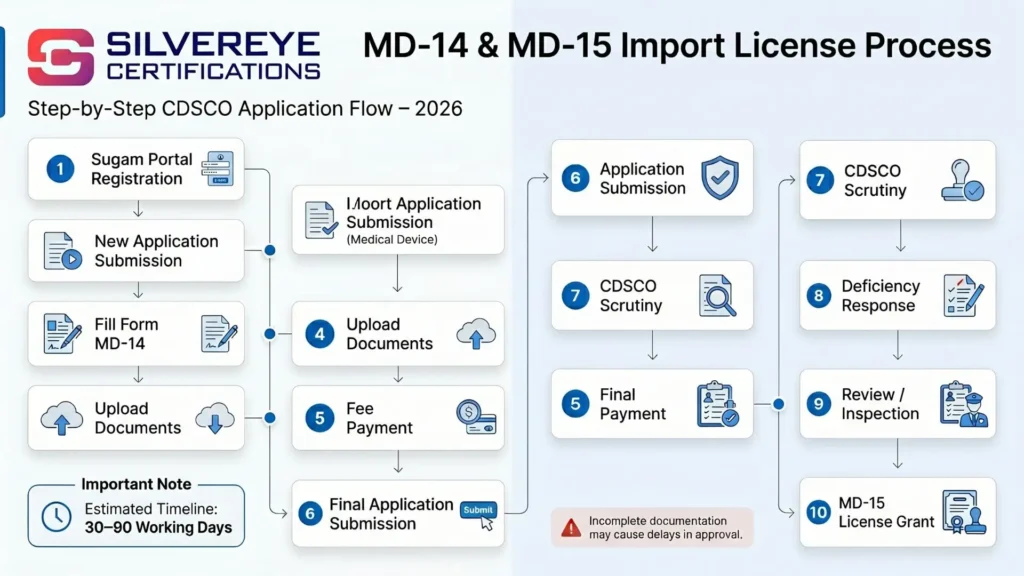
MD-14 Step-by-Step Application Process
- Register on the CDSCO Sugam portal as an importer entity
- Appoint an Authorized Indian Representative (AIR) if the overseas manufacturer has no Indian subsidiary
- Classify the syringe pump under MDR 2017 Third Schedule — confirm Class C or D
- Ensure the device holds a valid international regulatory approval — CE Mark, US FDA 510(k) or PMA, TGA, or equivalent
- Compile the complete Technical File / Summary Technical Documentation (STED)
- Prepare Essential Principles Checklist (EPC) per Schedule III of MDR 2017
- Pay the prescribed government fee via the Sugam portal
- File Form MD-14 online — attach all documents in prescribed format
- CDSCO scrutinizes the application and may raise technical, clinical, or document queries
- Respond to all Additional Information (AI) requests within stipulated timelines
- CDSCO grants the import license in Form MD-15 upon satisfactory review
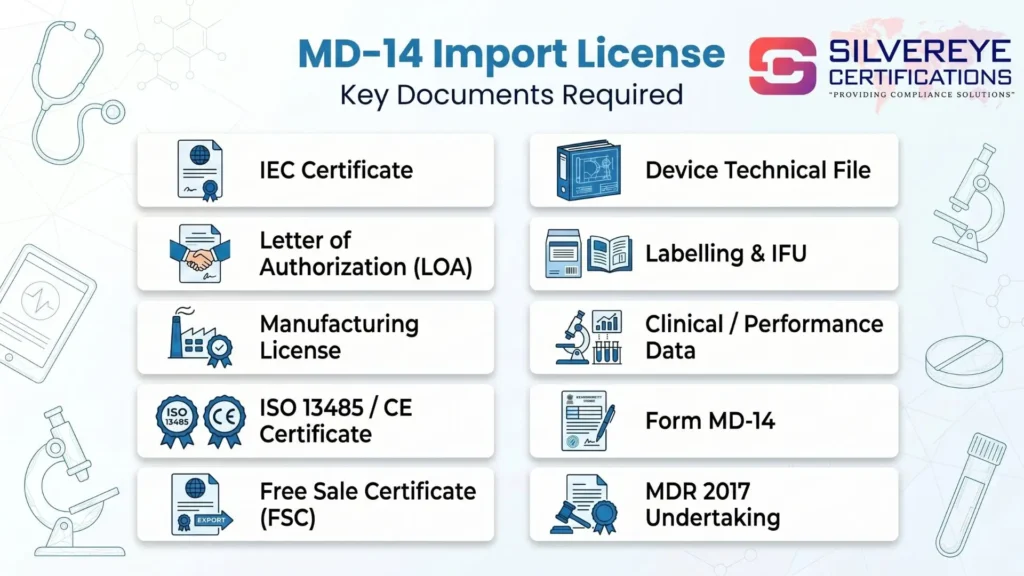
Documents Required for MD-14 (Import License — Syringe Pump)
| Document | Details / Requirement |
| Form MD-14 (duly filled) | Online submission via CDSCO Sugam portal |
| Certificate of incorporation / business registration | Of the Indian importer entity |
| Authorisation letter from overseas manufacturer | Appointing the Indian entity as AIR or importer |
| International regulatory approval certificate | CE Mark (EU MDR / MDD), US FDA 510(k) / PMA, TGA, Health Canada etc. |
| ISO 13485 certificate of the manufacturer | Valid quality management system certification |
| Device description and intended use statement | Detailed clinical indication and mode of action |
| Risk classification justification | Per MDR 2017 Third Schedule classification rules |
| Essential Principles Checklist (EPC) | Schedule III MDR 2017 — compliance mapping to safety & performance |
| Summary Technical Documentation (STED) / Technical File | Full safety, performance, and biocompatibility evidence package |
| IEC 60601-1 test report | General electrical safety — from NABL / accredited laboratory |
| IEC 60601-2-24 test report | Safety of infusion pumps and controllers — specific standard |
| IEC 60601-1-6 (usability / human factors) data | Usability engineering file for syringe pump interface |
| IEC 62133 / battery safety report (if applicable) | For portable / ambulatory syringe pumps |
| Software documentation — IEC 62304 | Software lifecycle file for embedded pump software |
| Risk management file (ISO 14971) | Risk analysis, evaluation, and residual risk acceptance |
| Clinical evaluation report | Per CDSCO / MEDDEV guidelines — literature or clinical data |
| Biocompatibility data (ISO 10993) | For fluid-path and patient-contact components |
| Post-market surveillance plan | Adverse event reporting and vigilance strategy |
| Labelling (draft) and Instructions for Use (IFU) | In English; bilingual where required |
| Unique Device Identification (UDI) details | Per CDSCO UDI framework |
| Import Export Code (IEC) of importer | Issued by DGFT, India |
| Declaration of conformity | Signed by authorised signatory of manufacturer |
Government Fee for MD-14 (Syringe Pump Import License)
| Fee Category | Amount |
| Application fee — Class C syringe pump | As per MDR 2017 Second Schedule (refer Sugam portal for current amount) |
| Application fee — Class D syringe pump | As per MDR 2017 Second Schedule (refer Sugam portal for current amount) |
| Import licence renewal fee | Per Second Schedule of MDR 2017 |
| Note: Fee amounts under MDR 2017 are periodically revised by CDSCO. Always verify the current fee applicable to your device class on the CDSCO Sugam portal before payment. Filing with incorrect fee leads to application rejection. |
MD-15: Grant of Import License for Syringe Pumps
On satisfactory review of the MD-14 application and all submitted technical documents, CDSCO issues the import license in Form MD-15. This is the legal authorisation to import the specified syringe pump model(s) into India for commercial sale or distribution.
Key Features of the MD-15 Import License
- Model-specific — covers the exact syringe pump model(s) and variants listed in the application
- Importer-specific — issued in the name of the Indian entity or AIR
- Records the overseas manufacturer's name, manufacturing site address, and country of origin
- Valid for 3 years for Class C and D devices — must be renewed before expiry
- Required at Indian customs for each import shipment — must be produced on demand
- Any change in device model, manufacturer site, labelling, or formulation requires an amendment application
| MD-15 Licence Parameter | Details |
| Form | MD-15 |
| Issued by | CDSCO (Central Drugs Standard Control Organisation) |
| Covers | Specified syringe pump model(s) from specified overseas manufacturer |
| Validity | 3 years (Class C and D devices) |
| Renewal | File renewal on Sugam portal before expiry |
| Amendment | Mandatory for any device, site, or labelling change |
| Customs requirement | Copy of MD-15 required for each import consignment clearance |
MD-41 Application: Wholesale License for Syringe Pumps
A company that distributes, supplies, or sells syringe pumps to hospitals, nursing homes, diagnostic centres, or other end-users within India must hold a valid wholesale license in Form MD-42 from the State Licensing Authority of the state in which it operates.
It is important to understand that the import license (MD-15) gives you the right to bring syringe pumps into India. The wholesale license (MD-42) gives you the right to distribute and sell those devices within India. Both are required if you are both the importer and the distributor.
Who Needs an MD-41 Wholesale License?
- Medical device distributors supplying syringe pumps to hospitals and healthcare facilities
- Importers who also act as distributors of their own imported syringe pump portfolio
- State-level stockists and regional depots of national medical device companies
- Branches of companies operating in multiple states — each state requires a separate MD-42
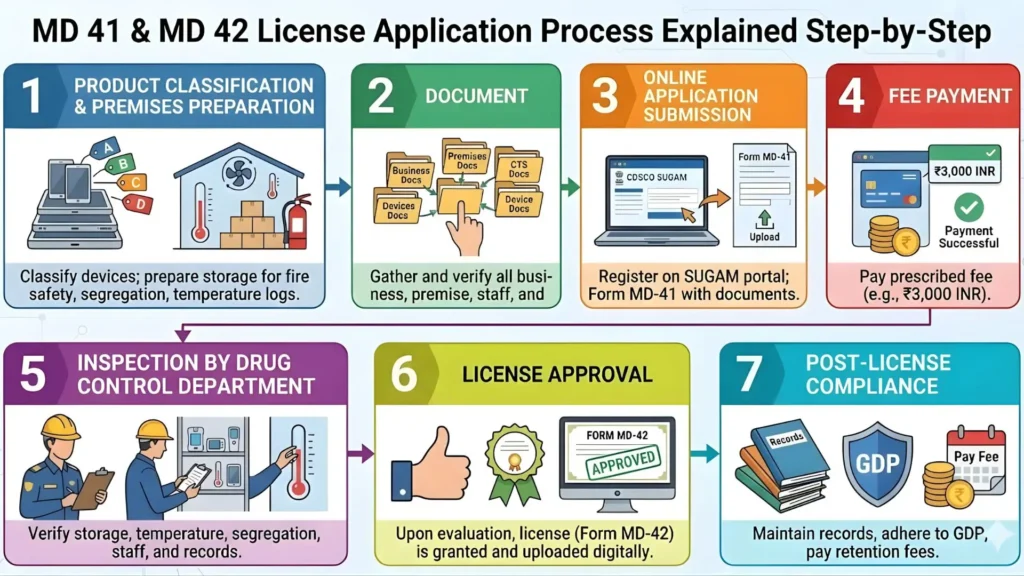
MD-41 Application Process
- Identify the State Licensing Authority (SLA) of the relevant state
- Arrange appropriate premises with adequate storage space and conditions for medical devices
- Appoint a technically qualified person as required under MDR 2017 and state notifications
- Prepare all required documents — list below
- File Form MD-41 with the SLA — online via state portal or physical submission depending on state
- SLA may conduct a premises inspection before granting the license
- Pay the prescribed state government fee
- SLA issues the wholesale license in Form MD-42 upon satisfactory compliance
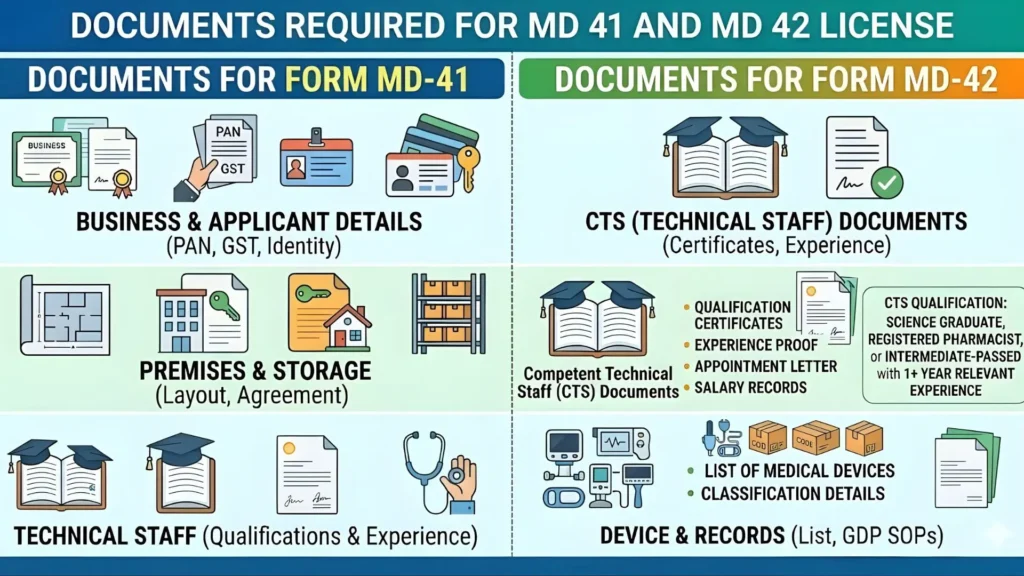
Documents Required for MD-41 (Wholesale License — Syringe Pump)
| Document | Details |
| Form MD-41 (duly filled) | Submitted to the State Licensing Authority |
| Proof of business premises | Ownership certificate or rental / lease agreement |
| Layout plan of storage and office area | Showing dimensions, storage racks, and conditions |
| Business entity registration | GST certificate, company incorporation, partnership deed etc. |
| Copy of valid MD-15 import licence (if importer-distributor) | Showing authorisation for the products being distributed |
| Details of technically qualified person | Qualification documents as per MDR 2017 / SLA requirement |
| Declaration of compliance | Signed by the business owner / authorised signatory |
| NOC or trade licence from local authority (state-specific) | As required by the state SLA |
MD-42: Grant of Wholesale License for Syringe Pumps
The State Licensing Authority issues the wholesale medical device license in Form MD-42 after verifying the MD-41 application and, where applicable, inspecting the premises. This licence is mandatory before the first syringe pump is supplied to any customer in that state.
| MD-42 Licence Parameter | Details |
| Form | MD-42 |
| Issued by | State Licensing Authority (SLA) |
| Covers | Wholesale distribution of medical devices (specified categories) in the state |
| Validity | Typically 5 years — confirm with relevant SLA |
| Renewal | Apply before expiry; updated documents required |
| Multi-state operations | Separate MD-42 required for each state of distribution |
| Display requirement | Licence must be displayed at the principal place of business |
MD-3 Application and MD-5 License: Manufacturing for Class A and B Syringe Pump Accessories
Indian manufacturers producing Class A or Class B syringe pump-related accessories — such as non-powered infusion sets, gravity drip accessories, or basic consumables — apply for a manufacturing licence through Form MD-3 filed with the State Licensing Authority (SLA) of their manufacturing state.
MD-3 Application Process (Class A / B)
- Identify the State Licensing Authority for the state where manufacturing takes place
- Ensure the manufacturing facility complies with Schedule I of MDR 2017 (GMP requirements)
- Build a quality management system aligned to ISO 13485 or equivalent
- Appoint technically qualified personnel as prescribed under MDR 2017 Schedule II
- Prepare all required documents — technical file, device list, premises details
- File Form MD-3 with the SLA along with all supporting documents and prescribed fee
- SLA conducts a GMP inspection of the manufacturing facility
- Address inspection observations within the timelines given by the SLA
- SLA grants the manufacturing license in Form MD-5 upon satisfactory compliance
Documents Required for MD-3 (Class A / B Manufacturing License)
| Document | Details |
| Form MD-3 (duly filled) | Submitted to State Licensing Authority |
| Proof of manufacturing premises | Ownership or lease agreement |
| Site master file and factory layout | Showing manufacturing, QC, and storage areas |
| List of devices to be manufactured | With description, intended use, and device class |
| Quality management system documentation | ISO 13485 aligned or equivalent QMS |
| Equipment list with qualification records | All production and testing equipment |
| Qualification and experience of technical staff | As per MDR 2017 Schedule II |
| Process validation and test protocols | Per device being manufactured |
| Risk management file (ISO 14971) | Risk analysis documentation |
| Draft labelling and IFU | For each product intended for manufacture |
| MD-5 Licence Parameter | Details |
| Form | MD-5 |
| Issued by | State Licensing Authority (SLA) |
| Applicable to | Class A and Class B medical device manufacturers |
| Validity | Typically 5 years — as per MDR 2017 and state notifications |
| Renewal | Before expiry; re-inspection may be required by SLA |
| Scope | Facility-specific and product category-specific |
MD-7 Application and MD-9 License: Manufacturing License for Class C and D Syringe Pumps
This is the most rigorous regulatory pathway for Indian manufacturers of clinical syringe pumps. Since standard hospital syringe pumps, ICU infusion pumps, PCA pumps, and high-risk Class D devices are all regulated centrally, their manufacturing licenses are applied for via Form MD-7 and granted by CDSCO — not the State Licensing Authority.
MD-7 Application Process (Class C / D Syringe Pump Manufacturing)
- Register on the CDSCO Sugam portal as a medical device manufacturer
- Establish a manufacturing facility fully compliant with Schedule I of MDR 2017
- Obtain ISO 13485 certification from an NABCB-accredited or internationally recognized certification body
- Complete device design and development — design history file, verification, and validation
- Conduct full technical testing per IEC 60601-1 and IEC 60601-2-24 at an accredited laboratory
- Develop the complete Essential Principles Checklist (EPC) per Schedule III of MDR 2017
- Prepare clinical evaluation report — literature-based or clinical study as required
- Build the full Risk Management File per ISO 14971
- Prepare IEC 62304 software lifecycle documentation for all embedded software
- File Form MD-7 on the Sugam portal with all required documents and prescribed fee
- CDSCO scrutinises the technical file and may raise technical, clinical, or quality queries
- CDSCO conducts a GMP audit of the manufacturing facility
- Respond to all CDSCO queries and address GMP audit observations within given timelines
- CDSCO grants the manufacturing license in Form MD-9 upon satisfactory review and audit
Documents Required for MD-7 (Class C / D Syringe Pump Manufacturing License)
| Document | Details / Notes |
| Form MD-7 (duly filled) | Online submission via CDSCO Sugam portal |
| Certificate of incorporation | Company / entity registration documents |
| ISO 13485 certificate | From NABCB-accredited or equivalent certification body |
| Manufacturing facility details and site layout | Detailed GMP-compliant factory documentation |
| Device description and intended use | For each syringe pump model |
| Risk classification justification | Per MDR 2017 Third Schedule |
| Essential Principles Checklist (EPC) | Schedule III MDR 2017 — full compliance mapping |
| Risk management file (ISO 14971) | Device risk analysis, evaluation, and control |
| Design history file / technical documentation | Engineering drawings, design V&V, DHF |
| IEC 60601-1 test report | General electrical safety — NABL / accredited lab |
| IEC 60601-2-24 test report | Safety of infusion pumps and controllers — essential for syringe pumps |
| IEC 60601-1-6 usability / human factors engineering file | User interface safety for syringe pump programming |
| IEC 60601-1-8 alarm system documentation | Alarm systems on infusion / syringe pumps |
| IEC 62304 software lifecycle documentation | For all embedded firmware and software |
| IEC 62133 battery safety (if applicable) | For portable / ambulatory syringe pump models |
| Biocompatibility data (ISO 10993) | For all fluid-path and patient-contact materials |
| Clinical evaluation report | Per CDSCO/MEDDEV guidelines — clinical data or literature |
| Process validation records | Sterilisation (if applicable), manufacturing process validation |
| Post-market surveillance plan | Vigilance, complaint handling, PMCF, PSUR strategy |
| Sterility data (if applicable) | For sterile consumables manufactured alongside the pump |
| Draft labelling and IFU | In English; per MDR 2017 labelling requirements |
| Unique Device Identification (UDI) details | Per CDSCO UDI framework |
| Declaration of conformity | Signed by authorised signatory |
| MD-9 Licence Parameter | Details |
| Form | MD-9 |
| Issued by | CDSCO (Central Drugs Standard Control Organisation) |
| Applicable to | Class C and Class D medical device manufacturers |
| Validity | 3 years (as per MDR 2017) |
| Renewal | Before expiry; GMP re-audit may be conducted by CDSCO |
| Scope | Facility-specific, device category-specific, and model-specific |
| Post-grant obligation | Adverse event reporting, PMCF, vigilance, annual PSUR |
All Four License Pathways Compared: Side-by-Side
| Criteria | MD-14/MD-15 (Import) | MD-3/MD-5 (Mfg A/B) | MD-7/MD-9 (Mfg C/D) | MD-41/MD-42 (Wholesale) |
| Who it is for | Syringe pump importers | Mfrs of Class A/B accessories | Mfrs of Class C/D syringe pumps | Wholesale distributors |
| Filed with | CDSCO (Central) | State Licensing Authority | CDSCO (Central) | State Licensing Authority |
| Device class | All (A–D) | Class A and B only | Class C and D | All (A–D) |
| GMP inspection | Document scrutiny | SLA site inspection | CDSCO GMP audit | Premises inspection |
| ISO 13485 required | Overseas mfr must hold it | Yes (or equivalent QMS) | Yes — mandatory | Not typically required |
| Clinical data needed | Yes (Class C/D) | Minimal (Class A/B) | Yes — mandatory | No |
| Key technical standard | IEC 60601-2-24 | IEC 60601-1 (basic) | IEC 60601-2-24 (mandatory) | Not applicable |
| Typical timeline | 6–18 months (Class C/D) | 3–9 months | 12–24 months | 4–12 weeks |
| Licence validity | 3 years (Class C/D) | 5 years (typical) | 3 years | 5 years (typical) |
Key Standards for CDSCO Registration of Syringe Pumps
CDSCO expects importers and manufacturers to demonstrate compliance with internationally recognised technical standards applicable to syringe pumps. Here are the primary standards:
| Standard | Scope | Relevance to Syringe Pumps |
| IEC 60601-1:2005+A1:2012 | General electrical safety and performance — medical electrical equipment | Mandatory for all powered syringe pumps |
| IEC 60601-2-24:2012 | Particular requirements for safety of infusion pumps and controllers | The primary standard for syringe pumps — covers flow accuracy, occlusion, free-flow protection |
| IEC 60601-1-6:2010+A1:2013 | Usability engineering — human factors | Covers syringe pump user interface, programming safety, alarm acknowledgement |
| IEC 60601-1-8:2006+A1:2012 | Alarm systems for medical electrical equipment | Syringe pump alarm system design and performance |
| IEC 62304:2006+A1:2015 | Medical device software — software lifecycle processes | All syringe pumps with embedded firmware or drug library software |
| ISO 14971:2019 | Risk management for medical devices | Risk analysis for pump failure modes — free-flow, occlusion, air-in-line |
| ISO 13485:2016 | Quality management systems for medical devices | Mandatory for all manufacturers applying for MD-7/MD-9 |
| ISO 10993 (series) | Biocompatibility evaluation of medical devices | Fluid-path components in contact with infused fluids |
| IEC 62133 | Secondary lithium cell and battery safety | Portable and ambulatory syringe pumps with rechargeable batteries |
Processing Timelines: How Long Does CDSCO Registration Take for Syringe Pumps?
| Licence Type | Typical Timeline | Key Factors |
| MD-15 Import Licence (Class C syringe pump) | 6 to 18 months | Document completeness, CDSCO query rounds, technical data quality |
| MD-15 Import Licence (Class D syringe pump) | 9 to 24 months | Higher clinical scrutiny, additional queries for life-critical devices |
| MD-9 Manufacturing Licence (Class C/D) | 12 to 24 months | GMP audit scheduling, design file depth, query response speed |
| MD-5 Manufacturing Licence (Class A/B accessories) | 3 to 9 months | SLA workload, GMP inspection scheduling |
| MD-42 Wholesale Licence | 4 to 12 weeks | State SLA workload, premises compliance, document completeness |
| Note: Applications with complete documents, a well-prepared technical file, and IEC 60601-2-24 test reports from accredited laboratories consistently process faster than incomplete submissions. Every query round from CDSCO can add 4 to 8 weeks to the timeline. |
Post-Market Compliance Obligations for Syringe Pump License Holders
Receiving an MD-15 or MD-9 license is not the end of your regulatory obligations. Both importers and manufacturers must maintain active post-market compliance under MDR 2017.
- Adverse Event Reporting: Serious incidents, near-misses, and malfunctions must be reported to CDSCO within prescribed timelines — typically 10 days for life-threatening events
- Field Safety Corrective Actions (FSCA): Initiate, report, and close out any product recalls or field safety notices in India
- Post-Market Clinical Follow-Up (PMCF): Continue collecting real-world clinical data to support safety evidence
- Periodic Safety Update Reports (PSUR): Submit as required by CDSCO for higher-risk devices
- Complaint Handling: Maintain a documented process for receiving, investigating, and closing customer complaints
- Labelling Changes: Any modification to labelling or IFU requires CDSCO approval before implementation
- License Renewal: File MD-15 and MD-9 renewals before the 3-year expiry — operating with an expired license is a violation
- UDI Compliance: Implement Unique Device Identification as CDSCO's UDI mandate rolls out across device classes
2026 Regulatory Updates: What Syringe Pump Importers and Manufacturers Need to Know
Strengthened Port-Level Enforcement
CDSCO has significantly increased enforcement at Indian ports of entry for notified medical devices. Syringe pumps arriving without a valid MD-15 import licence are being detained, and repeat violations are drawing heavier penalties. If you have been importing syringe pumps without a licence, getting compliant is now more urgent than it has ever been.
IEC 60601-2-24 Compliance Now Closely Scrutinized
CDSCO technical officers are increasingly scrutinising IEC 60601-2-24 test reports for flow accuracy, occlusion alarm sensitivity, and free-flow protection data. Submissions relying on older test reports or reports from non-accredited laboratories are facing queries. Ensure your test reports are current and from NABL-accredited or internationally accredited laboratories.
Smart Pumps and Drug Library Devices — Additional Regulatory Attention
Syringe pumps with integrated drug libraries, dose error reduction systems (DERS), Wi-Fi connectivity, and EHR/EMR integration are receiving additional scrutiny at CDSCO. Software validation per IEC 62304, cybersecurity risk documentation, and human factors data per IEC 60601-1-6 are increasingly being requested during query rounds for smart pump registrations.
UDI Implementation Timeline
CDSCO's Unique Device Identification (UDI) rollout is progressing through device categories. Importers and manufacturers of syringe pumps should prepare UDI labelling and database submission plans now, as phased UDI mandates for higher-risk devices are expected to include Class C and D infusion devices.
Mandatory CDSCO Sugam Portal for All Class C/D Applications
As of 2026, all MD-14 and MD-7 applications for Class C and D devices — including syringe pumps — must be submitted entirely through the CDSCO Sugam portal. Hybrid or partial paper submissions are not accepted. Ensure your organisation has an active Sugam account, digital signature certificates, and familiarity with the portal's document upload requirements.
Benefits of Working with a CDSCO Syringe Pump Registration Consultant
| Challenge | How a Consultant Adds Value |
| Correct device classification | Determines Class C vs D — avoids under-classification which can trigger enforcement action |
| Technical file / STED preparation | Structures the complete documentation package to meet CDSCO's specific expectations |
| Standard compliance mapping | Maps IEC 60601-2-24, ISO 14971, IEC 62304 test data to the EPC |
| Sugam portal filing | Handles all digital submissions, fee payment, and document formatting requirements |
| Query response management | Writes technically precise, well-evidenced responses to CDSCO deficiency letters |
| GMP audit preparation | For manufacturers: prepares the facility and documentation for CDSCO GMP audit |
| Drug library / software regulatory strategy | Advises on IEC 62304, cybersecurity, and human factors documentation for smart pumps |
| Multi-state wholesale licensing | Manages MD-41 filings across multiple states for pan-India distribution |
| Post-market compliance setup | Builds adverse event reporting, PMCF, and vigilance systems |
| Renewal management | Proactively tracks MD-15 and MD-9 expiry to prevent licence lapse |
If you are importing syringe pumps into India or manufacturing them domestically, Silvereye Certifications handles the full CDSCO registration process — from initial device classification and technical file preparation to license grant and ongoing post-market compliance. Their team has hands-on experience with the Sugam portal workflow and the documentation standards CDSCO expects for Class C and D infusion devices.
Conclusion
CDSCO registration for syringe pumps in India is a well-defined but technically demanding regulatory process. The pathway you follow depends on whether you are importing or manufacturing, and whether your syringe pump is Class C or Class D — which most clinical infusion pumps are.
For importers, the journey is Form MD-14 to Form MD-15 — with CDSCO expecting a complete technical file including IEC 60601-2-24 test data, ISO 13485 evidence, CE or FDA approval, and a clinical evaluation report. For domestic manufacturers, the route is Form MD-7 to Form MD-9 — which includes a GMP audit of your manufacturing facility in addition to a full technical file review.
Wholesale distributors need an MD-42 from the State Licensing Authority in every state where they operate. And manufacturers of Class A/B syringe pump accessories use the MD-3/MD-5 state-level pathway.
The Indian healthcare market's demand for infusion devices is growing rapidly — driven by expanding ICU infrastructure, home care adoption, and oncology treatment growth. But market access begins with a valid CDSCO license. Getting your documentation right, your device classified correctly, and your application complete the first time is the fastest path to market.
Silvereye Certifications supports both importers and manufacturers through the entire CDSCO syringe pump registration process, from first classification to final license grant.
Frequently Asked Questions
Is CDSCO registration mandatory for syringe pumps in India?
Yes. Syringe pumps are notified of medical devices under MDR 2017. No syringe pump can be legally imported, manufactured, or sold in India without valid CDSCO registration and licensing. Importing or selling without a license is an offence under the Drugs and Cosmetics Act, 1940 and can result in shipment seizure and penalties.
Under which class do syringe pumps fall under CDSCO MDR 2017?
Standard clinical syringe pumps — including hospital infusion pumps, ICU syringe drivers, PCA pumps, neonatal pumps, and ambulatory pumps — are classified as Class C under MDR 2017. High-risk implantable or life-critical devices such as intrathecal drug delivery pumps and closed-loop insulin systems are Class D. Basic non-motorised accessories are Class A or B.
What is the difference between MD-14 and MD-7 for syringe pumps?
MD-14 is the import license application — filed by importers who bring syringe pumps from overseas manufacturers into India. MD-7 is the manufacturing license application — filed by Indian companies that manufacture syringe pumps domestically. Both are filed with CDSCO for Class C and D devices.
How long does it take to get an MD-15 import license for a syringe pump?
A Class C syringe pump import licence typically takes 6 to 18 months from complete application submission. Class D devices may take 9 to 24 months due to more rigorous clinical and technical scrutiny. A well-prepared, complete application reduces the number of query rounds and shortens the total timeline.
What is IEC 60601-2-24 and why is it important for CDSCO registration?
IEC 60601-2-24 is the international safety standard specifically for infusion pumps and controllers, including syringe pumps. It specifies requirements for flow accuracy, occlusion detection and alarm, free-flow protection, bolus delivery accuracy, and KVO (keep vein open) rates. CDSCO requires a valid IEC 60601-2-24 test report as part of both the MD-14 and MD-7 application for syringe pumps.
Do I need a separate wholesale license (MD-42) if I already have an import license (MD-15)?
Yes. The MD-15 import licence authorises you to bring syringe pumps into India. It does not authorise you to distribute or sell them. You need a separate MD-42 wholesale licence from the State Licensing Authority of every state where you distribute. If you operate nationally, you need an MD-42 in each state
Can a foreign syringe pump manufacturer directly obtain CDSCO registration?
Foreign manufacturers cannot hold CDSCO licenses directly. They must appoint an Authorized Indian Representative (AIR) — an Indian registered entity that becomes the license holder and takes regulatory responsibility for the device in India. The AIR files the MD-14 application and holds the MD-15 license.
What is the validity of the MD-9 manufacturing license for syringe pumps?
The MD-9 manufacturing license for Class C and D devices — including syringe pumps — is valid for 3 years under MDR 2017. Manufacturers must apply for renewal before expiry. CDSCO may conduct a GMP re-audit at the time of renewal.
Is clinical data mandatory for syringe pump CDSCO registration?
Yes, for Class C and D syringe pumps. A clinical evaluation report — either based on a systematic literature review or clinical investigation data — is required as part of both the MD-14 and MD-7 application. The depth of clinical evidence expected by CDSCO is higher for Class D devices than for Class C.
What happens if I sell syringe pumps in India without a valid CDSCO license?
Selling, distributing, or importing notified medical devices without valid licenses is an offence under the Drugs and Cosmetics Act, 1940. Consequences include seizure of products, financial penalties, and in serious cases, criminal prosecution. CDSCO enforcement has intensified significantly since 2022, with regular checks at ports of entry and in the market.