- CDSCO mandates registration for all 144 ophthalmic medical devices under MDR 2017 — from simple spectacle frames (Class A) to implantable intraocular devices (Class D).
- Importers must obtain MD-14 application/MD-15 license; Indian manufacturers need MD-3/MD-5 (Class A/B) or MD-7/MD-9 (Class C/D); wholesalers require MD-41/MD-42 license.
- This guide covers the complete list of ophthalmic devices by class, license forms, required documents, fees, timelines, and renewal obligations under India's Medical Devices Rules 2017.
- Updated for 2026: Includes CDSCO Sugam portal process, current fee schedule, and practical compliance tips for manufacturers, importers, and wholesale distributors.
CDSCO Registration for Ophthalmic Medical Devices
CDSCO registration for ophthalmic medical devices in India is mandatory under the Medical Devices Rules, 2017 (MDR 2017). All 144 ophthalmic devices — from spectacle lenses (Class A) to vitreous body prostheses (Class D) — must be registered before sale, import, or distribution. Indian manufacturers apply via Form MD-3 (Class A/B) or MD-7 (Class C/D); importers use MD-14; and wholesale licensees use MD-41. Licenses are granted via MD-5, MD-9, MD-15, and MD-42 respectively. Registrations are valid for3–5 years and must be renewed before expiry.
Why Is CDSCO Registration Mandatory for Ophthalmic Medical Devices ?
Ophthalmic medical devices in India are regulated by the Central Drugs Standard Control Organization (CDSCO), which operates under the Ministry of Health and Family Welfare. The legal framework governing registration and licensing is the Medical Devices Rules, 2017 (MDR 2017), notified under the Drugs and Cosmetics Act, 1940.
All ophthalmic devices — whether manufactured in India or imported from abroad — must be registered with CDSCO before they can be legally sold, distributed, or used in clinical settings. Failure to obtain the required CDSCO license attracts penalties under the Drugs and Cosmetics Act, including product seizure, financial penalties, and potential criminal liability.
The classification of ophthalmic devices into Class A, B, C, and D follows Schedule III of MDR 2017. The risk class determines the type of license required, the documents needed, the fees payable, and the timelines involved.
| KEY REGULATION: Medical Devices Rules, 2017 (MDR 2017) — Schedule III lays down the classification criteria for all medical devices including ophthalmic devices. The Drugs Controller General of India (DCGI) and State Licensing Authorities (SLAs) share jurisdiction based on device class and activity type. |
How Ophthalmic Medical Devices Are Classified Under MDR 2017
Ophthalmic devices are classified on the basis of potential risk to the patient, duration of contact, degree of invasiveness, and active/non-active characteristics. The four classes are:
| Class | Risk Level & Description |
| Class A | Low risk. Non-invasive, diagnostic, or supportive devices with minimal patient contact. Examples: spectacles, trial lenses, visual charts, hand-held diagnostic instruments. |
| Class B | Low-to-moderate risk. Devices with short-term or limited invasive contact. Examples: contact lenses, corneal surgical instruments, tonometers. |
| Class C | Moderate-to-high risk. Devices intended for long-term invasive use, implantation, or use with energy systems. Examples: intraocular implants, ophthalmic laser systems, contact lens solutions. |
| Class D | Highest risk. Devices critical to sustaining life or with the highest risk of patient harm. Example: aqueous/vitreous humour replacement medium kit. |
Complete List of Class A Ophthalmic Medical Devices (MDR 2017)
| Class A ophthalmic devices are low-risk, non-invasive diagnostic and corrective instruments. They require the lightest regulatory pathway — Form MD-3 application and MD-5 grant of license for manufacturers, and Form MD-14/MD-15 for importers. |
| Total Class A Ophthalmic Devices Listed: 77 |
| Device Name | Intended Use / Description |
| Adaptometer | Measures retinal adaptation time and minimum light threshold |
| Amsler grid | Detects central and paracentral visual field irregularities |
| Anomaloscope | Tests red/green colour vision defects |
| Automated lensmeter (Dioptometer) | Measures focusing power of spectacle/contact lenses |
| Bagolini lens | Determines harmonious/anomalous retinal correspondence |
| Binocular vision test unit | Tests binocular vision |
| Blepharoplasty scissors | Cuts eyelid tissue during plastic surgery |
| Colour discrimination spectacle lens | Corrects refractive errors; enhances colour discrimination |
| Colour discrimination tester | Tests ability to differentiate colours |
| Colour-discrimination eye chart | Tests colour vision |
| Conjunctival scissors | Cuts conjunctiva and Tenon's capsule during surgery |
| Contact lens radius gauge | Measures radius of curvature of contact lenses |
| Diagnostic condensing lens | Focuses reflected fundus light in indirect ophthalmoscopy |
| Eikonometer | Diagnoses aniseikonia |
| Electronic occlusion spectacles | Tests and trains vision for decreased visual acuity |
| Enucleation scissors | Cuts tissue during enucleation surgery |
| Exophthalmometer | Measures degree of exophthalmos |
| Eye irrigation shield | Directs irrigation solution to the eye surface |
| Eye pad | Protects eye or absorbs eye secretions (sterile) |
| Eye spud | Removes foreign body from the eye surface |
| Eyelid clamp | Holds eyelid during ophthalmic surgical intervention |
| Eyelid weight (external) | Applied outside upper eyelid to restore eyelid muscle function |
| Felt tangent screen | Assesses peripheral visual field extent |
| Fibreoptic general-purpose ophthalmic hook | Manipulates structures/foreign bodies in the eye during surgery |
| Fornixscope | Provides access/viewing of upper conjunctival fornix |
| Fresnel lens | Thin flexible lens applied to spectacle lenses for vision management |
| Fresnel prism | Applied to spectacle lenses to manage strabismus/eye muscle dysfunction |
| Haidinger brush imager | Evaluates visual function, particularly macular integrity |
| Hand-held campimeter | Assesses central 30-degree visual field (portable) |
| Hand-held telescope | Enlarges images for visually impaired patients |
| Hruby fundus lens | 55-dioptre lens for vitreous body and fundus examination |
| Indirect binocular ophthalmoscope | Examines interior of eye with wide-angle stereoscopic view |
| Lens spoon | Manipulates/removes the lens of the eye in surgery |
| Maddox trial lens | Changes image size/shape/colour to evaluate eye muscle dysfunction |
| Mirror-prism spectacles | Enables patient to see over the top of their head |
| Nystagmus inducing optokinetic drum | Elicits nystagmus |
| Nystagmus inducing tape | Elicits optokinetic nystagmus; tests for blindness |
| Ocular occluder | Temporarily prevents/attenuates vision in one eye during testing |
| Ophthalmic calliper | Measures diameter, length, angles and thicknesses of the eye |
| Ophthalmic distometer | Measures distance between cornea and spectacle/trial lens |
| Ophthalmic examination station | Provides complete ophthalmic examination position and support |
| Ophthalmic head reflector | Reflects light onto eye for examination |
| Ophthalmic instrument table | Work surface supporting ophthalmic instruments |
| Ophthalmic surgical device handling forceps | Grasps/manipulates non-implantable invasive ophthalmic devices |
| Ophthalmic suture scissors | Cuts suture during eye surgery |
| Ophthalmodiastimeter | Determines proper placement of prescription lenses for both eyes |
| Ophthalmoleukoscope | Tests colour perception using polarized light |
| Optical pachymeter | Uses optics to measure corneal thickness |
| Orbital depressor | Displaces tissue to facilitate orbital cavity examination |
| Perimeter | Assesses extent of peripheral visual field (diagnostic) |
| Periocular/lacrimal retractor | Separates periocular tissues during ophthalmic intervention |
| Phorometer | Tests ocular balance |
| Phoropter | Determines patient's prescription for glasses |
| Pleoptophor | Treats eccentric eye fixation by dazzling perimacular retina |
| Polatest | Evaluates hidden (latent) squinting |
| Ptosis crutch | Attached to spectacle frame to prop open upper eyelid in ptosis |
| Pupillograph | Graphically records pupil response to light (diagnostic) |
| Pupillometer | Measures width/diameter of the pupil |
| Recumbent spectacles | Prismatic lenses to read/watch TV while lying supine |
| Sclerotome | Incises the sclera during sclerotomy (knife-like) |
| Scotometer | Records and measures areas of reduced/lost visual field sensitivity |
| Spectacle frame | Holds spectacle lenses in front of user's eyes |
| Spectacle lens | Corrects refractive errors; protects against radiation/hazards |
| Spectacle lens curvature gauge | Manually measures curvature of spectacle lens surface |
| Spectacle-mounted telescope | Enlarges images for visually impaired; attaches to spectacles |
| Spectacles | Worn in front of eyes to improve normal vision |
| Surgical binoculars | Mounted on surgeon's spectacles for magnified surgical view |
| Synoptophor | Evaluates and trains binocular function |
| Tachistoscope | Flashes words/images at speed for ophthalmic diagnostic testing |
| Tinted spectacle lens | Corrects refractive errors; attenuates light radiation |
| Tinted spectacles | Corrects refractive errors; attenuates light radiation (pair) |
| Trial lens | Individual ophthalmic lens from a trial lens set |
| Trial lens clip | Holds prisms/spheres/cylinders/occluders on trial lens frame |
| Trial lens frame | Holds/exchanges trial lenses during sight-testing |
| Trial lens set | Set of lenses of various dioptric powers for vision testing |
| Visual chart (Snellen) | Tests visual acuity |
| Visual light box | Translucent Snellen chart used for testing visual acuity |
| Visual projector | Projects image on screen to test visual acuity |
| Visual evoked-potential electrode | Records electrical potential for measuring visual evoked responses |
Complete List of Class B Ophthalmic Medical Devices (MDR 2017)
| Class B ophthalmic devices carry a low-to-moderate risk profile. They include surgical hand instruments, contact lenses, and diagnostic systems. Manufacturers apply via Form MD-3 (same as Class A) with grant via MD-5. Importers use MD-14/MD-15. |
| Total Class B Ophthalmic Devices Listed: 28 |
| Device Name | Intended Use / Description |
| Capsular tension ring – equivalent (Contact Lens) | Worn directly on cornea to correct vision or act as therapeutic bandage |
| Contact Lens | Device worn on cornea to correct vision conditions or act as therapeutic bandage |
| Corneal burr manual instrument | Excavates corneal tissue through manual rotation |
| Corneal burr system | Abrades cornea and other eye tissues (assembly) |
| Corneal burr (abrasion) | Polishes corneal scratches and pterygium bed post-surgery |
| Corneal burr (rust ring removal) | Removes rust stains from cornea after ferrous foreign body extraction |
| Corneal epithelium perforator | Creates perforations in corneal epithelium for riboflavin passage (crosslinking) |
| Corneal epithelium trephine | Creates circular epithelial cut for LASEK epithelial flap |
| Corneal light shield | Shields retina from excessive illumination during ophthalmic procedures |
| Corneal marker | Imprints/indents/incises corneal tissue before surgery |
| Corneal resection holder | Holds donated corneal tissue for resection before transplantation |
| Corneal scissors | Cuts corneal tissue during surgery |
| Corneal shield | Collagen mechanical eye shield placed on cornea for protection |
| Corneoscleral punch | Excises tissue from sclera/cornea or cadaver donor grafts |
| Epiretinal/inner limiting membrane scraper | Lifts ILM and/or epiretinal membrane during posterior segment surgery |
| Euthyscope | Modified ophthalmoscope projects bright light on fundus for amblyopia treatment |
| Eye cup | Receptacle fitted around eye socket for washing the eye with solution |
| Eye heat therapy pack | Applies heat over closed eyes to treat MGD, dry eye, blepharitis |
| Eye muscle clamp | Grasps and holds extraocular muscles during surgery |
| Flieringa ophthalmic ring | Circular band sutured to sclera to prevent globe collapse during surgery |
| Keratome | Shaves corneal tissue for lamellar transplant |
| Lacrimal tube | Implantable tube for tear drainage and sinus irrigation |
| Ophthalmic operating table top | Supports/stabilizes patient's head during ophthalmic surgery |
| Ophthalmic soft-tissue surgical forceps | Grasps/manipulates intraocular tissues during surgery |
| Ophthalmic tonometer | Measures intraocular pressure (IOP) |
| Ophthalmic ultrasound imaging system | Assembly for ophthalmic ultrasound imaging |
| Scleral marker | Indents/imprints sclera surface during perioperative procedure |
| Ultrasound pachymeter | Uses ultrasound to measure corneal thickness, axial length, and anterior chamber depth |
Complete List of Class C Ophthalmic Medical Devices (MDR 2017)
| Class C ophthalmic devices are moderate-to-high risk — they include implantable devices, laser systems, and active therapeutic devices. Manufacturers must apply via Form MD-7 (not MD-3) and receive license via MD-9. Importers use MD-14/MD-15. Stricter scrutiny, clinical data requirements, and higher fees apply. |
| Total Class C Ophthalmic Devices Listed: 37 |
| Device Name | Intended Use / Description |
| Contact lens agitation cleaning system | Cleans/disinfects contact lenses through mechanical agitation |
| Contact lens disinfecting solution | Aqueous formulation to loosen debris and disinfect contact lenses |
| Contact lens protein-removal solution | Proteolytic enzyme formulation to remove protein deposits from reusable lenses |
| Contact lens thermal cleaner | Disinfects/sterilizes reusable soft contact lenses by heat |
| Capsular bag anchor | Permanently implanted in posterior chamber for fixation of subluxated capsular bag |
| Corneal inlay (aperture reducing) | Implanted into cornea to treat presbyopia via aperture reduction |
| Corneal inlay (cornea reshaping) | Implanted into cornea to treat refractive errors by reshaping |
| Donor cornea container | Maintains, transports, and facilitates clinical examination of donated cornea |
| Endoscopic-imaging ophthalmic solid-state laser system | Treats retinal disorders and glaucoma during ECP procedures |
| Eye muscle sleeve | Encases or isolates ocular muscle (synthetic implantable) |
| Eye valve | Regulates fluid flow from anterior chamber to reduce IOP (implantable) |
| Eyelid weight (implantable) | Implanted subcutaneously in upper eyelid to restore muscle function |
| Femtosecond ophthalmic solid-state laser system | High-power laser for ocular resections and incisions |
| Fundus-imaging ophthalmic diode laser system | Coagulates abnormal retinal vasculature; captures real-time fundus images |
| Fundus-imaging ophthalmic solid-state laser system | Coagulates abnormal vascular tissue in retina for photocoagulation |
| Glaucoma supraciliary implant | Implanted in supraciliary space to restore aqueous humour outflow for open-angle glaucoma |
| Glaucoma therapy ultrasound system | Applies HIFU to decrease aqueous humour production and reduce IOP |
| Implantable intraocular pressure monitoring system | Continuously/regularly collects and displays IOP data for glaucoma monitoring |
| Implantable iris prosthesis | Implanted in posterior chamber to reconstruct partial or total iris defects |
| Intracorneal ring | Implantable open-ended band to flatten anterior corneal curvature and correct mild/moderate myopia |
| Intranasal lacrimal neurostimulator | Provides electrical stimulation to nasal sensory neurons to increase tear production |
| Intraocular pressure-reducing system | Applies controlled mechanical compression to eye surface to reduce IOP before surgery |
| Ophthalmic clip | Permanently or temporarily implanted to close wound edges or prevent bleeding in the eye |
| Ophthalmic cryosurgical system | Applies cold refrigerant to destroy/remove target tissue during surgery |
| Ophthalmic dye laser system | Coagulates abnormal vascular tissue and photocoagulates retinal tissue |
| Ophthalmic excimer laser system | Corneal ablation and other ophthalmologic procedures |
| Ophthalmic noble gas laser system | Coagulates abnormal vascular retinal tissue for photocoagulation |
| Ophthalmoscope | Examines interior of eye; clearly shows retinal details and other ocular structures/media |
| Orbital rim prosthesis | Reconstructs bony orbital floor cavity for artificial eye housing |
| Phacoemulsification system | Delivers energy via handpiece tip for phacoemulsification (lens removal) |
| Ptosis sling | Sterile implantable device for surgical correction of ptosis |
| Retinal tack | Permanently fixes detached retina to underlying RPE during surgery |
| Scleral buckling device | Implanted on sclera to compress eye for surgical treatment of retinal detachment |
| Scleral expansion implant | Implanted in sclera to alter ciliary muscle position |
| Symblepharon ring | Implantable circular band to prevent eyelid from adhering to eyeball |
| Vitrectomy system | Delivers energy to treat diabetic vitreous haemorrhage, retinal detachment, epiretinal membrane, macular hole |
| Vitreous body prosthesis | Sterile implantable bag/capsule to replace vitreous body and support retina |
Complete List of Class D Ophthalmic Medical Devices (MDR 2017)
| Class D ophthalmic devices carry the highest regulatory risk. They require the most comprehensive documentation, clinical evidence, and regulatory scrutiny. Manufacturers apply via Form MD-7 and receive licence via MD-9. The DCGI at the central level has jurisdiction. Importers use MD-14/MD-15. |
| Total Class D Ophthalmic Devices Listed: 1 |
| Device Name | Intended Use / Description |
| Aqueous/vitreous humour replacement medium kit | Collection of sterile devices including fluid/semifluid substance to replace ocular fluid |
CDSCO License Types for Ophthalmic Medical Devices: Complete Overview
The table below provides a consolidated overview of all licence types applicable to ophthalmic medical devices — for manufacturers, importers, and wholesale distributors — along with the applicable device classes and form numbers.
| Activity | Application Form | Licence Form | Applicable Class |
| Manufacturing (India) | MD-3 | MD-5 | Class A and Class B |
| Manufacturing (India) | MD-7 | MD-9 | Class C and Class D |
| Import (Foreign Origin) | MD-14 | MD-15 | Class A, B, C, and D |
| Wholesale Distribution | MD-41 | MD-42 | Class A, B, C, and D |
Manufacturing License for Class A & B Ophthalmic Devices: MD-3 & MD-5
Indian manufacturers of Class A and Class B ophthalmic devices — such as spectacle frames, trial lens sets, contact lenses, corneal instruments, and ophthalmic tonometers — must obtain a manufacturing licence under Form MD-5 by submitting Form MD-3 to the State Licensing Authority (SLA) of the state where the manufacturing unit is located.
Who Grants the MD-5 License?
The State Licensing Authority (SLA) — typically the State Drug Controller — grants the MD-5 manufacturing license for Class A and Class B medical devices. This is distinct from Class C and D, where the DCGI has central jurisdiction.
Documents Required for MD-3 Application (Class A/B Manufacturing)
- Completed Form MD-3 application
- Site Master File (SMF) with manufacturing facility layout and floor plan
- Quality Management System documentation — ISO 13485 certificate (if available) or equivalent
- List of devices proposed to be manufactured with their classification and IS/IEC standards
- Technical documentation and device description for each product
- Declaration of conformity for each device category
- Proof of ownership or lease of manufacturing premises
- Details of key personnel (qualified person, technical staff)
- Manufacturing equipment list with calibration records
- Standard Operating Procedures (SOPs) relevant to device manufacturing
- DD/online payment challan for applicable fee
MD-3 / MD-5 Fee Schedule (Class A & B Ophthalmic Devices)
| Fee Head | Amount (Approximate) |
| Application fee for MD-3 (one device category) | ₹3,000 |
| Application fee for MD-3 (2–10 device categories) | ₹3,000 + ₹1,000 per additional category |
| Application fee for MD-3 (more than 10 categories) | ₹3,000 + ₹500 per category above 10 |
| Licence fee for MD-5 grant | ₹1,500 per device |
| Note | Fees are as notified under MDR 2017 Fourth Schedule and may be updated — verify current rates on cdsco.gov.in |
Manufacturing License for Class C & D Ophthalmic Devices: MD-7 & MD-9
Indian manufacturers of Class C and Class D ophthalmic devices — such as intraocular implants, ophthalmic laser systems, vitrectomy systems, phacoemulsification systems, and the aqueous/vitreous humour replacement medium kit — must apply for a manufacturing license to the Central Licensing Authority (CLA), i.e., the DCGI at CDSCO, New Delhi, using Form MD-7. The licence is granted via Form MD-9.
Who Grants the MD-9 License?
The Drug Controller General of India (DCGI) at CDSCO, operating from FDA Bhawan, Kotla Road, New Delhi, grants the MD-9 manufacturing licence for Class C and Class D ophthalmic devices. Applications are submitted and tracked on the CDSCO Sugam online portal (sugam.gov.in).
Documents Required for MD-7 Application (Class C/D Manufacturing)
- Completed Form MD-7 application via Sugam portal
- Site Master File (SMF) with detailed manufacturing facility documentation
- ISO 13485 Quality Management System certificate (mandatory or near-mandatory at DCGI level)
- Technical documentation including design history file (DHF), risk management file (ISO 14971), and testing reports
- Clinical evaluation report or clinical investigation data
- Declaration of conformity to applicable harmonized standards (ISO, IEC, IS)
- Biocompatibility data (ISO 10993 series) for devices in contact with body tissues or fluids
- Sterilization validation data (if applicable)
- Shelf-life and accelerated aging study data
- List of devices with full technical specifications
- Details of all key personnel including Regulatory Affairs head and QA head
- Manufacturing process validation documents
- Post-market surveillance (PMS) plan
- Payment of applicable fees
MD-7 / MD-9 Fee Schedule (Class C & D Ophthalmic Devices)
| Fee Head | Amount (Approximate) |
| Application fee for MD-7 (one device) | ₹50,000 |
| Additional devices (same category) | ₹25,000 per device |
| Licence fee for MD-9 (Class C) | ₹50,000 |
| Licence fee for MD-9 (Class D) | ₹1,00,000 |
| Note | Fees as per MDR 2017 Fourth Schedule. Verify current rates before applying — subject to revision. |
Import License for Ophthalmic Medical Devices: MD-14 Application & MD-15 Grant
Any company or individual wishing to import ophthalmic medical devices into India must obtain an import license from CDSCO under Form MD-15 by submitting Form MD-14 to the Central Licensing Authority (DCGI). This applies across all device classes — A, B, C, and D — for all ophthalmic devices listed in this guide.
Importers are typically the Indian entity responsible for bringing the device into the country. They are distinct from the foreign manufacturer. The foreign manufacturer must hold a valid manufacturing approval in their home country, and this approval must be submitted as part of the MD-14 package.
Key Conditions for MD-14 Import License Application
- The importing entity must be a legally incorporated company or firm registered in India
- The foreign manufacturer must have a valid manufacturing authorization or equivalent regulatory approval in their home country
- The device must already be approved/registered in at least one Reference Country (USA FDA, EU CE, TGA Australia, Health Canada, PMDA Japan, or MHRA UK) OR a clinical investigation license in India must be obtained first
- A Free Sale Certificate (FSC) or CE Certificate or 510(k)/PMA from the country of origin is typically mandatory
- An authorization letter from the foreign manufacturer to the Indian importer is required
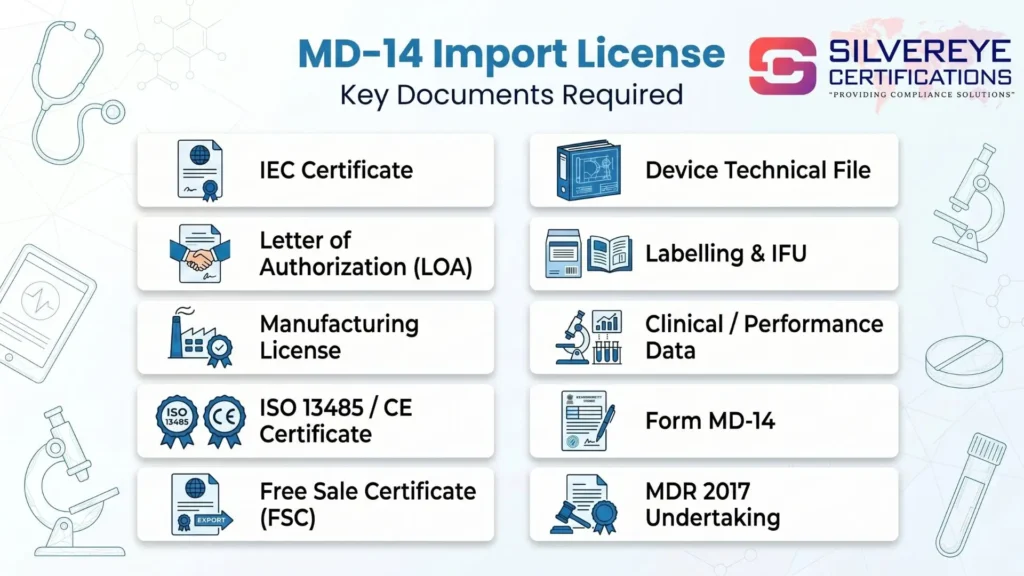
Documents Required for MD-14 Application (Import License)
- Completed Form MD-14 via CDSCO Sugam portal
- Certificate of Incorporation of the Indian importing company
- Wholesale drug license or existing CDSCO import license (if applicable)
- Authorization/Power of Attorney from the foreign manufacturer
- Free Sale Certificate (FSC) or CE Certificate or equivalent approval from country of origin
- Technical documentation: device description, intended use, specifications
- Labelling samples (English language label with Indian importer details)
- Instructions for Use (IFU) or User Manual
- Test reports from accredited laboratories (NABL or equivalent)
- Clinical evaluation data or clinical performance summary (for Class C/D)
- Risk management summary (ISO 14971)
- Declaration that the device is not banned in the country of origin
- Fee payment receipt
MD-14 / MD-15 Fee Schedule
| Device Class | Import Licence Fee (Approximate) |
| Class A import licence (per device) | ₹1,000 |
| Class B import licence (per device) | ₹2,000 |
| Class C import licence (per device) | ₹5,000 |
| Class D import licence (per device) | ₹50,000 |
| Application fee (MD-14) | ₹1,000–₹5,000 depending on class |
| Note | Verify current fees on cdsco.gov.in. Fees differ for new vs renewal applications. |
Wholesale License for Ophthalmic Medical Devices: MD-41 Application & MD-42 Grant
Companies and distributors involved in wholesale distribution of ophthalmic medical devices in India must obtain a wholesale license under Form MD-42 by submitting Form MD-41 to the State Licensing Authority (SLA) of the respective state. This applies to all classes of ophthalmic devices — A, B, C, and D.
Wholesale licenses act as intermediaries between manufacturers/importers and end-users (hospitals, eye clinics, opticians). They do not manufacture or relabel devices — they merely store and distribute.
Documents Required for MD-41 Application (Wholesale Licence)
- Completed Form MD-41 application
- Certificate of Incorporation or Partnership Deed of the applicant company/firm
- Proof of storage premises ownership or lease agreement
- Storage facility details: temperature-controlled storage evidence (for temperature-sensitive devices like contact lens solutions)
- Details of Qualified Person (pharmacist or qualified technical staff) with registration proof
- No-objection certificate (NOC) from local municipal authorities (state-specific)
- List of ophthalmic devices proposed to be distributed with class details
- Declaration of compliance with MDR 2017 storage and handling norms
- Fee payment challan
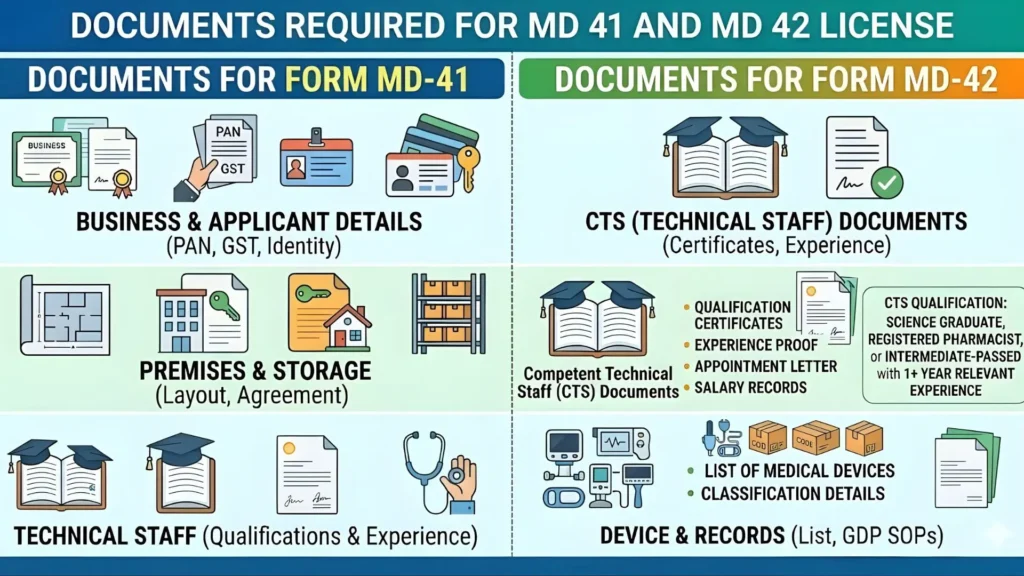
MD-41 / MD-42 Fee Schedule
| Fee Head | Approximate Amount |
| Application fee for MD-41 | ₹2,000–₹5,000 (varies by state) |
| Wholesale licence fee MD-42 (per class) | ₹5,000–₹10,000 depending on state and device class |
| Validity | Typically 5 years (renewable) |
| Note | State Licensing Authorities set final fee amounts — check with your SLA before applying. |
Step-by-Step CDSCO Registration Process for Ophthalmic Medical Devices
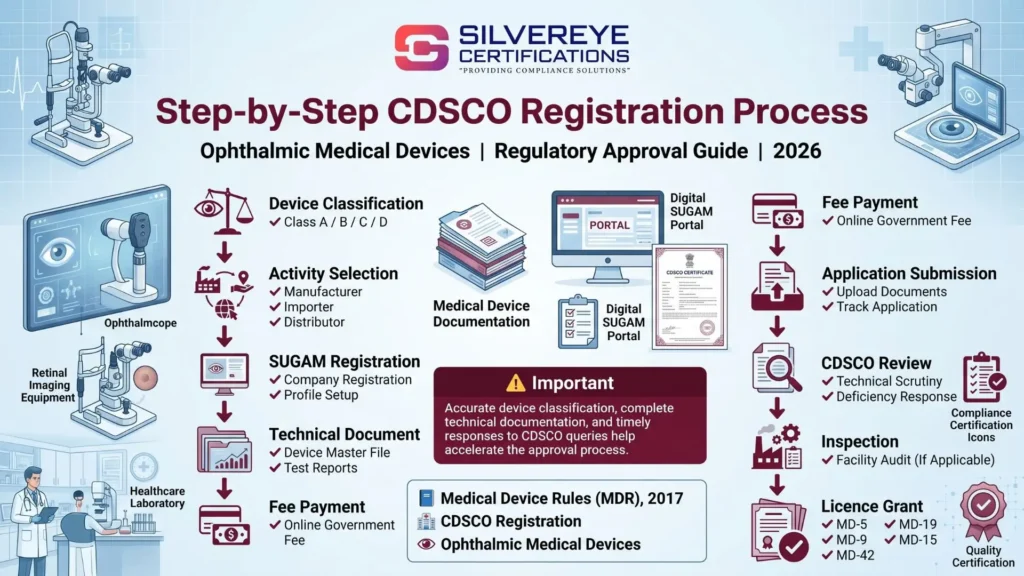
Step 1: Determine Your Device Classification
Use the MDR 2017 Schedule III classification table and verify your device's class (A, B, C, or D) based on the intended use and risk profile. Use the device lists in Sections 3–6 of this guide as your primary reference.
Step 2: Determine Your Activity Type
Are you manufacturing in India, importing from abroad, or distributing wholesale? This determines whether you need MD-3/MD-5, MD-7/MD-9, MD-14/MD-15, or MD-41/MD-42.
Step 3: Register on the CDSCO Sugam Portal
All CDSCO applications are filed online via the Sugam portal. Create a company account, add your device details, and upload documents in the prescribed format.
Step 4: Prepare Your Technical Documentation Package
Compile all required documents based on your device class and activity type. For Class C and D devices, expect significantly more documentation including clinical data, biocompatibility reports, and sterilisation validation.
Step 5: Pay the Applicable Fee
Pay the prescribed fee online through the Sugam portal payment gateway. Keep the payment receipt as it must accompany your application.
Step 6: Submit the Application and Track Status
Submit your application on Sugam. CDSCO will assign a file number and review your dossier. You can track status on the portal. CDSCO may raise deficiency queries — respond within the prescribed time to avoid rejection.
Step 7: Inspection (If Required)
For manufacturing licences (MD-5 or MD-9), CDSCO or SLA inspectors will conduct a physical inspection of the manufacturing facility. For import licences, inspection may be required for Class C and D devices.
Step 8: Grant of License
Upon satisfactory review and inspection, CDSCO grants the licence in the appropriate Form (MD-5, MD-9, MD-15, or MD-42). Download the licence certificate from the Sugam portal.
| Process Stage | Typical Timelines |
| MD-3/MD-5 (Class A/B Manufacturing) | 30–90 days from complete application |
| MD-7/MD-9 (Class C/D Manufacturing) | 90–180 days (may extend with deficiencies) |
| MD-14/MD-15 (Import — Class A/B) | 30–60 days |
| MD-14/MD-15 (Import — Class C/D) | 90–180 days |
| MD-41/MD-42 (Wholesale) | 30–60 days via SLA |
| Note | Timelines are indicative. Deficiency notices and incomplete submissions extend timelines significantly. |
Validity and Renewal of CDSCO Ophthalmic Device Licenses
| Licence Type | Validity |
| MD-5 (Manufacturing Class A/B) | 5 years Apply for renewal before expiry via Form MD-6 |
| MD-9 (Manufacturing Class C/D) | 5 years Apply for renewal before expiry via Form MD-8 |
| MD-15 (Import Licence) | 3 years (initial); 5 years on renewal Renewal via Form MD-16 (not to be confused with IVD test licence) |
| MD-42 (Wholesale Licence) | 5 years Renewal via Form MD-43 |
Benefits of CDSCO Registration for Ophthalmic Medical Device Companies
- Legal authorization to manufacture, import, or distribute ophthalmic devices in India — no licence means no legal market access
- Brand credibility and trust with hospitals, eye clinics, and procurement committees who verify CDSCO registration status
- Eligibility for government and institutional tenders — CDSCO registration is a mandatory tender condition across AIIMS, ESIC, armed forces procurement, and state health departments
- Protection against market entry by non-compliant competitors through enforcement actions by CDSCO
- Access to India's large and growing ophthalmic device market — estimated at USD 1.5 billion and expanding at 12–15% CAGR
- Regulatory harmonization pathway — CDSCO registration supports parallel registrations in neighbouring markets referencing Indian approvals
Common Mistakes to Avoid in CDSCO Ophthalmic Device Registration
- Misclassifying devices — for example, treating an implantable intraocular device as Class B instead of Class C significantly delays approval
- Incomplete technical documentation — submitting an application without a complete risk management file or clinical evaluation report for Class C/D devices invariably leads to deficiency notices
- Wrong licence type — applying under MD-3 for a Class C device (which requires MD-7) is a common error that leads to rejection
- Expired foreign approvals — ensuring the FSC or CE certificate submitted with MD-14 is current and not expired
- Missing Indian importer details on device labelling — a frequent deficiency in import applications
- Delayed renewals — missing renewal deadlines forces re-application from scratch in some cases, causing significant supply chain disruption
Conclusion
Navigating CDSCO registration for ophthalmic medical devices requires a clear understanding of your device's risk class, the correct license pathway, and the documentation standards that CDSCO expects at each level. Whether you are a domestic manufacturer of spectacle lenses applying for an MD-5 license, a multinational importing phacoemulsification systems under MD-15, or a regional distributor seeking an MD-42 wholesale license, this guide has laid out the complete regulatory framework you need to operate legally and confidently in India's ophthalmic device market.
With India's ophthalmic care market expanding rapidly — driven by a growing diabetic population, rising cataract surgery volumes, and increasing adoption of refractive surgery — getting your CDSCO registration right is not just a compliance obligation. It is a strategic business priority.
The team at Silvereye Certifications specializes in end-to-end CDSCO medical device registration support — from device classification and technical dossier preparation to Sugam portal submissions and post-approval compliance management. Reach out to us for a free regulatory assessment.
Frequently Asked Questions
Which authority grants the CDSCO license for ophthalmic medical devices in India?
For Class A and Class B ophthalmic devices, the State Licensing Authority (SLA) — the State Drug Controller — grants the license. For Class C and Class D ophthalmic devices, the Central Licensing Authority (CLA), which is the Drug Controller General of India (DCGI) at CDSCO, New Delhi, grants the license. Import and wholesale licenses have their own respective jurisdictions.
Do simple spectacles and trial lenses also need CDSCO registration?
Yes. Spectacles, spectacle frames, trial lenses, trial lens frames, and trial lens sets are all notified as medical devices under MDR 2017 and are classified as Class A ophthalmic devices. They require a valid CDSCO manufacturing license (MD-5 via MD-3) or import license (MD-15 via MD-14) before they can be legally sold or imported in India. The compliance requirements for Class A are lighter than higher classes, but registration is mandatory.
What is the difference between Form MD-3 and Form MD-7 for ophthalmic device manufacturers?
Form MD-3 is the application form for manufacturing licenses for Class A and Class B medical devices (low to moderate risk). Form MD-7 is the application form for Class C and Class D medical devices (moderate-to-high and highest risk). MD-3 is filed with the State Licensing Authority; MD-7 is filed with the DCGI at CDSCO.
Can a foreign manufacturer directly sell ophthalmic devices in India without an Indian importer?
No. Foreign manufacturers cannot directly import and sell medical devices in India. They must appoint an authorized Indian importer who obtains the import license (Form MD-15 via MD-14) from CDSCO.
Is ISO 13485 certification mandatory for CDSCO ophthalmic device registration?
ISO 13485 is strongly recommended and in practice near-mandatory for Class C and Class D devices at CDSCO. For Class A and Class B devices, it is not legally required but significantly strengthens the application and reduces the likelihood of deficiency queries. For import applications, the foreign manufacturer is typically expected to hold ISO 13485 or an equivalent QMS certification.
How long does it take to get a CDSCO import license for an ophthalmic laser system (Class C)?
An ophthalmic laser system is a Class C device. The CDSCO import license process for Class C devices via MD-14/MD-15 typically takes 90 to 180 days from the date of complete and deficiency-free application submission.
Does the wholesale license (MD-42) cover all classes of ophthalmic devices?
Yes. The Form MD-42 wholesale license granted by the State Licensing Authority covers wholesale distribution of ophthalmic medical devices across all classes — A, B, C, and D. However, distributors handling temperature-sensitive devices (such as contact lens disinfecting solutions or donor cornea containers) must ensure appropriate cold-chain storage infrastructure is in place.
What happens if I sell ophthalmic medical devices in India without a valid CDSCO license?
Selling notified medical devices without a valid CDSCO license is a violation of the Medical Devices Rules, 2017 and the Drugs and Cosmetics Act, 1940. Consequences can include: product seizure and recall, cancellation of any existing licenses, financial penalties, and prosecution under the Act — which can result in imprisonment in serious cases.
How do I check if an ophthalmic device is already registered with CDSCO?
You can search the CDSCO database on the official portal at cdsco.gov.in under the 'Medical Devices' section. The Sugam portal also provides a public search function where you can look up registered devices by device name, manufacturer, or importer.
Is the contact lens registration process different from other ophthalmic devices?
Contact lenses are classified as Class B ophthalmic devices under MDR 2017. The registration process follows the standard MD-3/MD-5 pathway for Indian manufacturers and MD-14/MD-15 for importers.
When should I start the CDSCO renewal process for my ophthalmic device license?
Start the renewal process at least 90 days before the licence expiry date. For complex devices (Class C or Class D), begin 120 to 180 days in advance to allow for any deficiencies CDSCO might raise. If your licence expires while renewal is pending and you submitted a timely application, CDSCO typically allows continued operation — but verify with your regulatory consultant as enforcement practice can vary.