
- 163 gastroenterology devices classified under MDR 2017 — from Class A ostomy bags to Class D bioabsorbable implants.
- Importers need MD-14 application & MD-15 license; manufacturers need MD-3/MD-5 (Class A/B) or MD-7/MD-9 (Class C/D).
- Wholesale dealers require MD-41 application and MD-42 license under Central Drugs Standard Control Organization.
Introduction
CDSCO registration for gastroenterology medical devices in India is governed by the Medical Devices Rules (MDR) 2017. All 163 devices listed in this guide — including endoscopes, ostomy bags, biliary catheters, gastrostomy tubes, and implants — are classified as Class A, B, C, or D. Importers file MD-14 for an import license (MD-15). Manufacturers apply MD-3 (Class A/B) or MD-7 (Class C/D). Wholesale dealers use MD-41 for an MD-42 license. Licenses are valid for 5 years and must be renewed before expiry.
What Is CDSCO Registration for Gastroenterology Medical Devices?
CDSCO registration for gastroenterology medical devices is the mandatory licensing process under the Medical Devices Rules (MDR) 2017, enforced by the Central Drugs Standard Control Organization (CDSCO) under India's Ministry of Health and Family Welfare. Any company that wants to import, manufacture, or distribute gastroenterology devices in India — including endoscopes, biliary catheters, ostomy bags, gastrostomy tubes, or GI implants — must obtain a valid CDSCO license before market entry.
The MDR 2017 classification system divides all medical devices into four risk-based classes (A, B, C, D), and the applicable license form depends on both the device class and the business activity (import, manufacture, or wholesale). Failure to register can attract penalties under the Drugs and Cosmetics Act, 1940.
Why Is CDSCO Registration Important for Gastroenterology Devices in 2026?
India's gastroenterology medical device market is growing rapidly, driven by rising GI disease burden, expanding diagnostic infrastructure, and growing demand for minimally invasive procedures. With the MDR 2017 fully in force, all gastroenterology devices — whether imported or domestically manufactured — must carry a valid CDSCO license.
- Legal compliance: Devices without CDSCO registration cannot be sold, imported, or distributed in India.
- Patient safety: Risk-based classification (A to D) ensures higher-risk devices like implantable GI stents face stricter scrutiny.
- Market access: Hospitals and distributors will only purchase devices with a valid MD-15 (import) or MD-5/MD-9 (manufacture) license.
- Avoiding penalties: Non-compliance can lead to seizure of goods, cancellation of license, and legal proceedings under the Drugs and Cosmetics Act.
MDR 2017 Risk Classification for Gastroenterology Medical Devices
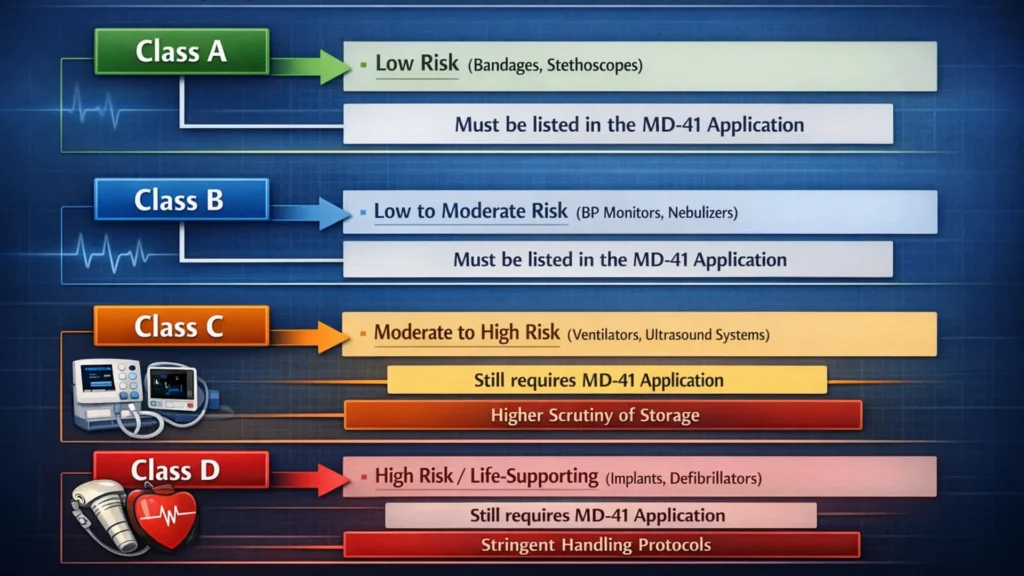
Under the First Schedule Part 1 of MDR 2017, every gastroenterology medical device falls into one of four risk classes. Here is a summary of how the classification system works:
| Class | Risk Level | Examples in Gastroenterology | Applicable Licence Forms |
| Class A | Low Risk | Ostomy bags, enema tubes, nasogastric tube holders | MD-3 (Mfg), MD-14 (Import), MD-41 (Wholesale) |
| Class B | Low-Medium Risk | Endoscopes, biliary catheters, balloon inflators | MD-3 (Mfg), MD-14 (Import), MD-41 (Wholesale) |
| Class C | Medium-High Risk | Gastrostomy tubes, bile duct prostheses, GI clips | MD-7 (Mfg), MD-14 (Import), MD-41 (Wholesale) |
| Class D | High Risk | Bioabsorbable GI anastomosis couplers, fistula-repair biomatrix | MD-7 (Mfg), MD-14 (Import), MD-41 (Wholesale) |
Class A Gastroenterology Medical Devices (Low Risk) — Complete List
Class A gastroenterology devices are low-risk, typically non-invasive or non-sterile consumables used externally or for simple bodily functions. These include ostomy bags, enema equipment, and tube holders. Manufacturer registration for Class A devices requires MD-3 application and MD-5 licence grant.
| Device Name |
| Closed-ended intestinal ostomy bag, multiple-piece |
| Closed-ended intestinal ostomy bag, one-piece |
| Enema tip, reusable |
| Enema tube |
| Enteral feeding/decompression tube clearing stem |
| Enteral tube extension, non-sterile |
| Enteral tube extension, sterile |
| Gastrointestinal ostomy tube pocket |
| Gravity enema set |
| Intestinal ostomy bag anti-adhesion device |
| Intestinal ostomy kit |
| Nasogastric tube holder, noninvasive, non-sterile |
| Nasogastric tube holder, noninvasive, sterile |
| Rectal/colonic lavage support kit |
| Rectoscope/proctoscope handle |
| Rectoscope/proctoscope handle end-cap |
Class B Gastroenterology Medical Devices (Low-Medium Risk) — Complete List
Class B devices represent the largest group of gastroenterology medical devices. These are invasive devices such as endoscopes, flexible colonoscopes, gastroscopes, biliary catheters, enema devices, laparoscopic instruments, and diagnostic catheters. They carry a moderate risk profile and are used under direct medical supervision. Manufacturer license for Class B also follows MD-3 (application) and MD-5 (license grant).
| Device Name |
| Absorbent enteric stomal dressing |
| Anal fistula circular cutter |
| Anoscope, reusable |
| Anoscope, single-use |
| Barium enema catheter |
| Biliary manometric catheter |
| Catheter-balloon inflator, reprocessed |
| Catheter-balloon inflator, reusable |
| Catheter-balloon inflator, single-use |
| Cholangiopancreatography catheter, reusable |
| Cholangiopancreatography catheter, single-use |
| Colonic endoscopy cuff |
| Colonic lavage kit, surgical |
| Colonoscope positioning sleeve |
| Colonoscope stiffener |
| Colorectal sizer |
| Common bile duct dilator |
| Endoscope tissue removal cap |
| Endoscopic biopsy valve, non-sterile |
| Endoscopic biopsy valve, sterile |
| Endoscopic cutting stapler connector |
| Endoscopic electrosurgical biopsy/resection kit, full-thickness |
| Endoscopic electrosurgical biopsy/resection kit, partial-thickness |
| Endoscopic electrosurgical electrode/submucosal lift needle |
| Endoscopic gastrointestinal stenosis dilator |
| Endoscopic motorized cutting stapler, reusable |
| Endoscopic motorized cutting stapler, single-use |
| Endoscopic needleless submucosal lift catheter |
| Endoscopic overtube, reusable |
| Endoscopic spray catheter |
| Externally-propelled flexible video colonoscope |
| Flexible fibreoptic choledochoscope |
| Flexible fibreoptic colonoscope |
| Flexible fibreoptic duodenoscope |
| Flexible fibreoptic enteroscope |
| Flexible fibreoptic gastroduodenoscope |
| Flexible fibreoptic gastroscope |
| Flexible fibreoptic oesophagoscope |
| Flexible fibreoptic pancreatoscope |
| Flexible fibreoptic sigmoidoscope |
| Flexible ultrasound colonoscope |
| Flexible ultrasound duodenoscope |
| Flexible ultrasound gastroduodenoscope |
| Flexible video choledochoscope |
| Flexible video choledochoscope, single-use |
| Flexible video colonoscope, reusable |
| Flexible video colonoscope, single-use |
| Flexible video duodenoscope, reusable |
| Flexible video duodenoscope, single-use |
| Flexible video enteroscope |
| Flexible video gastroduodenoscope |
| Flexible video gastroscope |
| Flexible video oesophagoscope, reusable |
| Flexible video oesophagoscope, single-use |
| Flexible video pancreatoscope |
| Flexible video sigmoidoscope |
| Gastric tonometry catheter |
| Gastrointestinal catheter/endoscope tracking system |
| Gastrointestinal endoscopic clip applier |
| Gastrointestinal endoscopic clip cutter |
| Gastrointestinal endoscopic clip cutter generator |
| Gastrointestinal manometric catheter, electronic |
| Gastrointestinal manometric catheter, non-electronic |
| Gastrointestinal/airway foreign body retrieval basket |
| Gastro-oesophageal pH/impedance catheter, non-sterile |
| Gastro-oesophageal pH/impedance catheter, sterile |
| Gastrostomy tube Y-piece connector |
| Gastro-urological director |
| Gastro-urological probe |
| Gastro-urological scoop |
| Intestinal stoma shield/support belt, reusable |
| Intestinal stoma shield/support belt, single-use |
| Intraluminal oesophageal retractor |
| Invasive silicone sheet dressing |
| Laparoscopic cholangiography catheter/needle |
| Laparoscopic grasping forceps, reprocessed |
| Laparoscopic grasping forceps, reusable |
| Laparoscopic grasping forceps, single-use |
| Laparoscopic swab forceps |
| Manual enema device |
| Manual enema device, reusable |
| Manual rectal irrigation system |
| Motorized laparoscopic forceps |
| Nasogastric decompression tube |
| Nasogastric tube holder, intranasal |
| Oesophageal temperature monitor |
| Over-guidewire oesophageal dilator |
| Percutaneous biliary biopsy procedure kit |
| Powered rectal/colostomy irrigation system |
| Proctoscope, reusable |
| Proctoscope, single-use |
| Rectal irrigation kit |
| Rectal speculum |
| Rectal suction biopsy system |
| Rectoscope, reusable |
| Rectoscope, single-use |
| Rigid oesophagoscope |
| Rigid sigmoidoscope |
| Robotic surgical retractor |
| Self-propelled flexible video colonoscope |
| Spring-loaded pneumoperitoneum needle, reusable |
| Spring-loaded pneumoperitoneum needle, single-use |
| Static magnetic anal plug |
| Stoma drainage catheter |
| TEM/TEO rectoscope, optical |
| TEM/TEO rectoscope, video |
| Video capsule endoscopy system |
| Video capsule endoscopy system application software |
| Video capsule endoscopy system capsule |
Class C Gastroenterology Medical Devices (Medium-High Risk) — Complete List
Class C devices are medium-to-high risk, typically implantable or life-supporting in nature. These include gastrostomy tubes, bile duct prostheses, GI anastomosis couplers, pharyngeal electrical stimulation catheters, and obesity-management implants. Manufacturers of Class C devices must apply using MD-7 and receive MD-9 grant of licence. These devices require clinical evaluation and post-market surveillance.
| Device Name |
| Anal fistula seton |
| Bile duct prosthesis |
| Biliary drainage catheter |
| Colonic mucosa barrier dressing |
| Duodenal bypass liner |
| Duodenal-jejunal bypass liner |
| Enteral feeding kit, adult/paediatric, non-sterile |
| Enteral feeding kit, adult/paediatric, sterile |
| Enteral feeding tube clearing kit |
| Gastric sleeve |
| Gastrointestinal anastomosis coupler, non-bioabsorbable |
| Gastrointestinal endoscopic clip, long-term |
| Gastrointestinal endoscopic clip, short-term |
| Gastrojejunostomy tube |
| Gastro-oesophageal antireflux prosthesis |
| Gastrostomy aspiration system gravity set |
| Gastrostomy aspiration system stomach tube |
| Gastrostomy button |
| Gastrostomy T fastener |
| Gastrostomy tube |
| Implantable gastric clamp |
| Implantable incontinence-control electrical stimulation system |
| Implantable peritoneal catheter holder |
| Intestinal splint |
| Jejunostomy tube |
| Nasoenteral tube |
| Non-vascular catheter introduction set |
| Oesophageal tube |
| Paediatric-temperature nasogastric/orogastric tube |
| Partially-implantable abdominal port/catheter |
| Pharyngeal electrical stimulation catheter |
| Probiotic oropharyngeal mucosa dressing |
| Robotic electrosurgical instrument, bipolar, single-use |
| Stoma support implant |
| Thermal-regulation orogastric tube |
| Transenteric drainage tube |
Class D Gastroenterology Medical Devices (High Risk) — Complete List
Class D devices are the highest-risk category in the gastroenterology segment. Currently, two devices fall under this class. These require the most rigorous pre-market approval, including clinical investigation data and performance evaluation. The manufacturer license process uses MD-7 (application) and MD-9 (grant of license).
| Device Name |
| Fistula-repair biomatrix implant |
| Gastrointestinal anastomosis coupler, bioabsorbable |
CDSCO License Forms for Gastroenterology Medical Devices — MD-14 to MD-42 Explained
There are distinct application and license grant forms depending on whether you are an importer, manufacturer, or wholesale dealer. Here is a clear breakdown of each form applicable to gastroenterology devices.
MD-14 Application and MD-15 Grant of License — Import License for Gastroenterology Devices
Any entity wishing to import gastroenterology medical devices into India must apply to CDSCO Central Licensing Authority using Form MD-14. Upon successful review and compliance, the Central Licensing Authority issues the import license in Form MD-15.
- Applicable to: All imported gastroenterology devices (Class A, B, C, D)
- Application Form: MD-14
- License Grant Form: MD-15
- Licensing Authority: Central Licensing Authority (CDSCO)
- Validity: 5 years from date of grant
- Renewal: Application to be filed before expiry in Form MD-14
- Fee: Varies by device class and number of products; refer to CDSCO fee schedule
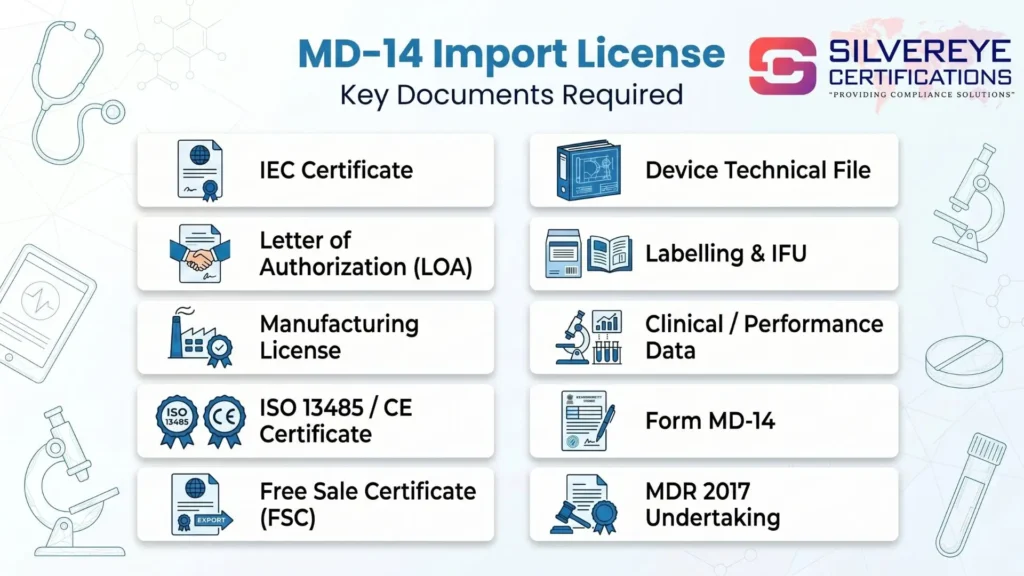
Key Documents Required for MD-14 Import License Application
- Application in Form MD-14 with prescribed fee
- Certificate of Incorporation / Registration of the importer entity
- Free Sale Certificate (FSC) / Certificate of Marketability from the country of origin
- ISO 13485 Certificate or equivalent quality management system certificate
- Declaration by the authorized agent in India
- Technical documentation and performance data of the device
- IEC (Importer Exporter Code) issued by DGFT
- Undertaking for post-market surveillance
- Declaration regarding quality and safety of the device
- Proof of establishment in India (registered office address)
MD-41 Application and MD-42 Grant of License — Wholesale Dealer License for Gastroenterology Devices
A wholesale dealer license is required for all entities that distribute or sell gastroenterology medical devices in bulk to hospitals, retailers, or other dealers. The application is made in Form MD-41 and the license is issued in Form MD-42 by the State Licensing Authority.
- Applicable to: Wholesale distributors of all Class A, B, C, and D gastroenterology devices
- Application Form: MD-41
- License Grant Form: MD-42
- Licensing Authority: State Licensing Authority (SLA)
- Validity: 5 years
- Renewal: To be filed before the license expiry date in Form MD-41
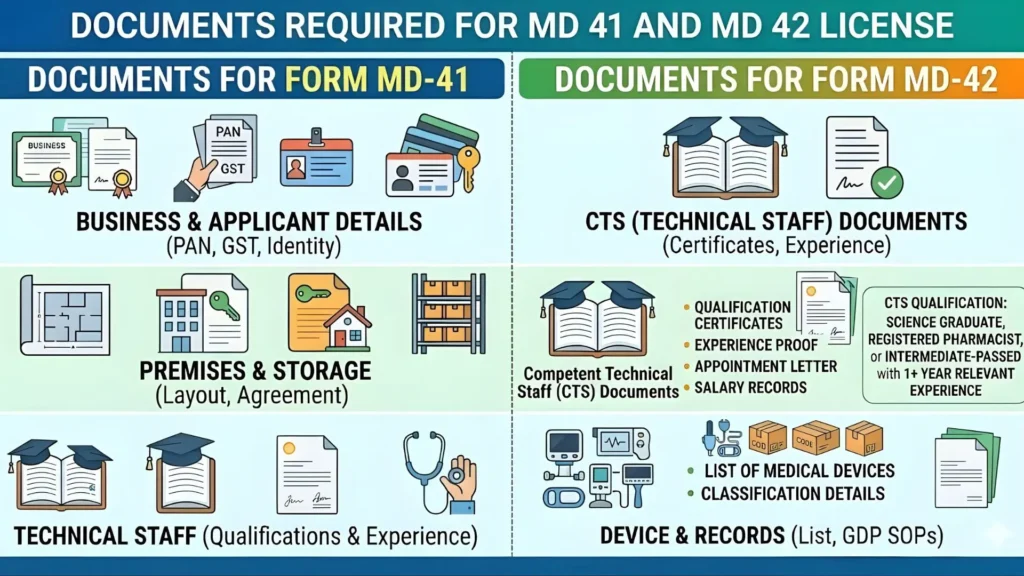
Key Documents Required for MD-41 Wholesale Dealer License
- Application in Form MD-41 with prescribed fee
- Proof of business establishment and address
- Affidavit and undertaking from the proprietor/director
- Site plan and layout of the premises
- List of devices proposed to be dealt in (with classification)
- Copy of import license (MD-15) or manufacturer license (MD-5/MD-9) of the supplier
- Details of qualified technical person (if applicable for higher-risk devices)
MD-3 Application and MD-5 Grant of License — Manufacturer License for Class A and Class B Devices
Manufacturers of Class A and Class B gastroenterology medical devices in India apply using Form MD-3. Upon compliance with GMP requirements and inspection, the State Licensing Authority (SLA) grants the manufacturing license in Form MD-5.
- Applicable to: Class A and Class B gastroenterology device manufacturers
- Application Form: MD-3
- License Grant Form: MD-5
- Licensing Authority: State Licensing Authority (SLA)
- Validity: 5 years
- GMP Standards: Schedule 5 of MDR 2017 (for Class A/B)
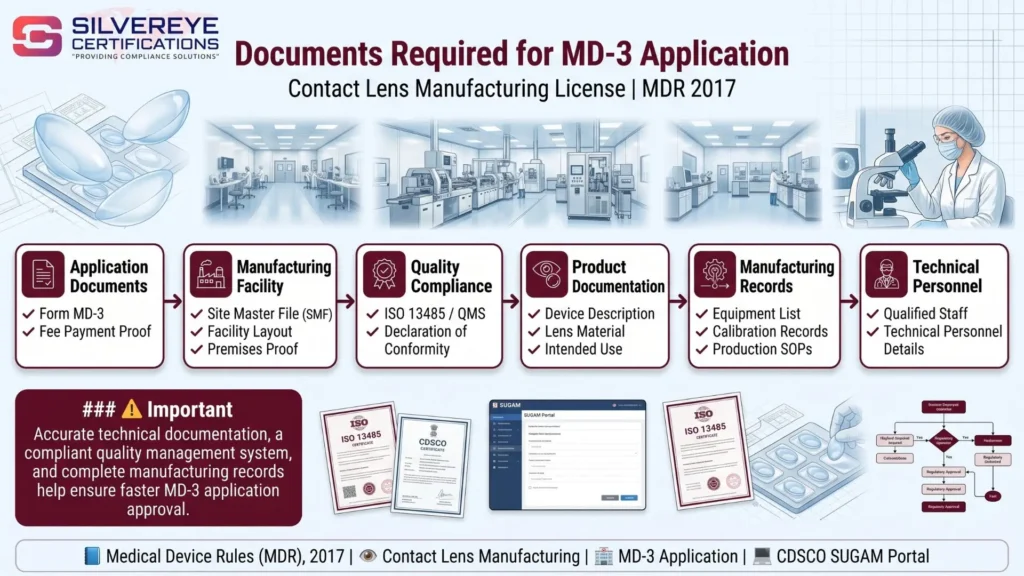
Key Documents Required for MD-3 Manufacturing Licence (Class A & B)
- Application in Form MD-3 with prescribed fee
- Certificate of Incorporation / Partnership Deed
- Site Master File (SMF) and site plan with GMP compliance details
- List of devices proposed to be manufactured with classification
- Details of manufacturing equipment and quality control lab
- Names and qualifications of technical staff
- Quality Management System (QMS) documentation
- Declaration of conformity to safety and performance requirements
- List of essential principles checklist as per Schedule 3
- Device Master Record (DMR)
MD-7 Application and MD-9 Grant of License — Manufacturer License for Class C and Class D Devices
Manufacturers of higher-risk Class C and Class D gastroenterology devices — such as gastrostomy tubes, bile duct prostheses, bioabsorbable anastomosis couplers, and fistula-repair biomatrix implants — must apply in Form MD-7 to the Central Licensing Authority (CDSCO). The manufacturing licence is granted in Form MD-9.
- Applicable to: Class C and Class D gastroenterology device manufacturers
- Application Form: MD-7
- License Grant Form: MD-9
- Licensing Authority: Central Licensing Authority (CLA) — CDSCO
- Validity: 5 years
- GMP Standards: Schedule 5 (enhanced requirements for Class C/D)
- Additional Requirement: Clinical investigation data, performance evaluation, post-market surveillance plan
Key Documents Required for MD-7 Manufacturing License (Class C & D)
- Application in Form MD-7 with prescribed fee
- All documents required for MD-3 (as above)
- Clinical evaluation report or clinical investigation data
- Summary Technical Documentation (STED)
- Risk management file as per ISO 14971
- Biocompatibility assessment (ISO 10993 series) — especially for implantable devices
- Sterilisation validation reports (where applicable)
- Shelf-life and stability data
- Post-market clinical follow-up (PMCF) plan
- Labelling as per MDR 2017 Schedule 7 requirements
CDSCO License Forms for Gastroenterology Medical Devices at a Glance
| Activity | Device Class | Application Form | Licence Form | Authority | Validity |
| Import | A, B, C, D | MD-14 | MD-15 | CLA (CDSCO) | 5 Years |
| Wholesale / Distribution | A, B, C, D | MD-41 | MD-42 | SLA (State) | 5 Years |
| Manufacturing | A, B | MD-3 | MD-5 | SLA (State) | 5 Years |
| Manufacturing | C, D | MD-7 | MD-9 | CLA (CDSCO) | 5 Years |
Who Is Eligible to Apply for CDSCO Gastroenterology Device Registration?
CDSCO registration is open to the following types of entities:
- Importers: Indian-registered companies or LLPs with valid IEC code, seeking to import gastroenterology devices from foreign manufacturers.
- Authorized Indian Representatives (AIR): Entities acting on behalf of a foreign manufacturer for imports.
- Domestic Manufacturers: Indian manufacturers of gastroenterology devices who comply with GMP standards under Schedule 5 of MDR 2017.
- Wholesale Dealers: Entities holding or applying for a wholesale dealership licence for distributing registered gastroenterology devices.
Important: For Class C and D device imports, the foreign manufacturer must also hold a valid registration from their home country's regulatory authority, and a Certificate of Marketability (FSC) is mandatory.
Step-by-Step CDSCO Registration Process for Gastroenterology Medical Devices (2026)
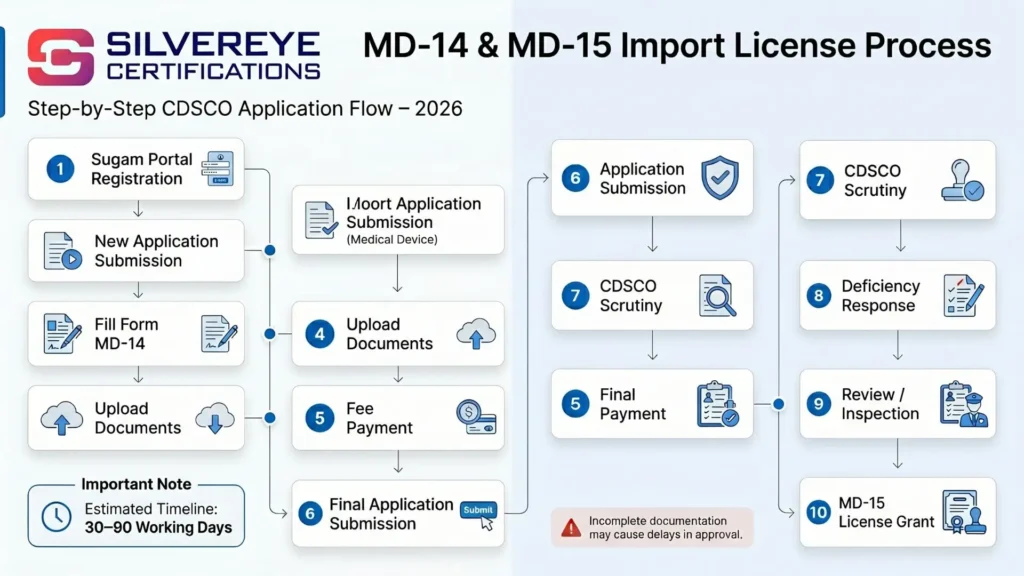
For Importers (MD-14 / MD-15)
- Identify the device classification (Class A, B, C, or D) under MDR 2017 First Schedule Part 1.
- Register on the CDSCO Online Portal (sugam.gov.in) and create an importer account.
- Prepare technical documentation — FSC, ISO 13485, performance data, labelling.
- Fill and submit Form MD-14 online with all required attachments and the prescribed fee.
- CDSCO scrutinizes the application and may request additional information (deficiency letter).
- Respond to queries within the stipulated time (typically 30-60 days).
- Upon approval, the Central Licensing Authority issues the import license in Form MD-15.
- Affix the registration number on product labelling and maintain post-market surveillance records.
For Manufacturers — Class A/B (MD-3 / MD-5)
- Classify the device and prepare site, GMP documentation, and QMS records.
- Register on the CDSCO/SLA portal applicable to your state.
- Submit Form MD-3 to the State Licensing Authority with supporting documents and fee.
- SLA conducts factory inspection for GMP compliance.
- Respond to inspection observations and submit compliance report.
- SLA grants manufacturing license in Form MD-5.
For Manufacturers — Class C/D (MD-7 / MD-9)
- Prepare comprehensive technical file including clinical evaluation, risk management, and biocompatibility data.
- Submit Form MD-7 to CDSCO Central Licensing Authority online via Sugam portal.
- CDSCO reviews technical documentation and may appoint a notified body or expert committee.
- GMP inspection is conducted by CDSCO inspectors.
- Respond to all queries and observations within timelines.
- CDSCO grants the manufacturing license in Form MD-9.
CDSCO Registration Fees for Gastroenterology Medical Devices (2026)
Fees are prescribed under the Second Schedule of MDR 2017 and are subject to revision. The following is indicative fee structure:
| Licence Type | Form | Class A/B Fee (Approx.) | Class C/D Fee (Approx.) |
| Import Licence | MD-14 | Rs. 5,000 – 50,000 per product | Rs. 50,000 – 2,00,000 per product |
| Manufacturing Licence | MD-3 / MD-7 | Rs. 3,000 – 25,000 | Rs. 25,000 – 1,00,000+ |
| Wholesale Dealer Licence | MD-41 | Rs. 2,000 – 5,000 | Rs. 2,000 – 5,000 |
| Renewal (any licence) | Respective form | Same as fresh application | Same as fresh application |
Note: Exact fees should be verified on the official CDSCO website or Sugam portal at the time of application, as these may be updated by the Ministry.
Validity and Renewal of CDSCO Gastroenterology Device Licenses
- All CDSCO medical device licenses (MD-15, MD-5, MD-9, MD-42) are valid for 5 years from the date of grant.
- Renewal must be applied for before the expiry date using the same application form (MD-14, MD-3, MD-7, or MD-41 as applicable).
- If the license expires and the renewal application is not filed in time, the company cannot legally import, manufacture, or distribute the device.
- Amendments to licenses (adding new products, change of premises, etc.) must be applied separately.
- Post-market surveillance (PMS) reports must be submitted periodically to maintain license compliance.
Key Benefits of Getting CDSCO Registration for Gastroenterology Devices
- Legal Market Access: Only registered devices can be legally sold in the Indian market.
- Hospital & Institutional Procurement: Government hospitals, AIIMS, and corporate hospitals require CDSCO-registered devices.
- Brand Trust: CDSCO registration signals quality and safety to Indian healthcare providers.
- Export Advantage: A valid Indian CDSCO registration supports reciprocal acceptance in SAARC and some other markets.
- GST and Procurement Benefits: Registered devices are eligible for GST input credits and government procurement channels.
- Investment Readiness: CDSCO compliance strengthens the regulatory posture for investor due diligence.
Common Mistakes to Avoid During CDSCO Gastroenterology Device Registration
- Incorrect device classification: Classifying a Class C device as Class B to avoid stricter requirements — this leads to rejection and penalties.
- Incomplete technical documentation: Missing ISO 13485, FSC, or clinical data is the most common reason for deficiency notices.
- Delayed response to CDSCO queries: Applications can be cancelled if deficiency responses are not submitted within 30-90 days.
- Using outdated forms: Always download the latest forms from cdsco.gov.in — MDR 2017 forms have been updated since initial publication.
- Labelling non-compliance: Not following Schedule 7 labelling requirements leads to post-approval compliance issues.
- Not maintaining PMS records: Post-market surveillance is a continuing obligation, not a one-time event.
Frequently Asked Questions
Which gastroenterology devices require CDSCO registration in India?
All 163 gastroenterology devices listed in the First Schedule Part 1 of MDR 2017 require CDSCO registration before they can be imported, manufactured, or distributed in India. This includes endoscopes, biliary catheters, ostomy bags, gastrostomy tubes, GI implants, and more.
What is the difference between MD-14 and MD-15?
MD-14 is the application form that an importer submits to CDSCO to request an import licence. MD-15 is the official import licence document issued by the Central Licensing Authority upon successful review of the MD-14 application.
How long does CDSCO registration take for a gastroenterology device?
Timelines vary by device class. For Class A/B devices, the process typically takes 3 to 6 months. For Class C/D devices, the timeline can range from 6 to 18 months depending on the completeness of the technical file and responsiveness to CDSCO queries.
Can a foreign manufacturer directly apply for CDSCO registration?
A foreign manufacturer cannot apply directly. They must appoint an Authorised Indian Representative (AIR) — typically a registered Indian company — who applies on their behalf and is responsible for all regulatory obligations in India.
What is the validity of the CDSCO import licence (MD-15)?
The MD-15 import licence is valid for 5 years from the date of grant. It must be renewed by filing Form MD-14 before the expiry date to avoid disruption to supply.
Are Class A gastroenterology devices exempt from CDSCO registration?
No. Class A devices are not exempt from registration — however, they follow a simplified process compared to Class C/D. They require MD-3 (manufacture) or MD-14 (import) and are subject to State Licensing Authority jurisdiction for manufacturing.
What is Form MD-41 and when is it required?
Form MD-41 is the application form for obtaining a wholesale dealer license for medical devices including gastroenterology devices. It is required for any entity that distributes medical devices in bulk — not for retail or direct hospital sales. The license is granted in Form MD-42 by the State Licensing Authority.
What is the difference between MD-3/MD-5 and MD-7/MD-9?
MD-3 (application) and MD-5 (licence) are used for manufacturing Class A and Class B medical devices, processed by the State Licensing Authority. MD-7 (application) and MD-9 (licence) are used for Class C and Class D devices, processed by the Central Licensing Authority (CDSCO) due to their higher risk profile.
Is clinical evaluation data mandatory for all gastroenterology device registrations?
Clinical evaluation data is mandatory for Class C and Class D devices. For Class A and Class B, literature-based clinical evaluation or declaration of conformity to essential principles may be sufficient, depending on the specific device and its risk profile.
How can I renew my CDSCO gastroenterology device licence?
Renewal must be applied before the expiry date using the same form as the original application (MD-14 for importers, MD-3 for Class A/B manufacturers, MD-7 for Class C/D manufacturers, MD-41 for wholesale dealers). Renewal applications submitted after expiry may require fresh registration rather than renewal.