
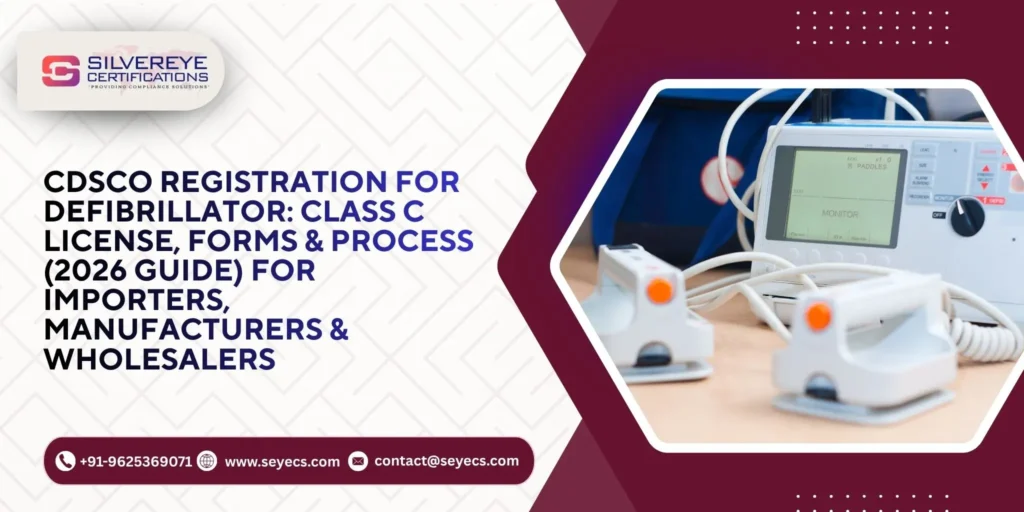
- Defibrillators — including AEDs and manual external defibrillators — are classified as Class C (moderate-to-high risk) medical devices under CDSCO's Medical Device Rules, 2017.
- Manufacturers use Form MD-7 (application) and Form MD-9 (license) from the Central Licensing Authority; importers use MD-14/MD-15, and wholesalers use MD-41/MD-42.
- CDSCO registration for defibrillators is mandatory before manufacture, import, sale, or distribution in India — non-compliance can mean product seizure and penalties.
- Manufacturing licenses are typically valid for 5 years from issue; import and wholesale licenses are generally valid in perpetuity subject to a 5-year retention fee cycle.
Introduction
CDSCO Registration for Defibrillator is mandatory under India's Medical Device Rules, 2017, before any defibrillator — automated external (AED), manual external, or related cardiac-shock device — can be manufactured, imported, sold, or distributed in the country. CDSCO classifies the defibrillator as a Class C (moderate-to-high risk) medical device because of its critical, life-saving role in cardiac emergencies.
Indian manufacturers apply through Form MD-7 and receive the manufacturing license as Form MD-9 from the Central Licensing Authority (CDSCO). Importers use Form MD-14/MD-15, and wholesalers/distributors use Form MD-41/MD-42. Manufacturing licenses are valid for 5 years; import and wholesale licenses are typically perpetual with a five-year retention fee.
What Is CDSCO Registration for Defibrillators?
A defibrillator is a medical device that delivers a controlled electric shock to the heart to correct life-threatening arrhythmias such as ventricular fibrillation and pulseless ventricular tachycardia. Because it plays a direct, critical role in cardiac resuscitation, every defibrillator sold, manufactured, or imported in India must be registered with the Central Drugs Standard Control Organization (CDSCO) under the Medical Device Rules, 2017 (MDR 2017).
CDSCO Registration for Defibrillator is the umbrella term for the licensing process that applies to manufacturers, importers, and wholesalers of this device. Depending on your role in the supply chain, you will apply for one or more of the following: a manufacturing license (MD-7/MD-9), an import license (MD-14/MD-15), or a wholesale license (MD-41/MD-42). CDSCO, functioning under the Directorate General of Health Services, Ministry of Health and Family Welfare, is the National Regulatory Authority responsible for approving and monitoring all these licenses.
Whether you manufacture a defibrillator domestically, import a defibrillator from an overseas supplier, or plan to wholesale a defibrillator to hospitals, clinics, and public-access sites, CDSCO registration for defibrillator businesses follows the same underlying framework: correct classification, complete documentation, and timely license renewal.
Why CDSCO Registration Is Mandatory for Defibrillators
Following the CDSCO notification G.S.R. 102(E) dated 11 February 2020, all medical devices in India — barring select Class A non-sterile, non-measuring devices — fall under a mandatory licensing regime. A defibrillator is a life-saving, moderate-to-high-risk device, which means a formal license is required before it can legally enter the Indian market, whether it is used in a hospital, ambulance, or public-access location.
- Ensures the device meets safety, accuracy, and performance benchmarks under the Essential Principles laid out in MDR 2017.
- Protects patients and first responders from device malfunction during a cardiac emergency.
- Legally required for hospital procurement, government tenders, public-access AED programs, and export documentation.
- Non-compliance can result in product seizure, monetary penalties, and legal action under the Drugs and Cosmetics Act, 1940.
CDSCO Classification of Defibrillator: Why It's Class C
CDSCO classifies all medical devices into four risk-based categories — Class A (low risk), Class B (low-to-moderate risk), Class C (moderate-to-high risk), and Class D (high risk) — under the First Schedule of MDR 2017. A defibrillator is classified as a Class C device because of its critical role in life-saving cardiac emergencies and the moderate-to-high risk associated with its use, whether operated by a trained clinician or a layperson using an automated external defibrillator (AED).
This Class C classification applies to the external defibrillator category — automated external defibrillators (AEDs), semi-automatic defibrillators, and manual external defibrillators used by trained healthcare professionals. This guide focuses specifically on this Class C category, in line with the applicable licensing forms: MD-7/MD-9 (manufacture), MD-14/MD-15 (import), and MD-41/MD-42 (wholesale).
Defibrillator Types Covered Under Class C
| Defibrillator Type | Description | CDSCO Class |
| Automated External Defibrillator (AED) | Portable device that automatically analyses heart rhythm and delivers a shock; designed for use by minimally trained laypersons. | Class C |
| Semi-Automatic External Defibrillator | Analyses cardiac rhythm and prompts the operator to press a button to deliver the shock. | Class C |
| Manual External Defibrillator | Used by trained healthcare professionals in hospitals and ambulances, with manual control of energy levels and ECG interpretation. | Class C |
| Defibrillator/Monitor Combination Unit | Combines external defibrillation with ECG, SpO2, and NIBP monitoring for use in Emergency Medical Systems and hospitals. | Class C |
| Regulatory Note Implantable Cardioverter Defibrillators (ICDs) — surgically implanted devices that continuously monitor heart rhythm and deliver shocks internally — are a separate notified device category and are generally classified as Class D (high risk) due to their implantable, life-sustaining nature. ICDs are not covered under this Class C guide and follow the Class D manufacturing pathway (also MD-7/MD-9, since this form covers both Class C and Class D, but with a more rigorous review). |
CDSCO Registration Pathways for Defibrillator (By Business Role)
Because external defibrillators are Class C devices, the applicable forms depend on whether you manufacture, import, or wholesale/distribute the device. Here is the complete form-wise breakdown:
| Business Role | Application Form | License/Grant Form | Licensing Authority |
| Domestic Manufacturer (Class C/D devices) | MD-7 | MD-9 | Central Licensing Authority (CDSCO) |
| Domestic Manufacturer (Class A/B devices — not applicable to defibrillator) | MD-3 | MD-5 | State Licensing Authority (SLA) |
| Importer (Foreign Manufacturer via Indian Agent) | MD-14 | MD-15 | Central Licensing Authority (CDSCO) |
| Wholesaler/Distributor/Stockist | MD-41 | MD-42 | State Licensing Authority (SLA) |
Note: MD-3 and MD-5 apply only to Class A and Class B devices such as BP monitors and thermometers. Since defibrillators are Class C, manufacturers use MD-7/MD-9, not MD-3/MD-5.
MD-7 Application and MD-9 Grant of License: Manufacturing Defibrillators (Class C/D)
Manufacturers who want to produce defibrillators within India must apply to the Central Licensing Authority (CDSCO) using Form MD-7. Once the application, supporting documents, and mandatory site inspection are satisfactorily completed, CDSCO grants the manufacturing license in Form MD-9.
Who Should Apply for MD-7/MD-9
- Domestic manufacturers setting up a facility to produce defibrillators or AEDs in India.
- Contract manufacturers producing defibrillators for a brand owner or loan licensee.
- Manufacturers who already hold a Test License (Form MD-13) and want to move to commercial production.
Documents Required for MD-9 License
- Covering letter and duly filled Form MD-7 application
- Constitution details of the manufacturer (company registration, partnership deed, or MoA, as applicable)
- Plant Master File describing the manufacturing premises, equipment, and processes
- Device Master File covering design, specifications, risk analysis, and labelling of the defibrillator
- Test License (Form MD-13), where applicable, for generating quality control data
- Quality Management System documentation as per ISO 13485:2016 or ICMED 13485
- Qualification and experience proof of the manufacturing chemist, analyst chemist, and technical staff
- Product labels, Instructions for Use (IFU), and performance evaluation report
- Proof of fee payment (challan/online receipt)
MD-7/MD-9 Process, Fees, Timeline & Validity
| Parameter | Details |
| Application Form | MD-7 (submitted via the CDSCO SUGAM portal) |
| Grant of License Form | MD-9 |
| Licensing Authority | Central Licensing Authority (CDSCO) |
| Government Fee | ₹50,000 per manufacturing site + ₹1,000 per distinct defibrillator model |
| Site Inspection | Conducted within approximately 60 days of MD-7 submission by CDSCO Medical Device Officers, with or without a Notified Body expert |
| Approval Timeline | Approximately 45 days after a satisfactory inspection; the overall process (including document preparation and query resolution) commonly takes 6 to 8 months |
| Validity | Generally 5 years from the date of issue |
| Renewal | Apply for renewal before expiry (commonly within 45 days of the due date) to avoid penalties or lapse of the license |
MD-14 Application and MD-15 Grant of License: Importing Defibrillators
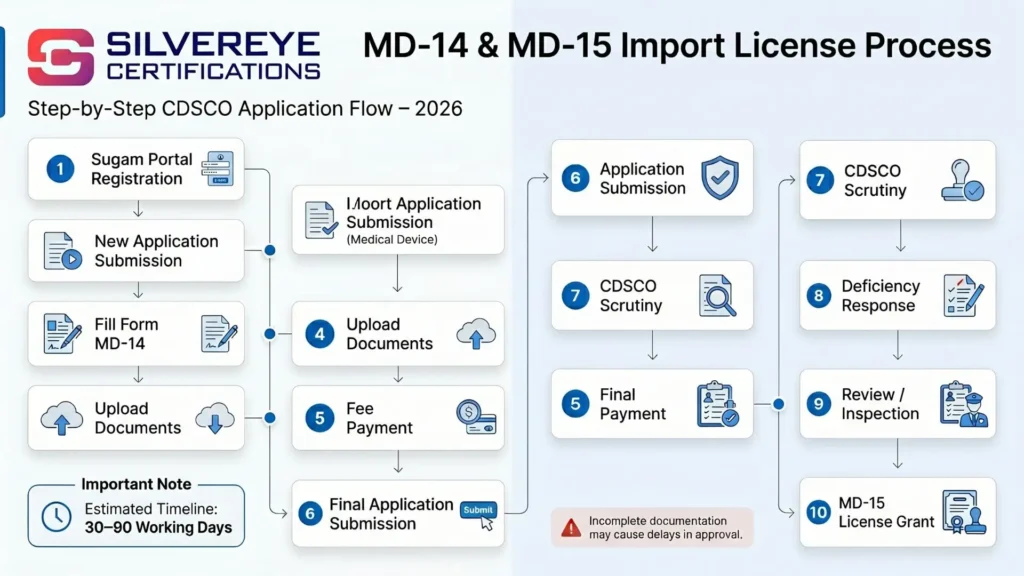
Foreign manufacturers cannot apply to CDSCO directly. A defibrillator manufactured outside India must be imported through an Indian Authorized Agent, who holds a valid wholesale license (MD-42) or manufacturing license, and who files the import application in Form MD-14 through the SUGAM portal. Since defibrillators are Class C devices, CDSCO may also conduct a manufacturing site inspection before granting the import license in Form MD-15.
Who Should Apply for MD-14/MD-15
- Foreign defibrillator manufacturers entering the Indian market (via an Indian Authorized Agent)
- Indian importers/distributors bringing in defibrillators manufactured overseas
- Companies adding new defibrillator models to an existing import license
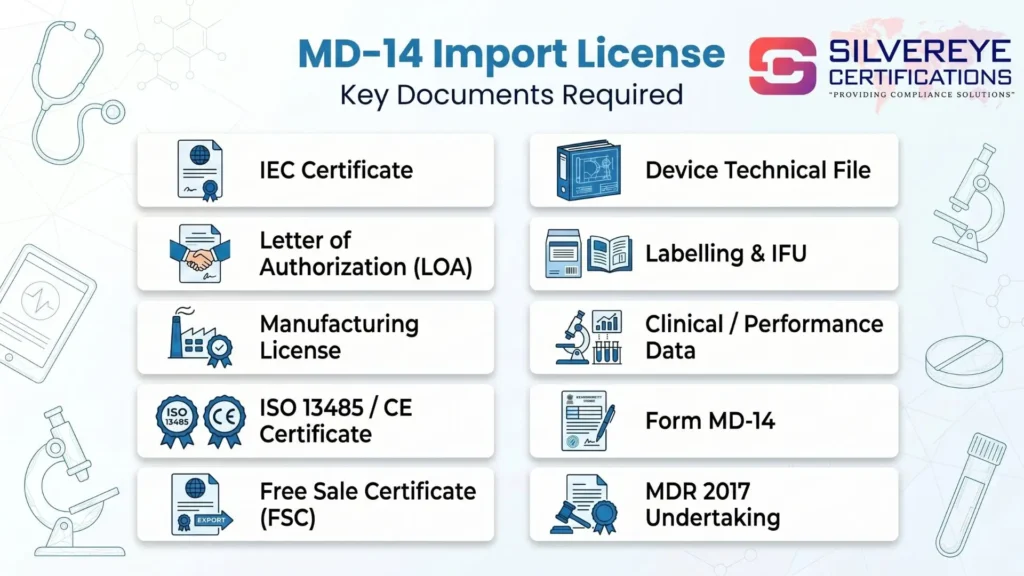
Documents Required for MD-15 License
- Form MD-14 application, duly completed
- Power of Attorney (PoA) authorizing the Indian Agent, notarized/apostilled as applicable
- Free Sale Certificate (FSC) from the country of origin's regulatory authority
- Device Master File and Plant Master File
- ISO 13485 Quality Management System certificate
- CE Marking certificate, FDA clearance, or equivalent international regulatory approval, where available
- Clinical/performance evaluation data supporting the defibrillator's safety and effectiveness
- Product labels and Instructions for Use (IFU) compliant with Indian labelling rules
- Wholesale license (MD-42) or manufacturing license of the Indian Authorized Agent
MD-14/MD-15 Process, Fees, Timeline & Validity
| Parameter | Details |
| Application Form | MD-14 (filed by the Indian Authorised Agent on the SUGAM portal) |
| Grant of License Form | MD-15 |
| Licensing Authority | Central Licensing Authority (CDSCO) |
| Government Fee (Class C) | Approximately USD 3,000 per manufacturing site + USD 1,500 per distinct device model (indicative; confirm current fee on the CDSCO portal) |
| Approval Timeline | Approximately 3 to 9 months, depending on document completeness, site inspection scheduling, and query resolution |
| Validity | Valid in perpetuity, subject to a retention fee before every 5-year cycle |
| Renewal | Retention application filed with the old license and fee challan before the 5-year cycle lapses |
MD-41 Application and MD-42 Grant of License: Wholesale of Defibrillators
Any business that wants to stock, sell, exhibit, or distribute defibrillators in India — whether sourced domestically or imported — needs a wholesale license. The applicant files Form MD-41 through the CDSCO SUGAM portal, and after document verification and a premises inspection by a Drug Inspector, the State Licensing Authority grants the license in Form MD-42.
Who Should Apply for MD-41/MD-42
- Wholesalers and stockists distributing defibrillators to hospitals, ambulance services, or corporate/public-access AED programs
- E-commerce sellers and marketplace vendors listing AEDs and defibrillators for sale
- Indian Authorized Agents who need a valid MD-42 license before filing an MD-14 import application
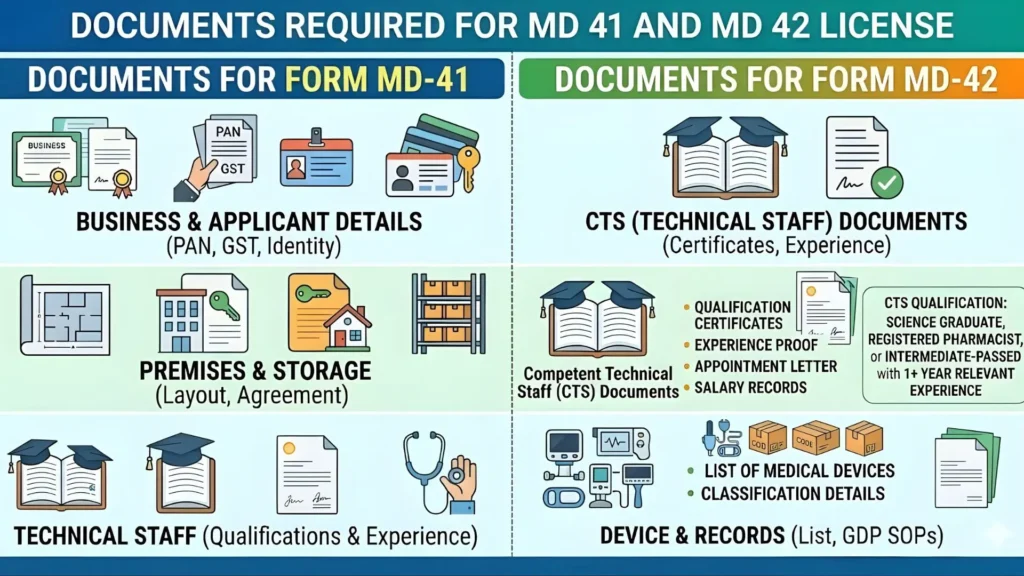
Documents Required for MD-42 License
- Form MD-41 application, duly completed
- Business registration proof (GST, PAN, incorporation certificate, or partnership deed)
- Premises proof, layout plan, and photographs of the storage facility
- Qualification and appointment proof of the Technical/Competent Person (e.g., D.Pharm, B.Pharm, or equivalent experience)
- Standard Operating Procedures (SOPs) for storage, handling, and record-keeping
- Proof of government fee payment
MD-41/MD-42 Process, Fees, Timeline & Validity
| Parameter | Details |
| Application Form | MD-41 (filed via the CDSCO SUGAM portal or applicable state portal) |
| Grant of License Form | MD-42 |
| Licensing Authority | State Licensing Authority (SLA) |
| Government Fee | Approximately ₹3,000 per premise (indicative; confirm current fee with your SLA) |
| Approval Timeline | Approximately 30 to 90 working days, depending on document readiness and inspection scheduling |
| Validity | Valid in perpetuity, subject to a retention fee before every 5-year cycle |
| Renewal | Apply for retention at least 90 days before the 5-year cycle ends to avoid business disruption |
Step-by-Step Process for CDSCO Registration for Defibrillator
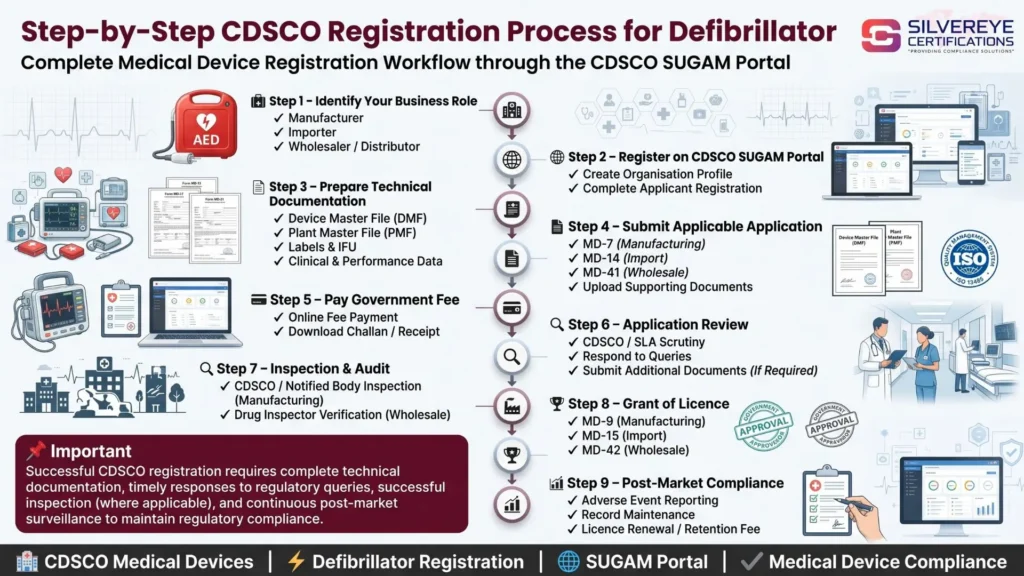
- Identify your role in the supply chain — manufacturer, importer, or wholesaler/distributor — since this determines which form(s) you file.
- Register your organization on the CDSCO SUGAM portal and complete your applicant profile.
- Compile the Device Master File, Plant Master File, labels, IFU, and clinical/performance data for the defibrillator model(s).
- Prepare role-specific documents: manufacturing (MD-7 with QMS and technical staff proof), import (MD-14 with PoA and FSC), or wholesale (MD-41 with premises proof).
- Pay the applicable government fee through the prescribed online payment mode and retain the challan/receipt.
- Submit the application online and respond promptly to any CDSCO or SLA queries or deficiency letters.
- Facilitate the CDSCO/Notified Body site inspection (for manufacturing) or Drug Inspector premises inspection (for wholesale).
- Receive the grant of license — MD-9, MD-15, or MD-42 — and begin compliant manufacturing, import, or distribution.
- Maintain post-market compliance: adverse event reporting, record-keeping, and timely license renewal or retention fee payment.
Benefits of CDSCO Registration for Defibrillator
- Legal authorization to manufacture, import, sell, or distribute defibrillators anywhere in India.
- Builds credibility with hospitals, ambulance services, corporate AED programs, and government procurement bodies.
- Reduces risk of product seizure, financial penalties, or business suspension under the Drugs and Cosmetics Act.
- Enables participation in tenders and institutional supply contracts that mandate CDSCO-licensed devices.
- Strengthens patient safety by ensuring the device meets India's Essential Principles for accuracy and performance in cardiac emergencies.
Why Choose Silvereye Certifications for CDSCO Registration
Silvereye Certifications helps manufacturers, importers, and wholesalers of defibrillators and other Class C/D medical devices navigate CDSCO's MD-7/MD-9, MD-14/MD-15, and MD-41/MD-42 processes end-to-end — from device classification and dossier preparation to SUGAM portal filing, site inspection coordination, and license renewal or retention. Our regulatory team keeps documentation aligned with the latest MDR 2017 requirements so applications move through CDSCO and the State Licensing Authority with minimal queries and delays.
Frequently Asked Questions
Is CDSCO registration mandatory for defibrillators in India?
Yes. Since the G.S.R. 102(E) notification of 11 February 2020, defibrillators — being critical, moderate-to-high-risk devices — require a mandatory CDSCO license before manufacture, import, sale, or distribution in India.
What CDSCO class does a defibrillator fall under?
External defibrillators — AEDs, semi-automatic units, and manual external defibrillators — are classified as Class C (moderate-to-high risk) medical devices under MDR 2017.
Which form do manufacturers use to get a defibrillator manufacturing license?
Manufacturers apply using Form MD-7 to the Central Licensing Authority (CDSCO). Once approved, the manufacturing license is granted in Form MD-9.
Which form is used to import defibrillators into India?
Importers, through an Indian Authorised Agent, apply using Form MD-14. CDSCO grants the import license in Form MD-15.
What license is needed to wholesale or distribute defibrillators?
Wholesalers, stockists, and distributors need to apply using Form MD-41. The State Licensing Authority grants the wholesale license in Form MD-42.
Do defibrillators need MD-3 or MD-5 licenses?
No. MD-3 and MD-5 apply only to Class A and Class B devices, such as BP monitors and thermometers. Since defibrillators are Class C, manufacturers use MD-7/MD-9 instead.
What is the government fee for an MD-9 manufacturing license?
The fee is approximately ₹50,000 per manufacturing site plus ₹1,000 for each distinct defibrillator model, payable to the Central Licensing Authority.
How long does it take to get a CDSCO manufacturing license (MD-9) for a defibrillator?
The site inspection typically happens within 60 days of MD-7 submission, with license grant following about 45 days after a satisfactory inspection. The overall process commonly takes 6 to 8 months, including document preparation and query resolution.
How long is a CDSCO manufacturing license for a defibrillator valid?
The MD-9 manufacturing license is generally valid for 5 years from the date of issue, after which it must be renewed.
Is an Implantable Cardioverter Defibrillator (ICD) the same as a Class C defibrillator?
No. ICDs are surgically implanted, life-sustaining devices and are generally classified as Class D — a separate, higher-risk category from the external Class C defibrillators covered in this guide.