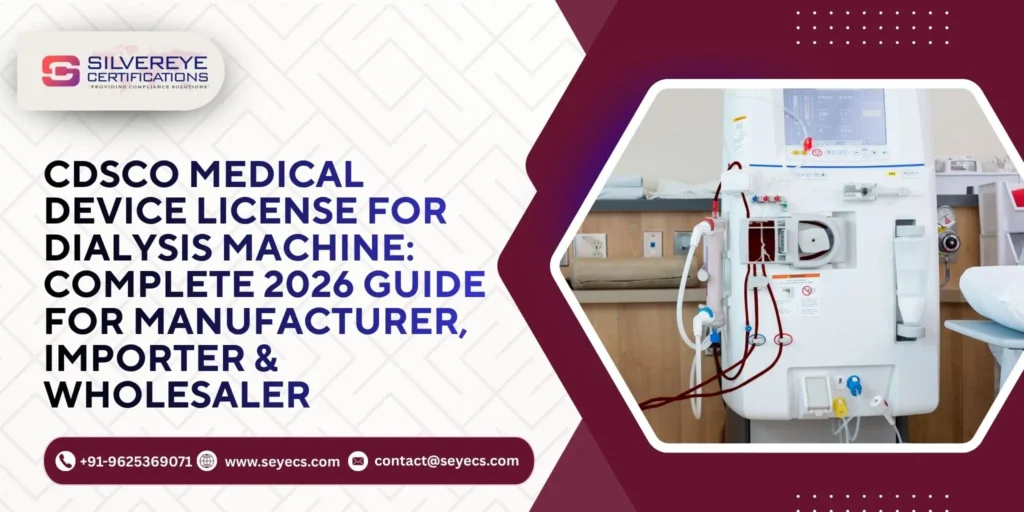
- Dialysis Machine (haemodialysis equipment) is classified as a Class C medical device under CDSCO — there is no standalone Class A, B, or D dialysis machine category.
- Manufacturers need Form MD-7 (application) and MD-9 (license); importers need Form MD-14 (application) and MD-15 (license).
- Related dialysis accessories — catheters, tubing sets, dialyzers — span Class A through D separately under CDSCO's Nephrology and Renal Care category.
- Licenses are valid in perpetuity once retention fees are paid every 5 years — there's no fixed expiry if compliance is maintained.
Introduction
A CDSCO medical device license for dialysis machine is mandatory before manufacturing, importing, or selling any haemodialysis or peritoneal dialysis machine in India. CDSCO classifies the standalone Dialysis Machine as a Class C medical device under the Medical Device Rules, 2017 — used for acute or chronic kidney failure to filter blood and remove excess water and waste products. Manufacturers apply through Form MD-7 and receive the license in Form MD-9. Importers apply through Form MD-14 and receive the license in Form MD-15.
Wholesalers/distributors apply through Form MD-41 and receive Form MD-42. Related dialysis accessories (catheters, tubing sets, dialyzers, reprocessing systems) fall under CDSCO's broader Nephrology and Renal Care category and span Class A to Class D individually. All Class C/D applications go to the Central Licensing Authority (CLA) via the SUGAM portal, supported by a Device Master File, Plant Master File, ISO 13485 certificate, and (for imports) a Free Sale Certificate. Approval typically takes 6-9 months, and the license remains valid as long as the 5-year retention fee is paid on time.
What Is CDSCO and Why It Regulates Dialysis Machines?
CDSCO (Central Drugs Standard Control Organization) is India's national regulatory authority for drugs, cosmetics, and medical devices, functioning under the Directorate General of Health Services, Ministry of Health & Family Welfare. Every medical device sold, imported, manufactured, or distributed in India — including dialysis machines — must be authorized under the Medical Device Rules, 2017 (MDR 2017).
A dialysis machine performs a life-sustaining function for patients with acute or chronic kidney failure by filtering blood outside the body and removing excess water and waste products. Because malfunction or poor manufacturing quality can directly endanger a critically ill patient, CDSCO does not allow open-market sale of dialysis machines, dialyzers, or related renal-care devices without a valid license.
CDSCO's Four Risk Classes — General Framework
To understand where the dialysis machine and its accessories sit, here is how CDSCO's four-tier risk classification system works for all medical devices under MDR 2017:
| Class | Risk Level | Regulatory Treatment | Example Devices |
| Class A | Low Risk | Subject to general controls; simplified registration | Haemodialysis chair, crimp for plier |
| Class B | Low-Moderate Risk | General controls + some special controls | Hemodialysis catheter, peritoneal dialysis catheter, dialyser connector |
| Class C | Moderate-High Risk | Stricter QMS, ISO 13485 evidence, CLA licensing | Dialysis Machine, automated peritoneal dialysis system, haemofilters |
| Class D | High Risk | Highest scrutiny; implantable/life-supporting devices | Absorbable peritoneum catheter cuff, collagen-containing peritoneum catheter cuff |
Class A — Dialysis & Renal Care Products
Class A devices in this category are low-risk, non-invasive support equipment used alongside dialysis treatment rather than the dialysis machine itself. Per CDSCO's official Nephrology and Renal Care classification notice, the following products are confirmed Class A:
| Product Name | Intended Use |
| Chair, Haemodialysis (Electrically Powered/Manual) | Supports the patient in a seated or reclined posture during haemodialysis procedures |
| Crimp for Plier, Haemodialysis | Used to manipulate the arteriovenous shunt of patients requiring haemodialysis |
Insert any additional Class A products from your own portfolio here once shared — each should be verified against the official CDSCO notified list before filing.
Class B — Dialysis & Renal Care Products
Class B covers catheters, connectors, tubing, and test components that have direct but lower-risk contact with the dialysis circuit. Confirmed Class B products from the official CDSCO notice include:
| Product Name | Intended Use |
| Hemodialysis Catheter | A catheter used for exchanging blood to and from the haemodialysis machine from the patient |
| Single Needle Hemodialysis Catheter / Blood Lines | Single-needle dialysis access using one cannula or a single lumen catheter |
| Peritoneal Dialysis Catheter | Allows dialysis fluid to enter the abdominal cavity, dwell, and drain back out |
| Peritoneal Dialysis Transfer Set | Tubing that connects the catheter to the bag of dialysis solution |
| Dialyser Connector | Connects between a dialysis fluid circuit and dialyzer |
| Hemodialysis Blood Tubing / Extracorporeal Systems | Sterilized blood tubing for hemodialysis, hemofiltration, and hemodiafiltration |
| Rigid Nephroscope | Visual examination, diagnosis, and treatment of the kidney and renal pelvis |
| Peritoneal Dialysis Ultraviolet Irradiation Unit | Ultraviolet irradiation for disinfection of peritoneal dialysis transfer tube set components |
| Haemodialysis Dialysate Water Chlorine Test Kit/Strip | Indicates total chlorine concentration in water used to prepare dialysate |
| Shunt Thrombus Suction Set | Suctions a thrombus developing inside an arteriovenous shunt during hemodialysis |
This is a representative selection from the official 44-device Nephrology and Renal Care list. Insert your specific Class B product list here once shared.
Class C — Dialysis & Renal Care Products (Includes the Dialysis Machine)
This is the correct and primary classification for the Dialysis Machine itself, along with most of the active, electrically-powered dialysis-system components. All core manufacturing, import, and distribution licensing for dialysis machines runs through the Class C process.
| Product / Model Name | Intended Use |
| Dialysis Machine (Haemodialysis Equipment) | Used for acute or chronic kidney failure; filters blood to remove excess water and waste products |
| Automated Peritoneal Dialysis System | An active medical device intended to perform peritoneal dialysis |
| Haemodialyzer Reprocessing System | Cleans, rinses, tests, and disinfects haemodialysis dialyzers after each use for reuse |
| Hollow-Fibre Haemodialysis Dialyser | Hollow fibre filter to remove impurities/fluid from the blood via the haemodialysis machine |
| Haemofilters | Allows for the removal of toxins and/or replacement of electrolytes during haemofiltration |
| Hemodiafiltration System | Device used for blood purification with a hemodiafilter |
| Reverse Osmosis Unit (for Dialysis) | Produces water through reverse osmosis suitable for use with haemodialysis equipment |
| Multi-Patient Dialysis Fluid Delivery System | Prepares and supplies dialysis fluid for two or more patients simultaneously |
| Hemodialysis Catheter (Long Term) | A long-term dialysis catheter with two lumens (venous and arterial) |
| Haemodialysis System Central Monitor | Connects with multiple haemodialysis systems to aid monitoring several treatments simultaneously |
Class D — Dialysis & Renal Care Products
Class D is reserved for the highest-risk renal-care products — primarily implantable components that stay embedded in the body for extended periods rather than the dialysis machine itself. Confirmed Class D products include:
| Product Name | Intended Use |
| Absorbable Peritoneum Catheter Cuff | Maintains stable contact between the skin and the peritoneal dialysis catheter and prevents bacterial invasion; embedded subcutaneously at the catheter outlet |
| Collagen-Containing Peritoneum Absorbable Catheter Cuff | A biodegradable, collagen-containing cuff embedded subcutaneously at the outlet of the peritoneal dialysis catheter |
No dialysis machine (the equipment unit itself) carries a Class D classification — only specific implantable accessories used alongside peritoneal dialysis catheters fall into this class.
Why You Need a CDSCO License for Dialysis Machine
- It is a legal requirement under MDR 2017 — manufacturing, importing, or distributing a dialysis machine without a valid license is a punishable offence under the Drugs and Cosmetics Act.
- Hospitals, dialysis centres, and government tenders require proof of CDSCO licensing before procurement.
- It assures buyers and regulators that the device has passed quality management, safety, and performance checks for a life-sustaining therapy.
- It is mandatory for customs clearance of imported dialysis machines and related consumables at Indian ports.
- Operating an unlicensed dialysis equipment business can lead to product seizure, application blacklisting, and legal penalties.
CDSCO License Pathways for Dialysis Machine: Complete Overview
Because the Dialysis Machine is a Class C device, your license pathway depends on your role in the supply chain — manufacturer, importer, or wholesaler/distributor. Each role uses a different form pair and goes to a different licensing authority.
| Role | Application Form | License Form | Licensing Authority | Validity |
| Manufacturer (India-based) | MD-7 | MD-9 | Central Licensing Authority (CLA) | 5 years (perpetual with retention fee) |
| Importer (foreign manufacturer via Indian agent) | MD-14 | MD-15 | Central Licensing Authority (CLA) | 5 years (perpetual with retention fee) |
| Wholesaler / Distributor / Stockist | MD-41 | MD-42 | State Licensing Authority (SLA) | 5 years (renewable) |
Manufacturing License for Dialysis Machine (Class C) — Form MD-7 & MD-9
Companies that manufacture dialysis machines in India for sale or distribution must apply through Form MD-7 to the Central Licensing Authority. Once approved, the manufacturing license is granted in Form MD-9. (For comparison, Class A/B devices — such as a haemodialysis chair or a hemodialysis catheter — use the lighter MD-3/MD-5 pathway through the State Licensing Authority. The dialysis machine unit itself does not qualify for this route since it is Class C.)
MD-7 Application Process — Step by Step
- Register your company on the CDSCO SUGAM online portal and obtain login credentials.
- Confirm your facility meets Good Manufacturing Practice (GMP) requirements under MDR 2017 — cleanroom areas where applicable, calibrated equipment, quality control zone, and documented SOPs.
- Prepare your Device Master File (DMF) — covering device design, specifications, risk analysis, manufacturing process, and performance/safety data.
- Prepare your Plant Master File (PMF) — covering manufacturing site layout, equipment list, and quality systems.
- Submit Form MD-7 online via SUGAM along with the prescribed fee challan.
- The State/Central Licensing Authority schedules a physical inspection of your manufacturing site.
- If the inspection and documentation are satisfactory, the license is granted in Form MD-9.
Documents Required for MD-7 (Manufacturing — Class C)
- Covering letter on company letterhead
- Form MD-7 application (auto-generated via SUGAM)
- Fee payment challan/proof
- Device Master File (DMF)
- Plant Master File (PMF)
- ISO 13485:2016 Quality Management System certificate
- Proof of company constitution — incorporation certificate, GST registration, factory licence
- List of technical staff with qualifications
- Site layout plan and equipment list
- Labelling and Instructions for Use (IFU) draft
MD-7/MD-9 Fees (Class C Manufacturing)
Government fees for manufacturing licenses are charged per manufacturing site plus a per-product/device fee, as prescribed under the Second Schedule of MDR 2017. Exact fee totals depend on the number of sites and products being grouped under one application — always confirm the current fee challan amount on the SUGAM portal before submission, as government fee schedules are periodically revised.
Import License for Dialysis Machine — Form MD-14 & MD-15
Foreign manufacturers who want to export dialysis machines into India cannot apply directly. They must appoint an Authorized Indian Agent who already holds a valid Wholesale License (Form MD-42) or a Manufacturing License (Form MD-5/MD-9). The Indian agent then files Form MD-14 with the Central Licensing Authority on the manufacturer's behalf, and once approved, the import license is granted in Form MD-15.
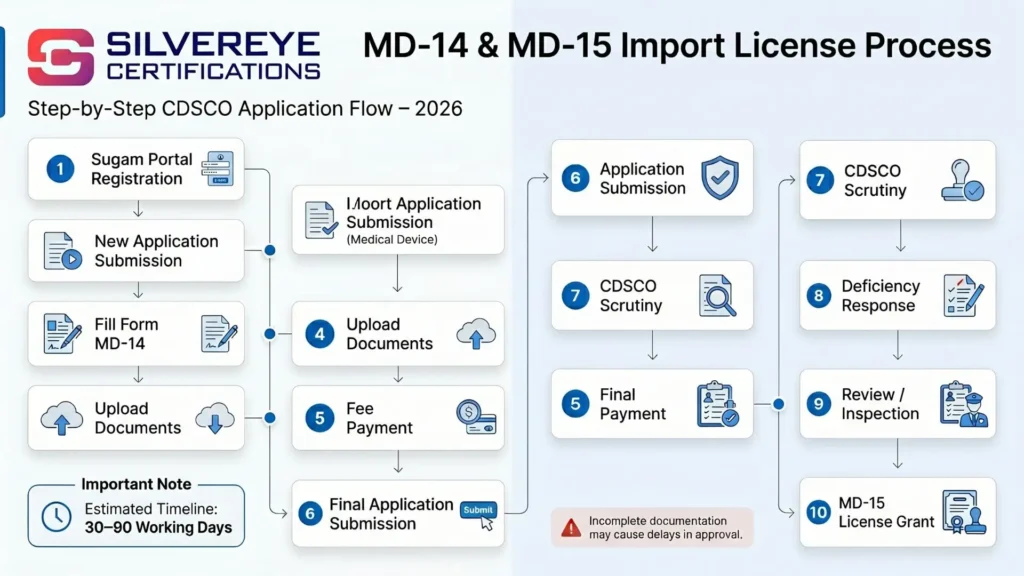
MD-14 Application Process — Step by Step
- Appoint an Authorized Indian Agent holding a valid MD-42 wholesale licence or MD-5/MD-9 manufacturing licence.
- Prepare a Power of Attorney (POA) from the foreign manufacturer to the Indian agent, notarized and apostilled (or authenticated via Indian Embassy / Magistrate of First Class).
- Compile the Device Master File and a Free Sale Certificate (FSC) from the country of origin or a GHTF reference country (USA, EU, UK, Canada, Japan, Australia).
- Submit Form MD-14 on the SUGAM portal with the fee challan and all supporting documents.
- CDSCO may conduct an inspection of the overseas manufacturing site; the applicant bears the inspection cost.
- On satisfaction, the Central Licensing Authority grants the import license in Form MD-15, typically within a defined statutory review window.
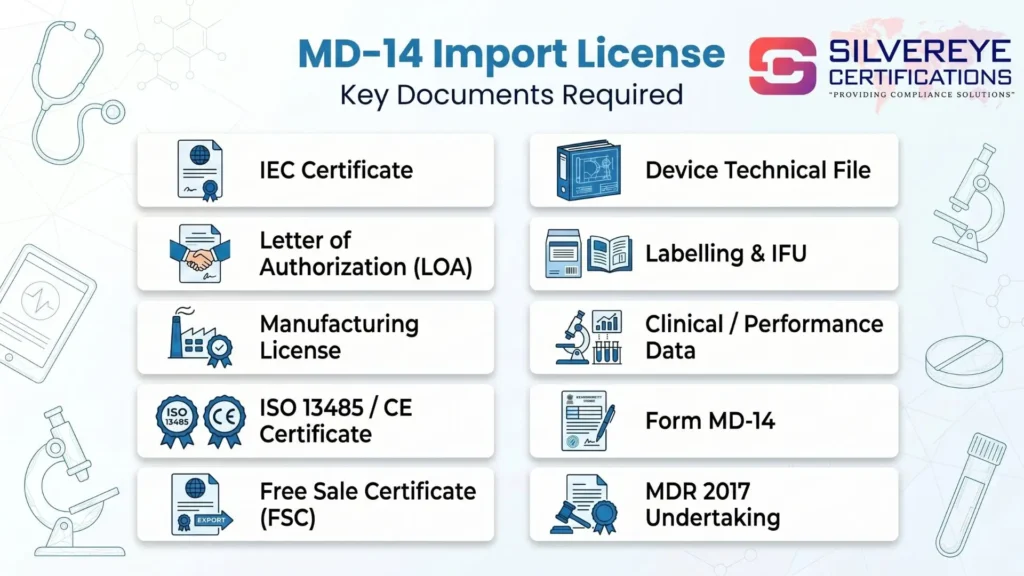
Documents Required for MD-14 (Import — Class C)
- Covering letter
- Form MD-14 application
- Fee payment challan
- Power of Attorney with undertaking (per Fourth Schedule, Part I of MDR 2017)
- Copy of Indian agent's Wholesale Licence (MD-42) or Manufacturing Licence
- Free Sale Certificate (FSC) / Marketing Authorization from country of origin
- Device Master File (DMF)
- Plant Master File of the overseas manufacturing site
- ISO 13485 / Quality Management System certificate of the manufacturer
- Labelling and IFU (in English)
- Latest audit/inspection report of the manufacturing site, if available
MD-14/MD-15 Fees and Timeline (Class C Import)
Import license fees are charged per manufacturing site and per distinct device/brand under the Second Schedule of MDR 2017, and are paid in foreign currency (USD) for overseas applicants. Class C and D import applications generally take longer to process than Class A/B due to the additional site-inspection requirement — applicants should typically plan for a 6 to 9 month timeline, though CDSCO's statutory outer limit for a decision after an overseas site inspection is 9 months from the date of application.
Wholesale License for Dialysis Equipment Dealers — Form MD-41 & MD-42
Retailers, wholesalers, distributors, and stockists who want to sell or distribute dialysis machines and related consumables (without manufacturing or importing it themselves) need a wholesale license from the State Licensing Authority (SLA). The application is filed in Form MD-41, and the certificate is granted in Form MD-42.
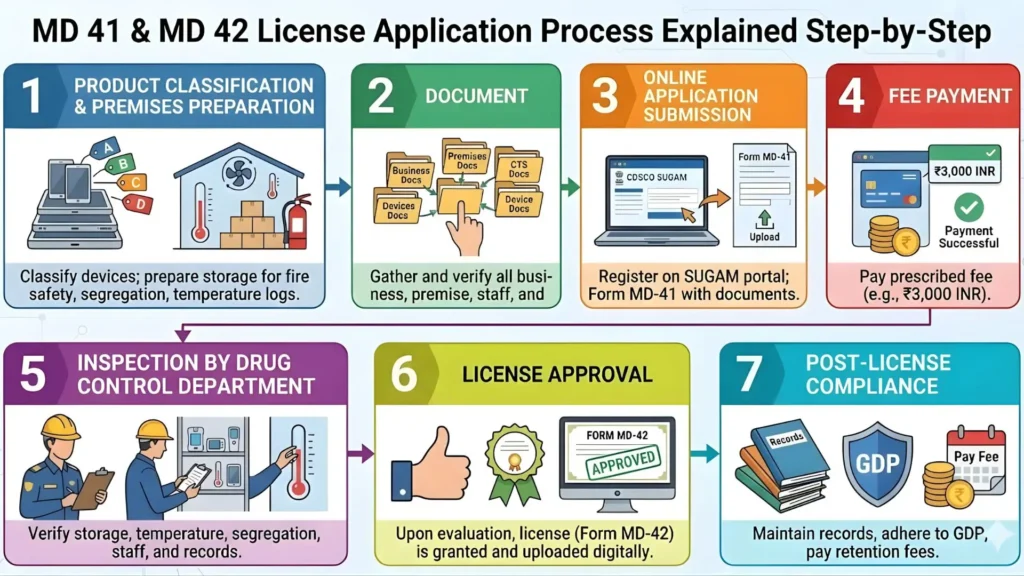
MD-41 Application Process — Step by Step
- Identify the State Licensing Authority (SLA) of the state where your wholesale premises are located.
- Prepare proof of business premises — rent agreement or ownership document, and storage facility details.
- Appoint a qualified technical staff member responsible for the wholesale operations, as required by MDR 2017.
- Submit Form MD-41 on the SUGAM portal along with the prescribed fee.
- The SLA reviews documentation and may inspect the premises.
- On approval, the Medical Device Wholesale Licence is granted in Form MD-42.
Documents Required for MD-41 (Wholesale)
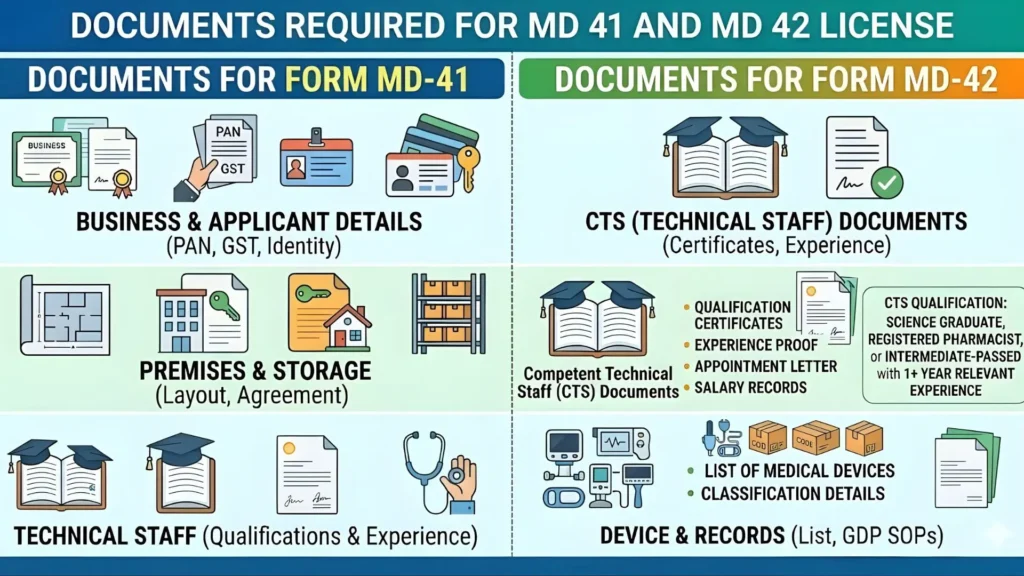
- Form MD-41 application
- Fee payment proof
- Proof of premises (ownership/rental documents)
- Storage facility and layout details
- Constitution documents of the business (partnership deed/incorporation certificate)
- Details and qualification proof of technical/competent staff
- Identity and address proof of the proprietor/partners/directors
MD-42 Validity and Renewal
The MD-42 wholesale licence is typically issued for a 5-year period. To keep it valid beyond that period, the licensee must pay the prescribed retention fee to the State Licensing Authority and confirm continued compliance with MDR 2017 before expiry.
MD-3 & MD-5 — When These Apply to Dialysis-Related Products
Form MD-3 (application) and Form MD-5 (license) are the manufacturing pathway specifically for Class A and Class B medical devices, processed through the State Licensing Authority rather than the Central Licensing Authority. Because the Dialysis Machine itself is Class C, manufacturers of the machine must use Form MD-7/MD-9. However, if your portfolio includes Class A or B dialysis accessories — such as a haemodialysis chair, a hemodialysis catheter, or a peritoneal dialysis transfer set — those specific products are correctly filed under MD-3/MD-5.
| Parameter | MD-3 / MD-5 Route | MD-7 / MD-9 Route |
| Applicable Class | Class A & B | Class C & D |
| Application Form | MD-3 | MD-7 |
| License Form | MD-5 | MD-9 |
| Licensing Authority | State Licensing Authority (SLA) | Central Licensing Authority (CLA) |
| Applies to Dialysis Machine (unit)? | No | Yes |
| Applies to dialysis accessories (catheters, chairs, connectors)? | Yes, if individually classed A/B | Yes, if individually classed C/D |
Eligibility Criteria for CDSCO Dialysis Machine License
- The applicant company must be legally registered in India (for manufacturing/wholesale) or have a duly appointed Indian Authorized Agent (for imports).
- The manufacturing facility must comply with Good Manufacturing Practices (GMP) and maintain a documented Quality Management System (ISO 13485 recommended, though not legally mandatory for the licence itself).
- The applicant must employ qualified technical staff competent to handle Class C medical device operations involving life-sustaining renal therapy equipment.
- For imports, the foreign manufacturer must hold a Free Sale Certificate from its country of origin or a recognized GHTF reference country.
- The Indian agent for import applications must independently hold a valid Wholesale License (MD-42) or Manufacturing License.
- All product/brand details (model number, intended use, GMDN code) must be consistent across the Device Master File, label, IFU, and application form.
CDSCO License Fees for Dialysis Machine
Government fees are prescribed under the Second Schedule of MDR 2017 and vary by device class, number of manufacturing sites, and number of distinct products/brands grouped in a single application. The figures below are indicative; always verify the current fee challan amount directly on the SUGAM portal at the time of filing, since government fee notifications are revised periodically.
| License Type | Fee Basis | Validity |
| Manufacturing License (MD-7/MD-9) | Per manufacturing site + per device, as per Second Schedule | 5 years; retention fee thereafter |
| Import License (MD-14/MD-15) — Class C | Per overseas site + per device, paid in USD as per Second Schedule | 5 years; retention fee thereafter |
| Wholesale License (MD-41/MD-42) | As prescribed by the respective State Licensing Authority | 5 years; renewable |
Exact rupee/dollar figures are not quoted here to avoid publishing outdated numbers — please confirm live fee amounts on the SUGAM portal (cdscomdonline.gov.in) before payment, since this guide prioritises accuracy over a fixed number that may change.
CDSCO Dialysis Machine License Timeline
| Stage | Typical Duration |
| SUGAM portal registration & credential approval | 3–5 working days |
| Document preparation (DMF, PMF, QMS, labelling) | 4–8 weeks (varies by readiness) |
| Application review & query resolution | 4–12 weeks |
| Site inspection (domestic or overseas) | Scheduled after document review |
| Final decision on Class C/D import applications | Up to 9 months statutory outer limit after site inspection |
| Typical total time (manufacturing or import, Class C) | 6–9 months |
Validity, Renewal, and Retention Fee Rules
CDSCO manufacturing and import licenses for medical devices, including dialysis machines, are now treated as valid in perpetuity rather than having a hard expiry date — provided the licensee pays the prescribed retention fee every 5 years and submits updated compliance documents on time.
Renewal Process
- Track your license's 5-year retention due date from the date of original issue.
- Pay the retention fee for the manufacturing/import license (per site) and for each approved product endorsement.
- Submit updated documents: renewed Free Sale Certificate (for imports), declaration of no unauthorized changes to product or manufacturing process, and any adverse event/recall disclosures.
- CDSCO reviews the retention submission and issues a Retention Certificate confirming continued validity.
Common Reasons CDSCO Dialysis Machine Applications Get Delayed or Rejected
- Incorrect device classification or filing under the wrong form (e.g., using MD-3/MD-5 for the main dialysis machine instead of MD-7/MD-9).
- Confusing the dialysis machine's classification with that of its accessories — each catheter, tubing set, or connector must be checked individually against the Nephrology and Renal Care list.
- Mismatch between model number/brand name across the Device Master File, label, IFU, and Free Sale Certificate.
- Missing or improperly notarized/apostilled Power of Attorney for import applications.
- Incomplete Plant Master File or absent ISO 13485 quality system evidence.
- Indian agent's wholesale or manufacturing license not valid or not matching the application.
- Free Sale Certificate not sourced from an accepted GHTF reference country when required.
Conclusion: Getting Your CDSCO License for Dialysis Machine Right the First Time
The most important step in this entire process is correctly identifying that the Dialysis Machine itself is a Class C medical device — this single fact determines every form, fee, and authority you'll deal with afterward. If your portfolio also includes accessories like catheters, tubing sets, or connectors, double-check each one individually against the Nephrology and Renal Care classification list, since these can fall anywhere from Class A to Class D.
Manufacturers go through MD-7/MD-9, importers go through MD-14/MD-15, and wholesalers go through MD-41/MD-42, all under the supervision of the Central Licensing Authority for the manufacturing/import side and the State Licensing Authority for the wholesale side. Getting documentation, classification, and timelines right from the start is the difference between a 6-month approval and a year of avoidable rejections.
Frequently Asked Questions
Is a Dialysis Machine a Class A, B, C, or D medical device under CDSCO?
The standalone Dialysis Machine (haemodialysis equipment) is classified as a Class C medical device under CDSCO. Related accessories like catheters, tubing sets, and connectors are classified separately and can fall under Class A, B, C, or D depending on the specific product.
Which form is used to apply for a dialysis machine manufacturing license?
Manufacturers apply using Form MD-7 to the Central Licensing Authority. Once approved, the manufacturing license is granted in Form MD-9.
Which form is used to import a dialysis machine into India?
Importers (through an Authorized Indian Agent) apply using Form MD-14. The import license is then granted in Form MD-15.
What form do dialysis equipment wholesalers or distributors need?
Wholesalers and distributors apply using Form MD-41 to the State Licensing Authority, and the wholesale license is granted in Form MD-42.
Can a Class A/B manufacturing license (MD-3/MD-5) cover a dialysis machine?
No, not for the dialysis machine unit itself, since it is Class C. However, MD-3/MD-5 does apply correctly to individual Class A/B accessories such as a haemodialysis chair or a hemodialysis catheter.
What is the difference between a dialysis machine and a dialyzer for licensing purposes?
The dialysis machine is the equipment unit and is Class C. The dialyzer (hollow-fibre haemodialysis dialyser) is a separate consumable component, also classified as Class C, but registered as its own distinct product under the Nephrology and Renal Care category.
Who is the licensing authority for dialysis machine licenses?
All dialysis machine manufacturing and import licenses (Class C) are granted by the Central Licensing Authority (CLA). Wholesale licenses are granted by the respective State Licensing Authority (SLA).
How long does it take to get a CDSCO dialysis machine license?
Manufacturing and import licenses for Class C devices like dialysis machines typically take 6 to 9 months, depending on document readiness and inspection scheduling.
How long is a CDSCO dialysis machine license valid?
Licenses are valid in perpetuity, provided the retention fee is paid every 5 years along with submission of updated compliance documents.
What documents are mandatory for a dialysis machine import license?
Key documents include Form MD-14, Power of Attorney, Free Sale Certificate, Device Master File, Plant Master File, ISO 13485 certificate, and the Indian agent's valid Wholesale or Manufacturing License.
Is ISO 13485 certification mandatory for a CDSCO dialysis machine license?
It is not strictly mandated by MDR 2017 for the licence itself, but in practice a valid ISO 13485 certificate and Plant Master File are treated as sufficient quality system evidence and are strongly recommended.
What happens if I don't renew my CDSCO dialysis machine license?
If the 5-year retention fee is not paid and updated documents are not submitted, the license can lapse, halting further legal sale, import, or distribution of the device until it is rectified.