- ECG machines are regulated as Class A, B, C, or D medical devices under MDR 2017 — registration is mandatory before import or manufacture in India.
- Importers must file MD-14 on the SUGAM portal and hold a valid MD-15 import license before the first commercial shipment of any ECG device.
- Indian manufacturers need MD-3/MD-5 for Class A/B ECG devices or MD-7/MD-9 for Class C/D devices such as holter systems and EP mapping systems.
- Wholesalers distributing ECG machines must hold MD-41 (application) and MD-42 (wholesale license) from the State Licensing Authority.
Introduction
CDSCO ECG Machine Registration is mandatory under Medical Devices Rules (MDR) 2017 for all ECG devices imported or manufactured in India. ECG machines are classified as Class A, B, C, or D based on risk. Importers file MD-14 and receive MD-15. Indian manufacturers need MD-3/MD-5 (Class A/B) or MD-7/MD-9 (Class C/D). Wholesalers require MD-41/MD-42. All applications are filed on the SUGAM portal. Compliance is mandatory for all commercial ECG device activity in India from 2026.
What Is CDSCO ECG Machine Registration?
ECG (Electrocardiogram) machines are classified as medical devices under the Medical Devices Rules (MDR) 2017, regulated by the Central Drugs Standard Control Organization (CDSCO) under India's Ministry of Health and Family Welfare. Any company or individual wishing to import, manufacture, or distribute ECG equipment commercially in India must obtain the appropriate CDSCO license before commencing operations.
The MDR 2017 brought ECG machines — including electrodes, holter monitors, EP systems, and AI-driven cardiac monitors — under a structured risk-based framework. The class of your ECG device (A through D) determines which license forms you file, which authority reviews your application, and how long the approval process takes.
Regulatory Authority: CDSCO (Central Drugs Standard Control Organization), operating under the Drugs and Cosmetics Act 1940 and Medical Devices Rules 2017.
Why Is CDSCO Registration Mandatory for ECG Machines?
ECG machines are direct-contact cardiac diagnostic devices. An inaccurate or substandard ECG reading can delay or miss a life-threatening condition such as myocardial infarction, ventricular fibrillation, or complete heart block. CDSCO registration ensures that every ECG device entering India meets:
- Applicable safety and performance standards (IEC 60601-1, IEC 60601-2-25, IEC 60601-2-47 for ambulatory ECG)
- Electromagnetic compatibility requirements (IEC 60601-1-2) to prevent interference in clinical environments
- Biocompatibility of all patient-contact parts (ISO 10993 series for electrodes and skin-worn devices)
- Software safety validation (IEC 62304) for ECG interpretation algorithms and AI-enabled arrhythmia detection
- Post-market surveillance and adverse event reporting obligations under MDR 2017
- Accurate labelling, instructions for use (IFU), and Unique Device Identification (UDI) compliance
Importing or manufacturing ECG machines without a valid CDSCO license is a cognizable offence under MDR 2017, attracting financial penalties, import holds, and criminal liability for the authorized signatory.
ECG Machine Classification Under MDR 2017 (Class A, B, C & D)
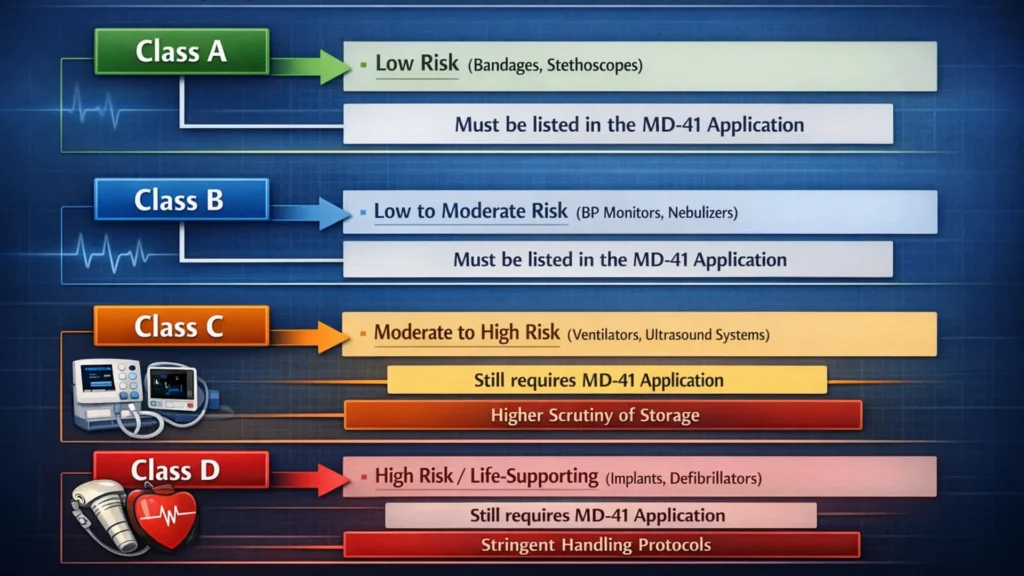
CDSCO classifies ECG devices into four risk categories under MDR 2017. The classification is based on the degree of patient contact, the invasiveness of the device, its duration of use, and the potential clinical consequence of device failure. Understanding your device class is the first and most critical step in the CDSCO registration process.
| Device Class | Risk Profile & Regulatory Implication |
| Class A | Lowest risk. Passive accessories and consumables. Self-certifiable. Notified Body not required. |
| Class B | Low-to-moderate risk. Standard diagnostic ECG devices. Notified Body audit required for manufacturers. |
| Class C | Moderate-to-high risk. Advanced diagnostic and ambulatory ECG systems. Full conformity assessment required. |
| Class D | Highest risk. Invasive intracardiac ECG and implantable devices. Central CDSCO review with full clinical evidence. |
Class A ECG Medical Devices (Low Risk — Passive Accessories & Consumables)
Class A ECG devices are passive, non-powered accessories that support ECG workflows. They do not independently acquire or process cardiac signals. Examples include disposable electrodes, lead wires, conductive gel, and thermal ECG paper. Although considered the lowest-risk category, all Class A devices must be registered on the SUGAM portal before market entry.
| S. No. | Device Name / Product | Intended Use / Description | Risk Class |
| 1 | ECG Electrode (Disposable) | Single-use adhesive electrode; passive skin-contact sensor with no active electronics | Class A |
| 2 | ECG Lead Wire / Cable (Non-powered) | Passive cable connecting patient electrodes to ECG machine; no signal processing | Class A |
| 3 | ECG Holter Recorder Patch — Electrode Only | Adhesive patch component; passive, no built-in electronics | Class A |
| 4 | ECG Conductive Gel / Paste | Conductive gel applied to skin for improved electrode contact; non-sterile accessory | Class A |
| 5 | ECG Paper / Thermal Recording Paper | Thermal paper roll for printing ECG waveforms; consumable accessory | Class A |
| 6 | ECG Machine Carrying Case / Protective Bag | Physical protective accessory for portable ECG devices; no clinical function | Class A |
| 7 | ECG Suction Cup Electrode (Reusable, Non-Powered) | Rubber suction cup to secure chest electrodes; passive attachment accessory | Class A |
| 8 | ECG Limb Clamp Electrode (Reusable) | Reusable metal clip electrode for limb leads; passive, no signal processing | Class A |
Class B ECG Medical Devices (Low-to-Moderate Risk — Standard Diagnostic ECG)
Class B covers the most widely used ECG devices in Indian clinical practice — resting 12-lead machines, portable monitors, basic holter recorders, and stress test systems. Manufacturers require a Notified Body conformity assessment before the State Licensing Authority grants an MD-5 manufacturing license. Importers must file MD-14 and hold MD-15.
| S. No. | Device Name / Product | Intended Use / Description | Risk Class |
| 1 | Resting 12-Lead ECG Machine (Standard) | Records standard 12-lead resting ECG for cardiac diagnosis in clinical settings | Class B |
| 2 | Single-Channel ECG Machine | Single-lead ECG recording for basic arrhythmia detection; used in primary care | Class B |
| 3 | 3-Channel ECG Machine | Simultaneous 3-lead acquisition with thermal printer; general diagnostic use | Class B |
| 4 | 6-Channel ECG Machine | 6-lead simultaneous ECG recording for expanded clinical diagnosis | Class B |
| 5 | Portable / Handheld ECG Monitor | Battery-operated, single or 3-lead ECG for point-of-care or home monitoring | Class B |
| 6 | Stress ECG System (Basic Treadmill ECG) | Exercise ECG with basic treadmill protocol; monitors ST changes during exertion | Class B |
| 7 | Holter Monitor (24/48-Hour Ambulatory ECG) | Wearable long-term ECG recorder for arrhythmia detection over 24–48 hours | Class B |
| 8 | Wireless ECG Transmitter (Basic Telemetry) | Short-range wireless ECG telemetry for in-hospital patient monitoring | Class B |
| 9 | Fetal ECG Monitor (External, Non-Invasive) | External fetal heart rate and ECG monitoring during antenatal assessment | Class B |
| 10 | Veterinary ECG Machine | ECG recording adapted for animals; diagnostic imaging for veterinary practice | Class B |
| 11 | PC-Based ECG System (Software + Hardware) | ECG acquisition hardware paired with PC software for data storage and reporting | Class B |
| 12 | ECG Interpretation Software (Standalone, Class B) | Software providing automated ECG interval measurement and basic arrhythmia flagging | Class B |
| 13 | Bedside Patient Monitor with ECG Module (Basic) | Bedside vital signs monitor with integrated basic ECG channel for ward use | Class B |
| 14 | Smartphone-Compatible ECG Device (Consumer Medical) | Single or 2-lead ECG recorded via smartphone app; cleared for atrial fibrillation screening | Class B |
Class C ECG Medical Devices (Moderate-to-High Risk — Advanced & Ambulatory Systems)
Class C ECG devices include AI-powered arrhythmia detection systems, multi-day ambulatory monitors, implantable loop recorders, and hospital telemetry systems. These devices require a full technical file, clinical evaluation report (CER), post-market surveillance plan, and — for manufacturers — an ISO 13485-certified QMS audited by a CDSCO-recognized Notified Body.
| S. No. | Device Name / Product | Intended Use / Description | Risk Class |
| 1 | 12-Lead ECG Machine with Advanced Analysis Software | Full 12-lead ECG with AI/algorithm-driven diagnostic interpretation; used in secondary care | Class C |
| 2 | Cardiac Stress Testing System (Advanced Exercise ECG) | Multi-lead stress ECG with advanced protocol management, haemodynamic monitoring, and diagnostic reporting | Class C |
| 3 | Holter Monitor with AI Arrhythmia Detection (Long-Term, >7 days) | Extended ambulatory ECG with automated AI arrhythmia classification over 7–30 days | Class C |
| 4 | Implantable Loop Recorder (ILR / ICM) | Subcutaneously implanted ECG monitor for long-term (up to 3 years) arrhythmia detection | Class C |
| 5 | Remote Patient Monitoring ECG System | Cloud-connected ECG device transmitting real-time data to clinical dashboard; AI-enabled alerts | Class C |
| 6 | Hospital Telemetry ECG System (Central Station) | Central multi-bed telemetry monitoring system with real-time ECG from multiple patients simultaneously | Class C |
| 7 | High-Resolution ECG System (Signal-Averaged ECG) | Records late potentials and microvolt T-wave alternans; used in electrophysiology risk stratification | Class C |
| 8 | ECG-Gated Imaging Trigger System | ECG trigger interface for cardiac CT/MRI gating; integrated into imaging workflows | Class C |
| 9 | Vectorcardiography (VCG) System | 3D spatial representation of cardiac electrical activity; used in advanced electrophysiology | Class C |
| 10 | Ambulatory Blood Pressure + ECG Combined Monitor | Combined 24-hour ABP and ECG holter recording device for cardiovascular risk profiling | Class C |
| 11 | Wearable ECG Patch (Multi-Day, AI-Enabled, Prescription) | Extended-wear adhesive ECG patch with AI arrhythmia detection; prescription medical device | Class C |
| 12 | Cardiac Rehabilitation ECG Monitoring System | Supervised exercise ECG monitoring system used in cardiac rehab programmes | Class C |
Class D ECG Medical Devices (Highest Risk — Invasive & Implantable Cardiac Devices)
Class D represents the highest-risk ECG-related devices — invasive EP recording systems, intracardiac mapping systems, and implantable ECG monitors. CDSCO's Central Licensing Authority (CLA) directly manages all Class D approvals. Full clinical investigation data, ISO 13485 QMS certification, and comprehensive risk management documentation (ISO 14971) are mandatory.
| S. No. | Device Name / Product | Intended Use / Description | Risk Class |
| 1 | Electrophysiology (EP) Recording System | Intracardiac multi-channel electrophysiology recording during invasive EP studies and ablation procedures | Class D |
| 2 | Intracardiac ECG Catheter System | Catheter-based intracardiac electrogram recording for diagnostic EP mapping; invasive | Class D |
| 3 | 3D Electroanatomical Mapping System (CARTO / EnSite) | Real-time 3D ECG-based cardiac mapping for ablation guidance; high-risk invasive system | Class D |
| 4 | Implantable Cardiac Monitor with Remote Telemetry (Advanced ILR) | Long-term implantable ECG device with encrypted remote data transmission; CDSCO Class D due to implantable nature | Class D |
| 5 | Cardiac Defibrillator with ECG Monitoring (ICD) | Implantable cardioverter-defibrillator with integrated ECG sensing and shock delivery; highest-risk cardiac device | Class D |
| 6 | Cardiac Resynchronisation Therapy (CRT) Device with ECG | CRT-P or CRT-D device using intracardiac ECG sensing for biventricular pacing optimisation | Class D |
| 7 | Automated External Defibrillator with ECG Analysis (AED — Advanced Hospital Grade) | Hospital-grade AED with real-time 12-lead ECG analysis and advisory shock delivery | Class D |
| 8 | EP Lab ECG Acquisition & Stimulation System | Combined intracardiac signal acquisition and programmed electrical stimulation system for EP lab | Class D |
CDSCO License Forms for ECG Machines: MD-14, MD-15, MD-3, MD-5, MD-7, MD-9, MD-41, MD-42
MDR 2017 prescribes specific forms for each type of stakeholder. Below is a complete breakdown of every applicable form for ECG machine businesses in India — importers, manufacturers, and wholesalers.
MD-14 and MD-15 — Import License for ECG Machines (Importer Route)
Every entity importing ECG machines into India — whether standard 12-lead units or advanced Class D EP systems — must obtain an import license from CDSCO before the first commercial shipment. The two key forms are:
| Form | Purpose & Description |
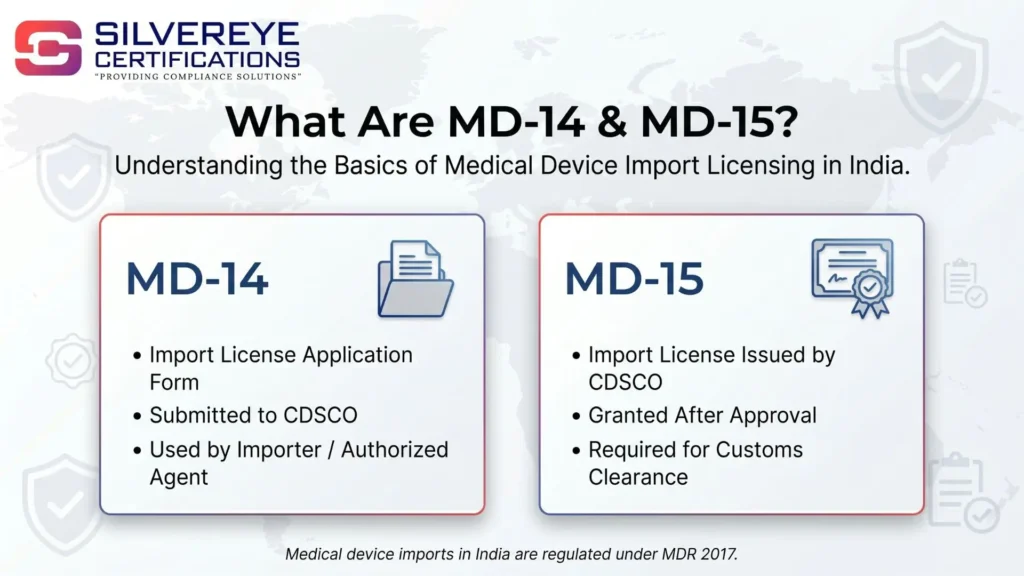
| MD-14 | Application form filed by the importer on the SUGAM portal to request a medical device import licence. Covers device details, manufacturer credentials, standards compliance, and technical documentation. |
| MD-15 | Import licence issued by CDSCO CLA upon successful review of the MD-14 application. Authorises the importer to bring specified ECG devices into India for 5 years. |
MD-14 Application — Step-by-Step Process for ECG Machine Importers
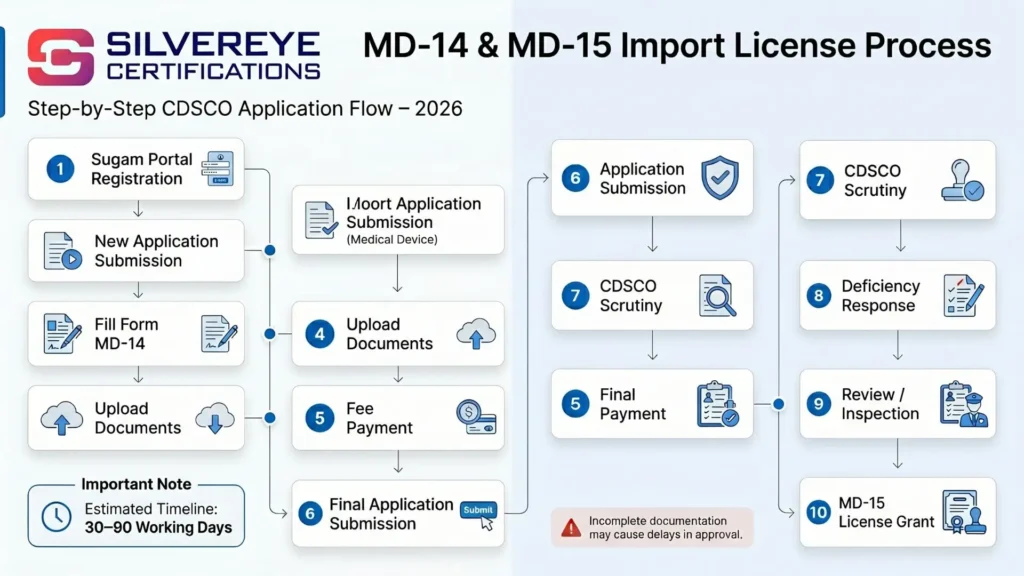
- Create and verify your entity account on the SUGAM portal using GST, PAN, and Aadhaar of authorized signatory.
- Select 'Medical Devices — Import' module and choose Form MD-14.
- Enter device details: generic name, brand/model, intended use, HS code, device class, and standards compliance.
- Upload the complete document dossier (see Document Checklist section).
- Pay the prescribed government fee through the SUGAM payment gateway.
- CDSCO scrutiny officer reviews the application; queries raised must be responded to within the stipulated window (typically 15–30 days).
- For Class C/D ECG devices, CDSCO may schedule a manufacturer site inspection or request additional clinical data.
- MD-15 import license issued upon approval — valid for 5 years from the date of grant.
MD-3 and MD-5 — Manufacturing License for Class A & B ECG Devices
Indian manufacturers of Class A or Class B ECG devices — such as electrodes, lead wires, single/multi-channel ECG machines, basic holter monitors, and stress test systems — apply to the State Licensing Authority (State Drug Controller) for a manufacturing license.
| Form | Purpose & Description |
| MD-3 | Application form for grant or renewal of a State-level manufacturing licence for Class A/B medical devices. Filed with the State Drug Controller of the state where manufacturing takes place. |
| MD-5 | Manufacturing licence issued by the State Licensing Authority upon successful review of MD-3. Authorises manufacture of specified Class A/B ECG devices for 5 years. |
- File MD-3 application with the State Drug Controller of the relevant manufacturing state.
- Submit factory layout, equipment qualification records, QMS documentation, and Qualified Person (QP) credentials.
- State inspector visits the manufacturing facility for GMP verification under Schedule M-II of MDR 2017.
- For Class B ECG devices, Notified Body (NB) audit confirmation of conformity with applicable standards (IEC 60601-2-25, IEC 60601-1) must be provided before the SLA issues MD-5.
- MD-5 manufacturing license issued upon SLA satisfaction — valid for 5 years.
Class A ECG accessories (electrodes, gel, paper) can be self-certified without Notified Body involvement; however, SUGAM registration is still mandatory before market placement.
MD-7 and MD-9 — Manufacturing License for Class C & D ECG Devices
Manufacturers of high-risk ECG systems — such as AI holter monitors, implantable loop recorders, 3D electroanatomical mapping systems, and EP lab acquisition systems — must seek central CDSCO approval through CDSCO's Central Licensing Authority.
| Form | Purpose & Description |
| MD-7 | Application form for grant or renewal of a Central-level manufacturing license for Class C/D medical devices. Filed directly with CDSCO CLA on the SUGAM portal. |
| MD-9 | Manufacturing licence issued by CDSCO CLA upon successful dossier review, site audit, and QMS verification. Authorises manufacture of specified Class C/D ECG devices for 5 years. |
- File MD-7 on the SUGAM portal under the CDSCO Central Licensing Authority module.
- Submit full Technical File: Design History File, Device Master Record, risk management (ISO 14971), clinical evaluation report (CER), biocompatibility (ISO 10993), and software documentation (IEC 62304) for AI-enabled ECG devices.
- ISO 13485 certificate from a CDSCO-recognized Notified Body is mandatory.
- CDSCO schedules a site audit of the manufacturing facility.
- MD-9 manufacturing license issued by CDSCO CLA — typically 90–150 working days for Class C/D devices.
For Class D ECG devices involving implantable components (ILR, ICD, CRT), clinical investigation data from human studies is mandatory alongside the standard dossier. Silvereye Certifications prepares the complete submission package aligned with CDSCO's current scrutiny checklist.
MD-41 and MD-42 — Wholesale Drug License for ECG Machine Distributors
Any business that stores and sells ECG machines at wholesale — to hospitals, diagnostic centres, dealers, or clinics — without holding an import or manufacturing license must obtain a Wholesale Drug License under MDR 2017.
| Form | Purpose & Description |
| MD-41 | Application form for grant or renewal of a wholesale medical device license. Filed with the State Licensing Authority in the state of business operations. |
| MD-42 | Wholesale drug licence issued by the SLA upon successful review and premises inspection. Authorises storage and wholesale distribution of specified ECG devices for 5 years. |
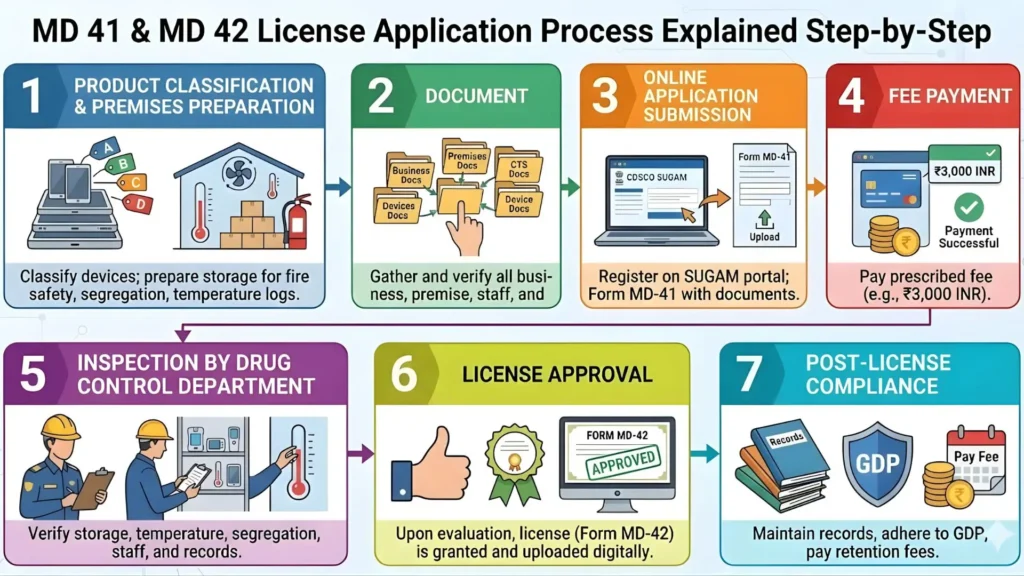
- File MD-41 application with the State Drug Controller of the state where the wholesale business operates.
- Provide premises details: storage area in sq. ft., environmental controls, and equipment storage compliance.
- Submit Qualified Technical Person (QTP) credentials — a degree holder in science, pharmacy, or biomedical engineering as per MDR 2017 Schedule M-II.
- SLA inspector visits the storage premises.
- MD-42 wholesale license issued upon compliance — valid for 5 years.
Wholesalers must retain copies of their supplier's valid CDSCO import (MD-15) or manufacturing (MD-9) licence for all Class C/D ECG devices in stock. This is verified during SLA inspections.
CDSCO ECG Machine License Forms — Quick Reference Comparison Table
| Form | Type | Applicant | Licensing Authority | Applicable Device Class |
| MD-14 | Application | Importer | CDSCO CLA | Class A, B, C, D |
| MD-15 | Licence Issued | Importer | CDSCO CLA | Class A, B, C, D |
| MD-3 | Application | Manufacturer | State Licensing Authority | Class A, B |
| MD-5 | Licence Issued | Manufacturer | State Licensing Authority | Class A, B |
| MD-7 | Application | Manufacturer | CDSCO CLA | Class C, D |
| MD-9 | Licence Issued | Manufacturer | CDSCO CLA | Class C, D |
| MD-41 | Application | Wholesaler | State Licensing Authority | Class A, B, C, D |
| MD-42 | Licence Issued | Wholesaler | State Licensing Authority | Class A, B, C, D |
Documents Required for CDSCO ECG Machine Registration
The required documents vary by stakeholder type (importer, manufacturer, wholesaler) and device class. Below is a comprehensive, class-specific checklist. Silvereye Certifications conducts a gap-analysis before submission to ensure a zero-deficiency dossier.
Documents for Importer (MD-14 Application — All Classes)
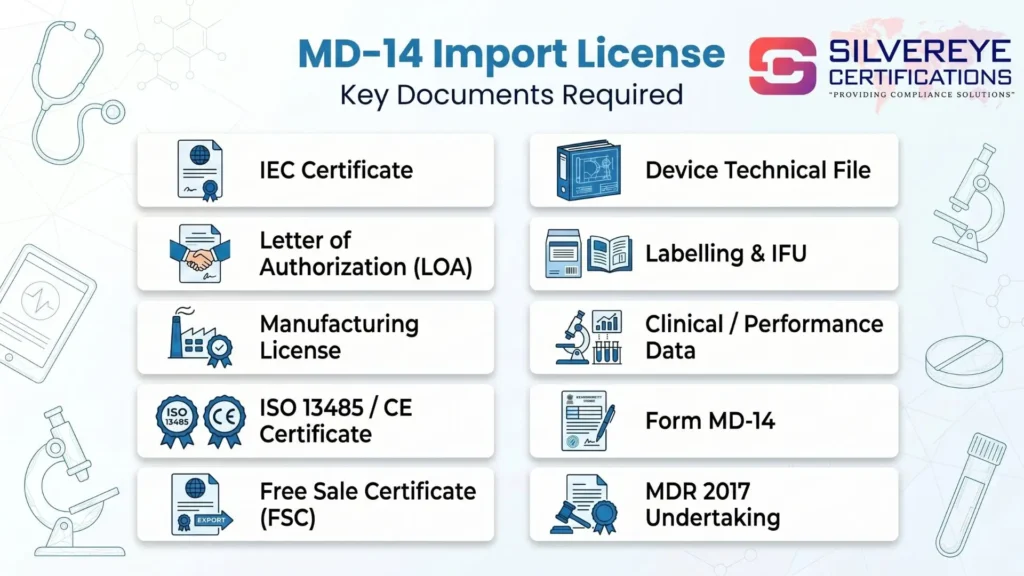
- SUGAM portal registered entity account details (GST, PAN, Aadhaar of authorized signatory)
- DGFT Import Export Code (IEC Code) from the Directorate General of Foreign Trade
- Free Sale Certificate (FSC) or Certificate of Conformity from the country of origin — notarized and apostilled
- CE Marking declaration or FDA 510(k) / De Novo clearance (for Class C/D devices)
- ISO 13485 Quality Management System certificate of overseas manufacturer
- IEC 60601-2-25 (resting ECG), IEC 60601-2-47 (ambulatory ECG), or IEC 60601-2-51 test reports from accredited lab
- Declaration of Conformity signed by the manufacturer's authorized representative
- Authorization letter from overseas manufacturer appointing Indian importer — on company letterhead, notarised
- Device description, intended use, specifications, models, and accessories covered
- Labelling samples and Instructions for Use (IFU) — in English and Hindi where required
- Clinical Evaluation Report (CER) as per MDR 2017 Schedule III — mandatory for Class C/D
- Performance Test / Validation Report from NABL-accredited laboratory (Class C/D)
- Software Documentation as per IEC 62304 — mandatory for AI/algorithm-driven ECG devices
- Post-Market Surveillance (PMS) plan — mandatory for Class C/D
Additional Documents for Indian Manufacturer (MD-7 Application — Class C/D)
- Site Master File with facility layout, manufacturing flow, cleanroom details (if applicable)
- ISO 13485 certificate from CDSCO-recognized Notified Body
- Design History File (DHF) and Device Master Record (DMR)
- Risk Management File as per ISO 14971:2019 — complete risk analysis and residual risk evaluation
- Biocompatibility reports as per ISO 10993 series — mandatory for skin-contact electrodes and wearable patches
- Software lifecycle documentation per IEC 62304 for any ECG device with embedded or standalone software
- Clinical Investigation summary (required for novel Class D ECG implantable devices)
- Qualified Person (QP) educational and professional credentials per MDR 2017 Schedule M-II
- Electromagnetic compatibility (EMC) test report per IEC 60601-1-2
Documents for Wholesaler (MD-41 Application)
- Premises proof: ownership deed or registered rent/lease agreement for storage facility
- Storage area details: floor area in sq. ft., temperature logs, humidity controls
- Qualified Technical Person (QTP) credentials — relevant degree in science, pharmacy, or biomedical engineering
- Business registration: Certificate of Incorporation, GST registration certificate
- Copy of supplier's valid CDSCO import or manufacturing license (MD-15 or MD-9) for each ECG device stocked
- Undertaking for proper storage, handling, and distribution of ECG devices per MDR 2017 requirements
CDSCO ECG Machine Registration Fees
All government fees are paid online through the SUGAM portal at the time of application filing. Fees are non-refundable irrespective of outcome. The below schedule is based on the current MDR 2017 fee schedule — verify on SUGAM before filing.
| Licence Type | Class A/B Fee (INR) | Class C/D Fee (INR) | Validity |
| Import Licence (MD-15) | ₹2,500 per device | ₹5,000 per device | 5 Years |
| Manufacturing Licence Class A/B (MD-5) | ₹3,500 per category | — | 5 Years |
| Manufacturing Licence Class C/D (MD-9) | — | ₹5,000 per device | 5 Years |
| Wholesale Licence (MD-42) | ₹2,000 (State) | ₹2,000 (State) | 5 Years |
| Renewal (all types) | Same as original | Same as original | +5 Years |
Note: The above fees are government fees only. Regulatory consultant fees (such as Silvereye Certifications) are charged separately based on scope. Fees are subject to revision by the Ministry of Health. Confirm on the SUGAM portal before filing.
Validity and Renewal of CDSCO ECG Machine Licenses
All CDSCO medical device licences are valid for 5 years from the date of grant. There is no statutory grace period after expiry — a lapsed licence legally prohibits import, manufacture, or distribution of the device. Renewal must be initiated before expiry.
| Parameter | Detail |
| Licence Validity | 5 years from date of issue |
| Recommended Renewal Start | 90 days before expiry (minimum: 30 days before expiry) |
| Renewal Form | Same form as original application (MD-14 for importers, MD-3/MD-7 for manufacturers, MD-41 for wholesalers) |
| Renewal Fee | Same as the original application fee |
| Grace Period After Expiry | No statutory grace period — licence lapses immediately on expiry date |
| Consequence of Lapse | All import/manufacture/distribution activities must cease until renewal is granted — a fresh application may be required |
| Post-Renewal Validity | 5 years from the date of renewal order |
Silvereye Certifications offers a proactive License Renewal Tracking service — automated reminders at 120, 90, 60, and 30 days before expiry across your entire CDSCO portfolio, eliminating the risk of accidental license lapse.
How to File CDSCO ECG Machine Registration on the SUGAM Portal
All CDSCO medical device applications are filed exclusively through the SUGAM portal. Physical submissions are not accepted for ECG device registrations. Here is the complete filing workflow:
- Register your entity on SUGAM: enter company details, GST number, PAN, and Aadhaar of the authorized signatory. Verify via OTP.
- Select the correct application module: 'Medical Devices — Import' (MD-14), 'Medical Devices — Manufacture' (MD-3 or MD-7), or 'Wholesale License' (MD-41).
- Complete the online form with accurate device details — generic name, model, classification class, intended use, HS code, and applicable standards.
- Upload all mandatory documents in prescribed PDF/ZIP format. Ensure file sizes comply with SUGAM upload limits per document type.
- Pay government fee via SUGAM payment gateway: net banking, UPI, debit card, or NEFT.
- Track application in real time on the SUGAM dashboard: statuses include Under Scrutiny, Query Raised, Under Inspection, Approved, and Rejected.
- Respond to CDSCO queries within the stipulated timeframe — typically 15 to 30 days from the date of query. Failure to respond results in application closure.
- Download the approved license document (MD-15, MD-5, MD-9, MD-42) directly from the SUGAM portal once issued.
Approval Timeline for CDSCO ECG Machine Registration
| Device Class | Licence Type | Estimated Timeline | Key Bottleneck |
| Class A | Import (MD-15) | 10–25 working days | Document completeness check |
| Class B | Import (MD-15) | 30–60 working days | Standards compliance review, NB cert |
| Class C | Import (MD-15) | 60–90 working days | CER review, PTR, possible audit |
| Class D | Import (MD-15) | 90–150+ working days | Full clinical review + site audit |
| Class A/B | Manufacture (MD-5) | 45–75 working days | SLA inspection + NB audit (Class B) |
| Class C/D | Manufacture (MD-9) | 90–150 working days | CDSCO site audit + QMS verification |
| All Classes | Wholesale (MD-42) | 20–45 working days | SLA premises inspection |
Timelines are indicative. Query responses, dossier completeness, and CDSCO workload are the three biggest variables. Silvereye Certifications' zero-deficiency dossier preparation has reduced client approval timelines by 30–40% compared to self-filed applications.
Eligibility: Who Can Apply for CDSCO ECG Machine Registration?
| Applicant Type | Eligibility Criteria |
| Importer (MD-14 / MD-15) | Any registered Indian company or LLP with a valid DGFT IEC Code, GSTIN, and a formal authorisation letter from the overseas ECG device manufacturer. |
| Indian Manufacturer (MD-3 / MD-7) | Registered Indian manufacturing entity with a physical facility meeting MDR 2017 Schedule M-II (GMP) norms. A Qualified Person (QP) must be employed on site. |
| Foreign Manufacturer (MD-7 / MD-9) | Foreign manufacturers with an authorised Indian Representative (IR) can apply for MD-9 through CDSCO CLA. The IR bears full regulatory responsibility in India. |
| Wholesaler / Distributor (MD-41 / MD-42) | Any registered Indian trading entity with compliant storage premises, a Qualified Technical Person (QTP), and verifiable supplier licence copies. |
Common Reasons for CDSCO ECG Machine Application Rejection
- FSC not apostilled or issued by an authority not recognized by CDSCO
- IEC 60601-2-25 or IEC 60601-2-47 test report not from an internationally accredited (ILAC/ENAS) lab
- Mismatch between device model listed in MD-14 form and model mentioned in the FSC or test reports
- ISO 13485 certificate issued by a Notified Body not recognized by CDSCO
- Clinical Evaluation Report (CER) missing or insufficient for Class C/D ECG devices
- Software documentation (IEC 62304) missing for AI-driven arrhythmia detection software
- Authorization letter not on company letterhead, or not notarized and apostilled
- Incorrect device class declared on SUGAM — typically Class B filed as Class A to avoid Notified Body costs
- Incomplete or outdated risk management file (ISO 14971) for Class C/D
- Post-market surveillance plan absent for Class C/D ECG devices requiring ongoing vigilance
Key Standards for CDSCO ECG Machine Compliance in India
| Standard | Applicability to ECG Devices |
| IEC 60601-2-25:2011 | Particular requirements for the basic safety and essential performance of electrocardiographs |
| IEC 60601-2-47:2012 | Ambulatory electrocardiographic systems — basic safety and essential performance |
| IEC 60601-2-51:2003 | Recording and analysis single-channel and multichannel ECG — essential performance |
| IEC 60601-1:2005+A1:2012 | General requirements for basic safety and essential performance of medical electrical equipment |
| IEC 60601-1-2:2014 | Electromagnetic disturbances — requirements and tests (EMC) for ECG devices |
| ISO 13485:2016 | Quality management systems for medical device manufacturers |
| ISO 14971:2019 | Application of risk management to medical devices — mandatory for Class C/D |
| ISO 10993 Series | Biological evaluation of medical devices — for skin-contact electrodes and wearable patches |
| IEC 62304:2006+A1:2015 | Medical device software — software lifecycle processes — mandatory for ECG software |
| IEC 62133 | Battery safety for portable ECG devices with rechargeable cells |
Post-Registration Compliance Obligations for ECG Device License Holders
A CDSCO license is the entry point, not the finish line. License holders must maintain continuous compliance to avoid suspension or cancellation of their CDSCO registration.
- Adverse Event Reporting: report serious adverse events and Field Safety Corrective Actions (FSCAs) to CDSCO within 10 days (Class C/D) or 30 days (Class A/B) of awareness.
- Post-Market Surveillance (PMS): maintain and annually update PMS plans; submit periodic safety update reports for Class C/D ECG devices.
- Annual Returns: file annual sales and complaint data returns with CDSCO and the relevant SLA.
- Labelling Updates: any change in device specifications, indications, or contraindications requires a SUGAM amendment application before market re-entry with updated labelling.
- Change Notifications: inform CDSCO of changes in manufacturing site, ownership, authorized representative, or addition of new models under an existing registration.
- UDI Compliance: maintain Unique Device Identification records for all ECG devices in the Indian market per MDR 2017 timeline roadmap.
How Silvereye Certifications Helps with CDSCO ECG Machine Registration
Silvereye Certifications is a specialist Indian regulatory compliance consultancy with proven expertise in CDSCO medical device registrations across all four device classes. Our end-to-end service for ECG machine clients covers:
- Device classification advisory: confirm correct class (A/B/C/D) and applicable MDR 2017 license forms
- Pre-submission gap analysis: identify missing documents before filing to eliminate CDSCO rejection risk
- Technical dossier preparation: Clinical Evaluation Report (CER), risk management file, technical file, IFU review
- Software documentation (IEC 62304) preparation for AI-enabled and algorithm-driven ECG devices
- SUGAM portal filing, fee payment, and real-time application tracking
- CDSCO query management: expert technical responses within deadlines
- Notified Body (NB) identification and audit coordination for manufacturers
- License renewal tracking, amendment filing, and post-market surveillance framework setup
- Annual return filing and adverse event reporting support
Frequently Asked Questions
Is CDSCO registration mandatory for all ECG machines sold in India?
Yes. Under the Medical Devices Rules 2017, all ECG machines — from disposable electrodes (Class A) to implantable EP systems (Class D) — must be registered with CDSCO before they can be legally imported, manufactured, or distributed commercially in India. There are no exemptions for small quantities or trial shipments without appropriate clearance.
What is the difference between MD-14 and MD-15 for ECG machine importers?
MD-14 is the application form that the importer files on the SUGAM portal to request an import license. MD-15 is the actual import license document that CDSCO's Central Licensing Authority issues upon successful review of the MD-14 application. Without a valid MD-15, no commercial import of ECG machines is permitted.
My ECG machine has an AI arrhythmia detection algorithm. What class does it fall under?
ECG machines with built-in AI or machine-learning-driven arrhythmia detection are typically classified as Class C devices under MDR 2017, given the elevated risk of incorrect diagnosis. The software component must separately comply with IEC 62304 (medical device software lifecycle) and must be validated for its intended clinical use. Class D classification may apply if the device is implantable.
Which form does an Indian manufacturer of 12-lead ECG machines (Class B) need?
An Indian manufacturer of Class B ECG devices such as standard 12-lead ECG machines must file Form MD-3 with the State Licensing Authority of their manufacturing state. Upon facility inspection, GMP verification, and Notified Body audit confirmation for Class B, the SLA issues Form MD-5 — the manufacturing license valid for 5 years.
Do ECG machine distributors/dealers need a CDSCO license in India?
Yes. Wholesale distributors storing and selling ECG machines must obtain a wholesale drug licence under MDR 2017. The application is filed using Form MD-41 with the State Licensing Authority. Upon approval and premises inspection, Form MD-42 (the wholesale licence) is issued. This is mandatory even if the distributor does not manufacture or import.
How long does CDSCO ECG machine registration take for Class C devices?
Class C ECG devices — such as AI holter monitors, implantable loop recorders, and hospital telemetry systems — typically take 60 to 90 working days from the date of filing a complete application on SUGAM. Timelines can extend if CDSCO raises technical queries or schedules a facility audit. Incomplete or deficient dossiers are the most common cause of delay.
Can a foreign ECG machine manufacturer directly register with CDSCO?
Yes. Foreign manufacturers can apply for an import licence (MD-14/MD-15) by appointing a registered Indian importer or authorised Indian Representative (IR). For manufacturing registrations (MD-7/MD-9), foreign companies can apply through CDSCO CLA with an appointed IR who bears full regulatory responsibility in India.
What IEC standards must an ECG machine meet for CDSCO registration in India?
Key standards include IEC 60601-2-25 (resting ECG machines), IEC 60601-2-47 (ambulatory/holter ECG systems), IEC 60601-1 (general electrical safety), IEC 60601-1-2 (EMC), and IEC 62304 for software-enabled devices. Skin-contact accessories (electrodes, patches) must also comply with ISO 10993 biocompatibility standards.
What happens if an ECG machine import license (MD-15) expires?
Once an MD-15 expires, you can no longer legally import that ECG device. There is no grace period under MDR 2017. Importing on an expired license is treated as importing without a license — a cognizable offence attracting penalties and potential seizure of goods. Renewal using Form MD-14 must be initiated at least 30 days before expiry; Silvereye recommends starting 90 days in advance.
How much does CDSCO ECG machine registration cost in India?
Government fees on the SUGAM portal range from approximately ₹2,500 (Class A/B import license) to ₹5,000 (Class C/D import license) per device. Manufacturing and wholesale license fees also fall in this range. Professional regulatory consultant fees vary based on device complexity and documentation gaps. Silvereye Certifications provides a detailed cost estimate after a free initial gap analysis.