
- BIS CRS registration for LED lighting chains is legally mandatory under India's Compulsory Registration Order — selling without it violates the BIS Act, 2016.
- The revised IS 10322 (Part 5/Sec 7): 2026 introduces dedicated TPL chain provisions, updated terminology, and alignment with the stricter 2026 base standard.
- Existing CRS licenses must submit fresh test reports under the 2026 standard by 02 August 2026 — failing to do so risks license cancellation.
- From February 2026, BIS CRS licenses under Scheme-II are valid for 5 years with annual fee payments — replacing the older annual renewal requirement.
What Is BIS CRS Registration for LED Lighting Chains?
BIS CRS (Compulsory Registration Scheme) registration is mandatory government certification for LED lighting chains sold in India, governed by the Bureau of Indian Standards under the BIS Act, 2016. Products including decorative LED chains, fairy lights, rice lights, curtain lights, and TPL chains must be tested against IS 10322 (Part 5/Sec 7): 2026 at a BIS-recognized laboratory before a CRS license is granted. BIS notified the revised standard in March 2026 with a compliance deadline of 02 August 2026. A February 2026 BIS amendment extended the CRS license validity from 1 year to 5 years under Scheme-II, with annual fee obligations continuing.
What Is BIS CRS Registration and Why Does It Apply to LED Lighting Chains?
If you manufacture, import, or sell LED lighting chains in India — whether decorative fairy lights, Diwali chains, festival string lights, curtain lights, or outdoor TPL chains — BIS CRS registration is not optional. It is a legal mandate under the Compulsory Registration Order (CRO), enforced by the Bureau of Indian Standards (BIS) under the Department of Consumer Affairs, Government of India.
LED lighting chains are among the highest-volume decorative electrical products sold in India, particularly around the Diwali, Christmas, and New Year festive seasons. Millions of units move through retail channels, e-commerce platforms, and wholesale markets every year. Because these products are used in homes, offices, commercial establishments, and public spaces — often by consumers with limited technical knowledge — safety standards are critical. Substandard lighting chains with poor insulation, inadequate connectors, or overloaded circuits have been responsible for fires and electric shocks in Indian households.
The BIS CRS framework for LED lighting chains operates under Scheme-II of the BIS (Conformity Assessment) Regulations, 2018. This allows manufacturers to obtain a CRS license based on successful third-party laboratory testing and self-declaration of conformance, without requiring an upfront factory inspection — making it accessible to both large manufacturers and smaller importers.
The applicable standard IS 10322 (Part 5/Sec 7): 2026 was revised in March 2026, replacing the 2017 version. All existing CRS licenses and new applicants must align with this revised standard by 02 August 2026.
Who Needs BIS CRS Registration for LED Lighting Chains?
- Indian manufacturers of LED lighting chains, fairy lights, rice lights, curtain lights, and net lights
- Importers bringing LED lighting chains into India from China, South-East Asia, Europe, or any other country
- Foreign manufacturers who brand and sell their LED lighting chains in the Indian market — directly or through Indian distributors
- Brand owners and trading companies whose label or trademark appears on the product even if manufacturing is outsourced
- Online sellers and e-commerce businesses listing LED lighting chains on Amazon India, Flipkart, Meesho, or other marketplaces
- Event management companies and decorative lighting distributors who procure and resell branded lighting chain products
LED Lighting Chain Products Covered Under BIS CRS: Product Classification Table
The following product categories fall under mandatory BIS CRS registration as LED lighting chains. All are governed by IS 10322 (Part 5/Sec 7): 2026, revised and notified by BIS in March 2026. Note that this section also references IEC 60598-2-20: 2022 for Fancy Lights as listed in the BIS notification.
| Product Type | Applicable Standard | CRO Status | Wattage Range | Use Environment | Notes |
| LED Lighting Chain (General Decorative) | IS 10322 (Part 5/Sec 7): 2026 | Mandatory CRS | 2W – 30W | Indoor / Limited Outdoor | Festivals, homes, retail decoration |
| LED Fairy Lights / String Lights | IS 10322 (Part 5/Sec 7): 2026 | Mandatory CRS | 2W – 20W | Indoor | Bedroom, party, event decor |
| LED Rice Lights (Chawal Batti) | IS 10322 (Part 5/Sec 7): 2026 | Mandatory CRS | 1W – 10W | Indoor | Festival and seasonal decoration |
| LED Curtain Lights | IS 10322 (Part 5/Sec 7): 2026 | Mandatory CRS | 5W – 40W | Indoor / Outdoor | Window, balcony, garden decoration |
| LED Net Lights | IS 10322 (Part 5/Sec 7): 2026 | Mandatory CRS | 5W – 30W | Outdoor | Landscape, garden, facade lighting |
| LED Icicle Lights | IS 10322 (Part 5/Sec 7): 2026 | Mandatory CRS | 5W – 30W | Outdoor | Roof edges, festive decoration |
| Temporarily Installed Protected (TPL) Lighting Chains | IS 10322 (Part 5/Sec 7): 2026 | Mandatory CRS | 5W – 50W | Outdoor / Semi-permanent | New 2026: specific TPL provisions added |
| LED Fancy Lights (Multi-colour chains) | IEC 60598-2-20: 2022 / IS 10322 (Part 5/Sec 7): 2026 | Mandatory CRS | 2W – 30W | Indoor / Outdoor | Diwali, Christmas, event lighting |
Note: Wattage ranges and environmental ratings above are indicative based on common industry products and IS 10322 (Part 5/Sec 7): 2026 requirements. Every specific product variant must be individually assessed against the applicable standard clauses at a BIS-recognised laboratory.
What Changed in 2026: Key Updates to IS 10322 (Part 5/Sec 7): 2026 for LED Lighting Chains
The 2026 revision brings substantive changes through both the product-specific Part 5/Sec 7 standard and the revised parent standard IS 10322 (Part 1): 2026. Here is a detailed breakdown of every change and its practical impact:
| Technical Change in 2026 Standard | Impact on LED Lighting Chain Manufacturers / Importers |
| IS 10322 (Part 5/Sec 7): 2026 — Specific provisions for Temporarily Installed Protected (TPL) lighting chains added | TPL chains — semi-permanent outdoor chains — now have dedicated requirements covering installation, insulation, and protection standards |
| IS 10322 (Part 5/Sec 7): 2026 — New terms and definitions added | Updated terminology aligns Indian standard with IEC 60598-2-20: 2022; manufacturers must review product classifications and labelling |
| IS 10322 (Part 5/Sec 7): 2026 — References to IS 10322 (Part 1): 2026 updated throughout | All tests and safety evaluations for lighting chains now cascade from the revised 2026 base standard |
| IS 10322 (Part 1): 2026 — Introduction of IPX9 high-pressure water ingress protection | Relevant for TPL chains and outdoor LED lighting chains rated for wet environments |
| IS 10322 (Part 1): 2026 — EMF safety requirements included | Electromagnetic field safety tests now apply to LED lighting chain drivers and control circuits |
| IS 10322 (Part 1): 2026 — PELV (Protective Extra-Low Voltage) system introduced | Addressed for lighting chains powered via SELV or PELV power supplies — common in low-voltage LED chains |
| IS 10322 (Part 1): 2026 — Photo-biological safety requirements extended | Blue light hazard and retinal safety evaluation now more comprehensive; relevant for high-output decorative chains |
| IS 10322 (Part 1): 2026 — Updated touch voltage and current limit tests | Revised dielectric strength and shock protection requirements applicable to all lighting chain products |
| IS 10322 (Part 1): 2026 — Revised marking requirements | Updated labelling rules apply to products and packaging — review your current compliance labels |
| IS 10322 (Part 1): 2026 — Normative annexure on battery/EDLC-operated luminaires | Applicable to battery-powered LED lighting chains; adds battery safety and thermal performance requirements |
| Concurrent running deadline: 02 August 2026 | After this date, no CRS licence can be granted or remain operative under IS 10322 (Part 5/Sec 7): 2017. All must comply with the 2026 version. |
The TPL Chain Provisions: What You Need to Know
One of the most significant new additions in IS 10322 (Part 5/Sec 7): 2026 is the inclusion of specific provisions for Temporarily Installed Protected (TPL) lighting chains. A TPL chain is a lighting chain designed for semi-permanent outdoor installation — used in applications like building facade decoration, outdoor venue lighting, garden installations, and commercial storefront decoration where the chain may remain installed for extended periods.
Prior to the 2026 revision, outdoor lighting chains were governed by general provisions without specific TPL-focused requirements. The 2026 standard introduces dedicated clauses covering installation requirements, mechanical protection standards, insulation specifications, and environmental resistance for TPL chains. If you manufacture or import outdoor lighting chains intended for semi-permanent installation, you need to specifically review your product's compliance against the new TPL provisions in IS 10322 (Part 5/Sec 7): 2026.
New Terms and Definitions: Why They Matter for Your CRS Application
IS 10322 (Part 5/Sec 7): 2026 also introduces updated terms and definitions aligned with IEC 60598-2-20: 2022. This matters practically because the way your product is classified — and the way it is described in your test report and CRS application — must align with the standard's current terminology. BIS scrutiny teams check for terminological consistency between test reports and application forms. Using outdated terminology from the 2017 standard version in a 2026 application can trigger queries and delay your licence grant.
BIS CRS License Validity: The February 2026 Amendment That Changes the Game
| New Rule: 5-Year CRS License Validity — Effective 25 February 2026 The BIS (Conformity Assessment) Regulations, 2018 were amended on 25 February 2026 to revise the validity and continuation of license provisions for CRS licenses under Scheme-II. CRS licenses are now granted for an initial period of 5 years. Renewal is also for a further 5-year period. Annual fee payment and production detail submission remain mandatory every year without exception. |
For LED lighting chain manufacturers and importers, this is a genuinely positive operational change. Previously, CRS licenses required annual renewal filings which created repetitive administrative overhead — particularly burdensome for businesses managing multiple product registrations. Under the revised framework, the initial license grant itself covers 5 years. Here is a clear comparison:
| Licence Parameter | Old Provision (Pre-Feb 2026) | New Provision (Post-Feb 2026) |
| Initial Licence Validity | 1 Year | 5 Years |
| Renewal Period | Annual renewal | 5 Years per renewal |
| Fee Payment Mode | Annual | Annual (in advance, before due date) |
| Failure to Pay Annual Fee | Suspension / Cancellation | Suspension / Cancellation (unchanged) |
| Production Detail Submission | Annual | Annual |
| Applicable Scheme | Scheme-II (CRS) | Scheme-II (CRS) — Revised |
| Governing Regulation | BIS (CA) Regulations, 2018 | BIS (CA) Regulations, 2018 as amended 25 Feb 2026 |
Practical Implications for Your Lighting Chain Business
- New CRS licenses granted after 25 February 2026 automatically carry the 5-year validity — no additional action needed to claim this benefit.
- Annual fees must still be paid every year in advance. Five-year validity does not mean a one-time payment for the whole term.
- If the annual fee and production details are not received by BIS before the due date, the license may be suspended and subsequently cancelled — even within the 5-year term.
- Renewal after the 5-year term must be applied for before expiry. At renewal, if the applicable IS standard has been revised, fresh test reports under the new standard must be submitted.
- For businesses managing seasonal festive lighting chains, the 5-year validity significantly reduces the compliance administration burden between peak seasons.
Step-by-Step BIS CRS Registration Process for LED Lighting Chains (2026)
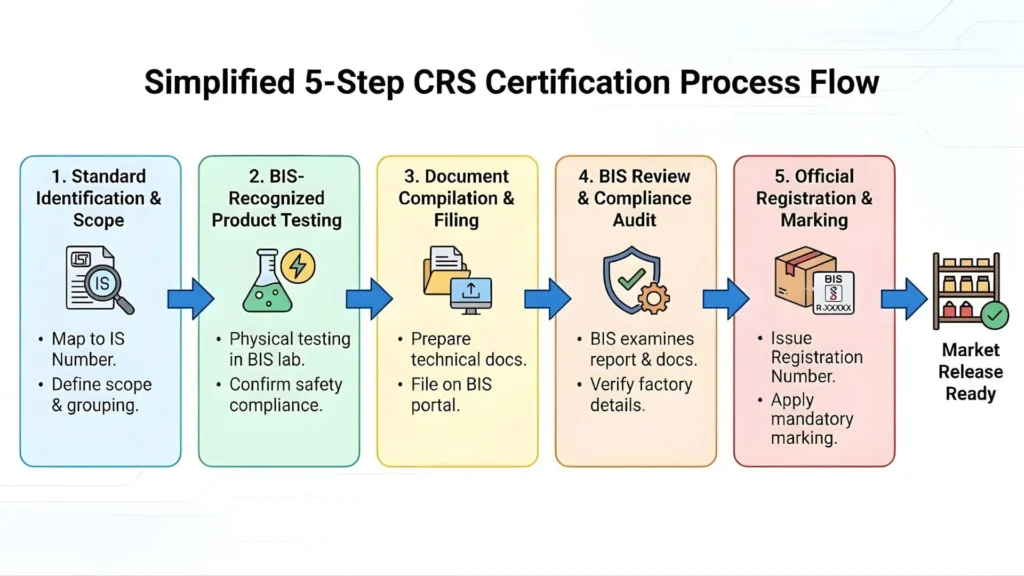
Here is the complete, step-by-step registration process for obtaining BIS CRS certification for your LED lighting chain products — from preparation through to license grant and ongoing compliance.
| Step | Stage | What You Do | Timeline |
| 1 | Pre-Application | Confirm product is an LED lighting chain / TPL chain under IS 10322 (Part 5/Sec 7): 2026; identify lead and series models; prepare technical file | 1–3 Days |
| 2 | Lab Testing | Submit samples to a BIS-recognised laboratory for testing against IS 10322 (Part 5/Sec 7): 2026 and IS 10322 (Part 1): 2026 | 15–30 Days |
| 3 | Online Application | Log in at manakonline.in; complete CRS application form; upload test reports and documents; pay application fee | 1–2 Days |
| 4 | Document Scrutiny | BIS reviews application, test reports, entity documents; may raise portal queries for clarification | 7–15 Days |
| 5 | Grant of CRS Licence | CRS licence issued; BIS Standard Mark can be affixed on product and packaging from this date | 3–7 Days |
| 6 | Annual Compliance | Pay annual licence fee before due date; submit annual production details; cooperate with BIS surveillance inspections | Yearly |
| 7 | Licence Renewal | Apply for 5-year renewal before expiry; fresh test reports required if standard revised since original grant | Before Expiry |
Stage 1: Pre-Application — Getting Your Product Classification Right
Start by confirming that your product falls within the scope of IS 10322 (Part 5/Sec 7): 2026. This standard covers LED lighting chains — a category that includes decorative lamp chains, fairy lights, rice lights, curtain lights, net lights, icicle lights, and TPL chains. Review the standard's scope clause carefully, particularly if your product is an outdoor or semi-permanent TPL chain, as it now carries additional requirements that may affect your test planning.
Identify your lead model — the representative model that will be formally tested. The lead model should be the most comprehensive version in your range: typically the highest wattage, longest chain, or most feature-rich variant. Other models that share the same fundamental design but differ in chain length, colour, or minor electrical parameters can be covered as series models through an undertaking.
Stage 2: Laboratory Testing — Working with a BIS-Recognized Lab
Submit your lead model samples to a BIS-recognized testing laboratory. Only reports from BIS-recognized labs are accepted for CRS applications — reports from non-recognized labs, even internationally accredited ones, will be rejected by BIS during scrutiny. Testing under IS 10322 (Part 5/Sec 7): 2026 covers electrical safety, mechanical safety, thermal requirements, insulation resistance, and for outdoor/TPL chains, IP ingress protection. Tests derived from the revised IS 10322 (Part 1): 2026 — including EMF safety, photo-biological safety, and touch voltage/current limits — also apply.
If your lighting chains are battery-powered, the normative annexure on battery and EDLC-operated luminaires in IS 10322 (Part 1): 2026 applies. Coordinate with your laboratory to ensure all relevant clauses are covered in your test plan before samples are submitted. Plan for a laboratory turnaround of 15 to 30 days.
Stages 3 to 7: Application, Scrutiny, License, and Compliance
Log into the BIS portal at manakonline.in, select the CRS (Scheme-II) application pathway for LED luminaires, fill in your application details, upload all required documents including your test report, and pay the application fee. BIS will then scrutinize your submission — typically within 7 to 15 days — and may raise portal queries for clarification. Once approved, your CRS license is issued and you can affix the BIS Standard Mark on your LED lighting chains. Annual fee payment and production detail submission are your ongoing obligations from that point.
Documents Required for BIS CRS Registration: LED Lighting Chains
Submitting complete, correctly formatted documents on the first attempt is the fastest way to avoid BIS queries and delays. Here is the full checklist:
| S.No. | Document Required | Notes |
| 1 | Valid test report from BIS-recognised laboratory (IS 10322 Part 5/Sec 7: 2026) | Mandatory; covering all lead models |
| 2 | Certificate of Incorporation / Partnership Deed / Business Registration | Notarised copy |
| 3 | Factory layout plan and manufacturing unit address proof | With photographs if requested by BIS |
| 4 | Product technical specifications and catalogue or brochure | Model-wise: chain length, wattage, lamp count, IP rating, voltage |
| 5 | Declaration of conformance to IS 10322 (Part 5/Sec 7): 2026 | Signed by authorised signatory |
| 6 | Undertaking for series models (if applicable) | Confirming compliance of models not individually tested |
| 7 | Trademark or brand authorisation letter | Required if product carries a third-party brand name |
| 8 | Power of Attorney or authorisation letter for agent/consultant | Notarised; required if filing through a representative |
| 9 | PAN and GST registration documents of the entity | Self-attested copies |
| 10 | Import documents and country of origin certificate | For imported LED lighting chains from any country |
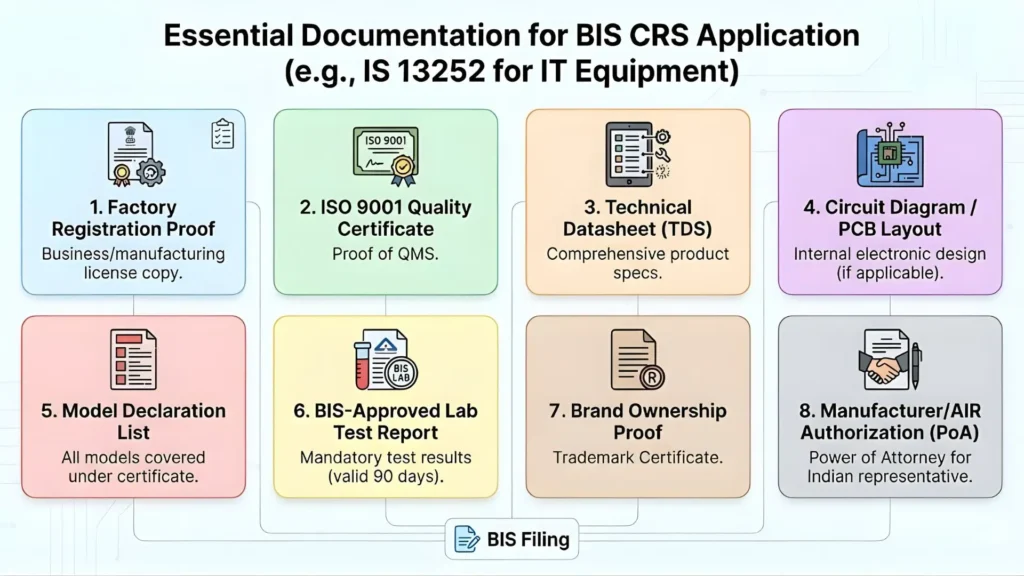
For existing CRS licenses switching from IS 10322 (Part 5/Sec 7): 2017 to the 2026 version: you must submit fresh test reports for all lead models and an undertaking for series models — both must reach BIS before 02 August 2026. Do not wait until the last minute as laboratory slots fill up ahead of the deadline.
BIS CRS Registration Fees for LED Lighting Chains: Complete Fee Breakdown
Planning your compliance budget requires clarity on all the costs involved. Here is a transparent breakdown of every fee component in the BIS CRS registration process for LED lighting chains:
| Fee Component | Amount (Approx.) | Frequency |
| Application Processing Fee | Rs. 1,000 – Rs. 2,000 | One-time per application |
| Annual Licence Fee (Scheme-II / CRS) | Rs. 1,000 – Rs. 5,000 (based on category/turnover) | Annual, paid in advance |
| Laboratory Testing Charges (BIS-Recognised Lab) | Rs. 12,000 – Rs. 35,000 per model set | Per lead model tested |
| Renewal Application Fee | Rs. 1,000 – Rs. 2,000 | Once every 5 years at renewal |
| Surveillance Inspection Charges (if applicable) | As per BIS schedule | As directed by BIS |
| Important: Annual Fee Compliance Is a Continuing Legal Obligation Under the revised Scheme-II framework, your CRS license runs for 5 years — but annual fees and production details must be submitted to BIS every year before the due date. This obligation does not change under the 5-year validity framework. Non-payment triggers suspension proceedings; sustained non-payment leads to cancellation. For festival lighting businesses with seasonal revenue patterns, ensure your annual fee compliance is managed through the year and not just during peak season. |
Note: Fee amounts above are indicative estimates based on BIS fee schedules and standard industry practice. For the current official fee schedule, refer to the BIS portal at manakonline.in or the BIS website at bis.gov.in.
Eligibility for BIS CRS Registration: LED Lighting Chains
Domestic Manufacturers
- Must be a registered business entity in India — Private Limited Company, LLP, Partnership Firm, Proprietorship, or other legally recognized form
- Must operate a manufacturing or assembly unit in India where the LED lighting chain is produced
- Product must successfully pass testing at a BIS-recognized laboratory under IS 10322 (Part 5/Sec 7): 2026
Importers and Trading Companies
- Must be a registered business entity in India
- Must hold written authorization from the foreign manufacturer if the product carries the foreign brand's name or trademark
- The imported product must be sent to a BIS-recognized Indian laboratory for testing — foreign test certificates from non-BIS-recognized labs are not accepted
- Importers of Chinese-manufactured LED lighting chains — the largest import source for India — must obtain separate BIS CRS registration; CE or CQC marks from China do not substitute for Indian BIS CRS
Foreign Manufacturers
- Can apply directly for BIS CRS to access the Indian lighting chain market
- Must submit a valid test report from a BIS-recognized laboratory in India
- May appoint an authorized Indian representative — an importer, distributor, or consulting firm — to manage the application and ongoing annual compliance
Benefits of BIS CRS Certification for LED Lighting Chains
BIS CRS registration is a legal requirement — but it also delivers real, practical business value that goes beyond regulatory compliance:
| Benefit | What It Means for Your Business |
| Legal Market Access | LED lighting chains cannot legally be manufactured for sale or imported without BIS CRS. Certification is your entry ticket to the Indian market. |
| Consumer Safety Assurance | The BIS Standard Mark tells buyers — wholesalers, retailers, and end consumers — that your product meets India's 2026 safety standards for lighting chains. |
| Festive Season Market Readiness | The Indian decorative lighting market peaks during Diwali, Christmas, and New Year. BIS-certified products are the only ones that can be legally stocked and sold during these periods. |
| Government and Institutional Supply | Public sector procurement, municipal decoration projects, and hospitality sector tenders require BIS CRS compliance for lighting products. |
| E-Commerce Platform Compliance | Amazon India, Flipkart, Meesho, and other platforms require BIS CRS documentation for LED lighting chain listings. Non-compliant products face delisting. |
| 5-Year Licence Stability (New from 2026) | The revised Scheme-II framework grants a 5-year initial licence — significantly reducing the administrative overhead of annual renewals while keeping annual fee obligations intact. |
| Protection Under BIS Act, 2016 | A valid CRS licence protects your business from market seizures, enforcement penalties, and criminal proceedings under the BIS Act, 2016. |
Renewal of BIS CRS License: Timeline and What to Expect
With the new 5-year validity framework, CRS license renewal for LED lighting chains is now a less frequent but equally important compliance milestone. Here is what renewal involves and when to start:
Renewal Process Timeline
- Begin renewal preparations at least 3 to 6 months before your license expiry to avoid any gap in certification — particularly important for businesses that sell during festive seasons
- File the renewal application through the BIS portal (manakonline.in) with updated entity information and current production details
- Pay the renewal application fee and ensure the first annual fee for the new 5-year term is also submitted at the time of renewal application
- If IS 10322 (Part 5/Sec 7) has been further revised since your original license grant, submit fresh test reports under the current version of the standard as part of your renewal package
- BIS will review and grant a fresh 5-year renewal term upon successful completion of scrutiny and document verification
2026-Specific Renewal Notes
- If your current CRS license was issued under IS 10322 (Part 5/Sec 7): 2017, you must comply with IS 10322 (Part 5/Sec 7): 2026 by 02 August 2026 regardless of your license expiry date. Renewal compliance and the 2026 deadline are two separate obligations.
- After 02 August 2026, renewal applications will only be processed under IS 10322 (Part 5/Sec 7): 2026. Applications referencing the 2017 standard will not be accepted.
- If your product range includes TPL chains, ensure your renewed license scope specifically covers TPL chain variants and that your test reports address the new TPL provisions.
Consequences of Selling LED Lighting Chains Without BIS CRS
BIS enforcement has intensified notably in 2025 and 2026, with particular focus on electrical products sold through e-commerce channels and festive season supply chains. Here is what non-compliance with BIS CRS requirements actually means for your business:
- Monetary penalty under BIS Act, 2016: Up to Rs. 2 lakh for first-time violations. Repeat violations attract progressively higher penalties.
- Criminal liability: Wilful violations can result in imprisonment of up to two years under the BIS Act, 2016.
- Market seizure: BIS enforcement officers are empowered to seize non-compliant LED lighting chain stock from warehouses, retail outlets, and wholesale markets — often conducted without prior notice.
- Customs detention: Non-compliant imported LED lighting chains can be detained at Indian ports of entry. Customs authorities increasingly cross-check BIS CRS status for CRO-listed products.
- E-commerce delisting: Amazon India, Flipkart, Meesho, and other major platforms require BIS CRS documentation for all LED lighting product listings. Non-compliant products are removed without notice — particularly damaging during peak festive seasons.
- Brand reputational damage: BIS enforcement actions — product seizures, penalty orders — become a matter of public record and damage your brand's reputation with distributors, retailers, and institutional buyers.
The festive season concentration of demand in the LED lighting chain market makes non-compliance particularly costly. A BIS enforcement action during Diwali or Christmas peak season — when your highest sales volumes occur — can be commercially devastating. The cost of BIS CRS registration is a fraction of that risk.
Need Help with BIS CRS Registration for LED Lighting Chains?
India's Trusted BIS CRS Certification Consultant — Silvereye Certifications
Silvereye Certifications is one of India's most experienced regulatory compliance consulting firms for BIS CRS registration across the LED luminaire product range. From decorative LED lighting chains and fairy lights to TPL outdoor chains and battery-powered string lights, their team has guided manufacturers and importers through every stage of the BIS CRS process — including the critical 2026 standard switchover.
Why LED Lighting Chain Businesses Choose Silvereye Certifications:
- Specialized expertise in IS 10322 (Part 5/Sec 7): 2026 and the full IS 10322 series for LED luminaire CRS
- Complete end-to-end support: BIS-recognized lab coordination, sample logistics, document preparation, portal filing
- Dedicated support for the 02 August 2026 standard switchover — for both existing licensees and new applicants
- Expert handling of the new TPL chain provisions and 2026 base standard (IS 10322 Part 1: 2026) requirements
- Guidance on the 5-year license validity framework and annual compliance obligations under revised Scheme-II
- Transparent pricing, no hidden charges, and a consistent record of first-attempt approvals
- Serving domestic manufacturers, importers, festival lighting brands, and international companies entering India
Get Your BIS CRS Licence for LED Lighting Chains — Done Right, The First Time
Conclusion: Act Now — The 02 August 2026 Deadline Is Firm
BIS CRS registration for LED lighting chains is one of the most time-sensitive compliance requirements in the Indian electrical products sector in 2026. The revised IS 10322 (Part 5/Sec 7): 2026 introduces meaningful safety improvements — particularly the new TPL chain provisions and the stricter requirements flowing from the revised IS 10322 (Part 1): 2026 base standard. And the 02 August 2026 concurrent running deadline is not a suggestion. BIS has explicitly stated that no license will remain operative after this date if compliance with the revised standard has not been established.
For existing CRS licenses, the immediate priorities are clear: identify which of your products are lead models, book your test slots at a BIS-recognized laboratory now — slots fill up significantly as the August deadline approaches — get your products tested under IS 10322 (Part 5/Sec 7): 2026, and submit your updated test reports along with undertakings for series models well before the deadline.
For new applicants and importers, the 5-year validity framework introduced in February 2026 means that a CRS license obtained now gives you five years of operational stability with only annual fee obligations. That is a significantly better investment profile than the old annual renewal cycle.
The Indian decorative and functional LED lighting chain market is substantial and growing — driven by festival culture, event management, hospitality, retail decoration, and home interior trends. BIS CRS certification is your legal foundation to compete in this market with full confidence. Build that foundation now, before the deadline.
Frequently Asked Questions
Is BIS CRS registration mandatory for LED lighting chains in India?
Yes. LED lighting chains are covered under the Compulsory Registration Order (CRO). No manufacturer or importer can legally sell LED lighting chains in India without a valid BIS CRS license under Scheme-II.
Which IS standard applies to LED lighting chains for BIS CRS in 2026?
IS 10322 (Part 5/Sec 7): 2026 — revised in March 2026, replacing the 2017 version. It also references IEC 60598-2-20: 2022. All applications must comply with this standard from 02 August 2026.
What is the last date to comply with IS 10322 (Part 5/Sec 7): 2026?
02 August 2026 is the concurrent running deadline. After this date, no CRS license will remain valid or be granted under the old IS 10322 (Part 5/Sec 7): 2017 standard.
What is a TPL lighting chain and why is it significant in 2026?
TPL stands for Temporarily Installed Protected lighting chain — a semi-permanent outdoor chain with higher protection requirements. IS 10322 (Part 5/Sec 7): 2026 specifically adds dedicated provisions for TPL chains for the first time, requiring manufacturers of outdoor lighting chains to review compliance against these new requirements.
How long is a BIS CRS license valid for LED lighting chains?
Per the BIS amendment dated 25 February 2026, CRS licenses under Scheme-II are now granted for an initial period of 5 years, with renewal available for a further 5 years.
Are fees paid annually or once for the full 5 years?
Annual fees must be paid in advance every year even though the license validity is 5 years. Non-payment by the BIS-specified due date can result in suspension or cancellation of the license.
Can importers apply for BIS CRS for LED lighting chains?
Yes. Importers must obtain BIS CRS registration before importing and distributing LED lighting chains in India. Foreign manufacturers can also apply directly or through an authorized Indian representative.
Which laboratory should I use for testing LED lighting chains?
Only BIS-recognized testing laboratories are accepted. BIS maintains an updated list of recognized labs at bis.gov.in. Reports from non-recognized labs will not be accepted during application scrutiny.
What happens if existing licensees miss the 02 August 2026 deadline?
BIS may initiate cancellation of the CRS license or deletion of non-compliant models from the license scope. The guidelines are explicit: no license will remain operative beyond 02 August 2026 if compliance with the 2026 standard has not been demonstrated.
Do I need to test all models or only the lead model?
Test reports are required for all lead models in your license scope. For series models — products that share the same basic design with minor variations — a written undertaking confirming compliance with IS 10322 (Part 5/Sec 7): 2026 is acceptable in lieu of individual testing.
Are battery-powered LED lighting chains covered separately?
Battery-powered LED lighting chains fall under the same IS 10322 (Part 5/Sec 7): 2026 standard. However, the 2026 revision of IS 10322 (Part 1) adds a normative annexure specifically for battery and EDLC-operated luminaires, which is directly applicable to battery-powered chains.
Can I sell LED lighting chains during the festival season while my BIS CRS application is pending?
No. Selling, importing, or manufacturing for sale without a valid BIS CRS licence is illegal under the BIS Act, 2016 regardless of the season. BIS enforcement is particularly active around the Diwali and Christmas periods when decorative lighting products are in high demand.