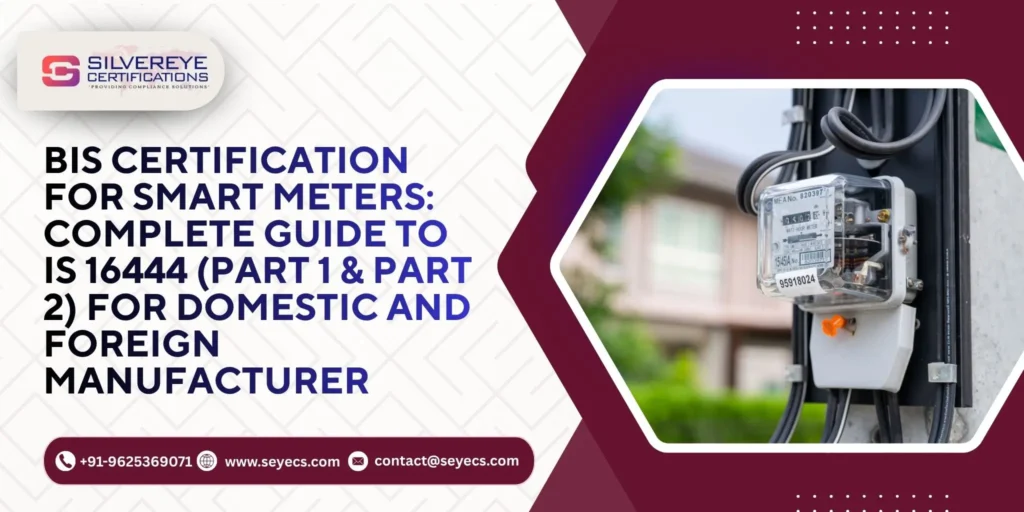
- IS 16444 (Part 1) covers AC static direct-connected watt-hour smart meters, Class 1 and Class 2, used mainly for residential and light commercial billing.
- IS 16444 (Part 2) covers AC static transformer-operated watt-hour and var-hour smart meters, Class 0.2S/0.5S/1S, used for higher-load industrial and commercial connections.
- Certification requires BIS-recognized lab testing, document submission on the Manak Online portal, and (for ISI Mark) a factory inspection before license grant.
- Selling, importing, or supplying uncertified smart meters is a punishable offence under the BIS Act, 2016, and can block participation in DISCOM/RDSS tenders.
Introduction
BIS certification for smart meters is mandatory in India under the Smart Meters (Quality Control) Order, 2023. AC static direct-connected smart meters (Class 1 and Class 2) are certified under IS 16444 (Part 1), while transformer-operated smart meters (Class 0.2S, 0.5S, 1S) fall under IS 16444 (Part 2).

Manufacturers must get their product lab-tested at a BIS-recognized laboratory, apply on the BIS Manak Online portal, and — for the ISI Mark scheme — undergo a factory audit. The process typically takes 25–45 working days, and the license must be renewed before expiry to keep selling or supplying meters legally in India.
What Is BIS Certification for Smart Meters?
BIS certification for smart meters is the conformity assessment carried out by the Bureau of Indian Standards to confirm that a smart energy meter manufactured, imported, or sold in India meets the safety, accuracy, and performance requirements laid down in the Indian Standard IS 16444.
Smart meters are electronic devices that combine energy measurement with two-way communication, remote reading, load control, tamper detection, and data logging — features that make them central to India's smart grid, RDSS (Revamped Distribution Sector Scheme), and prepaid metering rollouts. Because these meters directly affect consumer billing accuracy and grid data security, the government treats BIS certification as non-negotiable rather than a voluntary quality mark.

The certification is issued under the Bureau of Indian Standards Act, 2016, and administered through the Product Certification Scheme (commonly called the ISI Mark – Scheme I). Once a manufacturer's product and factory meet the requirements of IS 16444, BIS grants a license bearing a unique CM/L number, which must appear on every certified smart meter along with the ISI mark and the applicable IS number.
Why Is BIS Certification Mandatory for Smart Meters in India?
BIS certification for smart meters became compulsory after the Ministry of Commerce and Industry (Department for Promotion of Industry and Internal Trade) notified the Smart Meters (Quality Control) Order, 2023. This Quality Control Order (QCO) brings AC static direct-connected watt-hour smart meters, Class 1 and Class 2, under IS 16444 (Part 1) squarely within the mandatory BIS regime. In practical terms, this means no manufacturer, importer, or supplier can legally sell a smart meter in the Indian market — offline or online — without a valid BIS license for that product.
Key reasons the government made it mandatory
- Billing accuracy: certified meters are tested for accuracy class (±1% for Class 1, ±2% for Class 2), so consumers are billed correctly.
- Grid and data security: IS 16444 tests communication protocols, tamper detection, and data integrity so meters can't be manipulated or hacked.
- Tender eligibility: DISCOMs and AMISPs (Advanced Metering Infrastructure Service Providers) require valid, current BIS certification before accepting a meter for RDSS or state smart-metering tenders.
- Market cleanup: the QCO is meant to remove substandard, uncertified meters that cause billing disputes and safety risks.
IS 16444 (Part 1) vs IS 16444 (Part 2): What's the Difference?
Both standards fall under the IS 16444 family for smart meters, but they apply to different meter types and use cases. Knowing which one applies to your product is the first step before you approach BIS or a certification consultant.
| Parameter | IS 16444 (Part 1) | IS 16444 (Part 2) |
| Meter type | AC static direct-connected watt-hour smart meter | AC static transformer-operated watt-hour & var-hour smart meter |
| Accuracy class | Class 1 and Class 2 | Class 0.2S, 0.5S, and 1S |
| Typical use | Residential and light commercial connections | Industrial, commercial, and high-load (CT/PT operated) connections |
| Connection | Direct connection to supply | Operates through current/voltage transformers |
| Regulatory status | Notified under Smart Meters (QCO), 2023 — mandatory | Falls under BIS product certification; check current QCO notification for applicability |
| Key tests | Accuracy, load performance, communication, tamper, endurance, EMC | Accuracy, multirate tariff, bidirectional energy, communication, endurance, EMC |
Note: QCO applicability can be updated by the government from time to time. Always verify the current notification status for IS 16444 (Part 2) on the official BIS/DPIIT portal or with a certification consultant before starting the process.
Who Needs BIS Certification for Smart Meters?
If you manufacture, assemble, import, brand, or supply AC static smart meters for sale in India, BIS certification for smart meters applies to you. This covers a wide range of businesses in the metering and energy ecosystem.
- Domestic manufacturers of smart meters (Class 1, Class 2, or transformer-operated types).
- Foreign manufacturers exporting smart meters to India (certified through the Foreign Manufacturers Certification Scheme, FMCS, with an Authorized Indian Representative).
- System integrators and AMISPs supplying meters under RDSS or state DISCOM smart-metering contracts.
- Private-label brands that get meters manufactured on their behalf but sell under their own brand name.
- Importers and traders bringing smart meters into India for resale or B2G supply.
Eligibility Criteria for BIS Certification of Smart Meters
Before applying, BIS expects the applicant and the product to meet a few baseline conditions:
- A registered legal business entity (proprietorship, partnership, LLP, or company) with valid GST and company registration.
- A functioning manufacturing unit (in India for ISI Mark, or overseas with an appointed Authorised Indian Representative for FMCS).
- A product design that conforms to the technical parameters of IS 16444 (Part 1) or (Part 2), as applicable — accuracy class, communication protocol, tamper resistance, and so on.
- A valid test report from a BIS-recognised or NABL-accredited testing laboratory for the exact model/variant being certified.
- An in-house or contracted quality control system that BIS can audit as part of the factory inspection.
Documents Required for BIS Certification of Smart Meters
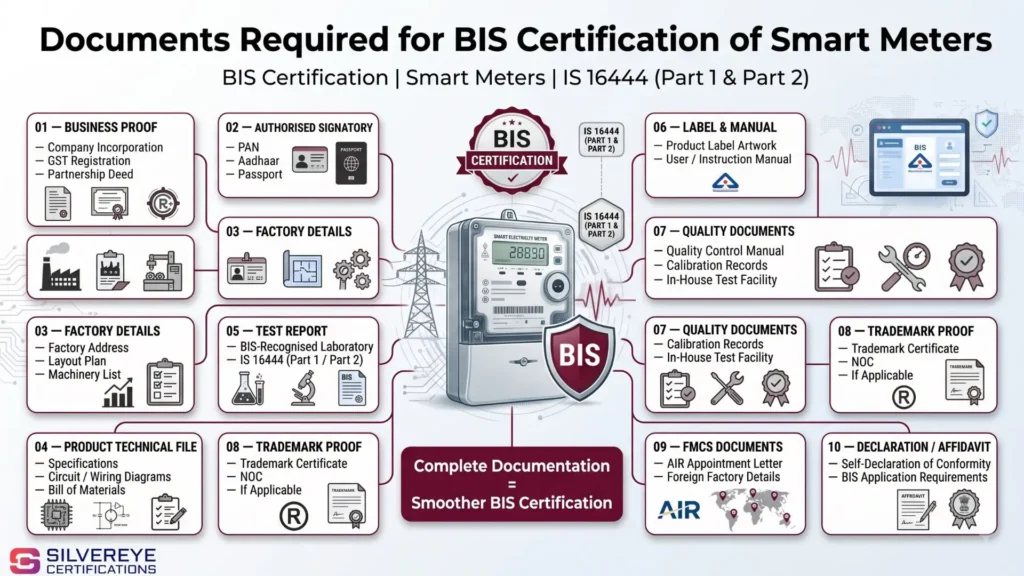
Keeping these documents ready in advance is the single biggest factor in avoiding delays during BIS certification for smart meters:
| Document Category | Details |
| Business proof | Company incorporation certificate / GST registration / partnership deed |
| Authorised signatory proof | PAN card, Aadhaar card, or passport of the authorised signatory |
| Factory details | Manufacturing unit address proof, layout plan, and machinery list |
| Product technical file | Product specification sheet, circuit/wiring diagrams, bill of materials |
| Test report | Type-test report from a BIS-recognised lab as per IS 16444 (Part 1 or Part 2) |
| Label & manual | Product label artwork and user/instruction manual as per marking requirements |
| Quality documents | Quality control manual, calibration records, in-house test facility details |
| Trademark proof | Trademark registration certificate or NOC, if applicable |
| FMCS documents (foreign units only) | Authorised Indian Representative (AIR) appointment letter and factory details |
| Declaration/affidavit | Self-declaration of conformity as prescribed in the BIS application form |
Step-by-Step BIS Certification Process for Smart Meters
Here is how the BIS certification for smart meters process actually works, from application to licence in hand:
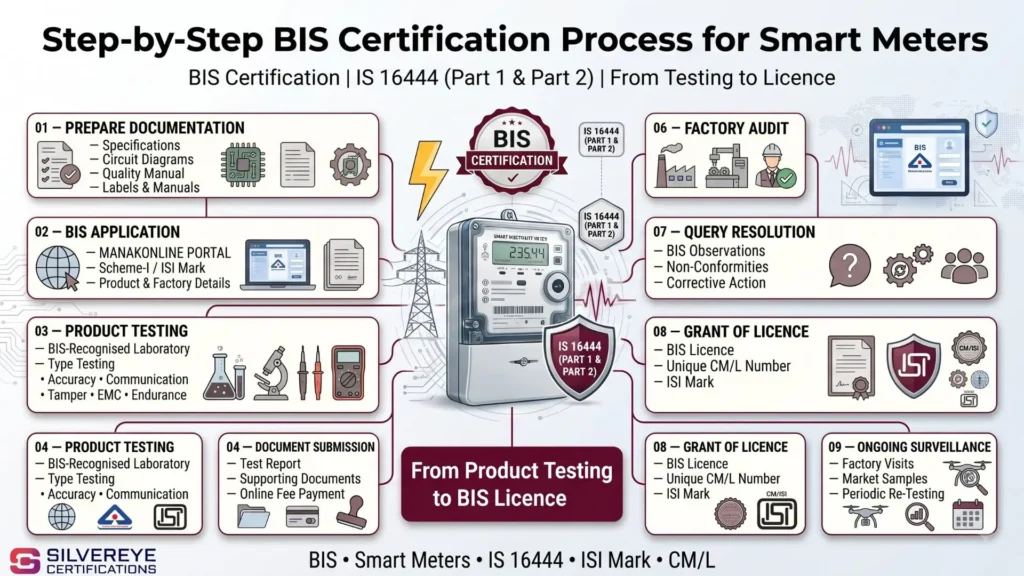
- Identify the correct standard: confirm whether your meter falls under IS 16444 (Part 1) or IS 16444 (Part 2), and check current QCO applicability.
- Prepare technical documentation: specification sheets, circuit diagrams, quality manual, and product labels/manuals.
- Get the product tested: send samples to a BIS-recognized laboratory for type testing against the applicable IS 16444 clauses (accuracy, communication, tamper, endurance, EMC, etc.).
- Register on the BIS Manak Online portal and fill in the application (Scheme-I / ISI Mark) with product and factory details.
- Upload the test report and supporting documents as per the BIS checklist, and pay the application fee online.
- Factory audit: a BIS officer inspects the manufacturing unit, quality control processes, and in-house testing capability.
- Query resolution: respond promptly to any observations or non-conformities raised by BIS during document scrutiny or the audit.
- Grant of license: once BIS is satisfied, it issues the license with a unique CM/L number, allowing you to use the ISI mark with the IS 16444 number on your smart meters.
- Ongoing surveillance: BIS may conduct periodic factory visits and pull market samples for re-testing to confirm continued compliance.
BIS Certification Fees for Smart Meters (Approximate Cost Breakup)
The total cost of BIS certification for smart meters depends on the accuracy class, number of models/variants, and the testing laboratory chosen. Based on current industry-reported ranges, applicants can expect the following broad cost heads:
| Cost Head | Approximate Range |
| BIS application fee | A few thousand rupees per application, as prescribed by BIS |
| Lab testing charges | Varies significantly by lab and number of parameters tested; typically a meaningful five-figure amount per model |
| Factory audit fee | Charged per man-day of the BIS officer's visit (higher for overseas FMCS audits) |
| Annual marking/licence fee | Recurring fee to retain the right to use the ISI mark, based on scheme and production volume |
| Consultant/professional fee (optional) | Charged by certification consultants like Silvereye Certifications for documentation, lab coordination, and audit handling |
Fee figures change periodically and vary by product variant, lab, and scheme (ISI Mark vs FMCS). Always confirm the latest official fee schedule on the BIS ManakOnline portal or with a certification consultant before budgeting.
Timeline: How Long Does BIS Certification for Smart Meters Take?
Under normal circumstances, and assuming documents and test reports are in order, BIS certification for smart meters takes approximately 25 to 45 working days from application to license grant. Lab testing alone can take 7–15 days depending on the lab's queue and the number of parameters being tested. Delays most commonly happen because of incomplete documentation, test failures that require re-testing, or non-conformities flagged during the factory audit — which is exactly where an experienced consultant can help you save time.
Validity and Renewal of BIS Certification for Smart Meters
An ISI Mark licence for smart meters is typically granted for an initial period of around 1 to 2 years, subject to ongoing BIS surveillance. Under the BIS Conformity Assessment Regulations update rolled out in 2026, renewal validity for BIS licences — including for products certified under IS 16444 — can now be extended up to 5 years at a time, with manufacturers paying the renewal fee annually instead of as a single lump sum. This reduces the frequency of paperwork while keeping annual compliance and fee-payment obligations in place.
- Renewal should be initiated 2–3 months before the license expiry date to avoid any compliance gap.
- Renewal typically requires updated test reports, production records, and confirmation of continued factory compliance.
- Operating with an expired BIS license is a violation of the BIS Act, 2016 — the right to use the ISI mark stops the moment the license lapses.
- BIS can conduct market surveillance and pull samples for testing even while the license is active, so ongoing quality control matters as much as the paperwork.
Benefits of BIS-Certified Smart Meters
- Legal market access: certified meters can be manufactured, imported, and sold in India without regulatory risk.
- Tender and DISCOM eligibility: mandatory for participating in RDSS and state DISCOM smart-metering tenders.
- Consumer trust: accurate, tamper-resistant meters reduce billing disputes and build brand credibility.
- Export and brand value: an ISI-marked product signals quality assurance to institutional buyers and EPC contractors.
- Grid readiness: certified meters are built to support two-way communication, load profiling, and smart-grid integration.
Consequences of Selling Non-Certified Smart Meters
Manufacturing, importing, distributing, or selling smart meters without valid BIS certification is an offence under the BIS Act, 2016. Consequences can include seizure of non-compliant stock, monetary penalties, disqualification from DISCOM and RDSS tenders, and reputational damage that is hard to recover from in a B2G-heavy sector like smart metering. Given how tightly DISCOMs now verify license validity before onboarding a meter, uncertified products are effectively locked out of the mainstream Indian market.
Why Choose Silvereye Certifications for BIS Certification of Smart Meters
Getting BIS certification for smart meters right the first time means understanding the fine print of IS 16444 (Part 1) and IS 16444 (Part 2) — from accuracy-class testing to factory-audit readiness. Silvereye Certifications works as an end-to-end consulting partner for smart meter manufacturers and importers who want a smooth, first-time-approval experience instead of repeated queries and lab re-testing cycles.
- Standard identification: helping you correctly classify your meter under IS 16444 (Part 1) or (Part 2) before you spend on testing.
- Documentation support: preparing the technical file, labels, manuals, and quality manual exactly as BIS expects.
- Lab coordination: connecting you with BIS-recognised testing laboratories and tracking the testing timeline.
- Factory audit readiness: preparing your unit and quality records so the BIS inspection goes through without non-conformities.
- Renewal and surveillance support: keeping your licence active well ahead of expiry and managing ongoing BIS compliance.
If you manufacture or import smart meters and want a certification partner who understands both the regulatory process and the ground realities of factory audits, Silvereye Certifications is positioned as a dependable consultant for BIS certification for smart meters under IS 16444 (Part 1) and IS 16444 (Part 2) — helping you get from application to licence with fewer surprises.
Frequently Asked Questions
Is BIS certification mandatory for all smart meters in India?
Yes. AC static direct-connected smart meters, Class 1 and Class 2, are mandatorily covered under IS 16444 (Part 1) through the Smart Meters (Quality Control) Order, 2023. Always check the current QCO notification status for other meter categories.
What is the difference between IS 16444 (Part 1) and IS 16444 (Part 2)?
IS 16444 (Part 1) applies to direct-connected AC static smart meters, Class 1 and 2, mainly for residential use. IS 16444 (Part 2) applies to transformer-operated smart meters, Class 0.2S/0.5S/1S, used for higher-load industrial and commercial connections.
How long does BIS certification for smart meters take?
Typically 25 to 45 working days from application to licence grant, assuming documents and test reports are complete and no major non-conformities are raised.
What documents are needed for BIS certification of smart meters?
Business registration proof, authorised signatory ID, factory details, technical specification sheets, a valid test report from a BIS-recognised lab, product labels/manuals, and a quality control manual.
Is a factory audit compulsory for smart meter BIS certification?
Yes, under the ISI Mark / Product Certification Scheme, BIS conducts a factory audit to verify manufacturing capability and quality control before granting the licence.
What is the validity of a BIS licence for smart meters?
Typically 1 to 2 years initially. Under the 2026 update to the BIS Conformity Assessment Regulations, renewal validity can extend up to 5 years, with fees payable annually.
Can a foreign manufacturer get BIS certification for smart meters?
Yes, through the Foreign Manufacturers Certification Scheme (FMCS), which requires an overseas factory audit and an Authorised Indian Representative (AIR) based in India.
What happens if I sell smart meters without BIS certification?
It is a punishable offence under the BIS Act, 2016, and can lead to seizure of stock, penalties, and disqualification from DISCOM or RDSS tenders.
Do smart meters need BIS certification to qualify for RDSS or DISCOM tenders?
Yes. DISCOMs and AMISPs typically require current, valid BIS certification under IS 16444 before accepting a meter model for smart-metering rollouts.
How much does BIS certification for smart meters cost?
Costs include the application fee, lab testing charges, factory audit fee, and annual marking fee — the exact amount depends on the meter class, number of variants, and testing lab. Consult the current BIS fee schedule or a certification consultant for an accurate quote
Can Silvereye Certifications help with both IS 16444 (Part 1) and (Part 2) certification?
Yes, Silvereye Certifications supports manufacturers and importers across both direct-connected (Part 1) and transformer-operated (Part 2) smart meter certification, from documentation to licence renewal.