- Skin beauty care appliances — including facial steamers, skin massagers, exfoliating devices, and cleansing devices — need mandatory BIS certification under IS 302 (Part 1):2024, enforced through the QCO notified by DPIIT on 6 April 2026 (S.O. 1739(E)).
- Certification is granted under Scheme-I (ISI Mark) of the BIS Conformity Assessment Regulations, 2018, and the licensed product carries the ISI mark on both the appliance and its packaging.
- General manufacturers must comply by 1 October 2026; small enterprises by 1 January 2027; and micro enterprises by 1 April 2027.
- Official BIS government fees start at ₹1,000 for the application, with lab testing, factory audit, and marking charges billed separately.
Introduction
BIS certification for skin beauty care appliances is mandatory in India under IS 302 (Part 1):2024, the safety standard covering electrical appliances used for facial and skin treatment, such as facial steamers, skin massagers, exfoliating brushes, and cleansing devices.
The requirement is enforced through the Safety of Household, Commercial and Similar Electrical Appliances (Quality Control) Order, 2026, notified by the DPIIT on 6 April 2026. Manufacturers and importers must obtain a BIS Scheme-I (ISI Mark) licence before selling these appliances in India.
General manufacturers must comply by 1 October 2026, small enterprises by 1 January 2027, and micro enterprises by 1 April 2027. Government fees start at ₹1,000, excluding lab testing, inspection, and marking charges.
What Is BIS Certification for Skin Beauty Care Appliances?
If you make or sell facial steamers, skin massagers, ultrasonic skin scrubbers, electric exfoliating brushes, or other electrical devices meant to be used on the face and skin, you've likely run into the requirement for "BIS certification for skin beauty care appliances" while checking what it takes to sell legally in India. Put simply, this is the government safety approval that confirms your device won't shock, overheat, or otherwise injure the person using it, before it ever reaches a customer's bathroom shelf.
BIS, the Bureau of Indian Standards, is the national standards body responsible for testing and certifying products before they enter the Indian market. Skin beauty care appliances are grouped as their own product category under IS 302 (Part 1):2024, sitting alongside related categories like massage appliances and beauty devices using lasers or intense light. Once a category is notified under a Quality Control Order (QCO), it stops being optional — manufacturing or selling it without a valid BIS licence becomes a legal violation under the BIS Act, 2016.

This matters more than ever right now. India's personal-care appliance market — everything from facial steamers to jade rollers with vibration motors — has expanded rapidly through D2C brands and marketplaces, and a large share of that supply is imported or contract-manufactured with little independent safety testing. The government's certification push is a direct response to that gap, aimed at keeping unsafe electrical devices away from people's faces.
What Is IS 302 (Part 1):2024 and Which Standard Applies to Skin Beauty Care Appliances?
IS 302 (Part 1):2024 is officially titled "Household and Similar Electrical Appliances — Safety — Part 1: General Requirements." It is India's version of the international standard IEC 60335-1:2020, meaning your appliance is tested against safety benchmarks broadly comparable to what regulators in the EU and UK already expect.
The standard covers electrical appliances rated up to 250V for single-phase use and up to 415V for other appliances, across household, commercial, and light-industrial settings. For a skin beauty care appliance, general safety testing under Part 1 is applied together with the relevant sectional clauses specific to beauty and personal-care devices, which address the particular risks of a device that heats water, as in a facial steamer, vibrates against skin, or is used near a power outlet in a bathroom.
In practical terms, testing labs check things like:
- Whether the heating element in a facial steamer can overheat, scald, or cause thermal injury during normal or foreseeable misuse.
- Whether internal wiring, motors, and battery packs are properly insulated against electric shock, especially in appliances used near water.
- Whether the device's construction resists moisture ingress, given many skin care appliances are used in bathrooms or steamy environments.
- Whether mechanical parts — vibration motors, rotating exfoliating heads — are free of pinch points or overheating risks during extended use.
This is why certification is not a rubber stamp. It requires actual laboratory testing against these clauses before BIS will issue a licence.
Why Is BIS Certification for Skin Beauty Care Appliances Now Mandatory?
There's a fair amount of outdated information floating around on this topic, so it's worth being precise about the timeline. The underlying Quality Control Order covering household and similar electrical appliances — including skin beauty care appliances — was first notified by the Department for Promotion of Industry and Internal Trade (DPIIT) in 2024. BIS then issued implementation circulars in December 2024 and September 2025 to guide manufacturers on licensing under the revised IS 302 (Part 1):2024 / IEC 60335-1:2020 standard.
That order has since been superseded. The governing notification today is the Safety of Household, Commercial and Similar Electrical Appliances (Quality Control) Order, 2026 — Gazette notification S.O. 1739(E), notified by DPIIT on 6 April 2026 under Section 16 of the BIS Act, 2016. This 2026 order replaces the earlier 2025 version and resets the compliance deadlines, giving brands a somewhat longer runway to certify before enforcement begins.
What Is the QCO 2026 Implementation Timeline?
| Enterprise Category | Compliance Deadline | Applicable Standard |
|---|---|---|
| General / Large & Medium Enterprises | 1 October 2026 | IS 302 (Part 1):2024 |
| Small Enterprises | 1 January 2027 | IS 302 (Part 1):2024 |
| Micro Enterprises | 1 April 2027 | IS 302 (Part 1):2024 |
Under this order, every covered appliance — skin beauty care appliances included — must conform to IS 302 (Part 1):2024 and bear the BIS Standard Mark (ISI Mark) granted under Scheme-I of Schedule-II of the BIS (Conformity Assessment) Regulations, 2018. Products manufactured or imported before your applicable deadline can typically continue to be sold for a limited transition window, commonly cited as up to six months, but this is conditional and should not be treated as a reason to delay applying.
Are Hair Care Appliances Covered Under the Same BIS Standard?
| A Note on Hair Care Appliances — Don't Confuse the Two Standards |
|---|
| Hair dryers, hair straighteners, curling irons, and similar hair styling appliances are regulated separately under IS 302 (Part 2/Sec 23):2009, through the Electrical Appliances for Skin or Hair Care (Quality Control) Order, 2023 — a QCO that reached full enforcement across all enterprise categories by September 2025. "Skin beauty care appliances" under IS 302 (Part 1):2024, covered in this guide, refers to facial and skin-focused devices such as steamers, massagers, and cleansing tools. If your product line includes both hair styling and skin/facial devices, you may need certification under both standards — confirm the exact classification of each SKU with BIS or a certification consultant rather than assuming. |
Who Needs BIS Certification for Skin Beauty Care Appliances?
BIS certification under IS 302 (Part 1):2024 applies to anyone bringing skin beauty care appliances into the Indian market, including:
- Indian manufacturers producing facial steamers, skin massagers, ultrasonic cleansing devices, or similar electrical beauty appliances domestically.
- D2C and private-label beauty brands that get these appliances manufactured on contract and sell them under their own brand name.
- Foreign manufacturers exporting skin care appliances to India, who apply through the Foreign Manufacturers Certification Scheme (FMCS) rather than the domestic Scheme-I route.
- Importers and distributors bringing in finished skin beauty devices for resale, since customs clearance for these products is tied to holding a valid BIS licence.
If your appliance is electrical, is used on the face or skin for a cosmetic or wellness purpose, and doesn't already fall under the separate hair-care standard described above, it's reasonable to assume it needs certification as a skin beauty care appliance under IS 302 (Part 1):2024 — but always confirm applicability for your exact SKU before launch.
What Are the Benefits of Getting BIS Certification for Skin Beauty Care Appliances?
Beyond avoiding penalties, brands that get certified ahead of the deadline tend to do it for reasons that go well beyond compliance.
- Legal market access: Without a BIS licence, manufacturing, importing, or selling the product after your applicable deadline is a punishable offence under the BIS Act, 2016.
- Marketplace and retail approval: Online marketplaces and organised retail chains are increasingly asking for BIS documentation before listing electrical personal-care appliances.
- Consumer trust: The ISI mark is one of India's most recognised quality symbols, and on a device used directly on the skin, that trust signal genuinely influences purchase decisions.
- Smoother customs clearance: For imported skin care appliances, a valid BIS or FMCS license prevents shipments from being held up or rejected at Indian ports.
- Lower product-liability exposure: A certified product comes with documented proof of safety testing, which matters if a burn, shock, or malfunction complaint is ever raised.
What Documents Are Required for BIS Certification of Skin Beauty Care Appliances?
The exact document checklist varies slightly between Indian manufacturers and foreign manufacturers applying under FMCS, but the core set BIS typically asks for includes:
- Company registration proof — GST certificate, Certificate of Incorporation, or Udyam/MSME registration.
- Factory address proof and a layout plan of the manufacturing or assembly unit.
- Technical specifications and circuit drawings of the appliance, including wattage, heating element details (for steamers), and motor specifications (for massagers/exfoliators).
- List of raw materials and components used, with supplier details for critical parts such as heating elements, motors, batteries, and power cords.
- In-house testing facility details, or an agreement with a third-party BIS-recognised lab where in-house testing capability is limited.
- Test reports from a BIS-recognised laboratory confirming compliance with IS 302 (Part 1):2024 and applicable sectional clauses.
- Trademark or brand authorisation letter, if the product is sold under a different brand than the manufacturer.
- Authorised signatory details and a Power of Attorney where an agent or consultant is filing on the applicant's behalf.
- For foreign manufacturers: an Authorised Indian Representative (AIR) appointment letter, as required under the FMCS route.
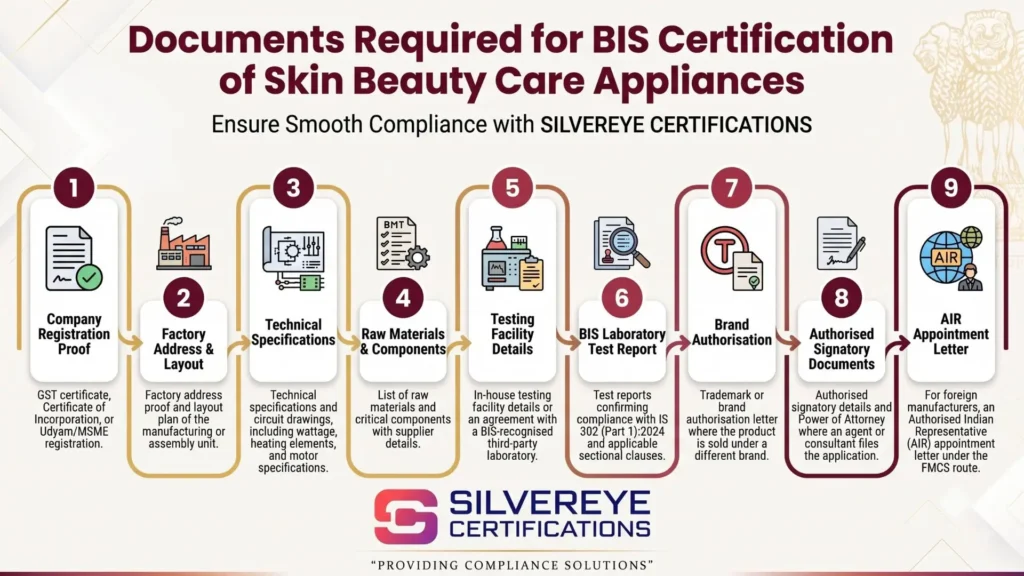
Incomplete or inconsistent documentation is consistently one of the top reasons applications stall at BIS, so it's worth having a consultant review your file before you submit it on the BIS Care portal.
How Does the BIS Certification Process Work Under Scheme-I?
BIS certification for skin beauty care appliances is processed under Scheme-I — the standard ISI Mark scheme — of Schedule-II of the BIS (Conformity Assessment) Regulations, 2018. Here's how the process typically unfolds:
- Product scope and standard confirmation: Confirm your appliance falls under IS 302 (Part 1):2024 as a skin beauty care appliance (and not under the separate hair-care standard) and identify the exact clauses applicable to it.
- Sample testing: Send product samples to a BIS-recognised laboratory for testing against the relevant clauses of IS 302 (Part 1):2024.
- Application filing: Submit the application, technical documentation, and test reports through the BIS Care Manager portal (manakonline.bis.gov.in).
- Document scrutiny: BIS reviews the application and supporting documents for completeness and technical accuracy.
- Factory audit: A BIS officer conducts an on-site inspection of the manufacturing facility to verify production capability and in-house quality control processes.
- Sample verification (if required): BIS may draw additional samples during or after the audit for independent verification testing.
- Grant of licence: Once testing and the audit are cleared, BIS grants the Scheme-I licence, allowing the ISI mark to be used on the appliance and its packaging.
- Ongoing surveillance: BIS conducts periodic market and factory surveillance audits after the licence is granted to confirm continued compliance.
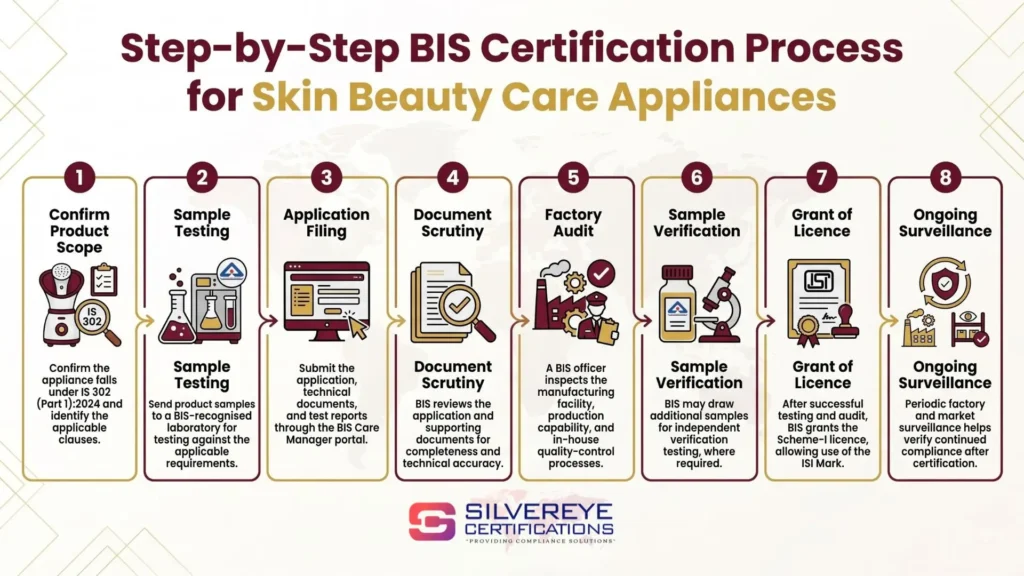
For applicants with complete documentation, the process from application to licence grant typically takes four to eight weeks, though it can extend if test reports need rework or the factory audit surfaces non-conformities that require correction.
How Much Does BIS Certification for Skin Beauty Care Appliances Cost?
The most common question brands ask is simply what this will cost. There isn't one flat number — total cost depends on the fixed government fees published by BIS, independent lab testing charges (which vary by product complexity and lab), and any professional or consultancy fees if you choose to work with an agency.
What Are the Official BIS Government Fees Under Scheme-I?
| Fee Component | Amount | Notes |
|---|---|---|
| Application Fee | ₹1,000 (+18% GST) | One-time, non-refundable, paid at filing |
| Annual Licence Fee | ₹1,000 (+18% GST) per year | Paid yearly to keep the licence active |
| Factory Audit / Inspection Fee | ₹7,000 per man-day (+18% GST) | Charged for each day of on-site BIS audit |
| Testing Charges | As per actuals | Depends on the BIS-recognised lab and number of parameters tested |
| Marking Fee | As per applicable rate | Recurring fee linked to production/sales volume once licensed |
| Renewal Application Fee | ₹1,000 (non-refundable) | Payable when the licence comes up for renewal |
| Inclusion of New Model/Variety | ₹5,000 | Applicable if you add a new appliance model to an existing licence |
These figures reflect the standard government fee structure published for BIS Scheme-I (ISI Mark) applicants and are subject to revision by BIS from time to time. For the most current and authoritative fee schedule, always cross-check directly on the official BIS website and the BIS Care Manager portal before finalising your certification budget.
On top of government fees, budget separately for independent lab testing (which can range from a few thousand rupees to well over ₹50,000, depending on how many parameters and models are tested) and, if you engage a consultant, their professional service fee for documentation, lab coordination, and audit support.
How Long Is BIS Certification Valid and When Do You Need to Renew It?
A BIS Scheme-I licence for skin beauty care appliances is generally granted for one year and is renewable annually, subject to continued compliance and payment of the annual licence fee. BIS also conducts periodic surveillance during the licence period, which can include repeat factory audits and market sample testing.
- Initial licence validity: 1 year from the date of grant, renewable thereafter.
- Renewal window: File the renewal application well before expiry, along with updated test reports if the product specification has changed.
- Late renewal: A late fee applies if the renewal is filed after the licence has lapsed, and continuing to sell under a lapsed licence counts as non-compliance.
- Model additions: Launching a new steamer, massager, or skin device variant under an existing licence generally goes through an "inclusion of new variety" process rather than a fresh application.
What Are the Latest 2026 BIS Regulatory Updates for Skin Beauty Care Appliances?
- The governing order is now the Safety of Household, Commercial and Similar Electrical Appliances (Quality Control) Order, 2026 (S.O. 1739(E), notified 6 April 2026), which supersedes the earlier 2025 order and covers roughly 90 categories of electrical appliances, including skin beauty care appliances.
- BIS's September 2025 implementation guidelines clarified that a manufacturer producing multiple appliance types under IS 302 (Part 1) can now be granted a single consolidated BIS licence, rather than a separate licence for each appliance category.
- Adding a genuinely new appliance category to an existing licence now involves a desk audit, review of independent test reports, and on-site verification by BIS, rather than requiring a full fresh application every time.
- The separate standard for hair care appliances — IS 302 (Part 2/Sec 23):2009, under the 2023 QCO — reached full enforcement across all enterprise categories by September 2025, so brands selling both hair and skin devices should check both timelines rather than assuming one deadline covers everything.
- Marking fees are applied per the rates in BIS Circular CMD-2/G-18 dated 29 April 2025; confirm current marking fee rates directly with BIS or your certification consultant before finalising product pricing.
Because QCO timelines and circulars have shifted more than once since 2024, treat any date in this article as something to reconfirm on the official BIS website before making a compliance decision, particularly if your deadline is approaching.
What Common Mistakes Do Skin Care Appliance Brands Make During BIS Certification?
- Assuming a CE mark, FDA registration, or another country's approval is enough for India — BIS certification is a separate, India-specific legal requirement.
- Confusing the skin beauty care category with the hair care category, and applying under the wrong standard or missing one entirely for a mixed product line.
- Waiting until close to the compliance deadline to begin testing, leaving no buffer if a report needs to be redone.
- Submitting incomplete technical documentation, which remains one of the most common causes of application delay.
- Underbudgeting by only accounting for the one-time application fee and forgetting marking fees, annual renewal, and testing costs.
Why Should You Choose Silvereye Certifications for BIS Certification?
Getting a BIS licence for skin beauty care appliances involves more than filling out a form — it means correctly identifying whether your product falls under IS 302 (Part 1):2024 or the separate hair-care standard, coordinating with a BIS-recognised lab for the right tests, and preparing a factory that passes its BIS audit on the first attempt. Silvereye Certifications works as a BIS certification consultancy for manufacturers, importers, and D2C beauty brands navigating exactly this kind of compliance.
- Hands-on BIS, CRS, and FMCS experience: The team works across BIS product categories, including electrical and personal-care appliances, and understands how Scheme-I applications are actually reviewed and audited.
- Correct product classification from the start: Since skin and hair care appliances sit under different standards, Silvereye Certifications helps confirm the right classification for each SKU before filing, avoiding wasted time on the wrong application.
- Documentation done right the first time: The team prepares technical files, coordinates test scheduling, and organises factory documentation upfront — reducing back-and-forth with BIS.
- Lab and audit coordination: Silvereye Certifications helps line up sample testing with BIS-recognised laboratories and prepares manufacturers for the factory inspection stage.
- Transparent, fair pricing: Government fees, testing charges, and professional fees are laid out clearly upfront, so brands can budget accurately instead of discovering hidden costs later.
- End-to-end support: From initial scope confirmation to licence grant and ongoing renewal, Silvereye Certifications supports the full lifecycle of the certification, not just the first application.
If your compliance deadline is approaching and you're still unsure whether your facial steamer, massager, or skin device needs certification, what documents you're missing, or how much the process will realistically cost, it's worth getting a proper scope assessment now — rather than finding out during a marketplace review or a customs hold.
What Should You Know Before Getting BIS Certification for Skin Beauty Care Appliances?
Skin beauty care appliances have gone from a niche personal-care segment to a fast-growing category in India, and regulation has caught up with that growth. BIS certification under IS 302 (Part 1):2024, enforced through the QCO 2026 notified on 6 April 2026, is now a legal requirement for anyone manufacturing, importing, or selling facial steamers, skin massagers, and similar devices — with deadlines running from 1 October 2026 for general manufacturers through to 1 April 2027 for micro enterprises.
The most sensible approach is not to wait for the deadline to arrive. Confirm whether your specific product falls within scope (and whether it might also need the separate hair-care standard), get your documentation and lab testing in order early, and treat the BIS Scheme-I licence as part of your product launch checklist rather than a last-minute scramble. Brands that plan for this now will be the ones still selling confidently on Indian marketplaces and in retail once enforcement is in full swing — while those who delay risk listing takedowns, customs holds, and lost sales at exactly the wrong moment.
Frequently Asked Questions
Is BIS certification mandatory for skin beauty care appliances in India?
Yes. Under the Safety of Household, Commercial and Similar Electrical Appliances (Quality Control) Order, 2026, skin beauty care appliances such as facial steamers and skin massagers fall under IS 302 (Part 1):2024, and BIS certification with the ISI mark is mandatory before manufacturing, importing, or selling them in India.
What is the deadline for BIS certification of skin beauty care appliances?
General manufacturers must comply by 1 October 2026, small enterprises by 1 January 2027, and micro enterprises by 1 April 2027, as per the current QCO 2026 timeline.
Do hair dryers and straighteners need the same certification as skin beauty care appliances?
No. Hair dryers, straighteners, and curling irons are regulated under a separate standard, IS 302 (Part 2/Sec 23):2009, through the Electrical Appliances for Skin or Hair Care (Quality Control) Order, 2023, which is already fully enforced. Skin beauty care appliances (steamers, massagers, cleansing devices) fall under IS 302 (Part 1):2024 via the 2026 QCO.
Which BIS scheme applies to skin beauty care appliances?
Domestic manufacturers apply under Scheme-I (ISI Mark Scheme) of Schedule-II of the BIS (Conformity Assessment) Regulations, 2018. Foreign manufacturers exporting to India typically apply under the Foreign Manufacturers Certification Scheme (FMCS).
How much does BIS certification cost for a facial steamer or skin massager?
Official government fees start at ₹1,000 for the application and ₹1,000 per year for the license, plus ₹7,000 per man-day for factory audits. Lab testing and marking fees are additional and vary by product and testing scope. Always verify current fees on the official BIS website.
How long does the BIS certification process take?
For applicants with complete documentation, the process — from sample testing to license grant — typically takes about four to eight weeks, though it can take longer if test reports need to be redone or the factory audit flags corrections.
What documents are required to apply for BIS certification?
Common requirements include company registration proof, factory layout, technical drawings, component and supplier details, test reports from a BIS-recognized lab, and authorized signatory details. Foreign manufacturers also need an Authorized Indian Representative.
Can I sell a skin massager or facial steamer online without BIS certification?
Once your compliance deadline under the QCO passes, selling without a valid BIS license is non-compliant, and marketplaces are increasingly requiring BIS documentation upfront for electrical personal-care appliances, regardless of the exact enforcement date.
Is the BIS license valid permanently once granted?
No. The license is typically valid for one year and must be renewed annually, along with payment of the renewal fee and, where applicable, updated test reports.
Do imported skin beauty care appliances also need BIS certification?
Yes. Imported skin beauty care appliances need certification through the FMCS route for foreign manufacturers, and customs clearance is generally linked to holding a valid BIS licence for the product.
What happens if I add a new appliance model after getting certified?
A new model under an existing license usually goes through an "inclusion of new variety" process rather than a completely fresh application, though it still involves a fee and, in many cases, additional test reports.