
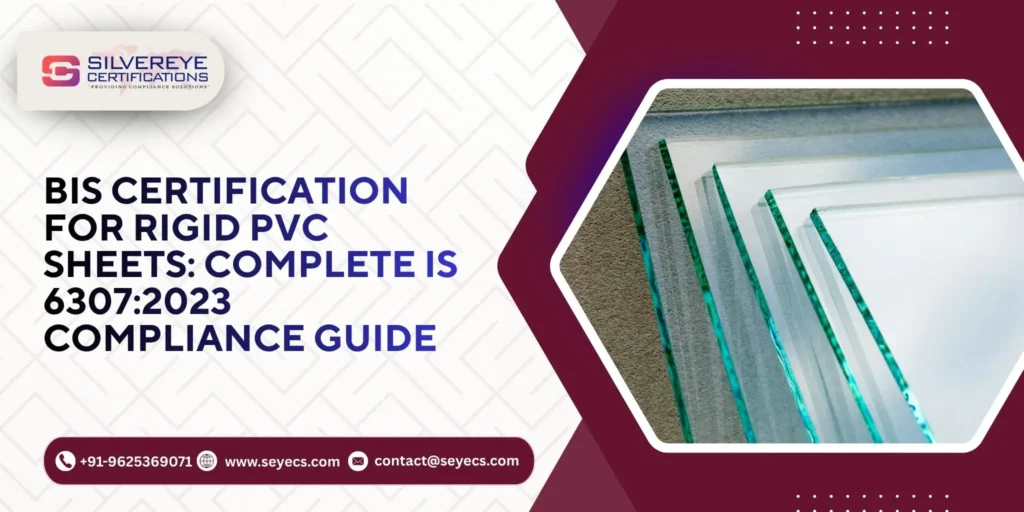
- Rigid PVC sheets are now certified by BIS under the updated Indian Standard IS 6307:2023.
- BIS has already granted India's first All India License under this standard, confirming the certification route is live.
- This guide covers eligibility, documents, process, fees, timeline, validity, and renewal — all in one place.
- Written for manufacturers, importers, and brand owners preparing ISI compliance for PVC sheets in 2026.
Introduction
BIS certification for rigid PVC sheets is the ISI mark approval issued by the Bureau of Indian Standards to manufacturers of rigid PVC sheets under the updated Indian Standard IS 6307:2023. Manufacturers apply on the BIS Manak Online portal, submit factory and product documents, undergo a factory inspection and lab testing, and receive a CM/L license number to affix the ISI mark.
BIS has already confirmed India's first All India License for "Rigid PVC Sheets" under IS 6307:2023, showing the certification pathway is fully functional. Specialist consultancies such as Silvereye Certifications also assist manufacturers with documentation, lab coordination, and BIS application filing.
What Is BIS Certification for Rigid PVC Sheets?
Rigid PVC sheets — used in signage, false ceilings, wall cladding, partitions, packaging, furniture panelling, and industrial linings — are covered under the Indian Standard IS 6307:2023, titled "Rigid PVC Sheets — Specification." This standard, maintained by BIS's Plastics sectional committee (PCD 12), lays down the material composition, dimensional tolerance, and performance requirements a rigid PVC sheet must meet to carry the ISI mark.

BIS certifies rigid PVC sheet manufacturers under its product certification scheme (Scheme-I), governed by the BIS (Conformity Assessment) Regulations, 2018. A manufacturer whose product and factory processes meet IS 6307:2023 requirements is granted a license — identified by a unique CM/L (Certificate of Manufacturing License) number — allowing the ISI mark to be printed on the sheets and their packaging.
BIS's Central Marks Department has already confirmed the grant of India's first All India License for "Rigid PVC Sheets" under IS 6307:2023. This first-license milestone confirms that BIS's testing protocols and review process for this specific, updated standard are active and operational — not a scheme that exists only on paper.
Why BIS Certification Matters for PVC Sheet Manufacturers
An ISI mark on rigid PVC sheets does more than tick a compliance box — it directly shapes your market access and buyer trust.
| Benefit | What It Means for Your Business |
| Market access | Certified sheets can be sold pan-India without state-level restrictions and become eligible for government and institutional procurement. |
| Buyer trust | Architects, contractors, and distributors increasingly ask for ISI-marked PVC sheets before placing bulk orders. |
| Export credibility | An active BIS license signals a mature, audited quality system — useful even when pitching to overseas buyers. |
| Competitive edge | Being an early license holder under the updated IS 6307:2023 sets you apart from manufacturers still working to the old standard. |
| Regulatory readiness | If a Quality Control Order (QCO) is later notified for rigid PVC sheets, existing license holders avoid a last-minute compliance rush. |
Who Needs to Apply?
- Domestic manufacturers producing rigid PVC sheets in India for sale within the country.
- Foreign manufacturers exporting rigid PVC sheets to India — these applicants must appoint an Authorized Indian Representative (AIR) to coordinate with BIS.
- Importers and brand owners marketing rigid PVC sheets under their own brand, either via their own license or an arrangement with a certified manufacturer.
- Not applicable: rigid PVC sheets manufactured strictly for export with no domestic sale generally fall outside mandatory domestic certification.
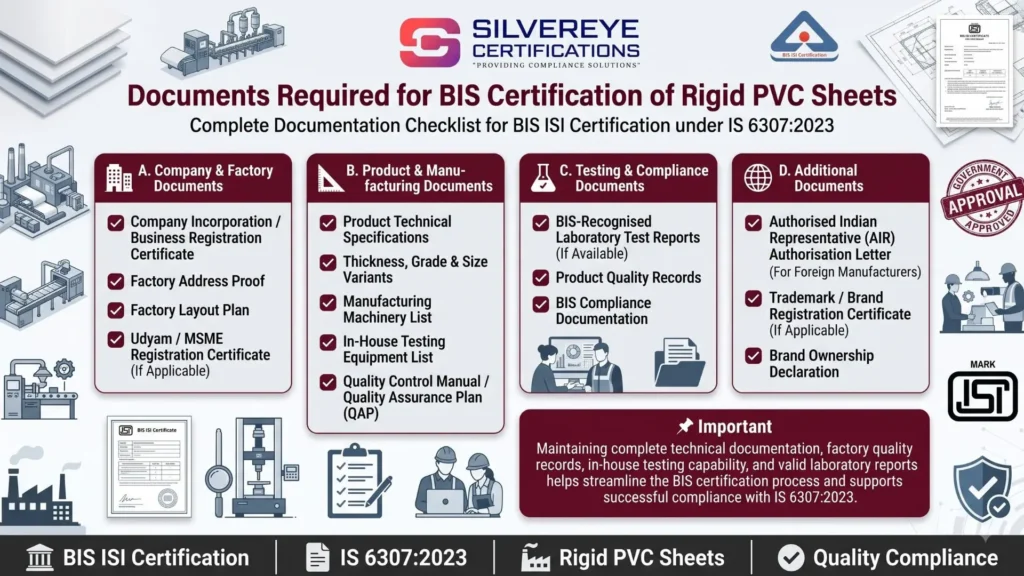
Documents Required for BIS Certification of Rigid PVC Sheets
| Document | Purpose |
| Company incorporation / business registration proof | Confirms the legal entity applying for the license. |
| Factory address proof and layout plan | Used by BIS to schedule and conduct the factory inspection. |
| Product technical specification (thickness, grade, size variants) | Shows conformity with IS 6307:2023 dimensional and material clauses. |
| List of manufacturing and in-house testing machinery | Verifies capability to produce and quality-check the sheets consistently. |
| Quality control manual / QAP | Demonstrates a documented, repeatable quality process at the factory. |
| Test reports from a BIS-recognized laboratory (if available) | Enables the simplified/fast-track procedure where valid reports already exist. |
| Udyam / MSME registration certificate | Required to claim fee concessions for micro, small, or startup enterprises. |
| Authorization letter for AIR | Mandatory for foreign manufacturers applying to sell in India. |
| Trademark or brand registration (if applicable) | Establishes ownership of the brand name marked on the sheets. |
Step-by-Step BIS Certification Process for Rigid PVC Sheets
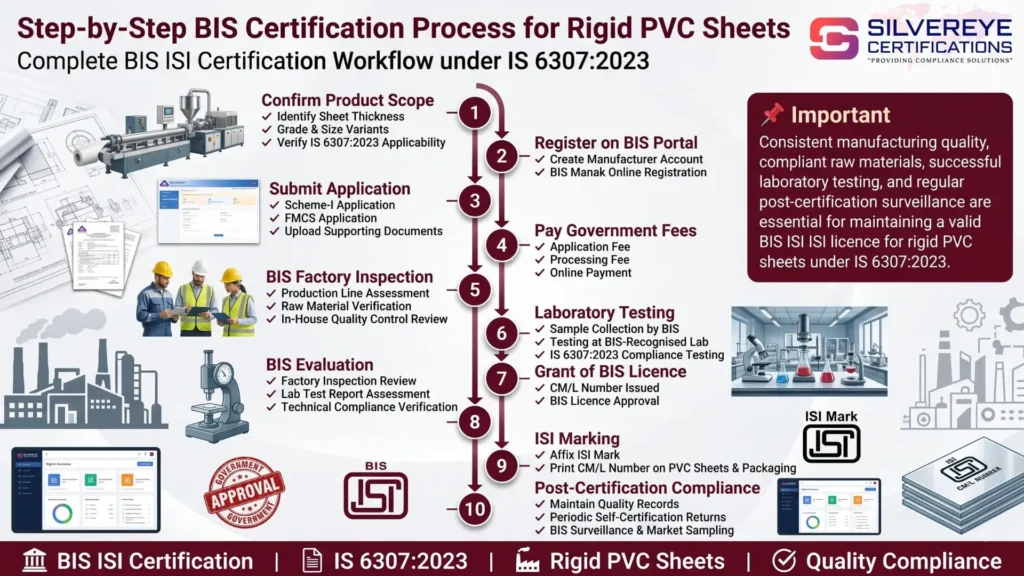
- Confirm your product scope — identify every sheet thickness, grade, and size variant that needs to fall under IS 6307:2023 before applying.
- Register on the BIS Manak Online portal (manakonline.in) as a manufacturer.
- Fill out the Scheme-I application (or the FMCS route for overseas manufacturers), and upload all supporting documents.
- Pay the applicable application and processing fees online.
- BIS schedules a factory inspection to assess your production line, raw material sourcing, and in-house quality control setup.
- Product samples are drawn and sent for testing at a BIS-recognized laboratory against IS 6307:2023 parameters.
- BIS reviews the factory inspection report together with the lab test results.
- On a satisfactory outcome, BIS grants the license with a unique CM/L number.
- The manufacturer affixes the ISI mark and CM/L number on the PVC sheets and their packaging.
- Post-certification, the license holder maintains quality records, files periodic self-certification returns, and cooperates with BIS surveillance inspections and market sampling.
Fees Involved in BIS Certification for Rigid PVC Sheets
BIS certification cost isn't a flat number — it depends on how many sheet variants (thickness/grade combinations) you're certifying, the testing scope under IS 6307:2023, and any MSME concessions you qualify for. Based on BIS's general Scheme-I fee structure (always verify current amounts on the official BIS portal, as fees are revised periodically):
| Fee Component | Typical Range |
| Application fee | Nominal, fixed fee per application |
| Processing / grant fee | Fixed fee, payable on application |
| Factory inspection fee (plus officer travel/lodging) | Varies by location and number of inspection visits |
| Product testing charges | Varies by number of variants and test parameters — can range from a few thousand rupees to well over a lakh depending on scope |
| Annual licence / minimum marking fee | Recurring yearly charge, with a floor amount regardless of production volume |
MSME and Startup Fee Concessions
- Micro enterprises: up to 80% concession on applicable fees.
- Small enterprises: up to 50% concession.
- Recognized startups: up to 80% concession.
- Women-led enterprises: an additional discount on top of the applicable MSME/startup concession.
To claim any of these, your Udyam Registration or startup recognition certificate must be submitted along with the application.
How Long Does BIS Certification Take?
If you already hold valid test reports from a BIS-recognized lab, the simplified procedure can typically be completed in roughly 5–6 weeks. First-time applicants without existing test data should plan for a longer window — usually one to four months — to allow for sample testing, factory inspection scheduling, and documentation review. Manufacturers with multiple sheet thickness/grade variants should expect testing to take proportionally longer, since each variant may need to be tested separately.
Validity and Renewal of the ISI License
A BIS license for rigid PVC sheets is granted for a defined validity period rather than being permanent. Renewal means submitting a renewal application, paying the applicable fee, and — where required — updated test reports, before the current licence expires. During the validity period, BIS also conducts surveillance audits and may draw market samples to confirm your sheets continue to meet IS 6307:2023 requirements. Letting a license lapse means the ISI mark can no longer be used on your product until it is renewed or a fresh application is approved.
Current Regulatory Status: Is Certification Mandatory Yet?
It's important to be precise here rather than repeat vague claims found on many generic BIS blogs. IS 6307:2023 is the current Indian Standard for rigid PVC sheets, and BIS's Scheme-I certification route under it is confirmed active — evidenced by the grant of India's first All India License for this product under the standard.
Whether a separate Quality Control Order (QCO) will make ISI certification for rigid PVC sheets legally compulsory — with its own enforcement date, exemption window for small manufacturers, and penalty clauses — is a distinct government notification. Manufacturers should track this directly through the BIS website's 'Upcoming QCOs' page or the official Gazette rather than relying on unofficial estimates. Applying for certification now, ahead of any mandatory deadline, is a sensible first-mover step either way.
Getting Expert Help: BIS Certification Consultants
Because the application involves factory inspection scheduling, lab coordination, and detailed technical documentation, many manufacturers choose to work with a certification consultancy rather than navigate BIS Manak Online alone. Firms such as Silvereye Certifications — a Noida-based compliance consultancy — offer end-to-end support for BIS ISI, CRS, and FMCS applications, handling documentation, coordination with BIS-recognised labs, and application filing on behalf of manufacturers and importers. If you'd rather not manage the paperwork and inspection logistics in-house, engaging a consultant like this can shorten the learning curve, particularly for first-time applicants.
Common Mistakes to Avoid
- Applying before finalizing every sheet thickness/grade variant — adding variants later can trigger fresh testing.
- Submitting a generic quality manual instead of a proper, documented QAP specific to your production line.
- Forgetting to attach the Udyam/MSME certificate and missing a legitimate fee concession.
- Underestimating lab testing lead time, especially when certifying several product variants at once.
- Foreign manufacturers delaying appointment of an Authorized Indian Representative, which stalls the entire application.
- Treating the license as a one-time task — surveillance audits and annual fee obligations continue for as long as the licence is held.
Conclusion
With IS 6307:2023 now governing rigid PVC sheets and BIS actively issuing licenses under it, manufacturers and importers have a clear, working certification pathway — not a scheme still on paper. Getting certified early, ahead of any mandatory QCO deadline, protects your business from last-minute compliance pressure and gives genuine first-mover credibility in a category where buyer expectations around quality marking are only rising.
Frequently Asked Questions
What is IS 6307:2023?
It is the current Indian Standard published by BIS specifying the material, dimensional, and performance requirements for rigid PVC sheets used in signage, cladding, partitions, and industrial applications.
Is BIS certification mandatory for rigid PVC sheets right now?
The BIS certification scheme under this standard is confirmed active — India's first licence for rigid PVC sheets under IS 6307:2023 has already been granted. Whether a separate Quality Control Order makes it legally compulsory, with a fixed enforcement date, is a distinct notification manufacturers should verify on the official BIS website.
Who is eligible to apply for this certification?
Domestic manufacturers of rigid PVC sheets, foreign manufacturers exporting to India (through an Authorised Indian Representative), and importers/brand owners selling PVC sheets in the Indian market.
How do I apply for BIS certification for rigid PVC sheets?
Register on the BIS Manak Online portal, submit the Scheme-I (or FMCS) application with the required documents, undergo factory inspection and product testing, and receive your CM/L licence number on approval.
How much does BIS certification cost for rigid PVC sheets?
Cost depends on the number of thickness/grade variants, testing scope, and any MSME/startup concessions you qualify for. It includes an application fee, processing fee, factory inspection charges, product testing fees, and a recurring annual licence fee. Always confirm current figures on the official BIS portal, as fees change periodically.
How long does the certification process take?
Roughly 5–6 weeks under the simplified procedure if you already hold valid lab test reports; one to four months for first-time applicants without existing test data, longer if you're certifying multiple product variants.
What is a CM/L number?
CM/L stands for Certificate of Manufacturing Licence — the unique licence number BIS assigns to a certified manufacturer, printed alongside the ISI mark on the product.
Can foreign manufacturers get this certification?
Yes. Foreign manufacturers must appoint an Authorised Indian Representative (AIR) based in India to handle applications, communication, and ongoing compliance with BIS.
How long is the ISI licence valid, and how do I renew it?
Licences are granted for a defined validity period and must be renewed before expiry by submitting a renewal application, fee, and updated documentation as required. A lapsed licence means you can no longer use the ISI mark until it's renewed.
Do small manufacturers and startups get any fee discount?
Yes. Micro enterprises and recognised startups can get up to 80% concession, small enterprises up to 50%, and women-led enterprises an additional discount on top of these — provided Udyam or startup registration is submitted with the application.