

- Two layers: Vegetable exporters need APEDA e-RCMC registration and, for certain vegetables, additional farm registration, packhouse and laboratory compliance.
- Cost and validity: The stated government fee is ₹5,900, including GST, and the RCMC is valid for five financial years.
- New in 2026: APEDA’s Veg.Net portal for EU-bound green chilli and drumstick was announced through a circular dated 18 March 2026 and reportedly went live on 23 March 2026.
- Check first: Verify your HS code and registering authority, as fresh green chilli and dried chilli may fall under different authorities.
Introduction
APEDA registration for vegetable exporters involves obtaining a Registration-cum-Membership Certificate (RCMC) from APEDA through the DGFT e-RCMC portal before exporting scheduled fresh or processed vegetables. Exporters need an active Import Export Code (IEC), supporting documents such as an FSSAI licence for manufacturer exporters, and a registration fee of ₹5,900 (₹5,000 plus 18% GST). The RCMC is valid for five financial years.

For certain vegetables and markets, such as green chilli and drumstick exports to the EU, additional requirements may include farm registration, recognized packhouses and laboratory testing through APEDA’s traceability systems. APEDA RCMC alone does not clear a shipment; exporters must also meet the applicable product-specific and destination-country requirements.
What Is APEDA Registration for Vegetable Exporters?
APEDA (Agricultural and Processed Food Products Export Development Authority) is the statutory body under the Ministry of Commerce and Industry that registers exporters of scheduled agricultural products. Fresh vegetables and vegetable products are included in its schedule.
The document issued to exporters is an electronic Registration-cum-Membership Certificate (e-RCMC). Since 17 July 2023, new applications have been processed through the e-RCMC service on the DGFT portal, replacing the older standalone APEDA filing route.
The legal basis is Section 12 of the APEDA Act, 1985, which requires exporters of scheduled products to apply for registration. The Foreign Trade Policy 2023 (Para 2.57) also allows authorities to request an RCMC when exporters seek FTP benefits.
For vegetable exporters, the RCMC is only the first layer of compliance. Additional requirements depend on the vegetable being exported and the destination country and may include farm registration, residue testing, packhouse registration and phytosanitary documentation. This guide covers both layers.
Is It Mandatory? Which Vegetable Exports Are Covered?
If your principal export product is a vegetable or vegetable product covered under APEDA’s schedule, APEDA registration is generally required. Match your business to the table below and verify the applicable HS code before applying.
| What you export | APEDA RCMC needed? | What to check |
|---|---|---|
| Fresh vegetables (okra, gourds, drumstick, fresh chilli, beans and similar) | Yes, if covered under APEDA’s schedule | Farm, packhouse and testing requirements for your product and market |
| Onions | Yes, as a scheduled vegetable | Onion farm registration under HortiNet and the current export policy |
| Frozen, dehydrated or canned vegetables | Generally required for scheduled products | FSSAI licence and processing proof |
| Pickles, chutneys and similar preparations | Depends on product classification | Confirm the HS code and product description |
| Dried chilli and other spices | Check the applicable authority | Spices may fall under the Spices Board; verify the HS code before filing |
| A product you are unsure about | Confirm first | Check APEDA’s current schedule against your HS code |
Choose your registering authority based on your principal export product and its classification, not simply because your business deals in agricultural products. Choosing the wrong authority can result in rejection or the need to submit a fresh application.
Benefits of APEDA Registration for Vegetable Exporters
- Legal compliance: Meet the Section 12 registration requirement for scheduled products.
- Smoother shipments: Maintain the required APEDA registration for scheduled products and help reduce potential compliance issues.
- Access to APEDA programmes: Registered members may access APEDA schemes, training and market information, subject to individual scheme rules.
- Access to traceability systems: Eligible APEDA-registered exporters can access relevant HortiNet-family portals.
- Buyer and bank confidence: Demonstrate that your business is registered with a government authority.
- Packhouse support: APEDA operates a packhouse recognition scheme for facilities handling fresh fruit and vegetable exports.
Who Can Apply for APEDA Registration for Vegetable Exporters?
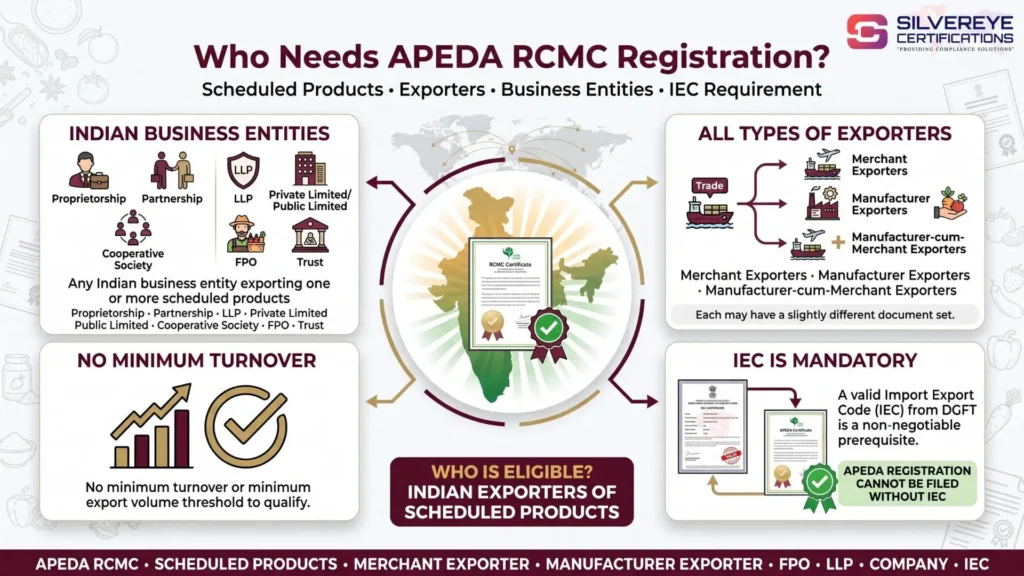
Any legally recognised entity with an active Import Export Code (IEC) that plans to export APEDA-scheduled products can apply. Eligible business structures may include proprietorships, partnership firms, LLPs, private and public limited companies, cooperative societies and trusts. Farmer Producer Companies and cooperatives with an IEC may also qualify.
| Exporter type | Typical vegetable business |
|---|---|
| Merchant exporter | Buys vegetables from farmers, mandis or packhouses and exports them in its own name |
| Manufacturer exporter | Grows, grades, packs or processes vegetables at its own facility, such as a packhouse, freezing unit or dehydration unit |
| Manufacturer-cum-merchant exporter | Handles some products at its own facility and sources the rest from other suppliers |
A merchant exporter can generally register without owning a farm. A manufacturer exporter must provide valid evidence supporting the facility and its activities.
Documents Required for APEDA Registration for Vegetable Exporters
For every applicant
- Signed and stamped copy of the IEC
- PAN details of the entity
- Registered or business address details
- Valid email ID and mobile number
- Bank account details
- Authorised signatory details
Additional proof for manufacturer exporters
| Vegetable business | Typical supporting documents |
|---|---|
| Fresh vegetable handling or packing | FSSAI licence, Udyam or MSME certificate, Department of Horticulture certificate, or other relevant processing or handling proof |
| Processed vegetable products | FSSAI licence, Udyam or MSME certificate, valid manufacturing or processing licence, and any product-specific approval |
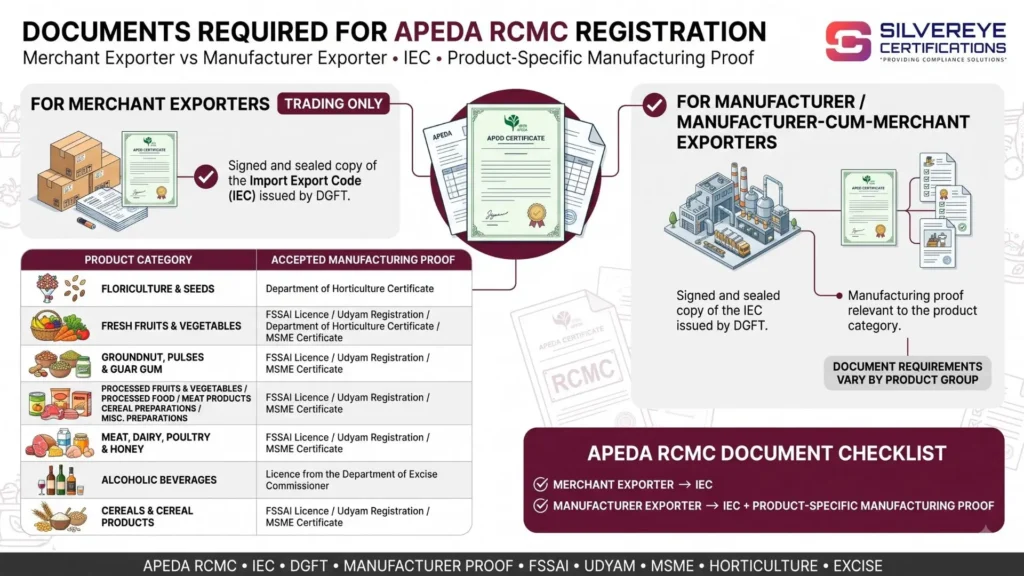
Merchant exporters generally submit the signed and stamped IEC and the required basic details.
APEDA’s 27 March 2026 e-RCMC circular provides category-wise documentation guidance. Use the latest applicable version as your checklist. Ensure that the legal name, PAN, address and business constitution match across your IEC, FSSAI license, Udyam certificate and facility documents. Mismatches can lead to deficiency notices and processing delays.
Process: Getting Your RCMC Online
- Get or update your IEC: Ensure your business name and PAN match your official records.
- Log in to the DGFT portal using the credentials linked to your IEC.
- Open the e-RCMC service and start a new application.
- Select APEDA as the registering authority.
- Enter exporter and product details: Clearly identify your vegetable products and avoid unrelated entries.
- Upload the required documents in the applicant’s own name.
- Pay the registration fee: The stated amount is ₹5,900 (₹5,000 plus ₹900 GST).
- Sign and submit the application using a DSC or Aadhaar-based e-sign, as available.
- Track your application: Monitor your DGFT dashboard and email. If APEDA raises a deficiency, submit the appropriate document and a clear explanation. Once approved, download your e-RCMC.
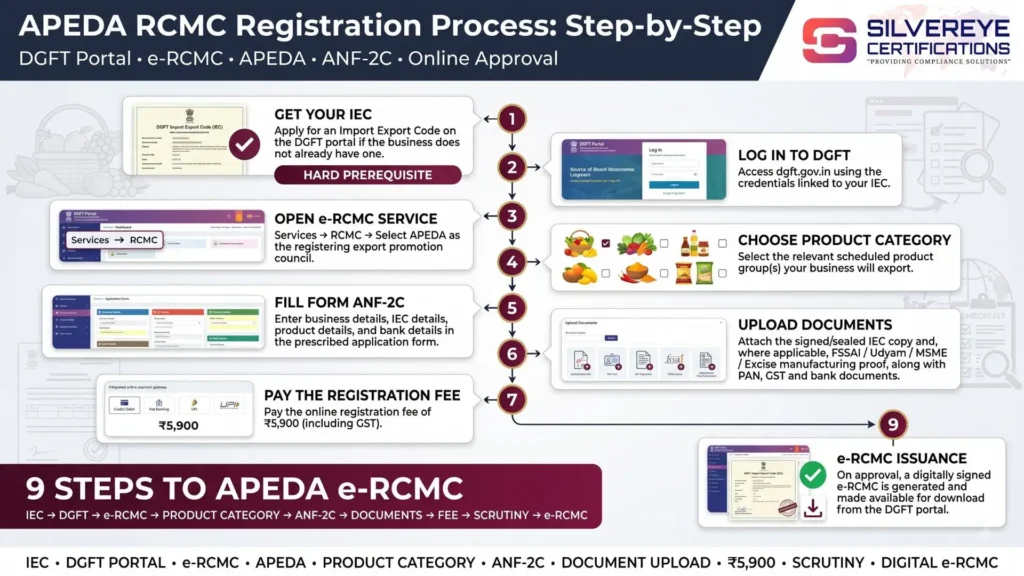
Service providers commonly report a processing time of around 7–15 working days for a complete application. This is an indicative estimate based on reported experience, not a guaranteed or statutory timeline.
The Vegetable-Specific Layer: HortiNet and Veg.Net
APEDA’s HortiNet is an online service for the certification and traceability of fresh horticultural produce. Its covered products include vegetables and onions, alongside grapes, pomegranates, mangoes and citrus fruits. Its standard operating procedures address farm registration, residue monitoring, laboratory testing, grading, and sanitary and phytosanitary requirements for markets such as the EU, the USA and Japan.
| Product | System and what to know |
|---|---|
| Green chilli and drumstick for the EU | The Veg.Net portal supports traceability. Farmers are registered through State Agriculture and Horticulture Departments, packhouses must be registered, and sampling and testing are carried out by APEDA-recognised laboratories. APEDA has urged exporters to use the system for EU-bound consignments of these vegetables. |
| Onions | Farm registration under HortiNet is opened by the State Horticulture Department according to the applicable annual registration schedule. |
| Other vegetables | HortiNet lists additional vegetables with dedicated farm-registration modules. Check APEDA’s current HortiNet page for your product. |
| Okra and other EU-bound vegetables | APEDA has issued product-specific export procedures. Review the latest procedure on APEDA’s export procedures page before finalising a contract. |
How it works in practice:
- Farm registration comes first: Farmers apply through the applicable registration process, sometimes using a mobile app. The State Agriculture or Horticulture Department approves the registration, and farm and sample geolocation details may be captured.
- Packhouses must be registered: Under Veg.Net, packhouses handling EU-bound green chilli or drumstick must meet the applicable registration requirements.
- Testing must use recognised laboratories: APEDA’s 25 March 2026 advisory lists recognised laboratories by state, includes accreditation validity dates, and specifies agrochemical testing requirements against applicable EU limits. The reported lists contain approximately 296 entries for green chilli and 285 for drumstick.
- Check laboratory accreditation validity: Some dates in the advisory’s annexures fall in 2026. Confirm the laboratory’s current recognition and accreditation status before sending samples.
Not every vegetable shipment to every destination requires the same compliance steps. Always match the vegetable, destination market and current APEDA procedure before signing an export contract.
Typical Shipment Paperwork
Beyond the APEDA RCMC, a vegetable shipment commonly requires a commercial invoice, packing list, phytosanitary certificate, certificate of origin, and bill of lading or airway bill. For products covered by traceability requirements, additional documents may include portal-generated records and residue test reports. Your buyer’s contract may specify further requirements.
Maintain farm registration records, pesticide application records and laboratory reports where applicable. APEDA may request relevant information and conduct inspections under Section 14 of the APEDA Act, 1985.
APEDA Registration for Vegetable Exporters: Fees (Indicative)
| Item | Amount |
|---|---|
| New RCMC (government fee) | ₹5,000 |
| GST at 18% | ₹900 |
| Total payable online | ₹5,900 |
| Renewal | Confirm the applicable fee under APEDA’s current procedure |
| Amendment after issue | Confirm the applicable procedure and fee |
| Laboratory testing, packhouse recognition and phytosanitary certification | Separate charges may apply. Check with the laboratory, APEDA and the plant protection authority. |
| Consultant fee | Varies by case; obtain a written quote. |
Fees and procedures may change. Some websites quote ₹5,000 without GST, so confirm the final amount on the DGFT payment screen before submitting your application.
Validity and Renewal of APEDA Registration for Vegetable Exporters
| Topic | What to know |
|---|---|
| RCMC validity | Valid for five financial years, not five calendar years. Check the dates on your certificate. |
| RCMC renewal | Apply through the DGFT e-RCMC module. As a practical measure, start 60–90 days before expiry. |
| Amendment | May be required for changes in address, business constitution, product, contact details, authorised person or facility status. |
| Fresh registration | A change of legal entity or PAN, such as converting a proprietorship into a company, may require a new IEC and registration. Confirm the applicable procedure. |
| Farm registration | Managed through the relevant State Departments and applicable HortiNet-family systems. Plan registration before the export season. |
| Laboratory accreditation | Each recognised laboratory has its own accreditation validity date. Recheck its current status before every testing round. |
| Cancellation | May occur under Rule 11 for incorrect information, violation of conditions or failure to export registered products for the prescribed continuous period. An opportunity to respond is ordinarily provided under the applicable procedure. |
2026 Updates Vegetable Exporters Should Know
| Date | Update | What it means for you |
|---|---|---|
| 5 February 2026 | APEDA advisory on exports of fresh fruits and vegetables to France | Review the advisory if France is one of your destination markets. |
| 18 March 2026 | APEDA circular on Veg.Net implementation for drumstick and green chilli exports to the EU | Traceability requirements for these two EU-bound vegetables use a dedicated portal, reported as operational from 23 March 2026. |
| 25 March 2026 | APEDA advisory on sampling and analysis of green chilli and drumstick for the EU | Provides information on recognised laboratories and agrochemicals to be tested. |
| 27 March 2026 | APEDA circular on the e-RCMC procedure | Covers category-wise documents, fees, renewal and amendments. |
| 26 June 2026 | Jan Vishwas amendment framework took effect | Changes to enforcement and adjudication under several commercial laws may affect compliance. Review the relevant APEDA-related provisions and Section 25A rather than relying on outdated penalty figures. |
| 20 July 2026 | DGFT Trade Notice No. 14/2026-27 | A reported draft amendment to Para 2.57(c) proposed exempting consignments up to ₹10,000 FOB from the RCMC requirement for FTP benefits, excluding restricted items. Verify whether a final notification has been issued before relying on the exemption. |
Important: Even if a low-value consignment exemption is finalised, it may apply only to RCMC requirements for FTP benefits. Do not assume it removes registration obligations under the APEDA Act for scheduled products.
Common Mistakes Vegetable Exporters Make
- Treating APEDA RCMC as the only requirement and skipping farm registration, packhouse and testing procedures.
- Using a laboratory that is not APEDA-recognised or whose accreditation has expired.
- Applying through APEDA for dried chilli or other spices without verifying the HS code and registering authority.
- Selecting the manufacturer exporter category without appropriate facility proof.
- Having name, PAN or address mismatches across IEC, FSSAI and Udyam records.
- Failing to check destination-country requirements before signing an export contract.
- Relying on an outdated procedure instead of checking the latest official circular.
- Responding to a deficiency notice by uploading the same document without addressing the issue.
- Allowing the RCMC to expire without arranging renewal.
How to Choose a Registration Partner
You can apply for APEDA registration yourself through the DGFT e-RCMC portal. Professional assistance may be useful if you export multiple vegetables to different markets or need help coordinating farm registrations, packhouses and laboratory testing.
Before choosing a consultant, ask:
- Will you confirm the registering authority using my HS code before filing?
- Which traceability, packhouse and laboratory requirements apply to my vegetable and destination?
- Are your professional fees provided in writing and separately from the government fee?
- Who will handle deficiency replies and renewal reminders?
- Will you provide links to official APEDA and DGFT guidance instead of promising guaranteed processing timelines?
Conclusion
APEDA registration for vegetable exporters is straightforward when you understand the requirements, but attention to detail is essential. Ensure your IEC details are correct, select the appropriate exporter category, and prepare all required documents. Then check the additional compliance requirements for your vegetable and destination market, including farm registration, registered packhouses and recognised, currently accredited laboratories, where applicable.
Keep track of the Veg.Net circular dated 18 March 2026, the e-RCMC circular dated 27 March 2026, and your five-year RCMC renewal date to help avoid compliance delays.
If you need professional assistance, Silvereye Certifications can help verify product coverage, prepare documents, file your e-RCMC application, and identify the applicable traceability requirements for your vegetable and export destination.
Silvereye Certifications — Your partner for APEDA registration and export compliance.
Frequently Asked Questions
Do I need APEDA registration to export vegetables?
Yes, if your main export product is a vegetable under APEDA’s schedule. You need an active IEC and the e-RCMC through the DGFT portal.
What is Veg.Net?
It is APEDA’s portal for traceability of drumstick and green chilli exports to the EU. It links farm registration, packhouse registration and testing by recognized laboratories.
Is Veg.Net compulsory?
APEDA has urged exporters to use it for all EU-bound consignments of green chilli and drumstick. Read the 18 March 2026 circular for the exact wording.
Can a vegetable trader get APEDA registration without a farm?
Yes, as a merchant exporter with an active IEC. Manufacturer exporters need facility proof.
What is the APEDA registration fee in 2026?
₹5,000 plus 18% GST, so ₹5,900. Confirm on the portal when paying.
How long is the APEDA RCMC valid?
Five financial years. Check the exact dates on your certificate.
How long does the RCMC take?
Service providers commonly report about 7 to 15 working days for a clean application. Deficiencies add time.
Where do I apply?
On the DGFT portal, through the e-RCMC service, selecting APEDA as the registering authority.
Is the IEC the same as the APEDA RCMC?
No. The IEC is the prerequisite from DGFT. The RCMC is the product-specific registration with APEDA.
Do I need APEDA registration for dried chilli?
Usually no. Dried chilli is generally a spice handled by the Spices Board. Fresh green chilli is a vegetable under APEDA. Confirm your HS code.
Does the RCMC allow me to ship immediately?
No. FSSAI, phytosanitary certification, residue compliance, customs and destination-country rules may still apply.
Is the ₹10,000 RCMC exemption in force?
It was proposed in DGFT Trade Notice 14/2026-27 as a draft. Check DGFT for a final notification before relying on it.