

- AEO-T1 (certified on or after 1 April 2019): A renewal application is not required under the stated procedure. File the annual self-declaration between 1 October and 31 December.
- AEO-T2: Follow the three-year renewal cycle and submit a fresh application with updated supporting documents.
- AEO-T3 and AEO-LO: Follow the five-year renewal cycle and submit a fresh application with updated documents, as applicable.
- CBIC renewal fees: No CBIC renewal fee is specified in the stated process. However, businesses may incur costs for audits, document preparation, and professional assistance.
- Plan ahead: Begin internal checks approximately three months before the relevant deadline to allow time to update documents and address compliance gaps. Missing a required submission window may affect your AEO status or associated benefits.
How Does the AEO Registration Renewal Process Work?
The AEO registration renewal process depends on the tier of your Authorized Economic Operator (AEO) certification. Eligible AEO-T1 entities follow an annual self-declaration process, while AEO-T2, AEO-T3, and AEO-LO holders must follow the applicable renewal procedure.

According to the official AEO India portal, the annual self-declaration window for eligible AEO-T1 entities runs from 1 October to 31 December. AEO-T2 certificates generally follow a three-year cycle, while AEO-T3 and AEO-LO certificates follow a five-year cycle. Renewal applications should be prepared according to the applicable CBIC guidelines and the entity's certificate validity.
CBIC does not charge a fee for filing an AEO application, according to the official portal. However, businesses may incur internal administrative, documentation, audit, or professional support costs.
AEO Renewal Process at a Glance
| AEO tier | Renewal route | When to act | Certification cycle |
|---|---|---|---|
| AEO-T1 (eligible entities) | Annual self-declaration under the continuous-certification arrangement | 1 October to 31 December each year | Subject to annual declarations and compliance review |
| AEO-T2 | Renewal application with updated documents | Prepare in advance of expiry; the commonly specified window is 60 days before expiry | 3 years |
| AEO-T3 | Renewal application with updated documents, subject to applicable eligibility requirements | Prepare in advance of expiry; the commonly specified window is 90 days before expiry | 5 years |
| AEO-LO | Renewal application with updated documents | Prepare in advance of expiry; the commonly specified window is 90 days before expiry | 5 years |
Important: The above filing windows should be checked against the current applicable CBIC circulars and the instructions shown on the AEO portal. AEO-T1 entities certified before 1 April 2019 should confirm their applicable procedure with the relevant AEO Programme Manager.
Is Your AEO Renewal Window Open Right Now?
As of 23 October 2026, the annual AEO-T1 self-declaration window is open and is scheduled to close on 31 December 2026.
If you hold AEO-T1 status and have not submitted the required declaration, review your eligibility and file within the applicable window. The AEO India portal's latest notice clarifies that the exemption applies to entities receiving fresh AEO-T1 certification during the relevant calendar year; renewals and auto-renewals do not qualify as fresh certifications and must submit the annual declaration.
For AEO-T2, AEO-T3, and AEO-LO, check the validity date on your certificate and confirm the applicable renewal deadline. If the deadline is approaching or has passed, contact the relevant AEO Programme Manager promptly to understand the procedure applicable to your case.
AEO-T1 Renewal Process: The Annual Self-Declaration
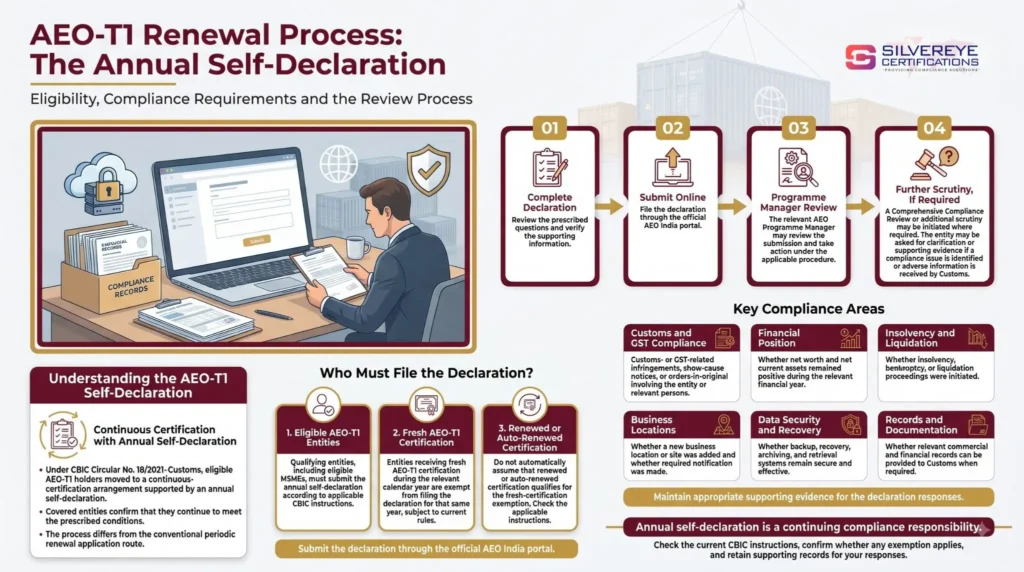
Under CBIC Circular No. 18/2021-Customs, eligible AEO-T1 holders moved to a continuous-certification arrangement supported by an annual self-declaration. Instead of following the conventional periodic renewal application route, covered entities submit a declaration confirming their continued compliance with the prescribed conditions.
Who Must File the Declaration?
- Eligible AEO-T1 entities, including qualifying MSMEs, must submit the annual self-declaration in accordance with the applicable CBIC instructions.
- Entities receiving fresh AEO-T1 certification during the relevant calendar year are exempt from filing the declaration for that same year, subject to the current rules.
- Entities whose certification is renewed or auto-renewed should not assume that they qualify for the fresh-certification exemption.
- The declaration must be submitted through the official AEO India portal.
What Information Does the Declaration Cover?
The prescribed annual self-declaration asks about key compliance, financial, and record-management matters. Businesses should maintain supporting evidence for their responses.
The declaration covers areas such as:
- Any customs- or GST-related infringement, show-cause notice, or order-in-original involving the entity or relevant persons.
- Whether net worth and net current assets remained positive during the relevant financial year.
- Whether insolvency, bankruptcy, or liquidation proceedings were initiated.
- Whether any new business location or site was added and whether the required notification was made.
- Whether systems for data backup, recovery, archiving, and retrieval remain secure and effective.
- Whether relevant commercial and financial records can be provided to Customs when required.
What Happens After Submission?
After the declaration is submitted, the relevant AEO Programme Manager may review it and take further action in accordance with the applicable procedure. A Comprehensive Compliance Review or additional scrutiny may be initiated where required.
If the declaration identifies a compliance issue or Customs receives adverse information, the entity may be asked to provide clarification or supporting records. AEO holders should therefore ensure that all declarations are accurate, complete, and supported by appropriate documentation.
AEO-T2, T3 and LO Renewal Process: The Application Route
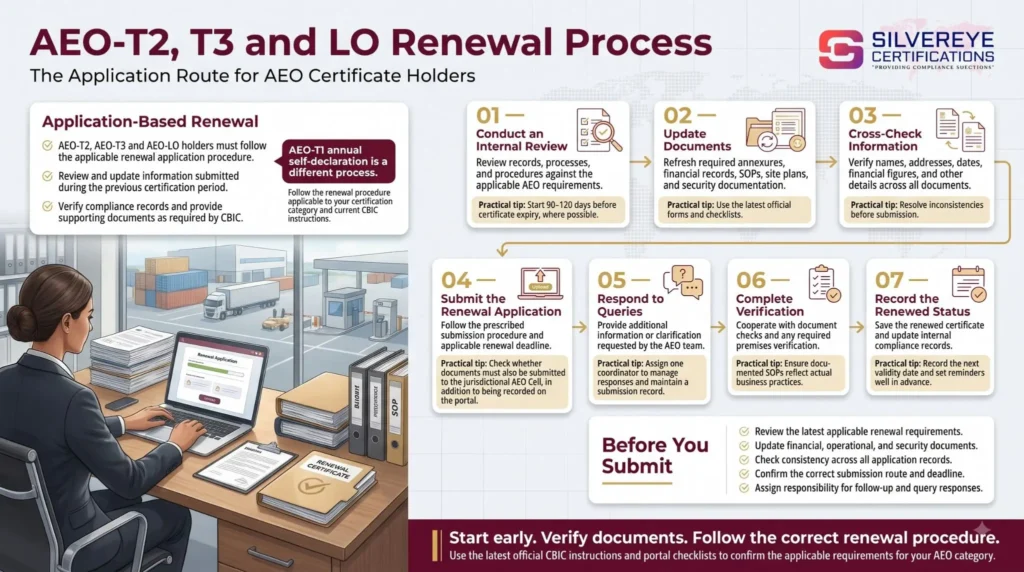
Unlike the annual self-declaration process followed by eligible AEO-T1 entities, AEO-T2, AEO-T3 and AEO-LO holders must follow the applicable renewal application procedure. The renewal process involves updating the information submitted during the previous certification period, reviewing compliance records, and providing supporting documents as required by CBIC.
For the initial application procedure, refer to our AEO Registration Process page.
| Step | What to do | Practical tip |
|---|---|---|
| 1. Conduct an internal review | Review your records and procedures against the applicable AEO requirements. | Start 90–120 days before certificate expiry, where possible. |
| 2. Update documents | Refresh the required annexures, financial records, SOPs, site plans, and security documentation. | Use the latest forms and checklists available on the official portal. |
| 3. Cross-check information | Verify names, addresses, dates, financial figures, and other details across documents. | Resolve inconsistencies before submission. |
| 4. Submit the renewal application | Follow the prescribed submission procedure and applicable renewal deadline. | Check whether documents must be submitted to the jurisdictional AEO Cell as well as recorded on the portal. |
| 5. Respond to queries | Provide additional information or clarification requested by the AEO team. | Assign one person to coordinate responses and maintain a record of submissions. |
| 6. Complete verification | Cooperate with document checks and any required premises verification. | Ensure documented SOPs reflect actual business practices. |
| 7. Record the renewed status | Save the renewed certificate and update internal compliance records. | Record the next validity date and set reminders well in advance. |
Under the published AEO renewal procedure, the commonly specified filing periods before expiry are 60 days for AEO-T2 and 90 days for AEO-T3 and AEO-LO. Confirm the current requirements with the relevant AEO Programme Manager before filing.
Documents Required for the AEO Renewal Process
Renewal generally involves updating existing records rather than preparing an entirely new set of documents from scratch. The documents required depend on your AEO tier, business structure, and any changes during the previous certification period.
| Document or record | AEO-T1 annual self-declaration | AEO-T2, T3 and LO renewal |
|---|---|---|
| Annual self-declaration | Required for eligible entities within the prescribed annual window | Does not replace the applicable renewal application |
| Renewal application and annexures | Not required under the standard annual self-declaration procedure | Prepare the prescribed application and supporting annexures |
| Financial statements and net-worth evidence | Keep supporting records available for the declaration | Update the financial documents required for your tier |
| Solvency certificate | Keep supporting records available where relevant | Obtain an updated certificate in the format required for the applicable tier |
| Site plan and process map | Update and report relevant site changes | Update to reflect the current business and operating locations |
| SOPs and security documentation | Keep relevant controls and records current | Review and update as applicable to the tier |
| Authorisation and contact details | Ensure details remain current | Update authorisations and contact information where required |
| Customs, GST and legal compliance records | Review records before completing the declaration | Disclose and document relevant matters as required by the application |
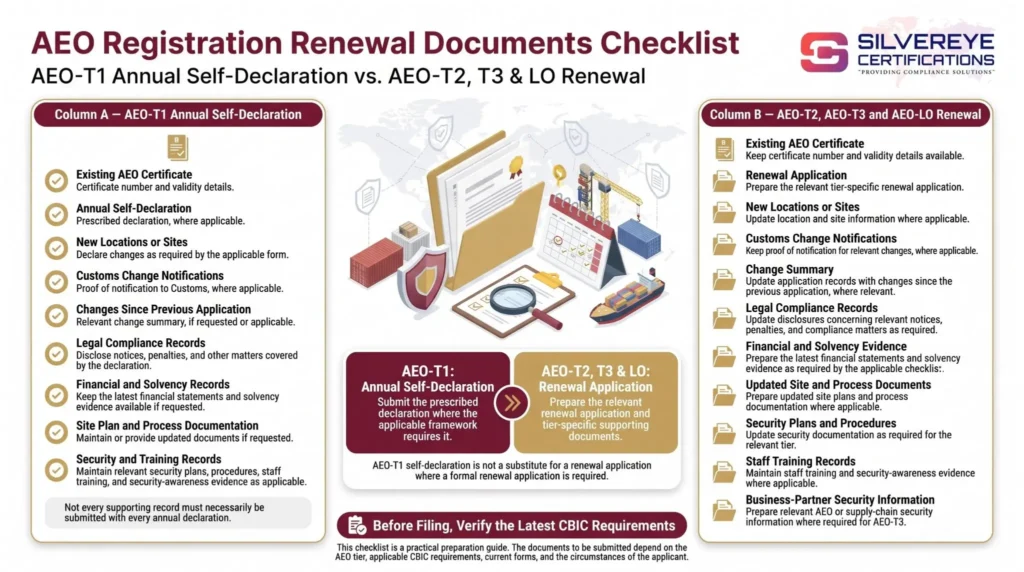
For the initial application checklist, see our AEO Registration Documents page. Before renewal, compare your existing documents with the latest requirements available on the official AEO India portal.
A Practical AEO Renewal Planning Calendar
The following schedule is an internal planning recommendation, not an official CBIC deadline. Adjust it to your certificate's expiry date and the applicable filing window.
| Suggested timing | Action |
|---|---|
| Four months before expiry | Assign an internal owner and review the previous application, financial records, compliance history, and changes to the business. |
| Three months before expiry | Conduct a gap assessment covering SOPs, security arrangements, solvency, and record management. |
| Two months before expiry | Update supporting documents and obtain required financial or professional certificates. |
| One month before expiry | Complete the final document review, obtain internal approval, and ensure the application is ready for submission. |
| After submission | Monitor application status, respond to queries, and record the next compliance and renewal dates. |
Important: For AEO-T2, start the submission process earlier than the commonly specified 60-day deadline. For AEO-T3 and AEO-LO, plan around the applicable 90-day filing period.
AEO Renewal Fees and Costs in 2026
The official AEO India portal states that no fee is charged by Indian Customs for filing an AEO application. Businesses may nevertheless incur internal and external expenses while preparing renewal documents and maintaining compliance.
| Cost item | Amount or basis | What to know |
|---|---|---|
| CBIC application or renewal fee | Nil, according to the official portal | Confirm the current instructions for the applicable renewal route. |
| Chartered Accountant or audit support | Varies by service provider | Costs depend on the required certificates and financial documentation. |
| Internal staff time | Depends on the business | Includes document collection, compliance reviews, approvals, and filing. |
| Security or site improvements | Depends on the premises and identified gaps | May be required if the review identifies deficiencies. |
| External AEO renewal assistance | Varies by scope | Request a written quotation with clear deliverables and milestones. |
No fixed rupee amount is provided for professional assistance because fees vary according to the business's requirements. Request an itemised quotation and confirm exactly which services are included.
AEO Certificate Validity and Renewal Cycle
The applicable validity period depends on the AEO tier and the certification arrangement.
| AEO tier | Validity or certification arrangement | Renewal requirement |
|---|---|---|
| AEO-T1 | Eligible entities covered by the continuous-certification arrangement follow the annual self-declaration and review process. | Submit the annual declaration within the prescribed window, subject to applicable requirements. |
| AEO-T2 | Generally three years | Submit a renewal application under the applicable procedure. |
| AEO-T3 | Generally five years | Submit a renewal application under the applicable procedure. |
| AEO-LO | Generally five years | Submit a renewal application under the applicable procedure. |
For AEO-T1, the continuous-certification arrangement introduced through CBIC Circular No. 18/2021-Customs applies subject to its conditions. The AEO India portal has also clarified that renewed and auto-renewed AEO-T1 entities must file the annual self-declaration; the exemption applies to eligible entities receiving fresh certification during the relevant calendar year.
What If You Miss Your AEO Renewal Window?
If you miss an AEO renewal deadline, contact your zonal AEO Programme Manager promptly rather than assuming that the certificate will renew automatically.
- AEO-T1: The annual self-declaration is an important condition under the continuous-certification arrangement. If you miss the prescribed window, seek guidance immediately on the action required to protect or restore your status.
- AEO-T2: Check the certificate's expiry date and contact the AEO Programme Manager if the prescribed renewal deadline has passed.
- AEO-T3 and AEO-LO: Seek prompt clarification if the renewal window has been missed, particularly if the certificate has expired.
The consequences of a missed deadline depend on the applicable CBIC instructions and the circumstances of the case. Do not assume that a fixed grace period applies or that a fresh application is always necessary. Obtain confirmation from the relevant authority before relying on continued AEO benefits.
Changes to Report Between AEO Renewals
AEO status holders should keep their business and compliance information current and report significant changes through the prescribed channel.
Relevant changes may include:
- Addition or deletion of a business location involved in the international supply chain.
- Changes to the legal entity, business name, or registered address.
- Changes in the nature of business, such as a change in manufacturing, trading, or export activities.
- Changes to accounting or computer systems relevant to business records.
- Changes involving senior personnel responsible for Customs matters.
- Relevant legal proceedings, compliance issues, or changes affecting eligibility.
The AEO programme's published guidance states that significant changes should be reported as soon as they are known and, where applicable, within 14 days of the change. Check the relevant reporting instructions for your specific change.
Reporting changes promptly helps maintain accurate AEO records and reduces the risk of inconsistencies during renewal.
Common AEO Renewal Process Mistakes
Avoid these common errors when preparing your renewal:
- Missing the 1 October–31 December annual declaration window for eligible AEO-T1 entities.
- Submitting an annual declaration without checking the underlying compliance and financial records.
- Using outdated annexures or application forms.
- Providing incomplete or outdated solvency documentation.
- Failing to report a new location or change in the legal entity.
- Waiting until the final days of the T2, T3, or LO renewal window to prepare the application.
- Leaving the authorised contact person's details or supporting authorisation outdated.
- Assuming that submission alone guarantees renewal or uninterrupted benefits.
Why a Timely AEO Renewal Process Matters
Preparing for renewal early can help your business:
- Reduce the risk of avoidable delays in maintaining AEO status.
- Keep certification records current for buyers, logistics partners, and other business stakeholders.
- Review internal compliance, security, financial, and record-management procedures.
- Identify and address documentation gaps before filing.
- Reduce the administrative burden of last-minute preparation.
AEO benefits remain subject to the applicable programme conditions and the status granted by Customs. Timely filing and complete records help support a smoother renewal process.
Should You Get Help With the AEO Renewal Process?
Many eligible AEO-T1 holders can manage the annual self-declaration internally if their compliance records are organised and up to date.
External assistance may be useful for AEO-T2, AEO-T3, and AEO-LO renewals, especially where a business operates multiple sites, has experienced changes in ownership or processes, needs updated financial certificates, or lacks an internal owner for the renewal project.
Before appointing a service provider, request a written scope covering document review, application preparation, coordination, and follow-up support. Choose a provider that explains the process transparently and does not guarantee a renewal outcome, which remains subject to the applicable CBIC requirements and decision.
Conclusion: Complete Your AEO Renewal on Time
The AEO registration renewal process helps businesses maintain their Authorised Economic Operator status and continue working towards the benefits available under the programme. Whether you need to submit an annual self-declaration for eligible AEO-T1 certification or a renewal application for AEO-T2, AEO-T3, or AEO-LO, timely preparation and accurate documentation are essential.
Start by confirming your AEO tier, checking the applicable deadline, reviewing your compliance records, and updating the required documents. Avoid waiting until the final days to address gaps or respond to queries.
Get Your AEO Renewal Ready With Silvereye Certifications
A smooth AEO registration renewal process starts with proper planning. Silvereye Certifications can assist with reviewing your renewal route, checking supporting documents, and preparing an annual self-declaration or renewal application according to your AEO tier.
Share your AEO tier, certificate expiry date, or annual declaration deadline with Silvereye Certifications to discuss your requirements and plan the next steps before the applicable filing window closes.
Frequently Asked Questions
Do AEO-T1 holders need an AEO renewal every three years?
Not if certified on or after 1 April 2019. They file an annual self-declaration instead, between 1 October and 31 December.
When is the AEO annual self-declaration due?
Between 1 October and 31 December each year, filed on aeoindia.gov.in.
Who is exempt from filing the annual declaration?
Entities certified between 1 January and 31 December of a year are exempt for that year.
How does AEO renewal work for T2 and T3?
You file a renewal application with updated documents before expiry. T2 certificates run three years, T3 five.
How early should I start AEO renewal for T2 or T3?
Commonly published windows are about 60 days for T2 and 90 days for T3 and LO. Check the portal for your dates.
Is there a fee for AEO renewal?
No. CBIC does not charge for AEO renewal or the annual self-declaration.
What documents do I need for the AEO renewal process?
Current annexures, audited financials, solvency proof, site plan, process map, SOPs and updated authorisation for your contact person.
What happens after I file the annual self-declaration?
The AEO Programme Manager records it, and the zone may start a Comprehensive Compliance Review.
What if I miss the AEO renewal window?
Contact your zonal AEO Programme Manager immediately. For T2, T3 and LO, a lapse can mean a fresh application.
Do I have to report a new site?
Yes. The form refers to informing the AEO Programme Manager within 14 days of adding a site.
Can MSMEs use the same renewal process?
MSME AEO-T1 entities are covered by the annual self-declaration arrangement. MSME T2 holders renew through an application.
Can I do AEO renewal without a consultant?
Yes. AEO renewal is filed by the AEO holder on the portal. Outside help is optional.