

- Already registered under the Street Vendors Act, 2014? If you hold a valid registration with your Municipal Corporation or Town Vending Committee (TVC), you are now deemed registered under FSSAI as well. No separate application or registration fee is required.
- Not registered under the Street Vendors Act? You must register through the FoSCoS portal as a hawker. However, since 28 September 2024, FSSAI registration has been free for eligible itinerant and mobile food vendors.
- Reduced paperwork for street vendors: This reform is expected to benefit more than 10 lakh street vendors across India by eliminating duplicate registration requirements between municipal vending authorities and FSSAI.
- PM SVANidhi loan eligibility: Your Certificate of Vending or Letter of Recommendation (LoR) may also help establish eligibility for working capital assistance under the PM SVANidhi Scheme. The scheme provides loan tranches of up to ₹50,000, along with a 7% interest subsidy, subject to applicable eligibility conditions and scheme guidelines. The scheme has been extended until 2030.
Introduction
FSSAI registration for hawkers depends on whether they are already registered under the Street Vendors (Protection of Livelihood and Regulation of Street Vending) Act, 2014. Hawkers who hold a valid registration with their Municipal Corporation or Town Vending Committee (TVC) are deemed registered under FSSAI under the amendment effective 1 April 2026, without needing a separate application or paying an additional registration fee.

However, hawkers who are not registered under the Street Vendors Act must apply directly through the FoSCoS portal as an itinerant or mobile food vendor. This FSSAI registration is also free of charge, following the fee waiver effective from 28 September 2024. Regardless of the registration route, all hawkers must maintain basic food hygiene and safety standards and conduct their vending activities within municipally permitted vending zones, in accordance with their Certificate of Vending or applicable local policies.
What Is FSSAI Registration for Hawkers?
FSSAI registration for hawkers is the food safety registration applicable to small-scale and mobile food vendors who sell food without operating from a permanent shop. It covers people selling food on foot, from pushcarts, bicycles, food carts, or mobile food vehicles while moving between locations.
This category includes vendors selling fresh-cut fruits, chaat, roasted snacks, tea, coffee, packaged food, and other ready-to-eat items. Whether you operate a small roadside food cart or move around your locality selling snacks, FSSAI regulations may apply to your food business.
Under FSSAI regulations, eligible hawkers generally fall under the Petty Food Business Operator (Petty FBO) category. The Food Safety and Standards (Licensing and Registration of Food Businesses) Amendment Regulations, 2026 specifically recognize hawkers, itinerant vendors, and temporary stall holders within the relevant definition. This clarification helps establish that mobile and temporary food-selling activities are covered under the food safety framework.
The Big 2026 Change: Deemed Registration for Street Vendors
One of the most important developments for hawkers and street food vendors is the introduction of deemed FSSAI registration for vendors already registered under the Street Vendors Act, 2014.
Under FSSAI Order No. RCD-01002/1/2021-Regulatory-FSSAI-Part(1), dated 13 March 2026, and the Food Safety and Standards (Licensing and Registration of Food Businesses) Amendment Regulations, 2026, notified on 10 March 2026 and effective from 1 April 2026, eligible street vendors registered with their Municipal Corporation or Town Vending Committee (TVC) are recognised as registered under FSSAI as well.
This means that vendors who already hold valid registration under the Street Vendors (Protection of Livelihood and Regulation of Street Vending) Act, 2014 do not need to complete a separate FSSAI registration process.
The key benefits of this change include:
- No separate FSSAI application: Vendors with valid registration under the Street Vendors Act are deemed registered under FSSAI.
- No additional registration fee: They do not need to pay a separate FSSAI registration fee for this deemed registration.
- Reduced paperwork: The reform aims to remove duplicate registration requirements between municipal vending authorities and FSSAI.
- Continued food safety responsibility: Deemed registration does not remove the obligation to maintain applicable food hygiene and sanitary standards.
The purpose of this reform is to simplify compliance for small food vendors. Previously, a person could hold a valid municipal vending certificate but still need to complete a separate FSSAI registration process. The 2026 amendment addresses this administrative duplication by recognising eligible Street Vendors Act registrations under the FSSAI framework.
What If You're Not Yet Registered Under the Street Vendors Act?
If you sell food from a pushcart, mobile stall, or other temporary vending setup but are not registered with your Municipal Corporation or Town Vending Committee under the Street Vendors Act, 2014, the deemed-registration benefit does not automatically apply to you.
However, you can still apply directly through the FoSCoS (Food Safety Compliance System) portal by selecting the applicable hawker or itinerant/mobile food vendor category.
There is also a cost benefit for eligible small vendors. The FSSAI registration fee for hawkers and itinerant food vendors has been waived since 28 September 2024, making the direct registration route free of charge.
| Your Situation | What You Need to Do | FSSAI Fee |
|---|---|---|
| Already registered under the Street Vendors Act, 2014, with a municipal body or Town Vending Committee | No separate FSSAI application is required if you qualify for deemed registration | ₹0 – No separate fee |
| Not registered under the Street Vendors Act but want FSSAI registration as a hawker | Apply through FoSCoS under the applicable hawker/itinerant or mobile food vendor category | ₹0 – Registration fee waived since 28 September 2024 |
| Operating a larger food business beyond the petty food business category or exceeding the applicable turnover limit | Apply for the appropriate Basic Registration, State Licence, or Central Licence, depending on the applicable eligibility criteria | Applicable fee depends on the registration or licence category |
For most small-scale hawkers and mobile food vendors who qualify under the relevant category, FSSAI registration can be obtained without a registration fee. Vendors already covered through deemed registration do not need to submit a duplicate application, while eligible vendors who are not registered under the Street Vendors Act can use the direct FoSCoS route.
The Official Definition: Who Counts as a 'Hawker' Under FSSAI?
FSSAI's definition of a Petty Food Business Operator (Petty FBO) covers more than people who sell food while moving from one location to another. It also includes certain small-scale food sellers who operate from temporary stalls, street locations, and mobile food units.
Depending on the nature of the business, the category may cover:
- Street food vendors: People selling ready-to-eat food from fixed or semi-fixed roadside locations, such as chaat stalls, snack counters, and small food kiosks.
- Hawkers and itinerant vendors: Individuals who move between locations to sell food using baskets, bicycles, pushcarts, or other mobile arrangements.
- Temporary stall holders: Small vendors selling food at fairs, melas, exhibitions, local markets, and seasonal events.
- Food truck and food cart operators: Businesses using mobile vehicles or carts to prepare, store, or sell food.
- Food distributors at religious or social gatherings: Eligible small-scale operators distributing food at community events, religious gatherings, langars, and similar occasions, subject to the applicable FSSAI classification.
The applicable registration category depends on the nature, scale, and activities of the food business. Professional catering operations and larger food businesses may fall under different licensing requirements rather than the petty food business category.
Do You Still Need a Vending Certificate?
Yes. A vending certificate is still important, even if you are deemed registered under FSSAI. Both registrations serve different purposes. FSSAI registration addresses food safety compliance, while a vending certificate issued under the Street Vendors (Protection of Livelihood and Regulation of Street Vending) Act, 2014 authorises eligible street vendors to carry out their vending activities under the conditions set by the local authority.
The certificate is generally issued through the local Town Vending Committee (TVC) and helps determine where and under what conditions you can operate. For eligible vendors, registration under the Street Vendors Act also provides the basis for deemed FSSAI registration under the 2026 amendment.
Here are a few important points to understand:
- Vending in designated zones: Street vendors are expected to operate within authorised vending zones or locations permitted under their Certificate of Vending and applicable municipal policies.
- Restrictions in no-vending zones: Selling food in prohibited areas can lead to action by local authorities. Depending on applicable municipal rules, unauthorised carts or vending equipment may also be removed or confiscated.
- Separate municipal registration: If you do not have a vending certificate, you can approach your local Municipal Corporation or Town Vending Committee to understand the registration process. This is separate from direct FSSAI registration and may also help you qualify for deemed FSSAI registration if you meet the applicable conditions.
Beyond FSSAI: Your Vending Certificate Also Helps You Access PM SVANidhi
A Certificate of Vending is useful beyond food safety compliance. It can also help eligible street vendors access financial assistance under PM SVANidhi (Prime Minister Street Vendor's AtmaNirbhar Nidhi), a government scheme designed to provide working capital support to street vendors.
Under the revamped scheme, eligible beneficiaries can access collateral-free working capital loans in three tranches of ₹15,000, ₹25,000, and ₹50,000. The scheme also provides a 7% interest subsidy on eligible loans, along with a UPI-linked credit facility and other digital transaction incentives, subject to the applicable guidelines.
The scheme has been extended until 2030, providing continued financial support to eligible street vendors. A valid vending certificate or other accepted eligibility document, such as a Letter of Recommendation (LoR), may be required depending on the applicant's circumstances and the scheme guidelines.
For hawkers, this makes formal registration valuable for more than regulatory compliance. It can help establish their vending status and provide access to institutional working capital support that may otherwise be difficult to obtain.
Documents Needed If You Register Directly on FoSCoS
If you are not covered under deemed registration and want to apply directly through the FoSCoS portal, you should keep the relevant applicant and business details ready. The documents and information required may depend on the selected registration category and the current FoSCoS application process.
Commonly relevant details include:
- Identity proof: Aadhaar card, Voter ID, or another accepted identity document.
- Applicant photograph: A recent photograph of the person applying for registration.
- Address details: Your residential address and, where applicable, details of your usual vending location.
- Food business details: A brief description of the food items you prepare, handle, or sell.
- Vending certificate or TVC details: If you already have a Certificate of Vending or municipal registration, keep its details available to establish your vending status.

Always check the latest FoSCoS document requirements for the selected Kind of Business before submitting your application.
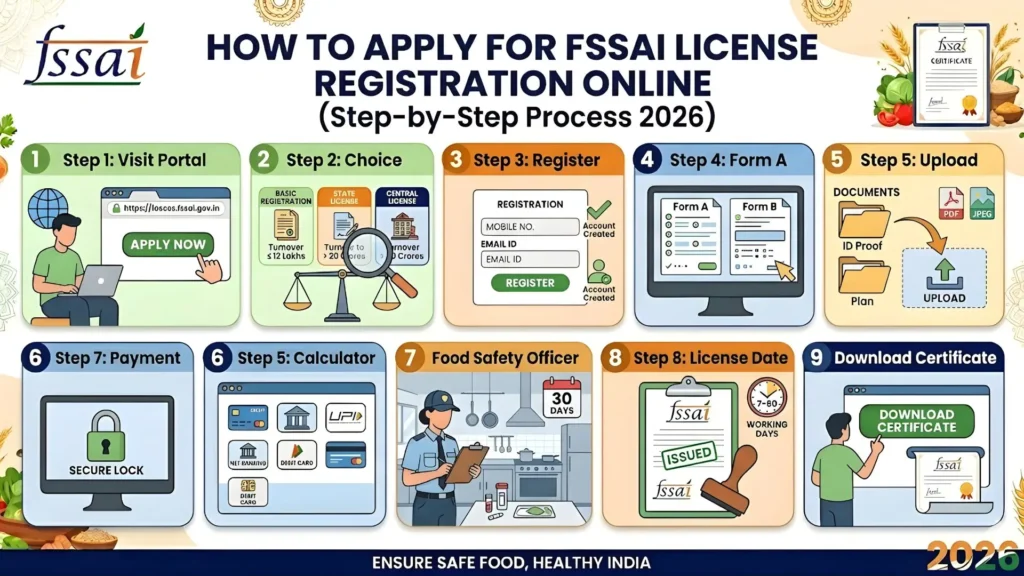
Step-by-Step: How Hawkers Should Approach FSSAI Compliance in 2026
Hawkers can follow a straightforward process to determine which FSSAI registration route applies to them. The first step is to check their existing municipal vending registration.
- Check your Street Vendors Act registration: Find out whether you already hold a valid Certificate of Vending or registration issued through your Municipal Corporation or Town Vending Committee. If you qualify under the 2026 deemed-registration provision, you do not need a separate FSSAI application.
- Apply for a vending certificate if required: If you are not registered under the Street Vendors Act, contact your local Town Vending Committee or Municipal Corporation to understand the process. This can help establish your legal vending status and may provide access to the deemed FSSAI registration benefit.
- Register directly through FoSCoS: If you are not covered by deemed registration, apply through the official FoSCoS portal under the applicable Hawker/Itinerant or Mobile Food Vendor category. Eligible hawker registration is free under the applicable fee waiver.
- Maintain basic food hygiene: Use clean utensils, source ingredients safely, protect food from dust and pests, maintain appropriate storage temperatures, and follow hygienic food-handling practices.
- Operate within permitted vending areas: Sell food only at locations allowed under your Certificate of Vending or applicable municipal rules. FSSAI registration does not independently authorise you to occupy a particular public space.
- Review your registration category as your business grows: If you expand into a larger food business, establish a permanent outlet, or cross the applicable turnover threshold, check whether you need a different FSSAI registration or licence category.
Ongoing Compliance for Hawkers
Obtaining FSSAI registration does not mean that hawkers are exempt from their ongoing food safety and municipal responsibilities. Even when registration is deemed or the application fee is waived, vendors must continue to follow applicable compliance requirements.
- Maintain food hygiene: Follow basic hygiene and sanitary practices while preparing, storing, handling, and selling food. Keep utensils clean and protect food from contamination.
- Keep your vending certificate valid: The renewal, validity, and other conditions of your Certificate of Vending are governed by the applicable municipal process. Track these requirements separately from FSSAI compliance.
- Follow applicable FSSAI requirements: If you hold a standard FSSAI registration or licence rather than relying on the hawker-specific route, comply with the applicable renewal, fee-payment, return-filing, and other regulatory requirements.
- Review your business category regularly: A hawker who expands into multiple food carts, a larger food outlet, or a more structured food business should reassess the applicable FSSAI registration or licensing category.
Penalties and Enforcement for Hawkers Without FSSAI Registration
Hawkers and other food business operators must comply with the applicable registration or licensing requirements under the Food Safety and Standards Act, 2006. The 2026 deemed-registration provision and the fee waiver have simplified compliance for eligible vendors, but they do not remove the requirement to hold valid FSSAI approval.
Under Section 63 of the Food Safety and Standards Act, 2006, carrying on a food business without the required licence can attract imprisonment for up to six months and a fine of up to ₹5 lakh. The applicable provision and penalty depend on the nature of the violation and the circumstances of the case.
Hawkers may also face separate municipal enforcement action if they operate without the required vending authorisation or sell food in prohibited vending areas.
Therefore, vendors should confirm whether they qualify for deemed FSSAI registration, complete direct registration if required, maintain food hygiene standards, and follow their local vending conditions. These steps help reduce regulatory risks while allowing hawkers to operate with greater confidence.
Why Choose Silvereye Certifications for FSSAI Registration?
Understanding FSSAI registration requirements can be confusing, especially when different rules apply to hawkers, street vendors, mobile food businesses, and larger food operators. Silvereye Certifications helps businesses understand the applicable food safety compliance requirements and choose the appropriate registration or licensing route.
Whether you are a small food vendor applying through FoSCoS or an expanding food business that needs a standard FSSAI licence, our team can guide you through the process.
Here's how Silvereye Certifications can help:
- Registration Guidance: Understand whether you qualify for deemed FSSAI registration under the Street Vendors Act or need to apply separately through FoSCoS.
- Document Assistance: Get guidance on preparing the relevant identity, address, and food business details required for your application.
- FoSCoS Application Support: Receive assistance with the online application process and selecting the appropriate Kind of Business category.
- Regulatory Compliance Guidance: Understand applicable food hygiene, safety, and sanitary requirements for your business.
- Licence Category Assessment: Get guidance if your business expands beyond petty food business operations and requires a different FSSAI registration or licence.
- Ongoing Compliance Support: Understand applicable renewal, documentation, and regulatory obligations as your food business grows.
With experience in regulatory and certification consultancy, Silvereye Certifications aims to make the FSSAI compliance process easier to understand and manage, so you can focus on running your food business.
Conclusion
FSSAI registration for hawkers in 2026 has become simpler with the introduction of deemed registration for eligible street vendors already registered under the Street Vendors Act, 2014. Those who are not covered by this provision can still apply directly through the FoSCoS portal under the applicable hawker or itinerant food vendor category, with the benefit of the applicable registration fee waiver.
However, simplified registration does not eliminate food safety responsibilities. Hawkers must continue to maintain proper hygiene, handle food safely, and follow the vending conditions established by their local municipal authorities.
Whether you operate a pushcart, roadside food stall, mobile food cart, or small street food business, understanding the correct registration route is essential for regulatory compliance. If you need assistance identifying the right FSSAI category or completing the registration process, Silvereye Certifications can help you understand the applicable requirements and move forward with greater confidence.
Frequently Asked Questions
Do hawkers need FSSAI registration in 2026?
Yes, in some form — but if you're already registered under the Street Vendors Act, 2014, you're automatically deemed FSSAI-registered and don't need to file anything separately.
What is 'deemed registration' for street vendors?
It means that if you're registered under the Street Vendors Act, 2014 with your municipal corporation or Town Vending Committee, FSSAI automatically treats you as registered under food safety law too, without a separate application or fee.
How much does FSSAI registration cost for a hawker?
Nothing, in most cases. Deemed registration (if you have a vending certificate) is free, and even direct registration on FoSCoS for hawkers/itinerant vendors has been fee-free since 28 September 2024.
What if I don't have a vending certificate — can I still get FSSAI registered?
Yes. You can register directly on FoSCoS as a Hawker/Itinerant or Mobile Food Vendor, and this registration is currently free, regardless of whether you hold a separate vending certificate.
Are food trucks covered under the hawker/street vendor deemed registration rule?
Yes, food trucks are explicitly included in FSSAI's expanded 'Petty Food Business Operator' definition, and deemed registration applies to food trucks registered under the Street Vendors Act with their municipal authority.
Do I still need to follow food hygiene rules if I'm deemed registered?
Yes. Deemed registration removes duplicate paperwork and fees, not your underlying obligation to follow basic food safety and hygiene standards.
Can I vend anywhere I like once I'm FSSAI registered?
No. Where you can vend is governed separately by your vending certificate and local municipal vending-zone rules, independent of your FSSAI registration status — operating outside a permitted zone remains an enforcement risk.
Does my vending certificate help with anything besides FSSAI compliance?
Yes — it's also the eligibility document for PM SVANidhi, the government's working capital loan scheme for street vendors, offering tranches up to ₹50,000 with a 7% interest subsidy.
How many street vendors does this 2026 reform actually affect?
Government estimates put the number at over 10 lakh (more than one million) street vendors nationally who benefit from the removal of duplicate registration requirements.
What documents do I need to register directly as a hawker on FoSCoS?
Photo ID proof, a photograph, basic details of where you vend, and a simple description of the food items you sell — a relatively lightweight document list compared to standard business licensing.
What happens if my hawking business grows beyond petty-vendor scale?
You should reassess your FSSAI category — a hawker business that scales into a proper fixed stall or small chain with meaningful turnover may need to move to standard Basic Registration or a State License instead.
Is there a penalty for hawking food without any FSSAI registration?
Yes — operating without valid registration remains an offence under the FSS Act, 2006, with penalties of up to ₹5 lakh and imprisonment of up to six months, though this risk is now easily avoidable given that compliance costs nothing for most hawkers under the 2026 reforms.