

- Factory surveillance and renewal: BIS ISI license holders remain subject to applicable factory surveillance and quality-compliance checks. CRS renewal generally follows an online application and document-based process, without a routine factory visit. BIS may still conduct applicable compliance checks and market surveillance.
- Major 2026 change: The BIS (Conformity Assessment) Amendment Regulations, 2026 revised validity and fee-payment provisions. Scheme I licenses and CRS registrations may be granted for up to five years, subject to the applicable scheme and conditions. Annual fees and required production or other statements must be submitted according to the relevant provisions.
- Missed annual payments: Under the amended provisions, failure to submit the applicable annual fee and production statement by the due date can result in suspension for 90 days. The suspension may be revoked if the required payment and statement are submitted within that period, along with the prescribed ₹5,000 late fee, where the provision applies.
- Apply before expiry: Renewal deadlines differ by scheme. Follow the current BIS instructions for ISI, CRS, and FMCS rather than assuming that a three-month pre-expiry deadline applies universally. Submit the renewal application, required documents, and fees within the applicable timeframe to help avoid a lapse in certification.
Introduction
BIS Certification Renewal is the process of extending an existing ISI license, CRS registration, or FMCS license in accordance with the applicable BIS requirements. Timely renewal helps manufacturers maintain valid certification and continue using the authorized BIS Standard Mark where permitted.
- ISI Certification Renewal: License holders must meet applicable renewal requirements, submit updated production and compliance records, and comply with BIS surveillance and inspection requirements. Factory inspection depends on the applicable procedure; it should not be described as a compulsory separate audit for every renewal.
- BIS CRS Registration Renewal: Renewal is handled through the prescribed CRS portal procedure and required documentation. Applicants should verify the current form, test-report requirements, and continued-conformity obligations. A routine factory visit is generally not required for CRS renewal.
- BIS FMCS Renewal: Foreign manufacturers must follow the applicable BIS renewal procedure, submit required records and fees, and coordinate through their Authorized Indian Representative (AIR). BIS may conduct overseas factory inspections or other compliance checks where required.
- 2026 validity changes: The BIS (Conformity Assessment) Amendment Regulations, 2026 revised validity and fee-payment provisions for Scheme I and Scheme II. Licenses or registrations may be granted for up to five years, subject to the applicable conditions; this is not an automatic validity period for every applicant. Annual fees and required statements must be submitted as prescribed.
Important: Renewal deadlines, forms, inspection requirements, and fees differ by scheme. Check the latest BIS instructions and the expiry date on your certificate well before renewal to help prevent a lapse in certification..
What Is BIS Certification Renewal and Why Does It Matter?
BIS Certification Renewal is the process of continuing an existing BIS license or registration in accordance with the applicable scheme requirements. Timely renewal helps manufacturers maintain certification and continue using the authorized ISI Mark or BIS Standard Mark, subject to the license conditions.
Renewal is more than a date extension. BIS may review production details, fee payments, self-compliance declarations, testing records, and other documents to verify continued compliance with the applicable Indian Standard. Factory surveillance and inspection requirements depend on the certification scheme and the circumstances of the license.
If a license or registration expires, is suspended, or is cancelled, the manufacturer may no longer be authorised to use the relevant mark. Depending on the product and applicable regulations, non-compliance can affect manufacturing, imports, sales, and distribution.
Each scheme has a different renewal procedure:
- ISI Renewal (Scheme I): Requires an online renewal application, production details, applicable fees, and a self-compliance report. BIS may review compliance and arrange inspections where required.
- CRS Renewal (Scheme II): Follows the prescribed online registration-renewal procedure, with applicable documents, declarations, fees, and continued-conformity requirements. A routine factory inspection is generally not required.
- FMCS Renewal: Foreign manufacturers follow the applicable BIS renewal procedure through their Authorised Indian Representative (AIR), submit production details and fees, and maintain the prescribed Performance Bank Guarantee. Overseas inspection may be required under the applicable procedure.
The following sections explain the Scheme I renewal process, documents, fees, timelines, and important 2026 regulatory changes.
BIS ISI Certification Renewal — Process, Fees and Timeline
BIS Scheme I renewal does not mean that a separate factory audit is automatically compulsory in every case. BIS reviews the renewal application and compliance records under the applicable guidelines. Factory surveillance and other inspections may be conducted as required, and licences under suspension or with unresolved compliance issues may require additional review.
When to Apply for ISI Renewal
- Apply early: BIS’s published Scheme I renewal guidelines recommend submitting the renewal application preferably two months before the licence expiry date.
- Check the current deadline: Follow the applicable BIS portal instructions and any product-specific requirements.
- Avoid late filing: Under the published Scheme I guidelines, a renewal application may be accepted within 90 days after expiry with a prescribed ₹5,000 late fee, subject to the applicable conditions.
- Do not assume continued marking rights: The right to use the Standard Mark after the stated validity date depends on the applicable regulations and BIS decision. Do not assume that filing late automatically authorises continued marking.
Documents Required for ISI Renewal
The following records are commonly required under the published Scheme I renewal procedure:
- Production statement for the relevant licence period, authenticated by a chartered accountant or cost accountant where required.
- Self-compliance report in the prescribed format.
- Updated manufacturing, quality-control, and Scheme of Inspection and Testing (SIT) records.
- Details of changes to the factory, machinery, manufacturing process, testing equipment, or authorised personnel, where applicable.
- Testing and calibration records for the relevant equipment.
- Details of products, brands, and consignees, as required by BIS.
- Evidence of applicable fee payments and clearance of outstanding dues.
- Any additional documents requested by BIS for the product or licence.
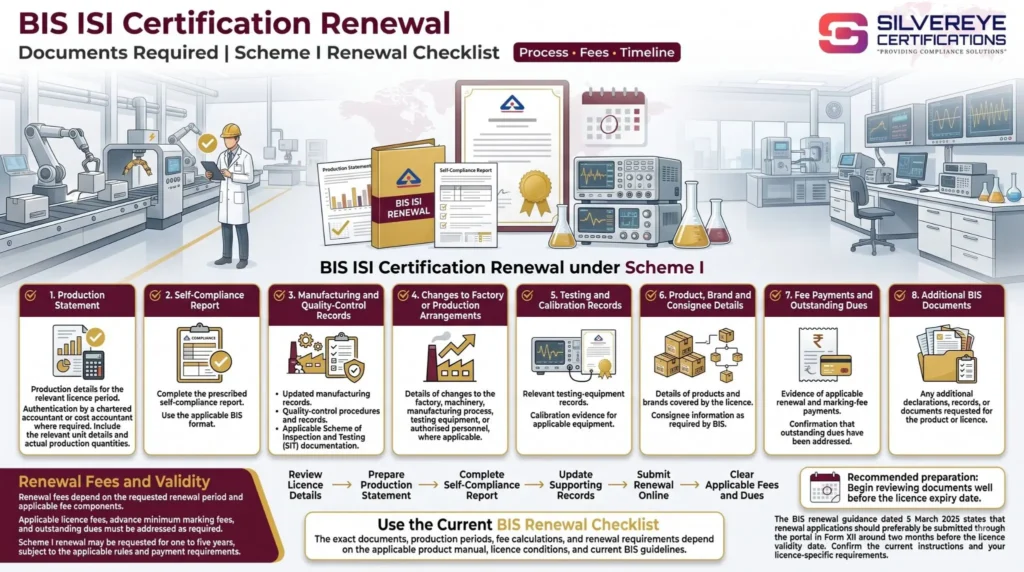
The precise checklist should be confirmed against the latest BIS renewal guidelines and the requirements applicable to the specific licence.
Step-by-Step BIS ISI Renewal Process
Step 1: Log in to Manak Online
Access the BIS portal and open the renewal option associated with the existing licence.
Step 2: Submit the Renewal Application
Complete the prescribed online renewal application, generally Form XII under the published Scheme I guidelines, and submit the relevant documents.
Step 3: Provide Production and Compliance Details
Submit the required production statement, self-compliance report, and information on applicable quality-control and testing requirements.
Step 4: Pay Applicable Fees
Pay the renewal application fee, annual licence fee, applicable marking fee, and any outstanding dues according to the requested renewal period and current BIS provisions.
Step 5: BIS Review and Compliance Checks
BIS reviews the application and records. If documents or fees are incomplete, the licence holder may need to provide clarifications or resolve outstanding issues. Additional inspection or review may be required in relevant cases.
Step 6: Renewal Decision
Where the applicable conditions are met, BIS processes the renewal. The renewal may be handled through the online procedure, while cases involving suspension or other specified issues require additional review and approval.
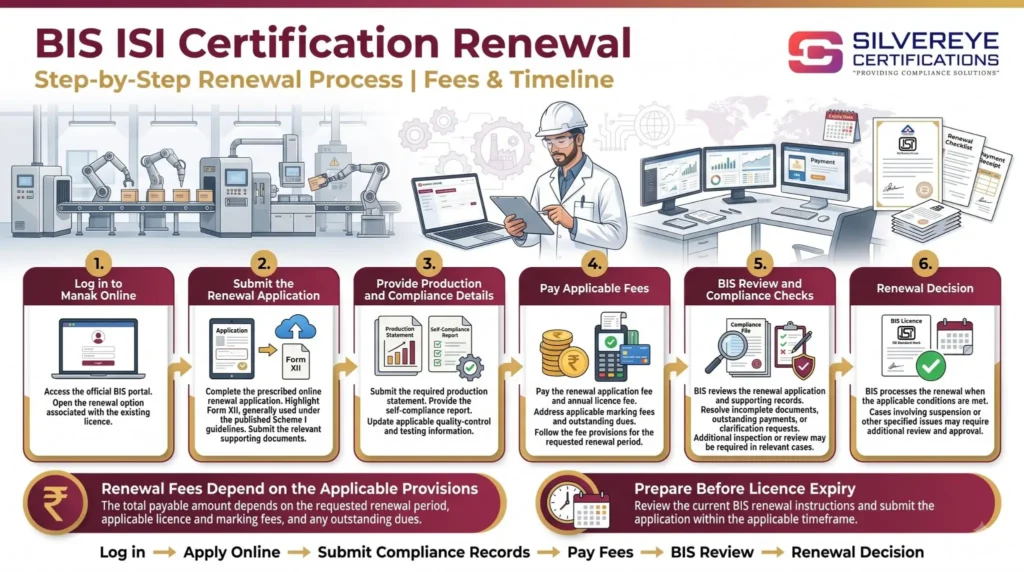
ISI Renewal Fees and Timeline
Renewal costs depend on the product, the requested renewal period, applicable marking fees, production details, and any outstanding dues.
| Fee Component | Details |
|---|---|
| Renewal application fee | Payable under the current BIS fee schedule |
| Annual licence fee | Payable according to the applicable provisions |
| Marking fee | Calculated according to the relevant product and marking-fee rules |
| Outstanding dues | Must be cleared where applicable |
| Late fee | A prescribed ₹5,000 late fee may apply to eligible applications submitted within the applicable 90-day post-expiry period |
Processing time: BIS does not guarantee a universal 15–30-day renewal timeline. Processing depends on the completeness of the application, fee and production-statement verification, compliance status, and whether additional review is needed. Apply well before expiry to allow time to resolve any queries.
ISI Renewal Validity — The 2026 Change
The BIS (Conformity Assessment) Amendment Regulations, 2026, notified on 25 February 2026, revised the validity and fee-payment provisions for Scheme I.
Under the amended Scheme I provisions:
- Initial licence validity: A licence may initially be granted for up to five years.
- Renewal period: A licence may be renewed for a further period of up to five years.
- Annual payments: Applicable fees must be paid in advance on an annual basis according to the prescribed requirements.
- Production reporting: The required annual fee must be submitted with the applicable production statement within the prescribed timeframe.
- Continued compliance: The licence holder must meet ongoing testing, quality-control, marking, and other licence conditions.
Five years is the maximum period permitted by the amended provisions, not a guaranteed period for every licence. Manufacturers should check the validity stated on their own licence and follow the current BIS renewal and annual-payment instructions.
BIS CRS Registration Renewal — Process, Fees & Timeline
BIS CRS Registration Renewal allows manufacturers to continue their registration under the Compulsory Registration Scheme, subject to the applicable BIS requirements. Renewal is submitted online through the official CRS portal and generally involves document verification rather than a routine factory inspection.
When to Apply for CRS Renewal
- Apply before expiry: Check the expiry date on your current registration certificate and follow the latest BIS renewal instructions.
- Online renewal: Log in to the BIS CRS portal and complete the prescribed renewal application.
- Check revised requirements: The renewal procedure, annual fee obligations, and validity period must be checked against the latest CRS circulars and applicable regulations.
Documents Required for BIS CRS Renewal
The required documents depend on the product and current BIS instructions. Common records may include:
- Existing CRS registration certificate and R-number.
- Prescribed renewal application and declarations.
- Production and model details required under the applicable provisions.
- Product test reports or other technical documents, where required.
- Details of changes to the product, model, brand, or manufacturing arrangements.
- Evidence of applicable fee payments and compliance with registration conditions.
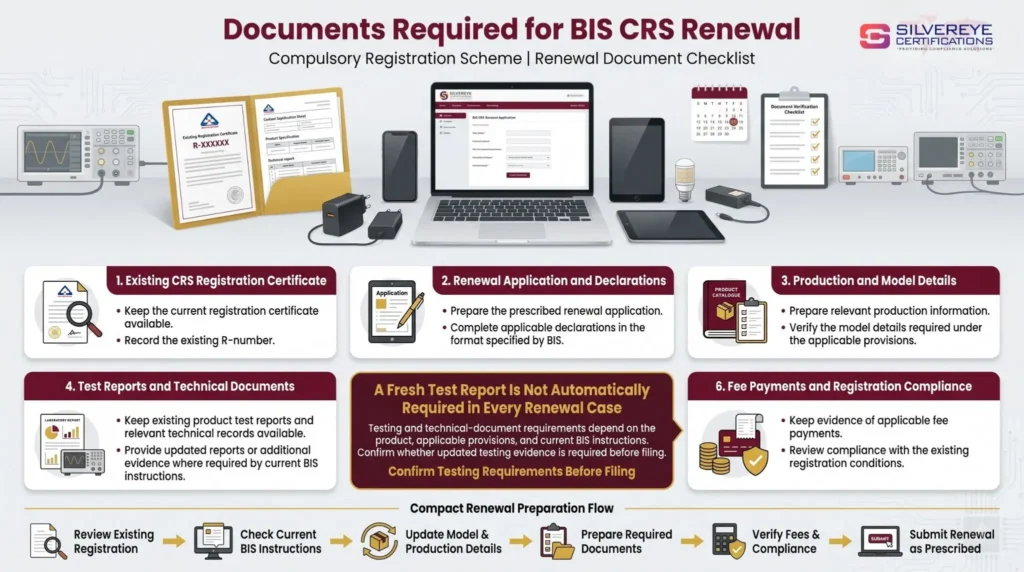
Do not assume that a fresh test report is required in every renewal case. Confirm the applicable testing and documentation requirements for the registered product.
Step-by-Step BIS CRS Renewal Process
Step 1: Log in to the BIS CRS Portal
Access the official CRS portal using the existing registration credentials.
Step 2: Complete the Online Renewal Application
Fill in the renewal application and upload the documents required under the current procedure.
Step 3: Submit Compliance and Product Details
Provide the prescribed production information, declarations, and supporting documents relevant to the registration.
Step 4: Pay Applicable Fees
Pay the required annual fee or other applicable charges according to the revised CRS provisions and the portal instructions.
Step 5: BIS Verification
BIS reviews the renewal application and supporting records. If additional information is required, respond to the query within the prescribed timeframe.
Step 6: Download the Renewal Certificate
Once renewal is approved, download the updated registration certificate from the portal and check the registration details and validity.
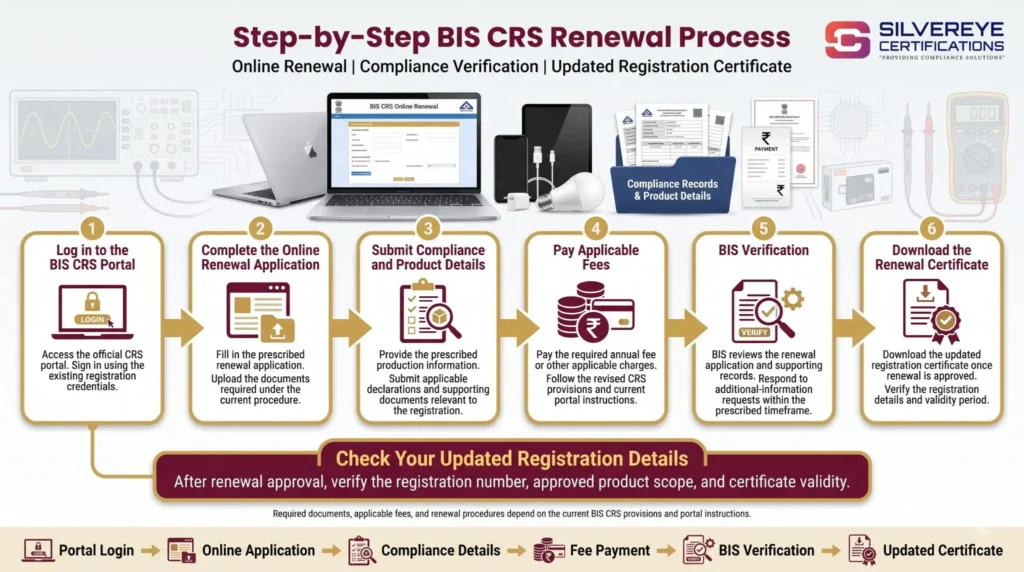
CRS Renewal Fees and Timeline
CRS renewal costs depend on the applicable fee schedule and registration requirements.
| Component | Details |
|---|---|
| Renewal application | Submitted online through the CRS portal |
| Annual fees | Payable according to the revised provisions |
| Additional testing | Required where applicable under the relevant procedure |
| Processing time | Depends on document completeness, payment verification, and any queries raised by BIS |
BIS does not guarantee one universal renewal processing time for every CRS registration. Apply early enough to resolve queries before the current registration expires.
CRS Registration Validity — The 2026 Change
BIS published revised provisions for CRS licence validity, renewal, and annual fee payment on 27 May 2026.
Under the revised provisions:
- Initial registration validity: Up to five years, subject to applicable requirements.
- Renewal validity: Governed by the revised CRS provisions; check the latest circular for the applicable renewal period.
- Annual fee payments: Applicable fees must be paid in advance according to the prescribed schedule.
- Ongoing compliance: Registration holders must submit the required production details and other information within the prescribed timelines.
The older statement that all CRS registrations are valid for exactly two years should not be used as a universal rule. Confirm the current validity and renewal conditions through the official CRS portal and applicable circular.
What Happens If You Miss the Renewal or Annual Payment Deadline?
Missing a prescribed deadline may lead to suspension, cancellation, or expiry-related consequences under the applicable rules.
- Annual fee and production details: Submit the required payments and information within the prescribed timeframe.
- Late renewal: Any late fee or post-expiry renewal facility depends on the applicable regulations and scheme-specific instructions.
- Use of the Standard Mark: Do not assume that submitting a late renewal application automatically authorises continued use of the mark.
Check the current CRS circular and your registration status before manufacturing or marketing products under the registration.
BIS FMCS Certification Renewal — Process, Fees & Timeline
BIS FMCS renewal enables foreign manufacturers to continue their BIS licence under the Foreign Manufacturers Certification Scheme. The process is coordinated through the manufacturer’s Authorised Indian Representative (AIR) and involves submission of production details, applicable fees, and other prescribed documents.
Documents Required for BIS FMCS Renewal
The following documents are identified in BIS’s published renewal guidance:
- Renewal application in Form XII.
- Month-wise production details for the relevant period, including complete consignee addresses.
- Extended Performance Bank Guarantee (PBG) covering six months beyond the licence validity, as specified by BIS.
- Evidence of payment of the applicable marking fees.
- Additional documents or compliance records requested by BIS, where applicable.
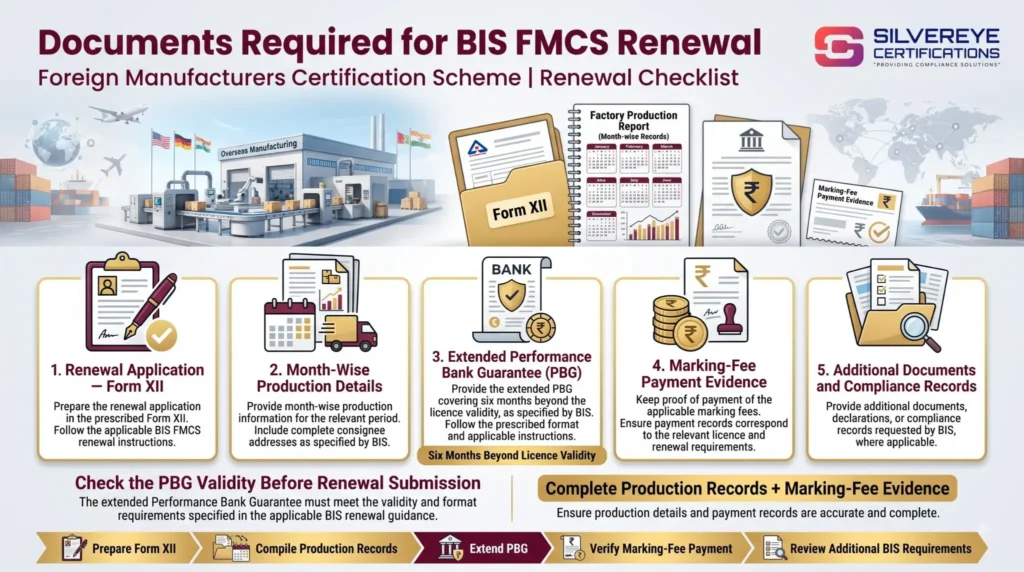
The manufacturer should coordinate with its AIR to confirm the latest portal checklist and ensure that the PBG remains valid for the required period.
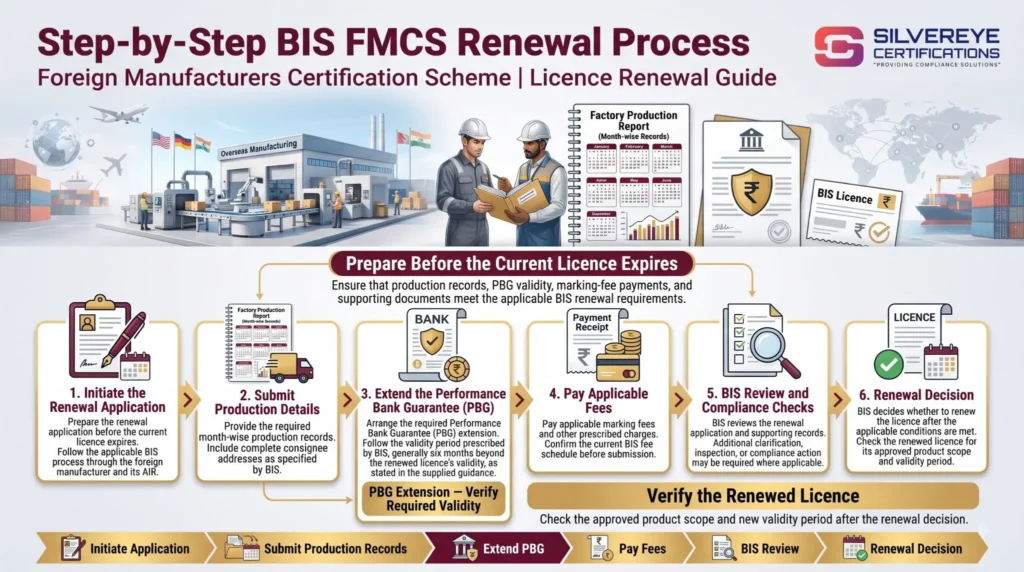
Step-by-Step BIS FMCS Renewal Process
Step 1: Initiate the Renewal Application
The foreign manufacturer, through the applicable BIS process and its AIR, prepares the renewal application before the current licence expires.
Step 2: Submit Production Details
Provide the required month-wise production records, including consignee addresses, in accordance with BIS instructions.
Step 3: Extend the Performance Bank Guarantee
Arrange the required PBG extension so that it covers the period prescribed by BIS, generally six months beyond the renewed licence’s validity.
Step 4: Pay Applicable Fees
Pay the applicable marking fees and other prescribed charges. Confirm the current fee schedule before submission.
Step 5: BIS Review and Compliance Checks
BIS reviews the renewal application and supporting documents. Additional clarification, inspection, or compliance action may be required where applicable.
Step 6: Renewal Decision
After the required conditions are met, BIS decides whether to renew the licence. Check the renewed licence for its approved product scope and validity period.
FMCS Renewal Fees, Timeline and Validity
FMCS renewal costs depend on the applicable marking fees, licence conditions, PBG arrangements, and any additional testing or inspection requirements.
BIS’s published FMCS renewal guidance states that:
- Renewal application: Form XII is used under the published procedure.
- Renewal period: A licence may be renewed for a period of one to five years, depending on the applicable requirements and fee payments.
- PBG extension: The guarantee must be extended for the period specified by BIS, generally six months beyond licence validity.
- Late renewal: A ₹5,000 late fee is specified for renewal applications submitted after licence expiry, subject to the applicable conditions.
There is no guaranteed universal processing timeline. Foreign manufacturers should initiate renewal early, coordinate with their AIR, and allow sufficient time for document review and any additional compliance requirements.
Important: BIS’s published FMCS renewal guidance should be checked directly before filing because the required forms, fees, and licence conditions may be updated. A renewal application alone does not guarantee continued authorisation to use the ISI Mark after expiry.
BIS Renewal at a Glance: ISI vs CRS vs FMCS
| Parameter | ISI Renewal (Scheme I) | CRS Renewal (Scheme II) | FMCS Renewal |
|---|---|---|---|
| Factory inspection | Surveillance or inspection may be required under the applicable procedure | No routine factory inspection as part of the standard renewal process | Overseas inspection may be required under the applicable procedure |
| Application route | Manakonline / BIS online portal | BIS CRS portal | Manakonline, coordinated through the AIR |
| Recommended filing window | Preferably two months before expiry under published Scheme I guidance | Follow the latest CRS circular and portal instructions | Apply well before expiry and follow current FMCS instructions |
| Validity provisions | Initial licence and renewal may each be for up to five years, subject to applicable conditions | Revised provisions allow registration for up to five years, subject to applicable conditions | Initial licence generally up to two years; renewal may be for one to five years under published FMCS guidance |
| Annual fee and production details | Submit applicable fees and required production details within prescribed deadlines | Follow the revised annual fee and reporting requirements | Pay applicable fees and submit prescribed production details |
| Late renewal | A 90-day post-expiry process and ₹5,000 late fee may apply under the published guidelines | Follow the applicable CRS circular and current portal instructions | A ₹5,000 late fee is specified for renewal applications submitted after expiry, subject to applicable conditions |
Note: A maximum validity period does not guarantee that every licence or registration will receive that term. Always check the current scheme-specific rules and the validity shown on your certificate.
Latest BIS Certification Renewal Updates (2026)
- BIS (Conformity Assessment) Amendment Regulations, 2026: The amendments notified on 25 February 2026 revised validity provisions for Scheme I and Scheme II. Initial licences or registrations may be granted for up to five years, subject to applicable requirements.
- Annual fee payment: Revised provisions require applicable annual payments and prescribed production or compliance information to be submitted within the relevant deadlines. Check the current rules for the exact fee and reporting obligations for your scheme.
- CRS renewal update — 27 May 2026: BIS published revised provisions covering CRS validity, renewal, and annual fee payment. Older guides that state a universal two-year CRS validity may therefore be outdated. Refer to the latest CRS circular and portal instructions.
- Scheme I renewal procedure: BIS’s published guidance recommends submitting the renewal application preferably two months before expiry. Where an application and the prescribed fees are not received before expiry, a limited post-expiry process may apply, subject to the applicable conditions and late fee.
- FMCS renewal requirements: BIS’s published guidance specifies Form XII, month-wise production details including consignee addresses, applicable marking fees, and an extended Performance Bank Guarantee. Foreign manufacturers should check the latest requirements with their AIR and BIS.
Because renewal rules and fee requirements vary by scheme, confirm the current provisions on the official BIS portal rather than relying on older articles or a general renewal checklist.
What Happens If a BIS License Is Not Renewed on Time?
- Loss of authorization: Once a license or registration expires, is suspended, or is cancelled, the holder must follow the applicable rules governing use of the BIS Standard Mark.
- Import and shipment complications: An expired or suspended licence may affect the import or clearance of regulated products. The actual consequences depend on the product, applicable QCO, and customs requirements.
- Sales-channel restrictions: Businesses may face marketplace or distributor restrictions if a product no longer meets applicable certification requirements.
- Suspension or cancellation: Failure to submit required annual fees, production statements, or other documents can trigger action under the relevant scheme. A 90-day post-expiry process and ₹5,000 late fee apply only where the relevant provisions permit them; these should not be treated as universal CRS, ISI, and FMCS rules.
- Additional compliance work: Depending on the reason for expiry or cancellation, restoring certification may require further documentation, testing, inspection, or a fresh application.
Important: Do not assume that a pending renewal application automatically authorises continued use of the mark. Confirm the status of the licence with BIS before continuing activities that require valid certification.
Common Mistakes That Delay BIS Renewal
- Starting the process too late: Allow enough time to prepare documents, make payments, and respond to queries before expiry.
- Expired calibration records: Keep equipment calibration and testing records current where required under the applicable product standard and quality-control procedure.
- Incomplete production and compliance records: Ensure that production statements, marking-fee calculations, and prescribed declarations are complete and consistent.
- Assuming CRS renewal requires a factory audit: CRS generally follows an online, document-based renewal process, but applicants must still satisfy the applicable testing, reporting, and conformity requirements.
- Ignoring annual fee deadlines: Track scheme-specific payment and reporting dates to reduce the risk of suspension or other regulatory action.
- Outdated AIR details for FMCS: Ensure that the Authorised Indian Representative’s information and required documentation remain current.
- Relying on old validity periods: Verify the latest amendments and the actual validity stated on the licence or registration certificate.
Why Work With Silvereye Certifications for BIS Certification Renewal
Renewing a BIS licence requires attention to the applicable deadline, documentation, fees, and ongoing compliance requirements. Silvereye Certifications supports manufacturers, importers, and foreign businesses with renewal preparation and coordination for ISI, CRS, and FMCS.
How Silvereye Certifications Helps
- Renewal deadline tracking: Helps clients monitor relevant expiry dates and prepare well in advance.
- Documentation review: Assists with organising production statements, declarations, quality records, and other scheme-specific documents.
- Inspection readiness: Helps eligible ISI and FMCS licence holders organise manufacturing, testing, calibration, and quality-control records for applicable inspections.
- CRS renewal support: Assists with the online renewal process and preparation of required documents under the current CRS procedure.
- AIR coordination for FMCS: Helps foreign manufacturers coordinate required documentation and communication through their Authorised Indian Representative.
- Fee and compliance tracking: Helps clients monitor applicable payments and reporting requirements to reduce avoidable renewal issues.
If your BIS ISI, CRS, or FMCS license is approaching expiry, start by checking the current validity period, renewal procedure, and applicable annual fee requirements. Silvereye Certifications can assist with documentation and application coordination, while the final renewal decision remains subject to BIS requirements.
Conclusion
Timely BIS Certification Renewal helps manufacturers maintain valid certification and continue meeting applicable product-compliance requirements. Although ISI, CRS, and FMCS share the goal of ensuring continued conformity, their renewal procedures, inspection requirements, fees, and validity provisions differ. Check the latest BIS guidance, submit the required documents and payments within the prescribed timeframe, and confirm your license status before continuing to use the authorized mark.
Silvereye Certifications can support businesses with renewal documentation, compliance preparation, and application coordination across all three schemes.
Frequently Asked Questions
What is BIS Certification Renewal?
It is the process of extending a valid BIS ISI, CRS, or FMCS licence before it expires, so the manufacturer can continue legally using the ISI/Standard Mark without a gap in market access.
Is a factory audit mandatory for BIS ISI renewal?
Yes. A surveillance/factory audit remains a compulsory part of the ISI renewal cycle to confirm the manufacturing unit still meets SIT requirements.
Is a factory audit required for BIS CRS renewal?
No. CRS renewal, filed through Form IX, is based on documentation and continued conformity — there is no factory audit step, even at renewal.
When should I apply for BIS renewal?
ISI and FMCS renewal should be initiated 60 to 90 days before expiry; CRS renewal should be filed at least three months before the certificate's expiry date.
What changed in BIS license validity in 2026?
Under the BIS (Conformity Assessment) Amendment Regulations, 2026, effective 25 February 2026, both ISI and CRS license validity can now extend up to 5 years, with fees payable annually instead of upfront.
What happens if I miss my BIS renewal deadline?
Missing the annual fee or production statement typically triggers a 90-day suspension, which can be revoked by paying outstanding dues plus a ₹5,000 late fee; continued non-payment can lead to cancellation.
How long does BIS ISI renewal take?
Typically 15 to 30 days once documentation is complete and the factory is ready for surveillance, though it can take longer if calibration certificates or QC records are incomplete.
Can I renew my BIS CRS registration with an old test report?
Only if the report's validity hasn't lapsed. If it has, an updated or continuing product test report is required as part of the Form IX renewal filing.
Who handles FMCS renewal for a foreign manufacturer?
The Authorised Indian Representative (AIR) coordinates the renewal filing and communication with BIS on the foreign manufacturer's behalf.
Does BIS renewal always guarantee a 5-year validity?
No. Following the corrigendum dated 28 April 2026, validity of up to five years is set by BIS at grant based on product risk, audit outcome, and compliance history — it is a maximum, not an automatic default.
Can a suspended BIS licence be reinstated?
Yes, generally by clearing outstanding dues plus the applicable late fee within the suspension window; if dues remain unpaid, the license risks cancellation and a longer reinstatement process.
What documents are needed for BIS ISI renewal?
Production and sales details for the previous period, a compliance self-declaration, updated QC/SIT records, and valid calibration certificates for testing equipment.