
- Same BIS-SAE Process for EVs and Conventional Vehicles: Electric vehicle manufacturers follow the applicable World Manufacturer Identifier (WMI) application, verification, and assignment process, just like manufacturers of petrol- and diesel-powered vehicles.
- Low-Volume EV Startups May Also Qualify: ISO 3780 provides for manufacturer identification arrangements for low-volume manufacturers. Eligibility and the applicable identifier format should be confirmed with the relevant issuing authority.
- WMI Supports CMVR Type Approval: WMI and Vehicle Identification Number (VIN) details form part of vehicle identification and may be required in the applicable type-approval documentation. Arranging the WMI early can help reduce delays during vehicle homologation.
- Apply Before VIN Assignment: EV manufacturers should plan their WMI application while finalising manufacturing and vehicle identification processes, rather than waiting until vehicles are ready for dispatch.
Introduction
WMI registration for ev manufacturers follows the applicable manufacturer identification process used for other vehicle manufacturers in India. The application is submitted to the Bureau of Indian Standards (BIS), which verifies the manufacturer’s details and coordinates the code-assignment process with SAE International (USA) in accordance with ISO 3780.
Manufacturers of electric two-wheelers, three-wheelers, and passenger vehicles should obtain the applicable World Manufacturer Identifier (WMI) as part of establishing a compliant 17-character Vehicle Identification Number (VIN) system. The applicable process, fee, and validity should be confirmed with BIS before applying, as these details may be subject to current requirements.

EV manufacturers should also plan WMI registration alongside other applicable regulatory requirements, including CMVR type approval and relevant battery-safety standards, such as AIS-156 or AIS-038, depending on the vehicle category. Coordinating these activities early can help reduce documentation gaps and avoidable delays during vehicle homologation.
Why Electric Vehicle Manufacturers Need WMI Registration
A Vehicle Identification Number (VIN) is a unique 17-character identifier used to identify a vehicle in accordance with applicable standards, including ISO 3779 and the relevant Indian automotive requirements. The first three characters of the VIN form the World Manufacturer Identifier (WMI), which identifies the vehicle manufacturer.
In India, the Bureau of Indian Standards (BIS) acts as the national WMI coordinator. It issues WMI codes to Indian vehicle manufacturers after assignment through SAE International (USA), the international agency responsible for maintaining WMI codes under ISO 3780. Electric vehicle manufacturers should arrange the applicable WMI as part of their vehicle identification and regulatory planning.
For EV manufacturers, completing this step early can help coordinate VIN allocation with manufacturing preparations, vehicle documentation, and applicable Central Motor Vehicles Rules (CMVR) type-approval requirements.
India's electric mobility sector continues to develop. In February 2026, government reporting highlighted the growing adoption of electric two-wheelers and three-wheelers under the PM E-DRIVE scheme. This growth makes it increasingly important for new EV manufacturers to plan their identification and compliance requirements before launching production.
Benefits of WMI Registration for EV Manufacturers
- VIN identification and traceability: An assigned WMI identifies the manufacturer within the VIN structure and supports consistent vehicle identification.
- CMVR type-approval preparation: Planning WMI and VIN details early can help manufacturers coordinate vehicle identification information with applicable homologation documentation.
- International manufacturer identification: A properly assigned WMI supports manufacturer identification within the international WMI system. Exporters must still meet the destination market's separate regulatory requirements.
- Vehicle traceability and recalls: A consistent VIN system helps manufacturers identify affected vehicles when addressing safety concerns, service campaigns, or recalls, including issues involving battery systems.
- Business and supply-chain readiness: Maintaining appropriate manufacturer identification records supports coordination with testing agencies, suppliers, distributors, and business partners.
Eligibility Criteria for EV Manufacturers Applying for a WMI
The WMI process is not a separate EV-only registration scheme. Electric vehicle manufacturers should follow the applicable BIS procedure and confirm the current eligibility criteria and document checklist before applying.
Applicants should be prepared to provide relevant details, such as:
- Business identity: Legal name and supporting registration documents for the applicant.
- Manufacturing facility: Details and address of the relevant manufacturing plant, as required by the BIS application checklist.
- Vehicle category: Clear identification of the type of vehicle being manufactured.
- Manufacturing details: Information supporting the application and the manufacturer’s proposed vehicle identification arrangements.
- VIN planning: Details needed to establish a compliant VIN structure under the applicable standards.
- Additional supporting documents: Any further information specified in the current BIS application form and checklist.
GST registration and Udyam/MSME registration may be relevant to a business's broader operations, but applicants should verify the actual WMI documentation requirements rather than assume every registration is mandatory for every application.
| EV Category | Typical Applicant |
|---|---|
| Electric two-wheelers and three-wheelers | Electric scooter, motorcycle, e-rickshaw, and e-cart manufacturers |
| Electric passenger vehicles | Electric car and SUV manufacturers |
| Electric commercial vehicles | Electric truck and light commercial vehicle manufacturers |
| Electric buses | Electric bus manufacturers and eligible vehicle manufacturers |
| Low-volume and niche EVs | Small-series or specialised vehicle manufacturers, subject to applicable WMI eligibility and assignment rules |
Before applying: Check the latest BIS WMI guidance and application checklist to confirm the required documents, vehicle-category details, and application procedure.
Documents Required for EV Manufacturer WMI Registration
The World Manufacturer Identifier (WMI) application process for electric vehicle manufacturers follows the applicable BIS procedure for vehicle manufacturers. The required documents should be confirmed against the latest BIS WMI application form and official checklist. EV battery test certificates are generally part of the separate vehicle type-approval and safety-compliance process, rather than the core WMI code-assignment process.
Before applying, EV manufacturers should prepare the following information and supporting documents, as applicable:
- Signed WMI Application Form: Complete the official BIS application and obtain the signature of the authorised representative.
- Business Registration Documents: Keep the Certificate of Incorporation, partnership deed, or other applicable proof of legal constitution ready.
- GST Registration Certificate: Keep a current copy available if required by the application checklist.
- Udyam Registration Certificate: Include this where applicable or requested; confirm whether it is required for your application.
- Manufacturing Facility Details: Prepare the plant address, supporting address documents, and any other facility information requested by BIS.
- Vehicle Category and Description: Clearly specify the vehicle type, such as an electric two-wheeler, electric three-wheeler, passenger EV, electric commercial vehicle, or electric bus.
- Manufacturing and VIN Details: Prepare the information needed to establish the manufacturer's identity and the proposed vehicle identification structure.
- Application Fee Payment Proof: Keep the payment receipt for the applicable BIS fee. BIS currently lists a WMI service fee of ₹5,000 plus applicable taxes.
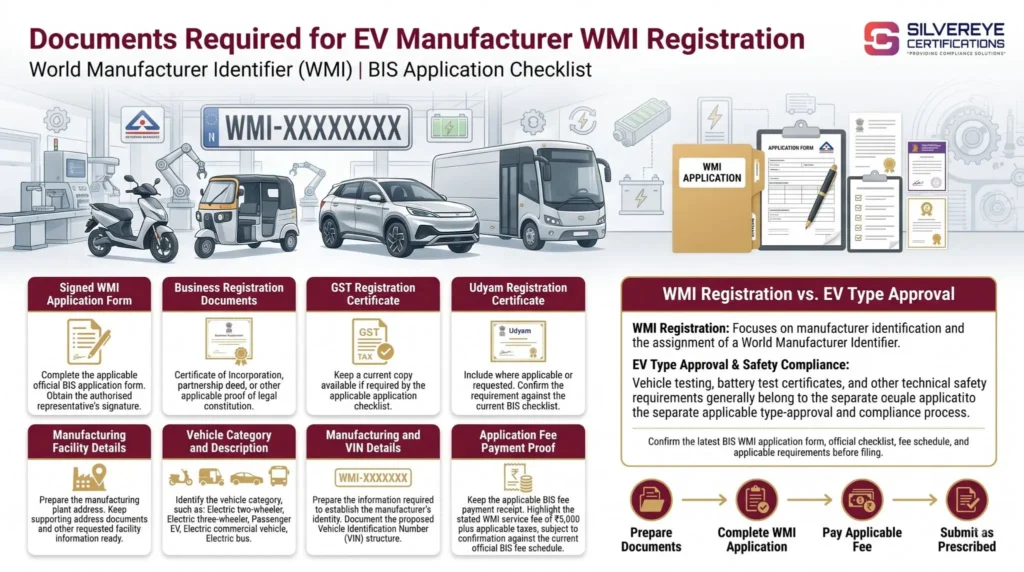
Plan EV safety compliance separately. Depending on the vehicle category, applicable battery-safety requirements may include AIS-156 for L-category electric powertrain vehicles or AIS-038 (Rev. 2) for M- and N-category electric powertrain vehicles. These requirements should be planned alongside CMVR type approval, but they should not automatically be treated as mandatory attachments to the WMI application.
Step-by-Step WMI Registration Process for EV Manufacturers
- Review the BIS requirements: Download the latest WMI application form and checklist from the official BIS website.
- Prepare the application: Enter the manufacturer's legal details, manufacturing information, and relevant vehicle-category details.
- Compile supporting documents: Arrange the business, facility, and other documents specified in the current checklist.
- Submit the application to BIS: Follow the submission instructions provided by BIS. The official BIS WMI page identifies the International Relations and Technical Information Services Department as the relevant department.
- BIS reviews the application: Respond to any requests for clarification or additional documents.
- WMI assignment coordination: BIS coordinates the assignment process with SAE International (USA), the international agency responsible for maintaining WMI codes.
- Receive the assigned WMI: Follow BIS instructions for receiving confirmation of the code.
- Establish the VIN structure: Use the assigned identifier in accordance with the applicable VIN standards and regulatory requirements.
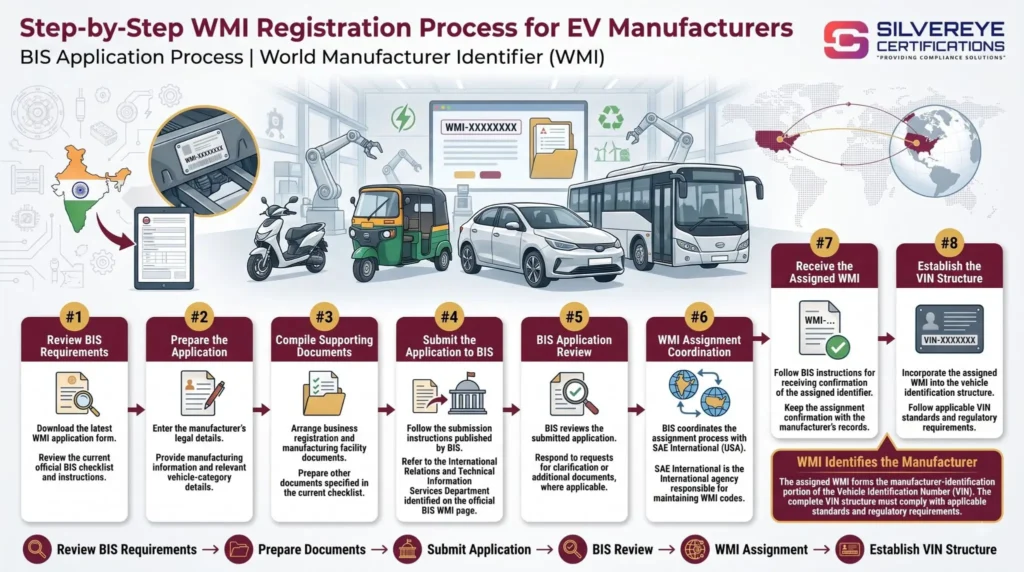
The processing time depends on the application, document completeness, and assignment process. BIS does not publish a fixed turnaround time on its WMI information page, so manufacturers should avoid relying on an assumed approval date when planning a vehicle launch.
Low-Volume Manufacturer Provision: An Important Consideration for EV Startups
Low-volume EV manufacturers may have an alternative WMI arrangement, depending on the applicable international identification rules and their production circumstances. Under the relevant low-volume identification framework, a manufacturer may be assigned a six-character manufacturer identifier instead of the standard three-character WMI.
In the six-character arrangement, the third VIN character is typically 9, and additional manufacturer-identifying characters are placed in VIN positions 12–14, in accordance with the applicable rules.
This arrangement can be relevant to small EV startups, niche vehicle manufacturers, and businesses producing limited quantities. However, eligibility and the correct identifier format must be confirmed with BIS and the applicable WMI assignment authority before VINs are generated.
Low production volume alone should not be assumed to disqualify an EV manufacturer from obtaining a WMI. Equally, manufacturers should not assume that a low-volume code will be granted automatically.
WMI Registration Fees for EV Manufacturers
| Fee Component | Amount | Notes |
|---|---|---|
| Official BIS WMI service fee | ₹5,000 + applicable taxes | Fee listed on the official BIS WMI page |
| Professional or consultancy fee | Varies by provider | Applies if external assistance is engaged |
| Inclusion of a new vehicle variety or plant-related modification | Confirm the applicable fee | Follow the current BIS modification form and fee instructions |
The published BIS WMI fee is not presented as a separate EV-specific fee. However, applicants should confirm the current amount and any applicable modification charges before submitting payment.
If you engage a consultancy such as Silvereye Certifications, professional charges will depend on the agreed scope of documentation and application support and are separate from government fees.
WMI Processing Timeline for EV Companies
BIS does not specify a fixed processing period on its official WMI page. The actual timeline can depend on document completeness, clarification requests, and coordination for code assignment.
EV manufacturers should plan for the following stages:
- Document preparation: Time required to gather business, manufacturing, and vehicle-category information.
- BIS review: Time taken to check the application and resolve any deficiencies.
- WMI assignment: Time required for the applicable assignment and confirmation process.
- VIN and homologation planning: Time needed to coordinate the assigned identifier with vehicle documentation and the relevant type-approval process.
There is no confirmed universal timeline for completing these stages. Starting the application early—while planning the manufacturing facility and vehicle documentation—can help reduce the risk of avoidable delays close to launch.
Validity, Modification, and Renewal for EV Manufacturers
WMI codes are manufacturer identifiers, not conventional product licences with a standard annual renewal cycle. Nevertheless, manufacturers should keep their identification records accurate and follow BIS instructions whenever their manufacturing arrangements change.
- Validity: Check the terms and applicable requirements associated with the assigned WMI. Do not assume that a code requires routine renewal in the same way as a time-limited licence.
- Adding a new vehicle variety: If you expand into a new vehicle category or variety, check whether BIS requires an inclusion application.
- Plant relocation or changes: BIS provides a separate application route for new plants and changes to plant addresses.
- Plant-name changes: Follow the relevant BIS modification process when the plant name changes.
- Company restructuring: If a merger, ownership change, or legal-entity change affects the registered manufacturer identity, confirm with BIS whether an update or fresh application is required.
BIS provides a separate form for the inclusion of new vehicle varieties, new plants, plant-address changes, and plant-name changes. Manufacturers should use the current form and checklist rather than assume every change follows the same procedure.
Common Mistakes EV Manufacturers Make During WMI Registration
- Applying too late: Waiting until vehicles are ready for production or dispatch can create avoidable scheduling pressure.
- Using a vague vehicle description: Clearly identify the vehicle category and variety instead of describing the product only as an “electric vehicle.”
- Overlooking low-volume options: Check the applicable low-volume manufacturer provisions if expected production is limited.
- Confusing WMI with type approval: A WMI identifies the manufacturer within the VIN structure; it does not replace CMVR type approval or other applicable vehicle compliance requirements.
- Ignoring modification requirements: Notify BIS and follow the applicable procedure when relevant manufacturing or plant details change.
- Assuming every supporting document is mandatory: Follow the current BIS checklist and distinguish WMI documents from separate EV battery-safety and homologation records.
- Relying on an unconfirmed timeline: Allow time for review and code assignment without assuming that a particular number of days guarantees completion.
2026 Update: What EV Manufacturers Should Know
The WMI registration process applies to electric and conventional vehicle manufacturers under the same general identification framework. However, EV manufacturers should also monitor developments in battery safety, vehicle type approval, and electric mobility policies that may affect their broader compliance and launch plans.
- PM E-DRIVE scheme momentum: In February 2026, the Union Minister for Heavy Industries reported that more than 28 lakh electric vehicles had been sold under the PM E-DRIVE scheme, including over 20 lakh electric two-wheelers and nearly 3 lakh electric three-wheelers. More than 14,000 electric buses had also been sanctioned across major cities. These figures reflect growing activity in India’s EV sector, although scheme eligibility and incentives depend on the applicable category and implementation rules.
- Battery safety standards and type approval: EV manufacturers must identify the applicable battery-safety and vehicle-approval requirements for their vehicle category. AIS-156 applies to relevant L-category electric powertrain vehicles, while AIS-038 (Rev. 2) covers relevant M- and N-category electric powertrain vehicles. Manufacturers should verify the current revisions and implementation requirements with the relevant testing agency. These requirements are separate from WMI assignment.
- AIS-153 requirements for buses: Manufacturers and bus body builders should review the applicable AIS-153 Bus Body Code requirements. Government guidance states that the relevant provisions for bus body builders came into effect on 1 September 2025. Applicability depends on the vehicle and manufacturing arrangement, so electric bus manufacturers should confirm the requirements for their specific models.
- BIS Conformity Assessment Regulations, 2026: BIS published amendments to its Conformity Assessment Regulations on 25 February 2026. These amendments concern specified conformity-assessment schemes and should not be interpreted as changing WMI code validity or introducing a separate EV WMI process. Manufacturers holding other BIS certifications should review the provisions relevant to their individual licences.
- No separate EV-specific WMI process identified on the BIS page: BIS’s published WMI guidance describes the general process for Indian vehicle manufacturers and lists a service fee of ₹5,000 plus applicable taxes. The guidance does not describe a separate EV-only application route. Applicants should check the official page for the latest application form, checklist, and fee details.
What this means for EV manufacturers in 2026: WMI registration is one part of a wider compliance plan. Manufacturers should coordinate their WMI application and VIN arrangements with the applicable CMVR type approval, battery-safety testing, and vehicle-specific requirements. Starting early can help identify documentation gaps before production or launch deadlines, while each approval should be tracked separately according to its own rules.
Get Your EV Company's WMI Registration Ready with Silvereye Certifications
For electric vehicle manufacturers, WMI registration is an important step in vehicle identification and production planning. Coordinating it with CMVR type approval, applicable battery-safety standards, and manufacturing documentation can help reduce avoidable delays during the vehicle launch process.
Silvereye Certifications supports EV startups and established manufacturers with WMI application preparation, document reviews, and guidance on the applicable BIS registration process. Our team can also help you plan your WMI application alongside other relevant vehicle compliance activities.
Contact Silvereye Certifications to discuss your EV manufacturer's WMI registration requirements and get guidance on preparing your application and supporting documents.
Frequently Asked Questions
Do electric vehicle manufacturers need a separate WMI registration process?
No. EV manufacturers use the exact same BIS-to-SAE International WMI registration process as manufacturers of petrol, diesel, or hybrid vehicles — there is no EV-specific application track.
Is WMI registration mandatory for electric two-wheeler manufacturers?
Yes. Any manufacturer generating VINs under ISO 3779/3780 and AIS-065 — including electric two-wheelers, three-wheelers, and passenger EVs — must hold a registered WMI before assigning VINs.
Can a new EV startup with low production volume still get a WMI code?
Yes. ISO 3780 provides for low-volume manufacturers through a six-character manufacturer identifier, so a genuine EV startup isn't excluded from registration simply because of a modest initial production run.
What documents does an EV manufacturer need for WMI registration?
The same core set as any manufacturer: incorporation proof, GST registration, Udyam certificate (if applicable), manufacturing plant address proof, and a clear description of the EV category, along with the signed application form and fee payment proof.
How much does WMI registration cost for an EV manufacturer?
The official BIS fee is ₹5,000 plus applicable taxes — identical to the fee for non-electric vehicle manufacturers, with no separate EV pricing tier.
Is a WMI code required before CMVR type approval for an EV?
WMI and VIN structure details are part of the documentation reviewed during CMVR vehicle type approval, so it's strongly advisable to have your WMI registered before or during the type-approval process, not after.
Does WMI registration cover battery safety compliance for EVs?
No. WMI registration only covers the manufacturer-identification code within the VIN. Battery safety compliance is handled separately under standards like AIS-156 (L-category) or AIS-038 Rev.2 (M/N-category), which you'll need alongside your WMI for full vehicle compliance.
How long does WMI registration take for an EV manufacturer?
There's no fixed statutory timeline, and EV applications aren't processed on a different schedule than other categories. In practice it commonly takes several weeks from a complete, well-documented submission to a confirmed code.
Can one EV manufacturer hold WMIs for multiple vehicle categories, like two-wheelers and passenger EVs?
Typically, adding a new vehicle category or variety under an existing manufacturer identity is handled through BIS's inclusion/modification application, rather than requiring an entirely separate WMI application from scratch.
What happens if an EV startup changes its name or ownership after getting a WMI?
You must notify BIS and submit the modification application form along with updated incorporation documents — a step many EV startups need to remember after funding-round-driven restructuring.
Do electric bus manufacturers need WMI registration too?
Yes. Electric bus manufacturers and bus body builders need a registered WMI just like any other vehicle category, and since September 2025 also need to comply with AIS-153 for bus body safety and construction.
Where can EV manufacturers get help with WMI registration?
While the process is designed to be manageable independently, many EV manufacturers work with certification specialists to prepare documentation and coordinate with BIS efficiently — support that Silvereye Certifications provides specifically for vehicle manufacturers, including EV companies.