

- Two-authority process: WMI registration in India is coordinated by BIS and finalized by SAE International (USA) under ISO 3779/3780.
- Low, fixed government fee: BIS charges a flat ₹5,000 plus applicable taxes for WMI code issuance — no product-based fee slabs.
- Permanent, not annually renewed: A WMI stays valid for the life of the business; you only need to update BIS after a name, ownership, or plant change.
- Mandatory before VIN generation: Every vehicle manufacturer — cars, two-wheelers, EVs, buses, trucks, trailers — needs a valid WMI before issuing compliant VINs under AIS-065.
Introduction
The WMI registration process is how a vehicle manufacturer obtains a World Manufacturer Identifier — the first three characters of the 17-character VIN. In India, the manufacturer applies to the Bureau of Indian Standards (BIS), which verifies company and plant details, proposes a code, and forwards it to SAE International (USA), the global registration authority under ISO 3780.

SAE assigns and confirms the code, BIS communicates it to the applicant, and the manufacturer then uses it in every VIN it issues. The official BIS fee is ₹5,000 plus applicable taxes, and the code stays valid as long as the company remains in business.
What Is a WMI (World Manufacturer Identifier)?
A World Manufacturer Identifier, or WMI, is a fixed three-character code that identifies a vehicle manufacturer and its country or region of production. It forms the very first block of the 17-character Vehicle Identification Number (VIN) that every road-going vehicle must carry.
Under ISO 3779 (VIN content and structure) and ISO 3780 (WMI code), the 17-character VIN is split into three sections. In India, this structure is adopted through AIS-065, the Automotive Industry Standard that governs VIN coding for vehicles manufactured or sold in the country.
| VIN Section | Positions | What It Represents |
| World Manufacturer Identifier (WMI) | 1–3 | Identifies the manufacturer and country/region of manufacture — the part obtained through WMI registration. |
| Vehicle Descriptor Section (VDS) | 4–9 | Describes vehicle attributes such as model, body type, engine, and platform, as defined by the manufacturer. |
| Vehicle Indicator Section (VIS) | 10–17 | Carries the model year, plant code, and a sequential production/serial number for each unit. |
Without a registered WMI, a manufacturer cannot legally construct a valid 17-character VIN, which in turn blocks type approval, registration, insurance, and export of the vehicle.
Why WMI Registration Matters: Key Benefits
WMI registration is not just a paperwork formality — it is the foundation of a manufacturer's global identity and legal compliance. The main benefits include:
- Legal VIN compliance: A registered WMI is a precondition for generating a valid VIN under ISO 3779/3780 and AIS-065, which is required for type approval and vehicle registration.
- Global manufacturer recognition: Once SAE International logs the code, the manufacturer is permanently identifiable in the worldwide WMI database used by regulators, customs, and industry bodies.
- Smoother exports: Customs and homologation authorities abroad routinely check that a vehicle's WMI is officially registered; an unregistered or invalid WMI is a common cause of shipment holds.
- Traceability for recalls and safety: A valid WMI lets regulators, insurers, and service networks trace a vehicle back to its manufacturer and plant during recalls, warranty claims, or theft investigations.
- Brand credibility: Holding an internationally logged WMI signals that a manufacturer meets recognised production and compliance standards, which matters to dealers, investors, and B2B buyers.
Who Needs WMI Registration?
WMI registration applies to any entity that manufactures road vehicles and intends to assign VINs to units it produces. This covers a wide range of vehicle categories:
| Vehicle Category | Typical Applicants |
| Passenger cars & SUVs | OEMs and new-entrant car manufacturers, including EV startups |
| Two-wheelers & three-wheelers | Motorcycle, scooter, and electric two/three-wheeler manufacturers |
| Commercial vehicles | Truck, van, and light commercial vehicle manufacturers |
| Buses | Bus body builders and integrated bus manufacturers |
| Trailers & towed vehicles | Trailer and semi-trailer manufacturers |
| Specialty & low-volume vehicles | Niche, custom-build, and small-series vehicle manufacturers |
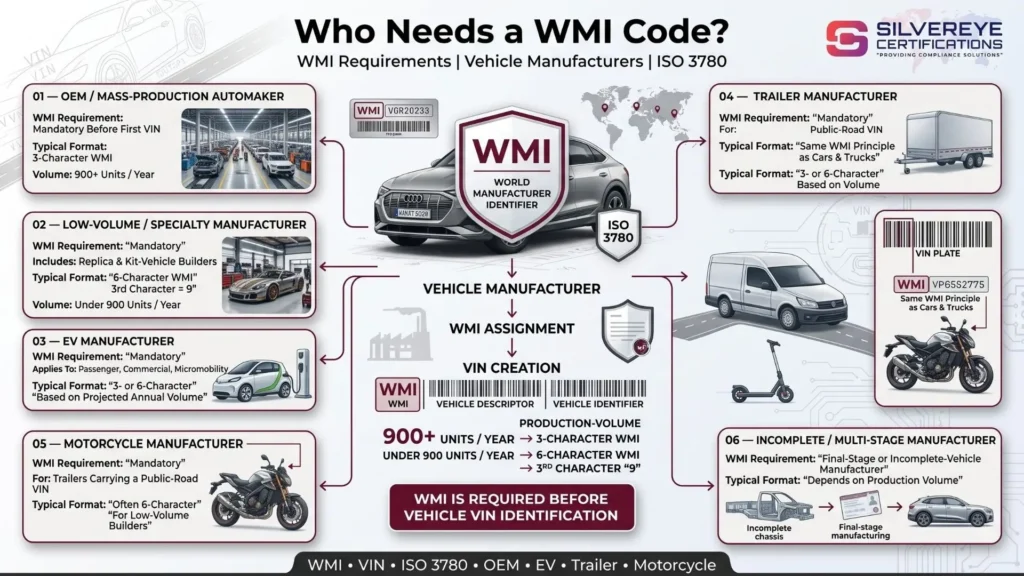
Before you apply, make sure your business meets these conditions:
- You operate as a legally registered manufacturing entity — a private limited company, LLP, partnership, or proprietorship with valid incorporation documents.
- You have a functional or near-functional manufacturing plant; BIS expects proof that production capability genuinely exists, not just a business plan.
- You hold current GST registration and, where applicable, Udyam/MSME registration.
- You can clearly define the vehicle category and product line for which the WMI is being sought.
- You are applying before you start assigning VINs commercially — retrofitting a WMI after vehicles are already on the road creates compliance gaps.
Documents Required for WMI Registration
Keeping documentation complete and consistent is the single biggest factor in avoiding delays. Typical requirements include:
- Duly filled WMI application form, signed by an authorised Director, Partner, or Proprietor
- Self-certified copy of the Certificate of Incorporation (or partnership deed/registration certificate for non-company entities)
- Self-certified copy of the current GST registration certificate
- Self-certified copy of the Udyam Registration Certificate (MSME), where applicable
- Memorandum of Association and Articles of Association (for companies) or Partnership Deed (for firms)
- Proof of manufacturing plant address (utility bill, lease/ownership document, or factory licence)
- Vehicle/product category for which the WMI is sought, with a brief description of the product line
- Proposed date or month of production commencement
- Proof of application fee payment
- Any additional supporting documents BIS may request during document verification
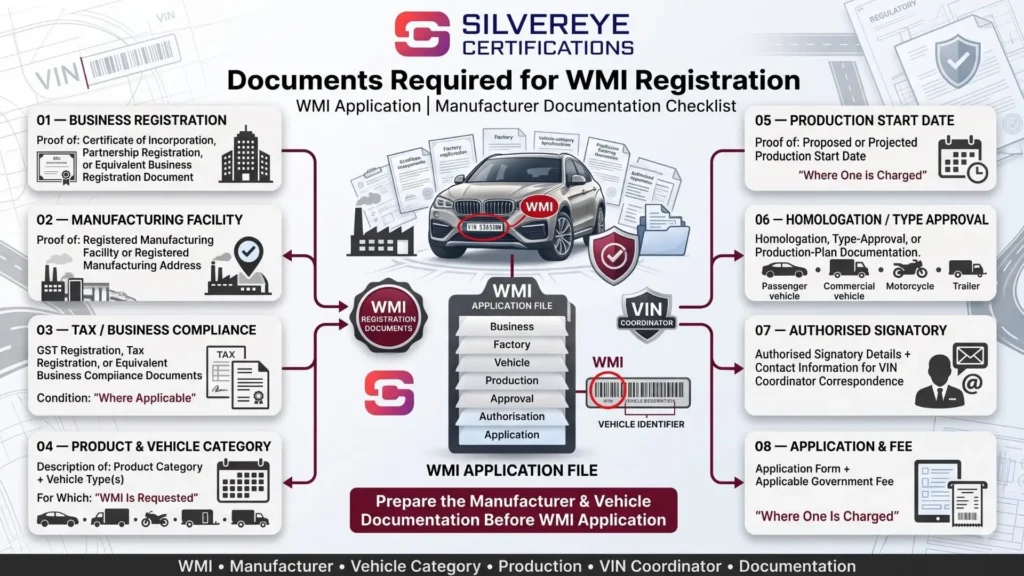
BIS also publishes an official checklist alongside the application form so applicants can self-verify completeness before submission — using it reduces the chance of a query or rejection.
Step-by-Step WMI Registration Process
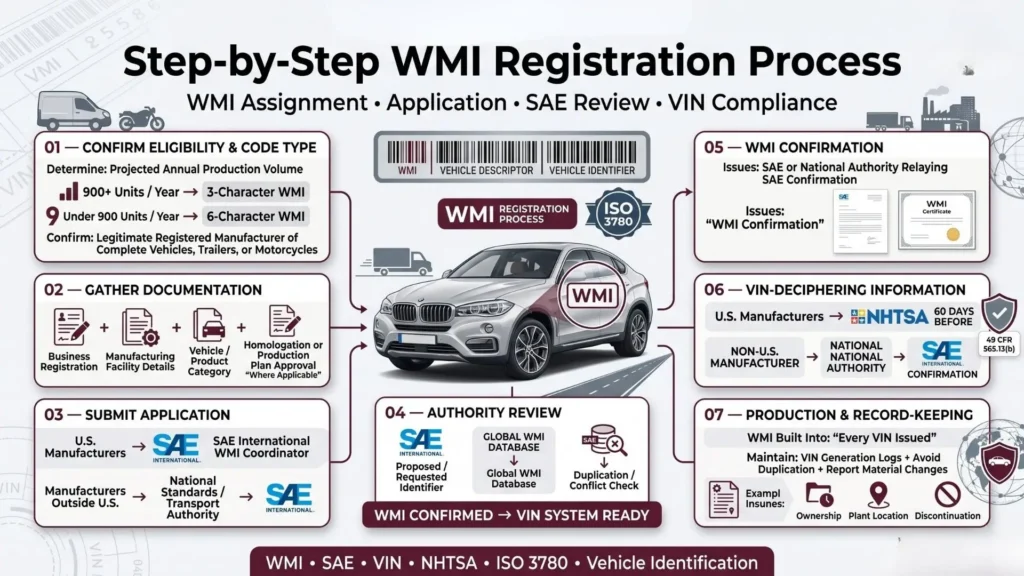
WMI registration in India runs through a coordinated two-authority process: BIS handles the domestic application and verification, while SAE International in the USA performs the actual global code assignment. Here is how it works, step by step:
- Prepare the application: Download the official WMI application form and checklist from the BIS website, and fill them in line with your company and plant details.
- Compile supporting documents: Attach the incorporation, GST, Udyam, address proof, and product-category documents listed above.
- Submit to BIS: Send the completed application, checklist, and fee to BIS's International Relations & Technical Information Services Department at Manak Bhawan, New Delhi (details in the FAQ section below).
- BIS verifies your details: BIS officials review manufacturer information, production activity, plant readiness, and your proposed VIN structure.
- BIS proposes a WMI: Once verification is complete, BIS proposes a code from the available series and records the entry in its database.
- Forwarded to SAE International: BIS forwards the proposal to SAE International, USA — the body appointed as the global registration authority for ISO 3780.
- SAE assigns and confirms the code: SAE assigns the WMI, logs it in the worldwide WMI database, and issues a confirmation.
- BIS communicates the final code: BIS sends the confirmed WMI code to the applicant, officially completing registration.
- Start using the WMI: The manufacturer embeds the assigned WMI into positions 1–3 of every VIN generated for vehicles it manufactures going forward.
WMI Registration Fees
| Fee Component | Amount | Notes |
| Official BIS application fee | ₹5,000 + applicable taxes | Fixed government fee as published on the official BIS website; does not vary by product category. |
| Professional/consultancy fee (optional) | Varies by service provider | Applicable only if you engage a certification consultant such as Silvereye Certifications for documentation and liaison support. |
| Modification/update fee | As applicable | Charged only when you file a change request — e.g., new plant, new variety, or name change. |
Because the government fee is fixed and modest, most of the real cost and risk in WMI registration comes from documentation errors and delays — not the fee itself.
WMI Registration Processing Timeline
BIS does not publish a fixed statutory turnaround time for WMI applications. In practice, processing depends on how complete your documentation is and how quickly BIS and SAE can coordinate on the code assignment. As a general guide:
| Stage | Typical Duration |
| Document preparation (applicant-side) | 1–2 weeks, depending on how quickly incorporation, GST, and address proofs are gathered |
| BIS verification of application | Varies by application volume and completeness of documents |
| SAE International code assignment | Generally completed once BIS forwards a verified, complete proposal |
| Total time to receive confirmed WMI | Commonly several weeks from submission, faster with clean, complete documentation |
Incomplete applications, mismatched addresses, or unclear product categories are the most common causes of extended timelines — most delays are avoidable with careful preparation.
WMI Validity, Renewal, and Modification Rules
Unlike many BIS certification schemes that run on fixed licence cycles, a WMI is not renewed on a periodic calendar. Instead:
- Validity: The WMI remains valid for as long as the manufacturing entity remains in business and continues to hold the identity under which it was registered.
- When you must update it: If your company changes its legal name, undergoes a merger or ownership restructuring, or sets up a new plant or address, you must notify BIS and file the modification form for inclusion of variety, plant address change, or name change.
- New product variety: Adding a new vehicle category or variety under the same manufacturer identity also requires an update filing with BIS, rather than a fresh WMI application in most cases.
- Cancellation risk: BIS can review or withdraw a WMI if a manufacturer discontinues operations, misuses the code, or provides false information during registration.
This makes WMI registration closer to a one-time foundational registration than a recurring compliance task — but it also means keeping BIS informed of structural changes is your ongoing responsibility, not a one-off filing you can forget after approval.
Common Mistakes That Delay WMI Registration
- Using a company or entity name that doesn't exactly match your incorporation, GST, and Udyam documents.
- Submitting an incomplete or mismatched manufacturing plant address across different documents.
- Applying before the manufacturing facility is functional or before production readiness can be demonstrated.
- Leaving the vehicle/product category vague instead of clearly specifying the intended vehicle type.
- Submitting duplicate applications for closely related entities, which can trigger rejection or extra scrutiny.
- Not using the official BIS checklist to self-verify the application before submission.
- Forgetting to update BIS after a legal name change, ownership change, or new plant — leading to a mismatch between the registered WMI and current company records.
What's New for 2026: Regulatory Context for WMI Applicants
The core WMI registration process — BIS verification followed by SAE International assignment — has not changed structurally. However, manufacturers applying for or holding a WMI in 2026 should be aware of the broader BIS regulatory environment moving around them:
- BIS Conformity Assessment Regulations, 2026 (amended 25 February 2026): BIS extended the maximum validity of several of its certification licenses to up to five years, with an option to pay renewal fees annually instead of as a single lump sum. This is a general modernization of BIS's compliance framework rather than a WMI-specific change, but it signals BIS's broader shift toward longer-cycle, lower-friction compliance for manufacturers, importers, and MSMEs it regulates.
- Rising relevance for EV and low-volume manufacturers: As electric two-wheeler, three-wheeler, and passenger-vehicle manufacturing has expanded in India, WMI details are increasingly required as part of the documentation submitted during CMVR vehicle type-approval, making early WMI registration a practical priority for new EV manufacturers rather than a late-stage formality.
- No separate WMI-specific fee change published: As of this update, BIS's official WMI page continues to list the ₹5,000-plus-tax fee with no product-based fee slabs. Applicants should always confirm the current fee and forms directly on the official BIS WMI page before submitting an application, since government fee schedules can be revised.
In short: the WMI process itself remains stable and predictable for 2026, but it now sits inside a BIS compliance ecosystem that is generally moving toward longer validity periods and tighter integration with vehicle type-approval documentation — both worth planning around if you are setting up a new manufacturing line this year.
Get Expert Help With Your WMI Registration
WMI registration is a one-time but detail-heavy process — a single mismatched document or unclear product category can add weeks to your timeline. If you'd rather have specialists handle the documentation, BIS liaison, and follow-up so you can focus on production,
Silvereye Certifications supports vehicle manufacturers through the complete WMI registration process — from document preparation and application filing to coordinating with BIS through to final code confirmation. Whether you're a new EV manufacturer setting up your first plant or an established company adding a new vehicle category, Silvereye Certifications helps you get your WMI right the first time, with fewer delays and no guesswork.
Frequently Asked Questions
What is the WMI registration process in simple terms?
It is the process by which a vehicle manufacturer applies to BIS, gets verified, and receives a three-character World Manufacturer Identifier that SAE International assigns and logs in its global database — the first step toward legally generating VINs.
Is WMI registration mandatory for all vehicle manufacturers in India?
Yes. Any entity manufacturing road vehicles that need a 17-character VIN under ISO 3779/3780 and AIS-065 — cars, two-wheelers, EVs, commercial vehicles, buses, trailers — must hold a registered WMI before assigning VINs.
Who issues the WMI code — BIS or SAE International?
Both play a role. BIS, as India's WMI coordinator and ISO member body, verifies the manufacturer and proposes the code; SAE International in the USA, appointed by ISO as the registration authority for ISO 3780, formally assigns and logs the code globally.
How much does WMI registration cost?
The official BIS fee is ₹5,000 plus applicable taxes. This is a flat government fee; any additional cost only applies if you hire a consultant for documentation and liaison support.
How long does WMI registration take?
BIS does not publish a fixed statutory timeline. In practice it commonly takes several weeks from submission to confirmed code, depending heavily on how complete and consistent your documentation is.
What documents are required for WMI registration?
Core documents include the incorporation certificate, GST registration, Udyam/MSME certificate (if applicable), MOA/AOA or partnership deed, manufacturing plant address proof, product category details, and proof of fee payment.
Does a WMI need to be renewed every year?
No. A WMI is not renewed on a periodic cycle. It stays valid as long as the company remains in business under the identity it was registered with. You only need to update BIS if there is a name, ownership, or plant change.
Can a small or low-volume manufacturer get a WMI?
Yes. ISO 3780 and related VIN regulations specifically provide for low-volume manufacturers, in some cases using a six-character manufacturer identifier (with a fixed digit in the third VIN position) alongside positions 12–14 of the VIN, so smaller manufacturers are not excluded from the system.
What happens if I use an unregistered WMI in my VINs?
Vehicles with an invalid or unregistered WMI will typically fail type-approval or homologation checks, can be blocked at customs during export, and cannot be reliably traced by regulators, insurers, or service networks — creating serious compliance and business risk.
Where do I submit the WMI application in India?
Applications go to the International Relations & Technical Information Services Department, Bureau of Indian Standards, Manak Bhawan, 9 Bahadur Shah Zafar Marg, New Delhi 110002, using the official application form and checklist published on the BIS website.
Do I need a WMI before or after setting up my manufacturing plant?
You should apply once your plant is functional or very close to it. BIS expects evidence of genuine production capability, so applying too early — before any real manufacturing setup exists — often leads to delays or queries.
Can I get help with the WMI registration process?
Yes. While the process is designed to be manageable in-house, many manufacturers work with certification specialists to prepare documentation, avoid common errors, and coordinate with BIS — which is exactly the kind of support Silvereye Certifications provides.