
- Explains PSARA License eligibility in Chennai, required documents, government fees based on district coverage, and the complete offline application process for private security agencies.
- Covers the role of Tamil Nadu's Controlling Authority, police antecedent verification, and the relevant application forms and verification requirements.
- Addresses the claimed May 2026 amendment to Sections 12 and 20(2) of the PSARA Act, subject to confirmation against the official Gazette before stating that criminal liability has been removed.
- Written for security agency owners, HR heads, and facility managers planning to operate in Chennai, Coimbatore, Tiruppur, and other districts of Tamil Nadu.
Introduction
A PSARA License in Chennai is the mandatory authorization required to operate a private security agency under the Private Security Agencies (Regulation) Act, 2005, and the applicable Tamil Nadu Private Security Agencies Rules, 2022. The license is issued by the state's Controlling Authority.
Eligible applicants, including proprietorships, partnerships, LLPs and companies, must submit the prescribed application, supporting documents and fees for the intended operating area. Applications may be submitted in person, by registered post or through electronic means, as permitted by the rules.
The process includes antecedent verification, scrutiny of the application and verification of the agency's premises. The license is issued in Form IV after the requirements are met and is valid for five years. Renewal applications must be submitted at least 45 days before expiry under the Tamil Nadu Rules, 2022.
The May 2026 amendment to the PSARA Act removed Section 20(2), according to the amended statutory text; however, any claim concerning changes to Section 12 or the continuing penalties for operating without a licence should be checked against the applicable amendment before publication.
What Is a PSARA License in Chennai?
A PSARA License in Chennai is the legal authorization required to operate a private security agency in Chennai and other parts of Tamil Nadu. It is governed by the Private Security Agencies (Regulation) Act, 2005, along with the Tamil Nadu Private Security Agencies Rules, 2022, which superseded the state's 2008 Rules.
The license is issued by the state's designated Controlling Authority after the applicant meets the prescribed requirements, including application scrutiny and antecedent verification. Private security agencies must obtain the license before commencing operations.
Applicants can apply for authorization covering one district, a group of districts, or the entire state, subject to the applicable licensing provisions and fees. The application process and submission method should be confirmed with the Tamil Nadu Controlling Authority before filing.
Who Needs a PSARA License in Chennai?
Any proprietorship, partnership, LLP, or company engaged in providing private security services for payment must obtain the required PSARA License before starting operations. This requirement applies to agencies serving clients across Tamil Nadu, including Chennai, Coimbatore, Madurai, and Tiruchirappalli.
Common services covered include:
- Security guards for offices, IT parks, shopping malls, hospitals, factories, and residential complexes.
- Security supervisors responsible for overseeing deployed guards and security operations.
- Bouncers and event security personnel for corporate events and private functions.
- Cash-in-transit and armoured car services, subject to the additional applicable requirements for these activities.
- Armed security services, which must comply with applicable firearms licensing and other relevant legal requirements in addition to PSARA compliance.
Tamil Nadu's manufacturing, IT, logistics, port, and textile industries create demand for professional security services. For agencies seeking contracts with corporate offices, industrial facilities, warehouses, and commercial establishments, maintaining a valid PSARA License can also be an important vendor-qualification requirement.
Benefits of a PSARA License in Chennai
- Legal compliance: Allows the agency to operate within the geographical scope authorised by its licence.
- Business opportunities: Helps meet licensing requirements for contracts with corporates, industrial facilities, and other organizations.
- Client confidence: Demonstrates that the agency has undergone the prescribed licensing and verification process.
- Structured operations: Supports compliance with applicable requirements for guard training, supervision, and agency records.
- Audit readiness: Provides documentary evidence of licensing and helps the agency demonstrate compliance during client audits and official inspections.
Eligibility Criteria for a PSARA License in Chennai
For the Agency
- Eligible business structure: The applicant must meet the applicable requirements for a proprietorship, partnership, LLP, company, or other eligible business entity.
- Business documentation: The applicant must provide the prescribed registration, identity, address, and other supporting documents.
- Suitable business name: The agency's name and representations must comply with applicable rules and must not falsely imply government affiliation.
- Training arrangements: The agency must comply with the prescribed requirements for security guard and supervisor training. Confirm the applicable training-institute approval and documentation requirements before submitting the application.
For Directors, Partners, and the Principal Officer
- Antecedent verification: The applicant and relevant persons must undergo the prescribed background verification.
- Legal eligibility: Directors, partners, and responsible personnel must satisfy the applicable disqualification criteria under the PSARA Act.
- Criminal history: Disqualifications relating to specified convictions and other circumstances under the Act must be assessed before applying.
- Relevant experience: Experience in the police, armed forces, or security sector may be useful for operational management, but it does not replace the statutory eligibility requirements.
For Security Guards and Supervisors
- Age and physical fitness: Personnel must meet the applicable age, physical fitness, and other eligibility requirements under the governing rules.
- Character verification: Guards and supervisors must satisfy the prescribed character and antecedent requirements.
- Mandatory training: The agency must ensure that guards and supervisors receive the training and skills prescribed under Section 9 of the PSARA Act and the applicable rules.
- Medical fitness: Personnel must meet applicable medical fitness requirements, including examinations where prescribed.
- Supervisor requirements: Agencies must comply with the Act's requirements concerning the engagement of supervisors and the applicable timelines.
Important: Eligibility, documents, training arrangements, and verification requirements should be checked against the current Tamil Nadu Rules and the Controlling Authority's instructions before an application is submitted.
Documents Required for PSARA License Registration in Chennai
Applicants seeking a PSARA License in Chennai should prepare the prescribed application forms and supporting documents before submitting their application to the Tamil Nadu Controlling Authority.
| Document Category | Documents to Prepare |
|---|---|
| Agency Registration | Certificate of incorporation, partnership deed, or other applicable business registration documents |
| Business Details | PAN, registered office address proof, and GST registration where applicable |
| Directors, Partners and Principal Officer | Identity proof, address proof, photographs, and personal particulars required for antecedent verification |
| Application Forms | Form I for the licence application, Form II for antecedent verification, and Form III affidavit, as prescribed by the applicable Tamil Nadu Rules |
| Training Arrangements | Training institute details and supporting documents required under the applicable rules |
| Additional Declarations | Prescribed affidavits, declarations, and other supporting documents requested by the Controlling Authority |
| Employment and Compliance Records | Applicable EPF, ESI, Shops and Establishments, and other registrations, depending on the agency's operations and statutory obligations |
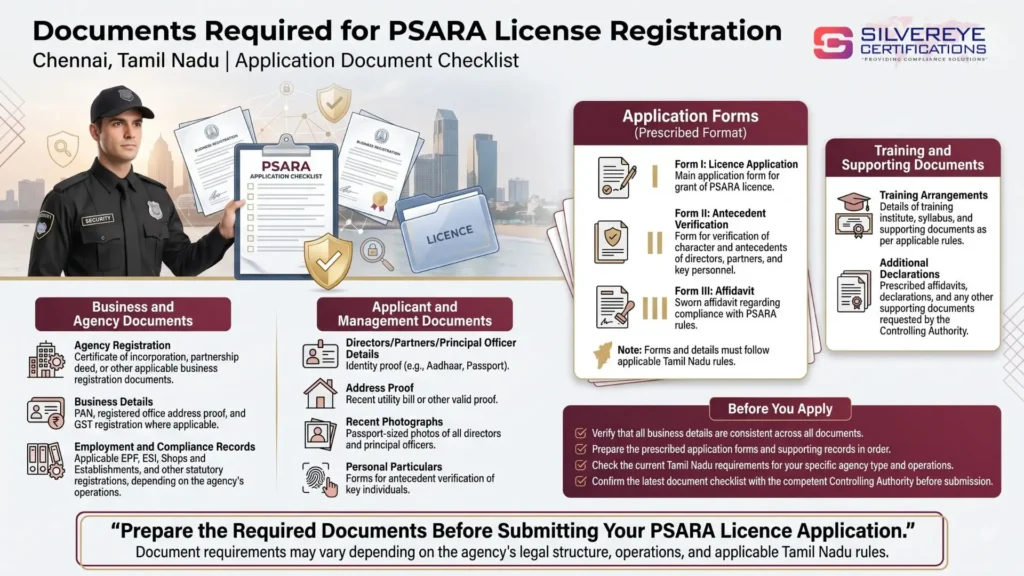
Important: The exact document list may vary according to the applicant's business structure and circumstances. GST, EPF and ESI requirements should not be presented as universally mandatory documents for every PSARA application. Confirm the latest checklist with the Controlling Authority before filing.
Applicants should keep organized physical copies of the required documents and follow the submission method currently accepted by the authority.
Step-by-Step PSARA License Registration Process in Chennai
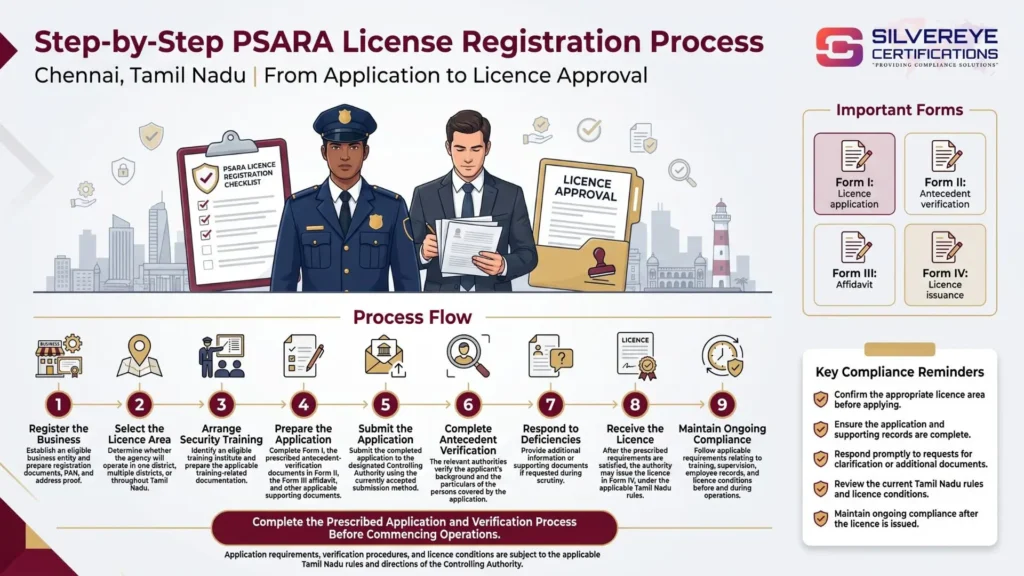
- Register the business: Establish an eligible business entity and prepare its registration, PAN, and address documents.
- Select the licence area: Decide whether the agency will operate in one district, multiple districts, or throughout Tamil Nadu.
- Arrange security training: Identify an eligible training institute and prepare the required training-related documentation.
- Prepare the application: Complete Form I, the prescribed antecedent-verification documents in Form II, the Form III affidavit, and all other applicable supporting documents.
- Submit the application: File the completed application with the designated Controlling Authority using the currently accepted submission method.
- Complete antecedent verification: The relevant authorities verify the applicant's background and the particulars of the persons covered by the application.
- Respond to deficiencies: Provide additional information or documents if requested during scrutiny.
- Receive the licence: Once the prescribed requirements are satisfied, the authority may issue the licence in Form IV under the Tamil Nadu Private Security Agencies Rules, 2022.
- Maintain ongoing compliance: After approval, comply with applicable requirements for training, supervision, employee records, and licence conditions before and during operations.
How Long Does PSARA Registration Take in Chennai?
The processing time depends on the completeness of the application, antecedent verification, and the authority's review. A 45–60-day timeline should be treated as an estimate, not a guaranteed processing period, unless confirmed by the relevant authority.
PSARA License Fees in Chennai
The applicable PSARA government fee depends on the geographical scope of the license. Tamil Nadu Police's published guidance lists the following fee structure, but applicants should verify whether these amounts and payment instructions remain current under the Tamil Nadu Rules, 2022.
| Licence Coverage | Published Government Fee |
|---|---|
| One district | ₹5,000 |
| Two to five districts | ₹10,000 |
| Entire state of Tamil Nadu | ₹25,000 |
These figures are based on published Tamil Nadu Police guidance and should be confirmed with the Controlling Authority before payment. Training costs and professional consultancy charges, if applicable, are separate.
The older police guidance specifies payment by demand draft or banker's cheque. Do not assume that cash challans or other payment methods are accepted without current confirmation.
PSARA License Validity and Renewal in Chennai
A PSARA License is valid for five years, unless it is cancelled earlier in accordance with the law. Agencies must apply for renewal to the Controlling Authority at least 45 days before the license expires, as prescribed under Section 8 of the PSARA Act, 2005.
The renewal application must include the applicable forms, fee, supporting documents, and other required particulars. The authority may conduct the necessary verification before deciding whether to renew the license.
Do not wait until the final days to begin renewal. An application submitted after the prescribed deadline may not qualify for renewal under the normal process, and the agency may need to apply for a fresh license. Operating without a valid license can disrupt business operations and expose the agency to legal consequences.
The 2026 PSARA Update: Decriminalization Under Sections 12 and 20(2)
An important regulatory change for private security agencies came into effect on 15 May 2026 under the Jan Vishwas (Amendment of Provisions) Act, 2026. The amendment omitted Section 12 and Section 20(2) of the Private Security Agencies (Regulation) Act, 2005. These changes apply nationally, including to agencies operating under PSARA licenses in Tamil Nadu.
Previously, Section 12 required a private security agency to display its license at its place of business. Section 20(2) prescribed criminal penalties for contraventions of Sections 9, 10, 11, 12 and 17, covering specified requirements relating to training, guard eligibility, license conditions, license display and identity cards.
With effect from 15 May 2026, Section 20(2)'s specific criminal penalty has been removed. However, this does not mean that the underlying training, eligibility, licensing-condition or identity-card requirements have automatically disappeared. Agencies must continue to follow applicable statutory provisions, state rules and license conditions. The precise continuing requirements should be checked against the current Tamil Nadu Rules.
What Still Applies to PSARA-Licensed Agencies?
- Valid PSARA license: Operating a private security agency without the required license remains an offence under Section 4 read with Section 20(1).
- Guard training: The training requirements under Section 9 continue to apply.
- Guard eligibility: The applicable requirements under Section 10, including citizenship, age, character and physical fitness, remain relevant.
- License conditions: Agencies must continue to comply with applicable conditions imposed under Section 11 and the relevant state rules.
- Identity cards: Applicable requirements under Section 17 must still be followed.
- Uniform restrictions: Unauthorized use of specified military or police uniforms remains subject to Section 21 and the applicable law.
The amendment is part of the broader effort to reduce criminal penalties for certain regulatory contraventions. It should not be interpreted as a general exemption from PSARA compliance.
Compliance Obligations After Getting a Chennai PSARA License
After obtaining a PSARA License in Chennai, agencies should maintain an effective compliance system covering the following areas:
- License validity: Keep the license valid and operate only within its authorized geographical scope.
- Training and verification: Ensure that guards and supervisors satisfy applicable training and antecedent-verification requirements.
- Employee records: Maintain prescribed employee registers, identity-card records, training details and other required documentation.
- Supervision: Appoint supervisors in accordance with the applicable statutory requirements and maintain suitable deployment records.
- Changes to agency details: Notify the Controlling Authority of changes to the agency's details wherever required by the applicable rules or license conditions.
- Employment compliance: Meet applicable EPF, ESI, wage, and other employment obligations based on the agency's workforce and legal circumstances.
- Renewal planning: Submit the renewal application at least 45 days before the licence expires, as required under Section 8 of the PSARA Act.
Note: Section 12's license-display requirement was omitted from the central Act with effect from 15 May 2026. Do not describe display at the registered office as a continuing requirement under Section 12 itself. Check the applicable Tamil Nadu Rules and license conditions before advising whether any separate display requirement remains.
Penalties for PSARA Non-Compliance in Tamil Nadu
Operating a private security agency without the required license remains punishable under Section 20(1) of the PSARA Act. The provision allows imprisonment for up to one year, a fine of up to ₹25,000, or both. Additional consequences may apply to continuing offences as provided by law.
The omission of Section 20(2) removes the criminal penalty previously specified for contraventions covered by that subsection. However, agencies must not assume that non-compliance with training, guard eligibility, license conditions or identity-card requirements is automatically consequence-free. Applicable regulatory action, including suspension or cancellation of a license where legally justified, may remain available to the competent authority.
Agencies providing armed security services must also comply with the applicable firearms licensing requirements under the Arms Act, 1959, and other relevant laws. A PSARA license should not be treated as a substitute for the necessary firearms authorization.
Maintaining a valid license and meeting ongoing statutory requirements are essential for protecting client relationships and avoiding regulatory disruption.
Common PSARA Compliance Mistakes to Avoid
- Assuming armed security is covered by PSARA alone: Obtain the additional firearms authorisations required for armed deployment.
- Submitting incomplete documents: Check the current Tamil Nadu application checklist before filing.
- Selecting the wrong geographical scope: Confirm the intended operating districts and the applicable procedure for extending coverage.
- Delaying training arrangements: Prepare the prescribed training-related documents early in the application process.
- Missing the renewal deadline: Start preparing the renewal application well before the statutory deadline.
- Misinterpreting the 2026 amendment: Decriminalisation under Section 20(2) does not automatically remove the underlying compliance obligations.
- Ignoring state-specific requirements: Check the current Tamil Nadu Rules, licence conditions and instructions issued by the Controlling Authority.
How Silvereye Certifications Can Help
Obtaining a PSARA License in Chennai involves preparing the application, organizing supporting documents, understanding the license geographical scope and following the applicable verification process.
Silvereye Certifications can support private security agencies and facility management businesses operating in Chennai, Coimbatore, Madurai and other parts of Tamil Nadu with application documentation, compliance preparation and renewal planning.
The objective is to help businesses understand the applicable requirements, reduce avoidable documentation errors and maintain their licensing compliance as the regulatory framework evolves.
Frequently Asked Questions
What is a PSARA license in Chennai?
It is the mandatory authorization issued under the Tamil Nadu Private Security Agencies Rules, 2008, by the state's Controlling Authority for private security agencies, allowing a business to legally provide private security services in Tamil Nadu.
Is the PSARA application in Chennai filed online or offline?
Tamil Nadu's PSARA application is typically filed offline, submitted directly to the Controlling Authority in Chennai, unlike some states that have moved to fully online portals.
How long is a PSARA license valid in Chennai?
A PSARA license issued in Tamil Nadu is valid for five years from the date of grant, matching the standard cycle followed by most Indian states.
When should I apply for PSARA license renewal in Chennai?
Guidance specific to Chennai recommends submitting the renewal application before 90 days of the license's expiry date to allow time for review and fresh background checks.
How much does a PSARA license cost in Chennai?
Commonly cited Act-aligned fee slabs are ₹5,000 for a single district, ₹10,000 for up to five districts, and ₹25,000 for the entire state of Tamil Nadu, excluding GST and training-institute charges — always confirm the current fee and payee name with the Controlling Authority.
How long does it take to get a PSARA license in Chennai?
Indicative timelines commonly cited for Tamil Nadu place the process at around 45 to 60 days for a complete application, depending on how quickly police verification is completed.
What documents are required for a PSARA license in Chennai?
Core documents include the entity's incorporation proof, PAN and GST registration, director identity and address proof, character certificates, a signed MoU with an authorized training institute, and Form-I, Form-II, and a Form-III affidavit for police verification.
What happens if an agency operates in Chennai without a PSARA license?
It is a criminal offence under Section 4 read with Section 20(1) of the Act, attracting a fine and imprisonment of up to one year, along with immediate exposure to enforcement action against the business.
What changed in the PSARA Act in 2026, and does it apply in Tamil Nadu?
Yes — effective 15 May 2026, the MHA omitted Sections 12 and 20(2) of the Act nationwide, removing criminal liability for certain procedural lapses such as not displaying the license. Tamil Nadu's Controlling Authority can still suspend or cancel a license for genuine non-compliance, and operating without a license, plus training and guard-eligibility norms, remain fully enforceable.
Does deploying armed guards need a different license in Chennai?
Yes. Armed private security services require a separate licence, stricter background checks, and compliance with Tamil Nadu's police and Arms Act regulations, in addition to the standard PSARA license.
What form is used to grant a PSARA license in Chennai?
Once the police NOC is received and the file is reviewed, the PSARA license in Tamil Nadu is issued in Form-IV.
Does a Tamil Nadu PSARA license allow operations in other states?
No. PSARA licensing is state-wise; an agency expanding beyond Tamil Nadu needs a separate PSARA license from each additional state's Controlling Authority.