
A PSARA License in Madhya Pradesh is required before a private security agency can legally provide security guards and private security services in Bhopal, Indore, Jabalpur, or other parts of the state.
- Licence validity: The central PSARA framework provides for a 5-year licence validity, unless the licence is cancelled earlier. Any MP-specific claim of a shorter validity should be verified against the latest applicable state notification before publication.
- Government fees: The statutory fee structure is ₹5,000 for one district, ₹10,000 for two to five districts, and ₹25,000 for the entire state.
- Online application: PSARA applications can be submitted through the national PSARA licensing portal, subject to the applicable state-level process and verification requirements.
- Bhopal and Indore verification: Both cities operate under a Police Commissionerate system. Local police verification and coordination for agencies operating in these areas may therefore follow the applicable commissionerate structure.
Introduction
A PSARA License in Madhya Pradesh is the mandatory approval required under the Private Security Agencies (Regulation) Act, 2005 for agencies providing private security services in the state.
To obtain the licence, an agency generally needs to register its business, arrange the required security-guard training, complete antecedent and police verification, prepare the prescribed documents, and submit the application with the applicable government fee. The statutory fee is ₹5,000 for one district, ₹10,000 for two to five districts, and ₹25,000 for the entire state.
The licence validity should be checked against the latest applicable Madhya Pradesh rules and instructions before planning renewals. The central PSARA framework provides for a 5-year validity period, so older or third-party sources claiming a one-year validity for Madhya Pradesh should not be relied upon without verifying the underlying state notification.
If you have read PSARA guidance written for Delhi, Maharashtra, Karnataka, or other states, it is important not to assume that every procedural requirement is identical in Madhya Pradesh. The application process, local police verification, documentation, and state-level requirements can differ.
This guide explains the PSARA License process in Madhya Pradesh, including requirements for Bhopal, Indore, Jabalpur, and other districts, along with applicable fees, documents, application steps, verification, renewal and important 2026 developments.
What Makes PSARA Licensing Different in Madhya Pradesh?
Madhya Pradesh implements the central Private Security Agencies (Regulation) Act, 2005 (PSARA) through the applicable state rules and administrative framework. The core requirements — including eligibility, police verification, training and supporting documentation — follow the national PSARA framework, while certain application and verification procedures are handled at the state level.
One point that should be verified carefully before applying is the license validity and renewal period applicable in Madhya Pradesh. Although some third-party sources describe a 1-year validity period, the central PSARA framework provides for a 5-year license validity. Therefore, applicants should confirm the current position directly with the Madhya Pradesh Controlling Authority rather than planning their compliance calendar solely on the basis of consultancy websites or older articles.
Who Issues the PSARA License in Madhya Pradesh?
The Controlling Authority designated by the Madhya Pradesh Government is responsible for processing and deciding PSARA license applications in the state. The police authorities carry out the required antecedent verification and local verification before the application is finally considered.
For agencies operating in Bhopal and Indore, applicants should also consider the local Police Commissionerate structure when dealing with police verification and related local requirements. Agencies in other districts may deal with the applicable district police authorities.
The exact verification route can depend on the applicant's Principal Place of Business and the current instructions of the Madhya Pradesh Police/Controlling Authority.
Who Can Apply for a PSARA License in Madhya Pradesh?
An applicant should satisfy the eligibility requirements prescribed under PSARA and the applicable Madhya Pradesh rules. Key requirements generally include:
- The applicant must satisfy the applicable Indian citizenship and legal eligibility requirements.
- The proprietor, partners or directors must meet the applicable antecedent and character requirements.
- The agency must have a qualifying place of business in Madhya Pradesh.
- The applicant must not fall within the statutory disqualifications under PSARA.
- The agency must make arrangements for the required training of private security guards and supervisors, including an appropriate tie-up with a recognised training institute where training is outsourced.
- The business should have the necessary financial, operational and statutory arrangements to conduct private security activities.
What Documents Are Required for a PSARA License in Madhya Pradesh?
The exact checklist can vary according to the constitution of the agency and the latest instructions of the Madhya Pradesh Controlling Authority. Applicants should generally prepare:
| Document Category | What's Typically Needed |
|---|---|
| Business Documents | Certificate of Incorporation, Partnership Deed, LLP documents or proprietorship proof; MOA & AOA for companies; PAN and applicable GST/business registrations |
| Applicant Documents | Identity and address proof of the proprietor, partners and directors, photographs and applicable antecedent/character verification documents |
| Address Documents | Proof of the Principal Place of Business, such as ownership documents, rent/lease agreement and applicable utility/address proof |
| Training Documents | MoU with a recognised security-guard training institute, where training is outsourced |
| Operational Documents | Proposed uniform design, identity-card specimen, agency details and other operational information required by the authority |
| Statutory Documents | Applicable EPF, ESIC, Shops & Establishments and other registrations, depending on the agency's constitution and workforce |
| Affidavits & Declarations | Prescribed affidavits, declarations and undertakings required under PSARA and the applicable state procedure |
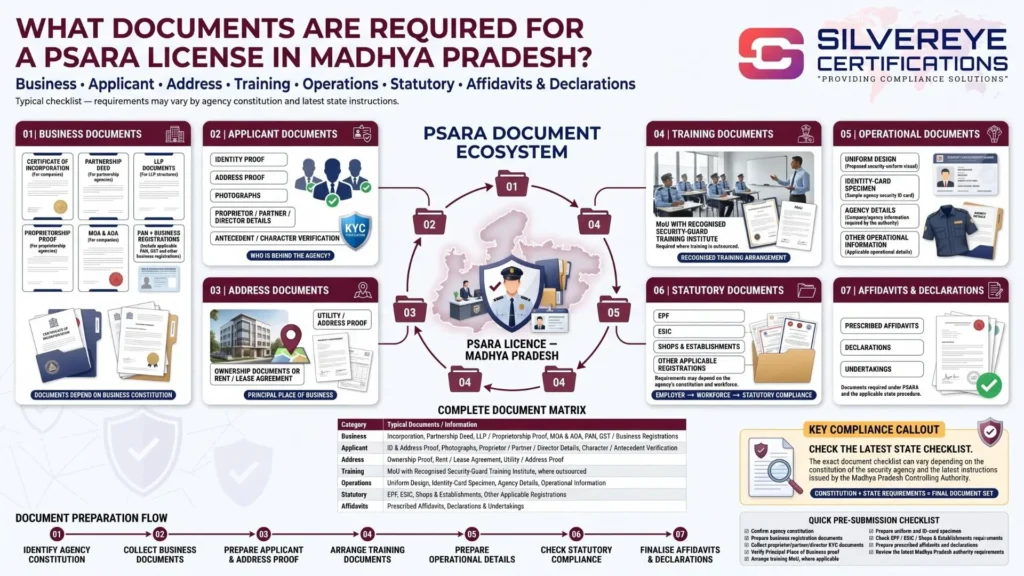
Before submission, the latest checklist should be reviewed because the authority may require additional documents depending on the application.
How to Apply for a PSARA License in Madhya Pradesh?
The process generally involves the following steps:
- Register the business entity and establish the required place of business in Madhya Pradesh.
- Arrange the required security-guard training tie-up with a recognised training institute, where applicable.
- Prepare the required identity, business, address, statutory and operational documents.
- Complete the prescribed PSARA application, affidavits and declarations.
- Submit the application through the applicable PSARA online process/portal and pay the prescribed government fee.
- The application undergoes the required antecedent and police verification through the appropriate police authority.
- The Controlling Authority reviews the application, including the police verification report and supporting documents.
- If the statutory requirements are satisfied, the PSARA licence is granted. If the application is refused, the authority must follow the applicable statutory procedure and communicate the decision as required.
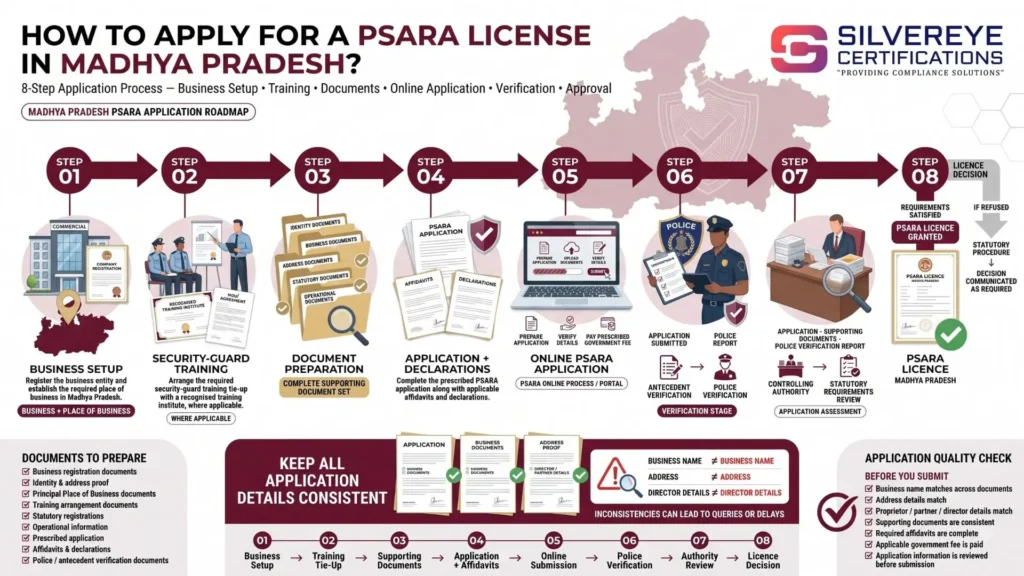
Applicants should keep the application details and supporting documents consistent throughout the process. Differences in business names, addresses, director details or other submitted information can result in queries or additional verification.
What Are the PSARA License Fees in Madhya Pradesh?
The statutory PSARA fee structure is based on the geographical area for which the licence is sought:
| Area of Operation | Government Fee |
|---|---|
| One district | ₹5,000 |
| Two to five districts | ₹10,000 |
| Entire state of Madhya Pradesh | ₹25,000 |
These are the government license fees prescribed under the PSARA framework. Applicants should verify the applicable payment method and any current administrative requirements before submitting the application.
Additional expenses may include training costs, affidavits/notarisation, documentation, police verification-related charges where applicable, and professional consultancy fees.
Important Note
Do not budget for PSARA renewal in Madhya Pradesh on the assumption that the license is automatically valid for only one year. Because this claim conflicts with the central PSARA framework's stated five-year validity, the current Madhya Pradesh position should be confirmed from the competent authority before publishing or relying on a state-specific one-year renewal cycle.
How Long Is a PSARA License Valid in Madhya Pradesh?
The validity and renewal period applicable to a PSARA license in Madhya Pradesh should be confirmed against the latest instructions issued by the competent Controlling Authority before an agency plans its compliance calendar.
Some third-party sources describe Madhya Pradesh as having a 1-year PSARA license validity, but this claim should not be presented as an established fact without a current state notification supporting it. The central PSARA framework and official MHA materials should be considered alongside any applicable Madhya Pradesh-specific rules or orders.
For an agency holding an existing license, the safest approach is to follow the expiry date printed on the license and begin the renewal process sufficiently early to avoid any gap in authorization.
Agencies should also:
- Keep the licence expiry date in their compliance calendar.
- Start renewal preparation well before expiry.
- Keep training arrangements and supporting documents current.
- Review the latest requirements before submitting a renewal application.
- Avoid assuming that renewal periods are identical across all states.
What 2026 PSARA Developments Should MP Agencies Watch?
1. Changes to the PSARA Compliance Framework
The Ministry of Home Affairs continues to administer the PSARA framework through its Police Modernization Division, which publishes the Act, Central Model Rules and related guidance. The Private Security Agencies Central Model Rules, 2020 also introduced greater use of digital processes and electronic payments, as well as technology-enabled antecedent verification.
For Madhya Pradesh agencies, this means applicants should use the latest forms, portal requirements and verification procedures rather than relying on older PSARA checklists.
2. Digitalization of Verification and Licensing
The Central Model Rules and subsequent MHA material place greater emphasis on digital verification, electronic payments and online data management. MHA has also stated that the PSARA system uses CCTNS/ICJS-based antecedent verification and that the verification framework has been designed to reduce processing time.
MP-based agencies should therefore keep their applicant, director/partner and employee information accurate and consistent across the application and verification records.
3. Keep Monitoring State-Level Instructions
PSARA licensing is administered through the state-level Controlling Authority, so national changes do not automatically replace every state-level administrative requirement.
Before filing a fresh application or renewal in Madhya Pradesh, agencies should check the latest instructions from the Madhya Pradesh Controlling Authority and Police Department, particularly for validity, renewal, fees, verification and online filing requirements.
What Are the Penalties for Operating Without a PSARA License?
Section 4 of the PSARA Act, 2005 prohibits a person from commencing or carrying on the business of a private security agency without a license. Under Section 20(1), contravention of Section 4 can attract imprisonment of up to one year, a fine of up to ₹25,000, or both.
Therefore, an agency should not continue providing regulated private security services after its licence has expired or been cancelled. The agency should first confirm its current licensing status and applicable renewal procedure with the competent authority.
What Common Mistakes Should MP-Based Agencies Avoid?
- Assuming a 1-year validity period without checking the current Madhya Pradesh licence or applicable state notification.
- Waiting until the licence expiry date before beginning renewal preparations.
- Allowing training arrangements or supporting documents to become outdated.
- Submitting inconsistent business, address, director or partner details across documents.
- Failing to complete the required police/antecedent verification correctly.
- Using an outdated PSARA checklist instead of checking the latest official requirements.
- Assuming the verification process is identical in Bhopal, Indore and other MP districts without confirming the applicable local police authority.
- Continuing operations without confirming that the agency holds a valid PSARA license.
Conclusion
Getting a PSARA License in Madhya Pradesh follows the national framework under the Private Security Agencies (Regulation) Act, 2005, but agencies still need to pay close attention to state-specific procedures, documentation and police verification requirements.
From preparing the correct documents and arranging the required training tie-up to completing police verification and keeping the license and supporting records up to date, careful compliance planning can help agencies avoid unnecessary queries and delays.
Since license validity and renewal requirements should be confirmed against the latest Madhya Pradesh instructions, agencies should not rely solely on generic PSARA guidance or third-party sources when planning their compliance calendar.
Need Help With Your PSARA License in Madhya Pradesh?
Silvereye Certifications helps private security agencies across Bhopal, Indore, Jabalpur and other parts of Madhya Pradesh with the PSARA licensing process.
Our support can include:
- PSARA application and documentation
- Training-institute coordination
- Police verification guidance
- Document review and compliance support
- Application follow-up
- Renewal and ongoing compliance guidance
Whether you are applying for a new PSARA License or preparing for renewal, Silvereye Certifications can help you understand the applicable requirements and manage the documentation process from application preparation through licensing and compliance support.
Get in touch with Silvereye Certifications for professional assistance with your PSARA License in Madhya Pradesh.
Frequently Asked Questions
Is a PSARA license mandatory for security agencies in Madhya Pradesh?
Yes. Any agency supplying security guards in Bhopal, Indore, Jabalpur, or anywhere else in the state must hold a valid PSARA license issued by Madhya Pradesh's Controlling Authority.
How long is a PSARA license valid in Madhya Pradesh?
It's widely and consistently reported across independent sources as 1 year, making Madhya Pradesh one of only a few Indian states with an annual PSARA renewal cycle rather than the standard 5-year period. Confirm the current period directly with the Controlling Authority before planning around it.
How much does a PSARA license cost in Madhya Pradesh?
₹5,000 for a single district, ₹10,000 for five districts, and ₹25,000 for the entire state — the standard fee slabs commonly cited by Madhya Pradesh-based licensing consultants.
Who verifies PSARA applicants in Bhopal and Indore?
Verification is routed through the Commissionerate of Police in both cities, since Bhopal and Indore have operated under a Police Commissionerate system since December 2021, unlike most other MP districts, which still use the District Police structure.
How long does it take to get a PSARA license in Madhya Pradesh?
Timelines depend on documentation completeness and how quickly police verification is completed; applicants are generally advised to follow up persistently with the state's PSARA Cell to track progress.
What happens if I miss the renewal deadline in Madhya Pradesh?
A lapsed license is typically treated the same as having no license at all, meaning the agency likely needs to file a fresh application with renewed police verification rather than a simple extension.
Is training mandatory for guards deployed under an MP PSARA license?
Yes. A signed tie-up with a recognised training institute is required, and guards must complete the prescribed training before deployment.
Can a Madhya Pradesh PSARA license be used in other states?
No. PSARA licenses are state-specific. An agency operating in both Madhya Pradesh and another state needs a separate license for each.
What is the maximum penalty for operating without a valid PSARA license in MP?
Up to 1 year of imprisonment, a fine of up to ₹25,000, or both, under the PSARA Act — unchanged by the 2026 decriminalisation notification, which only affects minor procedural lapses, not unlicensed operation.
Has anything changed for PSARA in Madhya Pradesh in 2026?
A May 2026 MHA notification decriminalized certain minor procedural lapses nationwide, which is especially relevant for MP given its more frequent, commonly reported annual renewal cycle. No MP-specific PSARA notification has been separately publicized as of this writing.
Do ex-servicemen get preference for supervisor roles in Madhya Pradesh?
Yes, in line with the national PSARA framework, a person from the Army, Navy, or Air Force with at least 3 years of experience is generally given preference when engaging supervisors.