- Explains PSARA license eligibility, required documents, government fees, and the complete registration process for security agencies operating anywhere in Tamil Nadu.
- Covers the Tamil Nadu Controlling Authority, the role of the police authorities in the verification process, and the relevant application and character/antecedent verification forms required during the licensing process.
- Explains the latest PSARA regulatory position in 2026, including any officially notified changes affecting licensing, compliance, and penalties.
- Written for security agency founders, HR heads, and facility managers operating across Chennai, Coimbatore, Madurai, Tiruchirapalli, Salem, and Tiruppur.
Introduction
A PSARA license in Tamil Nadu is the mandatory authorization required under the Private Security Agencies (Regulation) Act, 2005 and the Tamil Nadu Private Security Agencies Rules, 2008 for operating a private security agency. The State Government designates the Controlling Authority for administering the licensing process.
The licence allows an eligible proprietorship, partnership, LLP, or company registered in India to legally operate a private security agency, subject to the eligibility conditions and licensing requirements under PSARA. Applicants must demonstrate the availability of required training arrangements and complete the prescribed police antecedent verification process.
For Tamil Nadu, the prescribed application for a new licence or renewal is Form V. The process also involves the relevant verification documents and police authorities as prescribed under the Tamil Nadu Rules.
Under the central PSARA Act, the government fee is ₹5,000 for one district, ₹10,000 for more than one and up to five districts, and ₹25,000 for the whole State. A licence is generally valid for five years, and the Act requires a renewal application to be made at least 45 days before expiry.
The PSARA framework and related compliance requirements should be checked against the latest Central and Tamil Nadu notifications before filing, particularly where amendments or procedural changes may affect the application process.
What Is a PSARA License in Tamil Nadu?
A PSARA license is the legal authorisation a private security agency needs before providing security services in Tamil Nadu. It derives from the central Private Security Agencies (Regulation) Act, 2005 and is implemented in the State through the Tamil Nadu Private Security Agencies Rules, 2008.
The licence is issued by the Controlling Authority for the State of Tamil Nadu. The licensing process involves police antecedent verification and other prescribed requirements before the licence is granted. Tamil Nadu Police guidance states that applications are made in Form V, accompanied by Form I for antecedent verification of the relevant proprietor, majority shareholder, partner or director.
The Tamil Nadu process is largely based on physical submission. The Tamil Nadu Police instructions state that the application and supporting documents may be delivered to the Controlling Authority or sent by registered post.
Who Needs a PSARA License in Tamil Nadu?
Any eligible business that provides private security services for payment in Tamil Nadu must obtain a PSARA license before commencing such operations. The framework covers agencies providing services such as:
- Security guards for factories, IT campuses, hospitals, malls, residential communities and other commercial premises across Chennai, Coimbatore, Madurai, Tiruchirapalli and Salem.
- Security supervisors responsible for overseeing deployed guards. The PSARA Act requires agencies to employ supervisors in the prescribed manner and gives preference to persons with relevant armed forces, police or Home Guard experience.
- Bouncers and event security personnel, where the services fall within the scope of private security services under PSARA.
- Cash-in-transit and related security services, subject to the applicable security, transport and client requirements.
- Armed security services, which may involve additional requirements under applicable arms and other laws. These requirements should be assessed separately rather than treated as an automatic part of the standard PSARA licence.
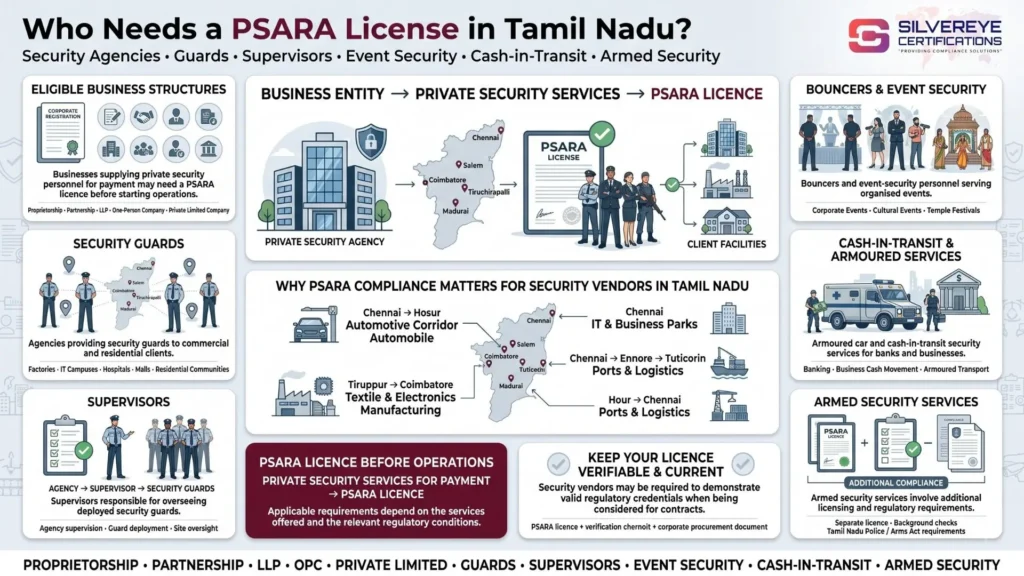
Tamil Nadu's industrial and commercial activity creates demand for licensed security providers across automotive, IT, ports, textiles, manufacturing, healthcare, retail and residential sectors.
What Are the Benefits of a PSARA License in Tamil Nadu?
- Legal authority to operate as a private security agency in the licensed area.
- Ability to participate in security contracts and vendor requirements where clients require a valid PSARA licence.
- Greater client confidence and easier compliance verification because the agency has completed the prescribed licensing and verification process.
- A more structured compliance framework for maintaining training, personnel and deployment records.
- A documented licence that can support client audits and compliance checks, subject to the terms and conditions of the licence.
What Are the Eligibility Criteria for a PSARA License in Tamil Nadu?
What Are the Requirements for the Security Agency?
- The applicant must be an eligible business entity registered or established in India, such as a proprietorship, partnership, LLP or company, subject to the applicable requirements.
- The agency must satisfy the prescribed requirements regarding its office, management, training arrangements and area of operation.
- The applicant must arrange the required security training facilities in accordance with the applicable Tamil Nadu rules.
- The agency must comply with the prescribed requirements for supervisors and security guards.
What Are the Requirements for Directors, Partners and Other Key Persons?
- Relevant persons are subject to character and antecedent verification as prescribed.
- The applicant must satisfy the applicable conditions under the PSARA Act and Tamil Nadu Rules.
- Persons with specified criminal convictions or certain dismissals for misconduct are subject to restrictions under the Act.
- Relevant security, police or military experience and qualifications may support the application where prescribed or applicable.
What Are the Requirements for Security Guards and Supervisors?
Under Section 10 of the PSARA Act, a private security guard must generally:
- Be 18 years or older and below 65 years of age.
- Satisfy the prescribed character and antecedent requirements.
- Successfully complete the prescribed security training.
- Meet the prescribed physical standards and other conditions.
The Act also provides preference to persons who have served in the Army, Navy, Air Force, armed forces, State Police organisations or Home Guards, subject to the applicable provisions.
What Documents Are Required for a PSARA License in Tamil Nadu?
| Category | Typical Documents |
|---|---|
| Agency / Entity | Registration or incorporation documents, PAN, applicable GST registration and proof of the agency's office address |
| Proprietor / Partners / Directors | Identity and address proof, photographs and documents required for character and antecedent verification |
| Police Verification | Form I for antecedent verification of the relevant proprietor, majority shareholder, partner or director, as applicable |
| PSARA Application | Form V for a new licence or renewal |
| Training Arrangement | Documents/letter relating to the required training facility or training arrangement |
| Affidavit | Prescribed affidavit under the PSARA framework |
| Government Fee | Fee paid through the prescribed mode to the Controlling Authority |
| Additional Supporting Documents | Special qualifications, security/training credentials and other documents required by the Tamil Nadu authority, depending on the application |
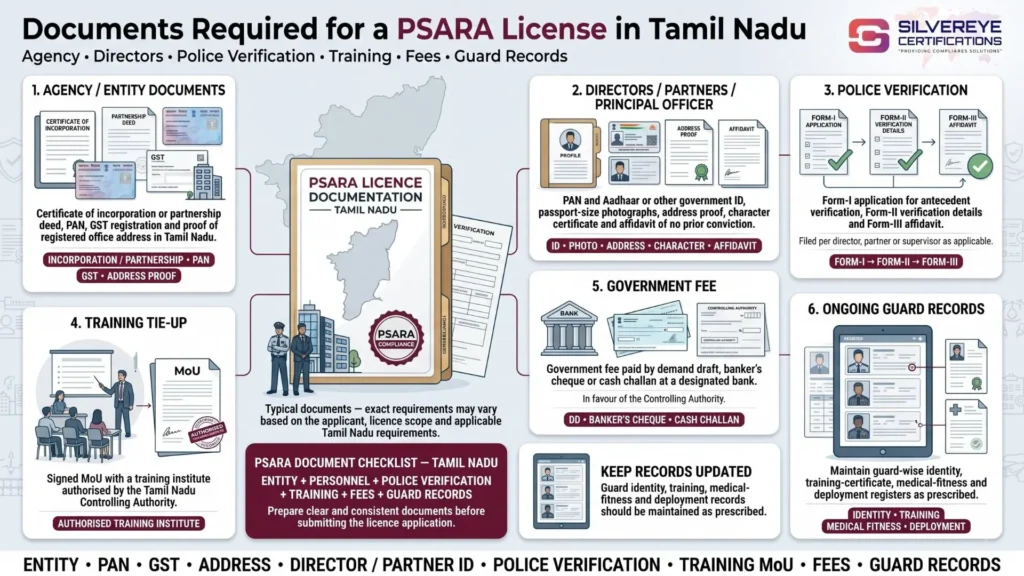
Tamil Nadu Police's published application guidance specifies ₹5,000 for one district, ₹10,000 for two to five districts, and ₹25,000 for the entire State of Tamil Nadu. It also states that the licence application is submitted in Form V, with Form I used for antecedent verification.
The final document list can vary according to the applicant's entity structure, proposed area of operation and current instructions of the Tamil Nadu Controlling Authority, so applicants should verify the latest checklist before filing.
How Do You Apply for a PSARA License in Tamil Nadu?
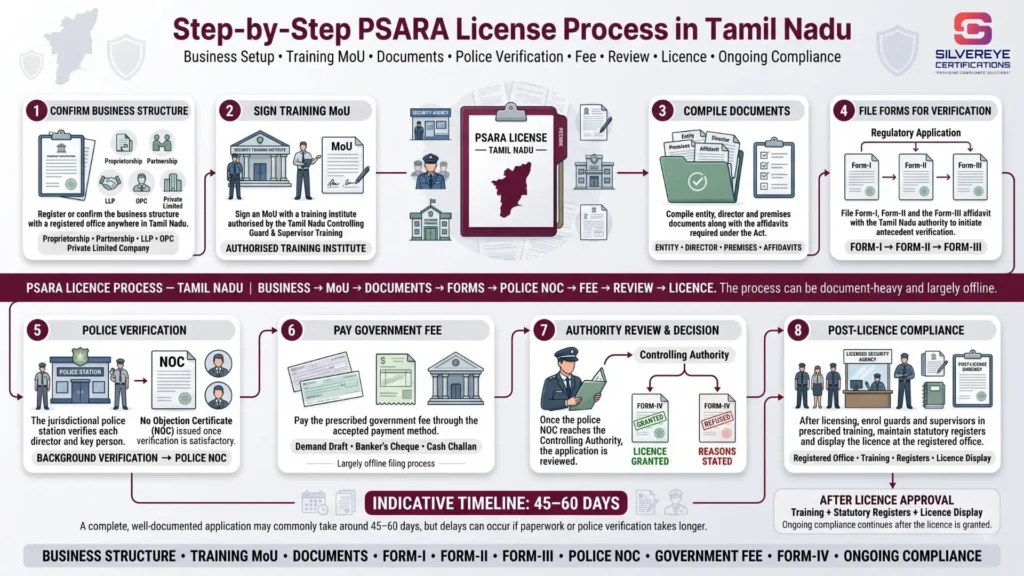
- Register or confirm the business structure — such as a proprietorship, partnership, LLP or company — and establish the required agency office and business details.
- Arrange the required security training facility or training arrangement in accordance with the Tamil Nadu PSARA Rules. Tamil Nadu Police's application guidance specifically requires a letter relating to the outsourcing of the training facility.
- Compile the required entity, applicant, premises and supporting documents, including the prescribed affidavit and other documents applicable to the agency.
- Complete Form V, which is the prescribed application for a new PSARA licence or renewal. The application must be accompanied by Form I for antecedent verification of the relevant proprietor, majority shareholder, partner or director, as applicable.
- Police authorities conduct the prescribed antecedent verification of the relevant persons. The verification process forms part of the Controlling Authority's assessment of the application.
- Pay the prescribed government licence fee through the payment method accepted under the Tamil Nadu procedure. Tamil Nadu Police's published instructions specify payment by demand draft or banker's cheque in the name of the Controlling Authority and provide the applicable fee slabs.
- Submit the completed application and supporting documents to the Controlling Authority. Tamil Nadu Police states that the application may be delivered to the Controlling Authority or sent by registered post.
- After the prescribed verification and assessment are completed, the Controlling Authority decides whether to grant or refuse the licence. The licence is issued in the prescribed Form VI, rather than Form IV.
- After obtaining the licence, the agency must continue to comply with PSARA training, personnel, supervisor and record-keeping requirements applicable to its operations.
How Long Does the PSARA License Process Take in Tamil Nadu?
The central PSARA Act provides that a complete fresh application is to be decided within 60 days, while a complete renewal application is to be decided within 30 days. Actual completion can take longer where police verification, missing documents, clarification requests or other procedural steps cause delays.
For planning purposes, agencies should therefore allow a reasonable buffer rather than relying on a fixed 45- or 60-day turnaround.
How Much Does a PSARA License Cost in Tamil Nadu?
Tamil Nadu Police's published PSARA application guidance specifies the following government licence fees: ₹5,000 for one district, ₹10,000 for two to five districts, and ₹25,000 for the entire State of Tamil Nadu.
| Area of Operation | Government Licence Fee |
|---|---|
| One district | ₹5,000 |
| Two to five districts | ₹10,000 |
| Entire State of Tamil Nadu | ₹25,000 |
The published Tamil Nadu instructions state that the fee is submitted by demand draft or banker's cheque in favour of the Controlling Authority, Tamil Nadu Private Security Agency, Chennai-4. Applicants should still confirm the current payment instructions before preparing the instrument.
The government licence fee is only one part of the overall cost. An agency may also incur training, documentation, police-verification-related, professional and operational compliance costs, depending on its structure and requirements.
How Long Is a PSARA License Valid in Tamil Nadu?
A PSARA licence is generally valid for five years from the date of grant, subject to the Act and the conditions of the licence. Section 8 requires an application for renewal to be made not less than 45 days before the licence expires.
Agencies should therefore maintain a renewal calendar well before the statutory 45-day deadline, particularly because the process may involve document preparation and verification.
If a licence expires without timely renewal, the agency should not assume that it can continue operating as though the licence were still active. The licensing position should be regularised with the Controlling Authority before continuing operations.
What Changed Under PSARA in 2026?
The Jan Vishwas (Amendment of Provisions) Act, 2026 omitted Section 12 of the PSARA Act and Section 20(2). The relevant provisions came into force for PSARA from 15 May 2026. The amendment therefore removed the specific offence/penalty mechanism that had been linked to those provisions.
Section 12 previously dealt with the requirement for the licence to be exhibited, while Section 20(2) provided a fine for contravention of Sections 9, 10 and 12. Following the amendment, those provisions are no longer framed as criminal offences through Section 20(2).
However, this does not mean that PSARA compliance requirements have disappeared. Agencies must still comply with applicable requirements concerning training, security guards, supervisors, antecedent verification and licence conditions, and the Controlling Authority retains powers relating to suspension and cancellation under the Act.
What PSARA Requirements Still Matter in Tamil Nadu?
- Operating without the required PSARA licence remains an offence. Section 20(1) provides for imprisonment that may extend to one year, a fine up to ₹25,000, or both for contravention of Section 4.
- Training requirements under Section 9 continue to apply even though Section 20(2) has been omitted.
- Guard eligibility and antecedent requirements under Section 10 continue to apply.
- The agency must continue to comply with applicable supervisor, personnel and operational requirements under the Act and Rules.
- Arms-related requirements remain separate for agencies providing armed security services and must be assessed under the applicable arms legislation and permissions.
The Ministry of Home Affairs continues to administer the central PSARA framework through its Police Modernisation Division, while the actual licensing process is handled through the designated State Controlling Authority.
What Compliance Obligations Apply After Getting a Tamil Nadu PSARA License?
- Deploy only eligible and properly trained guards and supervisors who meet the applicable antecedent, training and other statutory requirements.
- Maintain prescribed agency and personnel records, including details of management, security guards, supervisors, customers and duty rosters, as required under the Tamil Nadu Rules. The prescribed Form VIII register, for example, covers management details, guard and supervisor particulars, customer details and duty rosters.
- Maintain training and medical-fitness records and other personnel documentation required under the applicable rules and licence conditions.
- Appoint and maintain the required supervisor arrangement for overseeing deployed guards. The PSARA Act makes supervisor engagement and guard/supervisor training part of the agency's ongoing obligations.
- Report relevant changes in management, address or other prescribed particulars to the Controlling Authority as required under the licence conditions and applicable State Rules. Section 11 specifically allows State rules to prescribe information regarding changes in address, management and certain criminal charges.
- Maintain applicable EPF, ESI and other employment-law compliance where the agency and its employees fall within the relevant statutory coverage.
- Track the licence expiry date and submit the renewal application at least 45 days before expiry. The central PSARA Act expressly prescribes this 45-day minimum period.
Important 2026 update: Section 12 of the central PSARA Act, which previously required the licence to be exhibited at the business premises, was omitted with effect from 15 May 2026. Therefore, the older statement that licence display is mandatory specifically under Section 12 should not be presented as a current PSARA statutory requirement.
What Are the Penalties for PSARA Non-Compliance in Tamil Nadu?
Operating a private security agency without the required PSARA licence remains an offence under Section 4 read with Section 20(1). The provision allows imprisonment of up to one year, a fine of up to ₹25,000, or both.
The 2026 Jan Vishwas (Amendment of Provisions) Act omitted Section 12 and Section 20(2) of the PSARA Act with effect from 15 May 2026. This removed the specific criminal penalty mechanism under Section 20(2), but it did not remove the underlying PSARA compliance requirements relating to training, guard eligibility or other licence conditions.
The Controlling Authority can still suspend or cancel a licence for specified grounds, including violations of the Act, Rules or licence conditions.
Agencies providing armed security services must also examine the separate requirements applicable under arms legislation and should not treat those requirements as automatically covered by the standard PSARA licence.
What Are the Common PSARA Mistakes to Avoid in Tamil Nadu?
- Assuming every PSARA requirement is fully online — Tamil Nadu's published procedure includes physical submission or registered-post submission of the application and supporting documents.
- Treating armed security as a simple extension of standard PSARA services instead of checking the additional legal requirements that may apply.
- Delaying the training arrangement, which can hold up preparation of the application.
- Waiting until the last few weeks before licence expiry to start renewal. The statutory minimum is 45 days before expiry, and agencies should build additional preparation time into their internal calendar.
- Assuming the 2026 amendment means PSARA compliance can be relaxed. The omission of Section 12 and Section 20(2) changed the penalty framework for specified provisions; it did not eliminate the agency's broader compliance obligations.
- Failing to maintain prescribed registers and personnel records, which can make it harder to demonstrate compliance during inspection or regulatory review.
How Can Silvereye Certifications Help With PSARA Compliance in Tamil Nadu?
Getting and maintaining a PSARA licence in Tamil Nadu involves more than submitting the initial application. Agencies need to organise director and premises documents, training arrangements, police verification, prescribed records and renewal timelines.
Silvereye Certifications can assist security agencies and facility-management businesses operating across Chennai, Coimbatore, Madurai, Tiruchirapalli, Salem, Tiruppur and other parts of Tamil Nadu with PSARA application preparation, documentation, verification coordination and renewal tracking.
The goal is to help agencies maintain proper documentation and timely renewal so that PSARA compliance remains an ongoing business process rather than a last-minute exercise.
Frequently Asked Questions
What is a PSARA license in Tamil Nadu?
It is the mandatory authorization issued under the Tamil Nadu Private Security Agencies Rules, 2008, by the state's Controlling Authority, allowing a business to legally provide private security services anywhere in the state.
Is the PSARA application process in Tamil Nadu online or offline?
It's largely offline — applicants submit physical documents and pay the government fee via demand draft, banker's cheque, or a cash challan at designated banks, rather than through a fully digital portal.
How long is a PSARA license valid in Tamil Nadu?
A PSARA license issued in Tamil Nadu is valid for five years from the date of grant, in line with most Indian states.
When should I apply for PSARA license renewal in Tamil Nadu?
Guidance points to submitting the renewal application to the designated authority at least 90 days before the license expires, statewide.
How much does a PSARA license cost in Tamil Nadu?
Tamil Nadu is commonly cited as following Act-aligned fee slabs of roughly ₹5,000, ₹10,000, and ₹25,000 by geographic scope, but these are indicative — confirm the current fee and payee details with the Controlling Authority before paying.
How long does it take to get a PSARA license in Tamil Nadu?
Indicative timelines commonly cited are around 45 to 60 days for a complete application, though the state's offline process can extend this if documentation or police verification is delayed.
What documents are required for a PSARA license in Tamil Nadu?
Core documents include the entity's incorporation proof, director identity and address proof, Form-I with Form-II and Form-III for police verification, and a signed MoU with an authorised training institute.
What happens if an agency operates in Tamil Nadu without a PSARA license?
It is a criminal offence under Section 4 read with Section 20(1) of the Act, attracting a fine and imprisonment of up to one year, along with immediate exposure to enforcement action against the business.
What changed in the PSARA Act in 2026, and does it apply across Tamil Nadu?
Yes — effective 15 May 2026, the MHA omitted Sections 12 and 20(2) of the Act nationwide, removing criminal liability for certain procedural lapses such as not displaying the license. Tamil Nadu's Controlling Authority can still suspend or cancel a license for genuine non-compliance, and operating without a license, plus training and guard-eligibility norms, remain fully enforceable statewide.
Does an armed security agency need a different license in Tamil Nadu?
Yes. Armed PSARA services require a separate license, stricter background checks, and compliance with Tamil Nadu Police and Arms Act regulations, on top of the standard PSARA license.
What form is used to grant a PSARA license in Tamil Nadu?
Once the police NOC and application are reviewed and approved, the PSARA license in Tamil Nadu is issued in Form-IV.
Does a Tamil Nadu PSARA license allow operations in other states?
No. PSARA licensing is state-wise; an agency expanding beyond Tamil Nadu needs a separate PSARA license from each additional state's Controlling Authority.