
- Additional documents such as an import permit, treatment certificate, or laboratory report may be required depending on the product and destination country.
- Make sure every name, quantity, and product description matches across all documents. Any mismatch can cause the application to be held, returned, or delayed.
- Prepare your documents before packing, rather than after, so the inspection and certification process is not delayed because of missing paperwork.
Introduction
The phytosanitary certificate required documents for an Indian export usually include the online application, your Importer Exporter Code (IEC), commercial invoice, packing list and shipping details. Depending on the product and destination, you may also need an import permit, a fumigation or treatment certificate, lab test reports and an authorization letter.
Officers cross-check these against the goods at inspection, so every detail must match. Since import conditions differ by country, confirm the exact list with the Plant Quarantine Station before you apply.
What Documents Do You Need for a Phytosanitary Certificate?
Most delays with a phytosanitary certificate do not come from a pest problem. They often come from paperwork that does not agree with itself: an invoice showing 20 tonnes while the packing list says 19.8, a consignee name spelt two ways, or a treatment certificate dated after the inspection request. An officer cannot certify what the documents cannot clearly support.
The documents generally do three jobs. They prove who you are, describe exactly what is being shipped, and show that any condition set by the importing country has been met. If you think of each document as answering one of those three questions, the checklist becomes much easier to understand.
What Are the Core Documents Required for a Phytosanitary Certificate?
| Document | What it proves | What to check |
|---|---|---|
| Online application form | Product, quantity, packing, origin, port and consignee details | Botanical name, HS code and consignee details |
| IEC (Importer Exporter Code) | You are a registered exporter | IEC should be active and the name should match your invoice |
| Commercial invoice | Goods, value, buyer and destination | Quantity and description must match the packing list |
| Packing list | Package count, weights and marks for inspection | Total weights and number of packages must add up |
| Shipping details (draft bill of lading, airway bill or booking copy) | Route, port of exit and mode of transport | Vessel, flight and container details should be current |
| Fee payment receipt | Prescribed charges were paid | Keep the receipt with the application file |
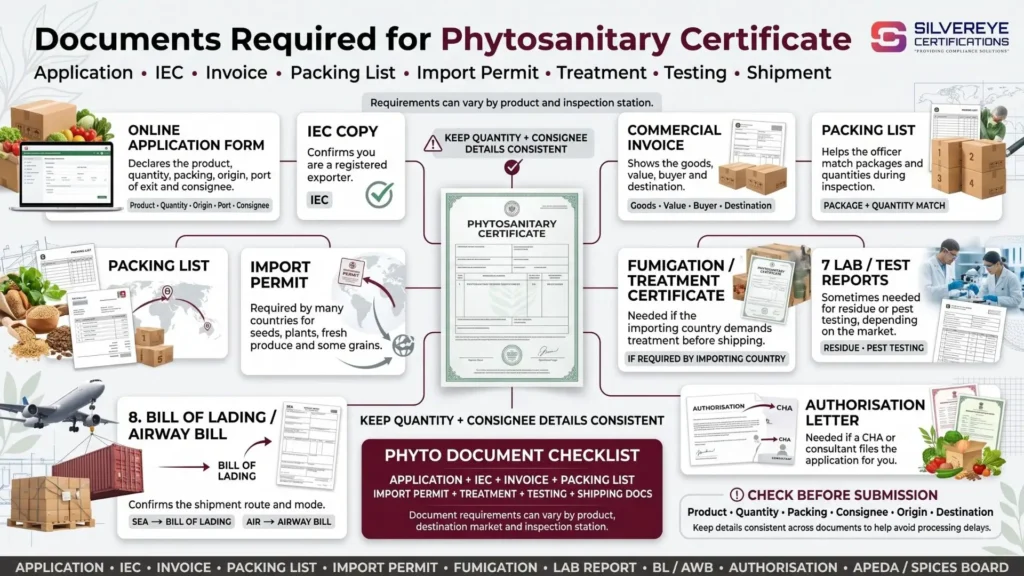
If a consultant or clearing agent is filing for you, add a signed authorisation letter to this list. It should name the person or firm, the consignment and the purpose.
When Do You Need Additional Phytosanitary Certificate Required Documents?
This is where many exporters need to pay extra attention. The destination country determines many of the additional plant-health requirements, not India. The table below shows some common additional documents and when they may be required.
| Additional document | When it may be needed | Where to confirm |
|---|---|---|
| Import permit of the destination country | Seeds, planting material, fresh produce, some grains and other regulated items | Buyer or destination plant protection office |
| Fumigation or treatment certificate | When the importing country requires pre-shipment treatment | Destination import conditions |
| Laboratory or test report | When testing for pests, residues or seed health is required | Buyer contract and import conditions |
| Additional declaration wording | When the destination requires specific wording on the certificate | Import conditions or import permit |
| Product registration or traceability record | Where a product-specific scheme applies, such as registered orchards or packhouses for some fruits | Relevant export promotion body |
| Original import certificate copy | For re-export consignments involving goods previously imported | Plant Quarantine Station |
| Purchase order or contract copy | When it contains plant-health conditions agreed with the buyer | Your buyer |
A good practice is to ask your buyer for the written import conditions from the destination country's national plant protection authority and keep that document with your shipment file. This helps confirm exactly what is required before you apply.
What Documents Are Needed for Different Types of Plant Products?
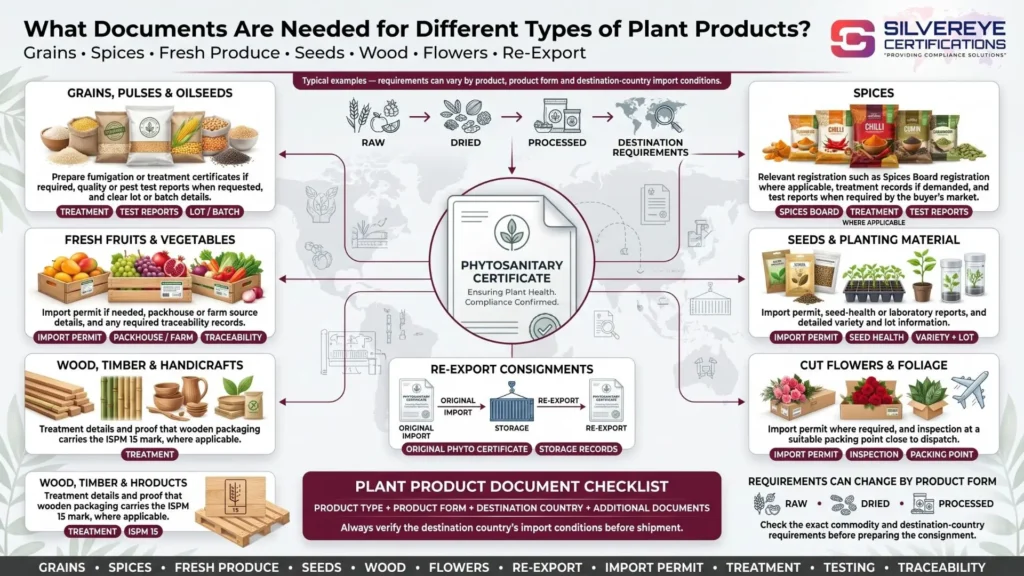
The requirements below are typical examples, not fixed rules. Always check the exact product, its form (raw, dried or processed), and the destination country's import conditions.
| Product type | Additional documents or information to prepare |
|---|---|
| Grains, pulses and oilseeds | Fumigation or treatment certificate if required, quality or pest test reports on request, and clear lot or batch details |
| Spices | Relevant registration such as Spices Board where applicable, treatment record if demanded, and test reports if the buyer's market asks for them |
| Fresh fruits and vegetables | Import permit if needed, packhouse or farm source details, and any required traceability record |
| Seeds and planting material | Import permit, seed health or laboratory reports, and detailed variety and lot information |
| Wood, timber and handicrafts | Treatment details and proof that wooden packaging carries the ISPM 15 mark, where applicable |
| Cut flowers and foliage | Import permit where required, and inspection at a suitable packing point close to dispatch |
| Re-export consignments | Copy of the original import phytosanitary certificate and proof of how the goods were stored |
How Can You Check That All Phytosanitary Documents Match?
Before you upload anything, lay your documents side by side. Check that important details are consistent wherever they appear.
| Detail to check | Should match across |
|---|---|
| Exporter name and address | Application, IEC, invoice and authorisation letter |
| Consignee name and country | Application, invoice, packing list, import permit and shipping document |
| Product name and botanical name | Application, invoice, packing list, treatment certificate and lab report |
| Quantity and weight | Application, invoice, packing list and treatment certificate |
| Number of packages and marks | Packing list, application and the actual goods at inspection |
| Container or vehicle details | Application, shipping document and treatment record |
| Dates | Treatment date should come before inspection, and inspection should fit the destination's timing requirements |
What Should You Do Before Applying?
The safest approach is to prepare the complete document set before packing and dispatch. Check the destination country's requirements, confirm the product description, botanical name, quantity, consignee and shipping details, and make sure any required treatment or additional declaration is arranged in advance.
This reduces the risk of application delays, document mismatches, inspection problems, or shipment delays.
When Should You Collect Each Phytosanitary Certificate Document?
| Stage | What to collect or confirm |
|---|---|
| Before packing | Destination import conditions, import permit, buyer's additional declaration and any registration needed |
| During packing | Packing list, batch details and packing material that meets the applicable requirements |
| After packing, before application | Treatment certificate, lab reports, invoice and draft shipping document |
| At application | Complete uploads, authorisation letter if a representative files, and fee receipt |
| At inspection | Originals available on site, goods accessible and marks clearly visible |
| After issue | Check the certificate against your documents and file all copies |
How Can You Prepare Your Phytosanitary Certificate Documents Correctly?
- Create one folder per consignment and name every file clearly, such as "Invoice", "Packing List" and "Treatment Certificate".
- Scan documents clearly. Blurred stamps, cropped edges or unreadable numbers can lead to queries or delays.
- Check the file format and size limits on the portal before uploading, since these requirements can change.
- Use the same product description consistently across all documents. Do not use a trade name on one document and a botanical name on another without ensuring the required terminology is clear and consistent.
- Get treatment done by an approved or authorised operator where required and check that the certificate identifies the correct consignment.
- Carry original documents to the inspection even if you have already uploaded scanned copies.
- Keep digital copies of all documents for buyer queries, future shipments and record-keeping.
What Common Document Mistakes Can Delay a Phytosanitary Certificate?
- Quantity or weight differences between the invoice, packing list and application.
- Missing import permit when the destination country requires one.
- A treatment certificate that identifies the wrong consignment or has incorrect dates.
- An inactive IEC or an IEC that does not match the exporter details.
- Missing or incorrect additional declaration wording compared with the destination requirement.
- Uploading incomplete, blurred or incorrectly prepared files.
- Applying before the commercial invoice and other key shipment details are finalised.
- Not checking the issued certificate before sending it to the buyer or submitting it to the destination authority.
What Should You Do If You Need to Correct or Replace a Document?
If you spot a mistake before the phytosanitary certificate is issued, correct the relevant source document and update the application as required.
If the mistake is discovered after the certificate has been issued, contact the issuing office promptly with the supporting documents. A correction or replacement may be possible depending on the circumstances and applicable procedures.
Do not alter an issued phytosanitary certificate by hand, as the importing country's authorities may not accept an altered document.
What Are the Fees, Validity and Processing Time for a Phytosanitary Certificate?
Three questions usually follow the document list, so here is a short overview:
- Fees: Government fees may apply and can change, so check the current fee schedule on the official portal before applying.
- Validity: The applicable validity or acceptance period depends on the destination country's requirements and the circumstances of the consignment.
- Certificate coverage: A phytosanitary certificate is generally issued for a specific consignment rather than as a reusable certificate for multiple shipments.
- If the certificate becomes unacceptable or expires: You may need to apply for a new certificate, depending on the destination country's requirements and the circumstances.
- Processing time: There is no single processing time for every application. It can depend on document completeness, inspection requirements, treatment and scheduling. Build sufficient time into your export schedule rather than waiting until the last working day.
Our main phytosanitary certificate guide covers the fees, validity and application timeline in greater detail.
Need Help With Phytosanitary Certificate Documents? Silvereye Certifications Can Help
Most rejections and delays can be avoided with a proper document check before you apply. Silvereye Certifications supports exporters with certification and registration paperwork, including guidance for Spices Board registration, helping ensure your file is complete, accurate and consistent before it reaches the issuing officer.
Share your product, destination country and shipment date with Silvereye Certifications and ask for a document checklist matched to your specific consignment.
Frequently Asked Questions
What are the basic documents required for a phytosanitary certificate?
Usually the online application, IEC, commercial invoice, packing list, shipping details and fee receipt.
Do I always need an import permit?
No. It depends on the product and the importing country. It is common for seeds, planting material and some fresh produce.
Is a fumigation certificate mandatory?
Only if the importing country requires pre-shipment treatment. If it does, the treatment certificate becomes part of your document set.
Can I apply without an IEC?
An IEC is normally expected for commercial exporters. Confirm your case with the Plant Quarantine Station.
Do I need lab test reports?
Only when the destination country or your buyer asks for them, for example for pest or seed health testing.
What is an additional declaration?
It is specific wording the destination wants printed on the certificate, such as a statement about pest freedom. It comes from the import conditions or import permit.
Can my clearing agent apply for me?
Yes, with a written authorization from you. Make sure the letter names the consignment.
Should I upload scans or originals?
Upload clear scans on the portal and keep originals ready for inspection.
Which document mistakes cause the most delay?
Mismatched quantities, missing import permits, unclear scans and treatment certificates that do not match the consignment.
What documents are needed for re-export?
Generally a copy of the original import phytosanitary certificate and proof of storage, along with the usual core documents.
What if the buyer changes the consignee after I apply?
Inform the issuing office quickly and update your documents. A change in the consignee may require a corrected application or a fresh one.
Where can I find the correct list for my product?
Ask your buyer for the destination's written import conditions and confirm the list with the Plant Quarantine Station handling your consignment.